38A Civil Affairs Officer
Most Army officers lead formations. Civil Affairs officers lead relationships – with local governments, tribal elders, international organizations, and civilian populations in some of the world’s most complex environments. The outcome of those relationships can shape an entire operation more than any convoy or kinetic strike.
As a 38A Civil Affairs Officer, your job is to understand the human terrain, reduce friction between military forces and civilian populations, and give commanders the context they need to make better decisions. You’ll work in small teams, often with minimal supervision, in places where cultural awareness matters as much as tactical skill.
Active duty CA is a special operations force. Every active component CA officer serves in the 95th Civil Affairs Brigade (Airborne) under the U.S. Army Special Operations Command and must qualify through airborne training and a demanding assessment and selection course. In the Army Reserve, CA is the dominant component – roughly 75 to 80 percent of the Army’s total CA capability lives there – and Reserve CA officers operate under a different pathway that doesn’t require airborne or selection.
This is one of the few Army officer branches where a Captain can walk into a room with a foreign minister, a USAID mission director, and a Special Forces battalion commander – and be the most relevant person at the table.
OCS candidates need a GT score of 110 on the ASVAB — our ASVAB for OCS guide covers exactly how to hit that number.
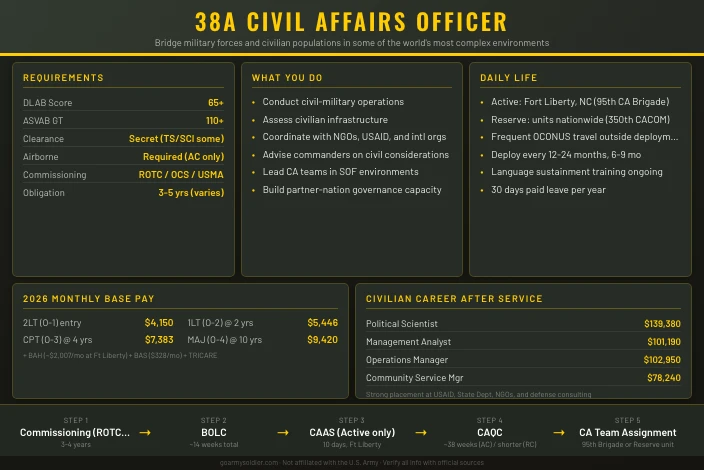
Job Role and Responsibilities
Civil Affairs Officers (AOC 38A) plan, coordinate, and execute civil-military operations that identify, evaluate, and influence civilian factors in the operational environment. They serve as the primary link between military commanders and civilian populations, governments, non-governmental organizations, and international agencies. CA officers advise commanders on how civilian considerations affect military operations and lead efforts to restore essential services, support governance, and reduce destabilizing conditions.
Command and Leadership Scope
At the junior officer level, a CA Captain commands a Civil Affairs Team, typically a four-to-six person element that operates directly with local authorities, community leaders, and international partners. These teams assess civil infrastructure, coordinate humanitarian assistance, and report findings that shape higher headquarters decisions.
At the Major level, CA officers serve on battalion and brigade staffs as Civil Affairs planners, integrating civil-military operations into overall campaign plans. They work alongside G9 (civil affairs) staff sections and coordinate with interagency partners including the State Department and USAID. At the Lieutenant Colonel level, officers compete for battalion command within the 95th Civil Affairs Brigade (active) or within the 350th Civil Affairs Command’s subordinate brigades (reserve), leading organizations of 200 to 500 soldiers and civilians.
Senior CA officers at the Colonel level serve in strategic roles at USASOC, geographic combatant commands, and joint headquarters where they shape civil affairs doctrine, force structure, and interagency coordination at the campaign level.
Specific Roles and Designations
| Designation | Code | Description |
|---|---|---|
| Civil Affairs Officer | 38A | Primary AOC; all commissioned CA officers |
| Civil Affairs SOF Officer | 38S | Additional identifier for senior CA officers with ARSOF credentials |
| Military Government Officer | 38G | Specialty focused on governance and civil administration |
| Foreign Area Officer (FA) | FA 48 | Post-KD broadening; regional expertise with attaché and joint billets |
| Strategic Plans and Policy | FA 59 | Post-KD functional area for senior planners |
| Information Operations | FA 30 | Available to CA officers with cross-functional influence operations background |
Mission Contribution
Civil Affairs fills a capability gap that conventional forces can’t close on their own. When a unit moves into an area, local governments and populations have needs, grievances, and information that directly affect mission success. CA officers translate that human context into military advantage: they identify key leaders, assess the impact of military operations on civilian life, and coordinate responses that prevent the friction that turns neutral populations hostile.
In major combat operations, CA officers support the transition from conflict to stability – assessing infrastructure damage, coordinating with host-nation governments, and helping restore services that prevent post-conflict collapse. In competition-phase operations, CA teams work alongside Special Forces and PSYOP to build partner-nation capacity and shape conditions before conflict begins.
Technology, Equipment, and Systems
CA officers use a mix of classified and unclassified tools to map the civil environment. These include the Civil Information Management (CIM) system for tracking data about populations, infrastructure, and organizations, and the Army’s standard command-and-control platforms (ATAK, CPOF) shared with conventional and SOF units. Language translation tools and open-source intelligence databases supplement direct human engagement. In austere environments, CA teams often operate with minimal connectivity and rely on structured reporting procedures to keep higher headquarters informed.
Salary and Benefits
Base Pay (2026)
CA officers enter at O-1 and progress through officer pay grades. The table below reflects 2026 monthly base pay from DFAS at the grades most CA officers hold across a typical career.
| Rank | Grade | Years of Service | Monthly Base Pay |
|---|---|---|---|
| Second Lieutenant | O-1 | Less than 2 | $4,150 |
| First Lieutenant | O-2 | 2 years | $5,446 |
| Captain | O-3 | 4 years | $7,383 |
| Captain | O-3 | 8 years | $8,126 |
| Major | O-4 | 10 years | $9,420 |
| Major | O-4 | 14 years | $10,214 |
| Lieutenant Colonel | O-5 | 18 years | $11,714 |
Special Pays
Beyond base pay, CA officers qualify for several additional pays:
- Foreign Language Proficiency Pay (FLPP): CA officers are required to maintain language skills; certified proficiency in designated languages pays $100 to $500 per month depending on language and proficiency level
- Hazardous Duty Incentive Pay (HDIP): Applies for airborne operations, which all active component CA officers conduct; currently $150 per month
- Hostile Fire / Imminent Danger Pay: $225 per month during qualifying deployed periods
- Combat Zone Tax Exclusion (CZTE): All base pay becomes tax-free during months served in a designated combat zone
CA-specific accession and retention bonuses vary by year and component. Check with your recruiter or HRC for current bonus amounts, as these change with the annual Army budget cycle.
Additional Benefits
Housing and food allowances are separate from base pay. Officers receive a Basic Allowance for Housing (BAH) that varies by duty location, pay grade, and dependent status. At Fort Liberty, NC – the primary active duty CA installation – a single O-3 receives approximately $2,007 per month in BAH. Officers also receive a Basic Allowance for Subsistence (BAS) of $328.48 per month.
Healthcare through TRICARE Prime costs nothing for the officer and nothing for enrolled family members at in-network providers. There are no premiums, no deductibles, and no copays at military treatment facilities.
Retirement under the Blended Retirement System (BRS) combines a pension at 20 years (40% of high-36 average base pay) with Thrift Savings Plan matching – up to 5% of basic pay when the officer contributes 5%. TSP matching begins in the third year of service.
Education benefits include up to $4,500 per year in Army Tuition Assistance while on active duty. After separation or retirement, the Post-9/11 GI Bill covers full in-state tuition at public schools plus a monthly housing allowance. Officers can transfer GI Bill benefits to dependents after six years of service with a four-year additional commitment.
Work-Life Balance
Garrison life for CA officers follows a roughly normal weekday schedule, with significant variability driven by unit training cycles, exercises, and pre-deployment preparation. Field exercises and combat training center rotations compress that schedule to 12 to 16-hour days for weeks at a time. Leave accrues at 2.5 days per month (30 days annually) and can carry over up to 60 days.
Active duty CA officers should expect frequent travel even outside of formal deployments – civil reconnaissance missions, partner engagement trips, and interagency coordination happen at a pace uncommon in conventional branches. Reserve CA officers integrate CA skills into civilian careers and are often able to apply military experience directly in their day jobs.
Qualifications and Eligibility
Commissioning Sources
Active Component (AC) CA has one primary accession path for junior officers: you commission in another branch first, then volunteer and compete for the Civil Affairs branch. CA does not take direct ROTC or OCS commissions at the O-1 level. Officers typically branch to a combat arms, combat support, or combat service support branch, complete their initial ADSO, and then apply for a branch transfer or direct accession into CA.
Reserve Component (RC) CA can commission directly through ROTC or OCS with a Reserve component contract. ROTC cadets and OCS graduates can be assigned directly to Reserve CA units without first serving in another branch.
| Commissioning Source | GPA Minimum | Degree Requirement | Age Limit | Key Prerequisite |
|---|---|---|---|---|
| ROTC (Reserve) | 2.0 GPA | Any bachelor’s degree | 30 at commissioning | Reserve OML branch selection |
| OCS (Reserve) | 2.0 GPA | Bachelor’s degree required | 34 at commissioning | Reserve officer contract |
| OCS (Active, lateral) | N/A | Degree from prior commissioning | Varies | Prior active service, branch transfer |
| USMA (Reserve) | N/A | West Point graduates; branch detail | 30 at commissioning | Branch detail then CA transfer |
| Direct Commission | Varies | Relevant professional degree | 42 (typically) | Foreign language, regional expertise |
Age limits are approximate and waivers exist. Confirm current limits with your recruiter.
Test Requirements
Officers commissioning via OCS must achieve a qualifying ASVAB score; the General Technical (GT) line score minimum for officer accession is 110. The GT score is derived from the Verbal Expression (VE) and Arithmetic Reasoning (AR) subtests.
CA officers – both active and reserve – must achieve a Defense Language Aptitude Battery (DLAB) score of 65 or higher, or demonstrate foreign language proficiency through a Defense Language Proficiency Test (DLPT) score of 1/1 or higher. The DLAB is not an ASVAB subtest; it is a separate assessment that measures a person’s aptitude for learning a new language. CA officers are expected to develop and maintain language skills throughout their career.
Branch Selection and CAAS
For active duty CA, selection is competitive. After completing an initial branch assignment and earning a positive record, an officer submits a request to attend the Civil Affairs Assessment and Selection (CAAS) course at Fort Liberty, NC. CAAS is a 10-day course that evaluates physical endurance, critical thinking, cultural adaptability, writing ability, and interpersonal skills under stress. Not all candidates pass.
Reserve CA officers assigned directly to Reserve CA units do not go through CAAS. They complete the Civil Affairs Qualification Course (CAQC) at Fort Liberty instead, on a timeline that accommodates Reserve schedules.
Upon Commissioning
All new officers enter at O-1 (Second Lieutenant). The Active Duty Service Obligation (ADSO) varies by commissioning source:
- USMA graduates: 5-year ADSO
- ROTC scholarship recipients: 4-year ADSO
- ROTC non-scholarship / OCS: 3-year ADSO
Officers who attend CAQC or specialized CA training incur an additional ADSO tied to the length and cost of that training. Verify current ADSO requirements in Army Regulation 350-100.
OCS candidates can find a focused GT study plan in our ASVAB for OCS guide.
Work Environment
Setting and Schedule
Active duty CA officers split their time between garrison planning, partner engagement, and field operations – often with fewer of the administrative burdens that fill a conventional battalion’s days. A typical week might include coordination calls with the G9 staff, language training, physical fitness, and preparation for an upcoming mission or exercise. When deployed or on a civil reconnaissance, the tempo increases significantly, and CA teams often operate in civilian clothes or non-standard gear to blend into the environments where they work.
Reserve CA officers work their civilian jobs five days a week and attend monthly drill weekends plus annual training. Between drills, they may take online courses, participate in unit planning, or travel for interagency liaison assignments – particularly officers in units that run active programs with USAID, the State Department, or FEMA.
Leadership and Chain of Command
Junior CA officers typically report to a CA Team or company commander, with staff support from a senior CA NCO – the Civil Affairs Non-Commissioned Officer (CANCO) – who serves a role similar to a platoon sergeant in conventional units. At the team level, the officer-NCO dynamic is especially collaborative because CA teams are small and interdependent. The NCO often brings years of regional and language experience the officer doesn’t yet have.
At the battalion level, CA officers serve alongside Special Forces and PSYOP officers in a USASOC command structure where the staff model is leaner and more mission-focused than in conventional Army battalions.
Staff vs. Command Roles
The typical active duty CA officer career moves through: team officer (CPT), staff planner at battalion or brigade (MAJ), company command or battalion XO (MAJ/LTC), and then battalion command (LTC) for those who remain competitive. Between those command assignments, staff tours at USASOC headquarters, geographic combatant commands, interagency organizations (NSC staff, USAID), and joint headquarters round out the file.
Fellows programs – White House Fellowship, State Department International Affairs Fellowship, Harvard Carr Center – are more accessible to CA officers than to officers in most other branches because of CA’s inherent interagency orientation.
Job Satisfaction and Retention
CA officers who stay tend to cite mission variety, intellectual engagement, and the autonomy that comes with working in small teams as the primary reasons. Officers who leave often cite the competitive and uncertain path to active duty CA (requiring prior branch service), the pace of OCONUS travel, and the challenge of managing family life around frequent deployments and travel. The reserve component offers significantly better work-life balance while retaining access to CA’s unique mission set.
Training and Skill Development
Pre-Commissioning Training
All commissioning paths require completion of the commissioning source’s standard leader development program: four years at USMA, four years in Army ROTC (typically final two years in the contracted program), or 12 weeks at OCS. These programs cover foundational leadership, land navigation, tactics, physical fitness, and officer development.
Officers on the active duty CA path also need to complete an initial branch assignment of at least two to three years in their base branch before competing for CAAS.
Basic Officer Leader Course (BOLC)
After commissioning, all officers attend the Basic Officer Leader Course (BOLC) – a two-phase program that transitions new officers into their branch specialty.
| Phase | Location | Duration | Focus |
|---|---|---|---|
| Phase I (BOLC A) | Fort Jackson, SC (or varies) | 6 weeks | Army leadership foundations, weapons, land navigation |
| Phase II (BOLC B) | Fort Liberty, NC | 8 weeks (approx.) | Branch-specific CA skills, civil-military operations, team operations |
Active duty CA officers who come through a lateral branch transfer report to Phase II at Fort Liberty after completing the initial branch BOLC. Reserve officers may attend BOLC B separately under Reserve scheduling.
Civil Affairs Assessment and Selection (CAAS)
Active component CA officers must complete CAAS at Fort Liberty before attending CAQC. The 10-day course evaluates candidates across physical performance, written communication, problem-solving, interpersonal interaction, and cultural adaptability. Candidates must arrive with:
- Airborne qualification (or a willingness to volunteer for airborne training)
- Valid SERE-C physical exam
- Interim Secret security clearance eligibility
- DLAB score of 65 or higher, or a 1/1 DLPT score
Civil Affairs Qualification Course (CAQC)
After CAAS (active component) or through Reserve scheduling, officers attend the Civil Affairs Qualification Course at Fort Liberty. The active component version runs approximately 38 weeks and covers four phases:
Reserve component officers complete an abbreviated version of CAQC that integrates online distance learning prior to the resident portion. The resident phase integrates Reserve soldiers with active duty students who covered the same material in the longer resident course.
Professional Military Education (PME)
After CAQC and initial assignments, CA officers follow the standard Army PME path:
- Civil Affairs Captains Career Course (CA-CCC): Approximately 4 weeks at Fort Liberty. Required for promotion to Major; covers advanced civil-military operations, planning, and CA staff functions.
- Intermediate Level Education (ILE/CGSC): 10 months at Fort Leavenworth, KS (or satellite campus). Required for Major selection boards and battalion-level command consideration. Typically attended around the 8 to 10-year mark.
- Senior Service College (War College): Highly competitive; attended by senior Majors and Lieutenant Colonels selected for strategic-level development. Locations include Carlisle, PA; Newport, RI; and Washington, DC.
Additional Schools and Training
Active duty CA officers are expected to pursue Airborne School (3 weeks, Fort Moore, GA) before or immediately after CAAS. Many also attend:
- Survival, Evasion, Resistance, and Escape (SERE-C): Required for CAAS eligibility
- Language Immersion Programs: Extended training at the Defense Language Institute (DLI) in Monterey, CA, for officers assigned to specific language tracks
- Special Operations Forces Interoperability Training: Conducted at Fort Liberty alongside SF and PSYOP units
Officers in the reserve component can pursue Airborne and SERE on their own initiative; neither is required for Reserve CA.
Before OCS, you need a qualifying GT score — see our ASVAB for OCS guide.
Career Progression and Advancement
Career Timeline
The table below reflects the typical active duty CA officer career path. Reserve officers follow a similar arc but with longer time in grade due to the part-time nature of service.
| Rank | Grade | Typical Time in Grade | Key Developmental Positions |
|---|---|---|---|
| Second Lieutenant | O-1 | 18 months | Initial branch assignment (varies by base branch) |
| First Lieutenant | O-2 | 18 months | Platoon leader or staff officer in base branch |
| Captain | O-3 | 4 years | CAAS/CAQC; CA Team Chief; Company XO |
| Major | O-4 | 4 years | Battalion or brigade staff (S3/S5/S9); FA 48 or FA 30 pursuit |
| Lieutenant Colonel | O-5 | 3-4 years | Battalion XO; Battalion Commander (KD); USASOC staff |
| Colonel | O-6 | Varies | Brigade Commander; Combatant Command staff; senior interagency billets |
Promotion System
Promotion from O-1 to O-3 is essentially automatic with time in service, assuming officers meet performance standards. Promotion to Major (O-4) is board-selected; the Army-wide selection rate typically runs 70 to 80 percent, but competitive rates within the ARSOF community require a strong record across CAAS, CAQC, team leadership, and initial staff assignments.
Promotion to Lieutenant Colonel (O-5) and Colonel (O-6) requires a strong evaluation record, successful completion of PME, and competitive board files. The KD position for LTC is battalion command – officers who do not command a battalion face significantly reduced promotion probability at O-6.
The evaluation system (OER) drives promotion boards. Specific file factors that matter for CA:
- Senior rater profile: A top-block rating from a senior rater with a limited top-block profile is worth significantly more than a top-block from someone who gives them liberally
- Ranger Tab: Not required for CA, but competitive for senior promotion boards; demonstrates tactical credibility
- Advanced degree: Increasingly expected for O-5 and O-6 boards; fully funded master’s programs are available through the Broadening Opportunities Program
- Interagency assignments: USAID, NSC, and State Department fellowships strengthen files for senior boards
Broadening Assignments
CA officers have unusually strong access to broadening assignments because of the branch’s interagency mission. Competitive options include:
- State Department International Affairs Fellowship: One-year assignment working alongside Foreign Service Officers
- USAID Development Leadership Initiative: Fellowship embedding CA officers in international development missions
- White House Fellowship: Highly competitive; less than 20 selected Army-wide per year
- ROTC instructor duty: Develops mentoring and leadership skills; counts toward education and training ADSO credit
Physical Demands and Medical Evaluations
Physical Requirements
All Army officers take the Army Fitness Test (AFT), which replaced the ACFT on June 1, 2025. The AFT has five events scored 0 to 100 each, with a maximum of 500 points. Officers must pass all five events to meet the standard.
| Event | Abbreviation | What It Tests |
|---|---|---|
| 3-Rep Max Deadlift | MDL | Lower body and core strength |
| Hand Release Push-Up | HRP | Upper body strength and endurance |
| Sprint-Drag-Carry | SDC | Muscular endurance and anaerobic capacity |
| Plank | PLK | Core stability and endurance |
| Two-Mile Run | 2MR | Aerobic endurance |
The general passing standard is 60 points per event (300 total), sex- and age-normed. CA is not among the 21 designated combat AOCs that require the higher 350-point sex-neutral standard, but active duty CA officers serving in ARSOF units maintain fitness at levels consistent with their SOF environment.
CAAS has its own physical assessment separate from the AFT. Candidates are evaluated across unknown-distance events and physical tasks that aren’t announced in advance. Arriving in excellent general physical condition – capable of rucking, running, and performing under accumulated fatigue – is the baseline expectation.
Medical Standards
CA officers meet standard Army officer medical standards (AR 40-501). Active duty CA officers attending CAAS also require a valid SERE-C physical exam, which includes additional screening for conditions that could be problematic in a survival or captivity scenario. Airborne training requires a physical exam confirming fitness for parachute operations.
There are no unique medical disqualifiers specific to the CA branch beyond what applies to all airborne-qualified officers.
Deployment and Duty Stations
Deployment Details
Active duty CA officers in the 95th Civil Affairs Brigade should expect significant deployment tempo. The brigade supports USASOC rotations across multiple geographic combatant commands, with CA teams deploying to support theater special operations commands (TSOCs) in AFRICOM, CENTCOM, SOCOM, EUCOM, and INDOPACOM. Deployment lengths for CA teams typically run 6 to 9 months, with rotations drawing from the brigade’s three battalions on a rotating cycle.
Between formal deployments, CA officers conduct civil reconnaissance trips, partner engagement visits, and interagency liaison missions that can accumulate significant OCONUS time even in a non-deployment year. This pace distinguishes CA from conventional branches where time away from home is concentrated in formal deployment windows.
Reserve CA officers deploy less frequently but are mobilized for both combat deployments (Title 10) and operational support missions (ADOS). The 350th Civil Affairs Command has supported operations in every recent conflict and maintains an active mobilization pipeline.
Duty Station Options
Active duty CA is concentrated at one installation:
- Fort Liberty, NC: Home of the 95th Civil Affairs Brigade (Airborne). The primary and essentially the only active duty CA installation. Officers assigned to the 95th stay at Fort Liberty except during deployments and broadening assignments.
Officers in broadening assignments or joint billets may serve at:
- Washington, DC (NSC staff, DIA, Joint Staff)
- Fort Leavenworth, KS (CGSC, TRADOC)
- Geographic combatant commands (Stuttgart, Germany; Tampa, FL; Honolulu, HI; Wiesbaden, Germany)
Reserve CA units are spread across the country under the 350th Civil Affairs Command, headquartered at Naval Air Station Pensacola Corry Station, FL, with subordinate brigades in multiple states. Reserve officers typically assign to units within commuting distance of their home.
Risk, Safety, and Legal Considerations
Job Hazards
CA officers work at the intersection of military and civilian environments, which creates distinct risks. Active duty CA teams operate in permissive, uncertain, and hostile environments – often in areas where the threat picture is ambiguous and civilian populations are present. The risk of being mistaken for a civilian target (operating in civilian clothes in some environments) adds a layer of personal risk distinct from conventional operations.
The branch’s SOF orientation means CA officers may find themselves in direct support of high-risk operations, including special reconnaissance and direct action missions alongside SF and Ranger elements. Airborne operations carry inherent injury risk. Kidnapping and hostage scenarios are more plausible for CA teams operating in denied territory than for most conventional officers.
Safety Protocols and Risk Management
CA officers are trained in Composite Risk Management (CRM) and apply it to civil-military operations. Pre-mission planning includes threat assessments, route analysis, and contingency planning for escalation scenarios. Officers working in non-permissive environments coordinate with intelligence and counterintelligence teams to stay current on the operating environment.
SERE-C training prepares officers for the specific scenario of capture, isolation, and exploitation – a meaningful risk given CA’s operating pattern.
Legal and Command Responsibility
CA officers hold the same command authority and UCMJ accountability as officers in any other branch. At the team level, the officer is responsible for everything the team does or fails to do. In environments where the team interacts with civilian populations, this extends to compliance with the law of armed conflict (LOAC), rules of engagement (ROE), and the specific legal constraints of the operational area.
CA officers must understand the legal distinction between military assistance to civilian populations (authorized) and functions that cross into civil governance (requiring legal authority). Missteps in this area can have operational and legal consequences. Relief for cause – removal from command for performance failures or ethical violations – carries permanent career consequences and is public record in the officer’s file.
Impact on Family and Personal Life
Family Considerations
The active duty CA lifestyle is demanding for families. Fort Liberty is the single permanent station for most of a CA officer’s career, which reduces the PCS turbulence common in other branches – officers may stay at Fort Liberty for five to eight years between moves. That stability is a genuine quality-of-life advantage. But the deployment tempo and frequency of OCONUS travel create sustained periods of absence that are among the highest in the officer corps outside of Special Forces itself.
Fort Liberty has a full suite of family support programs, including Army Community Service (ACS), Family Readiness Groups (FRGs) run through each CA company and battalion, and on-post childcare. Fayetteville, NC, the surrounding community, has deep experience supporting military families, though it carries the tradeoffs common to any heavily garrison-dependent city.
Dual-Military and Family Planning
Dual-military couples in which one partner is CA face coordination challenges at Fort Liberty because of the limited number of other officer specialties based there. HRC handles join-spouse requests on a best-effort basis, but CA’s concentrated footprint at a single installation makes co-location requests more dependent on the spouse’s branch. Officers should raise join-spouse requirements early in the assignment process.
Childcare on post is available but frequently oversubscribed. Many CA families use the Child Development Center waitlist as a planning tool, submitting requests well before the anticipated need date.
PCS Tempo
Active duty CA officers face fewer permanent change of station (PCS) moves than officers in many other branches because the 95th Brigade’s concentration at Fort Liberty keeps them in place longer. Officers who pursue broadening assignments or joint billets should expect one to two additional moves outside Fort Liberty across a career. Reserve CA officers don’t PCS at all; their unit is typically within driving distance of home.
Reserve and National Guard
Civil Affairs has an unusual component structure. The Army Reserve is the dominant CA force, with approximately 75 to 80 percent of the Army’s total CA capability. Most of the Army’s Civil Affairs brigades, battalions, and teams are in the Reserve, not on active duty. The National Guard has limited CA presence.
Component Availability
- Army Reserve: Full CA career available. Reserve CA includes the 350th Civil Affairs Command and its subordinate brigades and battalions, spread across the country. Direct accession into Reserve CA is possible from ROTC and OCS.
- Army National Guard: Limited CA presence; most Guard CA officers are in a handful of states with Guard CA units. Check with your state’s Adjutant General office for availability.
Commissioning Paths
Reserve CA officers can commission directly from ROTC with a Reserve contract and request a CA branch assignment. OCS candidates with prior enlisted or civilian background can commission through a state OCS program and request Reserve CA. Officers separating from active duty in other branches can transfer to a Reserve CA unit after their ADSO.
Active duty officers completing their ADSO can transfer to a Reserve CA unit without repeating commissioning requirements. Those already in CA branch simply affiliate with a drilling Reserve unit.
Drill and Training Commitment
The standard Reserve commitment is one weekend per month (Battle Assembly) and two weeks of Annual Training per year. CA adds training requirements on top of the standard schedule:
- CAQC attendance (for new officers who haven’t attended previously)
- Language sustainment training and annual DLPT testing
- Interagency coordination exercises and civil information management refreshers
- Pre-deployment rehearsals for units on the mobilization pipeline
Many Reserve CA officers describe their annual training time as running 30 to 60 days per year when exercises, additional training, and ADOS tours are included.
Part-Time Pay
Reserve drill pay is calculated as monthly base pay divided by 30, multiplied by the number of drill periods. A standard weekend equals four drill periods.
An O-3 with less than two years of service earns approximately $738 per weekend drill. An O-3 with three or more years earns approximately $903 per weekend. Annual training pays at the full daily rate for each day of active duty.
Benefits Differences
| Category | Active Duty | Army Reserve | Army National Guard |
|---|---|---|---|
| Monthly base pay (O-3) | $5,534 - $9,004 | Drill pay only (~$738-$903/weekend) | Drill pay only (~$738-$903/weekend) |
| Healthcare | TRICARE Prime, $0 premium | TRICARE Reserve Select (~$58/mo solo, ~$287/mo family) | TRICARE Reserve Select (same as AR) |
| Education | TA ($4,500/yr) + Post-9/11 GI Bill | Federal TA ($4,500/yr) + MGIB-SR ($493/mo) | Federal TA + state tuition waivers (varies) |
| Retirement | 20-year pension (BRS) + TSP | Points-based, collect at 60 | Points-based, collect at 60 |
| Deployment tempo | High (SOF rotations) | Mobilizations, ADOS tours | State missions + federal mobilizations |
| Command opportunities | 95th CA Brigade billets | Abundant (brigade, battalion, company) | Limited (Guard CA units) |
National Guard officers may also receive state-specific benefits including tuition waivers, state bonuses, and state income tax exemptions on military pay. These vary significantly by state.
Deployment and Mobilization
Reserve CA officers are mobilized regularly. The 350th Civil Affairs Command has maintained a consistent presence in CENTCOM, AFRICOM, and EUCOM across recent operational periods. Typical mobilization lengths run 9 to 12 months for combat deployments and 4 to 6 months for operational support (ADOS) missions.
USERRA protections guarantee Reserve and Guard officers the right to return to their civilian jobs after mobilization, prohibit discrimination based on military service, and require employers to maintain health insurance coverage for up to 24 months during military leave.
Civilian Career Integration
Reserve CA is one of the best-integrated military career tracks for professionals in international development, government, diplomacy, and the nonprofit sector. Officers working at USAID, the State Department, or international NGOs bring operational military credibility to civilian roles, while their civilian expertise feeds directly back into CA mission planning. The Reserve structure accommodates this integration far better than active duty.
Many Reserve CA officers report that their civilian employers – particularly in the development and security sectors – actively support their military service because the work directly overlaps.
Post-Service Opportunities
Transition to Civilian Life
CA officers develop a skill set that translates directly to high-demand civilian sectors. The core competencies – cross-cultural communication, interagency coordination, civil assessment, strategic planning, and population-focused analysis – map onto government, international development, consulting, and nonprofit leadership roles in a way that few other military specialties match.
Transition support programs available to separating CA officers include the Soldier for Life Transition Assistance Program (SFL-TAP), Hiring Our Heroes Corporate Fellowships, and the Army Career Alumni Program (ACAP). Officers leaving after their ADSO should plan for the transition at least 12 months out; CA’s network in the interagency community is one of the strongest of any Army branch, and peer networks are a meaningful resource.
Civilian Career Prospects
| Civilian Job Title | Median Annual Salary (BLS May 2024) | Job Outlook (2024-2034) |
|---|---|---|
| Political Scientist | $139,380 | -3% (small field, ~500 openings/yr) |
| Management Analyst | $101,190 | +10% (faster than average) |
| General and Operations Manager | $102,950 | +6% (average) |
| Social and Community Service Manager | $78,240 | +6% (faster than average) |
| Foreign Service Officer (State Dept.) | GS-7 to GS-15 (varies by post) | Competitive; ongoing hiring |
The most common civilian destinations for former CA officers are:
- U.S. Agency for International Development (USAID): CA experience in stabilization and governance operations aligns directly with USAID program officer roles in fragile state environments
- U.S. Department of State: Foreign Service Officer or Civil Service positions in political-military affairs, stability operations, and interagency coordination
- International NGOs: Program director and country director roles at organizations like International Rescue Committee, International Crisis Group, and Search for Common Ground
- Defense consulting: Policy and strategy roles at Booz Allen Hamilton, RAND, Leidos, and similar firms
- Intelligence community: Analysts and operations officers at DIA, CIA, and geographic combatant command intelligence centers
Graduate Education and Credentials
CA officers often pursue graduate degrees in international relations, public policy, or regional studies. The Army’s Broadening Opportunities Program funds fully-funded master’s degrees at civilian universities for competitive applicants, typically at the Captain level. The Post-9/11 GI Bill, available after service, covers full in-state tuition plus a monthly housing allowance.
Several CA-relevant professional credentials have civilian value:
- Project Management Professional (PMP): Applicable to program management roles in development and consulting
- Foreign language proficiency: DLPT scores are accepted by many government employers as proof of proficiency; some CA languages (Arabic, Dari, Pashto, Somali) are in high demand
- Interagency coordination experience: While not a credential, documented experience working with State, USAID, and international organizations is a meaningful differentiator in the development and government sectors
Is This a Good Job for You? The Right (and Wrong) Fit
Ideal Candidate Profile
The officer who thrives in CA is someone who is genuinely curious about other cultures, comfortable with ambiguity, and capable of building trust with people who have no reason to trust the military. You need strong writing skills – CA officers write more than most, and the quality of a civil assessment can directly influence command decisions. You also need to be intellectually honest enough to report what you found, not what the commander wants to hear.
If you’ve studied political science, international relations, area studies, foreign languages, or public policy – and you want to serve in uniform without spending your entire career in a conventional battalion – CA is worth serious consideration. The branch rewards officers who can operate independently, make sound judgments with incomplete information, and communicate clearly with audiences that span from local farmers to senior diplomats.
Candidates who want the direct-action intensity of Special Forces or Ranger service and see CA as a back door to SOF are likely to be disappointed. CA’s value comes from patient relationship-building and analytical rigor, not from kinetics.
Potential Challenges
Active duty CA has a high barrier to entry. You don’t commission directly into CA; you serve in another branch first, build a competitive record, and then compete for CAAS. Officers who want to be in CA from day one face several years of service in an assignment they may not prefer before they can make that transition. There’s no guarantee CAAS selection follows.
The pace of OCONUS travel – even outside of formal deployments – puts sustained pressure on relationships and families. Fort Liberty is an assignment you’ll likely hold for years at a time, and not everyone finds Fayetteville, NC, an easy place to establish civilian roots.
On the Reserve side, the challenge is time. Reserve CA officers who are serious about the mission often find themselves running 40 to 60 additional duty days per year on top of civilian careers. The civilian and military calendars compete.
Career and Lifestyle Alignment
If your goal is a full 20-year military career, active duty CA is a viable path – but it requires patience in building the initial record that earns a CAAS slot, and then performing well enough in the 95th to reach battalion command. Officers who leave after their ADSO find that CA credentials translate more immediately to high-value civilian opportunities than most Army branches.
For officers who want to serve part-time while building careers in international development, diplomacy, or government, Reserve CA is arguably the best-aligned option in the entire Army. The mission maps almost perfectly onto the civilian careers that CA Reserve officers hold.
More Information
Your Army recruiter can walk you through the current commissioning options for Civil Affairs and confirm whether direct accession into Reserve CA is available in your region. If you’re on the OCS track, the GT score section of the ASVAB is the key hurdle – your recruiter can point you to current study resources. For ROTC cadets, raise the CA branch preference with your PMS early; the Reserve CA commissioning pathway has specific timing requirements that your professor of military science can help you navigate.
- OCS candidates: prepare for GT 110 with our ASVAB for OCS study guide
This site is not affiliated with the U.S. Army or any government agency. Verify all information with official Army sources before making enlistment or career decisions.
Explore more Army Civil Affairs careers alongside related special operations officer paths such as the 37A PSYOP Officer and the 18A Special Forces Officer.