Army Military Government Officer (38G)
An Army military government officer is a Reserve officer whose civilian career is the qualification. The specialty code is 38G, and it exists for people who already work in government, law, public health, utilities, emergency management, economic development or a related field at a level the Army cannot train quickly.
The Army Reserve keeps every 38G authorization, from captain to colonel. Entry runs through a selection panel in every case, and the panel measures a graduate degree, at least four years of work in a matching field, and a security clearance. The practical catch is timing.
The Army Direct Commission Program page still labels Civil Affairs closed for FY26. A July 2025 message suspended that cycle’s panel; neither a historical closure nor a general board calendar confirms that 38G is accepting applications for the present cycle.
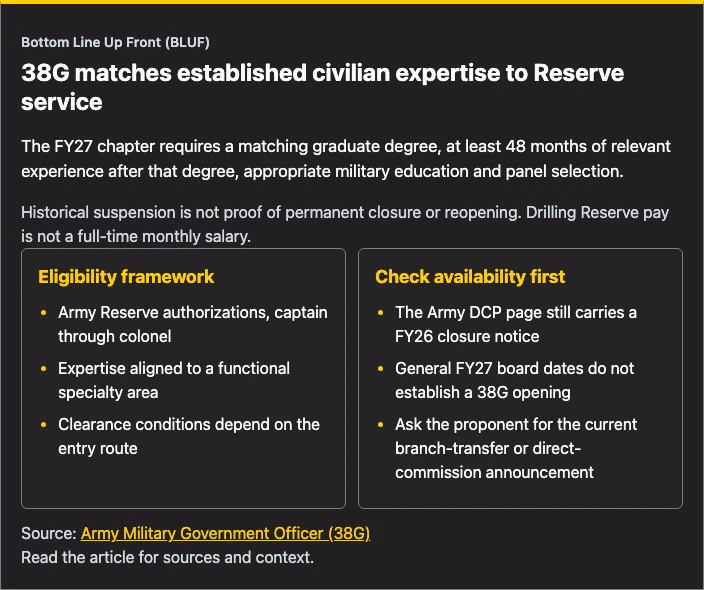
The FY27 chapter requires a matching graduate degree, at least 48 months of relevant experience after that degree, appropriate military education and panel selection.
Historical suspension is not proof of permanent closure or reopening. Drilling Reserve pay is not a full-time monthly salary.
Eligibility framework
- Army Reserve authorizations, captain through colonel
- Expertise aligned to a functional specialty area
- Clearance conditions depend on the entry route
Check availability first
- The Army DCP page still carries a FY26 closure notice
- General FY27 board dates do not establish a 38G opening
- Ask the proponent for the current branch-transfer or direct-commission announcement
Source: Army Military Government Officer (38G)
Read the article for sources and context.
On this page
Job Role and Responsibilities
Military government officers (AOC 38G) give Civil Affairs commanders the civilian-government expertise a military staff does not carry. They analyze how a government actually functions in a sector such as civil security, civil control, essential services, governance or economic stabilization, then advise the commander and the supported civil authority on what will break, what will hold and what has to be rebuilt first.
The Army’s FY27 Civil Affairs chapter describes the specialty as an analysis and engagement capability for CA commanders who need government expertise during operations. A 38G officer works with a 38S or 38A officer, and that partner integrates the advice into Army planning and operations. The 38G supplies the depth.
The CA officer supplies the military context and the authority to act on it.
Command and Leadership Scope
There is no platoon in this job. A 38G officer does not take command of a Civil Affairs team, company or battalion. The FY27 chapter lists company and battalion command as 38A and 38S assignments, and it tells 38G officers to serve only in positions coded for 38G.
Leadership shows up in three places instead. A 38G officer leads the analysis inside a functional specialty cell at a Civil Affairs command. The officer represents the civil authority’s real constraints in a planning meeting where everyone else is thinking in military terms.
And at the senior grades, the 38G officer is the command’s standing authority on a slice of government that no one else in uniform has run.
Span of control is small because the value of the officer is judgment about a system.
Specific Roles and Designations
The specialty is built from five functional specialty areas. Each has focus areas nested inside it, 23 in total, and each area maps to an officer skill identifier in DA Pam 611-21. The skill identifiers are restricted to AOC 38G in the grades of captain through colonel.
| Functional specialty area | Skill identifier | What the work covers |
|---|---|---|
| Civil Security | P2 | Public safety and protection from internal and external threats, including law enforcement administration, the rule of law, the legitimate monopoly of force and science-based investigation |
| Civil Control | P3 | Rule of law institutions, judiciary and corrections systems, including laws, regulations, comparative legal frameworks, human rights and institutional reform |
| Essential Services | P5 | Immediate and sustainable social well-being, including food relief, water, sanitation, public works, power, education administration, public health, transport and communications |
| Governance Support | P6 | State legitimacy and public administration, including how a government organizes, staffs and delivers its own functions |
| Economic Stabilization and Infrastructure | P7 | Stable economies, money control, financial institutions, natural resources, and critical infrastructure in power, agriculture, transport and telecommunications |
The Army Reserve program page groups current openings under 18 skill identifiers. The 18 and the 23 count different things. The skill identifiers mark the specific expertise a packet can be submitted against.
The focus areas are the narrower subjects inside them, and the degree fields and experience requirements for each one sit in Table 4-3 of DA Pam 611-21. The Commandant of the Civil Affairs Branch validates the match.
The distinction from the operational CA officer matters here. A 38A or 38S officer runs civil-military operations with a team in the field. A 38G officer is the person the team calls when the question is how a ministry, a court system, a water authority or a central bank is supposed to work.
In the FY27 structure, 38S is the active component AOC and 38A is the Reserve component AOC. 38G sits beside both of them as a Reserve-only specialty.
Mission Contribution
Military government operations are one of the four Civil Affairs core competencies in the current doctrine. The others are civil knowledge integration, civil network development and engagement, and civil-military integration. The 38G officer is the branch’s direct investment in the fourth one.
In competition, that means helping a CA unit or a joint force understand which institutions in a partner country are fragile and what would happen if they failed. During large-scale combat, it means reconstituting the functions of government in the rear area as the maneuver force moves through. An army can take ground quickly.
Restoring a court, a payroll system or a water utility takes longer than the fight, and the 38G officer is the person who knows what “restored” has to look like.
Technology, Equipment, and Systems
This is not an equipment-heavy specialty. The working tools are analytical: civil information management systems, unclassified and classified networks, geographic information systems, open-source data about infrastructure and institutions, and the assessment formats Civil Affairs uses to report on a civil environment.
The officer also works with people who are not in the military, including host-nation officials, aid organizations and other federal agencies. That makes correspondence, briefing products and plain writing part of the toolkit. A 38G officer who cannot explain a governance problem in two pages will not be read by the people who decide.
Salary and Benefits
Base Pay (2026)
Direct commission entry grade depends on education, certifications and experience, and the Army reviews each packet for constructive credit. A 38G officer therefore enters at captain or above rather than at second lieutenant. The table shows captain and major examples; it does not promise an appointment grade or a particular number of years credited for pay.
| Rank | Pay Grade | Years of Service | Monthly Base Pay | Annual Base Pay |
|---|---|---|---|---|
| Captain (CPT) | O-3 | 2 or less | $5,534 | $66,409 |
| Captain (CPT) | O-3 | Over 4 | $7,383 | $88,592 |
| Major (MAJ) | O-4 | 2 or less | $6,295 | $75,535 |
| Major (MAJ) | O-4 | Over 8 | $8,816 | $105,797 |
Source: DFAS 2026 pay tables. Figures reflect the 2026 pay raise.
These 2026 officer basic-pay examples are rounded to whole dollars. Annual amounts in the table are full-time basic pay, not expected earnings from a drilling Reserve position.
A drilling 38G officer is paid drill periods and annual training rather than a monthly salary. Base pay matters most when the officer is on active duty orders, which happens during annual training, schools and mobilization.
Special Pays
Military government officers do not draw flight pay, dive pay, hazardous duty incentive pay or special duty assignment pay. The specialty carries no published accession or retention bonus, and the FY27 chapter describes no incentive specific to 38G. Bonus programs change with each fiscal year and with the needs of the Army, so current amounts come from a Reserve recruiter rather than from a general guide.
The pay lever that does matter is constructive credit. A packet with a doctorate, a professional license and 15 years of directly relevant work can enter at a higher grade than one with a master’s degree and four years. Grade at entry sets the drill rate, the promotion timeline and the retirement calculation for the rest of the career.
Additional Benefits
Basic Allowance for Subsistence is $328.48 per month for officers, and it is paid during active duty periods rather than drill weekends. Basic Allowance for Housing follows the same rule. Both are tax-free, and BAH varies by duty station, grade and dependent status.
The health plan for a drilling Reserve officer is TRICARE Reserve Select, which cost $57.88 per month for the member alone and $286.66 for member and family in 2026.
Education benefits include federal tuition assistance while serving and the Montgomery GI Bill Selected Reserve for eligible members. Its full-time enrollment rate is $508 per full month from October 1, 2026, through September 30, 2027. Retirement is points-based, described under the Reserve section below.
Work-Life Balance
The civilian job comes first in this specialty, and the military schedule is built around it. A standard year is 48 drill periods, usually one weekend a month, plus 14 days of annual training. Schools, exercises and mobilizations add to that.
The balance is not the same in both directions. The military work overlaps the civilian work, so a drill weekend can sharpen a skill the employer already pays for. Against that, a 38G officer is often the only person in the unit with the expertise, which makes it difficult to skip a planning event or hand off a product.
Qualifications and Eligibility
Commissioning Sources
There is no ROTC, Officer Candidate School or West Point route into 38G. The Army recruits the specialty two ways, and both end at the same selection panel.
Branch transfer. An officer already in the Army Reserve, serving in a troop program unit, applies to move into 38G. The FY27 chapter opens this to officers from all Army branches. The officer keeps a military record and adds a specialty.
Direct commission. A civilian professional applies for a commission and the 38G specialty at the same time. The Army’s Direct Commission Program handles the appointment, and the Civil Affairs panel decides the specialty.
Both routes require the same graduate degree and experience. The difference is what the applicant already has: a military record or a civilian one.
Commissioning Requirements
| Requirement | Branch transfer | Direct commission |
|---|---|---|
| Degree | Master’s degree or higher associated with one of the five functional specialty areas | Master’s degree or higher associated with one of the five functional specialty areas |
| Civilian experience | At least 48 months in a matching focus area, earned after the graduate degree | At least 48 months in a matching focus area, earned after the graduate degree |
| Rank | Serving officer in a troop program unit, in a grade that fits a 38G authorization | Appointed at captain through colonel based on constructive credit |
| Security clearance | Secret clearance and eligibility for TS/SCI | Eligibility for a secret clearance up to TS/SCI |
| Medical and fitness | Army medical and fitness standards | Army medical and fitness standards |
| Military education | Appropriate professional military education for the grade | Direct Commissioning Course, Basic Officer Leader Course-B, then the Civil Affairs Captains Career Course |
| Selection | 38G selection panel | 38G selection panel |
The Army’s direct commission page adds the general requirements that apply to every applicant: U.S. citizenship, a clean moral background, and commissioning before age 55, with waivers available up to age 54. It also states that the program is not open to inter-service or inter-component transfers under DoD Instruction 1300.04, which is a separate question from an Army officer’s branch transfer.
Test Requirements
No ASVAB score applies. The ASVAB and its General Technical line score are entry requirements for enlisted service and for Officer Candidate School, not for a panel-selected specialty. Prior testing depends on the officer’s original accession route.
The 38G selection requirements themselves do not impose an ASVAB score.
The 38G section of the FY27 chapter also lists no language aptitude test, unlike the 38S section, which requires a Defense Language Aptitude Battery score or documented proficiency in a strategic language. Language skill still helps in the job. It is not the gate.
What remains is a military medical examination, a background investigation for the clearance, and the panel’s judgment of the record. The panel is the real test, and it reads a packet rather than a score.
Branch Selection and Assignment
Every 38G officer enters the specialty through a selection panel. The Army announces each panel in a military personnel message, and the message carries the application window and the packet instructions.
An application documents professional qualifications rather than relying on a job title. Earlier program instructions listed the following materials, but the current panel announcement controls the actual packet:
- A cover sheet
- A narrative essay of at least 750 words
- A direct appointment application
- A resume
- Three letters of recommendation
- Transcripts and diplomas
- A prescreening questionnaire
Branch transfer packets follow the same panel announcement through the Reserve chain.
Panel approval awards the AOC. The Commanding General of the U.S. Army John F. Kennedy Special Warfare Center and School is the waiver authority for the specialty, and questions go to the Civil Affairs proponent at Fort Bragg.
As checked on November 15, 2026, the Army recruiting page still carries a FY26 Civil Affairs closure notice. Its general FY27 board dates are not evidence that a board accepts 38G packets. Ask the Civil Affairs proponent for the current 38G panel announcement and whether it covers branch transfer, direct commissioning, or both before preparing an application.
Upon Commissioning
A direct commission appointee enters at captain or above. The 38G designation comes from the panel, not from the oath. An applicant is selected for the specialty by the 38G panel and appointed at the grade the Army approves after reviewing the packet.
A branch transfer officer keeps the current grade and moves into 38G-coded positions after approval. In practice, a 38G appointment lands at captain or above, because the specialty has no lieutenants.
Work Environment
Setting and Schedule
Most of the year is a Reserve center or an armory, one weekend a month, with a planning cycle running between drills by email and phone. The work is analytical and conversational: reading, writing assessments, briefing, and coordinating with people outside the unit.
Field time comes in blocks. Annual training, command post exercises and mobilization work put the officer in a planning cell or a civil-military operations center for two weeks or longer. Deployed, the setting can be a base with reliable networks or a small team location with none.
Leadership and Chain of Command
A 38G officer reports through the Civil Affairs chain to a team chief, a cell chief or a CA commander. In an operational assignment the officer may also advise a commander outside that chain, which means serving two masters with different priorities. The officer who cannot keep those relationships straight becomes either useless to the commander or unreliable to the unit.
Officer-NCO Dynamic
Civil Affairs noncommissioned officers carry regional knowledge, language skill and years of operational practice. A 38G officer brings depth in one civilian system. The strongest working pairs split the problem that way: the NCO knows how the unit operates and who to talk to, and the 38G officer knows what a functioning ministry, court or utility actually requires.
Staff vs. Command Roles
Almost all 38G work is staff and advisory work. The officer produces analysis, options and recommendations, and someone else decides. Senior 38G officers shape how a command approaches governance and stabilization, sit in planning groups, and represent the specialty to joint and interagency partners.
The reward is influence over decisions, not command authority.
Job Satisfaction and Retention
The fit depends on whether the officer wants advisory influence built around civilian expertise. Before seeking a position, ask the unit how that expertise is used between drills, which exercises require it, and what mobilization preparation adds to the ordinary schedule.
Training and Skill Development
Pre-Commissioning Training
The “pre-commissioning” phase of this specialty is the civilian career. A panel is not going to teach a 38G officer how a water utility is financed or how a court system is administered. It selects people who already know.
Direct commission applicants do complete the standard entry training after selection, described below. Branch transfer officers bring their earlier officer training with them.
Basic Officer Leader Course (BOLC)
| Phase | Location | Duration | Focus |
|---|---|---|---|
| Direct Commissioning Course | Fort Benning, Georgia | About 6 weeks | Officer foundation: leadership, basic soldier skills, fitness, marksmanship, land navigation |
| Basic Officer Leader Course-B | Varies by branch | Varies | Branch entry skills and the military decision process |
| Civil Affairs Captains Career Course | Fort Bragg, North Carolina | Phased resident course | Civil Affairs qualification and Military Education Level 6 credit |
The Direct Commissioning Course is run by the 199th Infantry Brigade at Fort Benning. It is the same course that prepares judge advocates and other direct commission officers, and it assumes no prior service.
The Civil Affairs Captains Career Course is the qualification course for the branch. Officers who already hold the equivalent military education level from another branch attend only the phases that award Civil Affairs qualification. The course is where a 38G officer learns how the branch plans, reports and integrates civil considerations, which is different from knowing a government sector well.
Professional Military Education
| Course | Typical Timing | Requirement |
|---|---|---|
| Captains Career Course | Captain | Military Education Level 6, the minimum for the specialty |
| Intermediate Level Education Common Core | Major, before the third year in grade | Military Education Level C1, required for promotion to lieutenant colonel |
| Advanced Operations Course, ILE Phase II | Major or lieutenant colonel | Military Education Level B1, required for promotion to colonel |
| Senior Service College | Colonel | Required for the senior grades |
The gates are firm. An officer who skips the common core is not competitive for lieutenant colonel, and an officer without Phase II is not competitive for colonel. Reserve officers attend these courses through distributed learning, satellite campuses and short resident phases, which is what makes the schedule workable alongside a civilian job.
Additional Schools and Training
The FY27 chapter recommends NATO Civil-Military Cooperation courses and reconstruction and stabilization courses through the Foreign Service Institute at the State Department. The wider Civil Affairs course list includes language refresher training, Army targeting courses, geospatial mapping, network analysis and interagency courses.
Self-development is part of the job. The chapter asks 38G officers to keep their civilian credentials current, publish, and stay active in their professional field. That is unusual for an Army specialty and it follows from the design: the officer’s military value is the civilian expertise.
Career Progression and Advancement
Career Path
| Rank | Grade | Military education | Key developmental assignment |
|---|---|---|---|
| Captain | O-3 | Captains Career Course | 38G-coded position in a Civil Affairs unit or command |
| Major | O-4 | ILE Common Core | 38G-coded position with wider scope, often at a CA command or higher headquarters |
| Lieutenant Colonel | O-5 | Advanced Operations Course | 38G-coded position advising a CA command or higher headquarters |
| Colonel | O-6 | Senior Service College | 38G-coded position at the senior level, including joint and interagency work |
Promotion timing follows Army Reserve boards rather than a fixed schedule inside the specialty. The Army does not publish a separate 38G time-in-grade table.
Every 38G-coded position is a key developmental assignment. The FY27 chapter identifies no developmental assignments for the specialty and directs 38G officers to serve only in 38G-coded billets. That is a narrower career path than most branches offer, and it is deliberate: the Army wants the officer’s civilian expertise applied to military government work, not spread across general CA jobs.
Promotion System
Promotion to captain is time-based, so a direct commission entrant at O-3 is already past that gate. Major, lieutenant colonel and colonel are board-selected. Boards read evaluation reports, military education, assignments and the officer’s documented impact.
There are no published 38G promotion rates. What the chapter does say is that officers must complete key developmental assignments and schooling to be best qualified at each grade. In a small specialty, that also means the file has to show the officer used the expertise, not just held it.
Broadening and Functional Areas
The chapter identifies no developmental assignments for 38G and describes no functional area transfer path. The broadening happens elsewhere: joint and interagency assignments, academic work, professional publishing, and the civilian career itself. An officer who wants command of soldiers should look at 38A or 38S instead, because command is not part of this specialty.
Building a Competitive Record
For a branch transfer, the record that wins is a strong officer evaluation history plus documented expertise in a focus area. For a direct commission, it is the civilian record. Three things carry weight in both cases:
- The degree matches the area applied for.
- The work experience is directly relevant, not adjacent.
- The narrative essay explains a specific problem the applicant can solve for a commander.
Certifications help when they are the ones the field recognizes, such as a planning certification, a professional engineering license, a public finance credential or a recognized emergency management certification. A generic leadership certificate adds little.
Physical Demands and Medical Evaluations
Officers take the Army Fitness Test, which replaced the Army Combat Fitness Test on June 1, 2025. The general standard is 300 points total with at least 60 points in each event. The official AFT scoring scales list these minimums for the youngest age bracket.
| Test event | Male 17-21 minimum | Female 17-21 minimum |
|---|---|---|
| Three-repetition maximum deadlift | 150 lb | 120 lb |
| Hand-release push-ups | 15 | 11 |
| Sprint-drag-carry | 2:28 or faster | 3:15 or faster |
| Plank | 1:30 or longer | 1:30 or longer |
| Two-mile run | 19:57 or faster | 22:55 or faster |
The FY27 chapter adds no branch-specific physical standard for 38G. Applicants complete a military medical examination, and officers maintain deployment medical readiness like every other member of the unit. The physical demands in garrison are modest.
The demands during a mobilization are the same as the unit’s.
Deployment and Duty Stations
Deployment Details
A 38G officer deploys with a Civil Affairs unit, not alone. The unit provides the team, the transport and the force protection. The 38G officer provides the government expertise the mission needs, usually inside a functional specialty cell or as the advisor to a CA commander.
Mobilizations follow the unit’s cycle and the needs of the Army, and the length follows the mission. The FY27 chapter describes the wartime role plainly: as the maneuver force advances, military government officers help reconstitute the functions of government in the rear area.
Duty Station Options
The Reserve’s Civil Affairs force sits under the U.S. Army Civil Affairs and Psychological Operations Command (Airborne) at Fort Bragg, North Carolina. Its subordinate civil affairs commands are the 350th, 351st, 352nd and 353rd CACOMs, and the units below them are spread across the country.
A troop program unit officer drills at the unit that holds the position, which for most 38G officers means a Reserve center within commuting distance rather than a permanent change of station. Officers who want a specific command or a joint assignment compete for it through the Reserve assignment process.
Risk, Safety, and Legal Considerations
Job Hazards
The physical hazards are the unit’s hazards. If the Civil Affairs unit goes to a contested area, the 38G officer goes with it and shares the same risk.
The occupational hazard is different. A 38G officer is often the only person in the room who understands a system that a commander is about to change, and the advice may be unwelcome. Being right and being ignored are both possible, and the second one can cost a community its water, its courts or its currency.
Safety Protocols
Unit force protection, risk management and medical readiness apply as they do across the Army. The specialty adds no separate safety program. The practical protection is preparation: knowing the environment, the partners and the limits of the advice before the mission starts.
Legal and Command Responsibility
A 38G officer holds a commission and is subject to the Uniform Code of Military Justice, but does not hold command of the unit. The officer’s authority is expertise and rank, exercised through advice.
That does not lower the stakes. Military government work touches civilian institutions and civilian lives, and the officer’s products can shape decisions about property, services and political authority. Accuracy, sourcing and candor in the assessment are the professional standard.
An officer who tells a commander what the commander wants to hear is more dangerous in this specialty than in most.
Impact on Family and Personal Life
Family Considerations
The routine is predictable in a way that active duty is not. Drill weekends are scheduled a year ahead, and annual training dates are published early. The unpredictability comes from mobilizations and from the extra schools and exercises that a serious career in the specialty requires.
Family support runs through the unit’s family readiness group and the installation support services available to Reserve families. Because the officer usually lives near the unit, the family often has a local network that active duty families lose with each move.
Dual-Military and Family Planning
Two Reserve schedules in one household can collide, especially when both members have annual training in the same month. The Army’s married couple programs apply to Reserve assignments, and the practical answer is to raise the conflict at the unit level early rather than after orders arrive.
Reserve and National Guard
Component Availability
The 38G AOC exists only in the Army Reserve. There is no Army National Guard 38G. A Guard officer who wants the specialty would be changing components, which is a separate decision with its own rules and timing.
Commissioning Paths
Entry is the selection panel described earlier. The Reserve assigns and trains after selection, and unit leadership recruits only officers who meet the branch qualifications in DA Pam 611-21. A direct commission applicant works through an Army Reserve recruiter and the Direct Commission Program.
A branch transfer applicant works through the Reserve chain and the panel announcement.
Drill and Training Commitment
The standard commitment is one weekend per month plus two weeks of annual training. Civil Affairs adds professional military education, unit training events and preparation for the unit’s mobilization mission. Officers who pursue additional schools and exercises commonly spend more than the minimum, and a mobilized year is full time.
Part-Time Pay
Drill pay is monthly basic pay divided by 30, multiplied by the number of drill periods. A standard weekend counts as four periods.
An O-3 with less than two years of service earns $737.88 for a standard drill weekend. An O-3 with more than three years earns $902.72. Annual training pays the full daily rate for each day.
A 38G officer entering at major or above earns proportionally more.
Benefits Differences
| Factor | Active Duty | Army Reserve | Army National Guard |
|---|---|---|---|
| Commitment | Full time | One weekend per month, two weeks per year | One weekend per month, two weeks per year |
| Pay basis (O-3, under 2 years) | $5,534 basic pay | $737.88 per drill weekend | $737.88 per drill weekend |
| Healthcare | TRICARE Prime, no premiums | TRICARE Reserve Select, $57.88 member only in 2026 | TRICARE Reserve Select, same plans |
| Education | Tuition assistance, Post-9/11 GI Bill | Federal tuition assistance, MGIB-SR, Post-9/11 after qualifying active duty | Federal tuition assistance, state tuition waivers in many states |
| Retirement | 20-year pension plus TSP | Points-based at age 60 | Points-based at age 60 |
| Deployment tempo | Follows the unit | Unit mobilizations and operational support tours | State missions and federal mobilization |
| Command opportunity | CA company and battalion command | None in 38G | None in 38G |
The retirement comparison is the one people ask about. A Reserve retirement is calculated from retirement points, not from a straight 20-year pension. Points come from drills, annual training and mobilizations, and the pension is paid at age 60 with an earlier start possible for some mobilized service.
The Thrift Savings Plan works the same way in both components, with an automatic 1 percent contribution and a match of up to 4 percent.
Command and Career Progression
There are no 38G command billets. Progression runs through 38G-coded positions at increasing responsibility, with the same military education gates as the active component. Promotion timing follows Reserve boards, and an officer who wants to compete for the senior grades should expect to complete the common core and Phase II on schedule.
Deployment and Mobilization
Civil Affairs units mobilize for named operations, for theater engagement work and for exercises. A 38G officer can also volunteer for shorter operational support tours when the Army advertises them. Mobilization length follows the mission, and the officer should confirm the current requirement with the unit before planning a civilian leave of absence.
Civilian Career Integration
This is the specialty’s central feature. A 38G officer’s civilian job is the qualification, so the military work keeps the civilian skill current instead of competing with it. A city manager, a public health official, a utility engineer, a prosecutor, an emergency manager or an economic development director can serve and stay in the same profession.
Federal law protects the civilian job during mobilization under the Uniformed Services Employment and Reemployment Rights Act. Employers get an employee with operational experience in a field they already value, and the officer gets a second context for the same expertise. That overlap is also why the specialty is hard to enter: the Army is not buying potential, it is buying a career.
Post-Service Opportunities
Transition to Civilian Life
There is little transition, because the officer never left. A 38G officer who completes a Reserve career returns to a civilian career that continued throughout. What changes is the record: operational planning experience, interagency work, and documented work in a governance or infrastructure field under conditions most civilians never see.
Civilian Pay and Outlook
| Occupation | Median Annual Wage (May 2025) | Job Outlook, 2025 to 2035 |
|---|---|---|
| Administrative services and facilities managers | $110,500 | 5 percent |
| Emergency management directors | $93,330 | 4 percent |
| Urban and regional planners | $89,320 | 4 percent |
Source: BLS Occupational Outlook Handbook. BLS reports 14,000 emergency management director jobs, 45,800 urban and regional planner jobs and 444,800 administrative services and facilities manager jobs in 2025. It projects 4 to 5 percent growth for these occupations through 2035, against a 3 percent average for all occupations.
Graduate Education and Credentials
The graduate degree is already in hand, which is the entry requirement. The GI Bill can fund a second degree or a certificate after qualifying service, and federal tuition assistance can fund courses while serving. Credentials that transfer cleanly include professional licensure in the officer’s field, planning and project management certifications, and public finance credentials.
Is This a Good Job for You? The Right (and Wrong) Fit
Ideal Candidate Profile
The officer who fits has a graduate degree, at least four years of real responsibility in a government-adjacent field, and a genuine interest in how institutions work under pressure. The work rewards people who can read a system, explain it to a commander in plain language, and stay useful when the plan changes.
The temperament matters as much as the resume. A 38G officer advises without commanding, works with civilians who may distrust the military, and often delivers unwelcome analysis. Patience and precision carry more weight than assertiveness.
Potential Challenges
The entry gate is the first obstacle. The degree has to match an open focus area, the experience has to be documented, and the panel has to see a specific use for the expertise. A strong career in a related but unmatched field does not clear the gate.
The second is the schedule. Drill weekends plus annual training plus professional military education is a real second job, and mobilizations take months away from the civilian career that qualifies the officer in the first place. The third is the ceiling.
There is no command track, so an officer who wants to lead soldiers should choose a different specialty.
Career and Lifestyle Alignment
For a mid-career professional who wants to serve, keep a civilian career, and use real expertise in uniform, 38G is one of the few specialties built exactly for that. For someone who wants a full-time military career, combat arms experience, or a first job out of college, it is the wrong door. The better question is whether the person wants to spend a weekend a month being the government expert in a military planning cell.
More Information
The first step is a conversation with the proponent or a Reserve recruiter, before any packet work begins. The Civil Affairs proponent at Fort Bragg answers specialty questions at swcscapersonnel@socom.mil, and a Reserve recruiter can confirm whether the direct commission panel is open for the current cycle. A serving Reserve officer should ask the branch proponent about the next 38G selection message.
Confirm the current panel’s eligibility and packet requirements before applying. The Army DCP page and the proponent are the starting points; a dated suspension notice should not be presented as a permanent closure or as proof of reopening.
No ASVAB preparation is needed for this specialty. A 38G applicant who is already an officer should focus on the degree match, the documented experience and the narrative essay instead. Civilians weighing a commission can read the officer paths guide for how direct commission fits with the other routes.
Explore more Army Civil Affairs officer careers on the 38A branch page, which covers Civil Affairs basics, component structure and the operational CA path this specialty supports.