17A Cyber Warfare Officer
The Army established the Cyber branch in 2014 to develop officers for a domain most soldiers never see. It has become one of the Army’s most technically demanding and selective branches, with its own selection process outside normal branching. Even a top ROTC cadet is not assigned to Cyber by default; the branch makes that decision.
This guide covers the 17A Cyber Warfare Officer AOC, including duties, selection, training and career opportunities after service.
OCS candidates need a GT score of 110. Our ASVAB for OCS guide shows how to hit it.
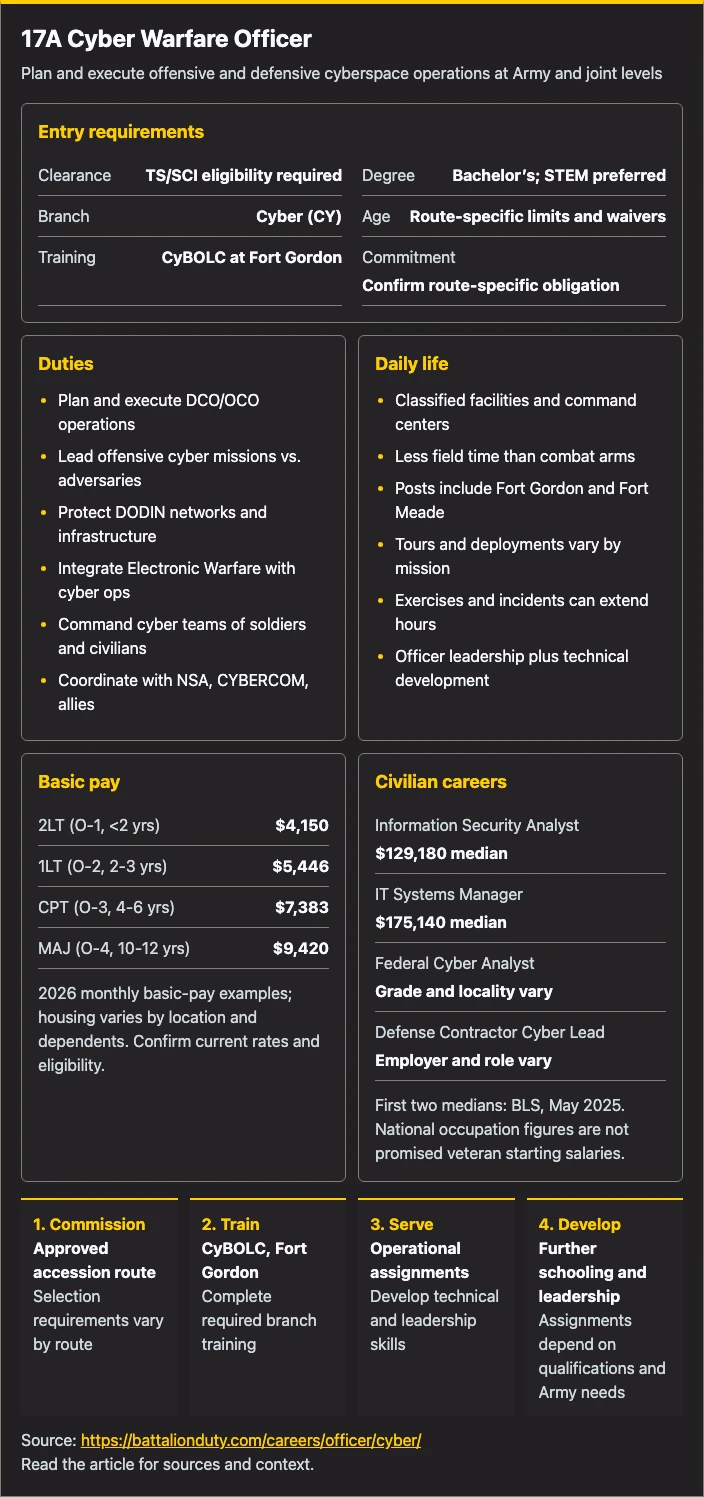
Entry requirements
- Clearance
- TS/SCI eligibility required
- Degree
- Bachelor’s; STEM preferred
- Branch
- Cyber (CY)
- Age
- Route-specific limits and waivers
- Training
- CyBOLC at Fort Gordon
- Commitment
- Confirm route-specific obligation
Duties
- Plan and execute DCO/OCO operations
- Lead offensive cyber missions vs. adversaries
- Protect DODIN networks and infrastructure
- Integrate Electronic Warfare with cyber ops
- Command cyber teams of soldiers and civilians
- Coordinate with NSA, CYBERCOM, allies
Daily life
- Classified facilities and command centers
- Less field time than combat arms
- Posts include Fort Gordon and Fort Meade
- Tours and deployments vary by mission
- Exercises and incidents can extend hours
- Officer leadership plus technical development
Basic pay
- 2LT (O-1, <2 yrs)
- $4,150
- 1LT (O-2, 2-3 yrs)
- $5,446
- CPT (O-3, 4-6 yrs)
- $7,383
- MAJ (O-4, 10-12 yrs)
- $9,420
2026 monthly basic-pay examples; housing varies by location and dependents. Confirm current rates and eligibility.
Civilian careers
- Information Security Analyst
- $129,180 median
- IT Systems Manager
- $175,140 median
- Federal Cyber Analyst
- Grade and locality vary
- Defense Contractor Cyber Lead
- Employer and role vary
First two medians: BLS, May 2025. National occupation figures are not promised veteran starting salaries.
- CommissionApproved accession routeSelection requirements vary by route
- TrainCyBOLC, Fort GordonComplete required branch training
- ServeOperational assignmentsDevelop technical and leadership skills
- DevelopFurther schooling and leadershipAssignments depend on qualifications and Army needs
Source: https://battalionduty.com/careers/officer/cyber/
Read the article for sources and context.
On this page
Job Role and Responsibilities
A 17A Cyber Warfare Officer plans and leads offensive and defensive cyberspace missions at Army and joint levels. Defensive Cyberspace Operations (DCO) protect friendly networks, while Offensive Cyberspace Operations (OCO) degrade enemy systems. Officers also support Department of War Information Network (DOWIN) missions and integrate Electronic Warfare (EW) effects into combined arms plans.
Command and Leadership Scope
At company grade, Cyber officers lead teams of soldiers and Army civilians conducting network defense, offensive operations or intelligence-based targeting. Captains will likely command cyber companies and may also serve on battalion or brigade staffs, while majors typically move into battalion staff assignments where they plan missions and coordinate cyber effects across teams.
Responsibility expands with rank: a lieutenant may lead a technical team of 8 to 15 people, while a company commander may oversee 60 to 100 soldiers. Junior officers spend more time on hands-on technical work; field grade officers increasingly plan missions, integrate effects and coordinate with joint and other-agency partners.
AOCs, Skill Identifiers, and Functional Areas
The branch uses several Area of Concentration (AOC) codes to identify different fields. Most Cyber lieutenants enter 17A training, while selected officers enter the 17D development track directly. Officers who move into 17B first complete the 17A foundation.
| Code | Designation | Focus |
|---|---|---|
| 17A | Cyber Warfare Officer | Integrated DCO/OCO operations |
| 17B | Cyber and Electronic Warfare Officer | Combined cyberspace and EW operations |
| 17D | Cyber Capability Development Officer | Software, tools, and cyber capabilities development |
Officers normally qualify for 17A through CyBOLC, after which some are selected for the 17B CEWO Qualification Course. The 17D AOC focuses on developing cyber tools rather than conducting missions.
Mission Contribution
Cyber operations can affect a force before ground combat begins by disrupting its command-and-control links, logistics software or air defense networks. On defense, Cyber officers protect Army networks, secure communications and identify threats before they cause damage.
The branch operates in joint, interagency, intergovernmental and multinational (JIIM) settings, so Cyber officers often work with NSA, CYBERCOM, CIA and allied units.
Technology, Equipment, and Systems
Cyber officers use classified platforms and tools for network exploitation, vulnerability analysis and effects delivery. They also work with Army command-and-control systems, including the Command Post Computing Environment (CPCE) and systems such as GCCS-A. The electromagnetic part of these operations belongs to the 17B Cyber Electromagnetic Warfare Officer, while the 17D Cyber Capability Development Officer develops the tools.
Salary and Benefits
Base Pay
DFAS sets officer pay; the table shows 2026 monthly base pay for Cyber officers at typical career points.
| Rank | Grade | Typical Years of Service | Monthly Base Pay |
|---|---|---|---|
| Second Lieutenant (2LT) | O-1 | Less than 2 | $4,150 |
| First Lieutenant (1LT) | O-2 | 2 to 3 | $5,446 |
| Captain (CPT) | O-3 | 4 to 6 | $7,383 |
| Captain (CPT) | O-3 | 8 to 10 | $8,126 |
| Major (MAJ) | O-4 | 10 to 12 | $9,420 |
| Lieutenant Colonel (LTC) | O-5 | 16 to 18 | $11,391 |
Basic Allowance for Subsistence (BAS) adds $328.48 per month under the 2026 officer rate. Basic Allowance for Housing (BAH) varies by duty location, grade and dependent status; use the DoD BAH lookup for the actual assignment rather than carrying a housing figure from one installation to another.
Special Pays and Bonuses
Cyber retention offers depend on current eligibility and staffing needs; confirm any bonus with HRC rather than treating a past offer as a promise. BRS members may also qualify for Continuation Pay. The Army sets the eligibility window, amount and additional service obligation for each calendar year. Read the current guidance and written agreement before accepting this payment.
Additional Benefits
Active-duty officers receive healthcare through TRICARE. Family coverage and out-of-pocket costs depend on the plan, beneficiary category and care received; check the current TRICARE costs and fees rather than assuming every service is free for every family member.
The Blended Retirement System (BRS) applies automatically to members who first entered uniformed service on or after January 1, 2018; earlier members had separate eligibility and election rules. For a regular retirement at 20 years, its defined benefit is 40% of the average of the highest 36 months of basic pay. Reserve retirement uses qualifying service and points under separate rules. BRS also includes government contributions to the Thrift Savings Plan, with matching subject to contribution and service requirements.
Officers earn 30 days of paid leave each year, accruing 2.5 days per month, and may carry up to 60 days between fiscal years.
Work-Life Balance
In garrison, Cyber officers often follow a structured but demanding schedule, with physical training most mornings and work ending in the early evening. Incidents, exercises and on-call requirements can extend those hours without warning because cyber threats do not follow a duty schedule.
Cyber officers generally spend less time in the field than combat arms officers, but major exercises and joint events can still require long days on site. Much of their deployed work takes place in secure buildings and command facilities.
Qualifications and Eligibility
Commissioning Sources
The three main commissioning routes are ROTC, OCS and Direct Commission; West Point (USMA) graduates can also seek Cyber through a separate packet. Rather than relying on the standard OML draft, the branch conducts its own selection process for candidates from every commissioning source.
| Commissioning Source | Degree Requirement | GPA Guidance | Age Limit | Notes |
|---|---|---|---|---|
| ROTC | Bachelor’s by commissioning | Competitive; STEM preferred | 30 at commissioning (waivers available) | Submit separate Cyber branch packet |
| OCS | Bachelor’s required | No minimum; STEM degree strengthens packet | 32 at commissioning (waivers available) | Cyber reviews packets independently of OML |
| USMA (West Point) | Bachelor’s awarded at graduation | Academic performance matters | N/A | Branch Cyber through separate selection process |
| Direct Commission | Bachelor’s required; relevant cyber experience weighted heavily | No stated minimum | Entry-rank limit applies; waiver requests through 54; commission before 55 | Available for experienced civilian cyber professionals |
Traditional branch selection favors STEM backgrounds, including computer science, engineering, cybersecurity and information technology. Direct-commission vacancies set their own degree and experience requirements, so applicants should follow the current posting for their route.
Tests and Scores
OCS applicants must meet the ASVAB requirement of at least 110 GT, although competitive candidates often score higher. The Cyber branch evaluates technical ability through education, experience and interviews rather than ASVAB line scores. SIFT is not required.
Branch Selection and Assignment
Cyber runs a separate accessions process across commissioning sources. ROTC cadets submit a branch packet containing transcripts, a resume, reference letters and a writing sample. The Cyber branch proponent at Fort Gordon reviews packets for technical background, leadership potential and clearance eligibility.
The small branch has historically offered fewer than 100 officer slots per year across all commissioning sources. Competitive applicants often have strong STEM grades, relevant internships, credentials such as CompTIA Security+ or CEH, prior IT work, or a high OML ranking.
Upon Commissioning
Traditional accessions normally begin at O-1 (Second Lieutenant). Direct-commission entry rank depends on qualifications and the vacancy; current 17A opportunities advertise Captain and Major positions. Service obligations depend on the commissioning route, funded training, incentives and written agreement.
OCS candidates can find a focused GT study plan in our ASVAB for OCS guide.
Work Environment
Setting and Schedule
Most Cyber officers work in secure buildings, including classified computer labs and command centers at Fort Gordon and intelligence facilities at Fort Meade and NSA sites. The branch spends less time in the field than infantry or armor. Physical training still takes officers outdoors, but most daily mission work happens at a desk.
Standard garrison training days may run about 0600 to 1700, but joint exercises, real incidents and high-priority taskings can extend those hours.
Leadership and Chain of Command
New team leaders work closely with senior NCOs, who may have substantially more hands-on technical experience. Enlisted 17C Cyber Operations Specialists bring knowledge that a lieutenant should use while developing their own skills. The officer remains responsible for the team’s planning and leadership, working with NCOs rather than treating technical expertise as a substitute for command judgment.
Captains report to battalion commanders while supervising team leaders and NCOs. Majors move into staff roles that connect mission planning with technical operations.
Staff vs. Command Roles
Cyber captains may spend about two to three years in company command or take staff or other key company-grade assignments before moving to major-level staff positions. Majors often serve as battalion operations officers (S3), intelligence officers or joint staff members at CYBERCOM. Between these assignments, officers may broaden their experience through ROTC instruction, recruiting, fellowships, or work with NSA, DHS/CISA and the intelligence community.
Job Satisfaction and Retention
Cyber officers weighing a longer Army career must compare military assignments and benefits with the civilian roles open to them. Bonuses and graduate education may support retention, but availability depends on current programs and selection. Mission depth and the work itself can make continued service attractive; officers who leave may pursue defense contracting, federal service or private cybersecurity work without assuming that any employer will automatically hire them.
Training and Skill Development
Pre-Commissioning Training
ROTC cadets complete a four-year program combining leadership courses and summer training, ending with the Cadet Leader Course at Fort Knox. OCS provides twelve weeks of basic officer training at Fort Benning, Georgia, while West Point is a four-year academy program. Cyber-specific technical instruction comes later at BOLC rather than through these commissioning paths.
Basic Officer Leader Course (BOLC)
At about 37 weeks, the Cyber BOLC (CyBOLC) at Fort Gordon, Georgia is the Army’s longest officer BOLC. The extended course provides the technical training officers need before they are ready for cyber work.
| Phase | Location | Length | Focus |
|---|---|---|---|
| Phase I: Basic Officer Foundation | Fort Gordon, GA | ~4 weeks | Army leader skills, branch orientation |
| Phase II: Technical Qualification | Fort Gordon, GA | ~26 weeks | DCO/OCO operations, network exploitation, cyberspace planning |
| Phase III: Mission Application | Fort Gordon, GA | ~7 weeks | Integrated exercises, joint operations, capstone scenarios |
The 17B Cyber Electromagnetic Warfare Officer track adds a course after 17A CyBOLC, while the 17D Cyber Capability Development Officer track uses a separate BOLC focused on software and tool building. Each specialty page explains its full training pipeline.
Professional Military Education (PME)
After BOLC and an initial assignment, captains attend the approximately four-month Cyber Captains Career Course (Cyber CCC) at Fort Gordon. The course develops mission planning and company-level leadership skills and is required for company command and promotion to major.
Eligible majors attend the ten-month Intermediate Level Education (ILE) program at the Command and General Staff College (CGSC) in Fort Leavenworth, Kansas. It covers mission planning, joint operations and senior staff work and is required for promotion to O-5. Selected O-5s and O-6s may later attend Senior Service College, or War College, to prepare for general officer responsibilities.
Additional Schools and Training
Additional schooling can build technical expertise or broaden an officer’s military experience. Opportunities include:
- Airborne School (Fort Benning, GA): 3 weeks, earns the Airborne badge
- Ranger School (Fort Benning, GA): 62 days, earns the Ranger tab and shows sustained leadership
- NSA Certificates and Courses: open through other-agency jobs
- Fully funded graduate school: the Advanced Civil Schooling (ACS) program sends officers to approved schools. They earn master’s degrees in computer science, information systems, or cybersecurity while on active duty
The branch values technical certifications. Some officers arrive with CompTIA Security+, Certified Ethical Hacker (CEH) or CISSP; others earn them during service. These credentials can document useful knowledge, but officers still need to apply it on the mission.
Career Progression and Advancement
Officer Career Timeline
| Rank | Grade | Typical Time-in-Grade | Key Positions |
|---|---|---|---|
| Second Lieutenant (2LT) | O-1 | 18 months | Platoon leader or team leader in cyber unit |
| First Lieutenant (1LT) | O-2 | 18-24 months | Executive Officer (XO) or senior team leader |
| Captain (CPT) | O-3 | 4-6 years | Company commander, battalion S3/S6, joint staff |
| Major (MAJ) | O-4 | 4-5 years | Battalion XO, brigade S3, joint/CYBERCOM staff |
| Lieutenant Colonel (LTC) | O-5 | 3-4 years | Battalion commander, joint staff, strategic plans |
| Colonel (COL) | O-6 | 3+ years | Brigade commander, senior staff, CyCOM leadership |
Key Developmental (KD) assignments include Platoon/Team Leader at O-1/O-2, Company Command at O-3, and Battalion S3 or XO at O-4. Completing the assignments required for an officer’s grade and career path helps build a competitive record, alongside strong Officer Evaluation Reports (OERs). Current branch guidance determines which positions qualify.
Promotion System
Promotion from O-1 through O-3 is largely driven by time in grade and satisfactory performance, while O-4 (Major) is more competitive. Army-wide O-4 promotion rates have ranged from about 75 to 80 percent for fully qualified below-the-zone and in-zone officers, although rates vary by year. O-5 selection is more restrictive and considers Officer Evaluation Reports (OERs), key developmental (KD) assignments, timely professional military education (PME), advanced degrees and joint experience.
Strong promotion records generally include completed KD assignments, current PME and experience with joint or other agencies.
Branching Out and Functional Areas
After company command, an officer may move into a Functional Area (FA), depending on their qualifications and Army needs. One option is FA 26, which covers network and data systems engineering through AOCs 26A and 26B and also accepts direct commissions. Other officers pursue intelligence assignments.
Space is no longer a Functional Area route: the Army established the Space Operations Branch on June 12, 2026, moving FA 40 officers into a basic branch. Officers whose intelligence and cyber work overlap may also consider a branch transfer to Military Intelligence (MI).
Broadening opportunities include ROTC instructor duty, Army fellowships with RAND, DARPA or congressional staffs, and support roles at NSA, DHS/CISA or CYBERCOM. Although these assignments do not count as KD positions, they can significantly broaden an officer’s record.
Physical Demands and Medical Evaluations
Cyber officers take the Army Fitness Test (AFT), which replaced the ACFT on June 1, 2025. The general scoring standard that applies to Cyber is explained below.
AFT Events and Minimum Standards
| Event | Abbreviation | Minimum Score |
|---|---|---|
| 3 Repetition Maximum Deadlift | MDL | 60 points |
| Hand Release Push-Up - Arm Extension | HRP | 60 points |
| Sprint-Drag-Carry | SDC | 60 points |
| Plank | PLK | 60 points |
| Two-Mile Run | 2MR | 60 points |
| Total Minimum | 300 points |
Scores are normed by age and sex, with a 300-point passing total and at least 60 points required in each event. Cyber is not a designated combat field, so the 350-point combat standard does not apply. The maximum is 500 points across five events.
Branch-Specific Medical Checks
Cyber applicants must meet Army medical accession standards under AR 40-501. Security vetting is a separate process: a position requiring TS/SCI access involves eligibility and access determinations, and some assignments may require a polygraph. Medical history or seeking mental healthcare should not be treated as an automatic clearance denial. Ask the responsible medical and security offices about the requirements that apply to your case.
Deployment and Duty Stations
Deployment Details
Cyber officers deploy less often than combat arms officers, typically on rotational tours supporting CYBERCOM or theater commands with network defense and offensive cyber capabilities. These combatant-command assignments usually last six to nine months, depending on the command. Officers may also support Special Operations Forces (SOF) on mission-specific tours of varying lengths.
Deployment frequency and duration depend on the unit, mission and operational demand. No fixed number of tours is guaranteed over a Cyber officer’s career.
Duty Station Options
The branch sits at a small number of posts.
- Fort Gordon, Georgia: home of Army Cyber Command and the Cyber Center of Excellence. The largest single cluster of Cyber officers in the Army.
- Fort Meade, Maryland: home of NSA and USCYBERCOM. Officers here often work beside NSA civilians and joint service staff.
- Fort Bragg, North Carolina: backs Special Operations cyber and EW missions.
- OCONUS jobs: officers may serve at European Command, Indo-Pacific Command, or other theater commands in cyber staff posts.
Officers submit assignment preferences through HRC, where a strong record may increase their influence over the next posting. Branch requirements remain decisive, and Cyber officers normally PCS every two to three years.
Risk, Safety, and Legal Considerations
Job Hazards
Cyber officers generally face less exposure to close combat than combat arms officers, but their missions carry substantial legal and professional responsibilities. Offensive cyberspace operations must follow applicable Title 10 authorities, rules of engagement, international law and approval requirements. Unauthorized access, targeting errors or other violations can have serious consequences for the officers who conduct or approve the operation.
Safety Protocols and Risk Management
Mission planning applies Army risk management to cyberspace, including possible effects on neutral or civilian networks and coordination with other agencies. Officers must document the required legal review and command approvals before conducting offensive operations.
Law and Command Duty
A Cyber officer in command has full UCMJ authority and responsibility for assigned soldiers, including equal opportunity compliance, command climate and subordinate conduct. Misconduct or a poor command climate can result in relief for cause, potentially ending an Army career and affecting later federal hiring. Cyber officers also have classification responsibilities, and mishandling classified material can be a criminal offense rather than merely a policy violation.
Impact on Family and Personal Life
Family Considerations
Cyber assignments concentrate at a smaller number of locations, including Fort Gordon and Fort Meade. A longer tour in one place may help families with school-age children, but officers should weigh that possibility against fewer opportunities outside the main cyber hubs. Assignment length still depends on Army needs.
Fort Gordon is outside Augusta, Georgia, while Fort Meade lies between Baltimore and Washington, D.C. Both offer Army Community Service (ACS) programs, Family Readiness Groups (FRGs) and on-post childcare. The D.C. area also offers spouse employment opportunities in federal service and defense, although some positions require a clearance.
Dual-Military and Family Planning
Dual-military Army couples can seek joint-domicile consideration through the Married Army Couples Program. Cyber and intelligence positions cluster around Augusta and Fort Meade, but co-location depends on suitable assignments and Army needs; enrollment does not guarantee a shared duty station.
Deployments and long exercises can strain family life. Less frequent field duty does not guarantee predictable evenings: incidents and mission demands can extend working hours without warning, even in garrison.
Reserve and National Guard
Where the Jobs Are
The Cyber branch serves in both the Army Reserve and the Army National Guard, where units contribute cyberspace capabilities alongside the active component. The unit’s assigned mission, authorities and access requirements determine the work its officers can perform.
Commissioning Paths
Reserve and Guard candidates may commission through ROTC under a Reserve Component contract. Guard candidates can also attend state-run OCS, while experienced cyber professionals may pursue an approved direct-commissioning route. Applicants should confirm Cyber selection requirements and available positions for their component rather than assume a commission guarantees the branch.
After completing their active-duty service obligation, officers may seek positions in the Army Reserve or Army National Guard while moving into civilian work. They should confirm available billets, transfer requirements and continued clearance eligibility rather than assuming the transition is automatic.
Drill and Training Time
Part-time service commonly includes monthly drill weekends and annual training, with additional duty, exercises or mobilization as required. A drill period is a pay unit, not a full calendar day: a normal weekend can contain four periods. Do not interpret 48 annual drill periods plus annual training as 62 calendar days.
Part-Time Pay
Each drill period pays 1/30th of monthly basic pay, and a normal drill weekend contains four periods. That gives a Reserve or Guard O-3 (Captain) about $737.88 per weekend with under two years of service, or $902.72 at the over-three-years pay step. These basic-pay examples exclude any separately authorized allowances.
Benefits
| Benefit | Reserve/Guard | Active Duty |
|---|---|---|
| Healthcare | TRICARE Reserve Select: $57.88/mo (member) or $286.66/mo (family) | Active-duty member coverage; family costs depend on plan |
| Education | Federal TA ($4,500/yr), MGIB-SR ($493/mo for 36 months), state tuition benefits (Guard) | Federal TA + full Post-9/11 GI Bill after 36 months active service |
| Retirement | Points-based BRS, collection begins at age 60 | BRS pension at 20 years: 40% of high-36 base pay |
| TSP Matching | Same schedule as active duty on drill/AT pay | Same schedule; larger contributions from higher pay |
Component Comparison
| Factor | Active Duty | Army Reserve | Army National Guard |
|---|---|---|---|
| Commitment | Full-time | Monthly drills and annual training; extra duty varies | Monthly drills and annual training; state or federal duty varies |
| Monthly Pay (O-3) | $5,534-$8,788 (full base pay) | ~$738-$903 per drill weekend | ~$738-$903 per drill weekend |
| Healthcare | Active-duty member coverage; family plan costs vary | TRICARE Reserve Select (~$58-$287/mo) | TRICARE Reserve Select (~$58-$287/mo) |
| Education Benefits | Full Post-9/11 GI Bill, Federal TA | Federal TA, MGIB-SR, Post-9/11 (if activated) | Federal TA, MGIB-SR, state waivers, Post-9/11 (if activated) |
| Deployment Tempo | Unit- and mission-dependent | Varies; mobilization-driven | Varies; governor and federal activation |
| Command Billets | Company and battalion command available | Company and some battalion billets | Company and battalion billets |
| Retirement | 20-year pension + TSP | Points-based, collect at 60 | Points-based, collect at 60 (reduced with qualifying active service) |
Deployment and Call-Ups
Reserve and Guard Cyber officers can serve federal missions under Title 10 orders, including combatant-command support and Active Duty Operational Support (ADOS). The orders determine the duty location and duration. Governors may also activate National Guard Cyber units for authorized state missions, including support to election security and critical infrastructure defense.
Demand for Reserve and Guard Cyber officers has grown since 2014. Call-ups come more often here than in many other fields.
Civilian Job Fit
Reserve Cyber service can complement civilian work at a federal agency, defense contractor or private cybersecurity firm. Military mission experience may help an officer compete for those roles, while civilian technical work can strengthen the skills they bring back to the unit. The value depends on the officer’s actual experience and the job’s requirements.
USERRA protects eligible service members against employment discrimination and provides reemployment rights when its conditions are met. The usual five-year cumulative service limit with one employer has exceptions; advance notice and timely return requirements also apply. Eligible employees may elect continued employer health coverage under USERRA’s rules, with costs depending on the length of service and applicable coverage provisions.
Post-Service Opportunities
Transition to Civilian Life
Cyber officers can bring mission experience, a leadership record and experience working with classified systems to a civilian job search. The Army’s Transition Assistance Program supports that move with resume preparation, interviews and other planning services. Eligible officers may also apply for DoD SkillBridge, which can provide approved civilian work experience near the end of service; participation requires authorization and is not an automatic entitlement to six months away from duty.
Cleared defense contractors, federal agencies and private technology firms recruit for cybersecurity roles. Applicants still need to meet the vacancy’s qualifications and hiring requirements; military service or a clearance does not automatically bypass the selection process.
Civilian Career Prospects
| Civilian Job Title | Median Annual Salary | 2025–2035 Job Outlook |
|---|---|---|
| Information Security Analyst | $129,180 | +21% |
| Computer and Information Systems Manager | $175,140 | +16% |
| Penetration Tester / Ethical Hacker | Varies by employer; no distinct median supplied | Not separately projected here |
| Federal Cyber Analyst | Varies by grade, locality and position | Not separately projected here |
| Defense Contractor Cyber Lead | Varies by employer and position | Not separately projected here |
The first two rows use BLS May 2025 national median wages and 2025–2035 employment projections. They describe broad civilian occupations, not starting pay or guaranteed outcomes for veterans. The other roles lack a distinct national median in those sources; actual pay depends on the employer, grade, locality and position.
Graduate School and Certificates
Advanced Civil Schooling (ACS) funds graduate study for selected officers under program terms and service obligations. Eligible veterans may instead use the Post-9/11 GI Bill to help with tuition and living expenses after service. Benefit levels, school type and current annual caps affect the amount paid; check the current VA rates before budgeting for a degree.
Cyber training and mission experience can support professional certifications such as CISSP (Certified Information Systems Security Professional), CEH, CompTIA Security+ and CySA+. Officers and NCOs should check each credential’s experience and examination requirements, along with the qualifications required for the civilian positions they want.
Is This a Good Job for You? The Right (and Wrong) Fit
The Right Fit
Cyber suits someone who wants demanding technical work and responsibility for leading people. A computer science background does not remove the challenges of command, and leadership ability does not replace the technical knowledge needed for CyBOLC and mission work. Officers need to develop both.
Signs that Cyber fits you:
- You hold a STEM degree or have real programming, networking, or security time
- You want mission duty, not just tech work
- You are at ease in classified settings on sensitive missions
- You can obtain and keep a TS/SCI clearance
- You are thinking past your first obligation and see value in the clearance and the record for a long career
Potential Challenges
CyBOLC has a steep technical learning curve, especially for officers without an IT background. Its extended syllabus requires sustained study, so candidates should build their technical foundation before arriving rather than assume the course will make every gap easy to close.
Officers focused primarily on income may prefer civilian cyber jobs, which generally pay more than comparable Army positions. Those who remain often value the mission, clearance opportunities and leadership experience.
Career and Lifestyle Alignment
An officer planning to leave after the first obligation can use that time to build technical skills, mission experience and a leadership record. Those can support a later civilian career, but service does not guarantee a particular certification, continuing clearance eligibility or salary.
For officers planning a 20-year career, Cyber offers technically demanding missions in one of the Army’s fastest-growing branches, with increasing departmental priority. Its relatively small size can also make an individual officer’s contribution more visible.
Officers who want extensive field time, a traditional combat arms culture or a wide choice of duty stations may find Cyber a poor fit. Assignments concentrate at a handful of posts, and the branch expects sustained technical work throughout a career.
More Information
Ask an Army recruiter or your ROTC program how Cyber selection works for your commissioning route. OCS candidates should confirm their GT score early; ROTC cadets should ask their battalion adviser about the Cyber packet before senior year. The Army’s Cyber Center of Excellence publishes course details and guidance for prospective officers.
- OCS candidates: prepare for GT 110 with our ASVAB for OCS study guide
Compare the branch’s specialist paths in the 17B Cyber Electromagnetic Warfare Officer and 17D Cyber Capability Development Officer profiles, or read 17A vs 17B vs 17D for a side-by-side comparison. The Army officer careers hub covers broader choices in combat arms, intelligence and technical fields.