Army Cyber Capability Development Officer (17D)
Some cyber officers run missions. The 17D builds the tools they use. A Cyber Capability Development Officer writes and ships the software, hardware and radio systems that cyber and electronic warfare teams need. The work happens in an Army build shop, not a software firm.
This is the most tech-heavy officer job in the branch. It is also the closest to a civilian tech career. That is the point. The Army needs officers who can lead a tech team and also tell whether a new tool will work.
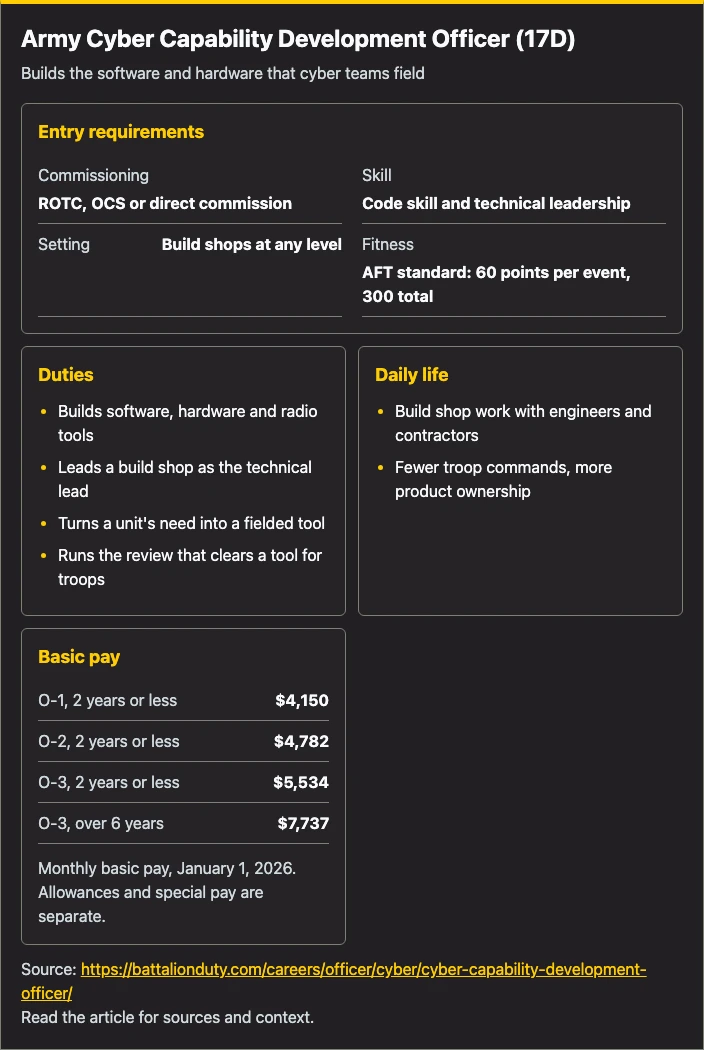
Entry requirements
- Commissioning
- ROTC, OCS or direct commission
- Skill
- Code skill and technical leadership
- Setting
- Build shops at any level
- Fitness
- AFT standard: 60 points per event, 300 total
Duties
- Builds software, hardware and radio tools
- Leads a build shop as the technical lead
- Turns a unit's need into a fielded tool
- Runs the review that clears a tool for troops
Daily life
- Build shop work with engineers and contractors
- Fewer troop commands, more product ownership
Basic pay
- O-1, 2 years or less
- $4,150
- O-2, 2 years or less
- $4,782
- O-3, 2 years or less
- $5,534
- O-3, over 6 years
- $7,737
Monthly basic pay, January 1, 2026. Allowances and special pay are separate.
Source: https://battalionduty.com/careers/officer/cyber/cyber-capability-development-officer/
Read the article for sources and context.
On this page
Job Role and Responsibilities
Army Cyber Capability Development Officers (AOC 17D, CCDO) lead and run the building of software, hardware, radio and other tech tools. Those tools support cyber operations and electronic warfare. Officers serve as builders and tech leads in build shops at any level. Their job is to turn a unit’s need into a fielded tool.
Command and Leadership Scope
A junior 17D writes code on a small team. That team often holds Army civilians and contractors with deeper tech skill. At that stage the officer brings three things: code skill, planning, and the sense to know when a request is too hard.
Leadership grows with rank. A senior captain or major may lead a build shop, own a product line, or run the review that decides whether a tool reaches troops. Command slots exist, but there are fewer than in the fighting branches. They are tech commands, not troop commands.
Team size varies a lot. A shop may be three engineers or thirty people across several fields. One thing does not change. The officer answers for whether the tool works when a soldier needs it.
AOCs, Skill Identifiers, and Designations
| Code | Designation | Relationship to 17D |
|---|---|---|
| 17A | Cyber Warfare Officer | The operational base AOC; some 17D officers also hold it. |
| 17B | Cyber Electromagnetic Warfare Officer | Separate AOC for electromagnetic warfare operations. |
| 17D | Cyber Capability Development Officer | This specialty. Also written CCDO. |
The branch splits its work by function, not by rank. A 17D officer normally serves in a 17D slot. The branch can still send that officer to a 17A or 17B job when a unit needs it.
Where the Need Becomes Gear
This is where a gap turns into equipment. A cyber unit finds a shortfall. Someone has to decide whether to buy a tool, change one they own, or build from scratch. Then someone has to push that work through test and fielding. The 17D is that officer.
The work is easy to miss, because the link to the mission is not direct. A tool that takes a year and a half to build may never come up in a briefing. The troops who use it know where it came from. Officers who need a quick win tend to find this job hard.
Technology, Equipment, and Systems
The tech scope is wide. Officers work in several code languages, on hardware mock-ups, on radio design, and on the test gear that holds it all up. Much of the work sits on closed networks or on stand-alone build machines. Moving code and gear between those worlds is slow and tightly watched.
Officers use normal tools: version control, issue tracking, and the Army’s buying process. The hard part is the limits. A fielded tool has to run in a war zone, pass a security review, and stay supported for years. That rules out much of what a civilian team would call normal.
Salary and Benefits
Officer Base Pay (2026)
Figures are 2026 DFAS basic pay rates, good from January 1, 2026. Each figure is monthly basic pay at the step shown.
| Rank | Title | Years of Service | Monthly Base Pay |
|---|---|---|---|
| O-1 | Second Lieutenant (2LT) | Less than 2 | $4,150.20 |
| O-2 | First Lieutenant (1LT) | Over 2 | $5,446.20 |
| O-3 | Captain (CPT) | Over 4 | $7,382.70 |
| O-3 | Captain (CPT) | Over 8 | $8,125.50 |
| O-4 | Major (MAJ) | Over 10 | $9,420.00 |
A new 17D starts at O-1 and follows the normal officer track, reaching O-3 at the four-year mark. The pay question here is not the branch. It is the civilian software market. A strong coder with a few years in the job can out-earn an O-3 in base pay alone. Allowances, tax breaks and benefits narrow that gap. They do not close it.
Special Pays and Bonuses
Cyber officers can get retention pay when the Army is short of mid-career tech skill. Those programs change every year. Some jobs carry extra pay during a deployment. Check any bonus figure against this year’s policy. The terms, the window and the service time all move.
Additional Benefits
The standard officer package applies. TRICARE Prime costs no premium. Housing allowance follows the post and your family status. There is a monthly food allowance. The Blended Retirement System matches Thrift Savings Plan gifts up to 5 percent of basic pay, from year three. Federal Tuition Assistance pays up to $4,500 a year for off-duty study.
One perk is tied to this job. The Army pays for tech training and certificates that would cost a civilian coder real money. Officers who want a graduate degree in a tech field often find the branch willing to help.
Work-Life Balance
Build work has its own beat. There are no shift turns in garrison. But ship dates, test events and fielding plans can squeeze a month of work into two weeks. Most weeks look like an office tech job.
Fielding and exercise support are the exception. The officer may fly to a unit to set up a system, train its troops, or fix a fault. Deployments come less often than for cyber combat jobs. They still happen, mostly to back systems already in the field.
Qualifications and Eligibility
Commissioning Sources
| Source | Typical requirement | Notes for this branch |
|---|---|---|
| ROTC | Bachelor’s degree, national-order-of-merit branching | Request Cyber; technical majors are common |
| USMA (West Point) | Cadet branch selection process | Same branching competition |
| OCS | Bachelor’s degree, GT score of 110 on the ASVAB | Branch availability varies by class |
| Direct commission | Technical degree and experience | Cyber Direct Commissioning Program |
This is the most tech-heavy field at entry. The course assumes a base of skill. A computer science, software engineering or electrical engineering degree is not required on paper. In practice, a candidate without one needs clear proof of code skill to win a slot.
Education Requirements
There is no fixed list of majors. What counts is whether you can help a build team in your first year. The 17D course assumes you have seen code and systems before. A strong portfolio, a good internship or past industry work puts a candidate ahead.
Test Requirements
The branch requires a Top Secret clearance with access to sensitive compartmented information. The background check is part of entry. Officer entries do not use a test for the MOS. The General Technical score of 110 is the OCS gate. School record counts in branching.
Upon Commissioning
Most cyber lieutenants go to the Cyber Basic Officer Leader Course for AOC 17A. A smaller group is picked for the 17D CCDO course instead. That is the direct route into this field. Officers who come in through the Cyber Direct Commissioning Program attend the Direct Commission Course and the Cyber Direct Commission BOLC, unless a policy exception applies.
The branch picks who joins the 17D track. A candidate cannot simply choose it. So say you want it early, and back it with proof.
Work Environment
Setting and Schedule
The setting is a build shop or a closed office. It is not a war room. Expect a desk, a build setup, and a mix of solo work and meetings. The garrison week is close to a normal office week, with PT built in and pushes near a ship date.
Closed work adds drag that civilian engineers never see. Networks are split. Moving files is watched. Each stage gets a security check. Officers who plan for that drag ship on time. Officers who ignore it do not.
Staff vs. Command Roles
A career moves back and forth between building and planning. Early jobs are hands-on. Mid-career jobs shift toward needs, tech oversight and program work, often in a buying office. Senior officers spend more time defending budgets and dates than writing code.
The officers who struggle thought they would code at the same rate for twenty years. The ones who thrive treat the shift as a wider scope, not a lost skill.
Officer-NCO Dynamics
Build teams are mixed. Officers work beside senior NCOs with deep field time. They work beside Army civilians who may have decades of engineering behind them, and contractors with narrow, sharp skills. Rank does not settle a tech argument here. An officer who leans on rank loses the team fast.
Retention and Job Satisfaction
Morale tracks with whether the officer gets to build things. Jobs that are all paperwork tend to push people out. The branch has lost tech officers to industry for that reason. Officers who stay tend to value the mission, the clearance, and the chance to work on problems they cannot talk about in public.
Training and Skill Development
Pre-Commissioning
Some code work before you commission is close to vital. A tech degree helps. So does real project work: an internship, open source work, or a portfolio that shows you finish what you start. The course will teach the Army side. It will not teach you to code from scratch in a term.
BOLC Pipeline
The 17D route runs through the Cyber Basic Officer Leader Course. Officers picked for the CCDO track attend the 17D course rather than the 17A one. Both are taught at Fort Gordon, Georgia, at the Cyber Center of Excellence. Both set the branch’s common base before a field.
CCDO Coursework
The CCDO course covers the build cycle inside an Army setting. That means needs, design, build, test, security approval, and fielding. It looks more like a systems engineering program than a code camp. The officer’s job is to lead the work as much as to do it.
Professional Military Education (PME)
Captains attend the Cyber Captains Career Course. It is required for command and covers planning and leadership at company level. Majors attend Intermediate Level Education at Fort Leavenworth, a ten-month course required for promotion to O-5. Senior officers may later attend Senior Service College.
Additional Schools and Education
Graduate programs in computer science, systems engineering and like fields are open on a competitive basis. The branch sends officers to buying and program courses as their careers move toward portfolio work. Industry certificates are common, and often paid for.
Career Progression and Advancement
Career Timeline
The first job is a builder or assistant project officer slot. That is where an officer learns how Army build work really goes. Years three through six bring more tech leadership. Then comes the Captains Career Course, then a broadening job or a key slot.
Field grade is where the two paths split. Some officers stay close to building and lead tech teams. Others move into needs, buying or program work. Both are real careers. Both feed the top ranks.
Key Developmental Positions
Key credit is shared across the 17-series AOCs. Eighteen months in a slot that counts does so at the same grade, whichever AOC the slot carries. So a tour in a 17A combat job is not a detour for a 17D officer. It counts as service, and it builds the field sense that makes later calls better.
Functional Areas and Broadening
Broadening options include buying corps work, joint staff jobs, and slots with national agencies that build or test tech tools. Officers who take them come back knowing how needs fight for money. That is the skill a senior officer needs.
Building a Competitive Record
Work here shows up in a way combat work often does not. A tool either fields or it does not. Officers who ship, who give honest dates, and who can explain a tradeoff to a commander with no tech background build a record fast. Papers, patents and advanced degrees help at the top.
Physical Demands and Medical Evaluations
Army Fitness Test Standards
All officers take the Army Fitness Test on the standard age and sex scale. This field has no separate standard. The test is a term of service, not a filter for the branch.
Branch-Specific Physical Requirements
The real demand is sitting still for long stretches, broken by trips to units for fielding and exercise support. Expect to move gear now and then, and to work outdoors on those trips. The job does not need the fitness of a combat arms officer.
Medical Standards
Entry requires the standard medical exam. The harder screen is the security check behind the Top Secret clearance and SCI access. The work is closed from the first job.
Deployment and Duty Stations
Deployment Tempo
17D officers deploy less than their combat peers. But they do deploy. Usual reasons are backing a system in theater, working with a unit that is fielding new gear, or serving on a staff that runs needs for a deployed command. Some of these tours run from a stateside site.
Primary Duty Stations
Fort Gordon, Georgia hosts the Cyber Center of Excellence and much of the branch’s training. Build shops sit at a few posts, including Fort Meade in Maryland and program offices in the national capital region. That short list matters before you sign. It limits where a spouse can also find work.
Risk, Safety, and Legal Considerations
Job Hazards
Physical risk is low. The job risks are not small. A tool that fails in the field can put troops in danger. A security slip during build work can end a career. Handling closed material the right way is the core safety duty here.
Safety Protocols and Risk Management
Build work follows formal test, security approval, and version control. Those steps exist because a fielded tool has to work when a life depends on it. Officers who treat them as blocks tend to ship systems that fail in the very cases the steps were built to catch.
Legal and Command Responsibility
The work touches export control, contract law, patents, and the law that governs cyber operations. An officer who signs off on a design may be making a legal call as well as a tech one. Knowing when to call a lawyer is part of the job.
Impact on Family and Personal Life
Family Considerations
This is one of the steadier officer fields for a family. Posts are fixed. Dates are easy to plan around outside a ship push. Deployments are rarer than in combat branches. The cost is place. Because the work sits at a few posts, a dual-military couple may have a harder time finding two jobs in one town than in a branch spread across many bases.
Dual-Military and Family Planning
Standard Army family programs apply: child care, spouse job help, and family groups. One thing is odd here. The officer’s skills sell well in a few big cities at high civilian pay. Some families find that makes the stay-or-go call harder, not easier.
Reserve and National Guard
Component Availability
The 17D field exists in the active force, the Army Reserve and the Army National Guard. Numbers are smaller than for the combat AOCs. Reserve and Guard cyber units need build officers for the same reasons active units do.
Commissioning Paths
Reserve and Guard officers commission through ROTC on a reserve contract, a state OCS program, or direct commission. An active 17D officer can move to a reserve part after the service time. The gaining unit decides whether a 17D slot is open.
Drill and Training Commitment
The standard drill is one weekend a month plus two weeks a year. Build work does not fold into weekends. So reserve shops often add training days and use remote work between drills.
Part-Time Pay
Drill pay uses the same table as active duty, split into drill periods. An O-3 with six years of service earns four drill periods for a normal drill weekend. That is about four-thirtieths of a month’s basic pay before allowances.
Benefits Differences
TRICARE Reserve Select has a premium. Active TRICARE Prime does not. School benefits differ by part and by state. Retirement is points-based rather than a twenty-year set benefit. Federal Tuition Assistance stays open.
Command and Career Progression
Reserve and Guard units have leadership slots in build work, though fewer than active units. Officers attend the same PME courses. Promotion runs on the same boards with a different beat. Chance depends on the size and mission of the unit.
Deployment and Mobilization
Call-ups for these officers tend to back a deploying command’s tech needs rather than a direct combat job. Length runs from a few months of support to a normal tour.
Civilian Career Integration
This field fits civilian work more closely than any other in the branch. The day-to-day job is software and systems engineering. Many reserve 17D officers work full time in defense work or commercial tech. USERRA guards the job. Firms in those fields tend to value the clearance and the Army build time.
| Factor | Active Duty | Army Reserve | Army National Guard |
|---|---|---|---|
| Commitment | Full time | One weekend a month, two weeks a year, plus mobilizations | Same, with possible state duty |
| Monthly pay (O-3) | $7,382.70 basic pay plus allowances | Drill pay for periods attended | Drill pay for periods attended |
| Healthcare | TRICARE Prime, no premium | TRICARE Reserve Select, premium | TRICARE Reserve Select, premium |
| Education | Federal Tuition Assistance, GI Bill | Federal Tuition Assistance, GI Bill by service period | Federal and state tuition programs |
| Deployment tempo | Periodic, often system support | Mobilizations, typically shorter tours | Mobilizations plus state emergencies |
| Command opportunities | Technical leadership and program offices | Reserve cyber units | Guard cyber units |
| Retirement | Blended Retirement System at 20 years | Points-based, payable at 60 | Points-based, payable at 60 |
Post-Service Opportunities
Transition to Civilian Life
The move out is the smoothest in the branch. Former 17D officers go into software work, systems engineering, tech program work and defense firms. Most need no extra papers. Hands-on build time, program work and a clearance sell well together.
The Transition Assistance Program and Hiring Our Heroes cover the steps. Defense recruiters look for officers with this past.
Civilian Career Paths
| Occupation | Median annual wage (May 2025) | Job outlook, 2025 to 2035 |
|---|---|---|
| Software developers | $135,980 | 10 percent, much faster than average |
| Electronics engineers, except computer | $130,220 | 8 percent, much faster than average |
| Computer programmers | $100,390 | 7 percent decline |
Figures come from the Bureau of Labor Statistics Occupational Outlook Handbook. The programmer row is here because it shows where the market is going. Routine code work is shrinking. Engineering and build roles are growing.
Graduate Education and Credentials
The GI Bill covers graduate study in computer science, systems engineering or business. Army tech training often counts toward a related master’s. Industry certificates in cloud, security and project work are cheap next to the pay they back.
Is This a Good Job for You? The Right (and Wrong) Fit
Ideal Candidate Profile
This job suits officers who want to keep building while leading people. The work calls for ease with code, tech docs and design tradeoffs. You should be just as at ease telling a colonel why a date slipped. Patience with process matters. Army build work is process-heavy by design.
Potential Challenges
The pay gap against industry is real and it lasts. Desk jobs can pull an officer off tech work for years. The slow feedback loop wears on people used to shipping code every week. Officers who need to see a result today should look at the combat AOCs.
Career and Lifestyle Alignment
For someone who wants a tech career with steady work, a clearance and a mission, this is a strong path. It also pairs well with a long reserve career beside a civilian tech job. For someone who wants to lead troops in the field, this is the wrong branch.
Weigh the other paths first. The 17A Cyber Warfare Officer route is operational. The 17B Cyber Electromagnetic Warfare Officer route puts like tech depth to work on the electromagnetic spectrum.
More Information
Talk with a recruiter or your ROTC program about Cyber branch entry and about the 17D track, since the branch assigns the AOC rather than the candidate choosing it. Check the current rules when you apply. Official facts come from Army Human Resource Command and goarmy.com, and the Army Cyber Center of Excellence publishes course details. Check it all with your recruiter or at MEPS before you decide.
- OCS candidates: prepare for GT 110 with our ASVAB for OCS study guide
Explore the full Cyber branch, compare all three paths in Army cyber officer specialties: 17A vs 17B vs 17D, or read the 17B Cyber Electromagnetic Warfare Officer profile.