Army Cyber Electromagnetic Warfare Officer (17B)
While much cyber work takes place inside networks, 17B officers operate where those networks interact with the electromagnetic spectrum used by radios, radars, drones and jammers. Cyber Electromagnetic Warfare Officers plan ways to disrupt an enemy’s spectrum use, protect friendly systems, gather intelligence and integrate those effects with the unit’s other operations.
The Army calls this electronic warfare (EW). The standard junior-officer route builds 17B qualification on 17A training. The current Direct Commission Program also advertises 17B positions for experienced professionals, whose entry grade and training follow the program’s instructions.
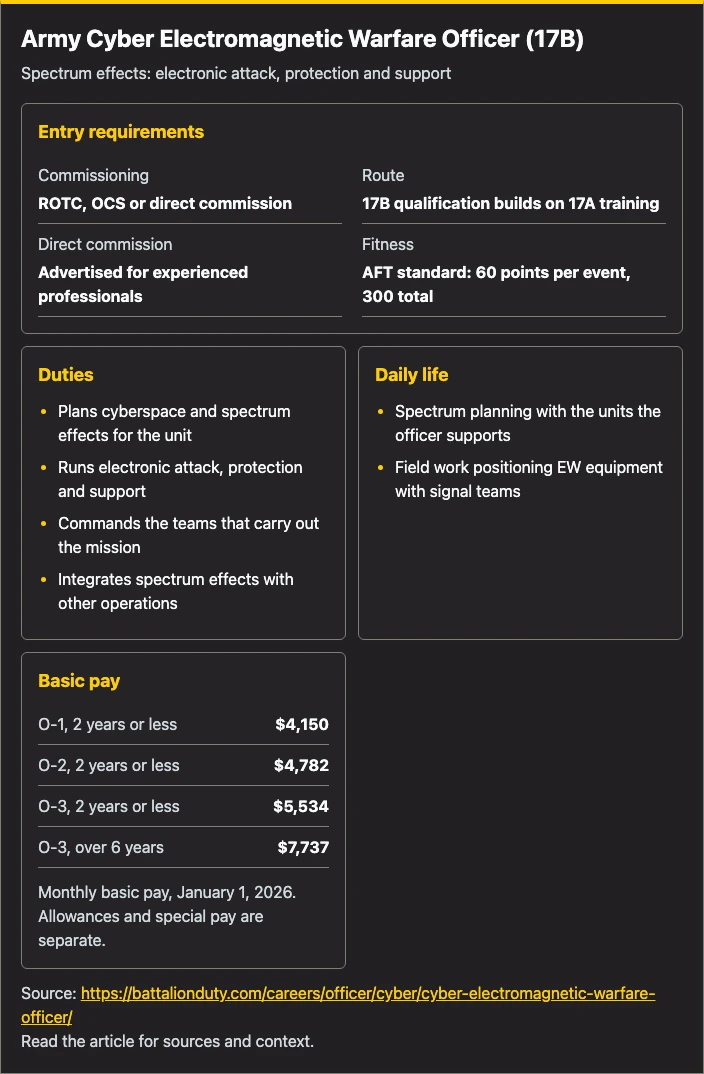
Entry requirements
- Commissioning
- ROTC, OCS or direct commission
- Route
- 17B qualification builds on 17A training
- Direct commission
- Advertised for experienced professionals
- Fitness
- AFT standard: 60 points per event, 300 total
Duties
- Plans cyberspace and spectrum effects for the unit
- Runs electronic attack, protection and support
- Commands the teams that carry out the mission
- Integrates spectrum effects with other operations
Daily life
- Spectrum planning with the units the officer supports
- Field work positioning EW equipment with signal teams
Basic pay
- O-1, 2 years or less
- $4,150
- O-2, 2 years or less
- $4,782
- O-3, 2 years or less
- $5,534
- O-3, over 6 years
- $7,737
Monthly basic pay, January 1, 2026. Allowances and special pay are separate.
Source: https://battalionduty.com/careers/officer/cyber/cyber-electromagnetic-warfare-officer/
Read the article for sources and context.
On this page
Job Role and Responsibilities
Army Cyber Electromagnetic Warfare Officers (AOC 17B, CEWO) lead and plan cyberspace, electronic warfare and spectrum effects across Army and joint units. Their work covers electronic attack, protection and support, including command of the teams that carry out those missions.
Command and Leadership Scope
A junior CEWO turns a commander’s intent into a spectrum plan, identifying which emitters to disrupt, which frequencies to protect, and where and when to position equipment. Lieutenants and captains lead small signal and EW teams while working directly with the units they support.
Company command generally comes later in cyber or EW units, with captains responsible for their unit’s training, readiness and technical proficiency. As a major, the work shifts toward battalion and brigade planning, where CEWOs explain what spectrum effects can and cannot accomplish in a given phase.
A section may contain five to fifteen soldiers and a company sixty to a hundred, but responsibility expands mainly through the number of units that depend on the CEWO’s plan rather than through headcount alone.
AOCs, Skill Identifiers, and Designations
| Code | Designation | Relationship to 17B |
|---|---|---|
| 17A | Cyber Warfare Officer | Prerequisite. Required before the 17B course. |
| 17B | Cyber Electromagnetic Warfare Officer | This field. Also written CEWO. |
| 17D | Cyber Capability Development Officer | Separate AOC for software and tool building. |
The Cyber branch has three fields: 17A provides the operational foundation, 17B adds EW, and 17D focuses on building cyber tools rather than running missions. Offensive and defensive cyber are mission areas within 17A, not additional AOC codes.
Mission Contribution
Modern units depend on the spectrum for command and control, position data, air defense, drone links and supply tracking. CEWOs aim to deny those capabilities to an enemy while preserving them for friendly forces.
Much of the CEWO’s contribution comes from planning and deconfliction. Jamming can affect other systems using the same frequency band, so officers must account for friendly emitters, neighboring units and joint-force activity when planning an attack. Protecting friendly communications is part of producing a useful effect against the enemy.
Technology, Equipment, and Systems
CEWOs use the Army’s spectrum warfare systems and the tools that connect them to an operational plan. These include gear to watch the spectrum and locate signal sources, plus jamming and deception systems mounted on vehicles or carried in transportable sets. Planning software helps officers choose effects and check for conflicts.
The Command Post Computing Environment (CPCE) supports the shared operational picture and mission planning. Officers coordinate cyber and spectrum effects within that broader plan, using the systems available to their unit. Much of this work takes place on classified networks and requires a Top Secret clearance with SCI access.
Salary and Benefits
Officer Base Pay (2026)
All figures are 2026 DFAS basic pay rates, effective January 1, 2026. Amounts are monthly basic pay for the step shown.
| Rank | Title | Years of Service | Monthly Base Pay |
|---|---|---|---|
| O-1 | Second Lieutenant (2LT) | Less than 2 | $4,150.20 |
| O-2 | First Lieutenant (1LT) | Over 2 | $5,446.20 |
| O-3 | Captain (CPT) | Over 4 | $7,382.70 |
| O-3 | Captain (CPT) | Over 8 | $8,125.50 |
| O-4 | Major (MAJ) | Over 10 | $9,420.00 |
Officers commonly begin commissioned service as an O-1 and progress to O-2 after 18 months and O-3 around four years under the standard timeline. Entry grade and individual progression can differ, including for direct commissions. Basic pay is supplemented by applicable housing and food allowances.
Special Pays and Bonuses
Cyber officers have access to the special pays available to other officers, and the branch has used retention incentives to address mid-career staffing shortages. Some assignments may also qualify for hazardous duty pay. Because bonus programs change with each fiscal year’s staffing needs, verify quoted amounts against current policy before relying on them.
Additional Benefits
Active-duty officers receive TRICARE coverage and applicable housing and food allowances. Eligible members of the Blended Retirement System receive a defined retirement benefit and government contributions to the Thrift Savings Plan, subject to service and contribution rules. Family healthcare costs depend on the selected plan and care received; tuition assistance also has current eligibility and payment limits.
Branch-funded training can be valuable beyond the allowances because officers develop technical skills that would be costly to acquire independently.
Work-Life Balance
In garrison, CEWOs usually follow relatively predictable schedules of planning, briefings, training management and system maintenance. Exercises and deployments can replace that routine with long operations-center shifts and weeks in the field.
Assignments range from mostly indoor technical roles to rotational work in tactical operations centers. Leave accrues at 2.5 days per month, with a 60-day carryover cap.
Qualifications and Eligibility
Commissioning Sources
| Source | Typical requirement | Notes for this branch |
|---|---|---|
| ROTC | Bachelor’s degree, national-order-of-merit branching | Request Cyber; accessions are competitive |
| USMA (West Point) | Cadet branch selection process | Same branching competition |
| OCS | Bachelor’s degree, GT score of 110 on the ASVAB | Branch availability varies by class |
| Direct commission | Required technical degree and experience | Experienced applicants may seek advertised 17B positions |
Cyber accessions are competitive. A strong academic record in a technical field can help, but the branch also considers officers from other backgrounds who demonstrate technical aptitude and leadership.
Education Requirements
No single major is required, although computer science, electrical engineering, mathematics and information systems can provide a useful foundation. Officers from other academic backgrounds also enter the branch, but they need to prepare for demanding technical coursework rather than assume training will make up every gap in their knowledge.
Test Requirements
Officer accession requirements differ by route: OCS candidates need an ASVAB General Technical score of at least 110, while other commissioning routes have their own academic and selection requirements. Cyber assignments also require the appropriate Top Secret clearance and SCI eligibility, making security vetting an important part of the process.
Upon Commissioning
New cyber lieutenants train at Fort Gordon, Georgia. Most attend CyBOLC for AOC 17A, while selected officers attend the separate 17D CCDO course. The CEWO route builds on the 17A foundation: officers complete 17A CyBOLC before attending the 17B CEWO Qualification Course.
Direct-commission applicants follow the program’s current training instructions and their issued orders. That sequence can differ from the junior-officer pipeline described here.
Work Environment
Setting and Schedule
Much of the work takes place in secure offices, operations centers and planning rooms. Classified tasks may require a sensitive compartmented information facility, while field assignments bring a different setting. In garrison the week looks like an office week, with physical training built in.
In the field, a CEWO may work rotating shifts in a tactical operations center housed in a vehicle or hardened shelter, alongside staff operating around the clock. The contrast with garrison work is a defining feature of the role.
Staff vs. Command Roles
The career alternates between command positions in cyber and EW units, where officers oversee training and readiness, and staff positions focused on planning. Both require knowing what spectrum effects can contribute to a mission and recognizing when they cannot contribute.
Technical expertise and staff experience both matter for promotion: officers with only technical assignments may struggle on staff, while those without technical depth may struggle in command.
Officer-NCO Dynamics
EW depends on experienced NCOs whose knowledge of the equipment often exceeds an officer’s. A new lieutenant needs to draw on that expertise while learning the job and taking responsibility for the team. Good CEWOs respect the technical authority of senior NCOs and work with them to plan and deliver effects.
Retention and Job Satisfaction
Officers who remain in the field often value its intellectual demands and clear contribution to missions. Those who leave may cite slower promotion than in combat arms, extensive staff work or higher private-sector pay for similar skills. Both sets of considerations deserve weight.
Training and Skill Development
Pre-Commissioning
There is no pre-commissioning EW course, but prospective officers can build a foundation in physics, radio, networking, signals and technical problem-solving. An electrical engineering or computer science degree is not required, although it can shorten the learning curve.
BOLC Pipeline
The CEWO pipeline builds electronic warfare training on a cyber foundation. At Fort Gordon, 17A CyBOLC covers cyberspace operations, network exploitation and planning in a joint setting; the subsequent CEWO course adds the spectrum skills required for 17B.
CEWO Qualification Course
The 17B CEWO Qualification Course covers attack, protection and support in the spectrum, together with the planning needed to coordinate those effects with maneuver operations. The challenge is applying the technical work within a larger operational plan.
Some officers attend the course as lieutenants immediately after CyBOLC, while others enter later. Captains assigned to a 17B position must complete the course before reporting.
Professional Military Education (PME)
Captains attend the Cyber Captains Career Course, which develops company-level planning and leadership skills and is required for command. Majors attend the ten-month Intermediate Level Education (ILE) program at Fort Leavenworth for joint planning, a requirement for promotion to O-5. A small number of senior officers later attend Senior Service College.
Additional Schools and Education
Officers can compete for graduate study in technical fields and for follow-on training in languages, joint spectrum operations and joint planning. These opportunities are selective and generally build on strong performance in an initial operational assignment.
Career Progression and Advancement
Career Timeline
The first four years focus on learning the equipment, the planning process and the supported unit’s operations. Promotion to captain and completion of the Captains Career Course prepare an officer for company command, commonly around years five to seven, depending on selection and available assignments.
At field grade, majors and lieutenant colonels broaden their experience through operational assignments, joint staffs and school positions such as instructor or writer. Performance in these roles and selection for further professional education help shape an officer’s prospects for advancement.
Key Developmental Positions
Qualifying 17-series assignments can provide developmental credit across the cyber branch. That flexibility allows an officer to broaden experience in another cyber field, subject to the current career-development rules for the assignment and grade.
Functional Areas and Broadening
Mid-career officers can broaden through functional areas or assignments involving joint spectrum staffs, intelligence, acquisition and national agencies. Experience in a joint spectrum office can provide a perspective difficult to gain within a single Army unit.
Because spectrum warfare involves multiple services, officers benefit from understanding how those services plan spectrum use rather than relying solely on Army procedures.
Building a Competitive Record
An officer can build a stronger professional record through effective field work, relevant technical courses and clear briefings to senior leaders. Those habits demonstrate useful performance; they do not guarantee a particular promotion timeline.
Physical Demands and Medical Evaluations
Fitness and field requirements
Cyber officers must meet the Army Fitness Test standard applicable to their specialty, age and sex. Fitness remains a condition of service rather than a separate Cyber entrance test, and officers are expected to lead physical training as well as meet the required standard.
Officers still face long shifts in operations centers, occasional field duty with the supported unit and the need to carry a combat load when deployed in a tactical setting.
Medical and clearance standards
Applicants must meet Army medical accession standards, and clearance eligibility is assessed through a separate security process. Because the work involves classified systems and often SCI access, officers should confirm both the medical and security requirements for their route rather than treat one as a substitute for the other.
Deployment and Duty Stations
Deployments and duty locations
Cyber and EW units support both maneuver formations and theater-level missions. A CEWO may deploy with a brigade combat team, a cyber battalion or a joint task force, with rotations governed by the Army’s wider deployment cycle and the unit’s mission.
Tours vary from standard overseas rotations to shorter assignments supporting a theater command. In either setting, the officer plans and integrates effects rather than operating the equipment personally.
Fort Gordon, Georgia, houses the Cyber Center of Excellence and its schoolhouses. Other assignments can include positions at Fort Meade, Maryland, as well as roles in signal and intelligence units or joint commands. Available positions depend on the mission and the officer’s qualifications.
Risk, Safety, and Legal Considerations
Operational hazards and safeguards
Physical hazards are generally lower than in combat arms, but technical errors carry significant operational and professional risks. A faulty spectrum check can disrupt friendly communications, while a targeting mistake may affect forces beyond the unit.
Spectrum effects require formal checks before use to prevent friendly interference and keep operations within approved geographic areas and time windows. These checks are operational safeguards, not merely administrative steps.
Legal and command responsibility
EW operations must comply with targeting rules, the law of armed conflict, spectrum rules and national policy. A CEWO must understand those limits and raise concerns through the proper channels when a proposed effect may be unlawful. An officer must refuse to carry out an unlawful order, even under pressure from a supported unit.
Impact on Family and Personal Life
Schedules and family planning
Garrison assignments can offer a more predictable routine outside exercises, but the schedule depends on the unit and mission. Deployments and other tours still disrupt family plans, and classified work can limit what an officer may discuss at home.
Dual-military couples face an assignment problem shaped by the branch’s concentration at a relatively small number of bases. That can help or hinder co-location, depending on the other member’s field. Family programs, child care and spouse employment support still depend on the installation and household’s circumstances.
Reserve and National Guard
Component availability and commissioning
Cyber officers serve in the active component, Army Reserve and Army National Guard, with Reserve and Guard formations contributing cyber and EW units. Both reserve components have also used direct commissioning to recruit technical talent.
Reserve-component commissioning options include ROTC with a reserve contract, Guard state OCS programs and approved direct-commissioning routes. Active-duty officers may also seek a reserve-component position after completing their service obligation, subject to transfer eligibility and acceptance by the gaining organization.
Drill obligations, compensation and benefits
The standard reserve schedule is one weekend each month and two weeks each year, although cyber units may add longer technical training and annual exercises of a week or more.
A standard battle assembly weekend normally includes four drill periods, each paying one-thirtieth of the monthly basic pay for the officer’s rank and years of service. An O-3 with six years therefore receives four-thirtieths of that monthly rate for the weekend. Annual training is paid separately under the applicable orders and allowances.
TRICARE Reserve Select has a monthly premium, unlike active-duty TRICARE Prime. Education benefits also differ: tuition assistance is available, some states waive tuition for Guard members, and GI Bill eligibility depends on periods of active service. Reserve retirement uses a points-based system rather than the active-duty 20-year service threshold.
Leadership, deployments and civilian integration
Reserve and Guard cyber units offer company and battalion command positions, and their officers can attend the same professional military education courses as active-duty officers. Promotion opportunities depend on the component, available positions and each year’s selection process; officers should not assume a fixed timeline.
Reserve and Guard cyber units can be mobilized for operational missions, combatant-command support or domestic response. The location and length depend on the orders; some work can take place at a stateside facility.
The technical skills can complement a civilian career in security, networks or defense contracting. Officers still need to plan for training and mobilization commitments alongside their civilian responsibilities, rather than assuming the two schedules will always fit easily.
| Factor | Active Duty | Army Reserve | Army National Guard |
|---|---|---|---|
| Commitment | Full time | One weekend a month, two weeks a year, plus mobilizations | Same, with possible state duty |
| Monthly pay (O-3) | $7,382.70 basic pay plus allowances | Drill pay for periods attended | Drill pay for periods attended |
| Healthcare | TRICARE Prime, no premium | TRICARE Reserve Select, premium | TRICARE Reserve Select, premium |
| Education | Tuition aid, GI Bill | Tuition aid, GI Bill by service period | Federal and state tuition programs |
| Deployment tempo | Rotations and field tours | Mobilizations, typically 6 to 12 months | Mobilizations plus state emergencies |
| Command opportunities | Cyber and EW units | Reserve cyber units | Guard cyber units |
| Retirement | Eligible regular retirement; BRS uses its own formula | Points-based; generally payable at 60 | Points-based; age may be reduced by qualifying service |
Post-Service Opportunities
Civilian careers and transitions
Former CEWOs can apply their skills to signals intelligence, EW programs, spectrum management and cybersecurity roles with defense contractors, federal agencies or private firms. Planning experience can distinguish an applicant who knows how to fit technical effects into a larger mission and explain the results to senior leaders. Each employer will assess the officer’s actual experience against its requirements.
The Transition Assistance Program, Hiring Our Heroes and Army credentialing programs can help officers prepare for the move into civilian work. Available services and eligibility differ by program.
| Occupation | Median annual wage (May 2025) | Job outlook, 2025 to 2035 |
|---|---|---|
| Electronics engineers, except computer | $130,220 | 4 percent, about as fast as average |
| Electrical engineers | $120,630 | 10 percent, much faster than average |
| Electrical and electronic engineering technologists and technicians | $78,190 | 2 percent, slower than average |
| Software developers | $135,980 | 10 percent, much faster than average |
Figures are from the Bureau of Labor Statistics Occupational Outlook Handbook. Median wages describe the occupation as a whole, not what a former officer earns on entry.
Graduate education and credentials
The GI Bill can support graduate study, and branch technical training may earn credit toward a related master’s degree. Officers may add industry certifications in cyber or networking, sometimes funded by defense employers. A clearance can also support civilian opportunities, particularly in jobs that require cleared personnel.
Is This a Good Job for You? The Right (and Wrong) Fit
Candidate fit and challenges
This field suits officers who enjoy both the detail of how a system radiates and the judgment involved in choosing an effect worth producing. They need to be able to tell a senior officer that a plan will not work and explain why. Curiosity about physics and electronics matters more than raw math speed.
Maintaining technical depth requires continued study as equipment and threats change. Heavy staff work may be largely invisible outside the operations center, and promotion can be slower than in combat arms. In a small branch, timing can matter alongside performance.
Career and lifestyle alignment
This field may suit an officer who wants technical work and military leadership, whether for one service obligation or a longer career. It offers a different kind of command experience from leading maneuver units, and a predictable home routine is not guaranteed. Civilian employers may value the experience, but a clearance or military assignment alone does not promise a job.
Compare the options before committing. 17A Cyber Warfare Officer provides the broader operational foundation, while 17D Cyber Capability Development Officer focuses on developing capabilities for officers who prefer building systems to running operations.
More Information
Ask an Army recruiter or your ROTC program about current Cyber openings, selection requirements and the training sequence for your commissioning route. Army Human Resources Command, GoArmy and the Cyber Center of Excellence publish official career and course guidance. Resolve questions with your accession office and check the current instructions before committing.
- OCS candidates: prepare to meet the GT 110 requirement with our ASVAB for OCS study guide
Explore the rest of the Cyber branch, compare all three paths in Army cyber officer specialties: 17A vs 17B vs 17D, or read the 17D Cyber Capability Development Officer profile.