17A Cyber Warfare Officer
The Army stood up the Cyber branch in 2014 because it needed officers who could fight in a domain most soldiers never see. Today, Cyber is one of the most technically demanding branches in the Army and one of the hardest to get into. The branch selects its own officers through a separate accessions process outside the normal branching system. That means a ROTC cadet at the top of the Order of Merit List doesn’t automatically get Cyber. The branch picks who it wants.
If you’re considering the 17A Cyber Warfare Officer AOC, this guide covers what the job actually involves, how to get selected, what the training pipeline looks like, and where an Army Cyber career can take you after your service obligation ends.
OCS candidates need a GT score of 110 on the ASVAB — our ASVAB for OCS guide covers exactly how to hit that number.
Job Role and Responsibilities
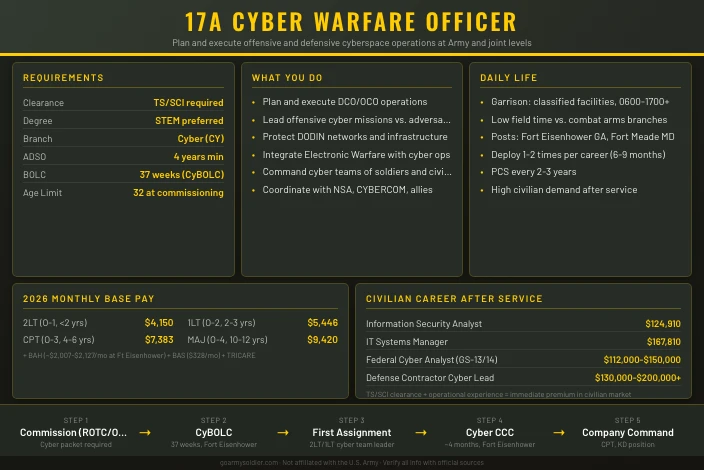
The 17A Cyber Warfare Officer plans and executes offensive and defensive cyberspace operations at Army and joint levels. These officers lead teams that conduct Defensive Cyberspace Operations (DCO) to protect friendly networks and Offensive Cyberspace Operations (OCO) to degrade enemy systems. Cyber officers also support Department of Defense Information Network (DODIN) operations and integrate Electronic Warfare (EW) effects into combined arms plans.
Command and Leadership Scope
At the company grade level, a Cyber officer leads a team of soldiers and Department of Army civilians focused on specific cyberspace missions, whether that’s network defense, offensive operations, or intelligence-driven targeting. As a captain, you’ll likely command a cyber company or fill a critical staff position at a cyber battalion or brigade. As a major, you move into battalion-level staff roles managing operational planning and integrating cyber effects across multiple subordinate teams.
The span of control grows as you advance. A lieutenant typically oversees a small technical team of 8 to 15 personnel. A company commander may manage 60 to 100 soldiers across multiple functional cells. The work shifts from hands-on technical execution at the lieutenant level toward mission planning, integration, and coordination with joint and interagency partners as you gain rank.
AOCs, Skill Identifiers, and Functional Areas
The Cyber branch uses multiple Area of Concentration (AOC) codes to designate specializations. All officers begin as 17A before branching into more specialized paths.
| Code | Designation | Focus |
|---|---|---|
| 17A | Cyber Warfare Officer | Integrated DCO/OCO operations |
| 17B | Cyber and Electronic Warfare Officer | Combined cyberspace and EW operations |
| 17D | Cyber Capability Development Officer | Software, tools, and cyber capabilities development |
Officers typically receive 17A qualification through CyBOLC. A subset are later selected to attend the 17B CEWO Qualification Course after completing 17A training. The 17D AOC focuses on developing cyber tools and capabilities rather than executing operations.
Mission Contribution
Cyber officers extend the Army’s reach into an invisible battlefield. An enemy force that loses command-and-control communications, logistics software, or air defense networks before a ground assault is already at a disadvantage. Cyber officers create those effects. On the defensive side, the same officers protect Army networks from adversary intrusion, ensure communications remain secure, and detect threats before they cause operational damage.
The branch operates across JIIM (Joint, Interagency, Intergovernmental, and Multinational) environments, meaning Cyber officers frequently work alongside NSA, CYBERCOM, CIA, and allied partner units.
Technology, Equipment, and Systems
Cyber officers work with classified platforms and tools for network exploitation, vulnerability analysis, and effects delivery. They use Army command-and-control systems including CPCE (Cyber and Electromagnetic Activities Planning and Management Tool) and coordinate through joint command systems such as GCCS-A. On the Electronic Warfare side, 17B-qualified officers operate EW systems designed to jam, spoof, or disrupt enemy communications and radar.
Salary and Benefits
Base Pay
All officer pay comes from DFAS. The table below shows 2026 monthly base pay for Cyber officers at typical career stages.
| Rank | Grade | Typical Years of Service | Monthly Base Pay |
|---|---|---|---|
| Second Lieutenant (2LT) | O-1 | Less than 2 | $4,150 |
| First Lieutenant (1LT) | O-2 | 2 to 3 | $5,446 |
| Captain (CPT) | O-3 | 4 to 6 | $7,383 |
| Captain (CPT) | O-3 | 8 to 10 | $8,126 |
| Major (MAJ) | O-4 | 10 to 12 | $9,420 |
| Lieutenant Colonel (LTC) | O-5 | 16 to 18 | $11,391 |
Base pay is only part of the compensation picture. Officers also receive Basic Allowance for Subsistence (BAS) of $328.48 per month and Basic Allowance for Housing (BAH) based on duty location and dependent status. BAH varies widely. An O-3 at Fort Eisenhower draws roughly $2,007 per month without dependents or $2,127 per month with dependents based on 2026 rates. Officers at Fort Meade, Maryland, in the Washington D.C. area draw significantly higher BAH due to local housing costs.
Special Pays and Bonuses
The Army has historically offered retention bonuses to cyber officers given the competition for talent from the private sector. Specific bonus amounts change annually based on manning priorities, so confirm current offers with your branch manager at HRC. Officers at the 8 to 12-year mark may also be eligible for Continuation Pay under the Blended Retirement System, which can range from 2.5x to 13x monthly basic pay in exchange for a 3-year service extension.
Additional Benefits
Active duty officers receive TRICARE Prime with zero enrollment fees, zero deductibles, and zero copays for both the officer and all covered family members. The annual family catastrophic cap is $1,000 for out-of-pocket costs.
The retirement system for officers commissioned after January 1, 2018 is the Blended Retirement System (BRS). At 20 years of service, BRS pays 40% of the average of your highest 36 months of basic pay as a lifetime pension. The government also contributes up to 5% of basic pay into your Thrift Savings Plan (TSP) when you contribute at least 5% yourself. Full TSP matching begins at the start of your third year of service.
Officers earn 30 days of paid leave per year, accruing at 2.5 days per month. Up to 60 days can carry over between fiscal years.
Work-Life Balance
In garrison, a Cyber officer’s schedule resembles a demanding but structured government job. Physical training runs most mornings. The workday typically ends in the early evening unless operational tempo spikes. The challenge is that cyber threats don’t follow a duty schedule. Incidents, exercises, and on-call responsibilities can extend hours unpredictably.
Field time for Cyber officers is less common than for combat arms counterparts, but large exercises and joint events require extended on-site presence. Deployed environments are often staff-heavy rather than field-austere, with Cyber teams frequently operating from secure facilities.
Qualifications and Eligibility
Commissioning Sources
Three primary paths lead to a commission: ROTC, OCS, and Direct Commission. West Point (USMA) graduates can also branch Cyber through a separate packet process. The branch does not fill slots through the standard OML branching draft. Every candidate, regardless of commissioning source, goes through the Cyber branch’s own selection process.
| Commissioning Source | Degree Requirement | GPA Guidance | Age Limit | Notes |
|---|---|---|---|---|
| ROTC | Bachelor’s by commissioning | Competitive; STEM preferred | 30 at commissioning (waivers available) | Submit separate Cyber branch packet |
| OCS | Bachelor’s required | No minimum; STEM degree strengthens packet | 32 at commissioning (waivers available) | Cyber reviews packets independently of OML |
| USMA (West Point) | Bachelor’s awarded at graduation | Academic performance matters | N/A | Branch Cyber through separate selection process |
| Direct Commission | Bachelor’s required; relevant cyber experience weighted heavily | No stated minimum | Commission before age 55 (waivers up to 54) | Available for experienced civilian cyber professionals |
The branch looks for STEM degrees in computer science, computer engineering, electrical engineering, cybersecurity, information technology, or related fields. Non-STEM degrees are not automatic disqualifiers, but documented cyber work experience carries significant weight in packet review.
Test Requirements
OCS candidates must meet minimum ASVAB requirements to attend OCS. The General Technical (GT) score is a key OCS qualifier, with a minimum of 110 GT required. Competitive OCS candidates typically score higher. The Cyber branch does not use ASVAB line scores for selection; the branch evaluates technical aptitude through degree, experience, and interview process. SIFT is not required for Cyber officers.
Branch Selection and Assignment
Cyber uses a separate accessions process for all commissioning sources. ROTC cadets submit a Cyber branch packet that typically includes transcripts, a resume, letters of recommendation, and a writing sample. The Cyber branch proponent at Fort Eisenhower reviews all packets and selects candidates based on technical background, leadership potential, and security clearance eligibility.
The branch is small and selective. Historically, fewer than 100 officer slots open per year across all commissioning sources combined. Cadets with strong STEM GPAs, relevant internships or certifications (CompTIA Security+, CEH, prior IT work), and high OML rankings stand the best chance.
Upon Commissioning
New officers commission at O-1 (Second Lieutenant). Direct Commission candidates may enter at O-1 through O-3 depending on years of relevant professional experience. The standard Active Duty Service Obligation (ADSO) is 4 years for ROTC and OCS graduates. Officers who receive funded graduate education or other incentives incur additional obligations on top of the base ADSO.
OCS candidates can find a focused GT study plan in our ASVAB for OCS guide.
Work Environment
Setting and Schedule
Most Cyber officers work in secured facilities. At Fort Eisenhower, that means classified computer labs and command centers. At Fort Meade and NSA co-located facilities, work environments are purpose-built for intelligence and cyber operations. This branch spends far less time in the field than infantry or armor counterparts. Physical training still happens outdoors, but the daily operational environment is primarily office-based.
Garrison schedules run roughly 0600 to 1700 on standard training days. Operations can push hours later, especially during joint exercises, real-world incidents, or command-directed high-priority missions.
Leadership and Chain of Command
At the platoon leader and team leader stage, a 2LT or 1LT works closely with senior NCOs who carry deep technical expertise. The officer-NCO dynamic in Cyber is particularly important because enlisted Cyber soldiers (17C Cyber Operations Specialists) often have more hands-on technical experience than newly commissioned officers. Smart lieutenants lean on their NCO’s technical knowledge while developing their own skills and owning the planning and leadership responsibilities the NCO cannot fill.
As a captain, you’ll report to a battalion commander while managing your own subordinate team leads and NCOs. At the major level, you occupy staff positions that bridge operational planning with technical execution.
Staff vs. Command Roles
Cyber captains spend roughly 2 to 3 years in a company command or key company-grade developmental role before transitioning to a major-level staff position. Majors typically serve as battalion operations officers (S3), intelligence officers, or joint staff positions at CYBERCOM. Between these key developmental assignments, officers fill broadening roles: ROTC instructor duty, recruiting, fellowships, or inter-agency assignments at NSA, DHS/CISA, or the intelligence community.
Job Satisfaction and Retention
Retention at the O-3 to O-4 transition is a known challenge for the Cyber branch. The private sector actively recruits Army Cyber officers, offering significantly higher salaries than military compensation. The Army counters this with bonuses, graduate education programs, and competitive assignments. Officers who stay through the O-4 selection point generally report high satisfaction with mission complexity and the quality of the work. Those who leave after their ADSO typically transition to cleared defense contractors, federal agencies, or private sector cybersecurity firms where their clearance and operational background are immediately valuable.
Training and Skill Development
Pre-Commissioning Training
ROTC cadets complete a 4-year program that combines leadership coursework and summer training, culminating in the Cadet Leader Course at Fort Knox. OCS is a 12-week course at Fort Moore, Georgia, building basic officer leadership skills before branching. West Point provides a 4-year commissioning program. None of these programs deliver Cyber-specific technical training. Branch-specific skills come at BOLC.
Basic Officer Leader Course (BOLC)
The Cyber BOLC (CyBOLC) at Fort Eisenhower, Georgia is the longest officer BOLC in the Army at approximately 37 weeks. That length reflects the volume of technical training required before a Cyber officer is operationally ready.
| Phase | Location | Length | Focus |
|---|---|---|---|
| Phase I: Basic Officer Foundation | Fort Eisenhower, GA | ~4 weeks | Army leader skills, branch orientation |
| Phase II: Technical Qualification | Fort Eisenhower, GA | ~26 weeks | DCO/OCO operations, network exploitation, cyberspace planning |
| Phase III: Mission Application | Fort Eisenhower, GA | ~7 weeks | Integrated exercises, joint operations, capstone scenarios |
Officers selected for the 17B track attend the CEWO (Cyber and Electronic Warfare Officer) Qualification Course after completing 17A CyBOLC. The 17D track leads to a separate CCDO (Cyber Capability Development Officer) BOLC focused on software and capability development.
Professional Military Education (PME)
After BOLC and a first assignment, captains attend the Cyber Captains Career Course (Cyber CCC) at Fort Eisenhower. The CCC takes roughly 4 months and builds planning, operational, and leadership skills at the company level. It’s a prerequisite for company command and major-level promotion.
Eligible majors attend Intermediate Level Education (ILE) at the Command and General Staff College (CGSC) at Fort Leavenworth, Kansas. ILE is a 10-month program focused on operational planning, joint operations, and senior staff skills. It’s required for promotion to O-5. Top-performing O-5s and O-6s may be selected for Senior Service College (War College), which prepares officers for general officer-level responsibilities.
Additional Schools and Training
Cyber officers who want to strengthen their operational profile pursue additional schools. Common choices include:
- Airborne School (Fort Moore, GA): 3 weeks, earns the Airborne badge
- Ranger School (Fort Moore, GA): 62 days, earns the Ranger tab and signals sustained leadership performance
- NSA Certifications and Courses: Available through inter-agency assignments
- Fully funded graduate education: The Advanced Civil Schooling (ACS) program sends officers to accredited universities for master’s degrees in computer science, information systems, or cybersecurity while on active duty
The Cyber branch values technical credentials. Officers who arrive with or earn CompTIA Security+, Certified Ethical Hacker (CEH), CISSP, or similar certifications strengthen their records and their operational effectiveness.
Before OCS, you need a qualifying GT score — see our ASVAB for OCS guide.
Career Progression and Advancement
Officer Career Timeline
| Rank | Grade | Typical Time-in-Grade | Key Positions |
|---|---|---|---|
| Second Lieutenant (2LT) | O-1 | 18 months | Platoon leader or team leader in cyber unit |
| First Lieutenant (1LT) | O-2 | 18-24 months | Executive Officer (XO) or senior team leader |
| Captain (CPT) | O-3 | 4-6 years | Company commander, battalion S3/S6, joint staff |
| Major (MAJ) | O-4 | 4-5 years | Battalion XO, brigade S3, joint/CYBERCOM staff |
| Lieutenant Colonel (LTC) | O-5 | 3-4 years | Battalion commander, joint staff, strategic plans |
| Colonel (COL) | O-6 | 3+ years | Brigade commander, senior staff, CyCOM leadership |
The Key Developmental (KD) positions that matter most for promotion are Platoon/Team Leader (O-1/O-2), Company Command (O-3), and Battalion S3 or XO (O-4). Officers who complete these KD positions on time and with strong Officer Evaluation Reports (OERs) are competitive for promotion.
Promotion System
Promotions from O-1 to O-3 are essentially automatic with time in grade. The O-4 (Major) board is where competition begins. Army-wide, promotion rates for O-4 have historically run around 75 to 80 percent for fully qualified below-the-zone and in-zone candidates, though rates shift year to year. The O-5 board is more selective. Board members evaluate the whole officer record: OERs, KD completion, PME on time, advanced degrees, and joint experience.
Cyber officers who complete their KD positions, stay current on PME, and accumulate joint and interagency experience build the most competitive promotion files.
Branching Out and Functional Areas
After company command, officers may be offered a Functional Area (FA) if their profile matches the Army’s needs. Cyber officers sometimes transition to FA 26 (Information Network Engineering), FA 40 (Space Operations), or intelligence-related FAs. Branch transfer to the Military Intelligence (MI) branch is also possible, particularly for officers with overlapping intelligence and cyber backgrounds.
Broadening assignments available to Cyber officers include ROTC instructor duty, Army fellowships at RAND, DARPA, or congressional staffs, and operational support assignments at NSA, DHS/CISA, or CYBERCOM. These assignments don’t count as KD positions, but they significantly expand a competitive officer record.
Physical Demands and Medical Evaluations
Cyber officers meet the same Army Fitness Test (AFT) standards as every other soldier. The AFT replaced the ACFT on June 1, 2025.
AFT Events and Minimum Standards
| Event | Abbreviation | Minimum Score |
|---|---|---|
| 3 Repetition Maximum Deadlift | MDL | 60 points |
| Hand Release Push-Up - Arm Extension | HRP | 60 points |
| Sprint-Drag-Carry | SDC | 60 points |
| Plank | PLK | 60 points |
| Two-Mile Run | 2MR | 60 points |
| Total Minimum | 300 points |
Scores are sex- and age-normed. The minimum passing total is 300 points with no event below 60. Cyber is not a designated combat specialty, so the 350-point combat standard does not apply. Maximum score is 500 points across all five events.
Branch-Specific Medical Considerations
The Cyber branch does not require aviation flight physicals, dive physicals, or OPAT screening. The primary medical concern unique to this branch is the security clearance process. Officers must pass a full background investigation for a Top Secret/Sensitive Compartmented Information (TS/SCI) clearance. Medical conditions involving certain prescribed medications, substance use history, or mental health treatment are evaluated during the investigation but are not automatic disqualifiers. Polygraph examinations are standard for TS/SCI access.
Deployment and Duty Stations
Deployment Details
Cyber officers deploy less frequently than combat arms counterparts, but deployments happen. The most common deployment types are rotational tours supporting CYBERCOM or theater commands, where Cyber teams provide network defense and offensive support to combatant command operations. Tours typically run 6 to 9 months. Some Cyber officers support Special Operations Forces (SOF) on task-organized deployments of varying length.
The deployment tempo is lower than infantry or aviation, but Cyber officers should expect at least one to two combat theater rotations over a standard 10 to 12-year career.
Duty Station Options
The Cyber branch is concentrated at a small number of installations.
- Fort Eisenhower, Georgia (formerly Fort Gordon): Home of Army Cyber Command and the Cyber Center of Excellence. The largest single concentration of Cyber officers in the Army.
- Fort Meade, Maryland: Home of NSA and USCYBERCOM. Officers assigned here often work directly alongside NSA civilians and joint service personnel.
- Fort Liberty, North Carolina (formerly Fort Bragg): Supports Special Operations cyber and EW missions.
- OCONUS assignments: Officers may serve at European Command, Indo-Pacific Command, or other theater commands in cyber-related staff positions.
Assignment preferences are submitted through HRC. Officers with strong records have more influence over their next assignment, but branch needs ultimately drive the decision. Cyber officers generally PCS every 2 to 3 years.
Risk, Safety, and Legal Considerations
Job Hazards
The physical risks for Cyber officers are low compared to combat arms. The branch does not routinely operate in close combat environments. The more significant risks are professional and legal. Offensive cyberspace operations operate under Title 10 authorities and are subject to Rules of Engagement, international law, and specific policy approvals at high command levels. Errors in targeting, unauthorized access, or failure to follow authorities can result in serious legal consequences for the officer who executed or approved the operation.
Safety Protocols and Risk Management
Cyber operations follow the Army’s Composite Risk Management (CRM) process adapted for cyberspace. Before executing any operation, officers develop a detailed mission analysis that accounts for collateral effects on neutral or civilian networks, deconfliction with other government agencies, and proper documentation of authorities. Every offensive action requires legal review and command approval through a defined chain of authorization.
Legal and Command Responsibility
A Cyber officer who commands a unit holds full UCMJ authority and command responsibility over assigned soldiers. That means accountability for equal opportunity compliance, command climate surveys, and the professional conduct of subordinates. Relief for cause, triggered by misconduct or poor command climate metrics, effectively ends a military career and can follow an officer into civilian federal employment screenings. Officers in cyber units also carry classification management responsibilities. Mishandling classified information is a criminal offense, not just a policy violation.
Impact on Family and Personal Life
Family Considerations
The Cyber branch concentrates its officers at fewer installations than most branches. That means longer assignments at places like Fort Eisenhower and Fort Meade rather than frequent moves across the country. For families with school-age children, longer tours at stable locations are generally a benefit. The tradeoff is that PCS opportunities to desirable locations outside the primary cyber hubs are less common.
Fort Eisenhower is outside Augusta, Georgia. Fort Meade sits between Baltimore and Washington, D.C. Both installations have Army Community Service (ACS) programs, Family Readiness Groups (FRGs), and on-post childcare. The D.C. area offers extensive spouse employment opportunities in the federal government and defense contracting sector, often with positions that benefit from or require security clearances.
Dual-Military and Family Planning
Dual-military Cyber couples can request co-location through HRC’s Joint Domicile Program, which gives preference to keeping military spouses at the same installation or within a reasonable commuting distance. Given the concentration of Cyber and intelligence billets in the same geographic areas (Augusta, D.C./Fort Meade), co-location is more achievable than in many other branches.
Deployments and extended field exercises create the most stress on family life. The Cyber branch’s lower deployment tempo helps compared to combat arms, but real-world cyber operations and exercises can extend work hours unpredictably during garrison periods.
Reserve and National Guard
Component Availability
The Cyber branch is available in both the Army Reserve and the Army National Guard. Reserve and Guard Cyber units perform many of the same defensive and planning missions as their active component counterparts, though access to the most sensitive offensive capabilities is typically limited to active duty and Title 10 activated personnel.
Commissioning Paths
Reserve and Guard officers can commission through ROTC on a Reserve Component contract, through OCS programs run at the state level for Guard candidates, or through the Direct Commission program for experienced cyber professionals. The same branch packet requirement applies. Cyber does not fill Reserve or Guard slots through standard branching.
Active duty officers who complete their ADSO can transfer to the Army Reserve or National Guard in the Cyber branch. This is a common path for officers who want to maintain their commission and clearance while transitioning to the private sector.
Drill and Training Commitment
The standard commitment is one weekend per month (Battle Assembly) plus two weeks of Annual Training each year. For Cyber officers in Reserve and Guard units, the technical nature of the work often requires additional training days, certification maintenance, and exercises beyond the minimum schedule. Expect roughly 62 paid training days per year as a baseline, with additional requirements depending on unit mission and readiness posture.
Part-Time Pay
Drill pay is calculated at 1/30th of monthly basic pay per drill period. A standard weekend equals four drill periods. A Reserve or Guard O-3 (Captain) with less than 2 years of service earns approximately $737.88 per drill weekend. A Captain with 3+ years earns approximately $902.72 per weekend.
Benefits
| Benefit | Reserve/Guard | Active Duty |
|---|---|---|
| Healthcare | TRICARE Reserve Select: $57.88/mo (member) or $286.66/mo (family) | TRICARE Prime: $0 premium, $0 copay |
| Education | Federal TA ($4,500/yr), MGIB-SR ($493/mo for 36 months), state tuition benefits (Guard) | Federal TA + full Post-9/11 GI Bill after 36 months active service |
| Retirement | Points-based BRS, collection begins at age 60 | BRS pension at 20 years: 40% of high-36 base pay |
| TSP Matching | Same schedule as active duty on drill/AT pay | Same schedule; larger contributions from higher pay |
Component Comparison
| Factor | Active Duty | Army Reserve | Army National Guard |
|---|---|---|---|
| Commitment | Full-time | ~62 days/yr + mobilizations | ~62 days/yr + state activations + mobilizations |
| Monthly Pay (O-3) | $5,534-$8,788 (full base pay) | ~$738-$903 per drill weekend | ~$738-$903 per drill weekend |
| Healthcare | TRICARE Prime ($0) | TRICARE Reserve Select (~$58-$287/mo) | TRICARE Reserve Select (~$58-$287/mo) |
| Education Benefits | Full Post-9/11 GI Bill, Federal TA | Federal TA, MGIB-SR, Post-9/11 (if activated) | Federal TA, MGIB-SR, state waivers, Post-9/11 (if activated) |
| Deployment Tempo | Moderate (1-2 deployments per career) | Varies; mobilization-driven | Varies; governor and federal activation |
| Command Billets | Company and battalion command available | Company and some battalion billets | Company and battalion billets |
| Retirement | 20-year pension + TSP | Points-based, collect at 60 | Points-based, collect at 60 (reduced with qualifying active service) |
Deployment and Mobilization
Reserve and Guard Cyber officers can be mobilized under Title 10 orders for federal missions, including combat deployments, CYBERCOM operational support, and ADOS (Active Duty Operational Support) tours. Mobilization lengths for cyber units typically run 6 to 12 months. National Guard Cyber units can also be activated by their state governor for domestic missions such as election security support and critical infrastructure defense.
Demand for Reserve and Guard Cyber officers has grown steadily since 2014. Mobilization is more frequent in this branch than in many other Reserve and Guard specialties.
Civilian Career Integration
The Cyber branch pairs exceptionally well with civilian careers. An Army Reserve Cyber officer can simultaneously hold a cleared position at NSA, DHS/CISA, a defense contractor, or a private sector cybersecurity firm. The military title, clearance, and operational experience directly strengthen civilian career prospects, and civilian technical experience directly feeds back into military performance. This bidirectional benefit is one of the strongest arguments for Reserve or Guard service specifically in the Cyber branch.
USERRA (38 USC sections 4301-4335) protects Reserve and Guard officers from job loss, demotion, or benefit denial due to military service. Employers must hold positions for up to 5 cumulative years of military leave and offer continued health insurance during deployment.
Post-Service Opportunities
Transition to Civilian Life
A Cyber officer leaving active duty carries three assets that command immediate premium in the civilian market: a TS/SCI clearance, operational cyber experience, and documented leadership at scale. The SFL-TAP (Soldier for Life Transition Assistance Program) helps officers build resumes, practice interviews, and access transition resources starting 12 months before ETS. DoD SkillBridge allows officers to work full-time at a civilian company during their final 6 months of service while still receiving military pay.
Cleared defense contractors, federal agencies, and private sector tech firms all actively recruit transitioning Cyber officers. The NSA, CISA, FBI Cyber Division, and the intelligence community civilian workforce have direct hire authority for many positions, allowing officers to bypass the standard competitive hiring process.
Civilian Career Prospects
| Civilian Job Title | Median Annual Salary | 10-Year Job Outlook |
|---|---|---|
| Information Security Analyst | $124,910 | +29% (much faster than average) |
| Computer and Information Systems Manager | $167,810 | +17% (much faster than average) |
| Penetration Tester / Ethical Hacker | $110,000-$160,000+ | High demand, no national BLS code |
| Federal Cyber Analyst (GS-13/14) | $112,000-$150,000 | Stable; agencies expanding cyber workforce |
| Defense Contractor Cyber Lead | $130,000-$200,000+ | Driven by DoD budget growth |
Salary figures from the Bureau of Labor Statistics (BLS) reflect May 2024 national median data.
Graduate Education and Credentials
Officers who complete the Advanced Civil Schooling (ACS) program leave active duty with a fully funded master’s degree. Those who do not go the ACS route can use the Post-9/11 GI Bill to cover tuition and living expenses for graduate school after service. The GI Bill covers the full in-state tuition rate at public universities and up to $29,920.95 per academic year at private institutions for 36 months of benefits.
Military Cyber training directly maps to several certifications. Officers and NCOs leaving the Cyber branch often already meet the experience requirements for CISSP (Certified Information Systems Security Professional), CEH, and CompTIA Security+ or CySA+. Many also qualify for DoD 8570/8140 baseline certifications that are required for federal cyber positions.
Is This a Good Job for You?
The Right Fit
Cyber Officer is a strong match for someone who wants a technically demanding job that also involves leading people. The best candidates are competitive in both dimensions. A computer science graduate who hates managing people will struggle with command. An excellent leader with no technical aptitude will find CyBOLC and operational environments frustrating.
Strong indicators that Cyber is the right branch for you:
- You have a STEM degree or substantial programming, networking, or security experience
- You want operational responsibility, not just technical execution
- You’re comfortable working in classified environments on sensitive missions
- You can obtain and maintain a TS/SCI clearance
- You’re thinking beyond your initial obligation and see value in the clearance and experience for a long-term career
Potential Challenges
The branch’s technical depth means the learning curve at CyBOLC is steep, especially for officers without prior IT backgrounds. The 37-week BOLC is the longest in the Army for a reason. Officers who underestimate the technical requirements often find themselves in the lower half of their cohort, which affects first assignment preferences.
The private sector pull is real. If your primary goal is maximizing income, the civilian cyber market pays better than military compensation at every comparable experience level. Officers who stay usually do so because they value the mission, the clearance pipeline, the leadership experience, or a combination of all three.
Career and Lifestyle Alignment
For a one-and-done officer planning to serve the minimum obligation and transition, Cyber offers an exceptional return. Four to five years of service yields a TS/SCI clearance, documented operational leadership, and a technical credential set that commands high salaries in the cleared defense and private sector markets.
For officers planning a full 20-year career, Cyber is one of the Army’s fastest-growing branches with increasing priority at the department level. The missions are consequential, the assignments are intellectually demanding, and the branch is small enough that individual performance is visible in ways that get harder to achieve in larger branches.
The branch is a poor fit for officers who want frequent field time, traditional combat arms culture, or wide geographic flexibility in duty stations. Cyber anchors you to a handful of installations and expects serious technical engagement throughout your career.
More Information
Contact your local Army recruiter or ROTC program to learn how the Cyber branch selection process works for your commissioning path. If you’re on the OCS track, confirm your GT line score on the ASVAB early. If you’re a ROTC cadet, ask your battalion advisor about submitting a Cyber branch packet before your senior year. The Army’s Cyber Center of Excellence at Fort Eisenhower publishes course details and branch guidance for prospective officers.
- OCS candidates: prepare for GT 110 with our ASVAB for OCS study guide
This site is not affiliated with the U.S. Army or any government agency. Verify all information with official Army sources before making enlistment or career decisions.
Explore more Army Cyber officer careers to find other cyberspace operations roles and career options within the branch.