12A Engineer Officer
Every Army operation leaves a physical mark on terrain – roads cut through forests, bridges thrown across rivers, obstacles cleared under fire, bases built from scratch in weeks. Engineer Officers make that happen. As a 12A, you lead soldiers who reshape the battlefield itself, and the decisions you make directly determine whether the unit behind you can move, fight, and survive.
You commission as a Second Lieutenant, take command of an engineer platoon, and spend the next two decades developing into one of the Army’s most versatile combat leaders. Engineers occupy a unique space in the force: you are trained to fight as infantry and to build as a civil engineer, and the Army will call on both skills regularly.
OCS candidates need a GT score of 110 on the ASVAB — our ASVAB for OCS guide covers exactly how to hit that number.
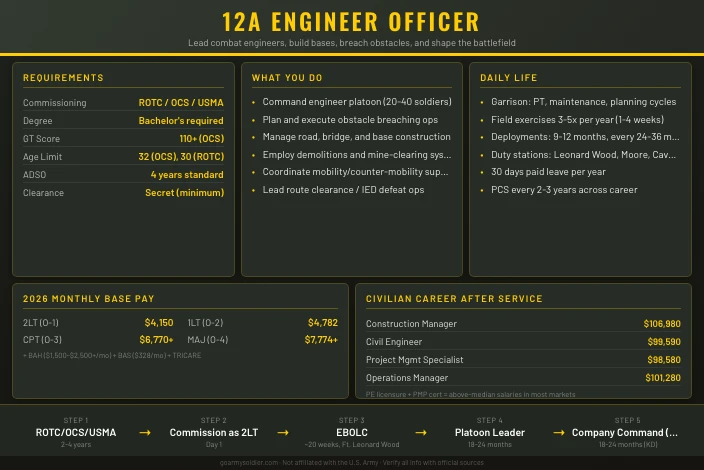
Job Role and Responsibilities
Engineer Officers (AOC 12A) plan and lead combat engineering, general engineering, and geospatial engineering operations from the platoon through the brigade level. At the tactical level, they support maneuver forces by clearing obstacles, emplacing barriers, constructing or destroying bridges, and breaching enemy defenses under fire. In general engineering roles, they manage road and airfield construction, base camp development, disaster response, and infrastructure projects ranging from small forward operating bases to major construction programs worth tens of millions of dollars.
Command and Leadership Scope
A new Engineer Officer commands a platoon of 20 to 40 soldiers, depending on whether it is a combat engineer platoon, a horizontal construction platoon, or a bridge platoon. The platoon leader owns the training plan, the maintenance program, and the tactical employment of engineer equipment. There is no buffer between you and your soldiers at this level.
At Captain, you command an engineer company – typically 80 to 150 soldiers, four platoons, and a fleet of equipment that can include M9 Armored Combat Earthmovers, M1 Abrams-size bridging rigs, or route clearance vehicles. Company command is the defining assignment in an Engineer Officer’s career. It sets the trajectory for everything after.
As a Lieutenant Colonel, an Engineer Officer commands an engineer battalion – 500 to 800 soldiers across multiple companies. At this scale, you are planning engineer support across a brigade combat team’s entire operational area, coordinating with adjacent units and higher headquarters, and managing a mission that spans both the fight and the construction program behind it.
Specific Roles and Designations
All Engineer Officers begin with AOC 12A. The branch uses Skill Identifiers (SIs) to track additional qualifications and code positions requiring specialized expertise.
| Designation | Code | Description |
|---|---|---|
| Engineer Officer | 12A | Basic branch AOC; all Engineer Officers begin here |
| Sapper | SI S4 | Completed Sapper Leader Course; key for combat engineer positions |
| Ranger | SI 5R | Ranger-qualified; competitive for combat engineer senior leadership |
| Airborne | SI 5P | Parachutist; required for 82nd Airborne and select SF-support engineer units |
| Degreed Engineer | SI W4 | Holds an accredited engineering degree; relevant for technical positions |
| Geospatial Leader | SI W2 | Qualified in geospatial engineering operations |
| Bradley Leader | SI 3X | Qualified on Bradley Fighting Vehicle; relevant for route clearance |
| Stryker Leader | SI R4 | Qualified on Stryker vehicle family |
Officers also have access to Functional Areas after completing their Key Developmental positions as a Captain. Common FAs for Engineer Officers include FA 49 (Operational Research/Systems Analysis), FA 51 (Acquisition), and FA 53 (Systems Automation).
Mission Contribution
Engineers operate across all three of the branch’s core capabilities: mobility (helping your forces move), counter-mobility (stopping the enemy from moving), and survivability (protecting your forces in place). In combined arms operations, an engineer platoon attached to an infantry company clears obstacles before the assault, breaches minefields under fire, and employs barriers to protect the objective after seizure.
General engineers support the Army’s sustaining base – they build the infrastructure that lets combat units operate for months in austere environments. Geospatial engineers produce the terrain analysis, mapping, and targeting data that commanders rely on to understand the battlefield.
Technology, Equipment, and Systems
Engineer Officers manage and employ a wide range of specialized equipment. Combat engineer platoons operate the M9 Armored Combat Earthmover, the M1 Assault Breacher Vehicle, M58 Mine Clearing Line Charges (MICLICs), and the Joint Assault Bridge. Bridge companies operate the Improved Ribbon Bridge and the M3 Amphibious Bridge/Ferry.
Construction engineers use heavy equipment including scrapers, graders, dozers, and cranes alongside the Rapidly Emplaced Bridge System. Route clearance platoons operate the Buffalo, Husky, and Cougar mine-resistant vehicles. Command and control tools include the Command Post of the Future (CPOF), Blue Force Tracker, and engineer-specific terrain visualization software integrated with the Common Operating Picture.
Salary and Benefits
Base Pay (2026)
Engineer Officers enter at O-1 (Second Lieutenant). Pay raises automatically through O-3 based on time in service; O-4 and above require board selection. All figures below reflect 2026 DFAS pay tables, which include a 3.8% across-the-board increase effective January 1, 2026.
| Rank | Grade | Typical Years of Service | Monthly Base Pay |
|---|---|---|---|
| Second Lieutenant | O-1 | 0-2 years | $4,150 - $5,222 |
| First Lieutenant | O-2 | 2-4 years | $4,782 - $6,618 |
| Captain | O-3 | 4-10 years | $6,770 - $8,788 |
| Major | O-4 | 10-16 years | $7,774 - $10,402 |
| Lieutenant Colonel | O-5 | 16-22 years | $9,250 - $12,395 |
| Colonel | O-6 | 22-28 years | $10,784 - $15,189 |
Allowances and Special Pay
On top of base pay, officers receive Basic Allowance for Subsistence (BAS) of $328.48 per month (2026 rate) and Basic Allowance for Housing (BAH), which varies by installation and dependency status. At a mid-tier installation, a Captain with dependents receives BAH in the range of $2,000 to $2,500 per month, tax-free.
Engineer Officers who complete Sapper Leader Course or Ranger School qualify for Special Duty Assignment Pay in some assignments. Hazardous duty pay applies to officers serving in demolitions or high-risk construction roles. There is no standing accession bonus for Engineer Officers, though retention bonuses at the 8-12 year continuation pay window (typically 2.5x monthly base pay) are available under the Blended Retirement System.
Additional Benefits
Active-duty officers and their families receive TRICARE Prime at no cost – no premiums, no copays, with coverage including medical, dental, vision, mental health, and prescriptions. Officers accrue 30 days of paid leave per year. The Army contributes up to 5% of base pay to the Thrift Savings Plan (TSP) under the Blended Retirement System, with matching that begins at the start of the third year of service.
The post-20-year military pension pays 40% of your high-36 average basic pay under the Blended Retirement System, with 2% added for each year beyond 20. Many Engineer Officers also carry active-duty Tuition Assistance benefits, which cover up to $4,500 per year for college courses during service. The Post-9/11 GI Bill provides up to 36 months of full tuition benefits for education after leaving active duty, with a 2025-2026 private school cap of $29,920.95 per academic year.
Work-Life Balance
Garrison work weeks run roughly 60 to 70 hours when accounting for physical training, maintenance, and planning. Field exercises add weeks of continuous operations. During company command, personal time is genuinely limited – commanders are on call constantly. Officers who accept that reality upfront adjust well; those who don’t find it difficult. The Army’s 30 days of annual leave provides real recovery time when you can take it, and most experienced officers are deliberate about using it.
Qualifications and Eligibility
Commissioning Sources
Engineer Officers commission through one of four paths. ROTC programs at over 1,700 colleges produce the largest share of lieutenants, with cadets selecting a branch preference during their junior year. The Officer Candidate School (OCS) at Fort Moore, Georgia is open to college graduates who did not commission through ROTC or a service academy. West Point (USMA) graduates select their branch through the Order of Merit List (OML) process. Direct commission into the Engineer branch is rare and primarily available to medical or legal officers; combat arms branches including Engineers almost always require commissioning from one of the standard paths.
| Commissioning Source | GPA Minimum | Degree Requirements | Age Limit | Physical Standards | Branch-Specific Notes |
|---|---|---|---|---|---|
| ROTC | 2.0 (varies by program) | Any bachelor’s degree | 30 at commissioning | AFT + medical physical | STEM degree preferred for Engineer |
| OCS | 2.0 | Bachelor’s degree required | 32 at commissioning | AFT + medical physical | GT score of 110+ required |
| USMA (West Point) | N/A (competitive admissions) | Bachelor’s degree (engineering focus available) | Appointment by age 17-23 | Candidate Fitness Assessment | Engineer is a top-selected branch |
Branch Selection and Assignment
ROTC and USMA cadets select branches through the OML branching process, which combines academic performance, physical fitness scores, and leadership evaluations into a single ranking. OCS candidates go through a board selection process with input from their OCS performance evaluation. Engineer is accessible to a broad range of candidates, though engineering or STEM academic backgrounds strengthen a packet.
Branch detail is a separate program allowing officers to begin their career in a different branch – typically Infantry or Armor – before transferring to their permanent branch (Engineer) after completing the detail branch’s BOLC and an initial assignment (typically 24 months). This gives officers combat arms experience early and is a competitive differentiator. Not all officers are offered branch detail, and it requires a longer initial commitment.
Upon Commissioning
New Engineer Officers enter at O-1 (Second Lieutenant). The standard Active Duty Service Obligation (ADSO) is four years. Officers who receive branch of choice through the Reserve Component Assignment System, accept certain bonuses, or complete select training courses incur additional service obligations. Attending BOLC is mandatory and does not separately add to your ADSO beyond the standard commitment.
OCS candidates can find a focused GT study plan in our ASVAB for OCS guide.
Work Environment
Setting and Schedule
A platoon leader’s daily environment ranges from the motor pool to the field. Morning starts with physical training, followed by maintenance formations and planning cycles. Field training exercises occur three to five times per year for most active-duty engineer units, lasting one to four weeks. Combat deployments shift the tempo entirely – operations become continuous, the workday has no real end, and technical problems get solved under time pressure.
Staff positions at the company and battalion level alternate between desk work and field support. An S3 (operations officer) in an engineer battalion spends significant time writing orders, managing training schedules, and coordinating with supported units – it is intellectually demanding but physically quieter than platoon leadership.
Leadership and Chain of Command
Engineer Officers work closely with their senior enlisted counterparts. The platoon sergeant is the most experienced soldier in the platoon and the primary advisor to a new platoon leader on technical standards, soldier welfare, and day-to-day operations. The relationship works when the lieutenant owns the tactical and planning decisions while respecting the platoon sergeant’s institutional knowledge. When it breaks down, usually because a new lieutenant ignores that dynamic, platoon performance suffers.
At the company level, the First Sergeant fills that role for the company commander. At the battalion level, the Command Sergeant Major advises the battalion commander on all enlisted matters and helps enforce standards across the formation.
Staff vs. Command Roles
A typical Engineer Officer career includes two to three platoon leader assignments (18-24 months each), an XO assignment at company level, company command (18-24 months), a battalion staff assignment (S3 or XO), and then battalion command for those selected. Between command assignments, officers spend time as staff officers at brigade, division, or higher headquarters – these assignments develop a broader understanding of how the Army operates but involve significantly less field time.
Broadening assignments outside the normal command track include recruiting duty, ROTC instructor positions, joint staff billets, and fully-funded graduate school through programs like the Advanced Civil Schooling (ACS) initiative, which allows Engineer Officers with accredited engineering degrees to pursue graduate degrees in engineering or related fields at Army expense.
Job Satisfaction and Retention
Engineer Officers report high satisfaction in platoon leader and company command positions, citing direct leadership and tangible mission results. Staff assignments at the major level draw more mixed feedback – the work is important but less visceral than command. Officers who leave after their initial obligation frequently cite the pace of PCS moves, the limited control over assignment timing, and the difficulty of dual-military or family planning as primary factors. Those who stay typically value the leadership opportunities and the depth of experience that comes from leading large organizations at a young age.
Training and Skill Development
Pre-Commissioning Training
ROTC cadets complete four years of military science courses, two summer training exercises (including Cadet Summer Training at Fort Knox), and a Leadership Assessment Course during the summer before their senior year. OCS runs 12 weeks at Fort Moore and is physically and mentally demanding, focused on basic officer skills under stress. West Point cadets complete a four-year program with significant military training integrated throughout.
Basic Officer Leader Course (BOLC)
All new Engineer Officers attend the Engineer Basic Officer Leader Course (EBOLC) at Fort Leonard Wood, Missouri, home of the U.S. Army Engineer School. EBOLC is approximately 20 weeks long and runs in three modules.
| Phase | Focus | Key Training |
|---|---|---|
| Foundation Phase | Leadership fundamentals | Army doctrine, values, shoot/move/communicate |
| Technical Phase | Engineer skills | Construction, demolitions, bridging, obstacle emplacement, route clearance |
| Field Training Exercises | Practical application | Urban assault FTX, route clearing operations, Sapper Stakes FTX |
The Sapper Stakes field training exercise is a capstone event – an overnight march and tactical exercise through Fort Leonard Wood terrain that culminates in graduates receiving the Army Engineer Regimental Corps crest. EBOLC is more technically demanding than most branch BOLCs because of the range of specialized skills engineers must learn, from carpentry and electrical work to demolition and combat bridging.
Professional Military Education (PME)
Engineer Captain’s Career Course (ECCC): Attended at Fort Leonard Wood after completing the Captain’s first assignment. ECCC runs approximately 21 weeks in residence, followed by additional coursework through Missouri University of Science and Technology (Missouri S&T) in Rolla – either in residence or through distance education. The partnership between the Army Engineer School and Missouri S&T allows Engineer Officers pursuing ECCC to simultaneously complete coursework toward a graduate degree in engineering management or systems engineering.
Intermediate Level Education (ILE/CGSC): Majors attend the Command and General Staff College at Fort Leavenworth, Kansas. This 10-month program develops operational planning skills and prepares officers for battalion-level command and staff assignments. Selection for resident ILE is competitive; non-resident completion is an option but carries career implications.
Senior Service College (War College): Available to selected Colonels and Lieutenant Colonels preparing for general officer or senior staff positions. The Army War College at Carlisle Barracks, Pennsylvania is the primary venue.
Additional Schools and Training
Engineer Officers are expected to pursue Airborne School (3 weeks, Fort Moore) and Sapper Leader Course (28 days, Fort Leonard Wood) as professional development priorities. Ranger School (61 days, Fort Moore and Camp Merrill) is strongly encouraged and significantly improves promotion competitiveness. Additional courses available to Engineer Officers include Pathfinder School, Air Assault School, the Bradley Leader Course, and the Stryker Leaders Course depending on unit assignment.
Before OCS, you need a qualifying GT score — see our ASVAB for OCS guide.
Career Progression and Advancement
Career Path
| Rank | Typical Time-in-Grade | Key Developmental Positions |
|---|---|---|
| 2LT (O-1) | 18 months | Platoon Leader (mandatory first assignment) |
| 1LT (O-2) | 18 months | Platoon Leader, Assistant S3, XO (company) |
| CPT (O-3) | 4-6 years at grade | Company Commander (KD), Battalion S3/XO |
| MAJ (O-4) | 4-5 years at grade | Battalion S3, Brigade Engineer, Division Staff |
| LTC (O-5) | 3-4 years at grade | Battalion Commander (KD), Brigade XO |
| COL (O-6) | 3-4 years at grade | Brigade Commander, Senior Staff |
O-1 through O-3 promotions are essentially automatic with time in service, provided the officer has no adverse action. O-4 and above require selection by a Department of the Army promotion board. Engineer Officers generally see competitive but not exceptionally high promotion rates at the Major and Lieutenant Colonel boards; the branch is mid-sized and the boards evaluate the full officer record with no single-factor determination.
Promotion System
Promotion boards review the Officer Record Brief, NCOER evaluations, awards, school completions, and command history. For O-4, completing company command is the most important check-the-box requirement. Officers who do not complete command as a Captain face a steep uphill fight at the Major board. For O-5, battalion-level staff and command experience is the differentiator. The Army uses a “fully qualified” versus “best qualified” standard – being technically competent is not enough; the officer record must show leadership results, progressive responsibility, and education milestones.
Branching Out and Functional Areas
Engineer Officers who want to pursue non-command career tracks can apply for Functional Areas after company-level command. FA 49 (Operational Research/Systems Analysis) suits officers with quantitative backgrounds. FA 51 (Acquisition) is a common path for Engineer Officers with STEM degrees who want to work in defense procurement. FA 53 (Systems Automation) and FA 59 (Strategic Plans and Policy) are also available based on competitive board selection.
Branch transfer to another basic branch is possible but uncommon after the initial career phase. Officers detailed into Engineer from another branch complete their assignment and then return to their basic branch for the Captain’s Career Course.
Physical Demands and Medical Evaluations
Physical Requirements
Engineer Officers take the same Army Fitness Test (AFT) as all soldiers. The AFT replaced the ACFT on June 1, 2025, and consists of five events scored 0-100 each with a 500-point maximum. The general Army passing standard is 300 total (minimum 60 points per event). Engineer Officers assigned to combat engineer units – which qualify as combat specialties – are held to the 350-point total standard.
| Event | Abbreviation | Description |
|---|---|---|
| 3 Rep Max Deadlift | MDL | Maximum weight lifted for 3 repetitions |
| Hand Release Push-Up | HRP | Push-ups with arm extension between reps |
| Sprint-Drag-Carry | SDC | 250-meter timed shuttle combining sprints, drags, and lateral shuffles |
| Plank | PLK | Timed plank hold |
| Two-Mile Run | 2MR | Timed two-mile run |
Minimum passing score is 60 points per event (300 total for general standard; 350 for combat engineer assignments). Scores are sex- and age-normed. The EBOLC graduation standard is a score of 270 or above, which is above the general passing minimum and signals that Engineer Officers are expected to maintain strong physical fitness throughout their careers.
Branch-Specific Physical Demands
Combat engineer operations involve significant physical demands beyond the AFT: carrying demolition charges, constructing fighting positions, performing breaching operations under fire, and extended patrols in full kit. General engineering operations involve heavy equipment operation, construction site work, and extended field operations in austere environments.
Officers pursuing Sapper Leader Course should expect a 28-day physically demanding course with extended foot movement, obstacle courses, and limited sleep – comparable in difficulty to Air Assault School and below Ranger School on the hardship scale. Engineer Officers are not required to complete a separate medical evaluation beyond the standard commissioning physical, unless pursuing specific assignments (airborne, Ranger) that require jump or mountaineering physicals.
Deployment and Duty Stations
Deployment Details
Engineer Officers deploy at the same tempo as the units they support. Officers assigned to infantry brigade combat teams typically deploy on the brigade’s rotation schedule – historically 9 to 12 months in length with 12 to 24 months between deployments, though the Army’s regionally aligned forces model and rotational presence missions (Europe, Korea, Middle East) have shortened the predictability of that cycle.
Corps and division engineers deploy in support of headquarters and can expect lower-intensity but longer-duration assignments. Officers attached to special operations engineer support units deploy more frequently and in smaller teams. U.S. Army Corps of Engineers officers serving in construction management roles may deploy on contingency construction programs with 6 to 12 month tours.
Duty Station Options
Engineer units are found across nearly every major Army installation. Primary locations for active-duty Engineer Officers include:
- Fort Leonard Wood, Missouri – Home of the Engineer School; multiple engineer training and operational units
- Fort Moore, Georgia – 36th Engineer Brigade and 20th Engineer Battalion
- Fort Liberty, North Carolina – 20th Engineer Brigade supporting the XVIII Airborne Corps
- Fort Cavazos, Texas – Engineer battalions supporting III Corps
- Joint Base Lewis-McChord, Washington – Engineer support to I Corps and Pacific-oriented units
- Fort Campbell, Kentucky – 326th Engineer Battalion supporting the 101st Airborne Division
Overseas assignments include Korea, Germany (USAREUR-AF engineer units), and rotational deployments to Eastern Europe. Assignment preferences are submitted through the HRC branching process, but the Army’s needs drive final placement, particularly for the first and second assignment.
Risk, Safety, and Legal Considerations
Job Hazards
Combat engineers face some of the highest risk of any branch outside of Special Forces and Infantry. Route clearance operations expose platoons and companies to IEDs, ambushes, and vehicle accidents. Breaching operations require moving through enemy fire lanes. Demolitions training and live operations carry inherent risk of explosive injury. Even garrison training with heavy equipment and explosives involves risks that most other branches don’t face.
For general engineers, construction site hazards – falls, equipment accidents, electrical faults – are the primary risk profile. Officers overseeing large construction programs manage contractor and soldier safety simultaneously.
Safety Protocols
Engineer Officers are trained in Composite Risk Management (CRM), which applies to both combat operations and training events. Demolitions operations follow strict DA safety regulations and require qualified personnel at each step. Heavy equipment operations require operator certification. Range safety officers control live-fire and demolitions training. The safety culture in engineer units is formal because the consequences of lapses are severe.
Legal and Command Responsibility
As a commissioned officer, an Engineer Officer holds full command authority under the Uniform Code of Military Justice (UCMJ). This includes accountability for the actions of subordinates during operations, responsibility for property and equipment valued in the millions, and personal liability for command decisions that result in injury or loss. Relief for cause – formal removal from command – is career-ending in most cases and follows an officer permanently in their record.
Command climate surveys and Equal Opportunity requirements are enforced across the Army. Engineer Officers are responsible for maintaining a professional command climate, addressing harassment or discrimination promptly, and building a unit where soldiers can report problems without fear of retaliation.
Impact on Family and Personal Life
Family Considerations
Engineer Officers move frequently. A typical 20-year career involves 8 to 10 Permanent Change of Station (PCS) moves, often including at least one or two overseas tours. Each move disrupts spouse employment, schooling, and established social networks. Families who thrive in this environment generally build community through the installation support system – the Army Community Service (ACS) program offers financial counseling, employment assistance, and family readiness resources at every installation.
Family Readiness Groups (FRGs) connect families within a unit, which is especially valuable during deployments. The Military OneSource program provides confidential counseling and referral services. TRICARE coverage travels with the soldier, so healthcare continuity is not a concern the way it would be for a civilian job change.
Dual-Military and Family Planning
Dual-military couples in the Army can request co-location assignments through the Army’s joint spouse program, which attempts to place both partners at the same or nearby installation. This works better at large installations with both partners in different branches. Two Engineer Officers married to each other face a narrower pool of co-location options because the same units may want both.
Parental leave includes 12 weeks of fully paid maternity leave (convalescent and non-medical, combined) and 3 weeks of non-medical paternity leave per the Army’s current policy. Field exercises and deployments during pregnancy or new parenting phases require coordination with the chain of command, and most units handle these situations individually. Support quality varies significantly by command climate.
Reserve and National Guard
Component Availability
Engineer is available in both the Army Reserve and the Army National Guard, with strong representation in both components. National Guard engineer units have a dual mission: federal mobilization for overseas operations and state support for disaster response, including hurricane relief, flood response, and infrastructure emergencies. This makes Guard Engineer Officers particularly relevant to their home states.
Commissioning Paths
Reserve and Guard Engineer Officers commission through ROTC with a Reserve component contract, state OCS programs, or – for Guard – direct appointment programs in some states. Officers who complete active duty and separate at the end of their ADSO can transfer to the Reserve or Guard to continue their career part-time, retaining their rank and much of their advancement record.
Drill and Training Commitment
Standard Reserve and Guard commitment is one weekend per month (four drill periods, or Unit Training Assemblies) plus two weeks of Annual Training per year. Engineer units frequently require additional training events for equipment qualification, demolitions refreshers, and pre-deployment readiness cycles. Officers in leadership positions (company commanders, battalion staff) invest more time than the minimum.
Part-Time Pay
A Captain (O-3) in the Reserve or Guard earns approximately $737 to $903 per drill weekend (four drills), depending on years of service, based on 2026 pay rates. Annual Training pays at the daily rate equivalent to active-duty base pay for the same grade and time in service.
Benefits Differences
| Factor | Active Duty | Army Reserve | Army National Guard |
|---|---|---|---|
| Commitment | Full-time | 1 weekend/month + 2 weeks/year | 1 weekend/month + 2 weeks/year |
| Monthly Pay (O-3) | $6,770 - $8,788 | $738 - $903/weekend drill | $738 - $903/weekend drill |
| Healthcare | TRICARE Prime ($0 premiums) | TRICARE Reserve Select ($57.88/mo individual, $286.66/mo family) | TRICARE Reserve Select (same rates) |
| Education Benefits | Full TA + Post-9/11 GI Bill | Federal TA + MGIB-SR ($493/mo) | Federal TA + MGIB-SR + state tuition waivers (varies) |
| Retirement | 20-yr pension (BRS, 40% high-36) | Points-based, collects at age 60 | Points-based, collects at age 60 |
| Deployment Tempo | High; based on unit rotation | Moderate; mobilization-dependent | Moderate; state + federal missions |
| Command Opportunities | Full progression to COL | Company and battalion commands available | Full progression available in most states |
Deployment and Mobilization
Reserve and Guard Engineer Officers have been consistently mobilized since 2001. Engineer units were heavily used in Iraq and Afghanistan for route clearance and base construction. Current mobilization patterns include rotational deployments to Europe, the Middle East, and Pacific theater, as well as ADOS (Active Duty for Operational Support) tours for individual augmentation to active-duty units. A Guard or Reserve Engineer Officer who serves a full career can expect at least two to three mobilization tours over 20 years.
Civilian Career Integration
Engineer Officers in the Reserve and Guard typically work in construction, civil engineering, government project management, or defense contracting in their civilian careers. The overlap between Army engineer skills and civilian engineering management is strong. An officer who commands an engineer company managing a $40 million construction program at a forward operating base has directly applicable credentials for a civilian project management role. USERRA protections require civilian employers to hold positions and benefits during military mobilization.
Post-Service Opportunities
Transition to Civilian Life
Engineer Officers leave the Army with a set of skills that translate directly to private sector management. Project management, team leadership, logistics coordination, and technical engineering oversight are the core competencies that civilian employers value most. The Army’s Soldier for Life – Transition Assistance Program (SFL-TAP) provides workshops, resume assistance, and employer networking to separating officers.
The U.S. Army Corps of Engineers (USACE) actively recruits former Engineer Officers into its civilian workforce. USACE manages over $20 billion in construction annually and operates as the largest government construction manager in the world. Many Engineer Officers transition directly into USACE project management, program management, or district leadership roles.
Post-Service Civilian Career Prospects
| Civilian Job Title | BLS Median Annual Salary | Job Outlook (2024-2034) |
|---|---|---|
| Construction Manager | $106,980 | +9% (much faster than average) |
| Civil Engineer | $99,590 | +5% (faster than average) |
| Project Management Specialist | $98,580 | +7% (faster than average) |
| General and Operations Manager | $101,280 | +5% (faster than average) |
Salary data from BLS Occupational Outlook Handbook, May 2024 figures. Engineer Officers with Professional Engineer (PE) licensure or Project Management Professional (PMP) certification command above-median compensation in most markets.
Graduate Education and Credentials
The ECCC partnership with Missouri S&T gives active-duty Engineer Officers a head start on graduate education during their Captain’s Career Course. Officers who complete the degree requirements earn an MS in Engineering Management or Systems Engineering, which is directly transferable to civilian roles.
The Post-9/11 GI Bill covers up to 36 months of tuition at 100% for officers who separate after qualifying service, with a private school annual cap of $29,920.95 for the 2025-2026 academic year. The GI Bill can be transferred to dependents after six years of service, with a four-year additional obligation.
Engineer Officers with a qualifying engineering degree are eligible to begin the PE licensure process (Fundamentals of Engineering exam, then the PE exam) – a credential that significantly increases civilian earning power in construction and infrastructure sectors.
Is This a Good Job for You? The Right (and Wrong) Fit
Ideal Candidate Profile
Engineer Officers tend to be people who solve problems with physical and practical results. If you find it satisfying to look at a completed bridge or a cleared obstacle lane and know that your planning made it happen, this branch fits. It rewards officers who are comfortable leading in ambiguity – you often get a mission and not much else, and you have to figure out how to accomplish it with the people and equipment you have.
A STEM background is helpful but not required for commissioning. It becomes more relevant when you pursue advanced schooling or technical functional areas. Officers who thrive here are generally strong at both the people side (managing 40 soldiers with different skill sets and personalities) and the technical side (understanding what equipment can and cannot do under real-world conditions).
Potential Challenges
The field time is high and the equipment is heavy. Combat engineer units spend a lot of time on maintenance, and vehicle and equipment readiness is a constant pressure. Officers who prefer staff work and analysis over field operations may find the first five years frustrating. The demolitions and route clearance missions carry genuine risk – this is not a paperwork branch.
Officers who want tight control over their assignment locations will find the Army’s needs-based system difficult to manage. The frequency of PCS moves is a real quality-of-life factor that affects families and personal relationships. Staff assignments at the Major level can feel disconnected from the direct leadership that made platoon and company assignments satisfying.
Career and Lifestyle Alignment
For officers who want a 20-year military career, Engineer is one of the better branches for long-term progression – it is large enough to have available command opportunities at each level and versatile enough that officers build diverse experience across their career. For officers who plan to serve four to six years and transition out, the civilian market for engineer officers is strong, particularly in construction management, government contracting, and infrastructure development. The one-and-done track works here if you use your time in service to pursue Ranger, Sapper, and airborne qualifications that signal leadership quality to civilian employers.
More Information
Contact your local Army recruiter or the nearest ROTC program to learn more about commissioning into the Engineer branch. If you are currently at a college or university, the ROTC program is the most direct path to branch selection and the Engineering branch. For OCS candidates, verify current GT score requirements (minimum 110) and physical standards before submitting your packet. Your recruiter can also provide current information on any available incentives and assignment options.
- OCS candidates: prepare for GT 110 with our ASVAB for OCS study guide
This site is not affiliated with the U.S. Army or any government agency. Verify all information with official Army sources before making enlistment or career decisions.
Explore more Army engineer officer careers to find additional branch options within the Engineer career field.