13A Field Artillery Officer
The Field Artillery branch is one of the Army’s oldest and most technically demanding combat arms. As a Field Artillery Officer, you are responsible for the lethal fires that suppress, neutralize, or destroy enemy forces across the battlefield – cannon, rocket, and missile systems that reach targets miles beyond what any rifle can touch.
You commission as a Second Lieutenant and immediately enter a branch that requires both the tactical instincts of a combat leader and the mathematical precision of a fires planner. You will lead artillery platoons, direct fire missions from battalion fire direction centers, and coordinate fires for infantry and armor commanders who depend on your judgment to survive contact. If you want to shape battles before the enemy even sees the maneuver force, Field Artillery is the branch to consider.
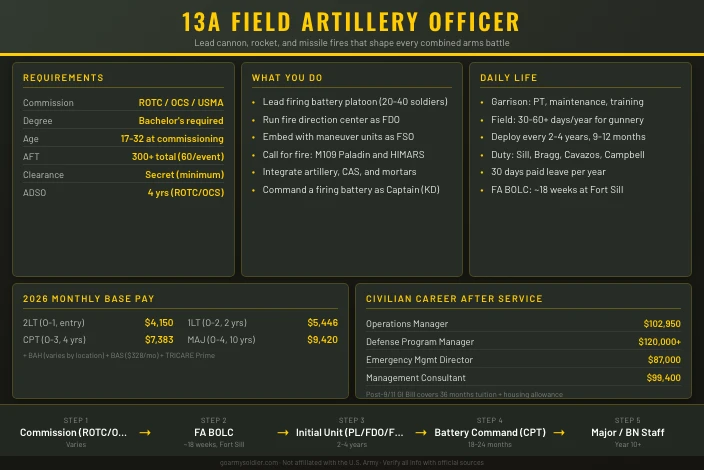
Job Role and Responsibilities
Field Artillery Officers plan, coordinate, and execute indirect fire support operations using cannon, rocket, and missile systems in support of combined arms operations. As a 13A officer, you lead firing batteries and fire support elements at the platoon through battalion level, owning the technical, tactical, and leadership decisions that determine whether fires land on target or result in fratricide. The branch integrates fire support across the maneuver commander’s entire battlespace, synchronizing artillery, naval gunfire, close air support, and mortars into a coherent scheme of fires.
Command and Leadership Scope
A new Field Artillery Officer starts as a Second Lieutenant assigned to one of three lieutenant-level jobs. The platoon leader (PL) commands a firing battery platoon of 20-40 soldiers operating M109 Paladin howitzers or HIMARS rocket artillery systems. The fire direction officer (FDO) runs the battery’s fire direction center, computing firing data and managing mission flow. The fire support officer (FSO) embeds with a supported maneuver company or battalion headquarters, advising the commander on fire support integration and calling for fires.
Every lieutenant in a Brigade Combat Team field artillery battalion is expected to complete all three of those jobs. The branch wants officers who can lead from the gun line and plan from the fire direction center before they ever move to a battery command.
At Captain, the key assignment is battery command – typically 80-120 soldiers across a firing platoon, headquarters, and maintenance section. Battery commanders own readiness, training, and the execution of fire missions. At Lieutenant Colonel, Field Artillery Officers command field artillery battalions of 400-600 soldiers, synchronizing fires across the brigade’s entire scheme of maneuver.
Specific Roles and Designations
| Designation | Code | Description |
|---|---|---|
| Field Artillery Officer (General) | 13A | The single FA officer AOC; all FA officers commission with this code |
| Joint Fires Observer | SI 6Y | Qualification for directing close air support; awarded at BOLC |
| Ranger | SI 5P | Ranger-qualified; competitive for senior FA leadership |
| Airborne | SI 5Q | Parachutist; required for airborne FA unit assignments |
| Functional Area 40 | FA 40 | Space Operations (post-KD broadening) |
| Functional Area 50 | FA 50 | Force Management (post-KD broadening) |
| Functional Area 59 | FA 59 | Strategic Plans and Policy (post-KD broadening) |
The 13A AOC is the only commissioned officer code in the Field Artillery branch. Unlike some branches that split into multiple AOCs after initial service, FA officers remain 13A throughout their career, with skill identifiers and functional area designations added as they earn qualifications and broaden their assignments.
Mission Contribution
Field Artillery is the Army’s primary means of delivering long-range lethal effects. In a combined arms operation, the Field Artillery battalion suppresses enemy air defense systems before attack helicopters enter the airspace, isolates enemy forces before the ground assault, and provides on-call fires that allow infantry and armor units to break contact or exploit success. A brigade combat team without effective fires support is slower, more vulnerable, and less decisive.
The branch’s relevance has grown significantly as the Army refocuses on large-scale combat operations against peer adversaries. HIMARS and M270 MLRS systems can strike targets at ranges of 40-180 miles, making Field Artillery a strategic asset in multi-domain operations well beyond its traditional role.
Technology, Equipment, and Systems
Field Artillery Officers manage some of the Army’s most expensive and technically complex systems.
- M109A7 Paladin: Self-propelled 155mm howitzer. Primary cannon artillery system in heavy and Stryker BCTs. Crew of four, automated loader, range of approximately 22 miles with extended-range munitions.
- M270A2 MLRS / M142 HIMARS: Multiple Launch Rocket System and High Mobility Artillery Rocket System. MLRS carries 12 rockets or 2 ATACMS; HIMARS carries 6. Both fire Guided Multiple Launch Rocket System (GMLRS) munitions to 45+ miles. ATACMS reaches beyond 180 miles.
- M777A2 Howitzer: Lightweight 155mm towed howitzer used in infantry BCTs and airborne/air assault units. Titanium and aluminum construction allows helicopter sling-load.
- Advanced Field Artillery Tactical Data System (AFATDS): The Army’s primary fire support command and control software. Manages calls for fire, computes firing data, and integrates air and naval fires. Every FA officer learns AFATDS at BOLC.
- Joint Air-Ground Integration Center (JAGIC): The brigade-level node that synchronizes ground fires with close air support. Senior FA officers run JAGIC cells in BCT headquarters.
Salary and Benefits
Base Pay (2026)
Field Artillery Officers enter at O-1 (Second Lieutenant). The table below reflects the 2026 pay tables, which include a 3.8% across-the-board increase effective January 1, 2026.
| Rank | Grade | Years of Service | Monthly Base Pay |
|---|---|---|---|
| Second Lieutenant | O-1 | Less than 2 | $4,150 |
| Second Lieutenant | O-1 | 2-3 years | $4,320 |
| First Lieutenant | O-2 | Less than 2 | $4,782 |
| First Lieutenant | O-2 | 2-3 years | $5,446 |
| Captain | O-3 | Less than 2 | $5,534 |
| Captain | O-3 | 4 years | $7,383 |
| Captain | O-3 | 8 years | $8,126 |
| Major | O-4 | 10 years | $9,420 |
| Major | O-4 | 14 years | $10,214 |
Source: DFAS 2026 Military Pay Charts
Special Pay and Allowances
Officers receive Basic Allowance for Subsistence (BAS) of $328.48 per month in 2026. Basic Allowance for Housing (BAH) varies by installation, rank, and dependent status. At Fort Sill (Lawton, OK), an O-3 without dependents receives around $1,500-$1,800 per month. At larger installations like Fort Liberty or Fort Cavazos, rates run higher.
Additional pays that can apply to Field Artillery Officers:
- Hostile Fire Pay / Imminent Danger Pay (IDP): $225 per month during months in a designated imminent danger area
- Combat Zone Tax Exclusion (CZTE): Base pay is tax-free during months spent in a designated combat zone
- Hazardous Duty Incentive Pay (HDIP): Applies during airborne operations for jump-qualified officers
Bonuses
The Army periodically offers accession bonuses for combat arms officers. Bonus availability and amounts change each fiscal year based on branch manning. Check with an Army officer recruiter or your ROTC battalion for current FA accession and retention incentive offers – bonus status can shift significantly between recruiting cycles.
Benefits Package
Active-duty Field Artillery Officers receive TRICARE Prime with no premiums, no deductibles, and no copays for in-network care. Coverage includes medical, dental, vision, mental health, and prescriptions. Family members are enrolled at no additional cost.
Under the Blended Retirement System (BRS), officers who complete 20 years earn a monthly pension equal to 40% of their high-36 average basic pay. The Thrift Savings Plan (TSP) provides government matching of up to 5% of basic pay beginning in the third year of service. Officers who leave before 20 years retain their TSP balance and any vested government contributions.
Officers accrue 30 days of paid leave per year and receive 11 federal holidays. The BRS continuation pay window typically falls at 8-12 years of service and offers a cash payment of roughly 2.5x monthly basic pay in exchange for a 3-year service extension commitment.
Work-Life Balance
Garrison life at a Field Artillery installation is structured around morning PT, training days, and afternoon maintenance. But the reality of an artillery unit is significant field time – gun crew certification, firing range rotations, and live-fire exercises are not optional. Most artillery battalions spend 30-60 days per year in field environments outside of any deployment. Combat training center rotations, at installations like Fort Irwin or in JRTC rotations at Fort Johnson, add weeks-long high-tempo evaluation periods to the calendar. Deployment cycles vary, but artillery officers should expect the same operational pace as any combat arms branch.
Qualifications and Eligibility
Commissioning Sources
All four Army commissioning paths are open to Field Artillery Officer candidates.
| Commissioning Source | GPA Minimum | Degree Requirement | Age Limits | Physical Standard | Notes |
|---|---|---|---|---|---|
| ROTC | 2.0 cumulative (2.5+ competitive) | Any accredited bachelor’s degree | 17-31 at commissioning | Pass AFT; Army medical standards | Branch via Talent-Based Branching (TBB) from national OML |
| OCS | No floor; 3.0+ is competitive | Bachelor’s degree required | 19-32 at commissioning | Pass AFT; 4-mile timed run; 12-mile ruck | Branch based on class standing and available slots |
| USMA (West Point) | Competitive admission | West Point grants the BS | Enter 17-22; commission around age 22 | Candidate Fitness Assessment; AFT | Branch via OML and cadet preference |
| Direct Commission | Varies | Advanced professional degree | Up to 42 (varies) | Same standards | Not a standard path for FA; rare exceptions exist |
Test Requirements
ROTC and USMA officers do not take the ASVAB. OCS candidates from a civilian background who went through enlisted processing hold ASVAB scores, but those scores do not determine officer branch selection.
There is no SIFT requirement for Field Artillery Officers.
The Army Fitness Test (AFT) is required at every commissioning source. OCS adds a 4-mile timed run (under 36 minutes) and a 12-mile foot march as evaluation requirements.
Branch Selection and Assignment
ROTC cadets branch through the Talent-Based Branching (TBB) process. Cadets submit branch preferences and the Army fills branch allocations from the national Order of Merit List (OML). Field Artillery is competitive within the combat arms tier. Cadets in the upper half of the OML who rank FA highly tend to receive the branch. Officers with strong physical fitness scores, leadership evaluations, and military science grades have the best odds.
OCS candidates branch during the course based on class ranking and available slots. Finishing in the top third of an OCS class opens the best options, including FA.
Branch detail is available for Field Artillery. An officer may commission into another branch and serve an initial tour before transferring to FA.
Upon Commissioning
All new officers commission at O-1 (Second Lieutenant). The standard Active Duty Service Obligation (ADSO) is four years for ROTC scholarship recipients and OCS accessions. USMA graduates owe five years. Some accession bonus contracts and post-selection obligations extend the ADSO by one to four years.
Work Environment
Setting and Schedule
Field Artillery Officers work in motor pools, battery areas, and field environments far more often than in offices. A garrison day at a firing battery typically starts with unit PT, runs through vehicle and equipment maintenance in the morning, and closes with training or administrative tasks in the afternoon. But the real work of the branch happens in the field – gunnery tables, calling for fire exercises, fire support planning, and battalion-level combined arms exercises pull officers out of garrison regularly.
Fire direction officers spend much of their time inside fire direction centers managing firing data and radio traffic. Fire support officers work embedded with maneuver units, often living with infantry or armor companies in the field, learning how the ground commander thinks and integrating fires into plans that infantry captains will execute. Both jobs require different skills and both are expected of every FA lieutenant.
Leadership and Chain of Command
A Field Artillery platoon leader works closely with a Platoon Sergeant (E-7, Sergeant First Class) who knows the guns and the soldiers better than a new lieutenant. The relationship functions best when the officer focuses on training priorities, tactical decisions, and standards while the Platoon Sergeant runs the day-to-day of crew qualification and maintenance accountability.
At battery command, the commander and First Sergeant (E-8) share responsibility for the unit’s climate, readiness, and discipline. At battalion, the Field Artillery Battalion Commander and Command Sergeant Major (E-9) set the standard together. The officer holds command authority; the NCO owns the enlisted force.
Staff vs. Command Roles
Field Artillery Officers alternate between command and staff throughout their careers. After a lieutenant tour in a firing battery or as an FSO, most move to a battalion staff position before battery command. After battery command, officers serve on brigade fires cells or division artillery (DIVARTY) staff before being considered for battalion command.
The Brigade Fire Support Officer and the DIVARTY operations officer are particularly valued staff positions because they sit at the intersection of fires and maneuver planning. Officers who perform well in those roles and build reputations as fires integrators have stronger promotion records.
Job Satisfaction and Retention
Field Artillery retains officers at rates comparable to other combat arms branches. Officers who stay often cite the combination of technical depth – the branch actually requires you to understand ballistics, weather corrections, and system capabilities – and the operational impact of seeing fires arrive exactly where planned. Officers who leave most often point to the staff grind after their battery command years and the challenge of PCS tempo on families.
Training and Skill Development
Pre-Commissioning Training
ROTC cadets complete four years of military science alongside their academic program, including Cadet Summer Training (CST) at Fort Knox – a 30-day leadership evaluation. USMA cadets complete four years of military academics with annual summer training at West Point. OCS runs 12 weeks at Fort Moore, Georgia, focusing on leadership under stress, small unit tactics, and officer core skills.
Field Artillery Basic Officer Leader Course (FA BOLC)
After commissioning, every Field Artillery Officer reports to the U.S. Army Fires Center of Excellence at Fort Sill, Oklahoma for FA BOLC. The course runs approximately 18 weeks and 4 days – longer than most BOLCs because the branch must teach firing battery operations, fire direction computation, and fire support integration in addition to the standard officer foundations.
| Phase | Focus |
|---|---|
| Officer Foundations | Leadership, land navigation, weapons qualification, Army profession, combined arms fundamentals |
| Fire Direction | AFATDS operations, fire mission computation, call-for-fire procedures, survey and meteorology basics |
| Systems | M109 Paladin / M777 crew operations, HIMARS familiarization, gunnery certification |
| Fire Support | FSO integration, battalion fire support coordination, joint fires, close air support procedures |
| Capstone | Combined arms live-fire exercise integrating all skills |
Upon graduating FA BOLC, officers receive JFO qualification. Slots for Ranger School, Airborne, Air Assault, and Pathfinder are available to officers who meet prerequisites.
Professional Military Education (PME)
| School | Timing | Length | Purpose |
|---|---|---|---|
| Airborne School | Early career (optional but valued) | 3 weeks | Static-line parachuting qualification |
| Ranger School | As a lieutenant or early captain | 61 days | Leadership under extreme stress; competitive for senior FA leaders |
| Field Artillery Captain’s Career Course (FACCC) | After XO, around year 4 | Approximately 6 months | Advanced fires tactics, combined arms integration, battery operations |
| Intermediate Level Education (ILE) / CGSC | As a Major | Approximately 10 months | Operational warfare; required for Lieutenant Colonel promotion |
| Senior Service College | Senior Colonel-select | Approximately 10 months | Strategic leadership; competitive selection |
The Field Artillery Captain’s Career Course is conducted at Fort Sill. It emphasizes how officers think about fire support planning rather than rote procedures, and it covers unified land operations, adaptive leadership, and fire support synchronization at the brigade level.
Additional Schools and Training
Field Artillery Officers can pursue additional qualifications to broaden their record:
- Air Assault School (10 days, Fort Campbell): Rappelling, sling load operations, helicopter operations
- Pathfinder Course (3 weeks, Fort Moore): Landing zone control, tactical air traffic coordination
- Joint Fires Observer (JFO) Qualification: Completed during BOLC; required for FSO duties
- Advanced Civil Schooling (ACS): Fully funded civilian graduate school; competitive selection for Captains with strong performance records
Career Progression and Advancement
Career Timeline
| Rank | Grade | Typical Timeframe | Key Position |
|---|---|---|---|
| Second Lieutenant | O-1 | Years 0-2 | Platoon Leader, FDO, or FSO in firing battery |
| First Lieutenant | O-2 | Years 2-4 | FSO or battalion staff |
| Captain | O-3 | Years 4-10 | Battery XO, then Battery Commander (KD) |
| Major | O-4 | Years 10-16 | BN S3, DIVARTY staff, Brigade FSO |
| Lieutenant Colonel | O-5 | Years 16-22 | FA Battalion Commander (KD) |
| Colonel | O-6 | Years 22-26+ | DIVARTY Commander, Brigade Commander, senior staff |
Key Developmental (KD) Positions
Two assignments define a Field Artillery Officer’s career file.
Battery Command (CPT): Typically 18-24 months commanding a firing battery or headquarters battery. This is the decisive evaluation for captains. Officers who complete a successful battery command with strong Officer Evaluation Reports are competitive for Major. Those who do not command, or who underperform in command, rarely advance past that point.
Battalion Command (LTC): Approximately 24 months commanding a field artillery battalion. Required for competitive promotion to Colonel. The battalion commander is responsible for fires training and readiness across the entire brigade.
Between those two command tours, the BN S3 Operations position stands out. Managing fires planning and training across a field artillery battalion – coordinating with maneuver S3s and brigade fires cells – demonstrates the kind of operational complexity management that promotion boards look for.
Promotion System
O-1 through O-3 promotions happen automatically with time in grade. Most officers reach Captain within four years. O-4 (Major) and above require selection by a centralized promotion board.
Field Artillery promotion rates to Major have historically been competitive, given Army demand for fires expertise. Selection rates tighten at O-5 and O-6, where the candidate pool is smaller and board expectations are more specific. OERs with “Most Qualified” ratings from senior raters, on-time KD position completion, and relevant broadening assignments are what drive board outcomes.
Building a Competitive Record
Finish in the top third of FA BOLC. Complete all three lieutenant jobs – PL, FDO, and FSO – before your captain pin-on. Attend Ranger School before your battery command window. Perform well as a battery commander, earn strong evaluations, and follow that with a visible staff position like BN S3 or Brigade FSO. Officers who execute that path on schedule are competitive for Major and have a real shot at battalion command.
Functional Area transitions become available after company command. Common options for former FA officers include FA 40 (Space Operations), FA 50 (Force Management), and FA 59 (Strategic Plans and Policy). Recruiting command tours, ROTC instructor assignments, and joint staff billets all add breadth to a file that needs more than fires experience by the time O-5 boards convene.
Physical Demands and Medical Evaluations
Field Artillery Officers meet the same Army Fitness Test (AFT) standards as other combat arms officers. The AFT replaced the ACFT on June 1, 2025.
Army Fitness Test (AFT) Standards
The AFT has five events scored 0-100 per event (500 maximum). Combat specialty standard requires a minimum total of 350 points with at least 60 points per event. Scoring is age-normed; the table below reflects minimum thresholds for the 17-21 age bracket.
| Event | Abbreviation | Minimum to Score 60 (Male, 17-21) | Minimum to Score 60 (Female, 17-21) |
|---|---|---|---|
| 3 Rep Max Deadlift | MDL | 140 lbs | 120 lbs |
| Hand Release Push-Up | HRP | 10 reps | 10 reps |
| Sprint-Drag-Carry | SDC | 3:00 | 3:35 |
| Plank | PLK | 2:09 | 2:09 |
| Two-Mile Run | 2MR | 21:00 | 23:22 |
Source: Army Fitness Test Standards, army.mil/aft
Branch-Specific Physical Demands
Operating self-propelled howitzers and HIMARS requires physical work – loading 95-pound artillery rounds, working in confined vehicle spaces, and conducting dismounted patrols during exercises. FSOs often live with maneuver units in austere field conditions for extended periods. Ranger School, while not mandatory, is expected for officers who want to be competitive at Major and above.
No additional medical evaluations beyond standard commissioning physicals are required specifically for the Field Artillery branch. Airborne-qualified positions require a separate jump physical.
Deployment and Duty Stations
Deployment Tempo
Field Artillery Officers deploy at roughly the same rate as other combat arms branches. A typical artillery officer can expect two to three deployments across a 10-year career. Deployment types include combat operations, security force assistance, bilateral training exercises with NATO and Pacific partners, and rotational force deployments to Korea and Europe.
HIMARS and MLRS units have seen increased demand as the Army responds to peer adversary threats in Eastern Europe and the Pacific. Officers in precision rocket artillery units have had higher deployment rates than pure cannon artillery units in recent years.
Duty Station Options
Field Artillery is present at nearly every major Army installation, though the heaviest concentrations are at a few key posts.
- Fort Sill, Oklahoma: The home of Field Artillery. The Fires Center of Excellence, the FA school, and multiple artillery training battalions. Instructors, BOLC staff, and some operational units.
- Fort Liberty (formerly Fort Bragg), North Carolina: 82nd Airborne Division artillery units; airborne M777 and HIMARS formations.
- Fort Cavazos (formerly Fort Hood), Texas: 1st Cavalry Division and III Corps artillery.
- Fort Campbell, Kentucky: 101st Airborne Division artillery; air assault M777 and HIMARS units.
- Joint Base Lewis-McChord, Washington: I Corps fires; Pacific-oriented artillery formations.
- Fort Carson, Colorado: 4th Infantry Division artillery.
- Schofield Barracks, Hawaii: 25th Infantry Division fires.
- Overseas: Germany (USAREUR-AF fires units), Korea (rotational HIMARS and cannon artillery), and Poland (rotational ABCT fires support).
Officer assignment preferences go to HRC, but actual assignments depend heavily on branch needs, performance record, and timing. Early career officers have limited influence over their first assignment; captains and majors with strong records have more negotiating room.
Risk, Safety, and Legal Considerations
Job Hazards
Field Artillery is a combat arms branch. Officers in deployed environments face the same threats as other ground forces – direct fire contact, IEDs, rocket and mortar attacks. The specific risk profile for an FA officer depends on role: FSOs embedded with maneuver units are often farther forward than officers in fire direction centers.
Training risks are real too. Managing live-fire artillery ranges, calling for fire with high-explosive rounds, and operating self-propelled tracked vehicles all carry inherent hazards. The consequences of a computational error in fire direction or a command decision that rushes safety steps are severe and permanent.
Safety and Risk Management
Composite Risk Management (CRM) is the Army’s standard risk mitigation framework. Field Artillery Officers apply CRM to every live-fire event, every gunnery table, and every training exercise. Range safety requirements for artillery are extensive: no-fire areas, minimum safe distances, and crew certification standards are non-negotiable. NCOs with years of gunnery experience are the institutional memory for those standards. Officers who override safety steps lose careers and sometimes soldiers.
Legal and Command Responsibility
Commissioned officers exercise authority under the Uniform Code of Military Justice (UCMJ). A battery commander can impose nonjudicial punishment (Article 15), prefer charges, and is accountable for everything the unit does or fails to do. That responsibility does not pause when the commander is exhausted or busy.
Command climate surveys and Equal Opportunity requirements matter. Officers who allow a toxic command environment, engage in fraternization, or commit ethics violations face UCMJ action and likely involuntary separation. Relief for cause removes an officer from command and ends most career trajectories.
Impact on Family and Personal Life
Family Considerations
Field Artillery demands a lot from families. PCS moves typically come every 2-3 years, often with 90 days or less of official notice. Field exercises, gunnery rotations, and pre-deployment training pull officers away from home for significant periods even when not deployed. A typical artillery officer should expect 60-120 days of field time per year in garrison.
Fort Sill (Lawton, Oklahoma) is a smaller community with limited civilian employment options for spouses. Other major FA installations – Fort Cavazos, Fort Campbell, Fort Liberty – have better surrounding labor markets and more on-post resources. Army Community Service (ACS) and Military OneSource provide real support, but family resilience matters most.
Officers with dependents receive BAH at the with-dependents rate, which covers a reasonable housing payment at most installations. On-post family housing is available at most FA installations, typically with short wait times for officers compared to enlisted families.
Dual-Military Couples
The Army’s join-spouse program attempts to co-locate dual-military couples but makes no guarantees. Major Field Artillery installations tend to be larger posts with billets across multiple branches, which helps. Early communication with HRC assignment officers and careful contract negotiation at commissioning improves the odds of reasonable co-location early in a career.
Reserve and National Guard
Component Availability
Field Artillery Officer billets exist in both the Army Reserve and Army National Guard. Most states maintain at least one Field Artillery battalion or brigade in their National Guard, and Guard FA officers can lead platoon through battalion-level formations. Army Reserve FA capacity has grown as the Army shifts force structure toward large-scale combat operations, which rely heavily on fires.
Commissioning Paths
Reserve and Guard Field Artillery Officers commission through ROTC (with a Reserve component contract), OCS through a state Guard program, or USMA (with a Reserve component assignment). Active-duty FA Officers may transfer to a Reserve or Guard unit after completing their ADSO with coordination through HRC and the gaining unit.
Drill and Training Commitment
The standard schedule is one weekend per month (Battle Assembly, four drill periods) plus two weeks of Annual Training. Artillery units typically require additional training days beyond that minimum – gunnery certification, live-fire range qualification, and combined arms field exercises are difficult to compress into standard drill weekends. Expect the actual time commitment to exceed the advertised schedule.
Part-Time Pay
An O-3 Captain with less than 2 years of service earns approximately $737.88 per drill weekend (4 drill periods). An O-3 with 3 years earns approximately $902.72 per weekend. Annual Training and any mobilization orders pay at the full daily active-duty rate for the officer’s grade and years of service.
Benefits Differences
| Benefit | Active Duty | Army Reserve | Army National Guard |
|---|---|---|---|
| Healthcare | TRICARE Prime ($0 premium, $0 copay) | TRICARE Reserve Select ($57.88/mo individual; $286.66/mo family) | TRICARE Reserve Select (same rates) |
| Monthly Pay (O-3, less than 2 yrs) | $5,534 base pay | ~$738/month drill (4 drills per weekend) | ~$738/month drill |
| Education | Full Post-9/11 GI Bill + TA ($4,500/yr) | MGIB-SR ($493/mo) + TA; Post-9/11 if activated 90+ days | State tuition waivers (varies by state) + MGIB-SR + TA |
| Retirement | BRS pension: 40% high-36 at 20 years | Points-based; collect at age 60 | Points-based; collect at age 60 (earlier if mobilized) |
| Deployment Tempo | High; 2-3 deployments per decade typical | Moderate; mobilization-driven | Moderate; state and federal mobilization |
| Command Opportunities | PL, Battery CDR, FA BN CDR | Company and battalion command billets available | Company and battalion command billets; state mission roles |
Many states offer Guard-specific benefits – full in-state tuition waivers, state income tax exemptions on military pay, and state bonuses for service commitments – that vary significantly by state.
Civilian Career Integration
Guard and Reserve Field Artillery Officers commonly work in engineering, defense contracting, emergency management, federal law enforcement, or operations management during the week. The combination of technical expertise (fire control, ballistics, precision systems) and leadership experience transfers directly to defense industry roles and government program management. USERRA protects civilian employment during mobilizations, and most large employers with veteran hiring programs value combat arms officer experience.
Deployment and Mobilization
Guard and Reserve FA officers have seen significant mobilization demand since 2001, and that trend has continued as HIMARS systems deployed to support operations in Ukraine and elsewhere increased the visibility and operational demand for fires-capable units. Mobilizations typically run 9-12 months including training and deployment time. ADOS (Active Duty Operational Support) tours allow drilling officers to serve in active-duty roles for shorter periods without full mobilization.
Post-Service Opportunities
Transition to Civilian Life
Field Artillery Officers leave the military with a mix of technical and leadership credentials that civilian employers in defense, energy, engineering, and operations management actively seek. Managing multi-million-dollar weapons systems, leading 80-120 soldier organizations, and executing complex time-critical fire missions under pressure – those experiences translate into operations director, program manager, and executive development roles across multiple sectors.
The Army’s SkillBridge program allows officers to complete internships with civilian companies in their final months of service at no cost to the employer. SFL-TAP (Soldier for Life Transition Assistance Program) and Hiring Our Heroes fellowships provide additional transition support. Officers with TS/SCI clearances from intelligence-related assignments have additional options in the cleared defense contractor market.
Civilian Career Prospects
| Job Title | Median Annual Salary | Job Outlook |
|---|---|---|
| General and Operations Manager | $102,950 | ~331,000 openings projected per year through 2034 |
| Training and Development Manager | $127,090 | 6% growth through 2034 |
| Emergency Management Director | $87,000 | 3% growth (stable) |
| Management Analyst / Consultant | $99,400 | 11% growth through 2034 |
| Defense Program Manager | Varies by role and clearance | Strong demand; defense contractors actively recruit FA officers |
Source: U.S. Bureau of Labor Statistics, May 2024 data.
Defense contracting is the most direct transition path for former FA officers, particularly those with HIMARS, MLRS, or fire control system experience. Federal agencies including DHS, DOE, and the State Department also recruit former combat arms officers for operations and program management roles. Engineering and energy companies value officers with technical operations backgrounds.
Graduate Education and Credentials
The Post-9/11 GI Bill covers full in-state tuition at public universities with no dollar cap, plus a monthly housing allowance at the E-5 with dependents BAH rate for the school’s ZIP code and up to $1,000 annually in book stipends. Private school tuition above the $29,920.95 annual cap (AY 2025-2026) can be covered through the Yellow Ribbon program at participating institutions.
Officers with strong performance records can apply for Army-funded graduate school through Advanced Civil Schooling (ACS). Selection is competitive and typically available to Captains following a successful battery command. No civilian license maps directly from FA officer training, but officers with a full command tour, fires planning experience, and a cleared background regularly pursue MBA, MPA, or engineering graduate programs.
Is This a Good Job for You? The Right (and Wrong) Fit
Field Artillery is worth serious consideration if you want a combat arms branch with strong technical depth. The branch asks more of its officers intellectually than most – fire support planning requires working knowledge of ballistics, meteorology, survey, communications, and joint fires procedures. You’re not just leading soldiers; you’re responsible for calculations that determine whether high-explosive rounds land on the enemy or on friendly forces.
Who Does Well Here
Officers who thrive in FA tend to be analytically oriented. You do not need to be a math prodigy, but you need to be precise and comfortable with numbers under stress. Strong performers are also leaders who can build trust quickly – FSOs embed with infantry units where nobody initially knows or fully trusts them, and earning that trust fast directly affects whether fires arrive when the maneuver commander needs them.
The branch works well for officers who want to stay relevant through every assignment. The PL, FDO, and FSO jobs are genuinely different from each other, and the branch’s insistence that lieutenants complete all three means you rarely get bored or plateau early.
Potential Challenges
The transition from the gun line to staff work is hard. Officers who love firing batteries and live-fire training often struggle with the planning-and-staff grind that follows battery command. Brigade fires cells and DIVARTY staff positions require patience, political awareness, and the ability to coordinate across many moving parts – skills that take time to build.
Field time is relentless. Artillery units conduct more field exercises than most people expect of a garrison-based branch. Officers who counted on a predictable schedule for family or personal commitments often find that reality does not match the expectation.
Long-Term Fit
For officers planning a full military career, FA offers a clear path through battery command and battalion command to brigade-level fires leadership and eventual general officer candidacy. The branch’s central role in large-scale combat operations has increased its visibility and importance in the post-Ukraine strategic environment.
For officers planning a four to six year commitment, FA builds a strong resume – technical credentials, leadership experience, and a profile that defense industry employers recognize. For the Guard and Reserve track, Field Artillery provides command billets in units that actually mobilize and deploy, not just support roles.
The branch doesn’t work for officers who want a predictable schedule, a slow operational pace, or primarily administrative work. If you want to operate complex weapons systems, lead soldiers in demanding field conditions, and integrate fires across a combined arms formation, Field Artillery delivers that career.
More Information
Talk to an Army officer recruiter or your local ROTC battalion to learn more about commissioning into Field Artillery. They can connect you with active-duty FA officers and walk you through current branch availability, bonus offers, and the Talent-Based Branching process. If you are pursuing the OCS track, your recruiter can advise on current class schedules and branch selection windows. For ASVAB preparation on the OCS track, see our ASVAB for OCS guide.
This site is not affiliated with the U.S. Army or any government agency. Verify all information with official Army sources before making enlistment or career decisions.
Explore more Army Field Artillery Officer careers to find additional resources and career paths in the fires branch.