36A Finance Officer
Every soldier in the Army gets paid on time because a Finance officer is somewhere in the chain making sure the system works. That’s not a small thing. Pay errors, travel entitlement disputes, and vendor contracts that fall apart in theater can cripple unit morale faster than most tactical problems. The 36A Financial Manager is the officer who owns that mission.
Finance Corps officers run disbursing operations, manage resource programs for major commands, and advise commanders on fiscal law. The branch sits inside the Army’s sustainment enterprise, which means Finance officers deploy with combat units and must operate in the same austere conditions as the soldiers they support. This is not a rear-area staff job for someone who wants to avoid the operational Army. It’s a technical specialty that also demands tactical competence.
If you’re drawn to financial management, budget execution, and the pressure of high-stakes accountability, the Finance Corps offers a career path that’s hard to replicate in the private sector at the same age.
OCS candidates need a GT score of 110 on the ASVAB — our ASVAB for OCS guide covers exactly how to hit that number.
Job Role and Responsibilities
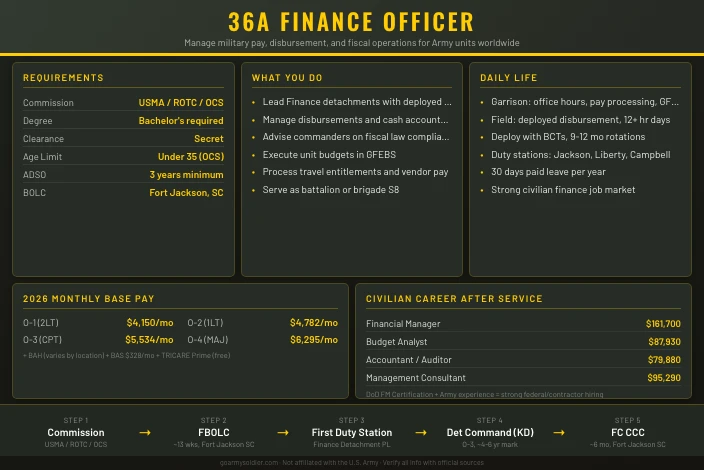
Finance Corps officers manage the full spectrum of military financial operations, from paying individual soldiers and civilian vendors to advising senior commanders on budget execution and fiscal law compliance. A 36A officer is responsible for disbursing operations, accounting, travel entitlements, commercial vendor services, and resource management across all phases of operations. At the tactical level, they lead Finance detachments deployed forward with combat brigades; at the strategic level, they fill resource management positions at major commands and the Pentagon.
Command and Leadership Scope
At the company grade level, a Finance officer typically leads a Finance Detachment. These small units deploy in direct support of Brigade Combat Teams and Division-level headquarters. A lieutenant or captain commanding a detachment may supervise 15 to 40 soldiers responsible for paying contractors in a deployed theater, processing travel claims, and maintaining accountability for cash funds that can exceed millions of dollars.
As officers advance to field grade, they shift into resource management and comptroller roles. A major serving as a battalion or brigade S8 advises the commander on all fiscal matters and manages the unit’s budget execution. At the O-5 and O-6 level, Finance officers run comptroller directorates and resource management offices at installations, corps headquarters, and Army commands.
Specific Roles and Designations
| Designation | Code | Focus |
|---|---|---|
| Financial Manager | 36A | Core AOC for Finance Corps commissioned officers |
| DoD FM Certification Level 1 | – | Entry-level financial management certification |
| DoD FM Certification Level 2 | – | Mid-career, required for most senior staff billets |
| DoD FM Certification Level 3 | – | Senior-level, required for senior resource management positions |
| Certified Defense Financial Manager | CDFM | Voluntary, widely respected professional credential |
| Certified Government Financial Manager | CGFM | Voluntary civilian-recognized credential |
Mission Contribution
The Finance Corps sustains Army operations by ensuring soldiers and vendors are paid accurately and on time. Without functioning disbursement, a deployed unit cannot pay local nationals, procure services, or maintain contractor support for critical systems. Finance officers also enforce fiscal law, which protects commanders from legal and congressional exposure when obligating federal funds.
Technology and Systems
Finance officers work extensively within the General Fund Enterprise Business System (GFEBS), the Army’s primary accounting and financial management platform. In deployed settings, they use the Standard Finance Officer Wartime Replacement System (SWIFT) for cash disbursement. Officers also operate within the Defense Travel System (DTS) and the Army’s financial reporting systems that feed into DoD-wide audits.
Salary and Benefits
Base Pay
Officers receive the same basic pay across all branches at the same grade and years of service. The figures below reflect 2026 DFAS pay tables.
| Grade | Rank | Entry Pay (Under 2 yrs) | Pay at 4 Years | Pay at 8 Years |
|---|---|---|---|---|
| O-1 | Second Lieutenant (2LT) | $4,150/mo | $5,222/mo | – |
| O-2 | First Lieutenant (1LT) | $4,782/mo | $6,485/mo | – |
| O-3 | Captain (CPT) | $5,534/mo | $7,383/mo | $8,126/mo |
| O-4 | Major (MAJ) | $6,295/mo | $7,881/mo | $8,816/mo |
| O-5 | Lieutenant Colonel (LTC) | $7,295/mo | $8,894/mo | $9,461/mo |
| O-6 | Colonel (COL) | $8,751/mo | $10,245/mo | $10,725/mo |
Basic pay is not the full picture. Officers receive Basic Allowance for Housing (BAH), which varies by duty location, pay grade, and dependent status. At Fort Jackson, SC, an O-3 with dependents receives $2,127/month in BAH. Basic Allowance for Subsistence (BAS) adds $328/month for officers regardless of location. Both allowances are tax-free.
Special Pays and Bonuses
The Finance Corps does not currently offer branch-specific accession bonuses. Officers may qualify for Continuation Pay under the Blended Retirement System between 7 and 12 years of service, which for Army active component officers is typically 2.5 times monthly basic pay in exchange for a 3-year service extension.
Deployed Finance officers may receive Hostile Fire Pay/Imminent Danger Pay and Family Separation Allowance when applicable.
Additional Benefits
Active-duty Finance officers receive TRICARE Prime at no cost, with zero premiums, zero deductibles, and zero copays. Family members are covered under the same plan with a $1,000 annual catastrophic cap for out-of-pocket costs.
The Post-9/11 GI Bill is transferable to dependents after 6 years of service with a 4-year additional obligation. At 100% entitlement, it covers full in-state tuition at public schools and up to $29,920.95 per academic year at private schools. Officers serving in key developmental assignments also qualify for the Army’s funded graduate education programs.
Retirement under the Blended Retirement System (BRS) pays 40% of the high-36 average basic pay at 20 years. The government automatically contributes 1% to the Thrift Savings Plan and matches up to an additional 4% for members who contribute 5% of their pay.
Work-Life Balance
Finance officers in garrison typically work standard duty hours with periodic after-hours requirements around pay periods, fiscal year-end, and unit training events. Field exercises and deployments shift that tempo significantly. During deployment, Finance officers often work 12-plus-hour days, seven days a week, to keep disbursement operations current. Officers receive 30 days of paid leave per year that accrue at 2.5 days per month.
Qualifications and Eligibility
Commissioning Sources
Finance Corps officers commission through four primary sources. All result in the same starting rank of Second Lieutenant (2LT) at O-1.
| Source | Degree Requirement | GPA | Age Limit | Branch-Specific Notes |
|---|---|---|---|---|
| USMA (West Point) | Bachelor’s degree earned at graduation | Competitive academic record | Must enter by age 23 | Branch assignment determined by OML at graduation |
| ROTC | Bachelor’s degree required at commissioning | Typically 2.5+ GPA minimum; competitive scores differ by program | Must commission before age 31 | Finance competes through OML; mid-tier branches available to broader OML range |
| OCS | Bachelor’s degree required; any field | 2.5+ GPA typical | Must be under 35 at commissioning | Branch assignment through OCS board process |
| Direct Commission | Degree in finance, accounting, or related field | Professional experience may substitute | Under 47 for most specialties | Available for civilians with relevant financial credentials |
Finance is generally considered a mid-tier branch in OML competitiveness. It’s more accessible than combat arms or aviation but draws candidates with business and accounting backgrounds who specifically want the specialty. Cadets and OCS candidates interested in Finance should highlight relevant academic work in accounting, finance, or business administration.
Test Requirements
Commissioned officer candidates do not take the ASVAB. Officers commission on the basis of academic record, physical fitness, leadership evaluations, and performance in commissioning programs.
OCS candidates from the civilian side must meet standard Army enlistment medical and physical standards. Officers commissioning through ROTC should know that OML rankings factor in physical fitness test scores, academic performance, and leadership evaluations from summer training.
Branch Selection and ADSO
Under the ROTC and USMA branching process, Human Resources Command (HRC) fills branch slots by OML rank combined with cadet preferences. The top 55% of allocations go by OML order. Finance typically falls in the mid-range of competition, meaning cadets in the middle third of their OML class can competitively branch Finance if it’s a top preference.
The standard Active Duty Service Obligation (ADSO) for new officers is 3 years. Officers who receive specialty training, graduate school funding, or extended education benefits incur additional obligations. Accepting BOLC and subsequent specialty training does not extend the base ADSO.
OCS candidates can find a focused GT study plan in our ASVAB for OCS guide.
Work Environment
Setting and Schedule
A Finance lieutenant spends most garrison time in an office environment managing unit accounts, processing pay actions, and preparing for exercises. But Finance detachments also train for deployment, which means field exercises, convoy operations, and establishing field finance sites in austere conditions.
Senior Finance officers working in resource management or comptroller roles spend more time in headquarters environments coordinating with G8 staff sections and attending budget execution reviews. The work becomes increasingly analytical and advisory as officers advance.
Leadership and Chain of Command
At the company grade level, a Finance officer leads enlisted Finance soldiers (36B Financial Management Technicians) and works for a battalion or brigade S8 or comptroller. The officer-NCO dynamic in Finance units is similar to other branches: the officer owns decision authority and command responsibility, while the senior NCO manages day-to-day soldier welfare and operational readiness.
Finance officers working in staff sections report to a G8 or Resource Management Officer, who in turn advises the commanding general on fiscal matters.
Staff vs. Command
Finance officers spend roughly equal time between command and staff roles across a 20-year career. Company-grade officers typically get a detachment command or executive officer position before the Captain’s Career Course. After CCC, officers move into major command staff roles as S8s or resource management officers. Battalion command at the O-5 level is available for Finance, though it’s competitive and not guaranteed.
Job Satisfaction and Retention
Finance Corps retention is generally strong at the company grade level. Officers who enjoy technical financial work and find purpose in supporting soldiers tend to stay. Those who expect frequent direct interaction with combat operations sometimes find the staff-heavy nature of senior Finance careers less engaging. The branch’s close ties to civilian financial management fields also create pull toward private sector careers after the initial obligation.
Training and Skill Development
Pre-Commissioning Training
All commissioning sources include the same foundation: leadership development, physical conditioning, and basic military skills. ROTC cadets complete a four-year curriculum plus summer training at Fort Knox (LDAC/CIET). OCS candidates complete a roughly 12-week course at Fort Moore, GA. USMA graduates complete a four-year program before commissioning.
Finance Officer Basic Leader Course (FBOLC)
All newly commissioned Finance officers attend the Finance and Comptroller Basic Officer Leader Course (FBOLC) at Fort Jackson, SC. The course runs approximately 12 weeks and 5 days.
| Phase | Location | Length | Focus |
|---|---|---|---|
| Phase I | Fort Jackson, SC | Weeks 1-4 | Military finance fundamentals, disbursing operations, fiscal law basics |
| Phase II | Fort Jackson, SC | Weeks 5-9 | Resource management, GFEBS, accounting procedures, field finance operations |
| Phase III | Fort Jackson, SC | Weeks 10-12 | Capstone exercises, comptroller operations, leadership integration |
FBOLC covers the technical and tactical skills officers need to lead a Finance detachment or serve as a battalion S8. It’s more classroom-intensive than combat arms BOLC but includes field training exercises that simulate deployed disbursement operations.
Professional Military Education
Additional Schools and Civilian Education
Finance officers with strong performance records can compete for fully funded graduate education through the Advanced Civil Schooling (ACS) program, which pays for a master’s degree in finance, accounting, business administration, or a related field. This is one of the most tangible advantages of a Finance Corps career for officers interested in long-term credential building.
Many officers also pursue the Certified Defense Financial Manager (CDFM) credential through the American Society of Military Comptrollers. The DoD Financial Management Certification Program (DFMCP) requires active Finance officers to maintain certifications at Level 1, 2, or 3 depending on their position, with continuing education requirements every two years.
Schools like Airborne and Air Assault are available based on assignment requirements and commander approval, though they’re less common career requirements for Finance officers than for combat arms.
Before OCS, you need a qualifying GT score — see our ASVAB for OCS guide.
Career Progression and Advancement
Career Timeline
Finance officers follow the same promotion timeline as other branches through O-3. O-4 and above require board selection.
| Grade | Rank | Typical Years | Key Developmental Positions |
|---|---|---|---|
| O-1 | 2LT | 0-18 months | Finance Detachment Platoon Leader, Disbursing Officer |
| O-2 | 1LT | 18 months-3.5 yrs | Finance Detachment XO, Assistant Resource Management Officer |
| O-3 | CPT | 3.5-11 yrs | Finance Detachment Commander, Battalion S8 |
| O-4 | MAJ | 11-16 yrs | Brigade S8, Resource Management Officer, ASAFM staff |
| O-5 | LTC | 16-22 yrs | Finance Battalion Commander, Installation Comptroller, G8 |
| O-6 | COL | 22-30 yrs | Finance Brigade Commander, Senior Resource Management Officer, HQDA |
Promotion System
Promotion from O-1 to O-3 is essentially automatic with time in grade, assuming satisfactory performance evaluations. O-4 promotion is board-selected with Army-wide selection rates typically in the 70-80% range for competitive files. O-5 rates run lower, around 50-70%, and O-6 is highly competitive.
Finance officers who complete key developmental (KD) positions on time and earn strong Officer Evaluation Reports (OERs) are competitive for promotion. The Finance Corps’ KD positions are Finance Detachment command (or equivalent) at O-3 and battalion or brigade S8 at O-4.
Building a Competitive File
Competitive Finance officers do several things consistently:
- Complete Finance Detachment command or a recognized equivalent KD position at captain
- Earn the DoD FM Certification appropriate to their grade
- Pursue the CDFM credential before the CCC
- Volunteer for joint assignments and deployments
- Complete Advanced Civil Schooling if selected
- Take Airborne or Air Assault if available and operationally relevant
Branching Out and Functional Areas
After completing company-level KD requirements, Finance officers can apply for Functional Areas (FA). FA 45 (Comptroller) is the primary FA within the finance and resource management space. Officers may also compete for joint staff positions and interagency assignments with the Office of Management and Budget or Treasury Department.
Physical Demands and Medical Evaluations
Finance officers meet the same physical standards as every other Army officer. The Army Fitness Test (AFT) replaced the ACFT on June 1, 2025. It has 5 events scored 0-100 each, with a maximum of 500 points.
| AFT Event | Abbreviation | General Standard (Pass) |
|---|---|---|
| 3 Rep Max Deadlift | MDL | 60 points minimum |
| Hand Release Push-Up | HRP | 60 points minimum |
| Sprint-Drag-Carry | SDC | 60 points minimum |
| Plank | PLK | 60 points minimum |
| Two-Mile Run | 2MR | 60 points minimum |
| Total | 300 points minimum |
Finance is not a designated combat specialty, so officers must meet the general standard of 300 total points with at least 60 per event. Scoring is sex- and age-normed.
The Finance Corps does not require branch-specific physical evaluations beyond the AFT. There are no dive physicals, flight physicals, or altitude requirements. Standard commissioning medical requirements apply, including vision and hearing standards at MEPS.
Deployment and Duty Stations
Deployment Patterns
Finance detachments deploy with the units they support. A Finance officer assigned to a Brigade Combat Team will deploy when that brigade deploys, typically on a 9 to 12-month combat rotation. COCOM-level resource management officers may deploy to theater-level headquarters on similar timelines.
Deployment tempo for Finance officers is moderate compared to combat arms but higher than some other support branches. Officers assigned to high-readiness BCTs at Fort Campbell, Fort Stewart, or Fort Cavazos can expect deployment cycles on a roughly 24 to 36-month rotation.
Duty Station Options
Finance units and resource management sections exist at nearly every major Army installation. Primary duty stations for Finance officers include:
- Fort Jackson, SC – Home of the Finance and Comptroller School; Finance Center
- Fort Liberty, NC – XVIII Airborne Corps; 82nd Airborne Division
- Fort Campbell, KY – 101st Airborne Division (Air Assault)
- Fort Cavazos, TX – III Corps; 1st Cavalry Division
- Fort Stewart, GA – 3rd Infantry Division
- Pentagon / Arlington, VA – ASAFM, DFAS, Army budget offices
- OCONUS – Germany (USAREUR-AF), Korea (USFK), Japan (USARJ)
Assignment decisions are made by HRC, with officers submitting preference sheets during assignment cycles. Officers have more control over assignment preferences at mid-career than at the lieutenant level.
Risk, Safety, and Legal Considerations
Job Hazards
Finance officers in deployed settings face the same force protection risks as any other officer with a forward-deployed unit. A Finance detachment working in a combat zone is not a protected rear-area element. Officers must be tactically prepared and carry weapons.
Beyond physical risk, Finance officers carry substantial fiscal and legal accountability. Improperly obligating federal funds, certifying false claims, or failing to maintain accountability for cash funds can result in criminal charges under the Uniform Code of Military Justice and civilian federal law. This accountability does not disappear because the environment is austere or under fire.
Safety Protocols
Finance officers apply the Army’s Composite Risk Management (CRM) process to all operations, including the physical movement of cash funds and the operation of finance sites. Protection of government funds involves coordination with military police, convoy escort procedures, and site security planning.
Legal and Command Responsibility
Finance officers routinely work within the constraints of fiscal law, specifically the Anti-Deficiency Act, which prohibits obligating funds in excess of what Congress has appropriated. Officers must understand these constraints and advise commanders accordingly. Violating fiscal law can trigger Inspector General investigations, congressional inquiries, and career-ending relief for cause actions.
Officers in command billets also hold full UCMJ authority over their soldiers and are responsible for command climate, equal opportunity compliance, and the professional conduct of every soldier in their unit.
Impact on Family and Personal Life
Family Considerations
Finance Corps families experience the standard Army family life: PCS moves every 2-3 years, deployment separations, and the lifestyle adjustments that come with frequent relocation. Finance officers do not face the extreme deployment frequency of special operations or combat arms, but deployments do happen and families need to be prepared.
The Army provides Army Community Service (ACS), Family Readiness Groups (FRG), and installation-based support programs at every major duty station. Military OneSource offers counseling and referral services available 24/7 to family members regardless of location.
Dual-Military Families
The Army manages dual-military couples through the Joint Domicile program, which attempts to co-locate both spouses when possible. Finance officers in a dual-military relationship should discuss assignment preferences early with their career managers at HRC. Co-location is not guaranteed, but the Army makes reasonable efforts, especially at field grade.
PCS Tempo
Finance officers typically PCS every 24 to 36 months at the company grade level and every 2 to 3 years at field grade. Each move affects dependent schooling, spouse employment, and housing decisions. BAH adjusts to the new duty station, which can increase or decrease significantly depending on local housing markets. Fort Jackson, for example, has lower BAH rates than high-cost areas like the Washington, DC region.
Reserve and National Guard
Component Availability
The 36A Finance Officer AOC is available in both the Army Reserve and Army National Guard. Reserve Finance units fall under the Army Reserve’s financial management structure, while National Guard Finance units support state missions and can be federalized for deployments.
Commissioning Paths
Reserve component officers commission through the same sources as active duty: ROTC with a Reserve component contract, OCS through state Guard programs, or direct commission. ROTC cadets who select a Reserve component contract upon commissioning will serve in drilling Reserve or Guard units after completing BOLC.
Active-duty Finance officers who complete their ADSO can transfer to the Army Reserve or National Guard and continue their careers in a part-time status.
Drill and Training Commitment
The standard Reserve/Guard commitment is one weekend per month (4 drill periods) plus 14 days of Annual Training per year. Some Finance units require additional training periods for certification maintenance or exercise support. Total paid days average 62 per year under the standard schedule.
Part-Time Pay
A Finance officer at O-3 (Captain) in the Reserve or Guard earns approximately $738 per drill weekend (4 drill periods) at less than 2 years of service, based on 2026 drill pay rates. An O-3 with 3 years earns approximately $903 per weekend. Annual Training at active-duty rates adds to annual compensation.
Active Duty vs. Reserve vs. Guard Comparison
| Factor | Active Duty | Army Reserve | Army National Guard |
|---|---|---|---|
| Commitment | Full-time | 1 weekend/mo + 2 wks AT | 1 weekend/mo + 2 wks AT |
| Monthly Pay (O-3, under 2 yrs) | $5,534 base | ~$738/weekend (drill only) | ~$738/weekend (drill only) |
| Healthcare | TRICARE Prime (free) | TRICARE Reserve Select ($57.88/mo individual) | TRICARE Reserve Select ($57.88/mo individual) |
| Education | TA ($4,500/yr) + Post-9/11 GI Bill | TA ($4,500/yr) + MGIB-SR ($493/mo) | TA + MGIB-SR + state tuition benefits (varies) |
| Deployment Tempo | Moderate (BCT cycles, ~2-3 yr rotation) | Mobilization-based, less predictable | State missions + federal mobilization |
| Command Billets | Yes, all grades | Yes, company and battalion level | Yes, company and battalion level |
| Retirement | 20 yrs = 40% high-36 pay | Points-based, collect at 60 | Points-based, collect at 60 |
Benefits Differences
Reserve and Guard Finance officers who are not on active-duty orders use TRICARE Reserve Select, which costs $57.88/month for the member alone or $286.66/month for the family. This is far cheaper than civilian insurance but does carry premiums unlike active-duty TRICARE Prime.
The Montgomery GI Bill – Selected Reserve (MGIB-SR) pays $493/month for up to 36 months of education while serving in the Selected Reserve. Officers who accumulate 90 or more aggregate days of active-duty service can qualify for Post-9/11 GI Bill benefits at varying tiers.
Guard officers also benefit from state-level tuition assistance programs, which vary significantly by state and can include full tuition waivers at public universities.
Reserve retirement is points-based. Officers earn 15 membership points per year, 1 point per drill period, and 1 point per day of active duty. Twenty qualifying years (50+ points each) makes a soldier eligible for retirement benefits, collected starting at age 60.
Under USERRA (38 USC §§ 4301-4335), employers cannot discriminate against Reserve/Guard officers for military service, must offer reemployment after deployment, and must maintain health insurance continuation for up to 24 months during military leave.
Deployment and Mobilization
Reserve and Guard Finance officers can be mobilized for combat deployments, operational support tours (ADOS), and state emergency missions (Guard only). Mobilization tempo varies significantly by unit and year. Some Reserve Finance units have deployed multiple times in the past decade; others have not mobilized at all. Finance is not among the highest-demand Reserve specialties, but demand exists, particularly during large-scale contingency operations.
Civilian Career Integration
Finance is one of the best Reserve and Guard officer branches for civilian career integration. An O-3 Finance officer who works in corporate finance, government contracting, or federal budget management brings directly applicable skills to every drill weekend. Conversely, the financial management skills developed in uniform translate immediately to civilian finance careers.
Employers who work with federal contracts are often supportive of Guard and Reserve service, and many actively value candidates with DoD financial management experience.
Post-Service Opportunities
Finance officers exit the Army with a set of credentials and experiences that civilian financial employers recognize and value. The combination of leadership experience, fiscal law expertise, and hands-on management of large-scale budgets is uncommon among candidates at the same age and career stage.
The transition programs Skillbridge, SFL-TAP (Soldier for Life – Transition Assistance Program), and Hiring Our Heroes all connect separating officers with private sector employers. Finance Corps alumni frequently land in:
- Federal agencies (DoD comptroller offices, OMB, Treasury, GAO)
- Defense contractors and consulting firms with federal clients
- Corporate finance and financial planning roles at major companies
- Banking, investment management, and financial services
- State and local government budget offices
| Civilian Role | Median Annual Salary | Job Outlook (2024-2034) |
|---|---|---|
| Financial Manager | $161,700 | +15% (much faster than average) |
| Budget Analyst | $87,930 | Stable growth |
| Accountant / Auditor | $79,880 | +6% |
| Management Consultant | $95,290 | +11% |
Salary data from Bureau of Labor Statistics Occupational Outlook Handbook, May 2024 figures.
Credentials and Certifications
Finance officers who complete the DoD Financial Management Certification Program at Level 2 or Level 3 hold credentials that translate directly to civilian government and contractor finance roles. The Certified Defense Financial Manager (CDFM) designation is recognized by federal agencies and defense contractors as a mark of genuine expertise.
Officers who use the Post-9/11 GI Bill for graduate education after separation can complete an MBA or Master of Science in Finance, which, combined with 5 or more years of Army financial management experience, is a strong credential package for senior civilian roles.
Is This a Good Job for You?
The Right Fit
Finance is a strong branch for someone who genuinely enjoys financial management work, can thrive in both office and field environments, and wants to lead soldiers while building technical expertise. If you’ve studied accounting, finance, or business and want to apply that training in a high-accountability, operationally relevant setting, the Finance Corps is a natural fit.
The branch also suits officers who want a clear civilian career path after service. Few Army specialties map as directly to private sector demand as financial management.
Potential Challenges
Finance is not the right choice for someone who wants maximum tactical exposure or hopes to spend most of their career leading soldiers in the field. Senior Finance careers are heavily staff-oriented. Officers at the O-4 and above level spend most of their time in resource management offices, budget reviews, and headquarters environments.
The fiscal accountability burden is real and unavoidable. Finance officers are personally responsible for significant government funds. Errors, even well-intentioned ones, can have career consequences. Officers who are uncomfortable with that level of accountability should think carefully before choosing this branch.
Career and Lifestyle Alignment
For officers planning a full 20-year career, Finance offers a viable path to battalion command and beyond, though competition at O-5 and O-6 is real. For officers planning one obligation (3-5 years), Finance provides strong civilian job placement, especially in defense contracting, federal agencies, and corporate finance.
The officer who thrives in Finance is someone who can switch between managing a spreadsheet of obligation rates in the morning and leading a field exercise in the afternoon without missing a beat. That combination is less common than people expect, and the Army values it.
More Information
Contact your local Army recruiter or ROTC program to learn about Finance Corps commissioning options and current accession needs. For OCS candidates, your recruiter can provide current branch availability and ADSO details. The Army Finance and Comptroller School at Fort Jackson publishes course information and professional development resources directly.
- OCS candidates: prepare for GT 110 with our ASVAB for OCS study guide
This site is not affiliated with the U.S. Army or any government agency. Verify all information with official Army sources before making enlistment or career decisions.
Explore more Army Finance officer careers for additional information on the Finance Corps branch and its role in Army sustainment operations.