Army Judge Advocate Officer
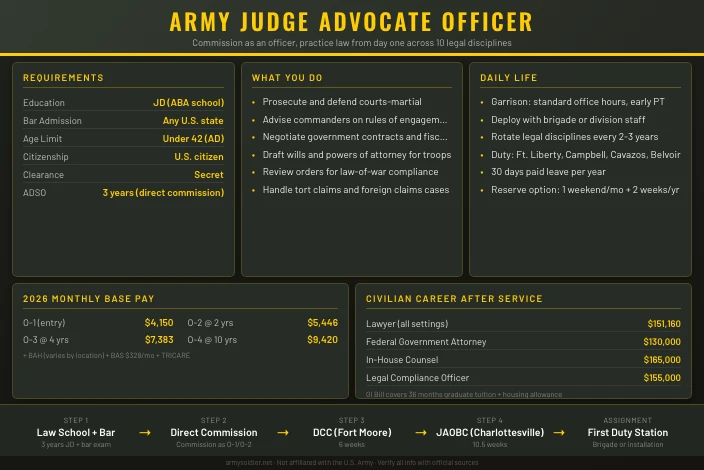
Most law school graduates choose between a firm, a public defender’s office, or a government agency. Army Judge Advocates get all three at once. Within a single career, you’ll prosecute courts-martial, negotiate multi-million-dollar government contracts, advise generals on the laws of war, and draft wills for soldiers heading to a combat zone. You commission as an officer, lead soldiers, and practice law from day one. No billable hours. No waiting years to see a courtroom.
OCS candidates need a GT score of 110 on the ASVAB — our ASVAB for OCS guide covers exactly how to hit that number.
Job Role and Responsibilities
Army Judge Advocate officers are commissioned officers who serve as the Army’s attorneys, providing legal support across military justice, administrative law, contract and fiscal law, legal assistance, and international and operational law. They advise commanders at all levels on legal matters affecting unit operations, soldier rights, and compliance with domestic and international law. Judge Advocates prosecute and defend courts-martial, represent the Army in claims and tort cases, and serve as legal advisors on everything from real property transactions to rules of engagement.
Command and Leadership Scope
Judge Advocates don’t lead rifle platoons, but they do lead legal offices. A Captain serving as a Brigade Judge Advocate manages a small team of paralegal NCOs and junior attorneys, handling all legal matters for a brigade of 3,000 to 5,000 soldiers. A Lieutenant Colonel serving as a Staff Judge Advocate at a large installation may oversee a legal center with dozens of attorneys and enlisted paralegals.
At the field grade level, Judge Advocates advise commanders directly. They attend operational planning sessions, review orders for law-of-war compliance, and often serve as the commander’s most trusted advisor on sensitive personnel and administrative matters. The span of influence is wide even when the span of direct supervision is narrow.
Legal Disciplines and Practice Areas
One of the branch’s defining features is breadth. JAG officers rotate through different legal disciplines every two to three years, which means no officer spends a career doing only one thing. The table below shows the ten core disciplines.
| Practice Area | What It Covers |
|---|---|
| Military Justice | Courts-martial prosecution and defense, investigations, disciplinary actions |
| Administrative Law | Board proceedings, separation actions, ethics, regulatory compliance |
| Legal Assistance | Wills, powers of attorney, family law, consumer protection, tax |
| Contract and Fiscal Law | Acquisition, procurement, appropriations, fiscal law advice |
| Claims | Tort claims, property damage, foreign claims, medical malpractice |
| International and Operational Law | Law of armed conflict, rules of engagement, status of forces agreements |
| Labor Law | Civilian employee relations, FLRA matters, EEO |
| Environmental Law | NEPA compliance, Superfund, real property transactions |
| Intellectual Property | Patents, technology transfer, acquisition IP rights |
| National Security Law | Intelligence oversight, detention operations, targeting law |
Mission Contribution
The Army cannot conduct lawful operations without legal support. Every major operation generates legal issues: detainee treatment, contractor oversight, host-nation agreements, and congressional reporting requirements. Judge Advocates embedded with units ensure that commanders have trained lawyers in the room when decisions are made, not just after the fact.
Technology and Systems
Judge Advocates use Army legal case management systems to track courts-martial, claims, and legal assistance appointments. At the operational level, they work within command and control systems used by brigade and division staffs. Contract attorneys use Federal Acquisition Regulation (FAR) databases and Defense Contract Management Agency systems. Operational law attorneys access legal resources through JAGCNet, the corps’ secure legal network.
Salary and Benefits
Base Pay
Judge Advocates commission as First Lieutenants (O-2) or Captains (O-3), depending on prior service. Most direct-commission attorneys with no prior military service enter as O-1 or O-2. All figures below are 2026 DFAS monthly base pay.
| Rank | Years of Service | Monthly Base Pay |
|---|---|---|
| O-1 (2LT) | Less than 2 | $4,150 |
| O-2 (1LT) | Less than 2 | $4,782 |
| O-2 (1LT) | 2 years | $5,446 |
| O-3 (CPT) | Less than 2 | $5,534 |
| O-3 (CPT) | 4 years | $7,383 |
| O-3 (CPT) | 6 years | $7,737 |
| O-4 (MAJ) | 10 years | $9,420 |
| O-4 (MAJ) | 14 years | $10,214 |
Base pay is the floor. Most officers also receive Basic Allowance for Housing (BAH), which varies by duty location, pay grade, and dependency status. A Captain at Fort Liberty, North Carolina with dependents draws roughly $2,000 to $2,500 per month in BAH depending on the local market. Officers also receive Basic Allowance for Subsistence (BAS) of $328.48 per month, which is a flat national rate.
Special Pay
Judge Advocates are generally not eligible for hazardous duty pay or flight pay. The branch does not carry a branch-specific accession bonus at the same scale as some technical branches, though the Army periodically offers retention incentives for mid-career officers. Check GoArmyJAG for current bonus availability since these change annually.
Additional Benefits
Active-duty Judge Advocates receive TRICARE Prime at no premium or copay for themselves and their families. The Army pays the full enrollment cost. Coverage includes medical, dental, vision, mental health, and prescriptions.
Retirement falls under the Blended Retirement System (BRS) for officers who joined after 2018. BRS combines a 20-year pension at 40% of your high-36 average base pay with TSP matching of up to 5% of basic pay. Officers who joined before 2018 may still be under the legacy system, which offers a higher pension multiplier with no TSP matching. Continuation Pay, available at the 8 to 12-year mark, provides a cash incentive in exchange for a three-year additional obligation.
Work-Life Balance
Garrison life for Judge Advocates more closely resembles a civilian legal office than a field unit. Most assignments involve standard duty hours with occasional evening work for hearings or urgent legal matters. Physical training occurs in the early morning. Unlike combat arms, JAG officers rarely spend weeks in the field. Deployments and exercises do disrupt this rhythm, but the day-to-day grind is generally more predictable than in branch units.
Annual leave accrues at 2.5 days per month (30 days per year), and federal holidays apply. Unused leave up to 60 days carries over to the next year.
Qualifications and Eligibility
Judge Advocates access through direct commission, not through USMA, ROTC, or standard OCS. The legal training occurs in law school, not in the Army.
Commissioning Requirements
| Requirement | Active Duty | Army Reserve |
|---|---|---|
| Education | JD from ABA-accredited law school | JD from ABA-accredited law school |
| Bar Admission | Must be licensed in any U.S. state, territory, or D.C. | Must be licensed in any U.S. state, territory, or D.C. |
| Citizenship | U.S. citizen at commissioning | U.S. citizen at commissioning |
| Age Limit | Under 42 at time of entry | Under 33 at time of entry |
| GPA | Not a stated minimum; academic record is part of the competitive review | Same |
| Security Clearance | Must qualify for Secret clearance | Must qualify for Secret clearance |
| Prior Experience | Not required for new attorneys; 2 years required for experienced attorney accessions | Same |
Application Windows
The GoArmyJAG application portal accepts applications year-round for licensed attorneys. For law students, application windows open in the fall semester of the 3L year for active-duty accessions. The 1L Summer Intern and Summer Associate programs open applications in January.
Branch Selection
JAG is not branched through the standard ROTC Order of Merit List (OML) process or the Officer Candidate School branch selection board. You apply directly to the Judge Advocate Recruiting Office (JARO). The branch selects officers based on law school record, bar results, writing samples, letters of recommendation, and an interview. Competition is meaningful because the corps is small and selective.
Entry Rank
Most direct-commission attorneys enter at O-1 (Second Lieutenant, 2LT) and receive a date of rank that may be adjusted based on prior military service or civilian legal experience. Officers with significant prior service may commission at O-2 or O-3. Confirm your entry grade with your JAG recruiter at the time of application.
Active Duty Service Obligation
Direct-commission JAG officers incur a three-year ADSO for active-duty service. Officers who receive additional training, post-graduate legal education, or selection for special assignments may incur additional obligations. FLEP participants incur a two-year obligation for each academic year funded, which runs concurrently with or in addition to the standard ADSO.
OCS candidates can find a focused GT study plan in our ASVAB for OCS guide.
Work Environment
Daily Setting
Most Judge Advocates work in an office. The typical day involves drafting legal opinions, reviewing contracts, advising commanders, and handling soldier legal assistance appointments. Trial counsel and defense counsel spend more time in courtrooms and hearing rooms. Operational law attorneys may deploy with combat units and work in forward operating environments.
The work setting changes with the assignment. A Staff Judge Advocate office at a large installation like Fort Campbell or Fort Cavazos runs what amounts to a full-service law firm, with specialists covering every practice area. A deployed JAG team may be three officers in a small office advising a division command on everything from detention procedures to contractor disputes.
Officer-NCO Dynamic
Judge Advocates work closely with legal NCOs (paralegal specialists, MOS 27D). The officer provides legal judgment and oversight; the NCO handles case intake, client scheduling, research support, and administrative functions. Senior paralegal NCOs are experienced professionals who know the office workflows better than a junior JAG officer on their first assignment. The best Judge Advocates learn from their NCOs while maintaining clear professional responsibility for legal work product.
Staff vs. Command Roles
JAG officers spend most of their careers in staff roles. Command billets for JA are fewer than in combat arms. Key positions include:
- Brigade Judge Advocate (O-3): Primary legal advisor to a brigade commander
- Division/Corps Staff Judge Advocate (O-6): Senior legal officer for a division or corps
- Senior Military Judge (O-5/O-6): Presides over courts-martial at trial and appellate levels
- Trial Counsel / Defense Counsel (O-2 to O-4): Prosecution and defense in courts-martial
Assignment as a Staff Judge Advocate at division level or above is a career-making position, equivalent to command in terms of professional prestige within the branch.
Job Satisfaction
Judge Advocates consistently report high job satisfaction during the first several years of service, largely because they practice law across more areas in a few years than most civilian attorneys see in a decade. The common reason officers leave is compensation. A mid-career JAG Captain with five years of trial experience can earn $200,000 or more at a large civilian firm. Retaining officers at the 4 to 8-year mark is the corps’ primary challenge.
Training and Skill Development
Pre-Commissioning
JAG officers complete law school independently before entering service. The Army doesn’t run its own law school. Officers apply during or after law school, complete their bar exam, and then commission.
Initial Training Pipeline
All Judge Advocates complete two training phases before their first assignment.
| Phase | Location | Length | Focus |
|---|---|---|---|
| Direct Commission Course | Fort Moore, GA | 6 weeks | Military fundamentals, leadership, fitness, tactics |
| JAOBC (BOLC-B) | TJAGLCS, Charlottesville, VA | 10.5 weeks | Military law: criminal, contract, international, legal assistance |
Professional Military Education
| PME School | Timing | Details |
|---|---|---|
| Judge Advocate Officer Advanced Course | ~6-8 years, CPT/MAJ | Branch-specific advanced training at TJAGLCS |
| Intermediate Level Education (ILE/CGSC) | ~10-12 years, MAJ | Command and General Staff College, Fort Leavenworth, KS |
| Senior Service College | ~20+ years, COL | War College (Carlisle, PA) or equivalent joint institution |
Additional Schools
JAG officers are not expected to attend Ranger School or Airborne School, though some volunteer for these courses. A small number attend fellowship programs (Congressional Fellowship, White House Fellowship, international law programs) that broaden their expertise. The TJAGLCS also offers an LL.M. in Military Law for selected officers, which strengthens career records for senior assignments.
Before OCS, you need a qualifying GT score — see our ASVAB for OCS guide.
Career Progression and Advancement
Career Timeline
| Rank | Typical Timeframe | Key Positions |
|---|---|---|
| O-1 (2LT) | 0-18 months | Completing DCC and JAOBC |
| O-2 (1LT) | 18 months-3 years | Junior attorney in first assignment |
| O-3 (CPT) | 3-10 years | Brigade Judge Advocate, Trial Counsel, Defense Counsel, Legal Assistance attorney |
| O-4 (MAJ) | 10-16 years | Senior staff attorney, Deputy Staff Judge Advocate, legal center chief |
| O-5 (LTC) | 16-22 years | Staff Judge Advocate (installation or brigade), Senior Trial Judge |
| O-6 (COL) | 22+ years | Division/Corps Staff Judge Advocate, TJAGSA faculty, Pentagon positions |
Promotion from O-1 through O-3 is essentially time-based. Officers who meet performance standards advance without a competitive board. At O-4 and above, promotion is board-selected and competitive. JAG officers compete within their own category, separate from line officers, which means a strong record within the corps matters more than performance compared to infantry or aviation officers.
Building a Competitive Record
A strong JAG record requires depth in at least two practice areas, a record of increasing responsibility, and progressive evaluation reports. Officers who have served as Trial Counsel or Brigade JA, completed ILE, and received a graduate legal education (LL.M.) are competitive for O-5 and O-6. Broadening assignments at the Pentagon, on joint staffs, or with allied nations add value for senior board consideration.
Functional Areas and Transitions
After company-grade assignments, JAG officers may pursue specialized tracks within the corps. A small number transition to the Army’s Functional Area 27 (Law), which involves assignment to higher-echelon legal positions. Officers who want to transition out of the branch entirely may apply for Inter-branch Transfer, though this is uncommon.
Physical Demands and Medical Evaluations
Judge Advocate officers meet the same Army Fitness Test (AFT) standards as all other officers. The AFT replaced the ACFT on June 1, 2025. There are five events, each scored 0 to 100 points, for a maximum total of 500. Officers must score at least 60 points per event.
| AFT Event | Abbreviation | Minimum Score (Ages 17-21) |
|---|---|---|
| 3-Rep Max Deadlift | MDL | 60 |
| Hand Release Push-Up | HRP | 60 |
| Sprint-Drag-Carry | SDC | 60 |
| Plank | PLK | 60 |
| Two-Mile Run | 2MR | 60 |
| Total Minimum | 300 points |
The general standard requires 300 total points, scored on sex- and age-normed scales. Judge Advocate is not a designated combat specialty, so officers are not held to the 350-point combat specialty standard.
Branch-Specific Physical Standards
JAG officers do not face branch-specific physical requirements beyond the AFT. There is no flight physical, dive physical, or special selection screening. Officers who volunteer for optional schools (Airborne, Air Assault) must meet those program’s medical standards at the time of application.
Deployment and Duty Stations
Deployment Tempo
Judge Advocate officers deploy with their units. The frequency depends on the assignment, not a fixed schedule. Officers assigned to combat brigades can expect deployment rotations consistent with those units. Legal center attorneys at support installations tend to deploy less often. Deployed JAG officers advise commanders on detention operations, rules of engagement, targeting law, and host-nation agreements.
Most mid-career JAG officers can expect at least one or two combat or operational deployments over a 20-year career, with more possible depending on unit assignment and global operational tempo.
Primary Duty Stations
JAG officers serve at major Army installations across the United States and overseas. Common duty stations include:
- Fort Liberty, NC (82nd Airborne Division)
- Fort Campbell, KY (101st Airborne Division)
- Fort Cavazos, TX (III Corps)
- Fort Leavenworth, KS (CGSC, Training and Doctrine Command)
- Joint Base Lewis-McChord, WA (I Corps)
- The Pentagon, Arlington, VA
- Fort Belvoir, VA (multiple Army agencies)
- OCONUS: Germany (USAREUR), South Korea, Japan, Hawaii
Assignment preferences are submitted through the Human Resources Command assignment process. Officers build relationships with the JAG assignments officer and submit preference sheets that influence, but don’t guarantee, duty station selection.
Risk, Safety, and Legal Considerations
Job Hazards
JAG officers in garrison face minimal physical danger. Those deployed with combat units face the same environmental and security risks as any officer in a forward area. Convoy travel, base security incidents, and operational tempo all apply.
The more significant risk in this branch is professional. As a licensed attorney, a JAG officer carries ethical obligations under the Rules of Professional Conduct and the Rules of Professional Responsibility for attorneys practicing before military tribunals. Ethical violations can end a legal career entirely, in both the military and civilian sectors. Officers must track bar membership requirements in their licensing state regardless of where they are stationed.
Command Responsibility
Judge Advocates are not commanders, but they advise commanders on decisions with serious consequences. A wrong legal opinion on the rules of engagement, on detention authority, or on the scope of a search authorization can affect soldier rights, mission legality, and command liability. The personal stakes are high.
UCMJ Accountability
Like all officers, JAG officers are subject to the Uniform Code of Military Justice. Conduct unbecoming an officer, dereliction of duty, and violations of professional responsibility standards are all punishable under the UCMJ and can result in separation. For attorneys, separation often carries bar discipline implications.
Impact on Family and Personal Life
Moves and PCS Tempo
JAG officers PCS roughly every two to three years, consistent with Army-wide officer assignment patterns. This is harder on families than civilian legal careers, where most attorneys stay in one city for years or decades. Spouses who are also professionals face the challenge of re-licensing, re-credentialing, or finding new employment with each move.
Army Community Service (ACS) and Family Readiness Groups (FRGs) provide support networks at most installations. Spouse employment assistance programs through ACS can help partners find work after a PCS, though results vary by installation and job market.
Dual-Military Families
The Army attempts to co-locate dual-military couples when operationally feasible, but there is no guarantee. Dual-military JAG officers may find co-location easier than some branches because major installations tend to have legal offices that can absorb officers from both sides of a couple. Still, deployments and school attendance separate families regardless of component.
Deployment Impact
Legal office deployments are typically shorter than combat arms rotations, though this is not guaranteed. Individual augmentee assignments and Joint Staff positions can result in 6 to 12-month deployments. The Army’s support programs, including Servicemembers Civil Relief Act (SCRA) protections for soldiers and family legal assistance, are available to JAG families just as they are to all Army families.
Reserve and National Guard
Component Availability
The Judge Advocate branch is available in both the Army Reserve and the Army National Guard. Approximately 5,000 attorneys serve across the Reserve component in total. Reserve JAG officers make up a large portion of the total corps strength, and many assignments at echelon legal centers are staffed primarily by Reserve officers.
Commissioning Paths
Reserve JAG officers commission through direct commission, the same as their active-duty counterparts. Requirements are the same: JD, bar admission, and U.S. citizenship. The Reserve age limit is under 33 at entry, lower than the active-duty limit of 42. Reserve officers may also attend law school through the ROTC Education Delay program or apply for the FLEP if they are already serving on active duty.
Active-duty JAG officers can transfer to the Reserve component after completing their ADSO. This is a common path for officers who want to continue practicing military law while building a civilian legal career.
Drill and Training Commitment
| Reserve Format | Commitment |
|---|---|
| Troop Program Unit (TPU) | 1 weekend/month + 15 days annual training |
| Individual Mobilization Augmentee (IMA) | 12 days annual training + correspondence credit |
Both formats earn retirement points. TPU officers serve with a specific unit and maintain continuity with that unit’s mission. IMA officers augment active-duty legal offices and may have more flexibility in scheduling.
Part-Time Pay
An O-3 (Captain) Reserve JAG officer with less than 2 years of service earns approximately $737 per drill weekend (4 drill periods). An O-3 at 3 years draws roughly $903 per weekend. Annual training pay equals one day of active-duty base pay for each training day.
Component Comparison
| Factor | Active Duty | Army Reserve | Army National Guard |
|---|---|---|---|
| Commitment | Full-time | 1 weekend/month + 2 weeks/year | 1 weekend/month + 2 weeks/year |
| Monthly Base Pay (O-3, <2 years) | $5,534 | ~$738/weekend | ~$738/weekend |
| Healthcare | TRICARE Prime (free) | TRICARE Reserve Select ($57.88/mo individual) | TRICARE Reserve Select ($57.88/mo individual) |
| Education Benefits | Full GI Bill (Post-9/11) | MGIB-SR ($493/mo) or Post-9/11 if mobilized | MGIB-SR + potential state tuition waivers |
| Deployment Tempo | Unit-driven, moderate | Periodic mobilizations | Periodic mobilizations + state activations |
| Retirement | 20-year pension (BRS, 40% high-36) | Points-based, collect at age 60 | Points-based, collect at age 60 |
| Command Billets | Full range | Legal center and staff positions | Legal center and staff positions |
| Age Limit at Entry | Under 42 | Under 33 | Under 33 |
Civilian Career Integration
Reserve JAG service is one of the strongest dual-career combinations in the military. A Reserve Judge Advocate might serve as an assistant district attorney, a BigLaw associate, a government contractor attorney, or a federal agency counsel during the week, then apply those exact skills in a military legal office one weekend a month. The experience is cross-pollinating. Trial experience from civilian practice makes Reserve JAG officers more effective in courts-martial. Military operational law experience makes them more marketable in national security, federal contracting, and government work.
USERRA protects Reserve officers from adverse employment action due to military service and guarantees reemployment rights after deployments of up to five years. Many law firms and federal employers are supportive of Reserve service, and some count military service toward partnership timelines.
Post-Service Opportunities
Civilian Transition
JAG officers exit the Army with a law license, years of trial and transactional experience, security clearance, and a leadership record that few civilian attorneys of the same age can match. The transition programs available through Soldier for Life – Transition Assistance Program (SFL-TAP) include legal-specific resources and connects to organizations like Hiring Our Heroes and the American Corporate Counsel Association.
The most important transition asset is the network. JAG alumni are spread across federal agencies, law firms, and in-house legal departments at defense contractors and Fortune 500 companies.
Civilian Career Prospects
| Civilian Role | Median Annual Salary (BLS, May 2024) | Outlook |
|---|---|---|
| Lawyer (all settings) | $151,160 | +4% through 2034 |
| Government Lawyer (federal, state, local) | ~$130,000 | Steady, low turnover |
| In-House Counsel (corporations) | $150,000-$200,000+ | Growing demand |
| Judge / Magistrate | $163,660 | Slower growth, competitive |
| Legal Compliance Officer | $140,000-$180,000 | Strong in financial and defense sectors |
Federal government legal positions are the most direct transition from JAG service. Agencies including the Department of Justice, Department of Defense, Department of Homeland Security, and the CIA actively recruit former military attorneys. Government service positions come with GS pay scales, but experienced JAG officers often enter at GS-13 or GS-14 levels.
Large defense contractors, including Northrop Grumman, Raytheon, and L3Harris, hire former JAG officers for in-house counsel and contract compliance roles, where military contracting experience commands a premium.
Graduate Education and Credentials
Post-9/11 GI Bill covers up to 36 months of tuition at the full in-state rate for public schools, or up to $29,920.95 per academic year for private schools. Most JAG officers already hold a JD, so GI Bill benefits typically fund LL.M. programs, MBA degrees, or other graduate education. Officers who earned an Army-sponsored LL.M. during service may transfer remaining GI Bill months to dependents, subject to eligibility rules (6 years of service, 4-year additional obligation).
Bar membership transfers automatically. Your state bar license is yours regardless of whether you were stationed in that state during service. Officers who want to expand their practice to additional jurisdictions can apply for admission by motion in most states, and courts-martial experience counts as trial experience in most bar applications.
Is This a Good Job for You?
The Right Fit
You’ll do well in this branch if you wanted to be a lawyer but also wanted to lead people, see the world, and work on problems that matter outside a single industry or client base. The officers who thrive here tend to be competitive without being mercenary about compensation, adaptable enough to handle a new legal discipline every few years, and comfortable enough with uncertainty to function in operational environments.
People who grew up wanting courtroom experience are often pleasantly surprised. New JAGs try cases in their first year, a timeline that beats most large-firm associates by years.
Potential Challenges
The pay gap is real. A fifth-year JAG Captain earns around $7,000 to $8,000 per month in base pay plus allowances. A fifth-year associate at a major law firm can earn $250,000 or more annually. Officers who entered law school with significant debt may feel that gap more acutely. This is the primary reason mid-career attrition exists.
The PCS cycle is hard on families. If your spouse has a career tied to a specific city or employer, the two-to-three-year move cycle creates genuine strain. Remote work has softened this for some civilian spouses, but it hasn’t eliminated it.
The branch is small and the senior ranks are thin. Promotion to O-5 and O-6 is board-selected and competitive within a peer group of excellent attorneys. Officers who don’t build a strong record in the early years can find themselves plateauing at O-4.
Career and Lifestyle Alignment
If you plan to serve 20 years or more, the JAG Corps is an outstanding long-term career. The pension, healthcare, and legal variety across assignments are difficult to replicate in civilian practice. If you plan to serve one term and transition, three to five years as a JAG officer produces a credential that opens doors in federal agencies, defense industry, and law firms that work in national security and government contracts. The one-and-done track works well here as long as you go in with realistic salary expectations.
Reserve and Guard service is genuinely compatible with a civilian legal career in a way that isn’t possible for infantry or aviation officers, who face higher physical and training demands.
More Information
Speak with a JAG recruiter before applying. The Judge Advocate Recruiting Office takes applications year-round for licensed attorneys and can answer questions about entry grade, timing, and current accession needs. If you’re still in law school, the 1L Summer Intern Program is the clearest path to an evaluation of your candidacy before you commit. OCS candidates heading to Army service who want to eventually transfer to JAG should confirm the inter-branch transfer process with a recruiter, as policies change.
- OCS candidates: prepare for GT 110 with our ASVAB for OCS study guide
This site is not affiliated with the U.S. Army or any government agency. Verify all information with official Army sources before making enlistment or career decisions.
Explore more Army Judge Advocate careers to find other legal officer options in the JAG Corps.