90A Logistics Officer
No soldier fires a round, drives a mile, or eats a meal without a logistics network behind them. That network runs on officers who know how to move fuel across a contested supply route, source ammunition for a brigade under fire, and keep 400 vehicles maintained through a six-month deployment. Since May 2025, every new logistics officer wears the same designation: 90A.
This is the guide for ROTC cadets, OCS candidates, and civilians weighing a commission in the Army’s sustainment enterprise. It covers what you actually do day to day, what you earn, how to get in, and what the career looks like at 5, 10, and 20 years.
OCS candidates need a GT score of 110 on the ASVAB — our ASVAB for OCS guide covers exactly how to hit that number.
Job Role and Responsibilities
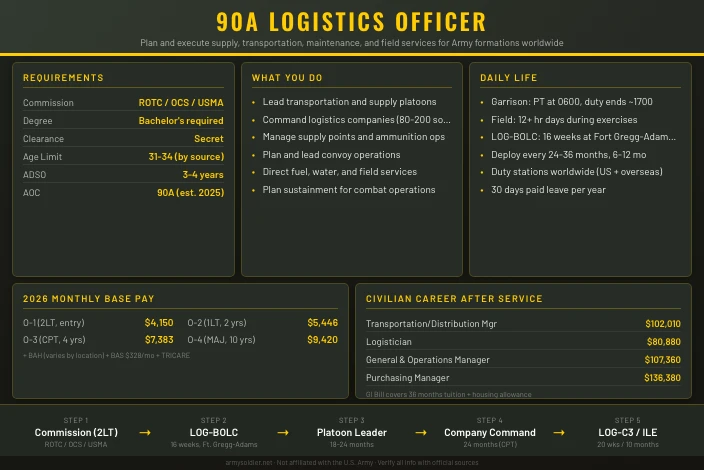
90A Logistics Officers plan, coordinate, and execute the full spectrum of Army sustainment operations – supply, transportation, maintenance, and field services – at every echelon from platoon to theater. As lieutenants, they lead platoons of 20 to 50 soldiers in transportation, supply, or maintenance units. As captains, they command companies and manage distribution networks serving an entire brigade. At field grade and above, they run logistics operations for divisions, corps, and theater sustainment commands spanning hundreds of units across multiple countries.
Command and Leadership Scope
A new 90A lieutenant typically leads a motor transport platoon, a field service platoon, a maintenance platoon, or a supply platoon, depending on assignment. The platoon sergeant, a Sergeant First Class (SFC), manages daily soldier accountability and technical proficiency. The lieutenant owns mission planning, convoy briefs, safety assessments, and reporting up the chain.
Company command at the CPT level is the career-defining assignment. A logistics company commander owns 80 to 200 soldiers across transportation, supply, ordnance, or quartermaster functions, and is accountable for every vehicle, weapon, and property book item in the formation. Between command assignments, captains serve as battalion staff officers – S4 (logistics officer), S3 (operations officer), or plans officer – coordinating sustainment for an entire battalion’s training and operational cycle.
At the major level, the shift moves to brigade and division staffs. Key positions include Support Operations Officer (SPO), Brigade S4, Battalion XO, and Division G-4 staff officer. By Lieutenant Colonel, officers command sustainment battalions of 400 to 700 soldiers or serve as logistics planners for division and corps headquarters.
The 2025 AOC Consolidation: What MILPER 25-204 Changed
Before May 2025, Army logistics officers commissioned into one of three separate branches, each with its own career track and Basic Officer Leader Course:
- 88A (Transportation): Movement of personnel and equipment by highway, rail, air, and sea; convoy operations, port operations, movement control
- 91A (Ordnance): Weapons systems maintenance, ammunition supply and management, equipment sustainment
- 92A (Quartermaster): Food service, petroleum and water distribution, aerial delivery, mortuary affairs, general supply, and field services
MILPER 25-204, published in May 2025, deleted AOCs 88A, 91A, and 92A for junior officers and consolidated them under the single AOC 90A (Logistics). The Army identified a training gap where junior officers lacked the cross-functional skills needed to operate in complex, multi-domain environments. The Office of the Deputy Chief of Staff, G-1 authorized the reclassification on March 11, 2025.
Officers now commission as 90A Logistics Officers regardless of which legacy corps organization they join. The three corps still exist – Transportation Corps (TC), Ordnance Corps (OD), and Quartermaster Corps (QM) – as organizational homes, but the AOC designation is uniform across all three. Second Lieutenants and First Lieutenants holding the old AOC codes were reclassified to 90A under this change.
Specific Roles and Designations
| Designation | Code | Description |
|---|---|---|
| Logistics Basic Branch | AOC 90A | All logistics commissioned officers (TC, OD, QM organizations) |
| Multifunctional Logistics | FA 90 | Functional Area for post-KD logistics broadening at operational/strategic levels |
| Operations Research | FA 49 | Quantitative analysis; post-KD option for math/systems-oriented officers |
| Force Management | FA 50 | Army force design and structure management |
| Systems Automation | FA 53 | Information systems management; post-KD option |
| Petroleum and Water | Skill Identifier | Available to officers with petroleum/water distribution experience |
| Aerial Delivery | Skill Identifier | For officers with rigging and airdrop qualifications |
Mission Contribution
The Army’s maneuver forces – armor, infantry, aviation – consume enormous quantities of fuel, ammunition, food, repair parts, and water every day of combat operations. A single armored brigade combat team burns through hundreds of tons of these commodities in a 24-hour period of sustained fighting. Logistics Officers are the officers who ensure that supply doesn’t fail.
In theater-opening operations, 90A officers manage port clearance, fuel point establishment, ammunition supply points, and ration distribution that allows the combat force to flow into a new theater and sustain itself. During large-scale combat operations, they run the distribution network from theater sustainment bases down to the last tactical mile. In redeployment, they reverse the entire system to move people and equipment home without losing accountability.
Technology, Equipment, and Systems
90A officers work across a broad set of platforms and information systems, drawing from the legacy of all three corps:
- Logistics Common Operational Picture (LCOP): Digital tracking for convoys, supply points, and distribution assets across the operational area
- Movement Tracking System (MTS): Satellite-based vehicle tracking for real-time convoy visibility
- PBUSE (Property Book Unit Supply Enhanced): Property accountability system for vehicles, weapons, and equipment
- SARSS (Standard Army Retail Supply System): Manages parts, supplies, and requisitions at the unit level
- GCSS-Army (Global Combat Support System): The enterprise resource planning system that integrates maintenance, supply, and financial management across the Army
- Petroleum Distribution Systems: Tanker management, HEMTT fuel vehicles, and bulk petroleum infrastructure
- Ammunition Management Systems: Supply point operations, ammunition reporting, and accountability tools for ordnance missions
Salary and Benefits
90A officers draw base pay, housing allowances, and subsistence allowances from day one. The combined package – especially early in a career – is competitive with private-sector logistics roles.
Officer Base Pay (2026)
All figures are monthly basic pay from DFAS 2026 pay tables. A 3.8% raise took effect January 1, 2026.
| Grade | Rank | Under 2 Yrs | 4 Yrs | 6 Yrs | 8 Yrs | 10 Yrs |
|---|---|---|---|---|---|---|
| O-1 | 2LT | $4,150 | $5,222 | – | – | – |
| O-2 | 1LT | $4,782 | $6,485 | $6,618 | – | – |
| O-3 | CPT | $5,534 | $7,383 | $7,737 | $8,126 | $8,376 |
| O-4 | MAJ | $6,295 | $7,881 | $8,332 | $8,816 | $9,420 |
| O-5 | LTC | $7,295 | $8,894 | $9,250 | $9,461 | $9,929 |
| O-6 | COL | $8,751 | $10,245 | $10,284 | $10,725 | $10,784 |
Basic pay is only part of the picture. Officers also receive Basic Allowance for Subsistence (BAS) of $328.48 per month and Basic Allowance for Housing (BAH) based on duty station and dependency status. At Fort Gregg-Adams, Virginia, an O-3 with dependents receives approximately $2,127 per month in BAH; without dependents, around $2,007. Both BAS and BAH are tax-free, which meaningfully increases total effective compensation compared to a civilian salary of the same dollar amount.
Special Pay and Bonuses
90A officers do not receive aviation or dive pay unless cross-assigned to those specialty roles. Officers serving in special duty assignments may qualify for Special Duty Assignment Pay (SDAP), ranging from a few hundred to over a thousand dollars per month depending on the billet.
Logistics is a sustainment branch with stable manning, so large-scale accession bonuses are less common than in critically short fields. Retention bonus availability changes with Army manning requirements. Check current bonus status with your ROTC battalion or OCS company commander before making financial plans around a bonus.
Additional Benefits
Active duty officers receive TRICARE Prime at zero cost – no enrollment fee, no copays for in-network care, full medical, dental, vision, and prescription coverage for the officer and dependents. The family catastrophic cap is $1,000 annually.
The Blended Retirement System (BRS) applies to officers commissioned after January 1, 2018. BRS combines a 20-year pension at 40% of high-36 average basic pay with TSP matching: the government automatically contributes 1% of basic pay from day one, then matches 100% of the first 3% you contribute and 50% of the next 2%, for a maximum government match of 5% starting at year three.
Officers can access fully funded graduate school through competitive Army programs, plus Federal Tuition Assistance of up to $4,500 per year for off-duty coursework. The Post-9/11 GI Bill is transferable to dependents after six years of service with a four-year additional obligation.
Work-Life Balance
Garrison life for logistics officers means structured duty hours – PT at 0600, duty ending around 1700 on normal days. The tempo spikes during combat training center rotations, major exercises, and pre-deployment workups, when 12-hour days extend for weeks. Field training in logistics units often involves sustained operations: fuel point operations, supply point runs, and convoy missions running around the clock.
Officers receive 30 days of paid leave per year. Taking leave requires deconfliction with unit readiness cycles, but the time is there if you plan around it. The largest lifestyle cost is the PCS cycle – logistics officers move every two to three years on average.
Qualifications and Eligibility
Commissioning Sources
The 90A AOC is accessible through all three commissioning pathways. No separate application or branch-specific prerequisite exists beyond the standard commissioning requirements.
| Source | Academic Requirement | GPA Minimum | Age Limit | Branch Process |
|---|---|---|---|---|
| USMA (West Point) | 4-year degree awarded at graduation | Competitive; no hard floor | Commission by age 31 | Branch assignment via Order of Merit List (OML) |
| ROTC | Bachelor’s degree from accredited institution | Generally 2.0; competitive branches require higher | Commission before age 31 | OML-based at national level |
| OCS | Bachelor’s degree before entry | No Army minimum; competitive applicants typically 3.0+ | Commission before age 34 (waivable) | Board and OML process |
Logistics is generally a mid-tier branch in OML competition. Combat arms branches (Infantry, Armor, Field Artillery) draw the top OML performers who specifically seek them. Sustainment – particularly after the 90A consolidation – attracts officers who want operational leadership in a field with strong civilian transitions. Officers who rank logistics highly in their branch preferences do not typically need top-quartile OML standing to receive it, though strong OML candidates do commission into 90A by choice.
Test Requirements
Commissioned officers do not take the ASVAB. That test applies to enlisted candidates and OCS applicants coming from the enlisted ranks; college graduates commissioning through ROTC or USMA are not required to take it. The relevant screening for commissioning is the physical fitness standard, medical evaluation, and academic record.
90A is not an aviation branch, so the SIFT (Selection Instrument for Flight Training) is not required. Officers assigned to aviation liaison roles or who later seek aviation cross-training would need SIFT scores, but that is a separate process after commissioning.
Branch Selection and Assignment
For ROTC and USMA officers, branching runs through the Officer Merit List (OML) – a combined ranking of academic performance, physical fitness scores, leadership ratings, and extracurricular achievement. A higher OML rank means more choices. Logistics is available across the OML range; it is not a branch that requires a top-percentile rank to access.
OCS officers branch through a board process weighing candidate performance and branch availability. 90A slots are regularly available at OCS given the Army’s sustained need for sustainment officers.
Branch detailing – where an officer serves in one branch before permanently transferring to another – is less common for logistics officers than for combat arms. Sustainment branches typically have enough officers to staff their own platoon leader billets without pulling from other branches.
Upon Commissioning
All new officers commission as Second Lieutenant (2LT, O-1). The standard Active Duty Service Obligation (ADSO) is four years for ROTC scholarship recipients. Non-scholarship ROTC and OCS officers typically incur a three-year obligation, though the exact terms appear in each commissioning contract. Officers who attend Army-funded graduate school or branch-specific specialty training incur additional ADSOs on top of the base obligation.
A Secret security clearance is required for 90A officers. The background investigation is initiated at commissioning; interim clearances allow access to SECRET-level information while the full investigation is pending. Officers with significant foreign contacts, financial issues, or foreign travel should discuss their background with a recruiter early in the process, as clearance adjudication can affect assignment and course start dates.
OCS candidates can find a focused GT study plan in our ASVAB for OCS guide.
Work Environment
Setting and Schedule
Logistics officers work in several distinct environments depending on career phase. As a lieutenant, most working hours are split between the motor pool, the supply room, or the field: tracking vehicle readiness, running sustainment rehearsals, and executing distribution missions. In field exercises, the work shifts to operations centers and supply routes.
As a company commander, the environment tilts toward the operations center and the commander’s office, with regular visits to the motor pool and supply point to maintain commander’s presence and accountability. At major level and above, the work is almost entirely staff-driven: briefings, plans documents, battle rhythm events, and coordination calls across multiple echelons.
Deployed environments vary considerably. A lieutenant running convoys in a combat theater will spend weeks on the road. A major on a theater sustainment command staff will work in a forward operating base or logistics base with a relatively stable physical environment – but 12-hour days and a high operational tempo.
Leadership and Chain of Command
At the platoon level, the platoon sergeant is the most important relationship in the formation. A seasoned SFC guides new lieutenants through practical supply operations, maintenance management, and soldier care. The lieutenant owns mission planning, risk assessment, and reporting to higher. The two together run the platoon.
A company commander answers directly to the battalion commander. The First Sergeant (1SG) is the senior NCO partner – managing enlisted discipline, welfare, and daily accountability. The battalion XO and S3 drive training schedules and taskings; the commander executes and is accountable for results.
Staff vs. Command Roles
A typical 90A career rhythm: platoon leader (18 to 24 months), battalion staff (12 to 18 months), company command (24 months), majors-level staff assignments (battalion XO, brigade S4, support operations officer), and eventually battalion command at LTC. The two command billets – company and battalion – are where reputations are built and boards focus their scrutiny.
Broadening assignments between command phases include ROTC instructor duty, recruiting command, joint staff billets, and competitive Army fellowships at Congressional offices, think tanks, or the White House. These typically fall between the O-4 and O-5 career phases.
Job Satisfaction and Retention
Logistics officers who stay for a full career consistently cite the operational impact as their primary motivation. You can measure your work in concrete terms: readiness rates, tons of supplies delivered, units supported, missions enabled. The 90A consolidation has added a new dimension to that satisfaction – officers now develop expertise across transportation, ordnance, and quartermaster functions rather than being siloed in a single discipline.
Common reasons officers leave after their initial obligation include the PCS cycle’s toll on family stability, competition from a private-sector logistics industry that pays well for officers who leave at the four to six year mark, and frustration with the pace of military career decisions. Officers who stay long-term tend to value the team structure, the leadership responsibility that arrives early, and the direct path to senior management roles in the civilian sector when the time comes.
Training and Skill Development
Pre-Commissioning Training
All three commissioning sources provide foundational training before branch-specific instruction begins. ROTC cadets complete leadership labs, field exercises, and a summer leadership assessment at Fort Knox. USMA cadets go through four years of integrated military education with field training built in. OCS candidates attend the 12-week Officer Candidate School at Fort Moore (formerly Fort Benning), Georgia.
Logistics Basic Officer Leader Course (LOG-BOLC)
After commissioning, all 90A officers attend the Logistics Basic Officer Leadership Course (LOG-BOLC) at Fort Gregg-Adams, Virginia. Fort Gregg-Adams (formerly Fort Lee, renamed 2023) is home to the Army Sustainment University (ASU) and the Combined Arms Support Command (CASCOM), housing all three legacy corps schoolhouses under one organization.
LOG-BOLC is a 16-week course that replaced the separate Transportation, Ordnance, and Quartermaster BOLCs with a single integrated curriculum. Officers from all three corps organizations attend together, developing the multifunctional perspective the Army identified as missing in the legacy single-branch courses.
| Phase | Focus | Key Content |
|---|---|---|
| 1: Army Profession | Leadership foundations | Communication, finance, ethics, legal responsibilities, UCMJ |
| 2: Building Readiness | Platoon leadership | Military operations, unit readiness, property accountability |
| 3: Mission Preparation | Deployment operations | Convoy planning, pre-deployment procedures, hands-on exercises |
| 4: Large-Scale Combat Ops | Tactical logistics | Brigade and echelon-above-brigade sustainment, multi-domain planning |
| 5: Mission Execution | LOGEX capstone | Full logistics exercise applying all prior modules |
| 6: Logistics Profession | Career development | Job-centric electives, staff rides, sustainment systems orientation |
Physical requirements at LOG-BOLC go beyond the standard AFT: students must complete a 4-mile run under 36 minutes and a 12-mile foot march in addition to meeting AFT standards. Height and weight standards under AR 600-9 are enforced throughout the course.
Professional Military Education (PME)
PME runs throughout an officer’s career and is required for promotion consideration at each level.
Logistics Captain’s Career Course (LOG-C3): Attended around the 4 to 6 year mark, typically following company command. The LOG-C3 is a 20-week course taught at Fort Gregg-Adams. It deepens operational planning, introduces brigade and division-level sustainment management, and prepares officers for major-level staff positions.
Intermediate Level Education (ILE/CGSC): Selected majors attend the Command and General Staff College at Fort Leavenworth, Kansas, a 10-month program focused on joint and operational planning at division, corps, and joint task force level. Selection is competitive and tied to promotion board performance. Non-resident ILE (MEL 4) is available for officers not selected for the resident course.
Army War College (AWC): For colonels and senior lieutenant colonels being developed for general officer consideration. Attendance is highly selective and reflects a record of sustained superior performance across the career.
Additional Schools and Training
90A officers have access to additional training that builds tactical credibility and broadens assignment options:
- Airborne School (Fort Moore, GA): 3-week parachute qualification; opens assignment options with airborne sustainment units (XVIII Airborne Corps, 82nd Airborne)
- Air Assault School (Fort Campbell, KY): 10-day course covering sling load operations and helicopter assault; relevant for supporting aviation and light infantry units
- Support Operations Course (Phases I and II): Required for officers competing for sustainment brigade command; covers operational and strategic logistics planning
- Unit Movement Officer Certification: Required for officers responsible for deploying units by military air or surface movement
- Petroleum Officer Course: Available for officers assigned to petroleum distribution roles
- Army Competitive Graduate School Program: Fully funded graduate degrees for competitively selected officers, typically between O-3 and O-4
Before OCS, you need a qualifying GT score — see our ASVAB for OCS guide.
Career Progression and Advancement
Career Path
The 90A career follows a structured track from platoon leader through battalion command, with two key developmental positions – company command and battalion command – that boards scrutinize most closely.
| Rank | Grade | Typical Time in Service | Key Developmental Position |
|---|---|---|---|
| 2LT | O-1 | 0-2 years | Platoon Leader (PL) |
| 1LT | O-2 | 2-4 years | Platoon Leader / Company XO |
| CPT | O-3 | 4-11 years | Company Commander |
| MAJ | O-4 | 11-17 years | Battalion XO / Support Ops Officer / Brigade S4 |
| LTC | O-5 | 17-23 years | Battalion Commander |
| COL | O-6 | 23-28 years | Brigade Commander / Senior Staff |
Desired career experiences for 90A officers include platoon leader, company commander, battalion or assistant brigade S4, support operations officer, plans officer, CSSB or BSB S3, and operations officer in a brigade plans section. Officers who develop breadth across these roles – rather than staying in a single functional track – are most competitive for senior selection.
Promotion System
Promotions from 2LT to CPT are essentially automatic with time in service, provided no adverse actions exist. The O-4 (Major) board is the first genuinely competitive gate – Army-wide promotion rates to Major typically run 70% to 80%, varying by year and branch.
O-5 (Lieutenant Colonel) rates drop further, often to the 50% to 70% range. Boards at this level examine OERs, command selection outcomes, school completion, and senior rater assessments. Officers without completed company command and at least one strong staff tour rarely compete successfully for LTC.
O-6 (Colonel) selection is the most competitive gate – roughly 40% to 50% of eligible officers are selected – and battalion command selection at the O-5 level is effectively a prerequisite for serious consideration.
Building a Competitive Record
A competitive 90A file typically combines:
- A top-block OER from a battalion commander during the platoon leader tour
- Early and strong company command with quantified outcomes (readiness rates, mission accomplishment, zero UCMJ actions)
- Strong CCC performance
- At least one joint or broadening assignment before the O-4 board
- A completed ILE by the time the O-5 board convenes
Officers who take broadening assignments – ROTC instructor, recruiting command, joint staff, or a competitive fellowship – differentiate themselves from peers who spend every tour in line units. Physical fitness scores above the minimum, especially during OER-rated periods, remain visible indicators of officer standards.
Functional Areas and Branch Transfers
After company command, officers may transfer to Functional Areas (FA), which draw from multiple branches and open staff pathways outside the logistics chain:
- FA 49: Operations Research / Systems Analysis – quantitative work at Army secretariat and joint staff
- FA 50: Force Management – Army force design and organizational structure
- FA 53: Systems Automation – information systems management
- FA 90: Multifunctional Logistics – broad logistics leadership at operational and strategic echelons
Branch transfers (VTIB) are available subject to Army manning requirements and HRC approval, typically after completing KD positions.
Physical Demands and Medical Evaluations
Logistics is not a combat-coded branch, but 90A officers operate in austere field environments, lead convoys in contested areas, and are expected to set the physical standard for their formations.
All Army officers take the Army Fitness Test (AFT), which replaced the ACFT on June 1, 2025. The AFT has five events scored 0 to 100 points each, for a maximum of 500 points. The general passing standard is 60 points per event, totaling 300 points minimum.
AFT Minimum Passing Standards (Age Group 17-21)
| Event | Abbreviation | Male Minimum | Female Minimum |
|---|---|---|---|
| 3 Rep Max Deadlift | MDL | 60 pts | 60 pts |
| Hand Release Push-Up | HRP | 60 pts | 60 pts |
| Sprint-Drag-Carry | SDC | 60 pts | 60 pts |
| Plank | PLK | 60 pts | 60 pts |
| Two-Mile Run | 2MR | 60 pts | 60 pts |
| Total | 300 pts minimum | 300 pts minimum |
Standards are sex- and age-normed – the raw performance threshold for 60 points varies by gender and age bracket. 90A is a general support branch; the standard 300-point minimum applies. Logistics officers are not among the 21 designated combat MOSs required to meet the higher 350-point combat specialty standard. Officers scoring 465 or above are exempt from body composition standards for that testing cycle.
LOG-BOLC adds physical demands beyond the standard AFT: a 4-mile run under 36 minutes and a 12-mile foot march are required during the course. Officers arriving physically under-prepared for these events risk academic setbacks.
Medical and Branch-Specific Requirements
90A officers meet the standard Army medical commissioning requirements. No aviation physical, dive physical, or special medical evaluation is required. Officers with color vision deficiencies should verify map reading requirements with their recruiter; logistics does not have the strict color vision standards that aviation carries.
Deployment and Duty Stations
Deployment Details
90A officers deploy with sustainment brigades, combat sustainment support battalions (CSSBs), theater sustainment commands (TSCs), and expeditionary sustainment commands (ESCs). These are the logistics formations attached to every major Army combat force.
Deployment tempo is moderate to high. Sustainment units support every major combat and contingency operation. Over a 20-year career, a 90A officer can expect three to five deployments of six to twelve months each. Active-duty units organic to sustainment brigades deploy more frequently than reserve component counterparts.
Deployed missions include running supply point operations, managing ammunition supply points, coordinating fuel distribution to forward units, overseeing field feeding operations, managing motor pool readiness in deployed conditions, and in some cases directing port operations or intermediate staging base (ISB) activities during theater opening.
Duty Station Options
Fort Gregg-Adams is the branch schoolhouse, but 90A officers serve across the Army’s worldwide installation network. Primary active-duty assignments include:
- Fort Gregg-Adams, VA: Army Sustainment University; all three corps schoolhouses; instructor and staff assignments
- Fort Campbell, KY: 101st Airborne Division sustainment; high deployment tempo; air assault qualified units
- Fort Carson, CO: 4th Infantry Division sustainment; mountain and high-altitude conditions
- Fort Riley, KS: 1st Infantry Division sustainment; CONUS-based training rotations
- Fort Bliss, TX: 1st Armored Division sustainment; large vehicle fleet operations
- Fort Cavazos, TX: III Corps sustainment; large corps-level logistics formations
- Fort Moore, GA: XVIII Airborne Corps and 3rd Infantry Division sustainment
- Overseas (Germany, South Korea, Japan, Italy): USAREUR-AF and INDOPACOM sustainment units
Officer assignments are managed by HRC branch managers. Officers submit preference sheets, and HRC balances Army needs against preferences and career development requirements. Logistics officers generally have more installation options than combat arms officers, since sustainment formations exist at most large Army installations.
Risk, Safety, and Legal Considerations
Job Hazards
Logistics officers face distinct risks that differ by assignment type. Ground convoy operations carry real danger – improvised explosive devices, vehicle accidents, and rollover incidents have caused casualties in every recent conflict. Officers leading convoys are directly responsible for route planning, vehicle spacing, rollover protection standards, and engagement protocols. Ordnance-mission officers work around ammunition, explosives, and munitions that require strict safety protocols at every handling step. Petroleum officers manage large quantities of flammable materials in field conditions where spills, fires, and vapor ignition are genuine hazards.
Even in garrison, motor pool operations involve heavy vehicle movements, crane operations, and fuel handling. The accident risk in a logistics unit does not disappear when the formation is not deployed.
Safety Protocols
90A officers use the Composite Risk Management (CRM) process for all vehicle, supply, and field operations. Before a convoy, a formal risk assessment covers route conditions, crew rest status, vehicle maintenance state, weather, and threat level. Before an ammunition handling operation, hazard controls are applied to every step of the process.
The Army’s safety programs provide the framework; the officer applies it. OERs reflect an officer’s ability to execute missions safely, not just complete them. A serious accident tied to negligent risk management can end a career regardless of tactical success in other areas.
Legal and Command Responsibility
Commanders hold command authority under the Uniform Code of Military Justice (UCMJ). Every action your soldiers take – on duty and in some cases off duty – falls within your accountability as a commander. A vehicle accident caused by negligence, a property loss, or an ammunition discrepancy can trigger a commander’s inquiry or a 15-6 investigation, even when you were not personally present.
Relief for cause is career-ending at any level. Poor equipment readiness, a serious accident attributed to officer negligence, financial fraud in a supply operation, or a toxic command climate are all grounds for relief. Company commanders are under constant scrutiny for readiness rates, property accountability, and accident prevention – three metrics that appear in OER bullets and follow an officer’s reputation across the branch.
Impact on Family and Personal Life
Family Considerations
A logistics career means frequent moves. Officers typically PCS every two to three years, which disrupts spouse employment, children’s schooling, and community continuity. Fort Gregg-Adams, Fort Campbell, and Fort Carson are relatively spouse-employment-friendly given their proximity to civilian labor markets, but some assignments – overseas tours, remote installations – offer fewer civilian job opportunities for partners.
The Army’s Army Community Service (ACS) and Family Readiness Groups (FRGs) operate at every installation. These organizations provide financial counseling, employment assistance, childcare referrals, and deployment support. The quality varies by installation and unit; they are worth using when you need them.
TRICARE Prime covers the entire family at no premium cost while on active duty. The challenge is continuity of care across moves – families rebuild provider relationships after every PCS. Families with complex medical needs benefit from mapping the TRICARE network at the gaining installation before each move.
Dual-Military Couples
The Army manages dual-military officer couples through the Join Spouse program, which attempts to co-locate both partners when compatible assignments exist and requests are submitted. Success is not guaranteed. Logistics officers at large sustainment installations have better outcomes than officers in niche or overseas assignments, since major bases tend to have billets across multiple branches.
Extended field exercises – Combat Training Center rotations at Fort Irwin (National Training Center) and Fort Polk (Joint Readiness Training Center) – can total 60 to 90 days away from home per year even without a deployment. Officers considering a long-term career should plan PCS moves 12 months out, use the housing office at the gaining installation, and factor BAH differentials between stations into financial planning.
Reserve and National Guard
Logistics is fully available in both the Army Reserve and Army National Guard. Sustainment units exist across virtually every state’s National Guard structure, and the Army Reserve maintains transportation battalions, CSSBs, and sustainment brigades nationwide.
Component Comparison
| Category | Active Duty | Army Reserve | Army National Guard |
|---|---|---|---|
| Commitment | Full time | 1 weekend/month + 2 weeks/year | 1 weekend/month + 2 weeks/year |
| Monthly Pay (O-3, under 2 yrs) | $5,534 | ~$738/drill weekend | ~$738/drill weekend |
| Healthcare | TRICARE Prime ($0 premium) | TRICARE Reserve Select ($57.88/mo individual; $286.66/mo family) | TRICARE Reserve Select (same rates) |
| Education Benefits | Full GI Bill + TA ($4,500/yr) | MGIB-SR ($493/mo) or Post-9/11 GI Bill if mobilized; TA available | State tuition waivers (vary) + federal TA + MGIB-SR |
| Deployment Tempo | Moderate to high | Periodic mobilizations | State emergencies + federal mobilizations |
| Command Opportunities | Company and battalion billets | Company and battalion billets available | Company and battalion billets available |
| Retirement | 20-year pension (BRS) | Points-based, collect at age 60 | Points-based, collect at age 60 |
Commissioning in Reserve and Guard
Guard and Reserve logistics officers commission through the same pathways: ROTC with a Reserve component contract, state OCS programs for the National Guard, or transfer from the active component after completing an ADSO. Some states offer direct commission opportunities for prior-service logistics NCOs who hold a bachelor’s degree.
Active-duty officers can request transfer to the Guard or Reserve after completing their obligation by applying through HRC and the gaining unit. 90A officers are competitive for these slots given the branch’s presence across both components.
Drill and Training Commitment
The standard schedule is one weekend per month (four drill periods) plus a two-week Annual Training. Logistics units often conduct convoy certification exercises, supply point operations, and equipment readiness assessments during AT and scheduled training assemblies. Some units schedule additional training assemblies for these certifications beyond the standard monthly weekend.
Reserve and Guard officers came under AFT administrative enforcement as of June 1, 2026, meaning AFT scores now directly affect promotion and retention actions in the Reserve components.
Civilian Career Integration
Reserve and Guard logistics officers often hold civilian careers in supply chain management, fleet management, procurement, transportation, or manufacturing operations – roles that pair cleanly with the 90A skill set. Civilian employers in logistics frequently value the military background; the skills transfer without translation. Officers who build a Reserve commission alongside a civilian logistics career can develop a genuinely synergistic track.
USERRA (Uniformed Services Employment and Reemployment Rights Act) protects every Reserve and Guard member: civilian employers must reemploy you after military leave of up to five cumulative years, cannot deny promotions or benefits based on military service, and must offer health insurance continuation during military leave.
PME in Reserve and Guard
Reserve and Guard logistics officers can attend the LOG-C3, ILE, and other PME schools through competitive selection. Promotion boards in the Reserve components evaluate PME completion the same way active-duty boards do. The timeline is longer – Reserve officers typically spend more years in each grade – but the career gates are the same.
Post-Service Opportunities
Transition to Civilian Life
90A officers leave the Army with something private-sector logistics employers actively want: real operational experience managing large teams, complex supply chains, and significant equipment assets under demanding conditions. The logistics and supply chain industry is one of the largest sectors of the American economy, and it has a persistent shortage of managers who have actually run operations rather than just studied them.
The Army’s Soldier for Life – Transition Assistance Program (SFL-TAP) runs at every major installation. It covers resume writing, federal hiring guidance, interview preparation, and employer network connections. Officers typically begin TAP 12 to 24 months before their terminal leave date.
Hiring Our Heroes fellowships allow transitioning officers to work inside a civilian company for 12 weeks near the end of active service, building relationships and testing career paths before separating. Logistics officers frequently place in supply chain, operations, procurement, and fleet management roles through this program.
Civilian Career Prospects
The Bureau of Labor Statistics tracks several occupations that match 90A officer experience directly:
| Civilian Role | Median Annual Salary | Job Outlook (2024-2034) |
|---|---|---|
| Transportation, Storage & Distribution Manager | $102,010 | +6% (faster than average) |
| Logistician | $80,880 | +17% (much faster than average) |
| General and Operations Manager | $107,360 | +7% (faster than average) |
| Industrial Production Manager | $115,760 | +2% (as fast as average) |
| Purchasing Manager | $136,380 | +2% (as fast as average) |
Officers who complete a full career and retire at O-5 or O-6 often move directly into director-level or VP-level logistics roles at major retailers, defense contractors, and third-party logistics providers, where 20 years of officer experience carries real weight in hiring decisions.
Certifications and Graduate Education
Military training does not automatically convert to civilian certifications, but the knowledge base transfers well. Former 90A officers commonly pursue:
- APICS CSCP (Certified Supply Chain Professional)
- Certified in Logistics, Transportation and Distribution (CLTD)
- Project Management Professional (PMP) – particularly relevant for officers with staff planning experience
- Certified Professional in Supply Management (CPSM) – for officers with procurement and contracting exposure
- Certified Petroleum Specialist – for officers with significant petroleum distribution experience
The Post-9/11 GI Bill covers 36 months of tuition and housing allowance for school. Officers with six years of service can transfer the benefit to dependents with a four-year additional obligation; without transfer, the full benefit remains available for personal use after separation.
Is This a Good Job for You? The Right (and Wrong) Fit
Who Thrives Here
Officers who do well in 90A share a set of practical traits. They are comfortable with ambiguity and changing requirements – a supply route can close because of enemy activity, a vehicle breaks down mid-mission, or a resupply request comes in with four hours’ notice. The officer adapts and solves the problem. They like concrete, measurable results: readiness rates, tonnage delivered, units supported, zero accidents.
The 90A consolidation makes this branch particularly attractive to officers who want breadth rather than depth in a single specialty. You will train in transportation, supply, maintenance, and field services – not just one of them. Officers who appreciate the systems-level view of how a military formation sustains itself find the expanded scope genuinely engaging.
Backgrounds that translate well include operations management, industrial engineering, business logistics, supply chain management, agriculture (relevant to QM food service background), and prior enlisted service in CMF 88, 91, or 92.
Who Struggles
Officers who want direct combat leadership – leading soldiers in close contact with enemy forces – will find logistics operations behind the forward edge unsatisfying. Convoys take casualties in contested environments, and logistics officers do face real danger. But the mission is distribution, not maneuver. If your primary goal is Infantry or Special Forces-style combat leadership, logistics is the wrong branch.
Officers who resent paperwork will struggle in every logistics assignment. Property accountability, supply documentation, maintenance records, and ammunition reports are not peripheral to the job – they are the mechanism by which the Army maintains accountability for billions of dollars of equipment and material. Commanders who neglect documentation get investigated. Attention to administrative detail is not optional.
The PCS cycle is a genuine filter at the O-3 to O-4 transition. Officers with spouses in established careers, children in school, or family caregiving obligations often find the two- to three-year move cycle increasingly difficult to sustain.
Career and Lifestyle Alignment
For officers willing to serve 10 to 20 years, 90A offers one of the clearest civilian transition paths in the Army. The logistics industry is large, recruits veterans at every level, and pays well for managers with real operational experience. A 90A officer who separates after company command at the CPT level has a credible resume for mid-level supply chain or operations manager roles. One who retires at O-5 with battalion command can step into a director or senior manager position in a major logistics company without needing an intermediate civilian proving period.
The branch is a strong fit for officers who want leadership responsibility that scales with career progression, a strong post-service economic landing, and the operational satisfaction of keeping a military force functioning in the field.
More Information
Your ROTC battalion or OCS company commander is the right first contact for current branching guidance. For 90A specifics, the Army Sustainment University at Fort Gregg-Adams publishes LOG-BOLC schedules, cadet branching resources, and officer career development information. HRC officer assignments manages branch preferences and functional area eligibility. The Army Transportation School maintains the 90A officer career page with duty station options and career milestone information.
- OCS candidates: prepare for GT 110 with our ASVAB for OCS study guide
This site is not affiliated with the U.S. Army or any government agency. Verify all information with official Army sources before making enlistment or career decisions.
Explore more Army officer careers including related sustainment roles like the 36A Finance Officer and the 42B Adjutant General Officer.