Army Aeromedical Evacuation Officer (67J)
An Army helicopter may need to reach an injured soldier long before a hospital can. The officer responsible for the aircraft and its mission must understand both flight operations and medical evacuation. That is the work of an Army aeromedical evacuation officer, known by Area of Concentration (AOC) 67J.
The 67J officer is a commissioned aviator in the Army Medical Service Corps, not an enlisted flight medic or a nurse. The officer’s work includes flying, leading flight crews and planning the movement of patients. The route requires military officer training and aviation qualifications, so it is different from joining a general hospital administration specialty.
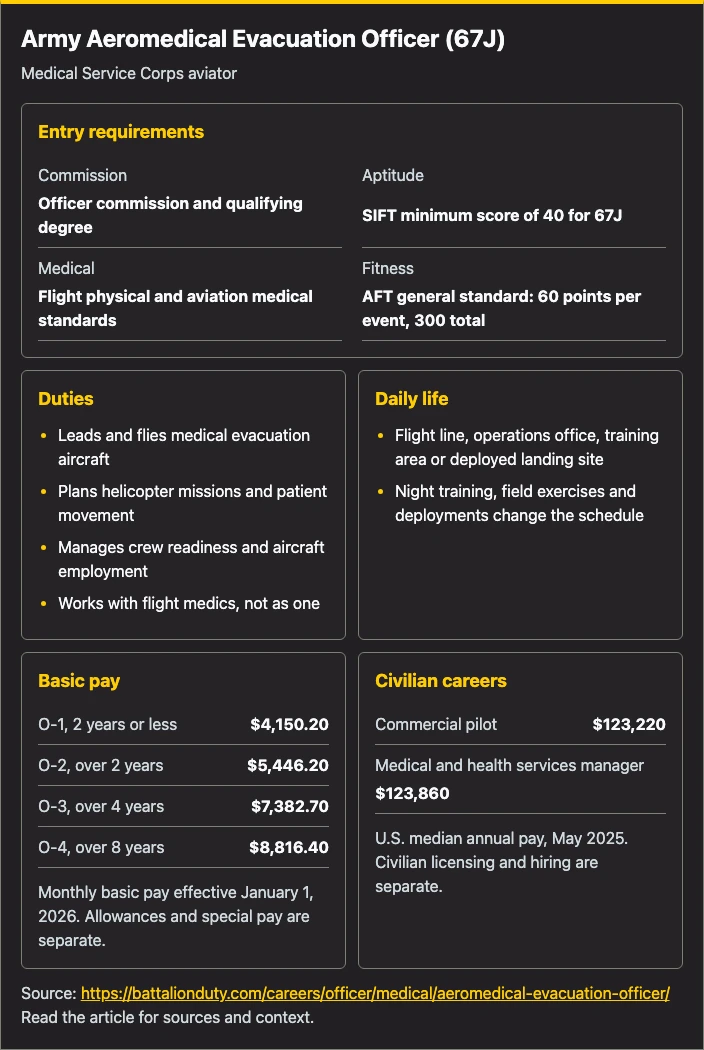
Entry requirements
- Commission
- Officer commission and qualifying degree
- Aptitude
- SIFT minimum score of 40 for 67J
- Medical
- Flight physical and aviation medical standards
- Fitness
- AFT general standard: 60 points per event, 300 total
Duties
- Leads and flies medical evacuation aircraft
- Plans helicopter missions and patient movement
- Manages crew readiness and aircraft employment
- Works with flight medics, not as one
Daily life
- Flight line, operations office, training area or deployed landing site
- Night training, field exercises and deployments change the schedule
Basic pay
- O-1, 2 years or less
- $4,150.20
- O-2, over 2 years
- $5,446.20
- O-3, over 4 years
- $7,382.70
- O-4, over 8 years
- $8,816.40
Monthly basic pay effective January 1, 2026. Allowances and special pay are separate.
Civilian careers
- Commercial pilot
- $123,220
- Medical and health services manager
- $123,860
U.S. median annual pay, May 2025. Civilian licensing and hiring are separate.
Source: https://battalionduty.com/careers/officer/medical/aeromedical-evacuation-officer/
Read the article for sources and context.
On this page
Job Role and Responsibilities
An Army 67J Aeromedical Evacuation Officer leads and flies medical evacuation aircraft, plans helicopter missions, and supports the safe movement of patients, medical teams and supplies. This commissioned specialty belongs to the Medical Service Corps, even though its officers train as Army aviators. Officers manage crew readiness, aircraft employment and mission decisions in both field and home-station settings.
The role sits within the Army Medical Service Corps. Its primary work is medical aviation, rather than the hospital administration duties performed by other officers in the corps.
Flight and leadership duties
A 67J officer may command a flight platoon, supervise a flight section or serve on a medical aviation unit’s operations staff. The exact number of soldiers supervised depends on the assigned billet, unit and grade. Junior officers should expect to learn flight operations while also handling the routine responsibilities of leading soldiers: training, maintenance coordination, risk decisions and personnel readiness.
A medical crew includes people with different jobs. Pilots control the aircraft and make flight decisions. Medical personnel provide patient care. On a mission, these duties have to work together, but becoming a 67J does not by itself qualify an officer to provide the care delivered by a flight medic, physician or nurse.
Codes and related roles
| Code or role | Classification | What it means |
|---|---|---|
| 67J | Commissioned AOC, Medical Service Corps | Aeromedical evacuation leadership and aviation duties |
| 70B | Commissioned AOC, Medical Service Corps | Entry-level health services administration, not the same flight qualification |
| 15A | Commissioned Aviation branch AOC | Broader Aviation branch career, not a substitute name for 67J |
| Flight medic | Enlisted medical role | Patient care in flight rather than a 67J commission |
The Army Medical Service Corps career guidance identifies 67J as a separate aeromedical evacuation specialty. That classification is the reason the role belongs on the medical career side of the site, despite its aircraft work.
Mission and equipment
An evacuation plan addresses where the aircraft will launch, how it will reach the pickup location, where a patient can be transferred and what the unit must do if weather, enemy activity or equipment problems change the plan. A 67J officer coordinates with medical planners, aviation crews and supported units. This work matters before an aircraft lifts off as much as it does in flight.
Army medical evacuation units operate rotary-wing aircraft, including Black Hawk medical evacuation variants. Aircraft assignment, equipment and specific duties depend on the unit. Officers also work with flight planning tools, radios, navigation equipment and the maintenance records needed to keep an aircraft ready. The officer is accountable for safe military flight operations within the assigned authority, not for independently diagnosing patients.
Salary and Benefits
Military basic pay
Army basic pay is based on pay grade and years of creditable service, not the 67J code. The examples below are monthly rates effective January 1, 2026. They show different service brackets rather than a guaranteed promotion schedule.
| Rank | Years of service shown | 2026 monthly basic pay |
|---|---|---|
| Second Lieutenant, O-1 | Two years or less | $4,150.20 |
| First Lieutenant, O-2 | Over two years | $5,446.20 |
| Captain, O-3 | Over four years | $7,382.70 |
| Major, O-4 | Over eight years | $8,816.40 |
The amounts come from the 2026 Defense Finance and Accounting Service officer pay table. The table is basic pay only. Housing and subsistence allowances, when eligible, are separate. Flight-related incentive pay can also depend on aviation service, orders and current qualification rules. No fixed 67J amount is assumed here. Bonuses and retention offers must be verified for the actual fiscal-year program and individual agreement.
Benefits and schedule
Eligible service members receive military healthcare, and benefits for dependents vary by plan and status. Basic Allowance for Housing depends on location, rank and dependent status. Under the Blended Retirement System, qualifying long-term service can earn retired pay alongside eligible government contributions to the Thrift Savings Plan. The exact benefit depends on entry date, component and service history.
Medical aviation work does not follow a regular office calendar. Flight crews have scheduled training and duty periods, but they can also respond to urgent missions. Night training, field exercises, temporary duty and deployment can change sleep and family routines. An officer considering this career should weigh the flight mission against those less predictable hours.
Qualifications and Eligibility
How officers enter the specialty
Candidates need to qualify for an Army officer commission and meet the medical and aviation standards that apply to 67J. The Army Reserve’s 67J recruiting description names college education, citizenship, flight medical screening and a supervised flight aptitude test as key parts of its pathway. That Reserve recruiting page is not proof that an identical age limit, application board or available slot applies to every Active Army candidate.
| Commissioning route | Degree and GPA | Age and medical screening | 67J-specific point to verify |
|---|---|---|---|
| ROTC | Qualifying bachelor’s degree, plus current school/program academic rules | Army officer standards plus aviation medical screening | Availability of a 67J placement and flight training |
| U.S. Military Academy | Academy degree and its selection requirements | Applicable military and aviation standards | Current specialty allocation and flight selection |
| Officer Candidate School | Qualifying college degree and current OCS admission rules | Current OCS standards plus aviation medical screening | Whether the candidate can compete for a 67J slot |
| Approved in-service or component route | Program-specific academic and service rules | Route-specific standards | Flight school, clearance and unit availability |
A fixed minimum GPA, universal age cutoff or guaranteed 67J selection threshold is not established for all four routes by the sources reviewed here. Applicants should ask an Army officer recruiter or the relevant component aviation office for the controlling current criteria, especially if they have prior service.
Aptitude tests and flight medical requirements
The Selection Instrument for Flight Training (SIFT) is an aviation aptitude test, rather than a general Medical Service Corps test. The Army officer classification issued in December 2025 specifies a minimum SIFT score of 40 for initial award of 67J. That minimum is not a promise of selection or evidence of the score competitive applicants earn. Current program boards may add requirements. Passing the applicable flight test is only one part of the evaluation. The military flight physical is a separate screening process. A person who meets normal Army commissioning medical standards might still need further review for aviation duty. The Army also assesses security eligibility and the ability to complete the aviation training path.
Candidates preparing for a permitted SIFT attempt can review the site’s Army SIFT preparation guide. Applicants should confirm which version of the test and any retesting rules their recruiter uses before purchasing study materials.

Grade and service obligation
A new officer normally begins in the grade specified by the actual commissioning appointment, often second lieutenant for standard cadet or OCS programs. Aviation training can create additional service obligations beyond a basic commission. The required commitment depends on the current accession agreement and training completed. The candidate should request written obligation terms before signing. A general OCS or ROTC estimate is not enough for 67J.
Work Environment
The job can shift between a flight line, an operations office, a training area and a deployed landing site. A normal home-station day may involve mission planning, aircraft readiness meetings, simulator or flight training, and counseling enlisted soldiers. During an operation, the work is more immediate: crews coordinate pickup points, patient movement, weather decisions, aircraft availability and changes to the evacuation plan.
Medical aviation officers work with experienced noncommissioned officers, warrant officers, aircraft maintainers, flight medics and medical planners. The officer does not replace their technical expertise. A sound flight plan depends on input from maintainers about the aircraft, pilots about conditions and medics about the patient’s transport needs.
Commissioned 67J officers may progress from flight and small-unit leadership to staff positions that plan evacuation support across larger formations. Selection for command or specialized assignments is competitive. No single percentage of time in the cockpit applies to all ranks or units, and published evidence reviewed here does not establish an occupation-wide satisfaction or retention rate.
Training and Skill Development
Army officer training and flight training develop different abilities. Military officer training covers leadership, Army operations and responsibility for soldiers. Aviation training teaches aircraft systems, flight safety and mission procedures. Later medical evacuation instruction connects flying to the task of transporting casualties.
| Training stage | Location or format | Duration | Main purpose |
|---|---|---|---|
| Commissioning preparation | ROTC, academy, OCS or approved in-service route | Set by route | Earn a commission and meet officer standards |
| Medical Service Corps officer training | Army medical officer course as assigned | Current course schedule required | Army medical organization and officer duties |
| Rotary Wing Aviator Course | Army aviation training system | Current class schedule required | Flight skills, aircraft procedures and aircrew qualification |
| Essential Medical Training for AMEDD Aviators (2C-F7) | Army-designated course | Current class schedule required | Medical aviation doctrine and mission qualification |
| Other required flight and survival training | Designated military courses | Route and unit dependent | Flight readiness, survival and operational risk |
| Unit progression and flight readiness | Assigned aviation unit | Continuing | Mission qualification, crew proficiency and safety |
The Army’s Medical Service Corps classification confirms the role and branch placement. The exact sequence and length of courses must come from current orders for the candidate’s accession pathway. A broad statement that all medical officers attend an identical ten-week course would be misleading for an aviator.
As officers advance, the Captain’s Career Course and later Army education become relevant according to grade, branch and eligibility. Flight training continues through qualification checks and unit standards. School attendance, advanced aircraft assignments and command selection are not guaranteed merely by holding the 67J code.
Career Progression and Advancement
The rank table shows possible responsibilities rather than a promised timeline. Assignment choices are limited by unit needs, aviation qualification, service record and available billets.
| Grade | Possible work as a 67J officer | Development focus |
|---|---|---|
| O-1, Second Lieutenant | Initial officer and aviation training, then junior unit duties | Safe flight habits and basic leadership |
| O-2, First Lieutenant | Flight operations and small-team leadership | Crew coordination and mission experience |
| O-3, Captain | Flight platoon or company-level duties, or planning staff work | Operational leadership and military education |
| O-4, Major | Battalion-level plans, operations or support duties | Managing multiple crews and missions |
| O-5, Lieutenant Colonel | Senior medical aviation command or staff, if selected | Unit readiness and larger operations |
| O-6, Colonel | Senior assignments for a limited number of officers | Policy, command and resource decisions |
Promotion depends on the Army’s board system, required education, evaluations and continued qualification. No reliable current 67J-only promotion rate was established here. An officer who wants to remain competitive should maintain aviation proficiency, document operational performance, complete required schools and show sound judgment in safety-critical decisions. Officers with medical aviation experience can also contribute to planning and broader healthcare operations without turning their original AOC into a separate guaranteed functional area.
Physical Demands and Medical Evaluations
The Army Fitness Test (AFT) has five scored events. The general, combat-enabling standard applies to 67J rather than the special combat-arms standard used for the Army’s listed 21 combat occupations. It requires at least 60 points per event and 300 points total. For a 17-to-21-year-old, the Army’s official AFT scoring tables give these 60-point performances:
| Event | Men, ages 17-21 | Women, ages 17-21 |
|---|---|---|
| Three-repetition maximum deadlift | 150 lb | 120 lb |
| Hand-release push-ups, two minutes | 15 | 11 |
| Sprint-drag-carry | 2:28 or faster | 3:15 or faster |
| Plank | 1:30 or longer | 1:30 or longer |
| Two-mile run | 19:57 or faster | 22:55 or faster |
Those values are age-specific. The military may also apply different rules for approved medical profiles. In addition to general fitness, a 67J aviator must meet the appropriate flight medical standard and keep required aviation medical clearance. Vision, hearing and other medical findings are evaluated under the applicable standards rather than a universal list of disqualifying conditions in a website article.
Deployment and Duty Stations
Medical evacuation units can serve at established Army installations, training centers and overseas locations. Missions may include field training, combat casualty evacuation support and assistance during disasters. Army Reserve aviation recruitment also describes humanitarian patient movement. Actual deployment tempo varies widely by unit and world conditions. There is no supportable promise that a 67J deploys for a fixed number of months every few years.
Assignments depend on the officer’s grade, flight qualifications, available medical aviation units and Army staffing needs. An applicant may express location preferences, but the Army does not guarantee a particular installation or aircraft. Officers should also distinguish routine evacuation flights from every other Army aviation mission. The 67J specialty is organized around medical evacuation.
Risk, Safety, and Legal Considerations
Helicopter flying presents risks from weather, low visibility, obstacles, fatigue and mechanical faults. A medical evacuation crew may also operate close to hostile activity or under pressure to reach a patient. Officers must use Army flight safety procedures, preflight planning, checklists, operational risk review and the established chain of command for decisions outside their authority.
Mission urgency does not eliminate aircraft safety rules. A 67J officer is responsible for assigned leadership and flight duties while licensed medical personnel remain responsible for their own clinical decisions. As in other Army officer positions, misconduct, unsafe practices or failures of command responsibility can lead to investigation or administrative action under applicable regulations. The legal outcome depends on actual conduct and authority, not a job-title slogan.
Impact on Family and Personal Life
Flight training requires concentrated study, repeated evaluation and long periods away from ordinary routines. After assignment to a unit, alerts, night operations, field exercises and deployments may disrupt childcare, college plans or a spouse’s job. These demands will not be identical at every installation or across Active Army and Reserve service.
Families can use Army community support, military family services and appropriate healthcare benefits. Dual-military couples may request consideration through applicable assignment programs, but the needs of two military careers cannot always be matched at one location. Before choosing aviation, candidates should plan around the time required for qualification and the additional service obligation that may follow.
Reserve and National Guard
The Army Reserve publicly recruits 67J aeromedical evacuation officers. Availability in a particular Army National Guard state, including aircraft and officer vacancies, must be checked with that state’s officer-strength office. Guard and Reserve aviation units can require substantial flight time outside routine monthly drills to remain qualified.
| Topic | Active Army | Army Reserve | Army National Guard |
|---|---|---|---|
| Work commitment | Full-time military service | Drills, training, required aviation periods and mobilization | State/federal service, drills, aviation periods and mobilization |
| O-3 basic pay example | $7,382.70 per month, over four years | About $984.36 for four drill periods at that pay rate | About $984.36 for four drill periods at that pay rate |
| Healthcare | Active-duty eligibility rules | Reserve-specific enrollment and activation rules | Guard-specific enrollment and activation rules |
| Education benefits | Program and service dependent | Reserve eligibility and qualifying service dependent | Federal plus possible state-specific programs |
| Aviation opportunities | Subject to Army assignments | Official 67J Reserve pathway exists | Confirm specific state 67J vacancies |
| Retirement | Active service retirement rules | Points-based non-regular retirement when qualified | Points-based non-regular retirement when qualified |
The drill example uses the same DFAS O-3 basic-pay rate divided by 30, multiplied by four. It is not a monthly salary, and it excludes other duty, flight and allowance payments. Reserve and Guard healthcare, education and retirement have their own eligibility rules. Mobilization frequency and number of flight-training days depend on the aviation unit. A standard one-weekend-per-month description alone understates the ongoing qualification work.
Post-Service Opportunities
Flight leadership can provide experience in aviation safety, training, planning and managing teams. Civilian jobs still have their own license and credential rules. Army flight training does not automatically provide a civilian commercial pilot certificate, airline eligibility or a civilian air-medical employment offer.
| Related civilian career | U.S. median annual pay | Employment outlook, 2025-2035 |
|---|---|---|
| Commercial pilot | $123,220 (May 2025) | 5% projected growth |
| Medical and health services manager | $123,860 (May 2025) | 24% projected growth |
The Bureau of Labor Statistics pilot outlook and medical-management outlook describe broad civilian occupations, not starting salaries or placements promised to former 67J officers. A transitioning officer should compare aviation qualifications, civilian licensing costs and personal interest in flying versus healthcare operations. Army transition assistance and veteran education benefits may help with planning, subject to individual eligibility.
Is This a Good Job for You? The Right (and Wrong) Fit
A 67J applicant needs more than an interest in helicopters. This career fits someone who wants to fly while making careful decisions under time pressure, leading people and supporting the medical evacuation mission. It also requires comfort with technical study, recurring flight evaluations and operations that can change with little notice.
It may be a poor fit for someone whose chief goal is direct patient treatment: flying the aircraft is a different profession from nursing or medicine. It may also be difficult for an applicant who wants a predictable office schedule, one permanent duty location or a short service commitment. A qualified candidate should compare the actual flight-training obligation with other Medical Service Corps opportunities before choosing a route.
More Information
Ask an Army officer recruiter or a current Army Reserve medical aviation recruiter to confirm 67J application openings, commissioning source, SIFT rules, flight physical standards and the written service obligation that would apply to you. The Army officer commissioning overview provides general entry-path context. The specialty-specific flight decision still needs a recruiter who handles aeromedical aviation.
For related roles without the same flight mission, explore the Army Medical Service Corps officer career alongside the Army Nurse Corps officer career and Army Medical Specialist Corps officer career.