Army Clinical Psychologist Officer (73B)
An Army clinical psychologist does more than provide appointments in a military clinic. The officer may assess and treat eligible patients, advise military leaders on behavioral health needs, and work with medical teams during demanding operations. The position calls for professional psychology training as well as Army officer responsibilities.
The formal code is 73B, Clinical Psychology, in the Army Medical Service Corps. It is not the same job as an Army psychiatrist, a psychiatric nurse practitioner or a research psychologist. The most important difference for applicants is the education route: the Army has separate pathways for qualified licensed psychologists and selected doctoral students who still need an internship or supervised training.
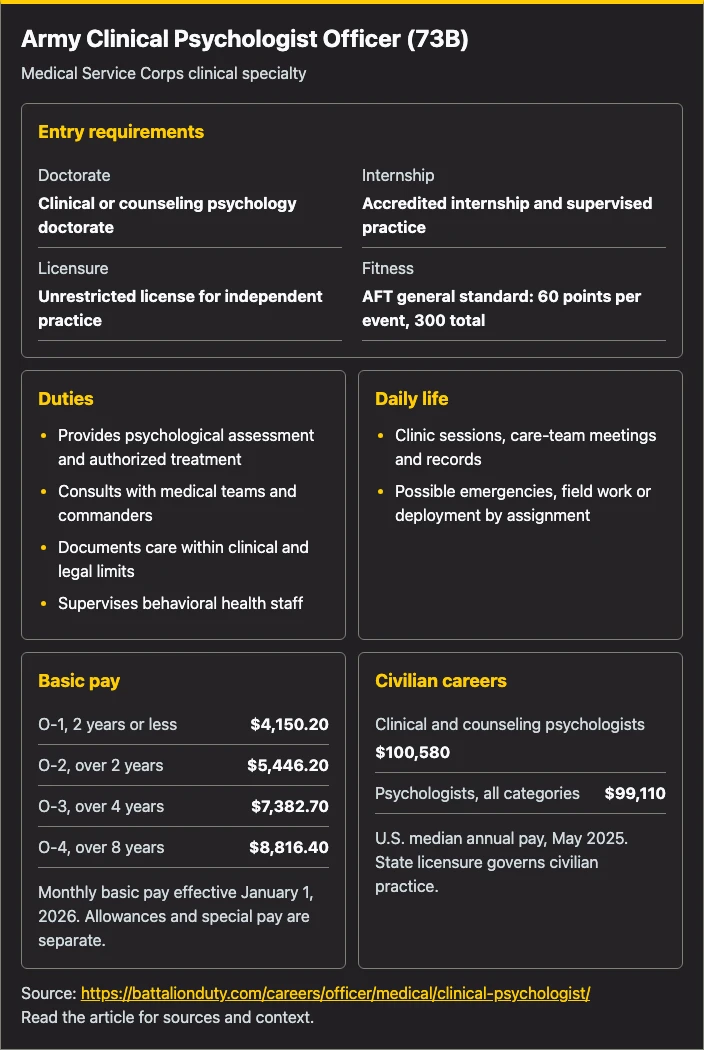
Entry requirements
- Doctorate
- Clinical or counseling psychology doctorate
- Internship
- Accredited internship and supervised practice
- Licensure
- Unrestricted license for independent practice
- Fitness
- AFT general standard: 60 points per event, 300 total
Duties
- Provides psychological assessment and authorized treatment
- Consults with medical teams and commanders
- Documents care within clinical and legal limits
- Supervises behavioral health staff
Daily life
- Clinic sessions, care-team meetings and records
- Possible emergencies, field work or deployment by assignment
Basic pay
- O-1, 2 years or less
- $4,150.20
- O-2, over 2 years
- $5,446.20
- O-3, over 4 years
- $7,382.70
- O-4, over 8 years
- $8,816.40
Monthly basic pay effective January 1, 2026. Allowances and special pay are separate.
Civilian careers
- Clinical and counseling psychologists
- $100,580
- Psychologists, all categories
- $99,110
U.S. median annual pay, May 2025. State licensure governs civilian practice.
Source: https://battalionduty.com/careers/officer/medical/clinical-psychologist/
Read the article for sources and context.
On this page
Job Role and Responsibilities
Army 73B Clinical Psychologist officers provide psychological assessment and treatment, consult with other health professionals, and support behavioral health programs within Army medical organizations. The specialty is a commissioned clinical profession in the Medical Service Corps and requires doctorate-level training, supervised clinical preparation and the appropriate professional credentials. Officers may also supervise teams and advise commanders within the boundaries of law, clinical ethics and their assigned duties.
The profession belongs to the Army Medical Service Corps. A qualified 73B psychologist provides clinical services rather than the administrative work usually associated with the 70B officer path.
Clinical work and military leadership
A 73B officer may interview and assess patients, carry out authorized clinical treatment, document care, consult with other providers and serve as part of a military behavioral health team. The exact care offered depends on licensure, clinical privileges, duty setting and the patient’s needs. Clinical psychology is a patient-care specialty. Neither a general bachelor’s degree in psychology nor an interest in counseling qualifies someone for independent practice as an Army clinical psychologist.
The officer may also coordinate clinic schedules, supervise professional and support staff, provide professional education or advise a commander on matters within a psychologist’s expertise. A psychologist’s patient-care obligations and a commander’s operational duties are not identical. The officer must handle both responsibly, with appropriate limits on what protected health information is shared.
The Army’s officer classification chapter lists Clinical Psychology as AOC 73B in the Medical Service Corps, within the behavioral sciences group. That classification does not make every psychological research or mental-health job a 73B billet.
Related Army specialties
| Code or profession | What the person does | Main career distinction |
|---|---|---|
| 73B Clinical Psychology | Psychological clinical assessment, treatment and consultation | Doctorate-level psychology training and professional credentialing |
| 73A Social Work | Professional social work and clinical social-work services | Social-work degree and licensing route |
| 71F Research Psychology | Behavioral and psychological research | Research-focused AOC, not the same independent clinical path |
| Medical Corps psychiatrist | Physician providing psychiatric medical care | Medical degree and physician specialty training |
| Army psychiatric nurse practitioner | Advanced-practice psychiatric nursing | Nurse practitioner education and nursing credentials |
A licensed clinical psychologist may consult with each of those professionals, but their degrees, professional authority and jobs are not interchangeable. Mental-health care itself should never be reduced to a competition between job titles.
Work systems and documentation
Psychologists use approved clinical assessment tools and medical records appropriate to their professional work. They may review clinical information with authorized care teams and take part in medical readiness programs. Records, testing materials and conversations about patients require careful handling. The clinical tools and patient population vary by treatment facility or operational assignment. This page does not describe or recommend an individual treatment plan.
Salary and Benefits
2026 military officer basic pay
An Army clinical psychologist is paid according to appointed rank and years of creditable service. Professional entry grade and credit for prior education or experience depend on the actual appointment rules. A doctorate does not by itself guarantee a particular rank or amount of constructive service credit.
| Rank | DFAS service bracket | 2026 monthly basic pay |
|---|---|---|
| O-1, Second Lieutenant | Two years or less | $4,150.20 |
| O-2, First Lieutenant | Over two years | $5,446.20 |
| O-3, Captain | Over four years | $7,382.70 |
| O-4, Major | Over eight years | $8,816.40 |
These examples come from the DFAS 2026 commissioned officer pay table, effective January 1, 2026. A psychologist who enters under a program that appoints participants at captain will need the pay amount for that officer’s actual service-credit bracket, which may differ from this example.
Scholarships, special pays and benefits
The Army Medical Recruiting Brigade publishes distinct clinical psychology programs, including scholarships, a military internship and a postdoctoral supervision path. It also describes conditional accession incentives for fully qualified clinical psychologists. Amounts, year-specific board openings and the ability to combine incentives must be verified directly with the program before an applicant relies on them. A published maximum is not an individual offer.
Eligible officers may receive military healthcare, housing and subsistence allowances, paid leave and education benefits. The Blended Retirement System provides a retirement framework for qualifying service and eligible Thrift Savings Plan contributions. These general benefits do not replace the conditions in a psychologist’s professional accession or scholarship contract.
Clinical schedules can include patient sessions, care-team meetings, records and administrative duties. Depending on assignment, there may also be emergencies, extended coverage, field work or deployment. There is no basis for promising fixed weekday hours to every 73B officer.
Qualifications and Eligibility
Degree, internship and license
The Army’s 73B classification calls for the relevant doctorate-level clinical or counseling psychology preparation, accredited internship and professional licensure for fully qualified practice. Applicants must distinguish eligibility for a training program from qualifications for independent clinical practice. A doctoral candidate who still needs an Army internship is not in the same status as a licensed psychologist entering after civilian training.
The Army Medical Service Corps recruiting page describes these pathways, subject to current recruiting notices:
| Route | Academic qualification | License or supervised training | Additional questions |
|---|---|---|---|
| Fully qualified clinical psychologist accession | Qualifying clinical or counseling psychology doctorate | Required supervised training and unrestricted professional licensure | Current direct-commission board, grade and obligation |
| Clinical Psychology Internship Program (CPIP) | Doctoral coursework toward a qualifying psychology degree completed | Selection for an Army clinical internship, with later credentials still required | Program vacancies, start date and service obligation |
| Postdoctoral supervision program | Doctoral training and specified qualifying internship | Supervised postdoctoral experience toward licensure | Whether the program is open and which agreements apply |
| Health Professions Scholarship Program | Enrollment in an eligible accredited doctoral program | Graduation and later approved clinical training required | Award year, scholarship term and separate service obligation |
The currently published CPIP recruiting description refers to a one-year internship and a specific service obligation for that program. The exact terms must be checked against the application year and written agreement, rather than applied to every 73B accession. Scholarship participants are not already independently licensed psychologists merely because they receive an officer appointment during school.
Commissioning tests, age and grade
A 73B applicant should start with a medical professional recruiter, not assume the ordinary ROTC or OCS branch ranking process is the sole route. The professional program may use academic records, an interview, clinical credentials and a board. The SIFT is an aviation selection test and is not a normal clinical psychology requirement. Enlisted ASVAB scores do not substitute for the doctorate and clinical credentials. Graduate Record Examination requirements may depend on the specific school or Army-sponsored education program and current admission cycle.
The medical, citizenship, security and age rules for commissioning are specific to the chosen program and can include approved exceptions. No universal age cutoff, minimum GPA, entry rank or duty obligation is asserted here. An applicant should obtain the current program announcement and written appointment terms before making a decision.
Work Environment
A 73B psychologist can work in a military treatment facility, behavioral health clinic, consultation role or operational support setting. In a clinic, the officer may see patients and meet with other providers. An operational billet may involve briefings, consultation and care coordination with military medical teams. The Army determines the actual assignment and scope of the billet.
Leadership differs from that of a medical administrative platoon leader. A clinical psychologist has obligations to professional care, clinical records and patients while also serving as an Army officer. When supervising enlisted behavioral health staff, the psychologist must respect training and scope-of-practice limits. When advising a commander, the psychologist must distinguish information that can be lawfully shared from private clinical material.
Some psychologists pursue clinical leadership, specialty practice, teaching or research-support positions as their careers develop. No verified Army-wide 73B retention percentage or universal caseload figure was established in the reviewed sources. Workload and job satisfaction may vary substantially with staffing, location and assignment.
Training and Skill Development
A 73B psychologist arrives with advanced professional education or completes a selected military-supported program before independent practice. Army military training and clinical psychology training serve different purposes. The officer must qualify both as a commissioned officer and as a professional clinician for the duties assigned.
| Training or milestone | Location or setting | Duration | Purpose |
|---|---|---|---|
| Accredited doctoral education | Approved university program | Degree-specific | Psychology research, assessment and clinical training |
| Approved clinical internship | Civilian or Army-approved training site | Program-specific, and Army CPIP advertises one year | Supervised patient care and clinical competence |
| Postdoctoral supervision if required | Approved supervised setting | Program-specific | Required supervision toward independent licensure |
| Military officer basic instruction | Army Medical Department officer course | Current class schedule required | Military leadership, rules and medical support context |
| Later professional and military education | Army or approved civilian training | Selection and program dependent | Clinical development, leadership and staff qualifications |
The Army’s Medical Service Corps career guidance describes the clinical profession and progression in the corps. Officers interested in a particular internship location or specialty must verify whether a position is open. A one-year internship or research project does not confer an independent clinical license by itself.
As officers gain experience, the Captain’s Career Course, intermediate military education and selected clinical courses may become relevant. Professional continuing education and license renewal requirements also remain important. The precise sequence will depend on the officer’s accession status, clinical qualification and military assignment.
Career Progression and Advancement
Clinical expertise and military leadership can develop together, but not every psychologist seeks command. A 73B officer may spend much of a career providing care, supervising clinical teams or working as a consultant. Senior assignments are competitive and limited by Army needs.
| Officer grade | Potential stage | Possible role |
|---|---|---|
| O-1, Second Lieutenant | Certain scholarship or education appointments | Student officer role, not independent licensed psychologist solely by appointment |
| O-2, First Lieutenant | Program-dependent early career stage | Eligibility depends on actual appointment or training status |
| O-3, Captain | Common professional entry or early qualified service in specific programs | Clinical psychologist, supervised training where program-authorized, clinic leadership |
| O-4, Major | Experienced clinician and leader | Behavioral health chief or operational consultant if selected |
| O-5, Lieutenant Colonel | Senior professional assignments | Clinical leadership and medical staff roles if selected |
| O-6, Colonel | Limited senior positions | Senior medical leadership, professional oversight and policy roles |
The table is a career framework, not an automatic promotion or appointment schedule. A licensed applicant may enter at a different grade from a doctoral student in a scholarship program. Promotion boards consider performance, professional credentials, military education and assignment records under the rules for the officer’s status. The Army does not publish a simple guaranteed 73B promotion rate for individual applicants.
Physical Demands and Medical Evaluations
Clinical psychologists must meet applicable Army commissioning and continuing fitness standards. The Army Fitness Test (AFT) for combat-enabling specialties requires at least 60 points on each event and 300 overall, using age- and sex-specific tables. For ages 17 through 21, the official AFT scoring standards list:
| Test event | Male 17-21 minimum | Female 17-21 minimum |
|---|---|---|
| Three-repetition maximum deadlift | 150 lb | 120 lb |
| Hand-release push-ups | 15 | 11 |
| Sprint-drag-carry | 2:28 or faster | 3:15 or faster |
| Plank | 1:30 or longer | 1:30 or longer |
| Two-mile run | 19:57 or faster | 22:55 or faster |
Older age groups have different event standards. Applicable medical profiles and appointment decisions are governed by the current Army medical policy. The 73B clinical profession does not carry a routine aviation flight-physical requirement. Medical screening for service is separate from professional psychology licensure, and an applicant must satisfy both sets of requirements where they apply.
Deployment and Duty Stations
Army psychologists may serve in large military medical centers, smaller treatment facilities or operational behavioral health assignments. Duty location depends on available 73B positions, grade, qualifications and Army needs. An intern or supervised trainee may have fewer choices than a fully qualified officer because the training program operates only at approved sites.
Operational psychology positions can involve travel, field conditions or deployment, but not every clinic-based psychologist deploys on the same schedule. No fixed deployment frequency, guaranteed hospital choice or universal patient population is supported by the sources reviewed here. Applicants should ask the medical recruiter and relevant program office what locations and assignments are actually available for their accession year.
Risk, Safety, and Legal Considerations
Clinical psychologists carry professional responsibility for licensed practice, documentation, assessment and patient safety. Their work can involve sensitive disclosures, urgent clinical situations and decisions about further evaluation or referral. Such work must follow professional standards, the officer’s clinical privileges, Army policy and applicable law. This article describes a career. It is not advice for diagnosing or treating any individual.
Military clinical confidentiality has specific rules and limits. An officer advising leaders must not treat the position as permission to distribute every detail from a patient record. Command consultation and clinical practice may be related, but they do not erase the need to apply the correct disclosure rules. The psychologist also has ordinary military duties, including leadership standards and responsibility for conduct in the assigned position.
Impact on Family and Personal Life
Doctoral education, internship selection and supervised practice can shape the earliest years of this career. Those stages may require a move before the officer has a permanent duty assignment. Later service can include changes of station, duty travel, on-call work and deployment according to the actual billet and mission.
Families may use military healthcare, housing support and Army family services if eligible. Dual-military couples can request assignment coordination under applicable rules, but training location and service needs may limit options. Applicants with an existing clinical practice should also plan for civilian licensing, supervision or professional obligations during a change to military service. The service agreement matters as much as the job description.
Reserve and National Guard
The Army Medical Recruiting Brigade identifies clinical psychology among specialties for which Army Reserve commissions may be available based on annual needs. The Army National Guard’s actual 73B authorizations and vacancies depend on state and unit. A civilian clinical license does not by itself guarantee a military commission or a part-time psychologist billet.
| Topic | Active Army | Army Reserve | Army National Guard |
|---|---|---|---|
| Employment model | Full-time military service | Drills, clinical/operational training and possible mobilization | State/federal duties, drills and possible mobilization |
| O-3 pay comparison, over four years | $7,382.70 monthly basic pay | About $984.36 for four drill periods | About $984.36 for four drill periods |
| Clinical qualification | Professional license/privileges for independent practice | Professional license/privileges and unit conditions | Professional license/privileges and state/unit conditions |
| Healthcare | Active-duty program eligibility | Reserve plan and activation eligibility | Guard plan and activation eligibility |
| Education | Programs based on individual eligibility | Reserve and qualifying-service programs | Federal and possible state programs |
| Availability | Current 73B program opening required | Specialty recruitment exists when needs permit | Confirm individual state 73B vacancy |
| Retirement | Active-service rules | Points-based non-regular retirement when eligible | Points-based non-regular retirement when eligible |
The four-drill example uses the same DFAS monthly O-3 rate divided by 30 and multiplied by four. It is not a monthly Reserve salary. Professional training, clinical credentialing and mobilization may require more days than standard drills. Reservists with civilian patients also need to account for coverage and scheduling when military duty occurs.
Post-Service Opportunities
Clinical psychology is a civilian licensed profession as well as an Army officer specialty. Officers who return to civilian practice must comply with the license requirements for the jurisdiction and the jobs they seek. Army service alone does not replace degree, internship, supervision or state licensing rules.
| Civilian occupation | Median U.S. yearly wage, May 2025 | Projected growth, 2025-2035 |
|---|---|---|
| Clinical and counseling psychologist | $100,580 | 12% |
| Psychologists, all categories | $99,110 | 6% |
The figures are from the Bureau of Labor Statistics psychologist profile. They cover civilian labor-market occupations, not military pay and not a salary offer to a former 73B officer. Experience in military clinical work may be relevant to employers, but job selection, location and professional licensing still control the transition.
Is This a Good Job for You? The Right (and Wrong) Fit
The 73B career can suit someone who wants to practice clinical psychology and serve in the Army, while accepting military training, officer responsibility and possible operational assignments. It calls for careful clinical judgment, the ability to work within a treatment team and respect for patients and professional boundaries. Applicants should be comfortable with advanced academic work and the continuing requirements of a licensed profession.
It may be a poor match for someone who wants a rapid commissioning route without graduate study, whose interest is mainly experimental research, or who prefers a medical physician’s prescribing career. It is also a difficult choice for someone who cannot accept training-location constraints or an extended service obligation. The most useful comparison is not a generic military-versus-civilian salary question, but the exact doctoral training route, available Army program and service contract.
More Information
Contact an Army healthcare professions recruiter for the current Clinical Psychology Internship Program, postdoctoral program, scholarship and fully qualified 73B accession requirements. Ask which board is open, what credentials it accepts, what clinical supervision remains and what service obligation applies to the offer. A general Army officer commissioning overview helps with basic military terms but does not replace a professional recruiting notice.
The Medical Service Corps officer parent explains how 73B fits the Army health system. To compare separate licensed medical fields, see the published Army Nurse Corps officer profile and Army Medical Corps physician profile.