Army Critical Care Nurse Officer (66S)
An intensive care nurse cares for the hospital’s sickest patients. In the Army, that same work may also take place in a field hospital tent.
The 66S AOC is a clinical specialty within the Army Nurse Corps, with a defined scope of practice and skills rather than an administrative focus.
This page explains how Army critical care nursing differs from its civilian counterpart. For branch structure, general pay and entry routes, see the Army Nurse Corps officer guide.
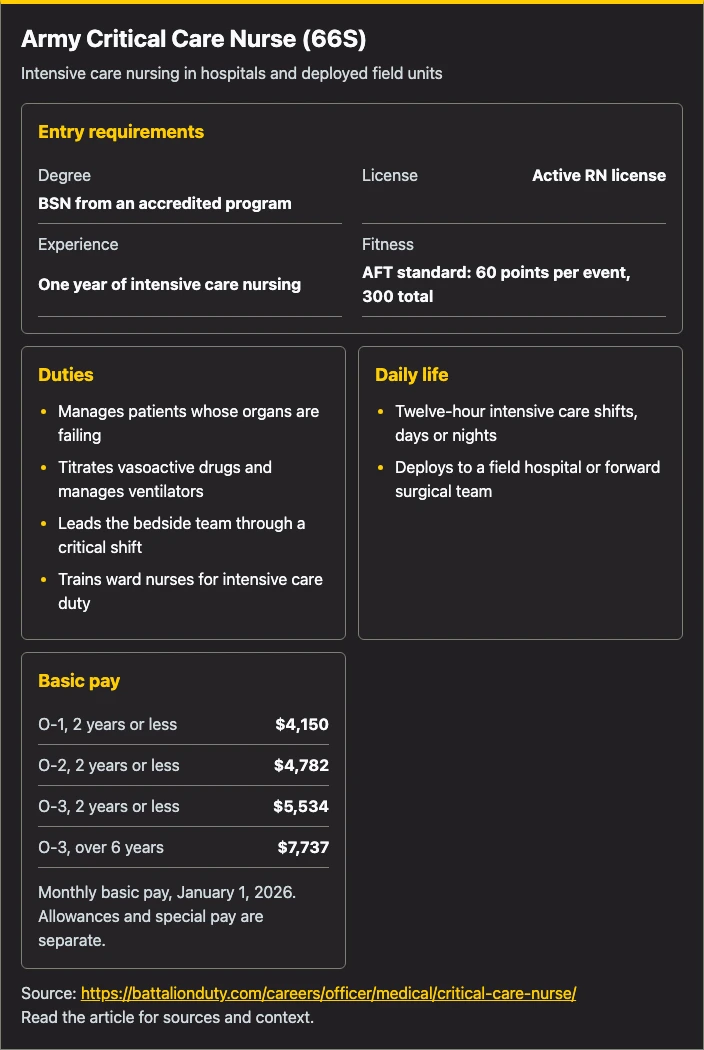
Entry requirements
- Degree
- BSN from an accredited program
- License
- Active RN license
- Experience
- One year of intensive care nursing
- Fitness
- AFT standard: 60 points per event, 300 total
Duties
- Manages patients whose organs are failing
- Titrates vasoactive drugs and manages ventilators
- Leads the bedside team through a critical shift
- Trains ward nurses for intensive care duty
Daily life
- Twelve-hour intensive care shifts, days or nights
- Deploys to a field hospital or forward surgical team
Basic pay
- O-1, 2 years or less
- $4,150
- O-2, 2 years or less
- $4,782
- O-3, 2 years or less
- $5,534
- O-3, over 6 years
- $7,737
Monthly basic pay, January 1, 2026. Allowances and special pay are separate.
Source: https://battalionduty.com/careers/officer/medical/critical-care-nurse/
Read the article for sources and context.
On this page
Job Role and Responsibilities
A 66S officer manages patients whose organs are failing, continuously monitoring vital signs, ventilator support and medication pumps.
ICU staffing depends on patient needs and the available clinical team. AACN’s adult critical-care staffing standards call for matching nurse competencies to patient needs; an assignment should not be understood as a guaranteed Army-wide nurse-to-patient ratio.
What the nurse owns
Bedside care combines assessment with continuous adjustment. The nurse checks lung sounds, heart rhythm, skin, urine output and mental status, while adjusting medications such as blood pressure drugs, sedation and insulin, sometimes minute by minute. Ventilator checks continue throughout the shift, tracking settings and the patient’s oxygen level.
The nurse also speaks with the family at the bedside. Those conversations can be among the hardest parts of the work.
What the nurse does not own
The intensivist directs the medical plan, the surgeon handles the operation, and the respiratory therapist manages the breathing circuit. The nurse coordinates care across those responsibilities.
How this differs from medical-surgical nursing
Medical-surgical nurses manage a broader ward assignment, while critical care nurses focus on patients who need intensive monitoring and may deteriorate without warning. The actual patient assignment depends on acuity and unit staffing.
How this differs from emergency nursing
Emergency nurses assess patients who arrive with unknown problems; critical care nurses provide ongoing care when the condition is identified but the patient remains unstable.
The emergency nurse page explains the initial assessment and stabilization that may precede an ICU admission. The handoff connects two specialties with different responsibilities.
How this differs from anesthesia
The nurse anesthetist page explains anesthesia care, including work in the operating room. Critical care nurses provide sustained intensive care when a patient remains unstable after surgery or another serious illness or injury.
Technology
Critical care nurses use ventilators, cardiac monitors, infusion pumps, dialysis machines and ultrasound for line checks. They document care in Military Health System Genesis.
Salary and Benefits
A 66S officer earns standard officer base pay. The specialty may add pay that varies by year and by contract.
Base pay and allowances
Base pay follows the officer table. An O-3 with four years earns $7,383 a month. An O-4 with eight years earns $8,816. Figures come from DFAS 2026 Military Pay Charts.
Housing and food allowances are separate from basic pay and generally tax-free. Housing allowance depends on duty location, rank and dependent status; confirm the current rate for the specific assignment.
Specialty pay
Because critical care nursing is a shortage specialty, officers may qualify for incentive pay, an accession bonus or a retention bonus.
Amounts and eligibility change with the program year and shortage designation list. Ask an AMEDD recruiter for current terms tied to your AOC and obligation length, using the Army Medical Recruiting Brigade as your starting point.
The funded training
The Army pays for the critical care course and continues the officer’s salary during training.
Qualifications and Eligibility
There are two routes into 66S: one for nurses with ICU experience and another for new graduates.
Door one: experienced ICU nurse
Direct commissioning into 66S requires a BSN, an active RN license and at least one year of intensive care experience.
Recruiters generally prefer recent ICU experience, and a gap of several years may require retraining, so confirm eligibility before applying.
Door two: new graduate
New graduates generally commission first as 66H medical-surgical nurses and complete the Clinical Nurse Transition Program. The Army’s nursing pathway says they can apply for specialty training after one year of service as a 66H nurse. Selection and available course seats still matter.
This longer route is common for new BSN graduates and provides a broader clinical foundation.
The BSN requirement
Commissioning requires a BSN from an accredited program, so nurses with associate degrees may need an RN-to-BSN bridge before applying.
Certification
The CCRN credential demonstrates critical-care expertise. Although the Army does not require it to enter 66S, certification can strengthen a nurse’s professional record.
Clearance and physical
Every route requires U.S. citizenship, eligibility for a Secret clearance and a qualifying military physical.
Age limits
Commissioning age limits may be waived, but the process can take months, so ask about eligibility early.
Work Environment
The garrison intensive care unit
Most 66S officers work in busy hospital ICUs, where constant alarms require nurses to distinguish urgent warnings from routine signals.
The field hospital
Army field hospitals bring intensive care forward into tents or hardened shelters using smaller, more rugged equipment.
In a field hospital, the nurse may have no specialist on call and only one spare ventilator.
The forward surgical team
A forward surgical team may have only a handful of beds, with nurses caring for post-operative casualties before rapid transfer to another site.
En-route care
Some officers accompany patients during air transfers, making clinical decisions in cramped, noisy conditions with limited monitoring.
Hours
Garrison shifts last 12 hours and rotate between day and night, while deployed schedules follow mission demands.
Training and Skill Development
Officer school first
New officers attend BOLC for 10 to 14 weeks at Fort Sam Houston, where they learn officer skills rather than bedside care.
The transition program
A new graduate then enters the Clinical Nurse Transition Program, which runs about six months and pairs the officer with a preceptor on a clinical unit. Supervised practice develops assessment, documentation and handoff skills, following the assigned site’s current training plan.
The critical care course
The 66S Critical Care Course is an 18-week resident program at Brooke Army Medical Center in San Antonio. It combines classroom and clinical training in ventilator management, drug titration, rhythm recognition and dialysis.
Simulation lets officers practice on mannequins before applying those skills in patient care.
Preceptorship
A new 66S officer works under a preceptor for weeks to months until required competencies are signed off.
Continuing skills
As critical care practices evolve, officers maintain their RN licenses, complete recertification and continuing education, and undertake additional Army readiness training.
Career Progression and Advancement
Clinical and leadership progression
A new 66S officer develops bedside competence before taking charge-nurse shifts. Responsibilities can then expand from managing a shift to leading a unit or a larger nursing service.
At Major, an officer may become a unit head nurse or take responsibility for training or deployment planning. Lieutenant Colonels and Colonels may lead nursing across a hospital, move into command or serve on the corps staff.
The move into a charge role also changes the kind of judgment an officer makes. Bedside care still matters, but staffing a shift, recognizing when a colleague needs help and giving the next team a reliable handoff become part of the job. For officers interested in later leadership roles, examples of training delivered, safety problems resolved and teams coordinated show more than the number of ICU shifts worked.
Promotion and alternative assignments
Promotion to O-4 is decided by a board that considers clinical depth, leadership and military schooling. Education, research and operational positions with maneuver units can broaden the record beyond bedside care, although no particular assignment guarantees promotion.
Physical Demands and Medical Evaluations
Physical requirements and protection
ICU nursing requires standing through much of a 12-hour shift, turning and lifting patients, and moving beds and equipment.
These officers take the Army Fitness Test under its general standard: at least 60 points in each of five events, for a minimum total of 300, with scoring based on age and sex. The events are the deadlift, hand release push-up, sprint-drag-carry, plank and two-mile run. Source: Army Fitness Test.
Deployment readiness
Field nurses use gloves, gowns and masks, and wear respirators when the patient’s condition or exposure risk requires that protection.
Deployable status requires a current physical, dental readiness and immunizations; a lapse in any of these can prevent an officer from joining a team.
Deployment and Duty Stations
Duty stations and deployment schedules
Critical care nurses serve at major medical centers, post hospitals with ICUs and deployable hospital units. Sites with intensive care include Brooke Army Medical Center at Fort Sam Houston, Walter Reed, Madigan, Tripler and Womack.
Critical care nurses can deploy with hospital units or as individual replacements. Individual assignments often last three to six months, while unit deployments generally run longer; the actual duration depends on the mission and orders.
Deployed work and assignment preferences
Depending on the mission, a deployed ICU may have anywhere from a few beds to twenty. Alongside patient care, nurses train medics, run drills and check the equipment the team depends on.
Officers submit assignment preferences, but Human Resources Command makes the final decision based on Army needs.
A hospital ICU and a deployable critical-care section draw on the same clinical skills but work within different limits. In a large medical center, specialist support and equipment may be close by. In a smaller deployed unit, the team must pay closer attention to what it can stabilize, monitor and transfer. Ask what work the billet involves between deployments, which clinical skills the unit trains together and how much time goes to readiness rather than direct patient care.
Risk, Safety, and Legal Considerations
Clinical and workplace hazards
Critical care carries constant risk because patients are unstable and a missed change in their condition can be fatal.
Nurses have obligations under both military law and their state nursing board’s regulations. Civil malpractice liability is a separate question. Under 10 U.S.C. § 1089, the usual civil remedy for negligent care within the scope of assigned military medical duties is a claim against the United States. That protection does not remove the possibility of military discipline or nursing-board action.
Accountability and operational pressures
ICU staff encounter blood and body fluids daily, and any needlestick must be reported.
Night shifts and long cases can cause fatigue and increase error risk. Although Army rules limit duty hours in some settings, field conditions can override those limits.
Critical care nurses encounter both expected and unexpected deaths, and support systems are available to help them cope.
The safest response to a changing patient begins before a dramatic emergency. A nurse needs to notice the trend, communicate what changed and leave enough detail for the next shift to recognize deterioration. During long shifts, asking for a second check or help with a handoff is a professional decision, not a failure of confidence. These habits matter in both a staffed hospital and a smaller deployed section.
Impact on Family and Personal Life
Work schedules, moves and deployments
Twelve-hour shifts and rotating night duty can disrupt sleep and require nurses to miss evenings and weekends with family.
Moves every two to three years can mean changing schools and disrupting a spouse’s job. Larger medical posts may offer more employment options, but families still need to plan for each assignment.
Deployments often mean absences of three to six months, with longer periods possible on unit rotations.
Family support and dual-military assignments
Army Community Service supports relocations, Family Readiness Groups assist during deployments, and on-post childcare may help with care arrangements. Dual-military couples should also ask about joint-domicile requests when assignments conflict, while recognizing that approval is not guaranteed.
A twelve-hour shift does not follow a school-day schedule. A nurse working nights may be asleep when family members are home, even during weeks without a deployment. Before comparing postings, find out what rotation the unit uses and how often training takes the officer away from the hospital. Childcare, a partner’s employment and rest between shifts deserve the same planning attention as a move to a new duty station.
Reserve and National Guard
Part-time service, training and pay
Critical care nurses also serve in reserve components, where assignments can include ICU coverage for deployable hospitals. Available positions and entry requirements depend on the component and unit.
A Reserve 66S officer typically combines monthly drills and annual training with a civilian nursing career. Additional training or mobilization can require more time than the usual part-time schedule.
Drill pay follows the officer table, with an O-3 earning about $738 per drill weekend at fewer than two years of service.
Clinical readiness and suitability
Reserve nurses must maintain current credentials and clinical skills, which civilian practice can help sustain. Military service can complement that career through unit experience and retirement credit, but adds training and service obligations of its own.
Part-time service creates two sets of obligations. A civilian ICU position can help maintain bedside experience, while the military unit still requires training and readiness for its assigned mission. Ask how the unit checks critical-care skills, what training occurs beyond scheduled drills and how mobilization could affect a civilian work schedule. The usual drill calendar is a starting point for planning, not a guarantee that every month will look alike.
Post-Service Opportunities
Civilian opportunities and leadership experience
Critical care experience is relevant to civilian hospital ICUs, cardiac units, transplant and trauma centers, and some teaching roles. Army nurses may also bring experience running units and managing teams alongside their clinical work. Employers will assess that experience against the requirements of the position.
Education and licensing after service
Eligible nurses may receive up to 36 months of Post-9/11 GI Bill education benefits, which can support graduate study. Transfers to family are not automatic. Under the usual VA rules, the service member needs six years of service, must agree to serve four more years and must request Defense Department approval while still serving. The dependent must also be enrolled in DEERS.
State licensure and the CCRN credential remain with the individual after service; neither requires an Army sponsor.
A civilian hospital will assess current licensure, recent critical-care work and the responsibilities the nurse can safely accept. Officers who expect to return to bedside practice should keep a usable record of clinical experience, credentials and leadership duties while serving. Before separating, check the destination state’s licensing process and the receiving hospital’s hiring requirements. Military rank alone does not establish civilian clinical privileges.
Is This a Good Job for You? The Right (and Wrong) Fit
Strengths and tradeoffs
This path can suit a detail-oriented nurse who stays calm under pressure and prefers sustained clinical depth to a wider variety of cases.
Teaching is another part of the role, including helping medics develop and maintain the skills their unit needs.
ICU work involves sustained attention to a smaller number of very sick patients, which may not suit a nurse who prefers frequent changes of pace and patient contact. Night shifts and possible deployments also deserve careful thought before choosing this specialty.
The route demands substantial training and difficult shifts. Its appeal rests on whether you want the clinical work and the military responsibilities that come with it.
More Information
Start with the Army Nurse Corps officer guide for branch structure, entry routes and general pay. To compare the clinical work, read about emergency nursing, nurse anesthesia and perioperative nursing.
The medical officer hub and Army officer careers hub place nursing among the wider career options. For entry decisions, use the officer commissioning guide and the medical officer versus enlisted medic comparison.
Ask an AMEDD nurse recruiter about current specialty pay, the critical care course schedule and which posts currently have 66S billets.