Army Dietitian Officer (65C)
An Army dietitian may work in a dining hall, but the job centers on clinical nutrition. Food service is only one part of the role.
Army dietitians combine clinical nutrition with responsibilities for medical food service. Their work includes treating patients and managing how food supports care, while broader supply functions involve different responsibilities.
This page explains 65C duties and qualifications, including the relationship between clinical nutrition and medical food service. The Specialist Corps officer guide covers branch structure, general pay and entry routes.
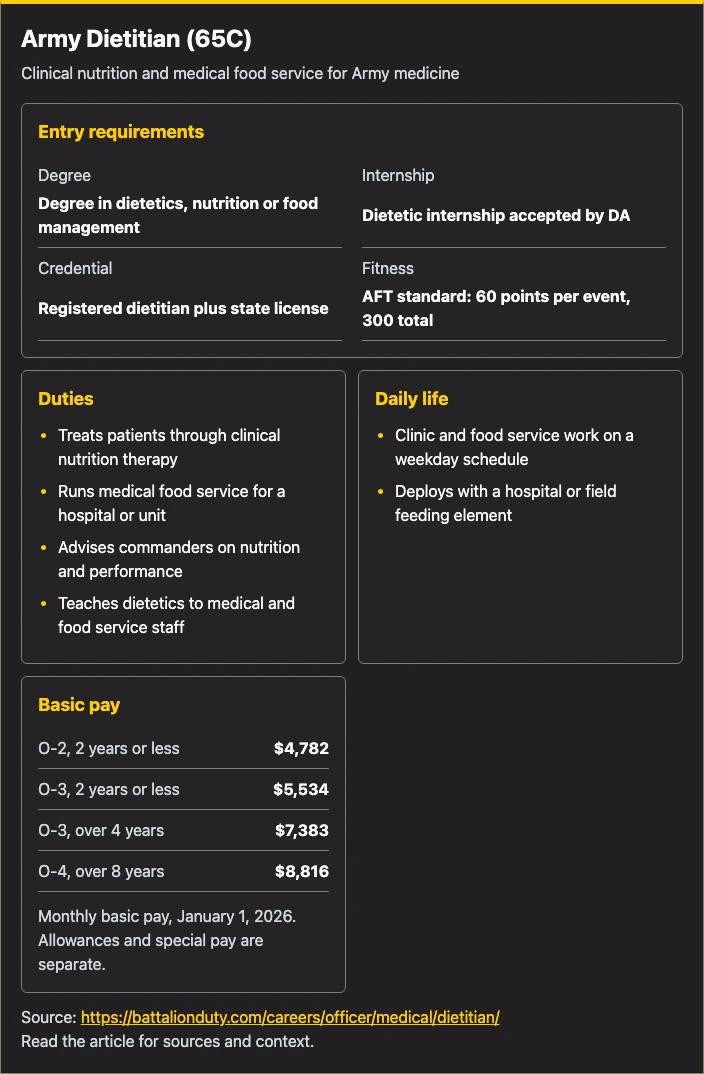
Entry requirements
- Degree
- Degree in dietetics, nutrition or food management
- Internship
- Dietetic internship accepted by DA
- Credential
- Registered dietitian plus state license
- Fitness
- AFT standard: 60 points per event, 300 total
Duties
- Treats patients through clinical nutrition therapy
- Runs medical food service for a hospital or unit
- Advises commanders on nutrition and performance
- Teaches dietetics to medical and food service staff
Daily life
- Clinic and food service work on a weekday schedule
- Deploys with a hospital or field feeding element
Basic pay
- O-2, 2 years or less
- $4,782
- O-3, 2 years or less
- $5,534
- O-3, over 4 years
- $7,383
- O-4, over 8 years
- $8,816
Monthly basic pay, January 1, 2026. Allowances and special pay are separate.
Source: https://battalionduty.com/careers/officer/medical/dietitian/
Read the article for sources and context.
On this page
Job Role and Responsibilities
A 65C develops policy and provides nutrition care in fixed medical facilities and field units, during routine service as well as mobilization and war.
The clinical work involves planning and providing modified diets for patients. Someone recovering from a wound or burn, or managing a gastrointestinal condition, needs an intake plan set by a trained clinician rather than a catering decision.
The officer also manages medical food-service operations, including preparation, service and the safe provision of food and rations for patients and staff in fixed facilities or field units. In the field that supply line is a medical matter, not only a supply one.
Health promotion extends the work beyond the hospital. Dietitians develop nutrition education and dietary-change programs for service members and families, connecting clinical knowledge with community health and unit readiness.
Dietitians contribute nutrition assessments and dietary treatment to patient care, conduct and lead applied research, and advise on how nutrition affects health and performance. Those responsibilities connect individual treatment with decisions about larger groups and programs.
A 65C also develops and directs nutrition and food-service instruction for food-service personnel, interns and other medical staff. Teaching brings the officer’s clinical and management knowledge into the work of the wider team.
Salary and Benefits
Dietitians receive standard officer basic pay based on rank and years of service. The Specialist Corps guide provides the pay table and explains branch benefits.
Additional medical or professional pay depends on the applicable rules, while sign-on bonuses depend on the program year and shortage list. Confirm the terms for your accession route and assignment rather than assuming extra pay accompanies every 65C billet.
Bonus amounts and eligibility can change by year and contract. An older figure is not proof of a current offer, and this page’s branch source does not supply an amount; ask the recruiter for the applicable written terms.
Qualifications and Eligibility
The 65C bar comes from the Army’s officer branch chapter. Four rules apply to every dietitian officer.
| Rule | Standard |
|---|---|
| Degree | A bachelor’s or advanced degree with a major in foods and nutrition, dietetics or institution food management, or a coordinated program accepted by TSG |
| Internship | A dietetic internship accepted by the Department of the Army |
| Credential | Registration through the Commission on Dietetic Registration, plus state licensure as a dietitian |
| Rule | Meet AR 135-100 and AR 135-101 |
Unlike the other requirements, the degree rule names a major or an accepted coordinated program. A general science degree does not meet that course-of-study requirement, even with clinical experience.
Candidates must also complete a dietetic internship accepted by the Army. Coursework alone cannot replace this supervised practice.
An Army dietitian needs both registration through the Commission on Dietetic Registration and a state license. Neither credential alone meets the requirement.
The Army branch chapter lists restrictions involving court-martial records, specified civil offenses under AR 27-10 and sex-offender registration. Disclose relevant history to the responsible recruiting staff for a formal eligibility determination; this page cannot decide an individual case.
Older descriptions of entry paths may not match the current program. Confirm your circumstances and route with a recruiter before relying on one path: the rule establishes eligibility, not a guaranteed slot.
Work Environment
The job splits between clinic and field kitchen. At a medical facility, a dietitian combines office work with patient visits, chart review and food-service responsibilities. In the field, the same officer works from a tent with far less help.
Most patients are young and fit, so the diet problems differ from those most often seen in a civilian hospital. The work includes nutrition for wound healing, weight management, performance, eating under stress and recovery from injury.
The branch rule lists brigade dietitian among 65C assignments. That role places the officer with an operational unit, advising on nutrition needs tied to training, performance and readiness.
Policy assignments can include chief of human dimension at the Army’s initial training command or chief nutrition program manager at Medical Command. These roles extend nutrition advice beyond individual patients to larger programs and organizations.
Menus, contracts, inspections and teaching programs also take time. An officer who wants only one-on-one care should consider how management responsibilities can grow with rank.
Training and Skill Development
For accession as an already qualified dietitian, a candidate needs the specified education, accepted internship and required professional credentials. Army-sponsored training pathways have separate admissions requirements.
The Army also trains dietitians through its own system. The branch rule names a dietetic internship consortium as a path into the corps and lists the chief of an internship as a 65C post. It does not establish who can enter that path now, so applicants need to check current entry rules.
As rank rises, a dietitian may take on more schooling and teaching, such as serving as a nutrition instructor at the Army medical training center or working in a graduate program. A senior officer may direct a graduate program in nutrition.
Career development combines clinical practice, formal schooling and teaching. Food-service leadership draws on management skills, while the broader 65C role also requires clinical judgment and the ability to advise others.
Career Progression and Advancement
Promotion follows the normal officer timeline. What differs is the range of posts at each grade.
A junior dietitian manages a caseload while learning how the Army delivers care. Two practical questions guide that work: are patients getting the nutrition they need, and can the unit use the advice?
At mid-career, a dietitian may serve at a brigade, Public Health Command or the U.S. Army Research Institute of Environmental Medicine. These roles combine clinical knowledge with advice that affects larger groups and programs.
Senior assignments can include chief nutrition program manager at Medical Command, chief of human dimension at the training command, chief dietitian or director of a graduate program. The available positions depend on the organization and the officer’s qualifications.
A dietitian can pursue senior leadership within the Specialist Corps without becoming a physician. Entering the Medical Corps is a separate route with its own medical-degree requirements.
Physical Demands and Medical Evaluations
The fitness bar for 65C matches the other Specialist Corps parts. It is not eased because the work is clinical.
| Item | Standard |
|---|---|
| Eyes and hands | Fixable sight, hand skill, normal color sense per AR 40-501 |
| Profile | 222222 |
| Demands rating | Moderate (Gold) |
| OPAT long jump | 120 cm or more |
| OPAT power throw | 350 cm or more |
| OPAT deadlift | 120 lb or more |
| OPAT shuttle run | 36 shuttles or more |
These are Moderate-category Occupational Physical Assessment Test accession standards, distinct from the Army Fitness Test used during service. The officer physical-requirements table lists this specialty in the Moderate category. Confirm the current accession requirements with the responsible recruiter.
The Moderate tag fits a job that pairs clinic work with field duty. A dietitian assigned to a forward unit may deploy with it and work in field food-service or treatment settings.
Medical examinations take place on entry and at required points during service, with health conditions assessed against AR 40-501. Required professional credentials must also remain current; a lapse can affect clinical privileges and eligibility to serve in the role.
Deployment and Duty Stations
Dietitians can serve with deployable units, and the branch rules explicitly describe their field responsibilities.
Deployment changes the resources and needs the dietitian must account for. Clinical work can include nutrition for wound healing, recovery and continued duty, alongside the safe provision of food and rations in field conditions.
Assignments span Army hospitals, public health organizations, research posts and field units. A career may include both clinical and operational settings, with the sequence determined by available billets, qualifications and Army needs.
Because the rule provides no current list of duty stations, this page does not offer one. Assignments depend on Army needs when orders are issued.
Risk, Safety, and Legal Considerations
Nutrition plans affect recovery from wounds, burns and surgery. An unsuitable plan can delay healing or harm the patient, making clinical assessment and follow-up central to the work.
Food safety connects the clinical role to food-service management. A dietitian helps keep food safe for patients and staff, because a failure in storage, preparation or distribution can affect many people at once. The responsibility extends beyond treating an individual patient.
Dietitians must maintain the registration, licensure and other credentials required by professional and Army rules. A lapse can affect clinical practice and eligibility to serve in the role.
The branch limit covers every Specialist Corps officer. Criminal-history concerns and offenses covered by accession rules require review by the responsible Army recruiting staff; this article cannot determine an individual’s eligibility.
Impact on Family and Personal Life
Families may find clinic hours predictable, but field time and deployments are less so. A dietitian assigned to a brigade should plan for both.
Deployment patterns depend on the unit and assignment. Ask how a brigade billet supports operational deployments and how its schedule differs from a hospital tour, rather than assuming every dietitian follows the same pattern.
Although desk work may stay at the clinic, responsibility for patients does not always end with the workday. Small sections therefore need reliable coverage arrangements.
Civilian dietetics offers another career path for families weighing a longer Army commitment. A serving dietitian can prepare by checking professional requirements and job opportunities in the state where the family hopes to settle.
Reserve and National Guard
Dietitians may combine part-time Specialist Corps service with civilian practice, subject to available positions and military obligations.
Reserve service uses the same credentials with a different patient mix. A reserve dietitian may devote one weekend a month to readiness work and complete annual training in a field medical unit.
Reserve 65C officers still need the specified degree, internship, registration and state license. The rule sets no lower entry standard for reserve service.
Vacancies change by state and unit, so this page cannot give an exact list of openings. Ask a reserve recruiter or unit contact about current slots.
Post-Service Opportunities
Army experience can support a move into civilian dietetics, but professional credentials still need to be current. Check the destination state’s and employer’s requirements rather than assuming that a military assignment automatically grants civilian practice privileges.
Hiring spans hospitals, dialysis and wound care centers, diabetes programs, long-term care and sports nutrition. Food-service management is another possible route, drawing on experience with staffing, menus, contracts and operations. Others go into public health or research.
Federal clinical, training and policy positions offer another possible route after military service. Applicants should check the position’s qualifications and how prior service affects benefits or service credit.
Leadership experience can strengthen an application for management roles alongside clinical expertise. A dietitian should describe the responsibilities they actually held, whether leading a nutrition program, advising a commander or managing field food operations.
Is This a Good Job for You? The Right (and Wrong) Fit
This job may suit someone who wants patient care alongside operational responsibilities. Army dietitians treat individuals while advising on nutrition that supports a unit’s training and recovery, so applicants should consider whether both parts interest them.
Management deserves equal consideration. Menus, contracts, inspections and food supply are part of the role, so an applicant seeking only individual patient care should weigh those responsibilities before choosing 65C.
It does not suit someone seeking a physician’s career: dietetics and medicine are separate branches with different degree requirements.
Someone primarily interested in catering or general food-service management should compare those careers with 65C carefully. Army dietetics requires clinical qualifications and responsibilities that extend beyond preparing and serving food.
Finally, the role requires ongoing attention to professional credentials. Registration and licensure are continuing responsibilities rather than one-time achievements.
More Information
The Specialist Corps officer guide covers branch shape, entry paths and the current pay table. The other three parts have their own pages: physical therapist, occupational therapist and physician assistant.
Read the Medical Corps guide if you are considering a physician’s route. The medical officer hub and Army officer careers hub place dietetics within the wider branch structure.
For entry decisions, use the officer commissioning guide and the medical officer versus enlisted medic comparison to distinguish commissioned clinical work from enlisted healthcare roles.
Rules and bonus plans change. Check current terms, program year and open slots with a recruiter before you act on any of this. The standards here come from the Army officer branch chapter, paragraph 3-65, checked in October 2026.