Army Emergency Nurse Officer (66T)
An emergency nurse assesses patients who arrive with a complaint rather than a diagnosis, often before anyone knows what is wrong.
The Army’s 66T AOC is an emergency nursing specialty within the Nurse Corps, with a defined clinical scope and set of skills.
This page explains how Army emergency nursing differs from critical care. For branch structure, general pay and entry routes, see the Army Nurse Corps officer guide.
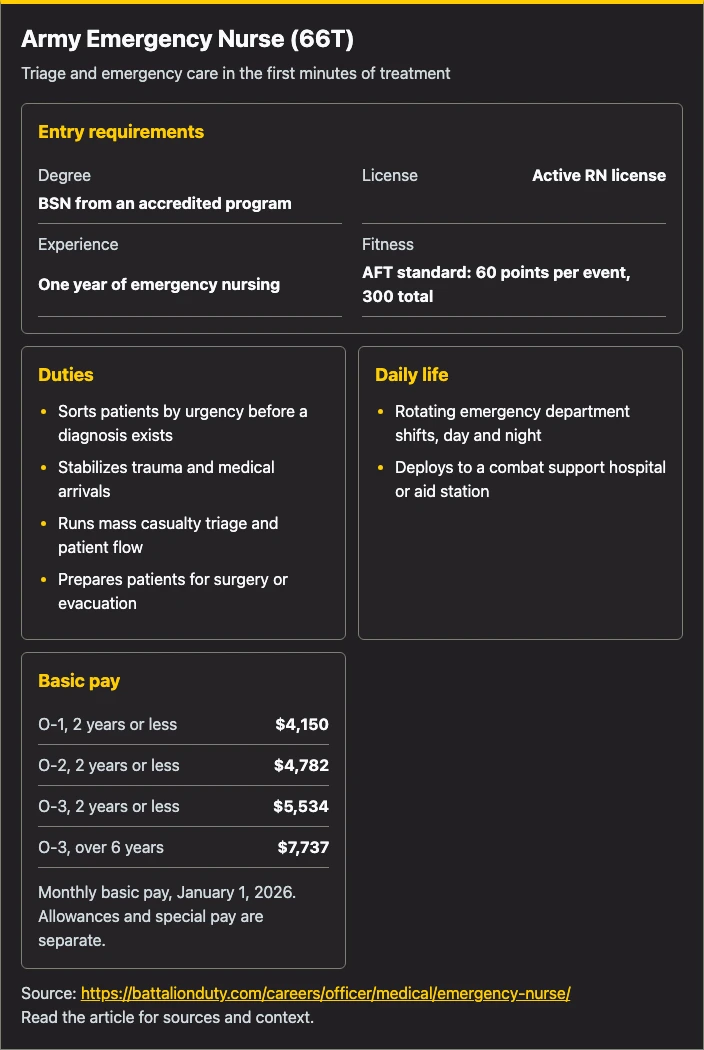
Entry requirements
- Degree
- BSN from an accredited program
- License
- Active RN license
- Experience
- One year of emergency nursing
- Fitness
- AFT standard: 60 points per event, 300 total
Duties
- Sorts patients by urgency before a diagnosis exists
- Stabilizes trauma and medical arrivals
- Runs mass casualty triage and patient flow
- Prepares patients for surgery or evacuation
Daily life
- Rotating emergency department shifts, day and night
- Deploys to a combat support hospital or aid station
Basic pay
- O-1, 2 years or less
- $4,150
- O-2, 2 years or less
- $4,782
- O-3, 2 years or less
- $5,534
- O-3, over 6 years
- $7,737
Monthly basic pay, January 1, 2026. Allowances and special pay are separate.
Source: https://battalionduty.com/careers/officer/medical/emergency-nurse/
Read the article for sources and context.
On this page
Job Role and Responsibilities
A 66T officer performs triage in the first minutes of care, sorting patients by the urgency of their life-threatening conditions.
After triage, the nurse begins stabilization, prioritizing airway, breathing and circulation while also starting pain control early.
What the nurse owns
The nurse makes the initial assessment, recording the chief complaint, vital signs and history provided by the patient.
The nurse assigns the triage level that determines who receives care next. This judgment carries legal consequences because an incorrect priority can leave a critically ill patient waiting too long.
In emergency units that use standing protocols, the nurse can initiate the authorized orders before a physician arrives.
The nurse also monitors the waiting room, where a patient’s condition may deteriorate without obvious warning. Scheduled reassessments help identify those changes.
What the nurse does not own
The emergency physician is responsible for diagnosis and the surgeon for the operation, while the nurse assesses and supports the patient between arrival and those clinical decisions.
How this differs from critical-care nursing
Critical care nurses manage patients over hours after their underlying problems have been identified.
Emergency nurses assess patients with initially unknown problems and must identify immediate priorities within minutes.
The critical care nurse page explains the ongoing intensive care that may follow emergency stabilization. The handoff connects two specialties with different responsibilities.
How this differs from an emergency physician
Army emergency physicians hold an MD or DO and complete residency training before serving in the Medical Corps.
Emergency nurses assess, triage and initiate care within their scope, while the physician is responsible for diagnosis.
How this differs from a combat medic
Emergency nurses practice under an RN license, with a clinical scope distinct from enlisted medics. The medical officer versus enlisted medic comparison explains those responsibilities.
Technology
Emergency nurses use cardiac monitors, point-of-care laboratory devices, ultrasound for line placement and ventilators for short-term support. They document care in Military Health System Genesis.
Salary and Benefits
A 66T officer earns standard officer base pay and may qualify for additional specialty pay, depending on the year and contract.
Base pay and allowances
Basic pay follows rank and years of service. Under the DFAS 2026 pay tables, an O-3 at the over-four-years step earns about $7,383 per month, while an O-4 at the over-eight-years step earns about $8,816.
Housing and food allowances are separate from basic pay and generally tax-free. Housing allowance depends on duty location, rank and dependent status; confirm the current rate for the assignment.
Specialty pay
Emergency nursing appears on shortage lists in most years, which may make officers eligible for incentive pay and accession or retention bonuses.
Amounts change each year with the shortage designation list. Ask an AMEDD recruiter for current figures that apply to your AOC and obligation length, using the Army Medical Recruiting Brigade as your starting point.
The funded training
The Army covers tuition for the emergency nursing course while the officer continues receiving full pay during training.
Qualifications and Eligibility
There are two routes into 66T: one for experienced emergency nurses and another for new graduates.
Door one: experienced emergency nurse
Direct commissioning into 66T requires a BSN, an active RN license and at least one year of emergency nursing experience.
Recent experience matters because a long gap may require retraining, so check the requirements before applying.
Door two: new graduate
New graduates generally commission first as 66H medical-surgical nurses and complete the Clinical Nurse Transition Program. The Army’s nursing pathway says they can apply for specialty training after one year of 66H service. Selection and course-seat availability still apply.
This route takes longer, but it builds a broader clinical base before specialty training.
The BSN requirement
Commissioning requires a BSN from an accredited program, so associate-degree nurses may need to complete a BSN bridge first.
Certification
The CEN credential demonstrates expertise in emergency nursing. Although the Army does not require it to enter 66T, it can strengthen an officer’s professional record.
Clearance and physical
Every route requires U.S. citizenship, eligibility for a Secret clearance and a qualifying military physical.
Age limits
Commissioning age limits may be waived, but the process takes months, so ask about eligibility early.
Work Environment
The garrison emergency department
Most 66T work takes place in a hospital emergency department, where a quiet stretch can turn suddenly into a surge of patients. Nurses need to stay alert through both.
An emergency nurse may manage several patients at once, including admitted patients who remain in the department for hours while awaiting beds.
The forward surgical team
A forward surgical team brings emergency care close to the fight, receiving casualties by ground or air.
On a forward surgical team, the nurse assigns a triage level to every arriving patient, even when several arrive together and no physician is immediately available.
Mass casualty events
Teams rehearse mass casualty response to prepare for incidents in which patient needs exceed the care immediately available. Nurses follow the incident’s triage protocols to prioritize care under those constraints, which can differ from the priorities of routine emergency department work.
Humanitarian work
Army emergency nurses also deploy for disaster relief missions involving trauma and disease in settings with limited resources.
Hours
Garrison shifts last 12 hours and rotate between day and night, while deployed schedules follow mission demands.
Training and Skill Development
Officer school first
New officers complete the AMEDD officer training required for their accession route. BOLC develops military skills; the current course instructions and issued orders determine the sequence and duration.
The transition program
A new graduate then enters the Clinical Nurse Transition Program, which runs about six months and pairs the officer with a preceptor.
Supervised clinical practice develops assessment, documentation and handoff skills. A clear handoff helps the receiving team understand the patient’s condition and continue care.
The emergency course
The 66T Emergency Nursing Course is an 18-week resident program at Brooke Army Medical Center in San Antonio. It combines classroom and clinical training in trauma assessment and airway care.
Further course topics include cardiac emergencies, stroke pathways, triage systems and mass casualty drills.
Certification courses
Two common national courses cover trauma nursing and pediatric emergency nursing, respectively, and both add credentials.
Continuing skills
As emergency practice evolves, officers maintain their RN licenses, complete recertification and continuing education, and undertake additional Army readiness training.
Career Progression and Advancement
Clinical and leadership progression
A new 66T officer develops triage judgment through emergency department work before serving as a charge nurse.
As a major, a 66T officer may become a department head nurse or take responsibility for training or deployment planning.
A Lieutenant Colonel or Colonel can lead nursing across a hospital, move into command or serve on the corps staff.
Leading an emergency department shift means keeping sight of patients who have not yet been seen as well as those already receiving care. A charge nurse may need to coordinate a handoff, move people toward available treatment space and bring a deteriorating patient to the team’s attention. Officers seeking larger leadership roles should be able to describe the decisions they made during demanding shifts, how they trained others and what they changed to make the department work better.
Promotion and alternative assignments
Promotion to O-4 is board-selected, with clinical depth, leadership and military schooling all considered. Officers whose experience is limited to bedside care may find advancement harder.
Education, research and operational positions with maneuver units can all broaden an officer’s career record.
Physical Demands and Medical Evaluations
Physical requirements and protection
Emergency nursing is physically demanding, requiring nurses to stand through most shifts, lift patients, push stretchers and move quickly when patients deteriorate.
Officers in this specialty take the Army Fitness Test under the general standard rather than the combat standard. Passing requires at least 60 points in each event, scored by age and sex, for a minimum total of 300.
The five events are the deadlift, hand release push-up, sprint-drag-carry, plank and two-mile run. See the Army Fitness Test for the scoring rules.
Deployment readiness
Emergency nurses face exposure risks and routinely use gloves, gowns and masks, adding respirators for some cases.
Deployable status requires a current physical, dental readiness and immunizations; lapses can prevent assignment to a team.
Deployment and Duty Stations
Duty stations and deployment schedules
Emergency nurses serve at major medical centers, post emergency departments and deployable hospital units.
Large sites include Brooke Army Medical Center at Fort Sam Houston, Walter Reed and Madigan. Tripler and Womack also run emergency rooms.
Because emergency nursing is a deployable specialty, officers serve on hospital unit deployments and as individual replacements.
Individual assignments often last three to six months, while unit deployments generally run longer. Both arrangements are common.
Deployed work and assignment preferences
A deployed emergency section may have a few beds or dozens, with its size and equipment determined by the mission.
The nurse also trains medics, runs drills and checks equipment.
Officers submit duty station preferences, but Human Resources Command makes the final assignments based on Army needs.
Emergency care in a deployed unit can involve the same urgent decisions as a hospital emergency department, but with less room to hold a patient and a different transfer process. Before listing preferred assignments, ask how the unit handles incoming casualties, what support is available after initial stabilization and how emergency nurses keep their clinical skills current between missions. A billet’s location says less about daily practice than its actual patient load and readiness work.
Risk, Safety, and Legal Considerations
Clinical and workplace hazards
Emergency care involves making rapid decisions from incomplete information, which creates clinical risk every day.
Nurses have professional obligations under both military law and the regulations of their state nursing board.
Under 10 U.S.C. § 1089, the usual civil remedy for malpractice during assigned military medical work is a claim against the United States, not a personal lawsuit against the nurse. The law covers negligent care when the provider acts within the scope of assigned duties. Military discipline and nursing-board action are separate matters.
Accountability and operational pressures
Emergency departments sometimes encounter agitated patients and assaults, and security personnel may not be able to respond immediately.
Emergency staff encounter blood and body fluids daily, and any needlestick must be reported.
Night shifts and long periods on duty can cause fatigue and increase error risk. Although Army rules limit duty hours in some settings, field conditions can override those limits.
Rapid decisions make a clear record especially useful. When patients move between triage, treatment and another service, the next team needs to know what was observed, what was done and what still needs attention. An officer also has to distinguish urgency from speed for its own sake: checking the medication, confirming an unclear order and asking for help can prevent a rushed shift from turning into an unsafe one.
Impact on Family and Personal Life
Work schedules, moves and deployments
Twelve-hour shifts and rotating night duty can disrupt sleep and require nurses to miss evenings and weekends with family.
Moves every two to three years can mean changing schools and finding new work for a spouse. Large medical posts may offer more employment options, but each move still requires planning.
Deployments commonly involve absences of three to six months, with longer periods on unit rotations.
Family support and dual-military assignments
Army Community Service supports relocations, Family Readiness Groups assist during deployments, and on-post childcare can help families with both.
Dual-military couples may face conflicting assignments; joint-domicile requests can help, but approval is not guaranteed.
Rotating shifts and unpredictable patient surges complicate household schedules even when the officer stays at one hospital. A move adds another layer if a partner needs new work or children need a new school. Compare the unit’s likely night and weekend duties with the family support available at that post, and plan how a household would manage a deployment without assuming relatives can fill every gap.
Reserve and National Guard
Part-time service, training and pay
Emergency nurses can pursue part-time Army service where suitable billets are available. Confirm the specialty, component and unit mission with an AMEDD recruiter, particularly if you are considering National Guard service.
A Reserve 66T typically combines monthly drills and annual training with a civilian emergency nursing job. Additional training or mobilization can require more time than that usual schedule.
Drill pay follows the officer table, with an O-3 earning about $738 per drill weekend at fewer than two years of service.
Clinical readiness and suitability
Reserve nurses must maintain current credentials and clinical skills, which civilian practice usually supports.
Reserve service can complement an established civilian nursing career with military retirement credit and a unit affiliation, while adding its own training and service obligations.
A civilian emergency department can provide the day-to-day experience that a part-time military schedule cannot. Still, a Reserve or Guard unit may expect separate training on its own equipment, team procedures and deployment tasks. Applicants should ask what clinical experience the billet requires, how readiness is checked and how the unit handles a mobilization that overlaps with civilian work. Those details can matter more than the advertised drill schedule.
Post-Service Opportunities
Civilian opportunities and leadership experience
Emergency nursing experience can support applications to civilian emergency departments and related acute-care roles. Employers will assess current credentials, experience and the requirements of the specific position.
After service, emergency nurses may work in hospital emergency departments, trauma centers, urgent care or flight programs, while others teach.
Army nurses may leave with experience running units and managing teams, giving them a leadership record beyond their bedside work.
Education and licensing after service
Eligible nurses may receive up to 36 months of Post-9/11 GI Bill education benefits, which can support graduate study. Transfers to family are not automatic. Under the usual VA rules, the service member needs six years of service, must agree to serve four more years and must request Defense Department approval while still serving. The dependent must also be enrolled in DEERS.
State licensure and the CEN credential remain with the individual after service; neither requires an Army sponsor.
Emergency nursing experience is useful to civilian employers when it is recent and can be documented. Keep the RN license and any additional credentials current, along with a record of the types of emergency work performed and teams led. A nurse seeking flight, trauma or teaching work should check the receiving employer’s specific requirements early. Service in an emergency unit does not by itself qualify someone for every civilian specialty role.
Is This a Good Job for You? The Right (and Wrong) Fit
Strengths and tradeoffs
This path can suit a nurse who thinks quickly, accepts uncertainty and enjoys varied cases. That combination matters when decisions cannot wait for a complete clinical picture.
It also suits a nurse who wants to teach. Emergency nurses train medics constantly.
A nurse who prefers sustained work with one patient may find the pace frustrating: emergency care moves from assessment and stabilization to handoff. Night shifts and possible deployments also deserve careful thought before choosing this specialty.
The route involves lengthy training and demanding shifts, but develops a scarce clinical skill with strong earning potential.
More Information
Start with the Army Nurse Corps officer guide. It covers branch structure, entry routes and general pay. Then read the critical care nurse page for the hours after stabilization.
Compare emergency nursing with nurse anesthesia and perioperative nursing to understand how responsibilities change as patients move into surgical care.
The medical officer hub and Army officer careers hub place nursing among the wider career options. For entry decisions, use the officer commissioning guide.
Talk to an AMEDD nurse recruiter about current specialty pay, the emergency course schedule and which posts currently have 66T billets.