Army Emergency Physician (62A)
Army emergency physicians assess and stabilize patients whose illness or injury needs immediate attention. The Medical Corps specialty is 62A: a physician route combining emergency-department practice with military readiness, operational medicine and leadership responsibilities.
Applicants need an acceptable medical degree and specialty preparation recognized by the Army. Medical-school funding, residency selection, appointment grade, clinical privileges and board certification are separate decisions; this profile explains those distinctions alongside pay, training and the practical demands of service.
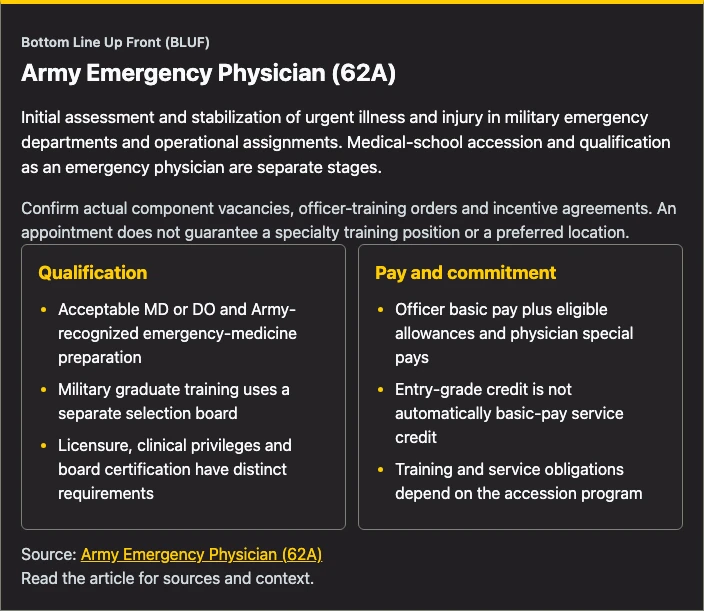
Initial assessment and stabilization of urgent illness and injury in military emergency departments and operational assignments. Medical-school accession and qualification as an emergency physician are separate stages.
Confirm actual component vacancies, officer-training orders and incentive agreements. An appointment does not guarantee a specialty training position or a preferred location.
Qualification
- Acceptable MD or DO and Army-recognized emergency-medicine preparation
- Military graduate training uses a separate selection board
- Licensure, clinical privileges and board certification have distinct requirements
Pay and commitment
- Officer basic pay plus eligible allowances and physician special pays
- Entry-grade credit is not automatically basic-pay service credit
- Training and service obligations depend on the accession program
Source: Army Emergency Physician (62A)
Read the article for sources and context.
On this page
Job Role and Responsibilities
Army emergency physicians (62A) examine, diagnose, and treat the initial phase of disease and injury. The Army officer classification manual defines the specialty around that initial care and requires an acceptable MD or DO plus specialty training and experience recognized by the Office of the Surgeon General.
In an emergency department, that work includes resuscitation, emergency diagnostics and procedures, and decisions about admission, transfer, or discharge. The physician also helps prepare the team for casualty surges and military operations.
Command and Leadership Scope
A 62A officer directs the clinical team during emergency care. Nurses, medics, technicians, and other clinicians contribute their own expertise as the physician coordinates the assessment and treatment of patients with competing needs.
Leadership responsibility depends on the assigned position. A staff physician may lead a resuscitation or supervise trainees, while a department chief also addresses staffing, clinical standards, and quality improvement; specialty qualification alone does not confer command of a unit.
Specific Roles and Designations
62A identifies the emergency physician specialty. A physician’s personnel record may also include medical proficiency designators, which are separate from the specialty code and do not replace licensure or hospital privileges.
The classification requirements do not make completed board certification a universal prerequisite for every 62A appointment. Residency completion, board eligibility, certification, and authorization to perform particular procedures are distinct milestones, so applicants should have the Army assess their actual training record.
Mission Contribution
Emergency medicine sits on the boundary between the fixed hospital system and the operational force. At home, the department is the entry point for almost everything that goes wrong outside scheduled clinic hours, from a training injury to a cardiac arrest in family housing. In the field, emergency physicians staff the facilities that receive casualties first, and their judgment shapes what happens to those patients downstream.
Emergency physicians also teach. They instruct medics, nurses, and non-medical officers in trauma care, and they run the simulation training that keeps a unit’s casualty response current.
Technology, Equipment, and Systems
The department runs on standard emergency equipment, including airway management sets, point-of-care ultrasound, monitors, defibrillators, and rapid diagnostic testing. Physicians work inside the military health system’s electronic record and ordering system, and they use the same documentation and quality reporting tools as the rest of the facility.
In deployed settings the equipment set narrows to what can be moved and sustained. Physicians may work with portable diagnostics and limited imaging, while blood availability and evacuation depend on the facility and mission. Those constraints affect which treatment can be delivered locally and when a patient needs transfer.
Salary and Benefits
Base Pay (2026)
Physicians commonly enter active clinical service as captains, with appointment grade determined by the approved accession record. Credit used to determine entry grade is separate from service credited for basic pay; medical school does not automatically give a new physician four extra years on the pay table.
| Rank | Pay Grade | Years of Service | Monthly Base Pay | Annual Base Pay |
|---|---|---|---|---|
| Captain (CPT) | O-3 | 2 or less | $5,534 | $66,409 |
| Captain (CPT) | O-3 | Over 4 | $7,383 | $88,592 |
| Major (MAJ) | O-4 | 2 or less | $6,295 | $75,535 |
| Major (MAJ) | O-4 | Over 8 | $8,816 | $105,797 |
| Major (MAJ) | O-4 | Over 12 | $9,888 | $118,660 |
Source: DFAS 2026 pay tables. Figures reflect the 2026 pay raise.
The table uses the site’s shared 2026 officer basic-pay data and rounds displayed amounts to whole dollars. It excludes allowances and physician special pays; the service-time labels identify pay brackets rather than predicted promotion dates.
Special Pays
Physician compensation may include Board Certification Pay, Incentive Pay, and a Retention Bonus, subject to eligibility and an approved agreement. The DFAS Medical Corps table uses those categories and states that its published rates are maximum amounts; an accession bonus is a separate possible incentive.
Before signing, ask the Army medical recruiter or special-pay office for the applicable fiscal-year terms, emergency-medicine rate, training-status restrictions, and any additional obligation. Do not treat a published maximum or a prior-year offer as guaranteed compensation.
Additional Benefits
Officer Basic Allowance for Subsistence is $328.48 per month. Housing allowance depends on eligibility, location, grade, and dependent status, so a single Fort Sam Houston example does not describe every physician’s compensation.
TRICARE Prime costs differ by beneficiary status. Active duty members have no out-of-pocket costs; active duty family members enrolled in Prime have no enrollment fees or network copayments, but point-of-service charges can apply when they use that option. Family coverage under another plan and coverage during part-time Reserve service follow different rules.
Active duty officers earn 30 days of paid leave annually, subject to approval and mission requirements. Leave entitlement does not guarantee that a physician can take particular holidays or immediately follow a deployment with time off.
The Blended Retirement System applies automatically to members whose initial entry into service was on or after January 1, 2018; some earlier entrants opted in, while others retain a legacy plan. Under BRS, an active duty retirement at 20 creditable years produces a pension based on 40 percent of the highest 36 months of basic pay, excluding allowances and special pays.
BRS also includes an automatic TSP contribution and matching contributions subject to service and contribution requirements. Reserve retirement uses qualifying years and retirement points, with retired pay generally beginning later; 20 calendar years of part-time service do not produce the same immediate pension as 20 active duty years.
Work-Life Balance
Emergency medicine requires round-the-clock staffing. The department never closes, so shifts run around the clock, including nights, weekends, and holidays. A physician may work several night shifts in a row and then have days off that fall on a Tuesday.
Shift work can provide blocks away from the department, but military training, administrative duties, and recovery from nights can consume that time. Garrison schedules and deployed schedules differ, and neither guarantees uninterrupted days off.
Qualifications and Eligibility
Commissioning Sources
Applicants can enter the medical pipeline before medical school, during postgraduate training, or after becoming practicing physicians. These routes differ in student status and obligations; receiving a commission does not by itself qualify someone as an emergency physician.
- Health Professions Scholarship Program (HPSP). Provides tuition and fee support and a stipend at an approved civilian medical school. Students serve as Reserve second lieutenants during the program, with annual active duty training requirements.
- Uniformed Services University (USU). Provides tuition-free medical education in Bethesda, Maryland, with active duty officer pay and benefits. Army medical students hold O-1 rank during school and move to O-3 upon graduation under the university’s rules.
- Direct commission. Allows qualified physicians to apply after medical school and clinical training. Entry grade and required officer training depend on the approved accession record, prior service, and component.
- Financial Assistance Program (FAP). Provides an annual grant and stipend for approved residency or fellowship training in exchange for service. Availability and obligation depend on the program agreement.
The Army medical scholarship overview describes the education-funding options. Compare the service obligation as carefully as the financial support.
Commissioning Requirements
| Path | Education stage | Service commitment to verify |
|---|---|---|
| HPSP | Accepted to or enrolled in an approved medical school | Scholarship length, any minimum active obligation, and obligations from later training |
| USU | Admission to the university’s MD program | Seven years of active duty after residency for military graduates |
| Direct commission | Physician with an acceptable MD or DO and qualifying professional credentials | Appointment terms, component requirements, and any incentive agreement |
| FAP | Approved residency or fellowship | Funded training period and the resulting active duty obligation |
The Army’s medical accession guidance describes commitments as program dependent. Residency, fellowship, and incentive agreements can affect the total, so obtain a written calculation of which obligations run together and which must be served separately.
Age rules also depend on the program. Army medical recruiting guidance lists a general 21–42 range, while USU’s current admissions explanation lists ages 18–36 by June 30 of the matriculation year. Applicants outside a published range need a program-specific eligibility or waiver determination, rather than relying on a universal direct-commission cutoff of 55.
Applicants must meet the applicable citizenship, medical, fitness, and security requirements. For independent clinical practice, the Army must also verify licensure, professional qualifications, and the privileges needed for the position; student accession does not require the same completed credentials as accession as a practicing specialist.
Test Requirements
Physicians use the health-professional accession route rather than general Officer Candidate School, so the ASVAB is not the physician entry exam. Medical-school applicants meet the school’s admissions and MCAT requirements, then complete the licensing examinations relevant to their medical degree and licensing board.
Military applicants compete for graduate training through the Joint Graduate Medical Education Selection Board, commonly called the military match. Service-approved civilian training may require additional civilian applications; Army residency positions should not be described as filling through the ordinary civilian match alone.
Board eligibility follows qualifying residency training, while certification requires completing the relevant board’s process. The American Board of Emergency Medicine and American Osteopathic Board of Emergency Medicine publish their own requirements; eligibility and certification are not interchangeable.
Upon Commissioning
HPSP students enter as second lieutenants rather than captains. USU likewise commissions Army medical students at O-1, and its academic policies specify advancement to O-3 at graduation.
A trained direct-commission physician’s grade reflects approved entry-grade credit and prior service. Confirm grade, date of rank, and basic-pay service separately, and have the Army determine specialty qualification from the actual clinical record.
Work Environment
Setting and Schedule
The primary workplace is an emergency department at a military treatment facility. That means a resuscitation bay, a monitored treatment area, and a fast-track section for minor complaints, all operating at once. The pace is set by arrival volume, which varies by installation, time of day, and whether a large training event is underway.
The setting changes completely on deployment. Physicians may work from a containerized facility, a tent, or a hardened structure, with the equipment that could be moved there. The patient mix depends on the mission and may include trauma as well as illness and noncombat injuries.
Leadership and Chain of Command
The physician works within the assigned department and facility leadership structure, or the deployed unit’s chain of command. Clinical authority comes from verified credentials and granted privileges; military authority depends on the officer’s position and orders. A physician’s rank alone does not authorize every clinical procedure.
Officer-NCO Dynamic
Senior medical NCOs help manage enlisted training, readiness, and the team’s daily military requirements. Physicians remain responsible for their clinical decisions and should work with the enlisted leadership rather than assume that clinical supervision replaces the unit’s military chain of command.
Staff vs. Command Roles
Assignments may combine patient care with teaching, quality improvement, operational planning, or department leadership. A chief or commander can have substantially less clinical time than a staff physician, but there is no universal rank-based schedule that moves every emergency physician away from practice.
Training and Skill Development
Pre-Commissioning Training
HPSP includes annual active duty training; its timing and activities must fit the student’s approved program. USU integrates military education and field training into medical school, alongside the clinical curriculum.
Basic Officer Leader Course (BOLC)
Medical officers complete the officer training required for their accession route and prior experience. The Medical Center of Excellence BOLC guidance distinguishes active and Reserve-component arrangements at Fort Sam Houston, Texas.
Confirm whether the actual training plan includes a direct-commission course, BOLC, distance learning, and resident attendance. A two-week Reserve resident phase is not a reliable description of every officer’s entire training requirement, and a generic three-phase schedule should not replace course orders.
Graduate Medical Education
Emergency medicine residency develops the specialty skills needed for practice. For example, the San Antonio Uniformed Services Health Education Consortium program describes a 36-month residency with military and civilian clinical rotations; applicants should verify the curriculum and length of each program they are considering.
Military selection, specialty qualification, licensure, and later board certification are separate steps. Acceptance into HPSP or USU does not guarantee an emergency-medicine residency position or a particular installation.
Professional Military Education
Clinical training and military professional education serve different purposes. Residency develops specialty practice, while military schooling prepares officers for operational planning and broader leadership duties.
Physicians should coordinate required courses with their career manager alongside residency, fellowship, and clinical assignments. Eligibility, delivery format, and deadlines depend on the officer’s record and current guidance, so a fixed years-of-service timetable is not a promotion guarantee.
Additional Training
Further opportunities can include fellowship, teaching, research, and training for a particular operational assignment. Selection depends on qualifications and Army needs; airborne, aviation, or special-operations training is not an automatic part of becoming a 62A.
Career Progression and Advancement
Career Path
A physician’s initial grade and later promotion are separate decisions. Emergency physicians may serve as staff clinicians, residency faculty, department leaders, operational medical staff, or medical commanders, depending on qualifications and available positions.
The balance of clinical and leadership work changes with the assignment. Applicants should discuss the specific billet’s patient-care expectations rather than assume that a captain always works shifts or a colonel always commands a hospital.
Promotion Factors
Performance evaluations, professional qualifications, military education, and the applicable promotion-board requirements affect advancement. Operational assignments and leadership experience can broaden an officer’s record, but neither deployment nor a particular staff job guarantees selection.
Maintaining clinical competence remains essential for a physician who wants to continue practicing. Discuss both clinical development and military career requirements with the specialty consultant and career manager rather than treating staff service as a substitute for either.
Broadening Opportunities
Teaching, fellowship training, research, and medical leadership can broaden a physician’s career. The Army classification manual places health-services specialties in the Medical Service Corps; they should not be presented as an automatic FA 70 progression for a Medical Corps emergency physician.
An officer interested in changing corps or career field needs a formal determination under the applicable personnel rules. The medical officer overview provides context for the different medical branches.
Physical Demands and Medical Evaluations
Emergency physicians must meet applicable Army commissioning and continuing fitness standards. The Army Fitness Test (AFT) replaced the ACFT on June 1, 2025. For ages 17 through 21, the official AFT scoring standards list:
| Test event | Male 17-21 minimum | Female 17-21 minimum |
|---|---|---|
| Three-repetition maximum deadlift | 150 lb | 120 lb |
| Hand-release push-ups | 15 | 11 |
| Sprint-drag-carry | 2:28 or faster | 3:15 or faster |
| Plank | 1:30 or longer | 1:30 or longer |
| Two-mile run | 19:57 or faster | 22:55 or faster |
Older age groups have different event standards. Emergency medicine is not a designated combat specialty, so the general standard of 300 points overall with at least 60 per event applies.
The specialty does not carry a routine aviation flight physical requirement. A physician selected for flight-surgeon duties must meet that assignment’s separate training and medical requirements. Medical screening for service and professional licensure are separate gates, and the physician must clear both.
Deployment and Duty Stations
Deployment Details
Emergency physicians can deploy in field hospitals, resuscitation teams, and other operational medical assignments. Deployment frequency depends on the unit, position, and current requirements; a hospital assignment does not guarantee protection from deployment.
The deployed patient mix can include trauma, illness, and noncombat injuries, with diagnostic resources and staffing determined by the facility. Evacuation delays and limited resources can make early stabilization and transfer decisions especially consequential.
Duty Station Options
Emergency physicians serve in military emergency departments and operational medical positions; not every clinic has an emergency department. Assignment is managed by Human Resources Command, and officers submit preference sheets that are weighed against the needs of the Army. Preferences do not guarantee a location; available positions and Army requirements govern the assignment.
Risk, Safety, and Legal Considerations
Job Hazards
The clinical hazards are the ones any emergency physician faces, including exposure to infectious disease, needlestick injury, and the physical strain of long shifts. Agitated or violent patients can also create risks for the clinical team.
Deployed practice adds risks from hostile activity and movement between facilities. A physician may need to treat patients while the area is under threat.
Safety Protocols
Emergency departments run on standard safety systems, including universal precautions, sharps handling rules, patient restraint policy, and de-escalation training. Deployed facilities add force protection requirements and casualty decontamination procedures. Physicians are responsible for enforcing these inside their area, not only for following them.
Legal and Command Responsibility
An emergency physician holds clinical authority through licensure and granted privileges. The officer also holds military authority through appointment, which carries UCMJ accountability and, at senior levels, command responsibility. A department chief answers for the clinical standards of the department, including adverse events, credentialing, and quality review.
A command or clinical leadership assignment brings accountability for organizational performance as well as individual practice. Adverse findings can affect duties, privileges, or the military career, depending on the circumstances and applicable process.
Impact on Family and Personal Life
Emergency medicine affects family life mainly through the schedule. Night shifts, weekends, and holidays fall on the physician, and the family adjusts around a calendar that does not match a school week or a spouse’s job.
Military service adds moves and deployments on top of that. Permanent change of station orders arrive on a cycle, and each move means a new facility, a new team, and a new set of credentialing requirements. Deployments remove the physician from the household for months at a time, and the timing is rarely convenient.
Support systems exist and are worth using. Family support centers, family readiness groups, and spouse employment programs are available at most installations. Dual-military couples face the additional problem of coordinating two assignment cycles, which the Army manages through the married army couples program when both members are eligible.
Reserve and National Guard
The Army Reserve and Army National Guard offer physician service alongside civilian practice, subject to available positions and component-specific eligibility. The Washington National Guard medical recruiting page, for example, lists emergency physician 62A among its medical specialties; that does not establish a vacancy in every state.
Part-time service includes training and readiness duties, and mobilization can interrupt a civilian emergency-department schedule. Applicants should ask the actual unit about training attendance, deployment expectations, clinical currency requirements, and the full officer-training sequence before accepting a position.
Pay, health coverage, incentives, and retirement depend on duty status and the applicable agreements. Compare those terms separately from the active duty package, and plan with the civilian employer for military absences.
Post-Service Opportunities
Emergency medicine training can support a transition to civilian emergency departments, teaching, or medical leadership. Military service does not automatically confer board certification or guarantee employment; civilian employers still assess licensure, certification status, recent clinical work, and hospital credentialing requirements.
Operational and leadership experience may be relevant to disaster response or administrative positions, but its value depends on the job. Before leaving active duty, preserve training and procedure records, check state licensing and certification deadlines, and allow time for the new employer’s credentialing process.
Is This a Good Job for You? The Right (and Wrong) Fit
Emergency medicine suits physicians who can assess urgent problems with incomplete information, act within available resources and revise a plan as new findings arrive. Army service adds obligations beyond the clinical shift, including military training, moves and possible deployments.
Before choosing the route, compare the commitments that would affect daily life:
- Clinical work: Ask the gaining department about case mix, supervision, procedures and expectations for maintaining specialty skills.
- Schedule: Review nights, weekends, call and administrative duties together; a shift roster does not capture every military obligation.
- Training and service: Obtain the actual residency-selection rules, officer-training plan and written service-obligation calculation.
- Location and family: Compare available assignments and mobilization requirements with the flexibility of the household and, for Reserve applicants, the civilian employer.
Compare a real civilian offer with the complete Army package, including eligible special pays, allowances and retirement benefits. Neither a national wage figure nor a recruiting maximum establishes an individual physician’s earnings. The decision also concerns clinical scope, operational service and control over where and when the physician works.
More Information
Compare the Army Medical Corps with the other routes in the medical officer overview. A prospective medical student, a resident and a practicing emergency physician enter at different points, so each needs advice tailored to the actual program and professional record.
The next practical step is a conversation with an Army medical recruiter and the relevant graduate-medical-education or specialty office. Request current written eligibility, training, compensation and obligation terms before making a commitment.