Army Family Nurse Practitioner Officer (66P)
Main job: Army Nurse Corps Officer.
An Army family nurse practitioner (FNP) may treat an injured Soldier, see a sick child, and help someone manage a long-term illness on the same day. These nurses give primary care, the care people need for common health problems and ongoing treatment.
The Army calls this job 66P. It requires nursing study beyond a bachelor’s degree, and it also comes with the training, fitness, and leadership duties of an Army officer.
A nurse who is already trained as an FNP can ask an Army medical recruiter about joining in this role. A registered nurse (RN) who still needs FNP training can finish that study before applying, or join as an Army nurse and seek a place in an FNP program later.
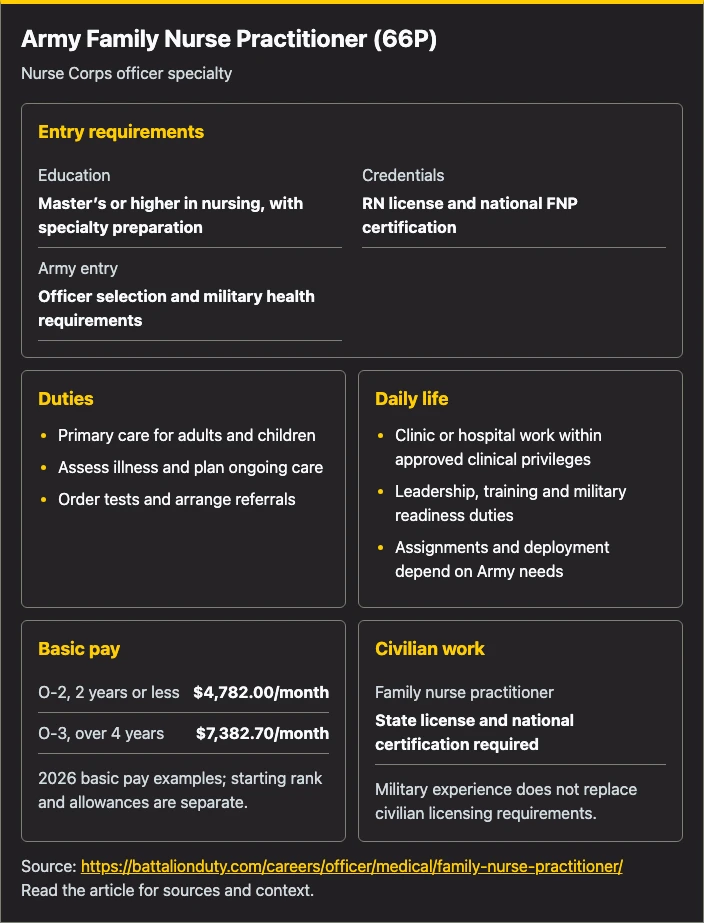
Entry requirements
- Education
- Master’s or higher in nursing, with specialty preparation
- Credentials
- RN license and national FNP certification
- Army entry
- Officer selection and military health requirements
Duties
- Primary care for adults and children
- Assess illness and plan ongoing care
- Order tests and arrange referrals
Daily life
- Clinic or hospital work within approved clinical privileges
- Leadership, training and military readiness duties
- Assignments and deployment depend on Army needs
Basic pay
- O-2, 2 years or less
- $4,782.00/month
- O-3, over 4 years
- $7,382.70/month
2026 basic pay examples; starting rank and allowances are separate.
Civilian work
- Family nurse practitioner
- State license and national certification required
Military experience does not replace civilian licensing requirements.
Source: https://battalionduty.com/careers/officer/medical/family-nurse-practitioner/
Read the article for sources and context.
On this page
Job Role and Responsibilities
An Army family nurse practitioner treats adults and children for common health problems and ongoing illnesses. The role can also include care linked to pregnancy and reproductive health, within the nurse’s training and permission to practice. FNPs give care, make treatment plans, and may lead clinics or nursing teams.
The Army’s 66P job description covers both treating illness and helping patients stay well. Daily work can include:
- Asking about a patient’s health history and current concerns.
- Giving exams and ordering or reviewing tests.
- Making or changing a treatment plan.
- Explaining how to follow the plan at home.
- Arranging other care when a patient needs it.
The clinic or hospital decides which kinds of care each FNP may give there. That permission is called clinical privileges. If a patient needs care beyond those limits, the FNP arranges a referral so the patient can see the right specialist.
What makes Army primary care different
For a Soldier, a health problem can affect the ability to train, work, or deploy. An FNP may need to fit follow-up care around field training or arrange care before a Soldier moves to another Army post. Readiness is the Army’s term for being ready to carry out military duties; health care is one part of it.
The clinic may also serve children, spouses, retirees, and other people who can receive military health care. Their needs do not always follow a Soldier’s work schedule. The patients an FNP sees depend on the clinic and the people it serves.
Visits may cover:
- Common infections and vaccines.
- Medicine checks and long-term illnesses.
- Health screening tests, which look for problems before symptoms appear.
- Reproductive health concerns within the FNP’s approved work.
The FNP decides what can be dealt with during a visit and what needs another care team. Test results, referrals, and urgent visits can fill the time between planned appointments.
An FNP who leads a clinic may also plan staff schedules, check care quality, and organize how patients get care. Leading a care team has different duties from commanding a military unit, so a clinic leadership title does not give someone all of a commander’s powers. The career section below lists the named leadership jobs within 66P.
How the specialty compares with nearby medical jobs
| Job | Army code and corps | How the work and training differ |
|---|---|---|
| Family nurse practitioner | 66P, Nurse Corps | Nursing study beyond a bachelor’s degree; primary care for patients of different ages |
| Psychiatric/behavioral health nurse practitioner | 66R, Nurse Corps | Further nursing study focused on mental health care |
| Medical-surgical nurse | 66H, Nurse Corps | Registered nursing; this training alone does not make an RN a nurse practitioner |
| Family medicine physician | 61H, Medical Corps | Medical school followed by residency, the supervised training doctors complete in their field |
| Physician assistant | 65D, Medical Specialist Corps | A separate health profession with its own graduate degree and Army medical corps |
An Area of Concentration (AOC) is the Army’s code for an officer’s field of work. The Army also has codes for added skills and names for particular jobs.
A short course or a new nursing assignment does not by itself earn the 66P code. The nurse must complete the FNP education and meet the other rules for that role.
Salary and Benefits
Army officer basic pay depends on rank and the years of service counted for pay. There is no separate basic-pay rate for 66P. The examples below come from the 2026 Defense Finance and Accounting Service (DFAS) officer pay table, which took effect on January 1, 2026.
| Rank and pay grade | Years counted for pay | Monthly basic pay in 2026 |
|---|---|---|
| O-1, Second Lieutenant | Two years or less | $4,150.20 |
| O-2, First Lieutenant | Two years or less | $4,782.00 |
| O-3, Captain | Over four years | $7,382.70 |
| O-4, Major | Over eight years | $8,816.40 |
The Army lists 66P jobs at O-2 through O-6. That tells you the ranks assigned to those jobs, but it does not settle the rank at which a particular person will join.
The Army reviews the person’s education, work history, and military service under its entry rules. Earlier service as an enlisted member or warrant officer can also change the pay row used.
The table shows examples of officer pay, so the O-1 row is not a promised starting rank for an FNP. Nor does the O-4 example mean an officer will reach that rank after eight years. Rank and years counted for pay are separate parts of the pay calculation.
Officers may receive benefits beyond basic pay, including:
- Money for housing and food. Housing pay depends on rank, location, and family status under military pay rules.
- Health coverage and paid time off.
- Retirement benefits for those who qualify.
The Blended Retirement System can provide benefits through the Thrift Savings Plan, a federal retirement savings account. Military retired pay has its own service rules. The total value of pay and benefits will differ from one officer to another.
Bonuses for joining and programs that help with school costs or loans can change from year to year. The Army’s medical funding programs include nursing options, but a general nursing offer may not apply to a specific 66P job.
Build the pay comparison from your written offer: starting rank, housing and food payments, health coverage, and any bonus. Then weigh those benefits against how long you must serve and when you might have to pay money back. A bonus is less useful if the service terms do not fit the life you want.
Qualifications and Eligibility
A bachelor of science in nursing (BSN) and an RN license are the first steps. To earn the 66P code, a nurse also needs FNP training through graduate study, meaning study beyond a bachelor’s degree. The Army’s November 2025 rules call for a master’s degree or higher in nursing.
The nurse must meet these education and license rules:
- Hold a master’s degree or higher in nursing.
- Complete FNP training within an FNP master’s program or a formal program taken after a degree. The nursing school must give graduate credit for that work.
- Complete an accredited nursing program that the Army accepts. Accredited means the program meets set education standards.
- Hold a current, valid, unrestricted state nursing license. Unrestricted means the state nursing board has placed no special limits on it.
The nurse must earn national FNP certification, proof of meeting the training and exam rules for this role. The Army rule gives a deadline of one year after graduation or one year after joining the Army Nurse Corps. That is separate from the state license and the clinic’s permission to treat patients.
The Army normally requires one year of work as an RN. It makes an exception for a nurse who starts a master’s in nursing right after the BSN.
The Army also prefers:
- 1,500 hours of relevant patient care in total.
- At least 750 of those hours in the current year.
Those hours are preferred, rather than a firm minimum for every person who applies.
Which path into Army nursing applies?
Receiving a commission means becoming an Army officer. One college path is the Reserve Officers’ Training Corps (ROTC), which can help a student enter Army nursing after earning a BSN. FNP study comes later unless the nurse has already completed it.
The table shows how these paths differ. GPA means grade point average, the average of a student’s school grades.
| Path into the role | School grades needed (GPA) | Degree needed | Age limit | Health and fitness rules | Extra steps for 66P |
|---|---|---|---|---|---|
| Civilian FNP applying to join | Ask for the current Army rule; the AOC chart gives no score | Nursing degree and FNP graduate training | Current Army entry rule | Army health review and the first-time specialty fitness rules explained below | RN license, national FNP certification, and the RN work rule |
| Army RN moving to 66P | Army and school rules | FNP graduate training after the RN degree | Army rules for that path | Army fitness and specialty rules | Win a place in a study program or get approval to change nursing fields |
| ROTC nursing, then FNP study | ROTC rules; no separate 66P cutoff | BSN and RN first; FNP degree later | ROTC rules | ROTC and Army health and fitness rules | Apply later for graduate school and the FNP role |
| Uniformed Services University FNP program | University and Army rules | BSN, followed by FNP graduate study | Rules for that program | Military entry and health rules | At least two years of nursing work at the BSN level |
The Uniformed Services University FNP program described by the Army asks for two years of nursing work. That program rule is separate from the usual one-year RN-work rule for 66P.
Meeting the Army’s minimum does not always mean a nurse meets a school’s entry rules. The preferred patient-care hours are another separate part of the Army’s guidance.
How to apply
If you are already an FNP, the main steps are:
- Check for an opening. Ask an Army Medical Department (AMEDD) recruiter whether the active Army, Army Reserve, or Army National Guard has an open 66P job that matches your training.
- Gather your records. Bring your nursing license, national certification, school records, and work history.
- Complete the Army’s review. The Army checks your records, health, fitness, and right to become an officer. It also decides the starting rank and the terms of the offer.
- Complete the training after appointment. Follow the Army training listed in your orders and the clinic’s steps for starting work.
Before patient care begins, the clinic or hospital checks the nurse’s degrees, license, certification, and work history. That check is called credentialing. The clinic then grants the clinical privileges needed for the job.
An RN who wants to train as an FNP later must first qualify to join the Army Nurse Corps. Possible paths include ROTC, a program for enlisted Soldiers who want to become nurses, or applying as a trained civilian nurse.
Once serving, the nurse may seek Army-paid graduate study. Another option is to pay for an accepted degree and ask the Army to approve a change to 66P. School admission and an FNP degree do not promise an Army job in that field.
The Army’s nursing education page explains these nursing paths.
Advice for general Army Officer Candidate School (OCS) applicants may not fit a nurse’s path. The 66P rules do not set one Armed Services Vocational Aptitude Battery (ASVAB) score, Graduate Record Examination (GRE) score, or selection score for everyone. Ask which age, school, test, and entry rules apply to the way you plan to join.
Work Environment
An Army FNP may work in a clinic on an Army post or another military health center with an approved 66P job. The work can include seeing patients, leading a clinic, or running programs that help people stay healthy. The daily mix depends on the patients, the staff, and the care the FNP is allowed to give.
At a follow-up visit, the FNP checks what happened after the last treatment. The patient may have new symptoms, test results, or concerns about a medicine. The FNP uses that information to plan the next steps and, if a Soldier is about to move, may need to pass the care plan to a new team.
The job continues after the patient leaves. The FNP may need to read records, answer secure messages, review test results, or arrange the next visit.
Doctors, nurses, pharmacy staff, therapists, lab staff, and other health workers each handle parts of the care. A clear handoff tells the next person what has been done and what still needs attention.
An outpatient clinic, where patients leave after care, can involve fewer night shifts than a hospital ward. It can still have early starts, weekend coverage, field training, paperwork, and deployment. Ask about the actual clinic’s hours and Army duties before judging the job by its title.
Training and Skill Development
FNP training teaches a nurse to give family primary care. Army officer training teaches how to lead and work in the military. A nurse joining the Army needs both, even when already skilled at treating patients.
| Training step | Where or how it takes place | Length | What it prepares the nurse to do |
|---|---|---|---|
| RN degree and FNP graduate study | An approved nursing school, with supervised patient care during study | Depends on earlier education and the program | Meet the nursing and FNP training rules |
| National FNP certification | A recognized national testing and approval process | Exam and approval dates vary; the Army gives the one-year deadline explained above | Meet the FNP certification rule |
| Direct Commission Course, if ordered | An Army officer course | Depends on the entry path and orders | Learn basic officer duties before or alongside other AMEDD training |
| AMEDD Basic Officer Leader Course (BOLC), active Army | Fort Sam Houston, Joint Base San Antonio | Army public guidance: about 10 to 14 weeks | Learn Army leadership, field duties, and work in medical units |
| AMEDD BOLC, Army Reserve | The assigned Reserve course | Army public guidance: two weeks | Complete initial officer training for that path |
| Approval to practice and training at the new clinic | The assigned clinic, hospital, or medical unit | Depends on the job and review of the nurse’s records | Learn local work rules and receive permission to give specific care |
The Army’s AMEDD training FAQ gives these BOLC lengths. The officer’s orders set the actual schedule.
The Army also offers Long-Term Health Education and Training (LTHET), described in its Nurse Corps career guide. This can provide a path to further study for selected officers.
Before accepting a place, confirm who pays, which school is approved, and how much longer you must serve. Active-duty and Reserve education programs have different terms.
Once working, the FNP must renew the nursing license and national certification on time and complete the required ongoing education. Those rules come from the state, the certifying group, and the military.
Later schooling may include the AMEDD Captain’s Career Course, Intermediate Level Education, and senior courses for selected officers. These help officers prepare to lead larger teams or take on Army planning and management work.
Career Progression and Advancement
A 66P officer can build a career around patient care, teaching, or leading nursing teams. As the work changes, an officer may spend more time running a clinic and less time seeing patients. A higher rank alone will not tell you how much of the week is spent in the exam room.
| Rank and pay grade | What the Army’s rules say | Work an officer might do |
|---|---|---|
| O-1, Second Lieutenant | The Army’s chart lists no O-1 66P jobs; entry rules still decide each person’s starting rank | An RN officer may still be working toward FNP training |
| O-2, First Lieutenant | A listed rank for 66P jobs; entry path affects starting rank | Give primary care and learn Army clinic duties |
| O-3, Captain | A listed rank for 66P jobs; there is no fixed 66P promotion schedule | Treat patients, arrange care, and perhaps lead a care team |
| O-4, Major | A listed rank for 66P jobs; Army promotion boards choose officers | Treat patients, improve clinic work, or oversee a clinic |
| O-5, Lieutenant Colonel | A listed rank for 66P jobs; officers compete for promotion | Lead a nursing service or take a planning or management job |
| O-6, Colonel | A listed rank for 66P jobs; reaching it is not promised | Take on senior nursing or clinic leadership duties |
The Army’s career guide names several possible leadership jobs:
- Officer in charge of a primary care clinic.
- Chief of ambulatory nursing, which covers care for patients who do not stay overnight.
- Chief of primary care nursing.
- Chief of health promotion, which focuses on helping people stay well.
Promotion depends on Army rules, work reports, nursing skills, military education, and open positions. These job titles show possible duties, not a set path that every FNP follows.
If regular patient care is what you most enjoy, ask how each possible assignment divides time between care and management. A leadership job may offer more say over staffing and clinic work, while leaving less time to follow individual patients. That trade-off deserves as much thought as the next rank.
Keep records that show what you have done. For patient-care roles, include ongoing education, care experience, and work to improve care. For leadership roles, also record the size of the team, staff training, safety work, and duties in running the clinic.
Physical Demands and Medical Evaluations
Army FNPs must meet military health and fitness rules as well as nursing rules. The 66P requirements set a Moderate (Gold) fitness level for first receiving the specialty code. They list these four marks for the Occupational Physical Assessment Test (OPAT):
| OPAT event for first qualifying in the specialty | Moderate/Gold mark |
|---|---|
| Standing long jump | 120 cm |
| Seated power throw | 350 cm |
| Strength deadlift | 120 lb |
| Interval aerobic run | 36 shuttles |
The November 2025 job rules appear to have a unit error: they give the deadlift amount in centimeters. The Army’s published Moderate/Gold standards give it as 120 pounds, which is used here. Ask the Army office handling your application which test and current rules apply.
The Army Fitness Test (AFT) checks fitness during service. Its general passing score is at least 60 points in each of five events and 300 points in total.
The examples below apply to people aged 17 to 21. Other age groups must use the marks for their age in the Army’s AFT scoring tables.
| AFT event | Male 60-point mark, ages 17-21 | Female 60-point mark, ages 17-21 |
|---|---|---|
| Three-repetition maximum deadlift | 150 lb | 120 lb |
| Hand-release push-ups in two minutes | 15 | 11 |
| Sprint-drag-carry | 2:28 or faster | 3:15 or faster |
| Plank | 1:30 or longer | 1:30 or longer |
| Two-mile run | 19:57 or faster | 22:55 or faster |
Army Directive 2026-07 introduced a separate Combat Field Test (CFT) for listed combat jobs in April 2026. 66P is not on that list. A possible deployment does not by itself put a nurse practitioner in a listed combat job.
The Army also checks vision, the ability to tell colors apart, hand coordination, and medical fitness. A nursing license does not show whether someone meets those military health rules.
Two terms may come up in a health review:
- A medical profile records limits on the military duties a person can do.
- A waiver is an approved exception to a rule.
Some assignments have extra requirements. If you have a medical concern, ask for an Army review and the waiver rules that apply to you; the fitness marks alone cannot settle whether you can serve.
Deployment and Duty Stations
An Army FNP can work in a regular clinic and still be sent away on a military assignment. The Army chooses assignments based on open jobs, the officer’s training and rank, and where it needs staff. A clinic’s current hours cannot tell you what a later assignment will involve.
A large Army post may have labs, imaging, a pharmacy, and specialists nearby. In a smaller clinic or a field setting away from a permanent hospital, arranging those services may take more work. The FNP still has to stay within the care they are trained and approved to give.
For someone choosing between two jobs, access to help is worth asking about. The same type of patient visit can involve a different workload when tests or specialist care are harder to arrange. A job title alone will not show those differences.
An FNP may also help Soldiers deal with health problems before military duty. That does not turn the role into a field-surgery job or promise regular trauma care.
To assess a specific assignment, ask the recruiter or the Army staff member who handles assignments:
- Which 66P jobs are open now?
- Which patients would this job serve?
- What testing, pharmacy, and specialist help is available?
- What field training and deployment duties come with the unit?
- Which parts of the assignment offer can be confirmed in writing?
Risk, Safety, and Legal Considerations
A primary care visit can leave work that must be finished later. A test may need checking, a referral may need booking, or another team may need the care plan. If nobody owns the next step, a patient can be left waiting while the care team assumes someone else has handled it.
Moves and deployments make those handoffs part of the job. A useful handoff states what has been done, what remains, who will do it, and when it needs attention. When judging a clinic job, ask who follows up on test results and referrals during leave, moves, and staff changes.
An FNP must keep the nursing license, national certification, and clinic permissions current. Rank does not widen those permissions. Even a senior clinic leader must seek help or refer a patient when the care needed falls outside the leader’s skills or approved duties.
Nurse officers also handle private health records and reports on whether Soldiers can perform military duties. A report about fitness for duty does not give permission to share the whole medical record. Department of War (DoW) and Army privacy rules set what may be shared, and military rules for professional conduct also apply.
Impact on Family and Personal Life
Primary care can offer steadier appointment hours than hospital nursing. Army moves, schools, field training, and deployment still shape family life. A family may be able to plan around the clinic week and have much less control over where it will live next year.
That is why the question “Are the hours good?” is too narrow on its own. For a family with children in school or a spouse with a local job, the timing of a move may matter just as much as nights and weekends. Compare both the weekly schedule and the chance of a move when you weigh an offer.
The change also depends on where you are in your career:
- An Army RN going to FNP school may need to move, return to full-time study, and agree to serve longer if the Army pays.
- A civilian FNP joining the Army may be leaving a practice, moving a household, and giving up some choice over future work locations.
Army family services, housing help, and spouse job services can help with planning. If both partners serve, they can ask the Army to place them near each other. That depends on suitable jobs, so a shared post is not promised.
Before accepting an offer, work through the first assignment and any school plan with the people whose lives will change. Include child care, a spouse’s work, moves, and who can help during an absence. School funding is useful, but its value to a family depends partly on the time and moves that come with it.
Reserve and National Guard
A qualified civilian FNP may want to keep a practice while serving in the Army Reserve or Army National Guard. These are parts of the Army where service is often part time. An approved nursing specialty does not mean that every unit or state has a job in that field.
Start with the actual opening: which unit needs an FNP, what care would the officer give, and how much time would the job take? Without those answers, a general offer to join the Reserve or Guard tells you little about the work you would do.
The table compares the three main choices. A drill is a paid training period; mobilization is a call into active service. Reserve and Guard retirement uses points to count service toward retirement.
| Issue | Active Army | Army Reserve | Army National Guard |
|---|---|---|---|
| Time commitment | Full-time military work | Usually part time when not on orders; longer duty is possible | State and federal duties; often part time when not on orders |
| FNP job | An Army-approved 66P position | An open Reserve job must match the nurse’s training | An approved state nursing job must match the specialty |
| Example 2026 O-3 pay, over four years | $7,382.70 monthly basic pay | $984.36 for four paid drills | The same federal drill-pay basis when the officer qualifies |
| Health coverage | Active-duty TRICARE rules | TRICARE Reserve Select for those who qualify; regular payments required | Reserve Select or coverage tied to duty status, for those who qualify |
| Education | Army graduate-study programs for selected officers | Reserve training and programs such as the Specialized Training Assistance Program (STRAP), where offered | State and federal programs, with different rules and funding |
| Leadership and promotion | Active-duty rules and open jobs | Reserve career rules and approved positions | Guard openings and state and federal rules |
| Retirement | Active-service rules | Service points and Reserve retirement rules | Service points and Guard retirement rules |
| Call to duty | Based on the Army assignment | Possible duty beyond regular drills | State or federal activation is possible |
The pay example comes from 2026 DFAS Reserve drill pay. Four drills are not a promise of total monthly pay. Yearly training, other orders, and extra pay have their own rules.
TRICARE Reserve Select has different costs and rules from active-duty health coverage. The 2022 Nurse Corps guide also describes Reserve training support and Guard education programs that vary by state. Confirm what is offered for your job before counting it in a pay or school plan.
The harder planning problem for a civilian FNP may be who will care for patients during an absence. Annual training, Army courses, other required work, and mobilization can take more time than a regular drill weekend. Licenses, certification, and permission to practice at each clinic also need to stay current.
The Uniformed Services Employment and Reemployment Rights Act (USERRA) can protect a civilian job when its rules apply. It does not provide another FNP to see the absent officer’s patients. Discuss patient coverage and military time away with the employer before taking on both jobs.
Post-Service Opportunities
After leaving the Army, an FNP can seek work in civilian primary care. State nursing rules, national certification, and the new employer’s checks still apply. Experience leading an Army clinic may also support a move into teaching or management, depending on the job’s requirements.
| Related civilian job | U.S. median yearly pay, May 2025 | Expected job growth, 2025-2035 |
|---|---|---|
| Nurse practitioners | $132,300 | 41% |
| Medical and health services managers | $123,860 | 24% |
These are national figures from the Bureau of Labor Statistics (BLS), covering nurse practitioners and medical and health services managers. They are not pay estimates for Army veterans or FNPs alone. The median is the middle pay amount: half earn more and half earn less.
Use those figures to get a broad view of civilian work, then check jobs in the place you want to live. Local pay, state rules, experience, and employer needs will shape the options. A national growth estimate cannot tell you whether a nearby clinic is hiring.
Before leaving, keep records that will help an employer understand your work:
- For patient-care jobs: Current licenses, certification, clinical privileges, ongoing education, and the kinds of care you have given.
- For management jobs: Responsibility for staff, teaching, clinic schedules, care quality, and day-to-day operations.
An Army title is a starting point for that account. An employer also needs to know what you were trusted to do and how that work fits the new job.
The Post-9/11 GI Bill and other education benefits depend on the service that counts under each program’s rules. The 66P code alone does not earn them.
Is This a Good Job for You? The Right (and Wrong) Fit
66P suits a nurse who wants to give broad primary care and also wants to serve as an Army officer. The clinical work calls for interest in patients of different ages, patience with health problems that take time to understand, and care that continues over many visits. Army life adds fitness, leadership, lawful orders, and changes of job or location.
If your only goal is to become an FNP, joining the Army adds a second career decision. You are choosing military service too, and a place in the graduate program you want is not promised. Army nursing itself should appeal to you before you rely on it as a path to further study.
If you are already an FNP, judge the written offer against the work and life you have now:
- Would you enjoy caring for the patients this clinic serves?
- How much time would you spend seeing patients, leading staff, or doing Army work?
- How do the full pay and benefits compare with your civilian job?
- Can you accept moves and time away from home?
- Would you still want the job if a later school place or promotion did not come?
A fixed home and full control over working hours are hard needs to fit around Army service. If those are essential for you, give them more weight than a possible bonus or future role.
If your strongest interest is talk therapy and psychiatric medicine, look at 66R and its own study requirements. FNP training prepares nurses for family primary care; it does not qualify them for every kind of nurse practitioner work.
More Information
Ask an Army AMEDD recruiter for the current 66P openings in the part of the Army you want to join. Take the education, license, certification, work, and prior-service records listed in the application section.
Ask for the written terms for that job:
- Starting rank and service counted for pay.
- Required training and course dates.
- School funding and bonuses.
- How long you must serve.
- Any terms that would require you to pay money back.
The Army Nurse Corps officer profile explains the wider nursing career and ways to enter it. The critical care nurse and emergency nurse profiles cover separate RN specialties. Those roles involve different nursing study and daily work from the FNP role.