Army General Surgeon (61J)
An Army general surgeon operates on soldiers, family members and retirees in a military hospital, then deploys to a small facility where the same officer is the only surgeon for a few hundred miles. The clinical work is familiar. The setting is not.
The specialty code is 61J, General Surgeon, in the Army Medical Corps. It is one of the surgical AOCs the corps uses, and it covers the broad abdominal, soft tissue and trauma work that general surgery covers in civilian practice. The Army also runs narrower surgical codes for thoracic, plastic, orthopedic, peripheral vascular and neurological surgery, which is why 61J is the generalist of the surgical group rather than the only surgeon.
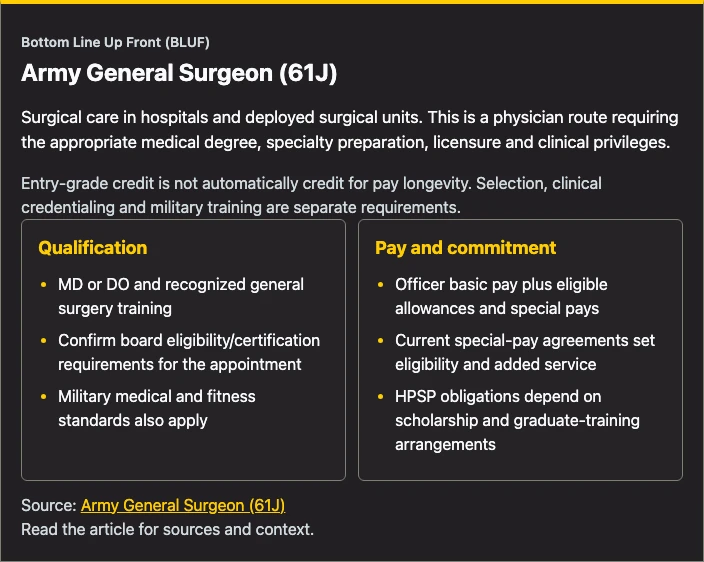
Surgical care in hospitals and deployed surgical units. This is a physician route requiring the appropriate medical degree, specialty preparation, licensure and clinical privileges.
Entry-grade credit is not automatically credit for pay longevity. Selection, clinical credentialing and military training are separate requirements.
Qualification
- MD or DO and recognized general surgery training
- Confirm board eligibility/certification requirements for the appointment
- Military medical and fitness standards also apply
Pay and commitment
- Officer basic pay plus eligible allowances and special pays
- Current special-pay agreements set eligibility and added service
- HPSP obligations depend on scholarship and graduate-training arrangements
Source: Army General Surgeon (61J)
Read the article for sources and context.
On this page
Job Role and Responsibilities
Army general surgeons (61J) examine, diagnose and treat patients who have injuries or conditions that require surgery, and they perform the operations themselves. They manage the patient before and after the operation, direct the surgical team in the operating room and take the call that decides whether a patient goes to the operating room at all.
The classification manual states the duties plainly: the surgeon examines, diagnoses and treats or prescribes the course of treatment and surgery for patients with injuries or disorders that have a surgical condition, and performs the required surgery. Everything else about the job follows from that sentence, including the on-call schedule and the responsibility that comes with being the person who decides to cut.
In a military treatment facility, a general surgeon runs an operating room block, holds a clinic for new referrals and follow-ups, rounds on inpatients and covers emergency general surgery call. The case mix resembles a civilian community hospital, with one difference worth noting. The population is young, so there is more trauma and less chronic surgical disease than a comparable civilian hospital sees.
Command and Leadership Scope
A surgeon leads a team in the operating room from the first incision to the closing count. That team includes an anesthesiologist or nurse anesthetist, surgical nurses and technicians. In the room the surgeon directs the procedure.
Outside it, the surgeon owns the patient’s course, including the complications.
With rank, the billets grow. A mid-grade surgeon may serve as chief of a surgical service or as the surgeon for a division or a medical brigade. Senior surgeons command surgical detachments, lead departments of surgery at medical centers and sit on the committees that set clinical standards for a facility.
Specific Roles and Designations
| Designation | Code | What it covers |
|---|---|---|
| General Surgeon | 61J | The primary specialty. Requires a medical degree and completed general surgery residency |
| Thoracic Surgeon | 61K | Chest surgery, after additional fellowship training |
| Plastic Surgeon | 61L | Reconstructive and cosmetic surgery |
| Orthopedic Surgeon | 61M | Musculoskeletal surgery |
| Peripheral Vascular Surgeon | 61W | Blood vessel surgery |
| Neurosurgeon | 61Z | Brain and spinal surgery |
| Field Surgeon | 62B | Position AOC for initial battlefield medical care within the unit medical element’s capability; not a synonym for a trained general surgeon |
| Medical Proficiency Designator | 9A to 9E | Clinical proficiency level and deployability status |
The 62B field surgeon code identifies a position, not proof of completed general surgery residency. The classification manual describes examination, diagnosis and initial treatment of battlefield disease and injury within the unit medical element’s capability. A 61J surgical qualification and a 62B billet therefore answer different questions about an officer’s work.
Mission Contribution
Surgery is the capability that keeps a deployed medical unit from being an evacuation point only. A forward surgical team can stabilize and operate on a patient who would otherwise die during a long evacuation, and the general surgeon is the reason that team exists.
In garrison, the contribution is less dramatic and just as necessary. Elective and urgent surgery keeps service members medically ready. A soldier waiting months for a hernia repair or a gallbladder operation is a soldier the unit cannot count on.
Technology, Equipment, and Systems
A military treatment facility’s operating rooms carry standard surgical equipment, including laparoscopic towers, electrocautery, anesthesia machines and imaging support. Larger medical centers have robotic surgery platforms, though access varies by facility and specialty.
Deployed surgery is a different equipment set. A forward surgical team works with portable operating tables, field anesthesia equipment, a limited instrument set and a blood supply that may depend on walking donors. The surgeon operates under lights that may be battery powered and in a tent that may be moved before the patient leaves.
The judgment required goes up as the equipment goes down.
Salary and Benefits
Base Pay (2026)
Physicians commonly enter active clinical service as captains, with appointment grade determined by the approved accession record. Entry-grade credit and years credited for basic pay are separate calculations; a medical degree alone should not be treated as extra years on the pay table.
| Rank | Pay Grade | Years of Service | Monthly Base Pay | Annual Base Pay |
|---|---|---|---|---|
| Captain (CPT) | O-3 | 2 or less | $5,534 | $66,409 |
| Captain (CPT) | O-3 | Over 4 | $7,383 | $88,592 |
| Major (MAJ) | O-4 | 2 or less | $6,295 | $75,535 |
| Major (MAJ) | O-4 | Over 8 | $8,816 | $105,797 |
| Major (MAJ) | O-4 | Over 12 | $9,888 | $118,660 |
Source: DFAS 2026 pay tables. Figures reflect the 2026 pay raise.
The table shows 2026 officer basic pay. Figures are rounded to whole dollars and exclude allowances and special pays; the service-time labels identify the applicable pay brackets.
Special Pays
Physician compensation can include Board Certification Pay, Incentive Pay and a Retention Bonus when the officer meets the applicable conditions. The DFAS Medical Corps table identifies these categories and labels its published rates as maximum amounts, with service-specific amounts determined by the service personnel office.
A listed maximum is not an individual offer. Before accepting an accession or retention agreement, ask the Army medical recruiter or special-pay office to identify the current fiscal-year authority, the qualifying specialty and training status, and the additional service obligation in writing. Compare the full compensation package rather than basic pay alone.
Additional Benefits
Basic Allowance for Subsistence is $328.48 per month. Basic Allowance for Housing varies by location, grade and dependent status and is not taxed. Health coverage is TRICARE Prime with no premiums or copays for the service member and enrolled family members, and officers earn 30 days of paid leave each year.
For officers covered by the Blended Retirement System, 20 years of active service yields a pension equal to 40 percent of the highest 36-month average of basic pay. BRS includes an automatic 1 percent Thrift Savings Plan contribution after 60 days and up to 4 percent in matching contributions after two years, when the member contributes at least 5 percent. Members who entered before 2018 and did not opt into BRS retain their applicable legacy retirement plan.
Work-Life Balance
Surgery is not a schedule-friendly specialty. Operating room days start early, cases run long and call comes with the territory. A surgeon may be in the hospital well past a scheduled shift because a patient needs another operation.
The military version adds deployments, field time and the administrative load that comes with being an officer. Surgeons who plan for a demanding schedule do better than surgeons who expect clinic hours.
Qualifications and Eligibility
Commissioning Sources
Health Professions Scholarship Program (HPSP). The Army pays tuition, fees and a monthly stipend at a civilian medical school, and the student commissions during school with annual training each year.
Uniformed Services University of the Health Sciences (USUHS). The federal medical school in Bethesda charges no tuition, pays students as officers and requires a longer service commitment.
Direct Commission. A licensed surgeon in civilian practice can commission directly and attend a condensed officer course. Reserve and National Guard surgeons use this route most often.
Financial Assistance Program. A surgeon already in residency can receive an annual grant and monthly stipend with an added service obligation.
Commissioning Requirements
| Path | Degree | Licensure | Service Obligation |
|---|---|---|---|
| HPSP | MD or DO, in progress or complete | Required before active duty practice | Depends on scholarship length and graduate training; commonly 3–4 years for the scholarship commitment |
| USUHS | MD conferred by USUHS | Required before active duty practice | 7 years after residency |
| Direct Commission | MD or DO, complete | Active state license | Depends on the appointment and any incentive agreement |
The Army’s medical accession guidance describes commitments by program rather than a universal four-year HPSP obligation. Residency, fellowship and incentive agreements can affect the total commitment, so obtain the complete obligation calculation for the chosen route before signing.
The classification manual adds two specialty conditions for 61J. The surgeon must have specialty training at a level the Office of the Surgeon General recognizes, and must have adequate training or professional experience to meet the minimum requirements set by the Department of the Army. The degree must come from a school acceptable to the Army, which applies to both MD and DO programs.
Test Requirements
Surgeons commission as health professionals, so the ASVAB does not apply. HPSP and USUHS applicants take the MCAT. State licensure requires the national medical exams that each board accepts.
Military applicants compete for residency positions through the Joint Graduate Medical Education Selection Board, often called the military match. Civilian training requires the appropriate service approval and its own application arrangements. Board certification comes after residency through the American Board of Surgery or the American Osteopathic Board of Surgery.
Branch Selection and Assignment
There is no branching competition for physicians. Officers are accessed into the Medical Corps and designated by specialty after residency, so the specialty decision happens at the match. A medical student who wants surgery applies to surgery programs.
The Army does not guarantee that every officer who wants a surgical subspecialty will get one. Fellowship selection is competitive and depends on the needs of the service as well as the officer’s record.
Upon Commissioning
Medical Corps officers typically enter at O-3 with credit for graduate education. The 61J designation applies once general surgery residency is complete.
Work Environment
Setting and Schedule
The primary workplace is a hospital operating room, a surgical clinic and an inpatient ward. A typical week mixes operating days, clinic days, call and administrative work. Large medical centers run residency programs, and the attending surgeon supervises residents in the operating room.
Deployed and field settings change the work substantially. A forward surgical team may operate in a tent with limited equipment and a small team, and the surgeon may be responsible for the entire surgical capability of a region.
Leadership and Chain of Command
A surgeon reports through the surgical service chain to the department chief and the facility commander. In an operational unit, the surgeon may report to a medical company or detachment commander. Clinical authority comes from licensure and granted privileges, and military authority comes from appointment.
Officer-NCO Dynamic
The operating room depends on experienced NCOs, particularly the surgical technologists and the operating room NCOs who run the sterile field and the instrument sets. A surgeon who learns from those NCOs early operates more smoothly than one who treats the enlisted team as interchangeable staff.
Staff vs. Command Roles
Junior surgeons spend most of their time operating. Mid-grade surgeons add service chief duties, residency faculty work and committee assignments. Senior surgeons move into department leadership and command, where the work is staffing, standards and training rather than the operating room.
Training and Skill Development
Pre-Commissioning Training
HPSP students complete a 45-day annual training period each year. USUHS integrates military training into the curriculum, including field exercises and leadership instruction.
Basic Officer Leader Course (BOLC)
Medical officers attend Army medical officer training at Fort Sam Houston, Texas. The Army AMEDD overview describes different active and Reserve training lengths and notes that specialty and prior military experience affect the requirement.
Use the course reservation and accession instructions for the actual schedule. Applicants should confirm whether they owe a direct-commission course, BOLC, or both, and which portions require resident attendance; a generic three-phase timetable is not a reliable substitute for those orders.
Graduate Medical Education
General surgery residency takes five years after medical school. Residents rotate through general surgery, trauma, vascular surgery, surgical oncology, critical care and the surgical subspecialties. The Army sponsors residency training through military programs and through civilian programs under HPSP.
Fellowships in trauma and critical care surgery, vascular surgery, colorectal surgery and surgical oncology add one to three years and lead to a different AOC or a subspecialty designation. Fellowship selection is competitive and depends on the needs of the Army at the time.
Professional Military Education
Clinical training and Army professional military education serve different purposes. Residency establishes specialty preparation; military courses develop the officer for operational planning and wider leadership responsibilities.
Physicians should plan required military schooling with their career manager alongside residency, fellowship and clinical assignments. Course eligibility, delivery format and completion deadlines depend on the officer’s record and current Army guidance, so a single years-of-service timetable should not be treated as a promotion guarantee.
Additional Training
Surgical officers assigned to airborne or air assault units attend those schools, which run about three weeks and ten days. Trauma surgeons often complete advanced trauma and critical care courses. The Army also funds civilian fellowships for selected officers through long-term health education and training.
Career Progression and Advancement
Career Path
| Rank | Grade | Typical Time in Service | Key Assignment |
|---|---|---|---|
| Captain | O-3 | 0 to 9 years, includes residency | Staff surgeon, forward surgical team |
| Major | O-4 | 10 to 15 years | Service chief, division or brigade surgeon |
| Lieutenant Colonel | O-5 | 15 to 20 years | Department chief, medical center staff |
| Colonel | O-6 | 20 to 27 years | Medical treatment facility command, medical command staff |
Appointment grade and later promotion are separate decisions. Officers should confirm their date of rank, military education requirements and promotion eligibility with their career manager rather than infer a promotion date from the clinical training timeline.
Promotion Factors
Evaluation reports dominate. The strongest files show a surgeon who operated, deployed, taught and led. Command of a surgical detachment, service chief time and residency faculty work all count.
Research and published work help at the senior ranks.
A surgeon who only operates limits the ceiling. The board selects for officers who can run a surgical service, not only for good technicians.
Broadening and Functional Areas
Broader work can include teaching, research, clinical-service leadership and medical staff assignments. These roles should be planned around the officer’s clinical qualifications, privileges and the available positions.
Health administration has its own Army classifications and appointment requirements. The officer classification manual lists 70A Health Care Administration and 70B Health Services Administration; it does not establish an automatic “FA70” progression for a physician after company-grade service.
Physical Demands and Medical Evaluations
The officer classification manual lists correctable vision, manual dexterity, normal color perception, a physical profile of 222222 and a Moderate (Gold) physical-demands category for this specialty. The Army’s published Gold OPAT explanation gives these thresholds:
- Standing long jump: 120 cm.
- Seated power throw: 350 cm.
- Strength deadlift: 120 lb.
- Interval run: 36 shuttles.
The deadlift is 120 pounds, approximately 54 kg. Applicants should confirm which accession assessments apply to their medical appointment; the occupational classification and the recurring Army Fitness Test are separate requirements.
Officers also take the Army Fitness Test (AFT), which replaced the ACFT on June 1, 2025. For ages 17 through 21, the official AFT scoring standards list:
| Test event | Male 17-21 minimum | Female 17-21 minimum |
|---|---|---|
| Three-repetition maximum deadlift | 150 lb | 120 lb |
| Hand-release push-ups | 15 | 11 |
| Sprint-drag-carry | 2:28 or faster | 3:15 or faster |
| Plank | 1:30 or longer | 1:30 or longer |
| Two-mile run | 19:57 or faster | 22:55 or faster |
Surgery itself adds practical demands that a fitness test does not measure. Operating requires standing for long periods, fine hand control and the stamina to work through a long case. The Army’s physical standard is the entry gate.
The operating room sets its own.
Deployment and Duty Stations
Deployment Details
Surgeons deploy with forward surgical teams, combat support hospitals, field hospitals and the surgical assets of medical brigades. A forward surgical team is small and moves close to the fight, and the surgeon may be the senior clinical decision maker on site.
The deployed case mix is different from garrison practice. Trauma dominates, patients are young and previously healthy, and the resources are thin. Surgeons who have trained for trauma and critical care do better in that environment than surgeons who have practiced only elective surgery.
Duty Station Options
Surgeons serve at medical centers and community hospitals across the Army, including the large medical centers that host residency programs. Assignment is managed by Human Resources Command, and officers submit preference sheets that are weighed against the needs of the service.
Large medical centers offer complex cases, residents to teach and research support. Smaller hospitals offer autonomy and a broader case mix, because there may be no specialist to hand the difficult case to.
Risk, Safety, and Legal Considerations
Job Hazards
Surgical practice carries exposure to bloodborne pathogens, needlestick injury, radiation during fluoroscopic procedures and the physical strain of long operations. Deployed surgery adds the hazards of the location, including indirect fire and the risk of moving patients under threat.
Safety Protocols
Operating rooms run on universal precautions, sharps handling rules, surgical counts and the time-out process that confirms patient identity and procedure before the first incision. Deployed facilities add force protection and mass casualty triage procedures. The surgeon is responsible for enforcing these standards, not only for following them.
Legal and Command Responsibility
A surgeon holds clinical authority through licensure and granted privileges, and military authority through appointment. Complications, adverse events and credentialing reviews are part of the job, and the surgeon answers for them inside the facility’s quality system.
Surgeons who hold command carry the additional exposure of relief for cause. A commander can be relieved for leadership failures that have nothing to do with surgical skill, and the effect on a career is the same.
Impact on Family and Personal Life
Family Considerations
Surgical schedules are hard on families. Early starts, late cases and call nights mean the surgeon misses dinners, school events and weekends. Deployments and field time add months away.
The military side offers supports that help. Family support centers, family readiness groups and spouse employment programs are available at most installations. So is the reality that a surgical family learns to plan around a schedule that changes.
Dual-Military and Family Planning
Dual-military couples coordinate two careers and two assignment cycles. The married army couples program helps when both members are eligible. Surgical couples face the additional problem that both may need to be near a hospital with the right capabilities.
Reserve and National Guard
Component Availability
The Army Reserve and the Army National Guard both carry general surgeons. Direct commission is the common route for a practicing civilian surgeon, and Reserve and Guard surgeons attend a condensed BOLC.
Drill and Training Commitment
A common training schedule is one weekend per month plus two weeks of annual training; schools, readiness duties and mobilization can add time. A drill weekend counts as four drill periods, and each period pays one-thirtieth of monthly basic pay. An O-3 with less than two years of service earns $737.88 for a standard drill weekend.
Part-Time Benefits
TRICARE Reserve Select premiums for 2026 are $57.88 per month for the member alone and $286.66 for member and family.
Eligible members can receive up to 36 months of Montgomery GI Bill Selected Reserve benefits; the full-time enrollment rate is $508 per full month from October 1, 2026, through September 30, 2027. Reserve retired pay is based on retirement points and generally requires 20 qualifying years, with payments normally starting at age 60; qualifying active service can reduce that age.
Comparison
| Factor | Active Duty | Army Reserve | Army National Guard |
|---|---|---|---|
| Commitment | Full time | One weekend per month, two weeks per year | One weekend per month, two weeks per year |
| Pay basis (O-3, under 2 years) | $5,534 basic pay | $737.88 per drill weekend | $737.88 per drill weekend |
| Healthcare | TRICARE Prime, no premiums | TRICARE Reserve Select, premiums apply | TRICARE Reserve Select, premiums apply |
| Education | Tuition assistance, Post-9/11 GI Bill | MGIB-SR, Post-9/11 after qualifying active duty | MGIB-SR, state tuition waivers in many states |
| Deployment tempo | Follows the unit | Unit rotations and individual mobilization | State missions and federal mobilization |
| Command opportunity | Service, department, facility | Surgical detachment and company command | Surgical detachment and company command |
| Retirement | 20-year pension plus TSP | Points-based at age 60 | Points-based at age 60 |
Civilian Career Integration
A reserve surgeon usually keeps a civilian practice and drills on weekends. The clinical work stays current in both settings, which makes the combination easier than it is for specialties that depend on military-specific equipment. Federal law protects the civilian job during mobilization under the Uniformed Services Employment and Reemployment Rights Act.
Post-Service Opportunities
Transition to Civilian Life
General surgery transfers to civilian practice directly. Residency training, board certification and licensure all carry over, and a departing surgeon can document completed training, board status and relevant operational experience for civilian credentialing.
That experience is the differentiator in civilian hiring. Trauma centers, hospital systems and surgical groups value surgeons who have operated in austere settings with limited support. Some military surgeons move into trauma leadership, surgical education or federal service.
Civilian Pay and Outlook
| Occupation | Median Annual Wage (May 2025) | Job Outlook, 2025 to 2035 |
|---|---|---|
| Surgeons, all other | $414,010 | 4 percent |
| Physicians and surgeons, all | $275,930 | 4 percent |
Source: BLS Occupational Outlook Handbook. BLS counts 27,500 surgeons in the all-other category in 2025 and projects 4 percent growth through 2035, about the same as physicians and surgeons overall.
Graduate Education and Credentials
The medical degree, residency certificate and board certification transfer unchanged. The GI Bill can fund a fellowship, and the Army’s long-term health education and training program can fund subspecialty training while the officer serves.
Is This a Good Job for You? The Right (and Wrong) Fit
Ideal Candidate Profile
Surgeons who do well in the Army make decisions quickly and accept the consequences. They are comfortable in a room where the answer has to be reached now, and they can lead a team that is watching them for direction. They also tolerate a schedule that takes more than it gives back in some seasons.
The military version asks for one more thing. The surgeon has to be willing to practice with less. A deployed operating room is not a medical center, and a surgeon who cannot work without a full instrument set and a specialist on call will struggle there.
Potential Challenges
The pace is the common complaint. Operating, clinic, call, teaching and administrative duties compete for the same hours, and the administrative load grows with rank. Surgeons who wanted to spend their career in the operating room often find that the Army asks for more.
The second challenge is deployment timing. A surgeon may be at the peak of a surgical career at home when orders arrive. The unit needs the surgeon, and the civilian practice or the residency program has to absorb the absence.
Career and Lifestyle Alignment
For a surgeon who wants trauma experience, early leadership and a practice that includes austere medicine, the Army offers a path that civilian surgery rarely matches. For a surgeon who wants a predictable schedule and a single hospital for a career, it does not.
Compare a real civilian offer with the complete Army package, including eligible special pays, allowances, retirement benefits and any service obligation. National wage statistics describe a labor market; they do not establish what an individual physician will earn or guarantee that one route pays more. Location, shifts, clinical scope and control over assignments matter alongside compensation.
More Information
General surgery is one of the surgical specialties in the Army Medical Corps. Compare it with emergency medicine, which shares the acute-care focus and the trauma exposure without the operating room, or with the perioperative nurse, which runs the sterile field the surgeon works in but does not perform the operation.
An applicant who wants the operating room but not the medical degree should look carefully at the nursing and technician routes. The nurse anesthetist path leads to anesthesia practice through nursing, and the perioperative nursing path leads to the surgical team through a different credential.
The most useful next step is a conversation with an Army medical recruiter, who can give current surgical specialty pay, current bonus amounts and the residency and fellowship programs accepting applications this cycle.