Army Health Services Administration Officer (70B)
A field hospital needs more than skilled clinicians. Someone must organize patient movement, supplies, staff, reports and the support that lets medical teams work. Army Health Services Administration officers learn to lead that side of military medicine.
The 70B Area of Concentration (AOC) is an entry-level administrative career in the Army Medical Service Corps. A new 70B officer may lead soldiers in an operational medical unit before moving to broader planning or healthcare management work. It is a different career from practicing as an Army physician, psychologist or nurse, and it is not the same as entering a later medical logistics specialty.
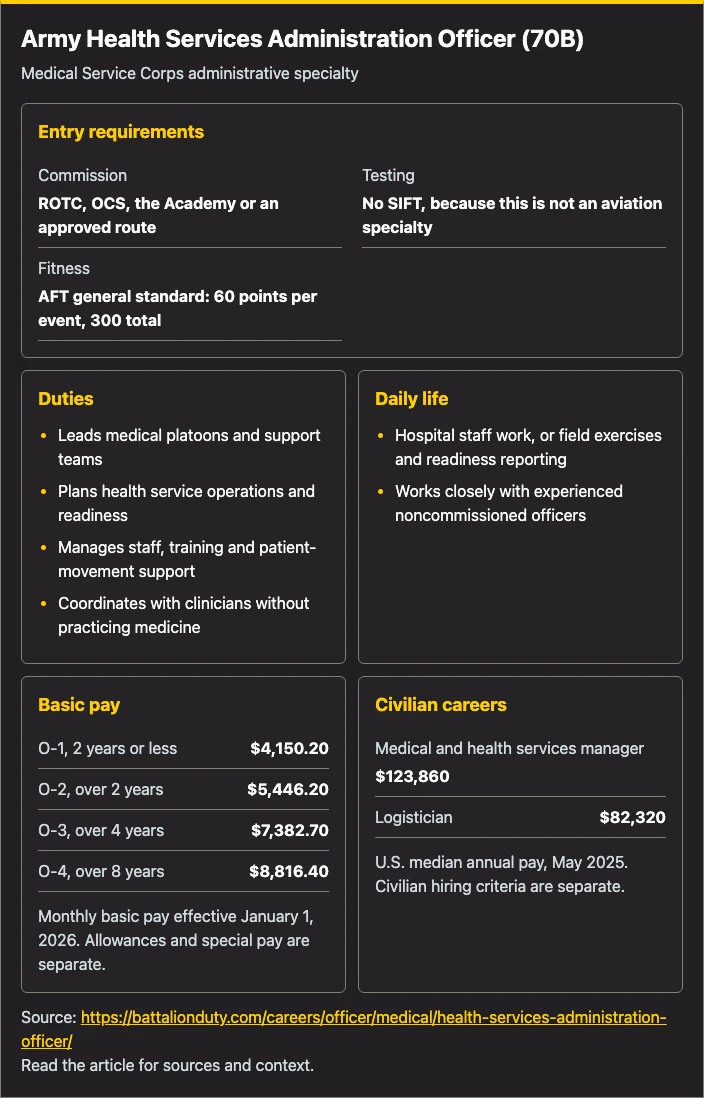
Entry requirements
- Commission
- ROTC, OCS, the Academy or an approved route
- Testing
- No SIFT, because this is not an aviation specialty
- Fitness
- AFT general standard: 60 points per event, 300 total
Duties
- Leads medical platoons and support teams
- Plans health service operations and readiness
- Manages staff, training and patient-movement support
- Coordinates with clinicians without practicing medicine
Daily life
- Hospital staff work, or field exercises and readiness reporting
- Works closely with experienced noncommissioned officers
Basic pay
- O-1, 2 years or less
- $4,150.20
- O-2, over 2 years
- $5,446.20
- O-3, over 4 years
- $7,382.70
- O-4, over 8 years
- $8,816.40
Monthly basic pay effective January 1, 2026. Allowances and special pay are separate.
Civilian careers
- Medical and health services manager
- $123,860
- Logistician
- $82,320
U.S. median annual pay, May 2025. Civilian hiring criteria are separate.
Source: https://battalionduty.com/careers/officer/medical/health-services-administration-officer/
Read the article for sources and context.
On this page
Job Role and Responsibilities
An Army 70B Health Services Administration Officer leads medical support teams, helps plan health service operations and manages the resources that keep Army medical units ready. The specialty is a commissioned Medical Service Corps AOC, with early assignments often in operational medical units. Officers coordinate people, supplies, training and patient-movement support rather than serving as licensed clinicians solely because of their 70B code.
This is an early administrative specialty of the Army Medical Service Corps. The parent corps includes separate aviation, logistics, scientific and licensed clinical roles with different qualification requirements.
What 70B officers lead
The Army Medical Service Corps career chapter describes 70B as a basic administrative specialty and identifies early developmental assignments in medical units. A new officer can lead a medical platoon or work in the operations section of a unit that supports soldiers in the field. This means checking that staff are trained, equipment and supplies are available, and the unit can carry out its assigned mission.
Leadership does not mean practicing medicine without training. A 70B officer works alongside clinicians, medical planners, medics and experienced noncommissioned officers. In a hospital, an administrator may help manage patient flow or staff processes. In a deployable medical formation, the officer may coordinate ambulances, medical equipment movement, field training or reports to the commander. The officer’s authority and number of direct reports depend on the actual assignment.
Medical Service Corps classification
| Code | Formal status | Relationship to 70B |
|---|---|---|
| 70B | Health Services Administration AOC | Core early administrative specialty |
| 70H | Health Services Plans, Operations, Intelligence, Security and Training AOC | Advanced work requiring its own qualification and assignment rules |
| 70K | Health Services Materiel AOC | Medical logistics specialization usually reached after 70B development |
| 67J | Aeromedical Evacuation AOC | Separate medical aviation specialty, not a 70B flight rating |
| 73B | Clinical Psychology AOC | Separately qualified clinical profession with doctorate-level preparation |
These are Army officer classification categories, not a menu of equal entry choices for every new lieutenant. Medical Service Corps development panels, schools and job openings affect when an officer may receive another AOC. The current classification authority is DA PAM 611-21’s officer chart.
Tools and mission support
Administrative officers use staffing records, training reports, unit plans, logistics records and military health information systems as required by their assignment. An officer may help maintain readiness reports while a clinical team uses the electronic health record for patient care. These systems have different access controls and jobs. The 70B career is chiefly about organizing services and making support decisions, not becoming an expert in every medical device.
Salary and Benefits
Officer basic pay in 2026
A 70B officer receives basic pay by rank and years of creditable service. No separate 70B salary scale applies. Here are four verified examples from the DFAS officer pay table effective January 1, 2026.
| Grade and rank | Service bracket | Monthly basic pay |
|---|---|---|
| O-1, Second Lieutenant | Two years or less | $4,150.20 |
| O-2, First Lieutenant | Over two years | $5,446.20 |
| O-3, Captain | Over four years | $7,382.70 |
| O-4, Major | Over eight years | $8,816.40 |
The table does not include housing or subsistence allowances. Basic Allowance for Housing depends on location, grade and dependents. Eligible officers may receive healthcare, paid leave, education benefits and retirement contributions under the rules applicable to their service. The Blended Retirement System has both a defined retired-pay element for qualifying service and the Thrift Savings Plan with eligible government contributions.
The 70B code does not establish a guaranteed accession bonus, special clinical pay or loan repayment award. Those programs require separate published eligibility and an actual agreement. An applicant comparing an Active Army offer with Reserve service should request the current terms in writing.
Work hours and responsibilities
In a medical treatment facility, a 70B administrator may work a regular staff schedule when the facility is not facing unusual demand. An operational medical unit follows training, readiness and deployment requirements, which can bring early starts, overnight exercises or long periods in the field. A leadership role also involves preparation, personnel counseling and responsibility for equipment even when routine administration is complete.
Qualifications and Eligibility
Commissioning options
The standard officer sources include the Reserve Officers’ Training Corps (ROTC), the U.S. Military Academy and Officer Candidate School (OCS), when positions are allocated. Each uses its own admission, medical and selection rules. A direct commission is common for some licensed Medical Service Corps clinical specialties, but that does not make a 70B direct commission automatically available. Applicants must confirm their actual program and component.
| Route | Education and GPA | Age, medical and fitness rules | 70B selection question |
|---|---|---|---|
| ROTC | College degree required for commissioning, with program academic rules | Current Army officer standards | Is Medical Service Corps being allocated in this cycle? |
| Military Academy | Academy degree and academy qualification process | Academy and Army appointment standards | How is 70B assigned at commissioning? |
| OCS | Qualifying bachelor’s degree and OCS selection standards | Current OCS requirements | Does this board have a 70B opening? |
| In-service or Reserve route | Requirements depend on the approved program | Program and component standards | Is a 70B vacancy available in the component? |
There is no source-backed universal 70B GPA cutoff, Officer Merit List rank or permanent age waiver that can be quoted for every route. Some applicants may need to complete a current enlisted-based General Technical score requirement in an OCS application, but the 70B specialty itself has no separate SIFT flight test. Applicants should check the official officer accession notice for their route rather than assume every college graduate is assigned 70B.
How a candidate is selected
The candidate first qualifies for an officer program. Branch preferences and service needs then determine whether a Medical Service Corps assignment is available. After commissioning and assignment to the appropriate training, the officer learns Army leadership and medical operational support. The officer does not need a psychologist’s doctorate or a physician’s medical license to serve in the general 70B administrative AOC.
A commission normally begins at the grade stated in the appointment, commonly second lieutenant for regular cadet or OCS routes. Obligated service varies with commissioning program, scholarship or other written agreement. No single obligation number should be applied to every 70B applicant without checking that contract.
Work Environment
Operational medical administrators can work in support battalions, medical companies, hospitals and headquarters. Their jobs change with the unit. During an exercise, an officer may be tracking patient collection points, staff coverage or vehicle readiness. During a normal duty week, the same officer may review training records or help prepare the next exercise.
Junior officers usually depend heavily on experienced noncommissioned officers. A senior NCO knows the unit’s people, day-to-day processes and equipment problems. The officer sets priorities within the commander’s intent and makes the decisions assigned to the billet. Good leadership means asking the right questions and addressing problems before they become failures during patient movement or field care.
Some 70B officers later move toward healthcare administration, personnel work, hospital management, plans or other Medical Service Corps specializations. There is no documented universal amount of time spent in command versus staff jobs and no current branch-wide 70B retention rate to quote here. An applicant should compare likely first assignments with the work they expect from a hospital administrator before accepting a career description.
Training and Skill Development
Officer preparation comes first. ROTC, the military academy and OCS teach general Army leadership through different programs. After a commission, Medical Service Corps officers complete their assigned Army medical officer training and develop administrative skills in units. Specialty courses become important later when pursuing more technical administrative or medical materiel work.
| Course or phase | Location | Duration | What the officer learns |
|---|---|---|---|
| Commissioning course | ROTC, academy, OCS or approved route | Program dependent | Military leadership and officer standards |
| Army medical officer basic instruction | Assigned Army medical training organization | Current class schedule applies | Medical support structure, field operations and officer responsibilities |
| Early operational assignment | Medical unit or staff | Assignment dependent | Medical readiness, planning, supervision and unit operations |
| Medical Service Corps follow-on courses | Approved school as eligible | Course dependent | Administration, operations or other qualified AOC work |
| Captain’s Career Course and later education | Army schools as assigned | Course and status dependent | Higher-level planning, command and staff skills |
The Army Medical Department training overview explains the corps’ broad administrative mission. It does not establish one unchanging BOLC length for every officer source and component. The course dates and location in the officer’s orders control. The Captain’s Career Course, intermediate education and senior military education matter at later grades, with selection and attendance based on current requirements.
A 70B officer interested in 70K Health Services Materiel should ask when the Medical Logistics Officer Course and later AOC designation can become available. The course alone is not a guaranteed new 70K billet. Civilian graduate education or specialized military schooling may be offered competitively. Applicants should not assume a paid degree slot is included with their original commission.
Career Progression and Advancement
The 70B specialty gives officers a foundation in the Army health system. Later positions may be more focused on operations, planning, materiel or healthcare administration. Promotions and assignments are based on evaluation reports, Army requirements, available openings and required education.
| Rank | Typical career stage | Possible administrative work |
|---|---|---|
| O-1, Second Lieutenant | Commission and initial training | Medical platoon or entry-level staff assignment |
| O-2, First Lieutenant | Early experience | Leading teams, unit plans and medical readiness |
| O-3, Captain | Broader duties | Company-grade command or operational staff when selected |
| O-4, Major | Field-grade responsibility | Medical operations, plans or specialty management |
| O-5, Lieutenant Colonel | Senior management | Battalion-level leadership or higher staff positions when selected |
| O-6, Colonel | Senior officer assignments | Major medical organization or Army staff leadership when selected |
The Army does not promise that every 70B officer will command a medical company, earn a graduate degree or transition to 70K. Completing the required schools, serving well in assigned positions and documenting readiness improvements can help an officer build a credible record. No precise 70B-only promotion percentage was established from the public sources reviewed for this page.
Physical Demands and Medical Evaluations
70B officers take the Army Fitness Test (AFT). The general combat-enabling standard applies to this medical administrative AOC rather than the special combat arms standard. Officers must earn at least 60 points on each of five events and 300 total. The 17-to-21-year-old minimum performances from the official AFT charts effective June 1, 2025 are:
| AFT event | Male 17-21 | Female 17-21 |
|---|---|---|
| Maximum deadlift, three repetitions | 150 lb | 120 lb |
| Hand-release push-ups, two minutes | 15 | 11 |
| Sprint-drag-carry | 2:28 or less | 3:15 or less |
| Plank | 1:30 or more | 1:30 or more |
| Two-mile run | 19:57 or less | 22:55 or less |
The listed values are not the minimums for all age groups. Medical screening for appointment follows the current officer accession standard and any approved profile or waiver rules. Unlike a 67J flight officer, a regular 70B assignment does not itself require an aviation flight physical. Field assignments can still involve lifting gear, moving in protective equipment and working outdoors in heat, cold or difficult conditions.
Deployment and Duty Stations
70B officers can be assigned wherever the Army uses medical administration and operational health support. Work is not limited to hospitals. A medical unit preparing for deployment may need an officer who coordinates staffing, evacuation support, training and supplies, while another officer performs planning duties at a headquarters.
The unit determines the actual work setting and deployment pattern. A 70B officer should expect potential field exercises and overseas assignments, but the sources reviewed do not support a fixed deployment frequency or guaranteed list of duty stations. Human resources assignment processes consider Army needs, position availability, grade and officer preferences. Personal preference alone does not guarantee a hospital job or a specific region.
Risk, Safety, and Legal Considerations
An administrative error can cause real harm when it delays equipment, staffing or patient transfer, so officers must treat readiness data and personnel decisions carefully. A 70B officer may manage records that contain protected personal information and must follow applicable military and health information rules. Work involving patients still requires clear boundaries between administrative authority and professional clinical decision-making.
Field duties also bring vehicle, weather, fatigue and training risks. Officers use established Army safety procedures, report hazards and follow the command chain. Authority for contracts, medical practice and command decisions comes from assigned responsibilities and law, not from the 70B title alone. Failure to follow applicable orders, mishandling resources or poor unit leadership can lead to administrative or disciplinary action according to the facts.
Impact on Family and Personal Life
A hospital-related posting may offer a more regular daily schedule than a field assignment, but no 70B job is guaranteed to remain at one location. Permanent changes of station, duty travel, exercises and deployments can disrupt family routines. For someone whose partner also serves in the military, assignment coordination is subject to both members’ career requirements and available positions.
Family services, Army Community Service, TRICARE eligibility and spouse employment programs may help with these demands. Their availability and benefit amounts depend on service status and the current rules. An applicant should plan for the difference between a home-station staff job and an operational unit rather than assume that every administrative officer works normal civilian hospital hours.
Reserve and National Guard
Medical administrative functions exist in Army Reserve and Army National Guard organizations, but a 70B vacancy is a position to verify, not an automatic entitlement for a prospective officer. State Guard programs and Reserve units have different missions, training demands and career openings.
| Factor | Active Army | Army Reserve | Army National Guard |
|---|---|---|---|
| Commitment | Full-time | Drills, annual training and possible mobilization | Federal/state duties, drills, annual training and possible mobilization |
| O-3 example, over four years | $7,382.70 monthly basic pay | $984.36 for four standard drill periods | $984.36 for four standard drill periods |
| Healthcare | Active-duty coverage rules | Reserve plan eligibility or active-duty coverage when activated | Guard plan rules and activation status |
| Education | Program eligibility required | Reserve and qualifying active-service rules | Federal and possible state-specific programs |
| Positions | Based on Army assignments | Depends on Reserve medical unit vacancy | Depends on state/unit vacancy |
| Retirement | Qualifying active-service rules | Points-based non-regular retirement | Points-based non-regular retirement |
The drill figure is a calculated example: $7,382.70 divided by 30 and multiplied by four. It excludes allowances and other service, and no officer receives the whole Active Army monthly amount merely for attending four drills. Civilian employers are generally subject to the federal USERRA employment-protection rules for eligible military service, while an officer still needs to manage the practical schedule with an employer. Mobilization and added training can change the number of days away from civilian work.
Post-Service Opportunities
Health administration offers experience in scheduling, staff leadership, resource planning and readiness management. Civilian employers have their own hiring criteria, and an Army position does not automatically award a civilian hospital-management credential. Graduate degrees and experience with civilian health systems can matter when choosing a post-service role.
| Civilian occupation | May 2025 U.S. median annual pay | 2025-2035 growth outlook |
|---|---|---|
| Medical and health services manager | $123,860 | 24% |
| Logistician | $82,320 | 18% |
These numbers come from the Bureau of Labor Statistics medical-management outlook and logisticians outlook. They describe U.S. occupations, not guaranteed starting pay for a separating officer. Army transition services can help with resumes, civilian job searches and understanding veteran benefits. The most relevant civilian path will depend on whether the officer’s Army work centered on hospital systems, operational planning or logistics.
Is This a Good Job for You? The Right (and Wrong) Fit
This career fits someone who enjoys leading people, making plans and solving practical problems that affect medical operations. A 70B officer must be comfortable with both administrative detail and Army field responsibilities. The job can suit an applicant who likes healthcare but does not want to become a clinician, provided the applicant also wants to serve as a military officer.
It may be the wrong fit for someone who expects to spend each day treating patients or who wants a permanent desk job with no field training. It is also a weaker match for someone whose main interest is aircraft flight, research psychology or advanced medical supply work. Those have their own qualification paths. Comparing the first assignment and the possibility of later AOC selection helps separate the real 70B job from a generic picture of hospital management.
More Information
Ask a current Army officer recruiter or ROTC adviser whether 70B Medical Service Corps positions are available through your commissioning source and component, then confirm the training schedule, service obligation and unit assignment process. The site’s officer commissioning guide covers the larger officer-entry decision.
The Medical Service Corps officer profile provides the parent career overview. For different healthcare professions, compare the already published Medical Specialist Corps officer profile and Army Nurse Corps officer profile.