Army Medical Logistics Officer (70K)
A medical unit cannot treat patients if it has the right clinicians but the wrong supplies. A broken patient monitor, missing sterile item or delayed medical shipment can stop a team from doing its work. The Army assigns trained officers to plan and manage the systems that prevent those shortages.
70K is the Army Medical Service Corps Area of Concentration for Health Services Materiel. It is commonly described as medical logistics. The work differs from general Army supply management because the inventory includes medical equipment, treatment supplies and items with special handling requirements. The path is also important: 70K normally follows service and further qualification as a 70B health services administration officer, rather than being a separate ordinary entry choice for an incoming second lieutenant.
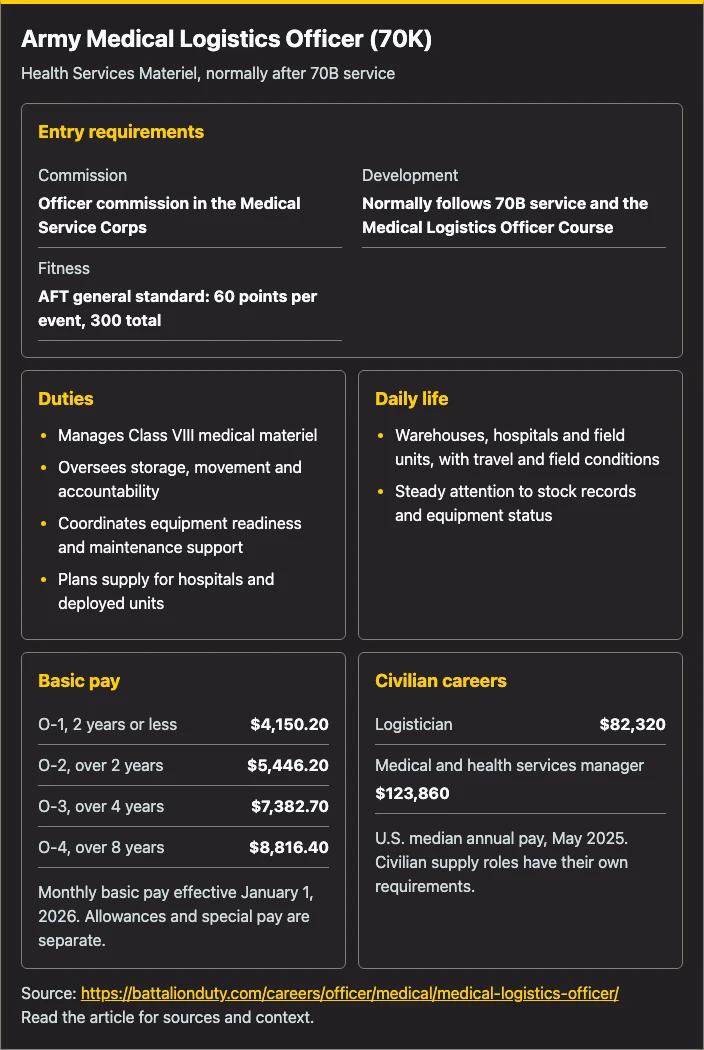
Entry requirements
- Commission
- Officer commission in the Medical Service Corps
- Development
- Normally follows 70B service and the Medical Logistics Officer Course
- Fitness
- AFT general standard: 60 points per event, 300 total
Duties
- Manages Class VIII medical materiel
- Oversees storage, movement and accountability
- Coordinates equipment readiness and maintenance support
- Plans supply for hospitals and deployed units
Daily life
- Warehouses, hospitals and field units, with travel and field conditions
- Steady attention to stock records and equipment status
Basic pay
- O-1, 2 years or less
- $4,150.20
- O-2, over 2 years
- $5,446.20
- O-3, over 4 years
- $7,382.70
- O-4, over 8 years
- $8,816.40
Monthly basic pay effective January 1, 2026. Allowances and special pay are separate.
Civilian careers
- Logistician
- $82,320
- Medical and health services manager
- $123,860
U.S. median annual pay, May 2025. Civilian supply roles have their own requirements.
Source: https://battalionduty.com/careers/officer/medical/medical-logistics-officer/
Read the article for sources and context.
On this page
Job Role and Responsibilities
An Army 70K Medical Logistics Officer plans and oversees the movement, storage, readiness and accountability of medical supplies and equipment. The formal AOC is Health Services Materiel within the Medical Service Corps. Qualified officers support medical facilities and field units by matching their medical supply needs with available equipment, maintenance support and distribution capacity.
The 70K specialty remains part of the Army Medical Service Corps. It generally follows 70B development and should not be confused with the separate general Logistics branch.
What medical logistics officers manage
The Army classifies Class VIII as medical materiel. It covers the types of medical supplies and equipment needed to provide military medical services. A 70K officer may work on forecast demand, track stock levels, manage medical supply processes, supervise a materiel section or coordinate with medical equipment maintenance personnel. Exact duties depend on whether the assignment supports an Army hospital, a distribution organization or a deployed medical unit.
This is leadership and system management, not a promise that every officer personally repairs clinical machines or dispenses medicine. A medical equipment specialist, pharmacist or authorized clinician may hold the technical approval for a task. The 70K officer makes sure the unit has a sound process, safe storage, trained people and a way to respond when supplies fail to arrive.
The Army Medical Service Corps career chapter places 70K within the corps and describes a qualification path that includes the Medical Logistics Officer Course and later AOC designation. It does not treat 70K as interchangeable with the general Logistics branch.
Officer codes and job boundaries
| Code | Army classification | How it relates to medical logistics |
|---|---|---|
| 70B | Health Services Administration AOC | Normal foundation for later 70K qualification |
| 70K | Health Services Materiel AOC | Medical logistics specialty after required development |
| 70H | Health Services Plans, Operations, Intelligence, Security and Training AOC | Adjacent healthcare operational planning specialty |
| 90A | Army Logistics AOC | Separate general logistics branch career, not the 70K medical code |
| Medical equipment technician | Technical role assigned separately | Equipment repair and maintenance work under its own credentials and authority |
Supplies, systems and mission planning
Medical supplies are not all ordinary warehouse products. Some items have expiration dates, temperature limits, controlled access or special accounting rules. An officer planning a supply mission must consider where items will be used, how they will be transported, and what happens if equipment is damaged or demand suddenly changes. The goal is to keep medical units ready without wasting stock or losing accountability.
A 70K officer can use inventory and property systems, readiness reports, maintenance records and movement plans. The exact software used varies. Officers also coordinate with medical staff so the right supplies reach the correct clinical teams, while authorized medical personnel retain responsibility for clinical use and patient-care decisions.
Salary and Benefits
2026 Army officer basic pay
A 70K qualification does not create a separate military basic-pay table. The Army pays by grade and creditable years of service. These examples use the DFAS rates effective January 1, 2026.
| Grade | Years of creditable service | Monthly basic pay |
|---|---|---|
| O-1, Second Lieutenant | Two or fewer | $4,150.20 |
| O-2, First Lieutenant | Over two | $5,446.20 |
| O-3, Captain | Over four | $7,382.70 |
| O-4, Major | Over eight | $8,816.40 |
The junior grades are provided to compare the overall officer career path. They do not mean a new O-1 officer ordinarily starts in 70K. Many 70K-qualified officers will already have completed years of 70B service before receiving the advanced designation. Special pays, bonuses and retention agreements are governed by the applicable program and eligibility, not an assumed fixed payment for this specialty.
Officers may receive housing and subsistence allowances according to current eligibility. Healthcare, leave, military education assistance and retirement depend on service and personal circumstances. Under the Blended Retirement System, qualifying service can earn retired pay and eligible government contributions to the Thrift Savings Plan. A Reserve officer’s pay basis differs from a full-time Active Army officer’s monthly basic pay.
Work schedule
A medical logistics office may run on predictable stock-control and planning deadlines at a permanent hospital. A field medical logistics unit can work longer hours around shipment windows, exercises or a deployment. Inspecting the condition of supplies, responding to shortfalls and accounting for expensive equipment may continue after a normal duty day ends. The exact schedule changes by unit and assignment.
Qualifications and Eligibility
How an officer reaches 70K
The important question is not simply how to commission, but when a commissioned Medical Service Corps officer may qualify for 70K. The 2022 Medical Service Corps chapter identifies officers developing through 70B, graduating from the Medical Logistics Officer Course, and receiving an AOC designation through the applicable process, generally after several years of commissioned service. Its description places the panel around the six-year point. That is career guidance, not a guaranteed promotion, automatic code change or current board schedule.
| Stage or source | Degree and GPA | Age, fitness or medical requirements | 70K decision |
|---|---|---|---|
| ROTC, Academy or OCS entry | Qualifying degree and the chosen program’s academic standards | Current commissioning standards | First seek an available Medical Service Corps/70B accession |
| Early Medical Service Corps service | Officer qualification and satisfactory military performance | Continuing Army standards | Build operational administration experience |
| Medical Logistics Officer Course | Must meet current course prerequisites | Current officer and any course requirements | Complete required materiel instruction |
| AOC designation or assignment | Meet current proponent and personnel requirements | Maintain service eligibility | Selection and available 70K billets govern the outcome |
A general 70K-specific GPA cutoff, direct-commission age limit and guaranteed entry rank could not be established from current 70K accession instructions. It would be misleading to list ordinary OCS as a program that directly promises a 70K code. A person entering the Army specifically to work in medical logistics should ask how often 70B officers reach the specialty, what training seats exist and what happens if not selected.
Testing, degree and service obligations
The 70K specialty is not a flight career, so the SIFT is not a standard 70K qualification. OCS applicants must comply with their own current admission and testing rules. Applicants do not take an extra enlisted ASVAB merely because a Medical Service Corps code begins with the number 70. Army officer training and personnel records matter after commissioning. Course eligibility and any added obligation must be checked against the actual current program.
An early-career officer should not assume that civilian supply-chain work substitutes for an Army course or designation panel. Relevant education or civilian experience can help a candidate understand materiel management, but it does not independently award an Army AOC or assure a particular job.
Work Environment
A 70K officer can work at a medical supply organization, within a military treatment facility or in the support structure of a deployable medical formation. The officer may oversee personnel, review ordering patterns, check equipment readiness or help plan replenishment for exercises and real operations. The job connects office decisions with physical supplies that have to reach clinicians in usable condition.
The officer works with experienced medical logistics noncommissioned officers, medical maintenance specialists, civilian supply staff and clinical teams. The medical teams help define what is needed. Supply and maintenance personnel explain delivery and repair limits. Officers must balance those inputs with budget, accountability and mission requirements. Depending on the billet, the officer may command a unit or work on a staff. No standard number of subordinates applies to every 70K position.
There is no verified 70K-only job satisfaction or retention rate in the sources used here. Someone considering the specialty should judge the actual work: steady attention to stock and records, frequent contact with field units and responsibility for problems that can be difficult to see until a medical team needs an item.
Training and Skill Development
The training path starts with standard Army commissioning and Medical Service Corps preparation. A prospective 70K officer should then gain operational experience, complete the required medical logistics instruction and meet the current designation process. The Army’s Medical Service Corps overview identifies administration and medical materiel among the corps’ functions.
| Stage | Location | Duration | Main learning goal |
|---|---|---|---|
| Commissioning program | ROTC, Academy, OCS or approved route | Varies by program | Leadership and military officer standards |
| Medical Service Corps basic officer course | Army medical officer training system | Current schedule required | Military health services and operational support |
| Initial 70B assignments | Army medical units | Assignment dependent | Unit leadership and administrative readiness |
| Medical Logistics Officer Course | Current Army course site | Confirm by class date | Medical supply, materiel accountability and support planning |
| Qualification and later military education | Assigned schools and units | Dependent on selection | Advanced technical and leadership responsibilities |
The available classification guidance does not support publishing one exact course length for all officers or presenting a future class as already scheduled. After qualification, 70K officers still complete applicable professional military education, such as the Captain’s Career Course and later staff education, according to their grade and selection requirements.
Additional development may involve property accountability, supply planning, equipment lifecycle management, contracting oversight or graduate education when specifically authorized. Some of those tasks require separate trained or designated officials. Officers must not assume that holding a materiel AOC gives them independent authority to sign or change government contracts.
Career Progression and Advancement
A 70K career needs to be understood across two stages: the underlying commissioned Medical Service Corps career, then the advanced materiel specialization. Those stages may overlap in practice, but a junior officer cannot treat the later AOC as an assured appointment.
| Grade | Typical development stage | Possible responsibility |
|---|---|---|
| O-1, Second Lieutenant | Early Medical Service Corps service | Unit administration and operational leadership, ordinarily 70B |
| O-2, First Lieutenant | Foundation experience | Medical readiness, team management and staff duties |
| O-3, Captain | Qualification and possible AOC selection | Medical materiel planning or leadership if selected |
| O-4, Major | Field-grade management | Larger medical logistics program or staff support |
| O-5, Lieutenant Colonel | Senior assignments | Unit command or service-wide materiel work if selected |
| O-6, Colonel | Limited senior billets | High-level medical support, command or policy |
Promotion to major and higher grades uses Army selection processes and requires a competitive officer record. A strong record may include dependable work in 70B assignments, timely military education, careful resource management and successful leadership of medical logistics teams. The Army does not promise a 70K designation in exchange for a degree alone, nor can a public occupational guide verify current 70K-only promotion percentages.
Physical Demands and Medical Evaluations
The Army Fitness Test applies to commissioned medical logistics officers. The general standard for combat-enabling specialties is at least 60 points in each event and 300 total, with age- and sex-based event scoring. The official Army Fitness Test tables list these minimum 60-point performances for ages 17 through 21:
| Event | Male 17-21 | Female 17-21 |
|---|---|---|
| Three-repetition maximum deadlift | 150 lb | 120 lb |
| Hand-release push-ups | 15 | 11 |
| Sprint-drag-carry | 2:28 or quicker | 3:15 or quicker |
| Plank | At least 1:30 | At least 1:30 |
| Two-mile run | At most 19:57 | At most 22:55 |
These figures are not the standards for every age group. Appointment and continuing service also depend on current medical and fitness requirements, including any approved medical profile. Working with medical supply may require officers to inspect warehouses, travel with units or operate in field conditions. It does not make a 70K officer an aviation pilot or require a routine 67J flight physical.
Deployment and Duty Stations
A deployable unit requires reliable medical supplies before it moves and once it arrives. A 70K officer may plan how stocks will be stored, protected and delivered when transport routes are limited. At a permanent medical facility, the same profession can focus more on hospital supply systems, equipment support and financial accountability.
Duty stations depend on medical logistics positions and Army assignment priorities. Some units support a major installation, while others can deploy for operations or exercises. The current public sources reviewed do not justify a standard tour length, a fixed deployment frequency or a guarantee of a preferred location. Candidates should ask about the actual field or fixed-facility balance in the jobs available to their grade.
Risk, Safety, and Legal Considerations
The most serious occupational risks often involve accountability and safe handling. Incorrect storage temperatures, missed expiration dates, equipment faults or gaps in controlled-materiel records can affect care and waste public resources. Officers need written procedures, good inventory records and a clear way to escalate shortages or damaged equipment to qualified staff.
A 70K officer can also face ordinary field and transport hazards during operations. The officer should follow Army safety rules, movement procedures and the applicable rules for hazardous or temperature-sensitive medical items. Clinicians and pharmacists retain their own licensed professional authority. Government purchasing and contract changes require separate legally delegated authority. A 70K title alone does not confer it.
Impact on Family and Personal Life
This career may have more predictable hours in a permanent medical logistics office than during a major field exercise, but officers still serve according to Army orders. Changes of station, deployments, duty travel and urgent supply needs can affect a family’s schedule. The advanced qualification process may also require time away for schooling and later changes in assignment.
Military family support, housing services, healthcare and dual-military assignment consideration are available according to current policies and eligibility. An applicant should consider the entire 70B-to-70K path, not merely the image of a civilian supply-chain manager working in one warehouse for many years.
Reserve and National Guard
Medical supplies and materiel leadership are needed in Army Reserve and National Guard medical units, but current 70K-qualified officer vacancies and designation rules must be checked for each component. It is not safe to infer an open 70K billet from the presence of a Reserve medical company or from broad Army Medical Service Corps documentation.
| Factor | Active Army | Army Reserve | Army National Guard |
|---|---|---|---|
| Commitment | Full-time | Drill, annual training and potential activation | Drill, state/federal missions and potential activation |
| O-3 pay comparison, over four years | $7,382.70 per month basic pay | Approx. $984.36 for four drill periods | Approx. $984.36 for four drill periods |
| Healthcare | Active-duty coverage rules | Reserve plan and activation rules | Guard plan and activation rules |
| Education | Applicable Army programs | Qualifying Reserve or active-service education benefits | Federal and state-specific rules as eligible |
| Career access | Positions and selection process | Verify 70K designation and unit vacancies | Verify 70K designation and state vacancies |
| Retirement | Qualifying active-service system | Qualifying points-based retirement | Qualifying points-based retirement |
The drill example is four periods at the stated O-3 basic-pay rate divided by 30. It does not include allowances, special duty days or separate orders. Some medical logistics officers must attend more training than the minimum drill calendar, so the number of days away from civilian employment can change with assignments and mobilization.
Post-Service Opportunities
Army medical materiel service can develop experience in stock control, distribution, equipment accountability and team supervision. Civilian employers hire for related supply-chain and healthcare-management roles, but officers still need to meet each employer’s qualifications and any professional licensing or certification requirements.
| Civilian occupation | Median U.S. annual pay, May 2025 | Projected employment growth, 2025-2035 |
|---|---|---|
| Logistician | $82,320 | 18% |
| Medical and health services manager | $123,860 | 24% |
The Bureau of Labor Statistics logistician profile and health services manager profile use occupational data for all U.S. workers in those fields. The numbers are not estimates of what former Army officers will be offered. Someone leaving military service can use transition counseling and applicable education benefits to explore professional supply-chain credentials, experience in civilian health systems and the type of management work they want.
Is This a Good Job for You? The Right (and Wrong) Fit
Medical logistics can suit an officer who enjoys solving concrete supply problems, leading technical teams and keeping careful records. It requires the ability to see how a missing or delayed item will affect medical operations later. The work can be satisfying for someone who prefers equipment, planning and operations over direct patient treatment.
It is a poor choice for someone who expects automatic admission to 70K at commissioning, wants to spend each day working as a clinician, or dislikes following detailed property and safety rules. An applicant who prefers broad transportation or vehicle logistics should also understand that 70K is a medical materiel specialty within the Medical Service Corps, not the general 90A logistics AOC. The years of earlier Medical Service Corps work are part of the decision.
More Information
Ask an Army Medical Service Corps career manager or appropriate medical recruiter to confirm the current 70B-to-70K qualification process, Medical Logistics Officer Course prerequisites, designation-panel schedule and available billets. The site’s officer commissioning guide covers the initial commission, but not an automatic later AOC designation.
For the wider Army medical branch structure, use the Medical Service Corps officer parent. The published Medical Specialist Corps officer guide and Army Nurse Corps officer guide explain the different professional missions of neighboring Army medical corps.