Army Medical Service Corps Officer (MS)
The Medical Service Corps is the Army’s most diverse officer branch. You won’t find another officer corps that includes healthcare administrators, clinical psychologists, laboratory scientists, optometrists, podiatrists, preventive medicine officers, and social workers under the same branch code. If you have a degree in health administration, behavioral science, or one of a dozen allied health fields, MS may be your path to a commission.
MS officers don’t deliver primary care – that’s the Medical Corps. Instead, they run the systems that make Army medicine work: managing hospital operations, leading behavioral health clinics, directing laboratory services, controlling disease outbreaks, and advising commanders on everything from pandemic response to hearing conservation programs. At the senior level, MS officers command AMEDD units and run entire military treatment facilities.
OCS candidates need a GT score of 110 on the ASVAB — our ASVAB for OCS guide covers exactly how to hit that number.
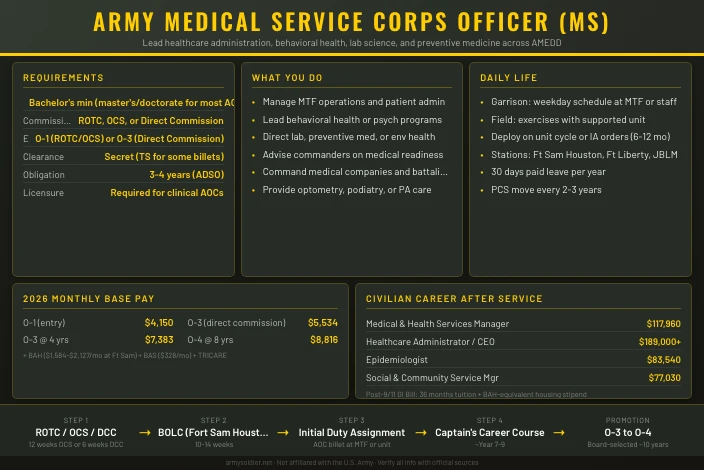
Job Role and Responsibilities
Army Medical Service Corps officers are commissioned healthcare administrators, scientists, and allied health professionals who lead AMEDD organizations, manage clinical programs, and provide specialized patient care across more than 20 Areas of Concentration. MS is the administrative and scientific backbone of Army medicine – without it, the Army’s medical system cannot function. Officers hold AOCs spanning four major functional areas: Health Services Administration (70-series), Medical Allied Sciences (71-series), Preventive Medicine Sciences (72-series), and Behavioral Sciences (73-series), plus specialized clinical AOCs for optometry, podiatry, and physician assistants.
Command and Leadership Scope
At the company grade level, an MS officer leads a small team or functional section within a medical unit, military treatment facility, or operational brigade. A 70B Health Services Administration officer at a community hospital might run a patient administration division, overseeing the work of medical records clerks, patient liaisons, and administrative NCOs. A 72D Environmental Science officer on a division staff advises the commanding general on environmental health threats in the area of operations.
By the field grade years, MS officers move into department chief, division officer in charge, or battalion-level command billets. MS officers command medical companies, medical battalions, and area support medical companies. Unlike Medical Corps officers who follow a primarily clinical track, an MS officer who pursues command can lead formations of hundreds of soldiers. MEDCOM (U.S. Army Medical Command) reports that MS officers hold command at every level from company through brigade.
Specific Roles and Designations
MS encompasses four functional groupings and several standalone clinical AOCs:
| AOC Code | Title | Minimum Degree |
|---|---|---|
| 70B | Health Services Administration | Bachelor’s (healthcare administration or related field) |
| 70H | Health Services Administration (Reserve) | Bachelor’s |
| 70K | Health Services Materiel | Bachelor’s (logistics or healthcare focus) |
| 71A | Microbiology | Master’s or doctorate in microbiology or related science |
| 71E | Clinical Laboratory Science | Master’s in clinical lab science or related field |
| 71F | Research Psychology | Doctorate in research, behavioral, or experimental psychology |
| 72A | Nuclear Medical Science | Master’s or doctorate |
| 72B | Entomology | Master’s in entomology or related science |
| 72C | Audiology | Doctorate of Audiology (Au.D.) |
| 72D | Environmental Science | Master’s in environmental science or public health |
| 73A | Social Work | Master of Social Work (MSW) from accredited program |
| 73B | Clinical Psychology | Doctorate in clinical or counseling psychology + APA-approved internship |
| 67E | Podiatry | Doctor of Podiatric Medicine (DPM) + surgical residency |
| 67F | Optometry | Doctor of Optometry (OD) + state license |
| 65D | Physician Assistant | Master’s in Physician Assistant studies + PA-C certification |
Skill Identifiers (SIs) can be added for subspecialties. Within the 70-series, Board Certification SI 9B is tracked individually for officers in human resources administration roles. Officers in health administration who want to pursue logistics management can qualify for 90A Functional Area opportunities through LOGC3.
Mission Contribution
Every Army unit has a medical readiness requirement. MS officers own the administrative and scientific programs that generate and sustain that readiness. A health services administrator ensures a battalion’s medical records are complete before a deployment validation exercise. An environmental science officer tests the water supply at a forward operating base. A clinical psychologist runs a combat stress control detachment supporting soldiers returning from combat.
In large-scale combat operations, the Army’s medical system must absorb and treat mass casualties while sustaining force health protection across a theater. MS officers manage the bed space, the blood supply, the laboratory diagnostics, the disease surveillance, and the behavioral health support that allow the MC physician to focus on clinical care. Without that management layer, the system collapses.
Technology, Equipment, and Systems
MS officers in health administration use the Military Health System Genesis electronic health record (EHR) platform, which replaced AHLTA across most AMEDD facilities. Health materiel officers (70K) manage the Army Medical Materiel Agency systems that track pharmaceutical stocks, medical equipment readiness, and Class VIII (medical supply) distribution. Environmental science officers use field detection equipment, water quality testing kits, and geographic information systems for disease mapping. Behavioral health officers work with DoD-approved assessment tools and telehealth platforms increasingly used for forward-deployed mental health support.
Salary and Benefits
Base Pay (2026)
MS officers typically commission at O-1 (Second Lieutenant) when coming straight from ROTC or OCS. Direct commission officers – those with a master’s, doctorate, or professional degree – generally enter at O-3 (Captain) with longevity credit for graduate education years.
| Rank | Grade | Years of Service | Monthly Base Pay |
|---|---|---|---|
| Second Lieutenant | O-1 | Less than 2 | $4,150 |
| First Lieutenant | O-2 | 2 years | $5,446 |
| Captain | O-3 | Less than 2 | $5,534 |
| Captain | O-3 | 4 years | $7,383 |
| Captain | O-3 | 8 years | $8,126 |
| Major | O-4 | Less than 2 | $6,295 |
| Major | O-4 | 8 years | $8,816 |
| Lieutenant Colonel | O-5 | 16 years | $11,391 |
| Colonel | O-6 | 20 years | $13,751 |
Source: DFAS 2026 Military Pay Charts
Special Pays and Bonuses
MS officers qualify for Health Professions Special and Incentive Pays based on their AOC. These are separate from base pay and negotiated annually:
- Physician Assistants (65D): Accession bonus up to $60,000 for a four-year initial obligation; retention bonuses up to $35,000 per commitment period
- Pharmacy Officers: Accession bonus of $30,000 for a four-year obligation; retention bonuses of $15,000 to $20,000
- Social Workers (73A): Accession bonus of $18,750 (three years) or $30,000 (four years)
- Clinical Psychologists (73B): Annual incentive pay of $5,000; retention bonuses up to $40,000 for a six-year commitment
- Optometrists (67F): Annual incentive pay of $1,200; retention bonuses in the $5,000 to $12,000 range
- Health Services Administration (70B) and laboratory/preventive medicine AOCs: Vary by shortage designation; contact AMEDD recruiting for current figures
Additional Benefits
Officers receive Basic Allowance for Subsistence (BAS) of $328.48 per month. Basic Allowance for Housing (BAH) varies by installation, pay grade, and dependency status – an O-3 at Fort Sam Houston receives $2,007 (without dependents) or $2,127 (with dependents) per month, tax-free. Larger metropolitan installations pay proportionally higher BAH.
Healthcare is TRICARE Prime with $0 enrollment fees, $0 deductibles, and $0 copays for the service member and enrolled family. Active duty officers earn 30 days of paid leave per year.
Retirement falls under the Blended Retirement System (BRS). Officers reaching 20 years earn a pension worth 40% of their high-36 average base pay. The Army auto-contributes 1% of base pay to the Thrift Savings Plan (TSP) after 60 days of service and matches up to 4% once the officer has two years of service. The maximum government contribution is 5% of base pay when the officer contributes 5%.
Work-Life Balance
Garrison life for most MS officers means consistent weekday hours at a medical treatment facility or staff position. On-call requirements exist for behavioral health officers and physician assistants but are lighter than for physicians and surgeons. Field exercises and deployments disrupt the garrison schedule significantly – a medical battalion staff officer or company commander will spend considerable time in the field alongside the units they support.
Qualifications and Eligibility
Commissioning Sources
Four paths lead to an MS commission:
ROTC (Reserve Officers’ Training Corps): College students in ROTC can branch into MS after commissioning, particularly those studying health administration, public health, biology, or psychology. ROTC cadets ranked high enough on the Officer Merit List (OML) can request MS as their first-choice branch. Cadets with health science degrees and strong academic records are competitive for MS.
OCS (Officer Candidate School): Candidates with qualifying degrees attend the 12-week OCS course at Fort Moore, Georgia, then request MS during the branch selection process. OCS candidates must have a bachelor’s degree minimum, though many MS AOCs require advanced degrees before full qualification.
Direct Commission: This is the most common path for MS officers with advanced degrees or professional licenses. A licensed optometrist, podiatrist, physician assistant, psychologist, social worker, or hospital administrator can commission directly without attending ROTC or OCS. Direct commission officers attend the AMEDD Direct Commission Course (DCC), a six-week course, before BOLC.
AMEDD Enlisted Commissioning Program (AECP): Active duty enlisted soldiers with a minimum of 24 months of service and at least an E-4 grade can apply to complete a healthcare-related degree on full pay and benefits, then commission into AMEDD. This path is particularly relevant for MS AOCs that require bachelor’s-level health administration degrees.
Commissioning Requirements
| Path | Degree Requirement | Age Limit | ADSO | Special Notes |
|---|---|---|---|---|
| ROTC | Bachelor’s minimum; advanced degree for most AOCs | Under 31 at commissioning (waiverable) | 4 years | MS branch detail possible |
| OCS | Bachelor’s minimum | Under 42 at commissioning | 3 years | Advanced degree required for most clinical AOCs |
| Direct Commission | AOC-specific (see AOC table) | Under 47 at commissioning (varies by AOC) | 3-4 years | Most common path for licensed providers |
| AECP | Earn qualifying degree while on active duty | Varies | 4 years | Must have 24 months service, minimum E-4 |
All commissioning paths require U.S. citizenship, a qualifying military physical, and eligibility for at minimum a Secret security clearance. MS officers in intelligence-adjacent staff positions or handling sensitive medical data may require Top Secret clearances, depending on their billet.
Test Requirements
Direct commission and OCS candidates do not face ASVAB requirements – the ASVAB is for enlisted accessions. OCS candidates must meet a GT score minimum, but for officers with college degrees, this is rarely a barrier. MS officers do not take the SIFT (that’s aviation only). Licensed providers must hold current, unrestricted state licensure before reporting to active duty in clinical AOCs.
Branch Selection and Assignment
ROTC cadets select MS through the OML-based branch preference process. Cadets with health science or public health degrees and strong academic records compete well. OCS candidates submit branch preferences during training; MS is not designated a combat arms branch and generally has available slots. For direct commission, candidates apply specifically for their AOC through AMEDD Recruiting.
Upon Commissioning
ROTC and OCS officers commission as O-1 (Second Lieutenant). Direct commission officers with advanced degrees typically enter at O-3 (Captain), with the exact grade dependent on years of qualifying education and experience. The standard Active Duty Service Obligation (ADSO) is three to four years for direct commissions and four years for ROTC/OCS, though specific bonus agreements may extend that obligation.
OCS candidates can find a focused GT study plan in our ASVAB for OCS guide.
Work Environment
Setting and Schedule
Most MS officers work in one of three settings: a military treatment facility, an operational medical unit, or a headquarters staff. MTFs range from large medical centers like Brooke Army Medical Center at Fort Sam Houston to smaller community hospitals on installations like Fort Drum or Fort Wainwright. Work in an MTF follows a structured clinical or administrative schedule – weekday hours with scheduled coverage for certain specialties.
Operational billets are different. A medical battalion operations officer (S3) or a brigade surgeon’s staff MS officer follows the unit training calendar. That means field exercises, ranges, and long days during collective training events. Preventive medicine officers and environmental science officers frequently travel to forward locations to assess health threats, which can mean field conditions even during garrison periods.
Staff billets at MEDCOM, Division, Corps, or Joint commands are predominantly office environments, though the operational tempo during deployments or high-readiness cycles can be demanding.
Leadership and the NCO Dynamic
MS officers work closely with senior medical NCOs across all environments. In a clinic, the Department Sergeant Major is the senior NCO and runs the day-to-day administrative operation – the MS officer sets policy and provides clinical oversight while the NCO executes. In a medical battalion command billet, the First Sergeant runs the formation while the MS commander focuses on mission, resourcing, and decision-making.
The officer-NCO partnership in AMEDD differs slightly from combat arms. Medical NCOs are often highly credentialed specialists – a medical laboratory technician SGT or a behavioral health specialist SSG has specialized skills the MS officer respects and depends on. The most effective MS officers treat their senior NCOs as technical partners, not just subordinates.
Staff vs. Command
MS officers follow a career pattern that blends more command opportunity with traditional staff work than the Medical Corps offers. At the company grade level, officers build technical competence in their AOC. At the field grade level, the track splits: some officers pursue command (medical company, medical battalion), while others build staff expertise on division or corps staffs, at MEDCOM, or in the Pentagon’s Army Medicine directorate.
Retention and Satisfaction
MS retention rates vary by AOC. Health administration officers (70B) face strong civilian competition from healthcare systems actively recruiting MBA and MHA graduates. Behavioral health officers in high-demand AOCs like clinical psychology (73B) and social work (73A) tend to stay longer, citing mission, loan repayment, and the breadth of patient populations. Physician assistants often cite the scope of practice and operational variety as reasons to continue service.
Training and Skill Development
Pre-Commissioning Training
ROTC cadets complete four years of ROTC curriculum with leadership labs, summer training, and a commissioning ceremony. OCS candidates complete the 12-week OCS course. Direct commission candidates – the majority of MS officers – complete the AMEDD Direct Commission Course (DCC) at Fort Sam Houston before BOLC. DCC is a six-week physical, weapons, and leadership course that covers the military fundamentals a direct commission officer never received through ROTC or OCS.
Basic Officer Leader Course (BOLC)
All MS officers attend AMEDD BOLC at the Medical Center of Excellence (MEDCoE), Fort Sam Houston, Texas. The course runs approximately 10 to 14 weeks for active duty officers.
| Phase | Location | Duration | Focus |
|---|---|---|---|
| Common Military Skills | Fort Sam Houston, TX | 4 weeks | Leadership, land navigation, weapons qualification, military law, physical training |
| AMEDD Officer Skills | Fort Sam Houston, TX | 4-6 weeks | Health service support doctrine, medical logistics, MEDEVAC coordination, field medicine, Army medical structure |
| Branch Specialty Orientation | Fort Sam Houston, TX | 2-4 weeks | AOC-specific duties, MTF operations, functional area introduction |
Reserve and National Guard MS officers attend a condensed two-week version. BOLC must be completed within two years of commissioning, or the officer faces administrative separation absent extenuating circumstances. The course teaches you to function as an Army officer first – the AOC-specific competency comes through follow-on training and operational assignments.
Professional Military Education (PME)
| Course | Typical Timing | Location | Duration |
|---|---|---|---|
| Captain’s Career Course (CCC) | O-3, 7-9 years in service | Fort Sam Houston, TX | 8-12 weeks |
| Intermediate Level Education (ILE/CGSC) | O-4, 14-16 years | Fort Leavenworth, KS | 10-12 months |
| Senior Service College (War College) | O-5/O-6 | Various locations | 10-12 months |
CCC for MS officers focuses on healthcare management, medical logistics, operational medicine planning, and Army officer development. ILE is required for promotion consideration above O-4 and for battalion command selection. Senior Service College is highly competitive and is a common marker for officers on a general officer track.
Additional Training and Education
MS officers can attend optional military schools that strengthen their operational credentials. Airborne School at Fort Moore (3 weeks) and Air Assault School at Fort Campbell (10 days) are available and valued for officers assigned to light or air assault formations. Officers in Special Operations support billets may have access to additional training requirements unique to those commands.
The Army funds fully paid civilian graduate education for selected MS officers through the Long-Term Health Education and Training (LT-HET) program. Officers can earn a master’s or doctoral degree in a health-related field while on active duty with full pay and benefits. Competitive AOCs with advanced degree requirements often use this path for officers who commissioned with a bachelor’s degree and are building toward a graduate-level AOC. Many health administration officers use LT-HET to earn an MHA, MPH, or MBA.
Before OCS, you need a qualifying GT score — see our ASVAB for OCS guide.
Career Progression and Advancement
MS officers follow a broader career arc than most Army branches because the range of AOCs creates genuinely different tracks. A 70B administrator and a 73B clinical psychologist have similar military career milestones but very different day-to-day content.
Career Timeline
| Rank | Grade | Typical Time in Service | Key Assignment |
|---|---|---|---|
| Second Lieutenant | O-1 | 0-2 years | BOLC, initial AOC orientation billet |
| First Lieutenant | O-2 | 2-4 years | Section OIC, platoon leader (medical unit), clinic operations |
| Captain | O-3 | 4-10 years | Company commander, department chief, battalion staff officer, CCC |
| Major | O-4 | 10-16 years | Battalion S3/S4, MTF department director, brigade surgeon staff |
| Lieutenant Colonel | O-5 | 16-22 years | Medical battalion command, MEDCOM division chief, ILE |
| Colonel | O-6 | 22-30 years | MTF command, MEDCOM directorate chief, senior medical advisor |
O-1 through O-3 promotions are time-based and essentially automatic with satisfactory performance evaluations. O-4 (Major) is board-selected and competitive; historical selection rates for MS hover around 70-80% below the zone and zone. O-5 and O-6 are more selective. Officers who want battalion command must signal that intent early – volunteer for operational assignments, build a record that includes both technical competence and leadership breadth.
Building a Competitive Record
A strong MS officer file combines AOC technical performance, operational exposure, and broadening assignments. Key markers that promotion boards look at:
- Officer Evaluation Reports (OERs) that show progressive leadership responsibilities
- Company-level command for health administration and operational AOCs
- PME completed at prescribed career points (not late)
- Operational assignments with maneuver units or in deployed environments
- Advanced civilian education in the relevant field
- Joint assignments (Pentagon, NORTHCOM, CENTCOM, etc.)
Pure administrative or clinical service without operational depth or command experience limits selection above O-4. Conversely, officers with command time, operational deployment, and competitive OERs can move through O-5 and into MTF command consideration.
Functional Areas and Broadening
After company-grade service, MS officers can apply to transfer to Functional Areas like FA 70 (Health Services) for health systems policy and management work at senior levels. Broadening assignments include ROTC instructor duty, recruiting command tours, fellowships at civilian healthcare organizations, and joint staff positions. The Army Interagency Fellowship and Congressional Fellowship programs are open to competitive field-grade MS officers.
Physical Demands and Medical Evaluations
MS officers meet the same Army Fitness Test (AFT) standards as all other officers. The AFT replaced the ACFT on June 1, 2025. There are no branch-specific physical standards beyond the standard AFT requirements.
Army Fitness Test (AFT) Standards
The AFT has five events, each scored 0-100 points. The general passing standard is 300 total (minimum 60 per event), normed for sex and age. MS is not a designated combat specialty, so the combat specialty standard of 350 points does not apply.
| Event | Abbreviation |
|---|---|
| 3-Rep Maximum Deadlift | MDL |
| Hand Release Push-Up | HRP |
| Sprint-Drag-Carry | SDC |
| Plank | PLK |
| Two-Mile Run | 2MR |
Source: Army Fitness Test
Branch-Specific Medical Requirements
Licensed MS officers – optometrists, podiatrists, physician assistants, psychologists, and social workers – must maintain their civilian professional licenses throughout their career. A lapsed or revoked license affects clinical privileges and can impact the officer’s AOC qualification. There are no flight physicals or dive physicals required for MS unless the officer holds an additional qualification in aviation or special operations.
Deployment and Duty Stations
Deployment Details
MS deployment tempo depends heavily on AOC and assignment type. Health services administrators and medical battalion staff officers deploy on the same cycle as the unit they support – an active duty medical battalion attached to an infantry brigade rotates on a 9-12 month deployment cycle. Behavioral health officers in combat stress control detachments are among the more frequently deployed MS AOCs, given sustained demand for mental health support in active theaters.
Laboratory scientists (71A, 71E) and preventive medicine officers (72A, 72D) deploy in support of theater public health missions. These officers may serve on shorter rotations of 6-9 months or on individual augmentee orders filling theater-level requirements. Optometrists and physician assistants deploy within their parent unit’s rotation.
Officers in staff positions at MEDCOM or Pentagon have lower deployment frequencies but can be tasked for individual augmentee assignments or temporary duty to deployed commands.
Duty Station Options
MS officers serve at any installation with a military treatment facility or medical unit. Primary installations include:
- Fort Sam Houston, TX – Home of MEDCoE and Brooke Army Medical Center; the largest AMEDD installation
- Fort Liberty, NC – Major medical unit presence supporting XVIII Airborne Corps
- Joint Base Lewis-McChord, WA – Madigan Army Medical Center
- Fort Campbell, KY – Medical units supporting the 101st Airborne Division
- Fort Wainwright, AK and Schofield Barracks, HI – Remote and OCONUS assignments with unique operational environments
- Pentagon / National Capital Region – Staff billets for senior MS officers in Army Medicine headquarters
Assignment preferences are submitted through HRC, but branch needs drive final decisions. MS officers generally have good assignment flexibility compared to combat arms officers because qualified billets exist at most major installations.
Risk, Safety, and Legal Considerations
Job Hazards
MS officers in operational assignments share environmental risks with the soldiers they support: deployed medical units operate in combat zones, and health service support teams move to forward locations during high-intensity operations. Behavioral health officers working in combat stress roles have high occupational exposure to secondary trauma and vicarious traumatization. Physician assistants and other clinical MS officers face standard clinical workplace exposures including bloodborne pathogens.
The inherent risks for MS officers are generally lower than for combat arms officers, but the deployed operational environment eliminates that distinction at the lower tactical levels.
Legal and Command Responsibility
Licensed MS officers hold concurrent obligations under both UCMJ and their civilian state licensing boards. A physician assistant or psychologist who commits a clinical error may face both military administrative action and civilian licensing board proceedings. The Federal Tort Claims Act provides protection for clinical actions taken within the scope of military duty, but that protection has limits.
Officers in command positions hold full UCMJ command authority and are responsible for their soldiers’ welfare, conduct, and readiness. Command climate surveys, Equal Opportunity requirements, and Army Values standards apply equally to MS commanders as to commanders in any other branch. Relief for cause ends a career as definitively in AMEDD as anywhere else.
Risk Management
MS officers apply the Army’s Composite Risk Management (CRM) process to operational planning. In clinical settings, patient safety programs mirror civilian hospital quality management frameworks. Environmental science and preventive medicine officers apply systematic risk assessment to public health threats, water supply safety, and occupational hazard surveillance. Behavioral health officers follow DoD clinical practice guidelines and mandatory reporting requirements under federal and military law.
Impact on Family and Personal Life
Family Considerations
Active duty MS officers move on a PCS cycle of two to three years, consistent with Army-wide patterns. The PCS grind affects spouses’ careers, children’s schooling, and family social networks in ways that compound over a 20-year career. The Army provides relocation support through Army Community Service (ACS) and Family Readiness Groups (FRG) at each installation.
Dual-military couples where both partners hold commissions can request joint-domicile assignments, though the Army’s ability to accommodate requests depends on open billets at the same installation. Medical installations tend to be larger than average, which improves the odds of a collocated assignment for dual-military medical officers.
Licensed MS officer spouses – nurses, social workers, therapists – face state licensing reciprocity challenges with each PCS. The Interstate Licensure Compacts for nursing, social work, and psychology have reduced but not eliminated that friction.
Deployment Impact
Deployments of 9-12 months for operational MS officers place the full parenting burden on the remaining spouse. Behavioral health officers in high-optempo assignments deploy frequently enough that family support planning is a genuine career consideration. The Army’s TRICARE coverage, on-post childcare, and Family Readiness Groups provide structural support, though their quality varies significantly by installation.
Reserve and National Guard
Component Availability
MS is available in both the Army Reserve and the Army National Guard. Medical officers are among the most actively recruited Reserve and Guard officers because the Army cannot sustain its medical readiness requirements from the active component alone. Reserve MS officers fill positions in MEDCOM Reserve units, area support medical companies, and behavioral health units. National Guard MS officers serve in state medical units that activate for both federal and state-mission emergencies.
Commissioning Paths
The direct commission route is the most common path for Reserve and Guard MS officers. A licensed optometrist, social worker, physician assistant, or hospital administrator with no prior military service can commission directly into the Reserve or Guard, complete DCC and BOLC, and serve in a drilling unit. Active duty MS officers completing their ADSO can transfer to the Reserve or Guard to continue serving while building a civilian career.
ROTC graduates with health science backgrounds can accept a Reserve component contract, commissioning into the Reserve rather than active duty. This is a viable option for new graduates who want to maintain military service while building a civilian healthcare career.
Drill and Training Commitment
The standard Reserve and Guard commitment is one weekend per month (four Unit Training Assemblies) plus two weeks of Annual Training. Some MS AOCs require additional certification maintenance or field training events beyond that standard. Clinical psychologists and physician assistants must maintain licensure currency, which requires ongoing civilian practice – the two-weekend-a-month schedule generally allows enough civilian work time to maintain clinical qualifications.
Reserve Pay
An O-3 MS officer earns approximately $737.88 per drill weekend (four drills at less than two years of service) or $902.72 per drill weekend with three or more years of service. During Annual Training and mobilizations, Reserve officers receive the same daily base pay as active duty officers at the same grade and time-in-service.
Component Comparison
| Feature | Active Duty | Army Reserve | Army National Guard |
|---|---|---|---|
| Commitment | Full-time | 1 weekend/mo + 2 weeks AT | 1 weekend/mo + 2 weeks AT |
| Monthly Base Pay (O-3) | $5,534+ | ~$738/weekend drill | ~$738/weekend drill |
| Healthcare | TRICARE Prime ($0) | TRICARE Reserve Select ($57.88/mo individual) | TRICARE Reserve Select ($57.88/mo individual) |
| Education Benefits | Full Post-9/11 GI Bill | MGIB-SR ($493/mo) or Post-9/11 if activated | State tuition waivers (varies) + MGIB-SR |
| Deployment Tempo | Moderate to high (unit cycle) | Low to moderate (mobilization-dependent) | Low to moderate |
| Command Opportunities | Company, battalion, MTF command | Medical company OIC, limited battalion command | State-mission medical unit command |
| Retirement | 20-year pension (BRS) | Points-based, collect at age 60 | Points-based, collect at age 60 |
Civilian Career Integration
Reserve and Guard MS officers pair military service with civilian healthcare careers far more smoothly than most branches. A Reserve 70B health administrator works in hospital management Monday through Friday and trains with a medical unit one weekend a month. A drilling 73B psychologist runs a private practice or works at a VA during the week and serves in a behavioral health unit on drill weekends. The knowledge transfer between civilian healthcare management and Army medical administration is direct and practical.
USERRA protects Reserve and Guard officers from job loss or adverse employment action related to military service. Employer Support of the Guard and Reserve (ESGR) provides mediation and employer education for situations where civilian employers are unfamiliar with military duty obligations.
Post-Service Opportunities
Military service as an MS officer builds a career profile that civilian healthcare employers find genuinely useful: budget management, operations leadership, staff supervision, and crisis response under pressure. These are skills that hospital executives, public health agencies, and consulting firms actively want.
Civilian Career Prospects
| Civilian Role | Median Annual Salary | Job Outlook (2024-2034) |
|---|---|---|
| Medical and Health Services Manager | $117,960 | +23% (much faster than average) |
| Healthcare Administrator / CEO | $189,000+ | Strong demand |
| Social and Community Service Manager | $77,030 | +9% (faster than average) |
| Epidemiologist / Public Health Officer | $83,540 | +6% (faster than average) |
| Clinical Laboratory Director | $90,000-$130,000 | Stable |
Sources: BLS Occupational Outlook Handbook – Medical and Health Services Managers; BLS – Epidemiologists
Transition Resources
The Soldier for Life Transition Assistance Program (SFL-TAP) helps separating officers build civilian transition plans. Hiring Our Heroes and American Corporate Partners (ACP) both run programs that match healthcare officers with civilian employers and mentors. Federal hiring preference gives military veterans a real advantage at the Department of Veterans Affairs, HHS, CDC, and other agencies with large healthcare administration workforces.
Credentials and Licensing
MS officers leave active service with their professional licenses intact, graduate degrees that the Army often funded, and management experience that most civilian healthcare managers take a decade or more to acquire. Health administration officers can pursue the Fellow of the American College of Healthcare Executives (FACHE) designation using their military administrative experience toward the eligibility requirements. Preventive medicine and public health officers are well-positioned for roles at state and county health departments, the CDC, or international health organizations.
The Post-9/11 GI Bill provides up to 36 months of education benefits for officers who served on active duty. Officers who commissioned with a bachelor’s and built their graduate qualifications through LT-HET or civilian education during service can transfer remaining GI Bill benefits to eligible dependents after six years of service.
Is This a Good Job for You?
The Right Fit
MS works well for people who want to lead in a healthcare environment without spending a decade in medical school. You’re a manager, a scientist, or a licensed provider – not a physician – and you want a career that combines professional expertise with genuine leadership responsibility and organizational scale that civilian healthcare rarely offers at an early career stage.
Health administration officers who like operations, budgeting, and problem-solving under constraints thrive in the 70-series AOCs. Scientists who want applied work over laboratory research do well in 71-series and 72-series billets. Licensed providers – PAs, psychologists, optometrists, social workers – who want operational variety and mission-driven patient populations often find Army service more satisfying than civilian practice, at least for an initial obligation.
Reserve and Guard service is a particularly strong fit for MS. The civilian-military knowledge transfer is direct, the time commitment is manageable around a healthcare career, and the operational experience adds genuine professional depth that a purely civilian resume can’t replicate.
Potential Challenges
If your goal is to maximize clinical income, active duty MS service has real compensation limits for certain AOCs. A physician assistant in a high-demand civilian market will likely earn more than an Army PA after the initial years. A health administrator with an MBA from a top program may advance faster on the civilian side.
The military command structure and frequent PCS moves can disrupt the clinical continuity that some providers value. Psychologists and social workers must maintain licensure currency through civilian-equivalent practice hours, which becomes logistically complex during deployments or remote assignments. Officers who prefer clinical independence over administrative responsibility often find field grade service increasingly distant from the patient care they originally sought.
Career and Lifestyle Alignment
For someone deciding between a military MS commission and a civilian healthcare career, the honest comparison comes down to mission, stability, and starting conditions. The Army offers a clearly structured career path, immediate leadership responsibility, graduate education funding through LT-HET, and a benefits package – housing, healthcare, retirement – that civilian entry-level healthcare roles don’t provide. In exchange, you accept PCS moves, deployment exposure, and pay scales that trail civilian peers in high-demand specialties.
For a 22-year-old with a health administration degree and no graduate school debt, a four-year ROTC-sourced obligation with MS is a competitive career move. For a 32-year-old podiatrist with $200,000 in debt and an established practice, a Reserve commission makes more practical sense than active duty.
More Information
Talk to an AMEDD recruiter to get current bonus amounts for your specific AOC, open billet locations, and current direct commission requirements. Medical recruiting operates separately from general Army recruiting – contact the Army Medical Recruiting Brigade at recruiting.army.mil/MRB_MedicalServices or speak with your ROTC battalion’s medical advisor if you’re pursuing the ROTC path.
If you’re currently enlisted and interested in commissioning through AECP, visit recruiting.army.mil/aecp for current application cycles and eligibility requirements.
- OCS candidates: prepare for GT 110 with our ASVAB for OCS study guide
This site is not affiliated with the U.S. Army or any government agency. Verify all information with official Army sources before making enlistment or career decisions.
Explore more Army medical officer careers including the Medical Corps Officer (MC) for Army physicians and the broader scope of AMEDD officer branches.