Army Nurse Anesthetist Officer (66F)
A nurse anesthetist administers anesthesia and monitors patients through procedures. In the Army, that responsibility may include keeping a wounded soldier alive when no anesthesiologist is nearby.
The Army’s 66F nurse anesthesia AOC sits within the Nurse Corps, but it is an advanced practice role with a distinct credential, training path and pay structure.
This page explains how nurses qualify for Army nurse-anesthesia practice. For branch structure, general pay and entry basics, see the Army Nurse Corps officer guide.
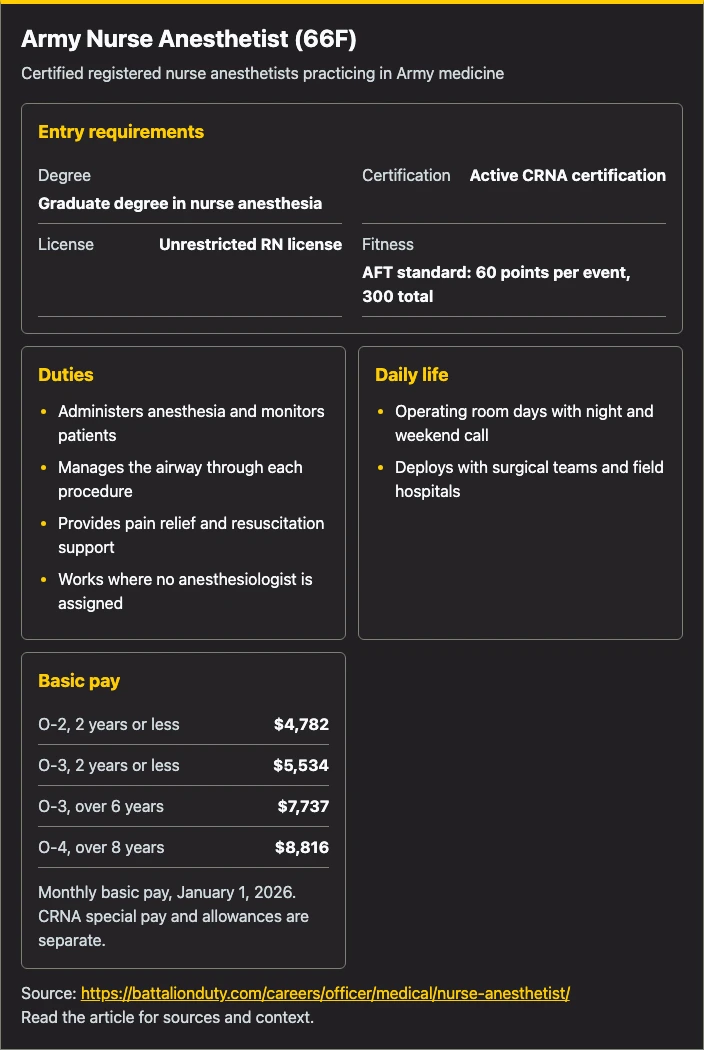
Entry requirements
- Degree
- Graduate degree in nurse anesthesia
- Certification
- Active CRNA certification
- License
- Unrestricted RN license
- Fitness
- AFT standard: 60 points per event, 300 total
Duties
- Administers anesthesia and monitors patients
- Manages the airway through each procedure
- Provides pain relief and resuscitation support
- Works where no anesthesiologist is assigned
Daily life
- Operating room days with night and weekend call
- Deploys with surgical teams and field hospitals
Basic pay
- O-2, 2 years or less
- $4,782
- O-3, 2 years or less
- $5,534
- O-3, over 6 years
- $7,737
- O-4, over 8 years
- $8,816
Monthly basic pay, January 1, 2026. CRNA special pay and allowances are separate.
Source: https://battalionduty.com/careers/officer/medical/nurse-anesthetist/
Read the article for sources and context.
On this page
Job Role and Responsibilities
A 66F officer is a Certified Registered Nurse Anesthetist with a commission. They plan and administer surgical anesthesia, manage the airway and medications, monitor the patient and oversee a safe recovery from anesthesia.
The role extends beyond the operating room to anesthesia in labor and delivery, trauma cases, and dental and orthopedic procedures. Army CRNAs also teach.
The role can require independent decisions: on a forward surgical team, a CRNA may be the only anesthesia provider, with no anesthesiologist available to consult.
What the CRNA owns
The CRNA is responsible for the anesthesia plan, airway management, monitoring and drug record.
The CRNA also manages the recovery plan, including pain control, breathing support and decisions about when to wake a patient or maintain sedation.
What the CRNA does not own
The surgeon is responsible for the operation, while the CRNA is responsible for anesthesia, a distinction that matters in a malpractice review.
How this differs from an anesthesiologist
An anesthesiologist is a physician with an MD or DO and completed residency training. Army anesthesiologists serve in the Medical Corps.
A CRNA is a nurse with a graduate degree and national CRNA credential. Although the Army recognizes both roles as anesthesia providers, their scopes of practice and pay differ.
How this differs from floor nursing
Unlike a floor nurse managing several patients, a CRNA focuses on one patient at a time while that person is asleep or heavily sedated.
Technology and equipment
CRNAs use anesthesia machines, gas monitors, airway scopes and ultrasound for nerve blocks. They document care in Military Health System Genesis and use equipment kits designed for austere field sites.
Salary and Benefits
A 66F officer earns the same base pay as any other officer of the same grade. The difference sits in the special pays.
Base pay and allowances
Under the standard officer pay table, an O-3 with four years of service earns $7,383 per month and an O-4 with eight years earns $8,816, according to DFAS 2026 Military Pay Charts.
Housing and food allowances are separate from base pay and tax-free. An O-3 at Fort Sam Houston receives $2,007 per month in housing allowance without dependents.
Why CRNA pay runs high
Civilian CRNA salaries are an important consideration when comparing Army compensation. Specialty pay and retention incentives can affect that comparison, but their availability and terms depend on the current program and contract.
Three forms of specialty pay usually apply: an accession bonus for a new contract, a retention bonus for an extension, and monthly incentive pay for designated specialties.
Specialty pay amounts change annually with shortage designations. Ask an AMEDD recruiter for current figures based on your AOC and service obligation, or consult the Army Medical Recruiting Brigade at recruiting.army.mil/MRB_Nurses.
The funded degree
For selected officers, the Army funds CRNA school, covering tuition, fees and books while the nurse continues to receive full active duty pay throughout the program. That support can offset an otherwise expensive degree.
Qualifications and Eligibility
There are two routes into 66F, each with different requirements.
Door one: already a CRNA
Nurses who already hold a graduate degree in nurse anesthesia, active CRNA certification and an unrestricted RN license can commission directly.
Direct commissioning is the fastest route and the one recruiters prefer because the officer arrives ready to practice.
Door two: a serving Nurse Corps officer
As a serving Nurse Corps officer, you can apply for CRNA school through the Long-Term Health Education and Training (LTHET) program. Selection is competitive.
Applicants need a strong record that includes critical care clinical experience, solid evaluations and the required prerequisites.
The critical care prerequisite
The Army’s USAGPAN program requires more than 12 months of critical care nursing experience. Other accredited programs set their own prerequisites, so applicants should check the rules for the program they want to attend.
Army nurses can build the required experience as a 66S Critical Care Nurse. Programs differ in how they evaluate other experience, so applicants should check the specific admissions rules before assuming emergency or recovery-room work will count.
Degrees and grades
For the Army’s USAGPAN route, applicants need a BSN. Current U.S. nurse-anesthesia programs award doctoral degrees for entry into practice, while some nurses certified under older programs earned a master’s degree. Schools set their own science-grade and other admission rules. Check the Council on Accreditation’s requirements and the Army program before applying.
Age and service limits
Commissioning age limits may be waived, while LTHET has separate service rules that usually require an additional obligation after graduation.
Clearance and physical
Every route requires U.S. citizenship, eligibility for a Secret clearance and a qualifying military physical.
Work Environment
The operating room
CRNAs spend most of their time in cold, brightly lit operating rooms doing quiet, precise work that often requires standing for long periods.
The labor and delivery ward
Labor and delivery assignments include epidurals and emergency cesareans at unpredictable hours, sometimes with the CRNA working alone.
The forward surgical team
Forward surgical assignments can differ sharply from civilian hospital work: small teams deploy close to combat and provide care with fewer staff and resources.
On a forward surgical team, a CRNA must administer anesthesia with limited equipment while accounting for potential blood shortages and power failures.
The classroom
Senior CRNAs train nurse anesthesia students, run simulation labs and brief units on airway management.
Hours
In garrison, work follows an early-starting surgical schedule with rotating call duty. On deployment, hours depend on the mission rather than a fixed schedule.
Training and Skill Development
If you enter as a CRNA
Direct commission CRNAs attend the AMEDD Direct Commission Course followed by BOLC, a 10- to 14-week course at Fort Sam Houston focused on officer skills rather than anesthesia.
You skip the Clinical Nurse Transition Program. You already have the clinical depth it builds.
If the Army sends you to school
The funded-school route begins with BOLC and service in a critical care billet, followed by an LTHET application and attendance at a civilian or military CRNA program.
The U.S. Army Graduate Program in Anesthesia Nursing lasts 36 months and awards a DNP through Baylor University. It has 12 months of classroom instruction in San Antonio and 24 months of clinical training at military hospitals, with specialty cases such as cardiac, pediatric and obstetric anesthesia. Other accredited doctoral programs may take longer.
You sit the national certifying exam at the end. Passing earns the CRNA credential.
After graduation
Funded training carries an additional service obligation. Its length depends on the program and signed agreement, so confirm the exact terms with an AMEDD recruiter before applying.
Continuing skills
CRNAs recertify on a cycle, log continuing education and keep an RN license current in at least one state. They must also complete the Army’s readiness training.
Career Progression and Advancement
From clinical practice to service leadership
A new 66F officer builds case volume, takes call and learns the Army medical system. At Major, the emphasis may shift toward leading a hospital anesthesia section, including responsibility for staffing, schedules and quality data; some Majors serve as department chiefs. A Lieutenant Colonel or Colonel can take responsibility for anesthesia across an entire medical center or move into hospital command or corps-level staff work. Clinical skill remains important, but the scale of leadership grows with rank.
As responsibility grows, the officer has to look beyond individual cases. A section lead must consider who is qualified for each assignment, how the schedule supports safe care and what happens when equipment or staffing changes. Documenting those decisions, teaching colleagues and maintaining clinical practice can help show whether an officer is ready for a broader role without assuming every senior position will remain hands-on.
Promotion and opportunities beyond the operating room
Promotion to O-4 is decided by a board that reviews clinical breadth, leadership and military schooling. A record limited to operating room cases can restrict advancement, which is why operational billets matter alongside clinical practice. Teaching and research offer other ways to develop, as do joint assignments and positions with special operations medical elements. These paths broaden an officer’s record without replacing the need to remain competent in anesthesia.
Physical Demands and Medical Evaluations
Clinical workload and Army fitness
Anesthesia work may look stationary, but CRNAs stand for long periods, reposition patients and move gas cylinders or monitoring equipment. They must also pass the Army Fitness Test, although the combat standard does not apply to this branch. The general passing standard is 300 points, with at least 60 in each event under age- and sex-based scoring. Its five events are the deadlift, hand-release push-up, sprint-drag-carry, plank and two-mile run. See the Army Fitness Test for the official test description.
Credentials and readiness for deployment
Keeping an active RN license and CRNA certification is a continuing requirement, not simply an entry condition. Losing either credential ends eligibility for the 66F AOC. Deployment adds separate medical-readiness obligations: CRNAs need a current physical, dental readiness and required immunizations. Even an officer with current professional credentials can be kept off a team if this documentation lapses. The clinical and military requirements therefore have to be maintained at the same time.
Deployment and Duty Stations
Hospital assignments and posting decisions
CRNAs work at major Army medical centers, smaller post hospitals and deployable surgical units. Large locations with anesthesia services include Brooke Army Medical Center at Fort Sam Houston, Walter Reed, Tripler, Madigan and Womack. Officers can submit preferred duty stations, but Human Resources Command makes the final decision according to Army needs. Because medical billets are spread across most large installations, an officer may serve in different hospital settings before or between operational assignments.
Deployment frequency and working conditions
The shortage of nurse anesthetists creates demand for them on forward surgical teams and in combat support hospitals. An individual replacement may deploy for three to six months, while a unit deployment can last nine months or longer. The clinical environment also varies: a CRNA may work in a hardened facility or a tent and may be the only anesthesia provider for miles. Along with caring for patients, deployed CRNAs train local medics, conduct drills and keep equipment ready.
Before accepting a billet, ask whether the team primarily provides scheduled operations, urgent surgery or stabilization before transfer. Those settings place different demands on call schedules, equipment preparation and the number of clinicians available to assist. A deployable anesthesia role also requires maintaining readiness between missions, so the practical workload includes training and planning as well as patient care.
Risk, Safety, and Legal Considerations
Clinical, chemical and infection hazards
Anesthesia has inherent risks because medications can suppress breathing and airways can become obstructed, sometimes leaving little time to respond. CRNAs also work around waste anesthetic gas, which modern scavenging systems reduce but older field equipment may not control as effectively. Needlesticks and blood exposure are additional hazards. The work therefore involves both immediate patient-care decisions and workplace precautions, including following established exposure protocols and mandatory reporting requirements.
Professional accountability and fatigue
A CRNA has obligations under both the Uniform Code of Military Justice and a state nursing board; a serious clinical error can have consequences in either system. Under 10 U.S.C. § 1089, the usual civil remedy for malpractice during assigned military medical work is a claim against the United States, not a personal lawsuit against the CRNA. The law covers negligent care when the provider acts within the scope of assigned duties. Military discipline and nursing-board action remain separate matters. Long cases and overnight call introduce fatigue-related error risks as well. Army duty-hour limits apply in some settings, although field conditions can override them.
Anesthesia decisions often depend on information gathered before a procedure. Checking the clinical history, discussing the plan with the surgical team and communicating a change in patient condition are separate responsibilities. Fatigue makes a clear handoff and a willingness to ask for help especially important. Military rank does not replace professional credentialing or the clinical limits of an officer’s privileges.
Impact on Family and Personal Life
Calls, moves and time away
Operating rooms start early, and overnight call can interrupt evenings, dinners and school events. Army service adds relocation and deployment to those familiar hospital demands. Officers typically move every two to three years, which can mean changing children’s schools and disrupting a spouse’s job. Larger medical posts may offer more employment options for a working spouse, but that does not remove the disruption of a move. Individual deployments commonly last three to six months, with unit deployments running longer.
Available support and dual-military assignments
Army Community Service provides relocation help, Family Readiness Groups assist during deployments, and on-post childcare can support families through both. These programs may reduce practical strain, but they cannot guarantee a predictable schedule or location. Couples in which both partners serve may face conflicting assignment requirements. Joint-domicile requests can help them seek the same location, although approval is not guaranteed and Army requirements still govern postings.
Overnight call may disrupt family plans even when there is no deployment. Families evaluating a posting should ask about call rotations, likely moves and whether support is available when both adults have work obligations. Dual-military couples can request coordinated assignments, but should still plan for periods when the services cannot place both members at the same location.
Reserve and National Guard
Part-time service alongside a civilian practice
Nurse anesthetists also serve in the Army Reserve and Army National Guard, which need anesthesia coverage for hospitals that can deploy. A Reserve CRNA usually drills one weekend per month and completes two weeks of annual training. Outside those periods, the officer generally works in a civilian anesthesia position. Part-time service therefore retains a civilian clinical career while still involving military training and the obligation to maintain deployable skills.
Drill pay, credentials and career fit
Drill pay is based on the officer pay table. For an O-3 with fewer than two years of service, the example rate is about $738 per drill weekend; the amount increases with time in service. Reserve CRNAs must keep both their RN license and CRNA certification current and maintain clinical currency, which civilian practice usually supports. This arrangement can suit someone with an established civilian career who wants a military unit affiliation and retirement credit without a full-time Army assignment.
Civilian anesthesia practice can help preserve the patient-care experience needed for a part-time military role, but unit readiness still takes separate time. Ask how the unit checks qualifications, what training its surgical team performs together and whether a mobilization would interrupt a civilian practice. Compare the total time commitment, rather than drill pay alone, when deciding whether the component fits an established career.
Post-Service Opportunities
Civilian anesthesia practice and leadership
CRNA certification is portable, and civilian hospitals compete for nurse anesthetists. Former Army CRNAs may join hospital anesthesia groups, surgery centers or pain clinics; some move into teaching. In addition to their clinical work, they may have led anesthesia services and managed teams during military service. That leadership experience can distinguish their professional record, particularly for nurses who assumed management responsibilities relatively early in their careers.
Education benefits and independent credentials
Eligible CRNAs may receive up to 36 months of Post-9/11 GI Bill education benefits for further study. Family transfers are not automatic. Under the usual VA rules, the service member needs six years of service, must agree to serve four more years and must request Defense Department approval while still serving. The dependent must also be enrolled in DEERS. State licensure and national CRNA certification remain with the individual after service; neither needs military sponsorship. Separating officers therefore keep the credentials behind their clinical career while considering how to use any remaining education benefits.
A civilian employer will review licensure, national certification, recent case experience and the privileges required for its setting. Military leadership experience may be valuable, but it does not replace those checks. Officers expecting to move into civilian anesthesia work should maintain usable records of credentials and clinical responsibilities and confirm state and employer requirements before separation.
Is This a Good Job for You? The Right (and Wrong) Fit
Who may benefit from the route
66F fits nurses who want demanding procedural care, can make independent clinical decisions and enjoy precision. The Army may also appeal to nurses seeking funded CRNA education, since selected serving officers receive school support. Applicants should evaluate both parts of the offer: the opportunity to develop an advanced-practice skill and the military responsibilities that accompany it. The role is not simply civilian anesthesia with a different employer.
Tradeoffs before committing
CRNAs focus on one patient at a time, so the work may not suit nurses who want a varied caseload across many patients. Early surgical starts, night call and the prospect of more deployments than in many Nurse Corps specialties are also substantial considerations. The training route is lengthy and may carry an additional service obligation. In return, it builds a scarce clinical qualification with strong civilian earning potential, but applicants should weigh that benefit against the specific obligation and lifestyle.
More Information
Start with the Army Nurse Corps officer guide for branch structure, entry routes and general pay, then read about the critical care experience that supports CRNA applications. The emergency nurse and perioperative nurse pages explain adjacent clinical roles.
For the wider career picture, explore Army medical officers and Army officer careers. The officer entry guide explains commissioning routes, while the medical officer versus enlisted medic comparison helps distinguish the two career paths.
Talk to an AMEDD nurse recruiter about current CRNA bonus amounts. Ask about LTHET board dates. Ask which posts currently carry anesthesia billets.