Army Occupational Therapist Officer (65A)
An Army occupational therapist treats the tasks a person needs to perform, whether that means getting dressed, lifting a child, carrying a weapon or driving.
Those tasks are where an injury shows up first. They are also where recovery has to land.
Both occupational therapy and physical therapy address function, with overlapping goals and different approaches. This guide focuses on the daily tasks, adaptations and role performance described in the Army’s 65A duties.
This page explains the work of an Army occupational therapist and the qualifications for 65A. The Specialist Corps officer guide covers branch structure, general pay and entry routes.
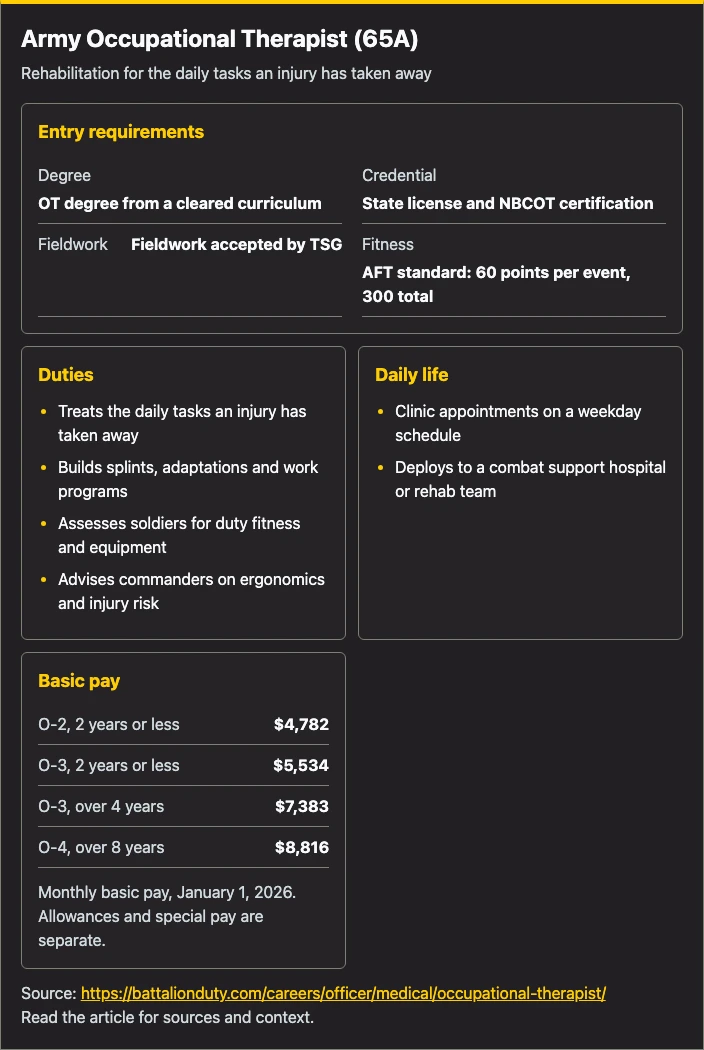
Entry requirements
- Degree
- OT degree from a cleared curriculum
- Credential
- State license and NBCOT certification
- Fieldwork
- Fieldwork accepted by TSG
- Fitness
- AFT standard: 60 points per event, 300 total
Duties
- Treats the daily tasks an injury has taken away
- Builds splints, adaptations and work programs
- Assesses soldiers for duty fitness and equipment
- Advises commanders on ergonomics and injury risk
Daily life
- Clinic appointments on a weekday schedule
- Deploys to a combat support hospital or rehab team
Basic pay
- O-2, 2 years or less
- $4,782
- O-3, 2 years or less
- $5,534
- O-3, over 4 years
- $7,383
- O-4, over 8 years
- $8,816
Monthly basic pay, January 1, 2026. Allowances and special pay are separate.
Source: https://battalionduty.com/careers/officer/medical/occupational-therapist/
Read the article for sources and context.
On this page
Job Role and Responsibilities
A 65A plans and runs occupational therapy programs in medical facilities, the wider health care community, and both base and field settings. The work is not confined to a clinic.
Patients usually arrive through a referral from a doctor or another provider. The occupational therapist identifies the tasks the person needs to resume and builds a plan to help them do so.
Occupational therapy centers on a person’s ability to handle daily life. The therapist works to keep, restore or build that ability while helping prevent disease and make up for function that cannot be restored. This work covers mental, physical and developmental needs.
An OT assesses how a soldier manages responsibilities at work, in the unit and at home as a parent or partner. Treatment can include habits, self-care, coping skills and daily living tasks, alongside ways to reduce the strains that contribute to injury.
The hands-on work includes designing and making splints and special equipment to fit a person’s disability. An OT also uses physical reconditioning to maintain fitness, support healing and build independence in self-care.
Army rules define specific cases in which an occupational therapist acts as a physician extender, providing primary care for upper limb nerve, muscle and joint injuries. That care includes custom splints made for the patient. The scope comes from those rules rather than an assumed right to provide primary care.
An OT advises commanders and units on injury prevention and ergonomics through work-site checks, task analysis and changes to the workplace. A clerk with a back problem may need a new desk height more than a course of treatment.
In war, occupational therapists serve in combat stress control units, usually attached to Division Mental Health. They assess function and treat soldiers with traumatic brain injury or acute and chronic combat stress. Battlefield unit needs assessments help them judge a unit’s mental health. To help soldiers return to duty sooner, OTs reduce wasted effort, simplify work and use reconditioning to build fitness and duty skills.
Salary and Benefits
Occupational therapists receive standard officer basic pay based on rank and years of service. The Specialist Corps guide provides the pay table and explains branch benefits.
Additional medical or professional pay depends on the applicable rules, while sign-on bonuses depend on the program year and shortage list. Confirm the terms for your accession route and assignment rather than assuming extra pay accompanies every 65A billet.
Occupational therapy has appeared on Army shortage lists, but an older bonus figure does not establish what an applicant can receive today. Amounts and eligibility change with the program year. The branch source used here provides no current figure, so ask a recruiter for the terms that apply to your route.
Qualifications and Eligibility
The 65A bar comes from the Army’s officer branch chapter. Three rules apply to every occupational therapist officer.
| Rule | Standard |
|---|---|
| Degree | A bachelor’s or advanced degree in OT from a school with a cleared curriculum, including fieldwork accepted by TSG |
| Credential | A current state license and current NBCOT certification |
| Rule | Meet AR 135-100 and AR 135-101 |
The degree rule contains a narrow exception where the internship was required to earn the bachelor’s degree itself. Applicants should confirm how that provision applies to their education; it does not create a general waiver of the school requirement.
Unlike 65B physical therapists, whose stated credential requirement is a state license, 65A occupational therapists need both a state license and NBCOT certification. Either credential alone is insufficient for OT.
The Army branch chapter lists restrictions involving court-martial records, specified civil offenses under AR 27-10 and sex-offender registration. Disclose relevant history to the responsible recruiting staff for a formal eligibility determination; this page cannot decide an individual case.
Older descriptions of entry paths may not match the current program. Confirm your circumstances and route with a recruiter before relying on one path: the rule establishes eligibility, not a guaranteed slot.
Work Environment
The setting changes the resources available for care. A treatment facility offers dedicated space and equipment, while field work requires an OT to adapt to what the team can carry.
Most patients are young and fit by civilian standards, but they must return to demanding physical work. Occupational therapy therefore aims beyond comfort toward helping a soldier perform the job again.
Some assignments focus on mental health. In a combat stress control unit, an OT treats soldiers with brain injury and combat stress while examining how they function in daily life. Can the soldier manage a crowded room, cope with loud noise or complete a night watch? Those practical questions guide the assessment.
Specialized assignments can include leading burn rehabilitation at the Army surgical research institute or running an ergonomics program at Public Health Command. Each requires a different balance of patient care, equipment work and advice to other staff.
Courses, injury-data analysis and command advice take time away from individual patient care. Officers considering a longer career should account for the administrative and leadership responsibilities that can grow with rank.
Training and Skill Development
For accession as an already qualified occupational therapist, a candidate needs an OT degree from an approved school and both required credentials. Army-sponsored training programs have separate admissions requirements.
The Army also trains occupational therapists through its own internship and doctoral programs. The branch rule names both paths into the corps and lists their directors as 65A posts. It does not establish who can enter those programs now, so applicants need to check current entry rules.
Further development can include teaching in the 68L occupational therapy specialist program. The branch rule lists that program’s director as a 65A position and also identifies doctoral-program leadership among senior assignments.
Career development combines clinical practice, formal schooling and instruction. The corps needs occupational therapists who can teach incoming personnel as well as treat patients.
Career Progression and Advancement
Promotion follows the normal officer timeline. What differs is the range of posts at each grade.
Junior OTs treat a caseload while learning the military side of practice. Their work is judged in practical terms: are patients recovering function, and can the unit rely on their advice?
Midcareer assignments can broaden into ergonomics-program leadership, section-chief duties or burn rehabilitation. Other officers develop their teaching and management experience as instructors or program directors.
Senior OTs may direct a doctoral or specialist training program, lead an occupational therapy section or move into corps-level policy work.
Therapists can pursue senior leadership within the Specialist Corps without becoming physicians. Entering the Medical Corps is a separate route with its own medical-degree and accession requirements.
Physical Demands and Medical Evaluations
The fitness bar for 65A matches the other Specialist Corps parts. It is not eased because the work is clinical.
| Item | Standard |
|---|---|
| Eyes and hands | Fixable sight, hand skill, normal color sense per AR 40-501 |
| Profile | 222222 |
| Demands rating | Moderate (Gold) |
| OPAT long jump | 120 cm or more |
| OPAT power throw | 350 cm or more |
| OPAT deadlift | 120 lb or more |
| OPAT shuttle run | 36 shuttles or more |
These are Moderate-category Occupational Physical Assessment Test accession standards, distinct from the Army Fitness Test used during service. The officer physical-requirements table lists this specialty in the Moderate category. Confirm the current accession requirements with the responsible recruiter.
Manual dexterity matters when making splints and fitting equipment, where small adjustments can affect how well the device works for the patient.
Medical examinations take place on entry and at set points during service, with health conditions assessed against AR 40-501. Occupational therapists must also maintain their required professional credentials; a lapse can affect eligibility to practice and serve.
Deployment and Duty Stations
Occupational therapists can serve with deployable units, and the branch rules explicitly describe their wartime role.
Downrange, the work shifts toward mental health and function, including combat stress, brain injury and the daily-task assessments that help decide whether a soldier can stay in the fight. An OT in that setting works close to the unit, not behind a hospital wall.
Posts span Army hospitals and operational units. An OT might serve in a treatment facility, a combat stress unit or a public health role, with assignments moving between clinical and field settings according to Army needs.
Because the rule provides no current list of duty stations, this page does not offer one. Assignments depend on Army needs when orders are issued.
Risk, Safety, and Legal Considerations
Rehabilitation plans and fitted equipment both require clinical judgment. A poorly fitted splint can injure a patient, as can a plan that progresses beyond what the person can safely manage.
Occupational therapists must maintain the professional credentials required for their role. A lapse can affect both clinical practice and eligibility to serve.
The rules identify specific upper limb cases in which an OT acts as a physician extender. Those provisions should not be read as general authority to provide primary care beyond the defined scope.
Accession restrictions also apply to Specialist Corps officers. A recruiting eligibility review is separate from clinical licensure and professional-board requirements, so applicants must address both.
In a combat stress unit, an OT’s assessment of function can inform decisions about a soldier’s duties. That responsibility requires clear findings and an understanding of the occupational therapist’s scope within the wider mental health team.
Impact on Family and Personal Life
Families may find clinic hours predictable, but field time and deployments are less so. An occupational therapist assigned to a combat stress unit should plan for both.
Deployment patterns depend on the unit. An OT attached to a division mental health element should ask how that assignment supports the division’s deployments; its schedule can differ substantially from a hospital tour.
Although desk work may stay at the clinic, responsibility for patients does not always end with the workday. Small sections therefore need reliable coverage arrangements.
Civilian occupational therapy offers another career path for families weighing a longer Army commitment. A serving OT can prepare by checking licensing requirements and job opportunities in the state where the family hopes to settle.
Reserve and National Guard
Occupational therapists may combine part-time Specialist Corps service with civilian practice, subject to available positions and military obligations.
Reserve service uses the same credentials with a different patient mix. A reserve OT may devote one weekend a month to readiness work and complete annual training in a field medical unit.
Reserve applicants still need the required education, state license and NBCOT certification. Part-time service does not remove those professional requirements.
Available positions vary by state, component and unit. Ask a reserve recruiter or the prospective unit which specialty billets are currently open.
Post-Service Opportunities
Army occupational therapy has a direct civilian counterpart, but the transition still requires current credentials and compliance with the destination state’s practice rules.
Civilian opportunities include hospitals, rehabilitation centers, hand therapy practices, schools and home health. Army experience advising on work-site demands may also be relevant to ergonomics and consulting, while program leadership can support applications for management roles. Other OTs open a practice.
Federal clinical, training and policy positions offer another possible route after military service. Applicants should check the position’s qualifications and how prior service affects benefits or service credit.
Program leadership, command advice and combat stress assignments can add experience beyond individual patient care. An OT applying for a management role should explain which programs they led, what decisions they supported and how their work affected care.
Is This a Good Job for You? The Right (and Wrong) Fit
This job may suit someone who enjoys finding why a soldier cannot complete a task and testing changes to the activity, the person’s abilities or the setting. The focus is practical function: what does the person need to do, and what would help them do it?
It suits a person who is at ease with the mental side of injury. Combat stress and brain injury are part of the wartime role. A therapist who wants only physical cases will find that side hard.
It does not suit someone seeking a physician’s career: occupational therapy and medicine are separate branches with different degree requirements.
Compare the work with physical therapy before choosing. Both professions address function, so the decision deserves more than a simple movement-versus-daily-life distinction. Read the Army’s duties for each specialty and consider which assessments, treatments and assignments interest you.
The role also requires continuing attention to the state license and NBCOT certification. Both are ongoing professional obligations.
More Information
The Specialist Corps officer guide covers branch shape, entry paths and the current pay table. The other three parts have their own pages: physical therapist, physician assistant and dietitian.
Compare the clinical work with Army physical therapy, or read the Medical Corps guide if you are considering a physician’s route. The medical officer hub and Army officer careers hub place these roles within the wider branch structure.
For entry decisions, use the officer commissioning guide and the medical officer versus enlisted medic comparison to distinguish commissioned clinical work from enlisted healthcare roles.
Rules and bonus plans change. Check current terms, program year and open slots with a recruiter before you act on any of this. The standards here come from the Army officer branch chapter, paragraph 3-65, checked in October 2026.