Army Optometrist Officer (67F)
An Army optometrist officer is a primary care provider for the eye. The officer examines patients, diagnoses and treats conditions of the visual system, prescribes glasses and contact lenses, and may manage eye disease with medication. On a deployment, the same officer may be the person deciding which eye injuries need to move to a surgeon and which can be treated in place.
The formal code is 67F, Optometry, in the Army Medical Service Corps. Optometry is one of the corps’ separate clinical areas of concentration, alongside pharmacy and podiatry, rather than a branch inside a larger group. Optometry is a licensed doctoral profession with its own qualification standard, and it is not the same career as ophthalmology.
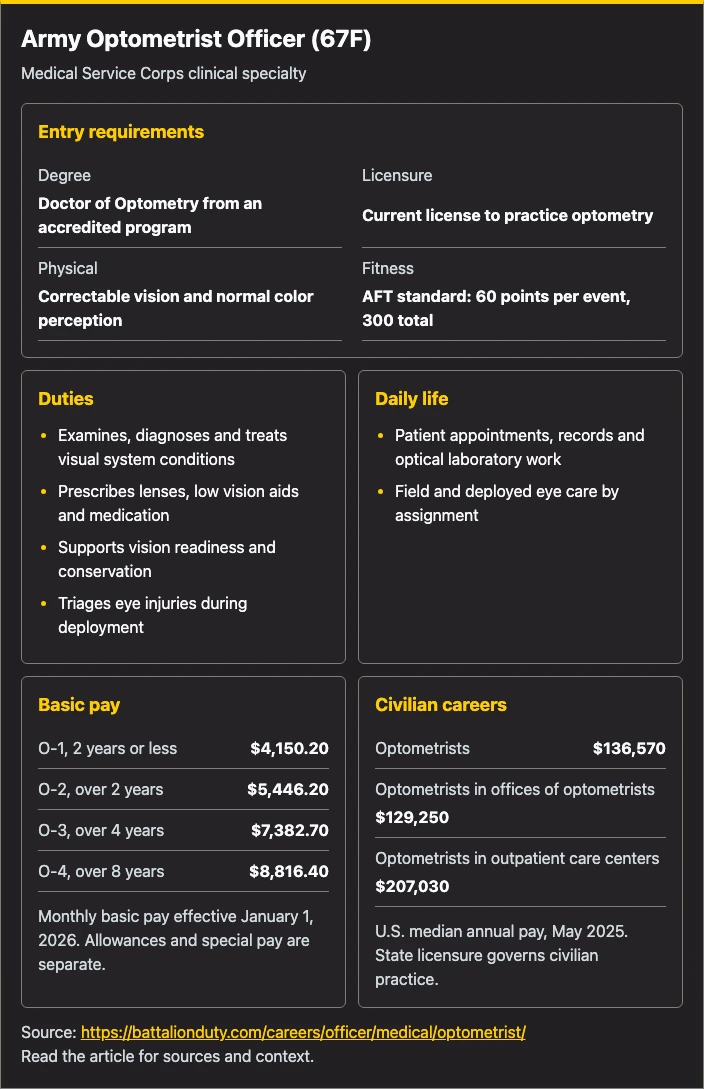
Entry requirements
- Degree
- Doctor of Optometry from an accredited program
- Licensure
- Current license to practice optometry
- Physical
- Correctable vision and normal color perception
- Fitness
- AFT standard: 60 points per event, 300 total
Duties
- Examines, diagnoses and treats visual system conditions
- Prescribes lenses, low vision aids and medication
- Supports vision readiness and conservation
- Triages eye injuries during deployment
Daily life
- Patient appointments, records and optical laboratory work
- Field and deployed eye care by assignment
Basic pay
- O-1, 2 years or less
- $4,150.20
- O-2, over 2 years
- $5,446.20
- O-3, over 4 years
- $7,382.70
- O-4, over 8 years
- $8,816.40
Monthly basic pay effective January 1, 2026. Allowances and special pay are separate.
Civilian careers
- Optometrists
- $136,570
- Optometrists in offices of optometrists
- $129,250
- Optometrists in outpatient care centers
- $207,030
U.S. median annual pay, May 2025. State licensure governs civilian practice.
Source: https://battalionduty.com/careers/officer/medical/optometrist/
Read the article for sources and context.
On this page
Job Role and Responsibilities
Army 67F optometrist officers serve as independent primary eye care providers in fixed and field medical organizations. They examine, diagnose, treat and manage diseases, injuries and disorders of the visual system and identify related systemic conditions. They prescribe spectacles, contact lenses, low vision aids and medications, may perform certain surgical procedures, and support vision readiness for the force.
The profession belongs to the Army Medical Service Corps. The officer’s clinical authority comes from licensure and granted privileges. The officer’s military authority comes from appointment and assignment. Both are required.
Optometry and ophthalmology are different professions
This is the distinction readers most often get wrong, so it belongs near the top.
An optometrist holds a Doctor of Optometry degree and is licensed to examine the eyes, diagnose and manage vision conditions and eye disease, prescribe corrective lenses and medications, and perform certain procedures within the scope their license and privileges allow. Optometry is a Medical Service Corps specialty in the Army.
An ophthalmologist is a physician. That officer holds a medical or osteopathic doctorate, completes a residency in ophthalmology, and is a member of the Army Medical Corps. Ophthalmologists perform eye surgery.
The two professions work together, and they are not interchangeable. An applicant who wants to perform eye surgery is looking at the physician route through medical school and residency, not the optometry route. An applicant who wants to practice primary eye care, refraction, contact lens management and medical management of many eye conditions is looking at 67F.
What the officer does
The published duties describe an independent practitioner who conducts examinations to prevent, diagnose, treat and manage diseases and disorders of the visual system, the eye and associated structures, and who diagnoses related systemic conditions. That last phrase matters. An eye examination can be the first place a systemic disease becomes visible, and the optometrist is expected to recognize it and refer appropriately.
The same source describes prescribing spectacles, contact lenses, low vision aids, medicines and other therapy for eye injuries and disease. It also notes that the officer may use medical and surgical instruments in providing treatment. The scope is clinical, and it is bounded by license and privilege rather than by rank.
Beyond direct care, the duties include consultation, research, instruction, vision conservation and readiness, staff assignments and optical laboratory management. That combination is broader than most civilian optometry roles.
Where a 67F officer is placed
Published positions include staff optometrist, optical laboratory officer, optometry research and development officer, instructor at the Army Medical Department center and school, optometry consultant to a medical command clinical services directorate, commander or executive officer of a medical detachment for optometry, and vision conservation officer. The same guidance names security force assistance brigade assignments as a broadening option.
These are categories of assignment rather than a sequence every officer follows. Command of a medical detachment is a competitive assignment, and the senior consultant roles come later.
Enlisted eye care roles are separate
The Army also trains enlisted eye specialists and optical laboratory specialists who support examinations, dispensing and lens fabrication. Those soldiers work within their own scope under supervision. The optometrist officer is the licensed practitioner accountable for diagnosis, treatment decisions and the standard of care in the service.
Salary and Benefits
2026 military officer basic pay
An Army optometrist is paid according to appointed rank and years of creditable service. Entry grade and credit for earlier professional experience follow the appointment rules in force when the officer is appointed. Neither the degree nor the license sets an entry grade or a service credit figure by itself.
| Rank | DFAS service bracket | 2026 monthly basic pay |
|---|---|---|
| O-1, Second Lieutenant | Two years or less | $4,150.20 |
| O-2, First Lieutenant | Over two years | $5,446.20 |
| O-3, Captain | Over four years | $7,382.70 |
| O-4, Major | Over eight years | $8,816.40 |
These examples come from the Defense Finance and Accounting Service (DFAS) 2026 commissioned officer pay table, effective January 1, 2026. A licensed optometrist entering through a direct commission may be appointed above the entry grade shown here. The correct amount depends on the appointment and the service credit granted with it.
Scholarships, special pays and benefits
The Army Medical Recruiting Brigade medical services page describes the Health Professions Scholarship Program for optometry. The published terms are two and three year scholarships for students enrolled in or accepted to accredited optometry programs, with full tuition, a monthly stipend of over $2,999 for ten and one half months, reimbursement of certain academic fees, and second lieutenant pay for 45 days of active duty training. Participants are commissioned as second lieutenants in the Medical Service Corps while in the program, and the active duty obligation is year for year with a minimum of three years. The board meets once a year, in January.
The same page lists optometry among the specialties for which Reserve Health Professions Special Pay may be available, published as up to $20,000 per year for a two, three or four year affiliation in qualifying Reserve status. That is a Reserve incentive tied to a specific affiliation rather than a general bonus.
Scholarship amounts, board dates and incentive eligibility change between cycles. A published maximum is not an individual offer, and an applicant should confirm current terms with a recruiter.
Qualifying officers receive military healthcare, housing and subsistence allowances, paid leave and education benefits. The Blended Retirement System governs retirement for qualifying service, alongside eligible Thrift Savings Plan contributions.
Optometry schedules are usually clinic-based, with patient appointments, records and administrative work. Deployed and field assignments change that pattern. No fixed weekday schedule should be promised to a prospective 67F officer.
Qualifications and Eligibility
Degree, license and entry route
The Army requires a Doctor of Optometry degree from an accredited school of optometry acceptable to The Surgeon General, a current license to practice optometry in the United States, its territories or the District of Columbia, and completion of the Army Medical Department officer basic course. Professional qualifications for unrestricted practice must be met.
| Requirement | Standard | Notes |
|---|---|---|
| Professional degree | Doctor of Optometry from an accredited program | The program must be acceptable to The Surgeon General |
| License | Current license to practice optometry | A United States, territorial or District of Columbia license |
| Professional standing | Qualifications for unrestricted practice | Restricted or conditional licensure is a problem to resolve before a board |
| Military training | Army Medical Department officer basic course | Completed after appointment |
| Later military education | Captains Career Course for lieutenant colonel level positions, intermediate level education for colonel level | Required for the executive positions in the career guidance |
Board certification and fellowship in the American Academy of Optometry are described as highly encouraged but not mandatory. That is unusual among the clinical specialties and worth noting, because it means the license is the gate rather than a specialty board.
Physical standards specific to this specialty
Optometry carries an explicit physical standard. Officers must have correctable vision, manual dexterity and normal color perception under the Army medical standards regulation, with a physical profile of 222222 and a physical demands rating of moderate. The published qualifying scores are a standing long jump of 120 centimeters, a seated power throw of 350 centimeters, a strength deadlift of 120 pounds and an interval aerobic run of 36 shuttles in the moderate physical demand category.
Those are the initial award standards for the area of concentration. They are separate from the general fitness test described below, and both apply.
Commissioning tests, age and grade
A 67F applicant should work with a medical professional recruiter. The board considers academic records, licensure, references and an interview. The SIFT, the Selection Instrument for Flight Training, is an aviation test and is not an optometry requirement. Enlisted ASVAB scores do not substitute for the doctorate and the license.
Each program sets its own medical, citizenship, security and age rules, with approved exceptions possible. No universal cutoff for age, grade point average or entry rank applies. Ask for the current announcement and the written appointment terms before deciding.
Work Environment
An optometrist officer may work in a hospital eye clinic, a troop medical clinic, an optical fabrication laboratory, a research activity or a deployable medical unit. The clinical setting determines the case mix. A large medical center offers specialty equipment and complex cases, while a small clinic or a field unit offers volume, readiness screening and a different kind of autonomy.
Vision readiness is a recurring theme in the specialty. Military work often depends on corrected vision, and the optometrist is part of the system that keeps soldiers deployable and their equipment matched to their eyes. That is a military requirement with no direct civilian equivalent, and it shapes how the officer spends time.
Some officers move toward research, teaching, detachment command or consultant roles as their careers develop.
Training and Skill Development
Optometry training continues after the degree. The Army’s career guidance lists residencies and short courses that build specialty depth.
| Training or milestone | Setting | Duration | Purpose |
|---|---|---|---|
| Doctor of Optometry | Accredited program, or an Army-supported route through the scholarship program | Degree-specific | Professional foundation and licensure eligibility |
| Army Medical Department officer basic course | Army Medical Department center and school | Current class schedule required | Military leadership and medical support context |
| Combat casualty care course | Army medical training | Course-specific | Operational medical skills |
| Clinical residency in family practice, primary eye care or neuro-rehabilitation | Accredited program | Typically one year | Advanced clinical practice |
| Graduate management or public health degree | Civilian or Army-Baylor program | Program-specific | Leadership and health administration preparation |
| Captains Career Course and intermediate level education | Army school system | Required at the corresponding grade | Senior leadership and staff qualification |
The published options include the Federal Service Optometry Symposium short course, clinical residencies in family practice, primary eye care and neuro-rehabilitation, and master’s or doctoral programs in public health, business administration or health administration through a school of choice or the Army-Baylor program. Selection is competitive and depends on Army requirements.
Career Progression and Advancement
Clinical standing and military advancement are measured separately. Advancement turns on performance, military education and the requirements of the corps. Clinical authority depends on licensure, privileges and demonstrated practice.
| Officer grade | Typical stage | Possible role |
|---|---|---|
| O-1, Second Lieutenant | Scholarship or initial appointment | Entry grade, with licensure and training requirements still in force |
| O-2, First Lieutenant | Early practice | Staff optometrist in a clinic or medical unit |
| O-3, Captain | Qualified practitioner | Optometrist with independent scope, detachment leadership, residency or specialty practice |
| O-4, Major | Experienced practitioner and leader | Clinic chief, detachment commander or executive officer, senior clinical role |
| O-5, Lieutenant Colonel | Senior professional assignment | Service chief, medical command staff, consultant role |
| O-6, Colonel | Limited senior positions | Senior medical leadership and policy positions |
The table is a framework rather than a promotion schedule. The guidance makes the Captains Career Course a condition for lieutenant colonel executive billets, and intermediate level education a condition at colonel level. The Army does not publish a guaranteed 67F promotion rate for an individual officer.
Physical Demands and Medical Evaluations
Optometrist officers must meet applicable Army commissioning and continuing fitness standards, including the specialty specific vision and profile requirements described above. Combat-enabling specialties score the Army Fitness Test (AFT) against age and sex tables, with a 60 point floor per event and 300 overall. The 17 through 21 age bracket, taken from the official AFT scoring standards, requires:
| Test event | Male 17-21 minimum | Female 17-21 minimum |
|---|---|---|
| Three-repetition maximum deadlift | 150 lb | 120 lb |
| Hand-release push-ups | 15 | 11 |
| Sprint-drag-carry | 2:28 or faster | 3:15 or faster |
| Plank | 1:30 or longer | 1:30 or longer |
| Two-mile run | 19:57 or faster | 22:55 or faster |
Older age groups have different standards. Licensure and military medical fitness are distinct gates, and the applicant must clear both. The 67F specialty does not carry a routine aviation flight physical requirement.
Deployment and Duty Stations
Optometrist officers serve in military treatment facilities, troop medical clinics, optical laboratories and deployable medical units. Assignment depends on available 67F positions, grade, qualifications and Army needs. An officer in a residency program has limited location choice because the program exists only at specific sites.
The deployment mission is explicit in the specialty. It includes triage of patients for ocular signs of eye injuries or trauma. That can make the officer the first clinical decision point for a service member with a serious eye injury. Not every optometrist deploys on the same schedule, and no fixed deployment frequency is supported by the sources reviewed here.
Risk, Safety, and Legal Considerations
Optometry carries direct patient safety responsibility. An inaccurate prescription, a missed diagnosis or an unrecognized systemic condition can cause harm, and the officer is accountable for the examination, the record and the referral decision. Infection control and equipment safety are part of the same duty.
Clinical decisions must stay inside the officer’s license and granted privileges. Scope varies by state licensure and by military privileging, and an officer moving between jurisdictions should confirm what is authorized rather than assume continuity.
Impact on Family and Personal Life
Optometry education, licensure and any residency year extend the runway before a first operational assignment. Later service can include changes of station, duty travel and deployment. Clinic hours are usually predictable, though field and deployed assignments change that.
Where eligible, families have access to military healthcare, housing support and Army family services. Assignment coordination is available to dual-military couples on request, and program locations or service needs can still limit it. A licensed civilian optometrist considering a commission should plan for license portability and for practice ownership or partnership obligations that may not survive a move.
Reserve and National Guard
The Army Reserve and Army National Guard commission optometrists when needs and vacancies permit. The core requirement does not change. A Reserve or Guard optometry officer still needs the accredited degree and the current license. A civilian practice does not by itself produce a military commission.
| Topic | Active Army | Army Reserve | Army National Guard |
|---|---|---|---|
| Employment model | Full-time military service | Drills, training and possible mobilization | State and federal duties, drills and possible mobilization |
| O-3 pay comparison, over four years | $7,382.70 monthly basic pay | About $984.36 for four drill periods | About $984.36 for four drill periods |
| Clinical qualification | License and privileges for the assigned scope | License and privileges plus unit conditions | License and privileges plus state and unit conditions |
| Special pay | Scholarship and accession incentives by program | Published 67F special pay for qualifying affiliation | Federal and possible state programs |
| Availability | Current 67F board required | Specialty recruitment when needs permit | Confirm the individual state vacancy |
| Retirement | Active service rules | Points-based non-regular retirement when eligible | Points-based non-regular retirement when eligible |
The four-drill figure uses the same DFAS monthly O-3 rate divided by 30 and multiplied by four. It isn’t a monthly Reserve salary. Annual training, credentialing and mobilization often take more than a standard drill weekend.
Post-Service Opportunities
Optometry is a licensed civilian profession. An officer who leaves service must satisfy the licensing rules of the state where they intend to practice. Military experience can be relevant to an employer, and it does not replace the degree or the license.
| Civilian occupation | Median U.S. yearly wage, May 2025 | Projected growth, 2025-2035 |
|---|---|---|
| Optometrists | $136,570 | 10% |
| Optometrists in offices of optometrists | $129,250 | Included in the category above |
| Optometrists in outpatient care centers | $207,030 | Included in the category above |
The figures come from the Bureau of Labor Statistics optometrist profile. The numbers describe civilian employment rather than military pay, and no salary offer is implied. The industry rows show how much the setting changes the number, which is useful context for an officer weighing a return to civilian practice.
Is This a Good Job for You? The Right (and Wrong) Fit
The 67F career suits a licensed optometrist who wants primary eye care with real clinical breadth, who is interested in readiness and operational medicine, and who accepts military assignment as part of the job. It rewards people who are precise, patient with routine screening volume, and comfortable making referral decisions under pressure.
It’s a poor fit for someone who wants to perform eye surgery, which is the ophthalmology route through medical school and residency. It’s also a poor match for a reader who wants a clinical career with no military obligations, no detachment leadership and no deployment, or for someone who cannot accept a posting cycle.
What settles it is the credential route a reader is willing to complete, the obligation attached to it, and whether primary eye care plus military leadership is the work they want.
More Information
Contact an Army healthcare professions recruiter for the current 67F board, direct commission terms, the optometry scholarship program and residency selection. Ask whether a residency slot can be combined with the accession, what grade and obligation apply, and which license the board accepts. For the military vocabulary itself, start with the Army officer commissioning overview, then rely on the professional recruiting notice.
The Medical Service Corps officer parent explains how 67F fits the Army health system. Readers weighing the physician route should read the Army Medical Corps officer profile, which covers the separate path to ophthalmology and the other physician specialties.