Army Perioperative Nurse Officer (66E)
A perioperative nurse coordinates the operating room, taking responsibility for its setup, safety checks and surgical counts.
The Army’s 66E AOC is a perioperative nursing specialty within the Nurse Corps. Officers have a defined clinical scope and work as part of a surgical team.
This page explains Army perioperative nursing. For branch structure, general pay and entry routes, see the Army Nurse Corps officer guide.
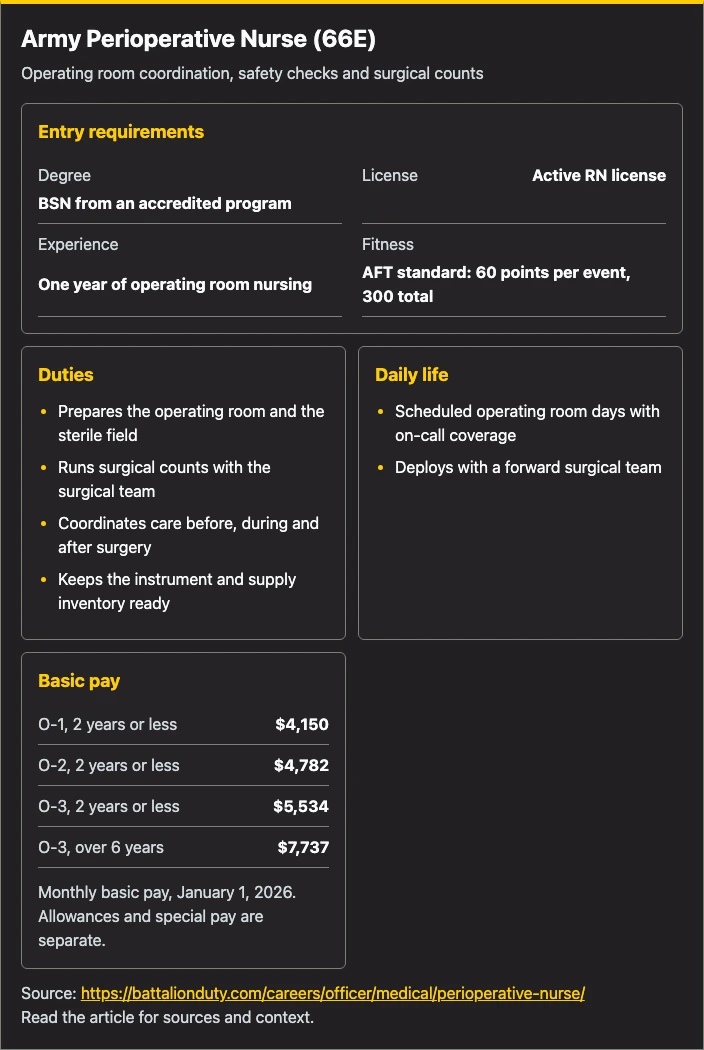
Entry requirements
- Degree
- BSN from an accredited program
- License
- Active RN license
- Experience
- One year of operating room nursing
- Fitness
- AFT standard: 60 points per event, 300 total
Duties
- Prepares the operating room and the sterile field
- Runs surgical counts with the surgical team
- Coordinates care before, during and after surgery
- Keeps the instrument and supply inventory ready
Daily life
- Scheduled operating room days with on-call coverage
- Deploys with a forward surgical team
Basic pay
- O-1, 2 years or less
- $4,150
- O-2, 2 years or less
- $4,782
- O-3, 2 years or less
- $5,534
- O-3, over 6 years
- $7,737
Monthly basic pay, January 1, 2026. Allowances and special pay are separate.
Source: https://battalionduty.com/careers/officer/medical/perioperative-nurse/
Read the article for sources and context.
On this page
Job Role and Responsibilities
A 66E officer coordinates care through the surgical suite, including the stages before, during and after an operation.
As a circulator, the nurse moves around the operating room to document care, retrieve supplies and perform checks.
As a scrub nurse, the officer stays at the operative field, passes instruments and maintains sterile conditions.
What the nurse owns
The nurse maintains the sterile field, since a loss of sterility can stop the procedure. Surgical counts of sponges, needles and instruments are also the nurse’s responsibility before and after the procedure, and an incorrect count can affect the patient’s outcome.
Before the first incision, the nurse leads the spoken safety pause to confirm the patient, surgical site and planned procedure. The nurse also positions the patient on the operating table and protects pressure points and limbs.
What the nurse does not own
The surgeon directs the operation, the anesthetist manages sedation and the surgical technologist handles the instrument tray, while the nurse coordinates the surrounding care.
How this differs from anesthesia
Anesthesia providers manage sleep and airway care, as explained in the nurse anesthetist page, while perioperative nurses coordinate the operating room and sterile field.
Both officers work in the same case. They do not do the same work.
How this differs from obstetric and gynecologic nursing
The Army classifies obstetric and gynecologic nursing separately as 66G, focused on labor, delivery and women’s health.
Perioperative nursing is 66E and focuses on the surgical suite. Both 66E and 66G nurses may participate in a cesarean section, but the shared procedure does not make them the same specialty.
How this differs from critical care and emergency nursing
The critical care nurse page explains ongoing intensive care, while the emergency nurse page focuses on initial assessment and stabilization. Perioperative nurses coordinate the surgical procedure and the care surrounding it.
Technology
Perioperative nurses use electrosurgical units, suction devices, laparoscopic towers, microscopes and instrument tracking systems. They document care in Military Health System Genesis.
Salary and Benefits
A 66E officer earns standard officer base pay and may qualify for additional specialty pay, depending on the year and contract.
Base pay and allowances
Under the standard officer pay table, an O-3 with four years of service earns $7,383 per month and an O-4 with eight years earns $8,816, according to DFAS 2026 Military Pay Charts.
Housing and food allowances are separate and tax-free. An O-3 at Fort Sam Houston draws $2,007 a month in housing without dependents.
Specialty pay
Perioperative nursing appears on shortage lists in some years, potentially making officers eligible for incentive pay and accession or retention bonuses.
Amounts change each year with the shortage designation list. Ask an AMEDD recruiter for current figures tied to your AOC and obligation length, using the Army Medical Recruiting Brigade as your starting point.
The funded training
The Army covers tuition for the perioperative course while the officer continues receiving full pay during training.
Qualifications and Eligibility
There are two routes into 66E: one for experienced operating room nurses and another for new graduates.
Door one: experienced OR nurse
Direct commissioning into 66E requires a BSN, an active RN license and at least one year of operating room experience.
Recent experience matters because a long gap may require retraining, so check the requirements before applying.
Door two: new graduate
New graduates generally commission first as 66H medical-surgical nurses and complete the Clinical Nurse Transition Program. Under the Army’s nursing pathway, they may apply for specialty training after one year of 66H service. Army Nurse Corps guidance also lists one year of medical-surgical nursing before the perioperative course. Selection and course seats still matter.
This route takes longer, but it builds a broader clinical base before specialty training.
The BSN requirement
Commissioning requires a BSN from an accredited program, so associate-degree nurses may need to complete a BSN bridge first.
Certification
The CNOR credential demonstrates expertise in perioperative nursing. Although the Army does not require it to enter 66E, it can strengthen an officer’s professional record.
Clearance and physical
Every route requires U.S. citizenship, eligibility for a Secret clearance and a qualifying military physical.
Age limits
Commissioning age limits may be waived, but the process takes months, so ask about eligibility early.
Work Environment
The garrison operating room
Most 66E time happens in a hospital operating room. The room is cold and bright. The work is quiet and exact.
Cases may run back to back with short turnover periods, requiring the nurse to reset the room between procedures.
The pre-operative area
In the pre-operative area, the nurse prepares the patient and checks consent, allergies and fasting status.
The recovery room
The nurse may also work in post-anesthesia care, monitoring patients as they wake with particular attention to airway and pain management.
The forward surgical team
A forward surgical team brings surgical care close to the fight and may work with just two operating tables.
On a forward surgical team, nurses work with limited supplies and may need to improvise sterile processing while remaining prepared to move with little notice.
Hours
Garrison work follows the surgical schedule, with early cases and rotating call duty, while deployed hours depend on the mission.
Training and Skill Development
Officer school first
New officers complete the AMEDD officer training required for their accession route. BOLC develops military skills; the current course instructions and issued orders determine the sequence and duration.
The transition program
A new graduate then enters the Clinical Nurse Transition Program, which runs about six months and pairs the officer with a preceptor.
The program builds roughly 500 clinical hours through work on assessment, documentation and handoff.
The perioperative course
The 66E Perioperative Nursing Course lasts 16 weeks and is offered at Brooke Army Medical Center or Joint Base Lewis-McChord. It teaches sterile technique and instrument handling.
Additional course topics include surgical counts, patient positioning, aseptic practice and equipment safety.
Certification courses
National courses covering operating room practice or post-anesthesia care provide additional credentials that can support promotion.
Continuing skills
As surgical practice evolves, officers maintain their RN licenses, complete recertification and continuing education, and undertake additional Army readiness training.
Career Progression and Advancement
Clinical and leadership progression
A new 66E officer learns circulating and scrub duties through surgical cases and takes call.
As a major, a 66E officer may become head nurse of a surgical service or take responsibility for training or deployment planning.
A Lieutenant Colonel or Colonel can lead nursing across a hospital, move into command or serve on the corps staff.
As a perioperative nurse moves into a charge role, the work expands from one procedure to the flow of an operating room. The officer may need to coordinate staff availability, anticipate equipment needs and make sure the team is prepared for the next case. Experiences supervising turnover, teaching safe practices and resolving scheduling conflicts provide useful evidence of leadership beyond time spent scrubbed into surgery.
Promotion and alternative assignments
Promotion to O-4 is board-selected, with clinical depth, leadership and military schooling all considered. Officers whose experience is limited to the operating room may find advancement harder.
Education, research and operational assignments with surgical teams can all broaden an officer’s career record.
Physical Demands and Medical Evaluations
Physical requirements and protection
Surgical nursing requires hours of standing, lifting trays, moving beds, and holding retractors or patient positions.
Officers in this specialty take the Army Fitness Test under the general standard rather than the combat standard. Passing requires at least 60 points in each event, scored by age and sex, for a minimum total of 300.
The five events are the deadlift, hand release push-up, sprint-drag-carry, plank and two-mile run. See the Army Fitness Test for the scoring rules.
Deployment readiness
Operating rooms present exposure risks, so nurses routinely wear gloves, gowns, masks and eye protection, with additional protective layers for some cases.
Deployable status requires a current physical, dental readiness and immunizations; a lapse in any of these can prevent an officer from joining a team.
Deployment and Duty Stations
Duty stations and deployment schedules
Perioperative nurses serve at major medical centers, post hospitals with surgical facilities and deployable surgical units.
Large sites include Brooke Army Medical Center at Fort Sam Houston, Walter Reed and Madigan. Tripler and Womack also run operating rooms.
Because perioperative nursing is a deployable specialty, officers serve with surgical units and as individual replacements.
Individual assignments often last three to six months, while unit deployments generally run longer. Both arrangements are common.
Deployed work and assignment preferences
Depending on the mission, a deployed surgical suite may contain one to four operating tables.
The nurse also trains medics, runs drills and checks instrument sets.
Officers submit assignment preferences, but Human Resources Command makes the final decision based on Army needs.
A deployed surgical unit may need to prepare for urgent cases while operating with fewer people and less equipment than a large hospital. The nurse’s work therefore includes checking instrument availability, organizing the room and supporting a reliable handoff after surgery. When comparing assignments, ask how often the unit trains as a complete surgical team and what the nurse will do between deployments to maintain clinical skills.
Risk, Safety, and Legal Considerations
Clinical and workplace hazards
Surgery carries inherent risks, including wrong-site procedures, which the pre-operative safety pause is designed to prevent.
Retained surgical items are a serious patient-safety risk. Surgical counts help the team detect discrepancies, which must be resolved under the facility’s procedures and may require imaging and reporting.
Accountability and operational pressures
Nurses have professional obligations under both military law and the regulations of their state nursing board.
Under 10 U.S.C. § 1089, the usual civil remedy for malpractice during assigned military medical work is a claim against the United States, not a personal lawsuit against the nurse. The law covers negligent care when the provider acts within the scope of assigned duties. Military discipline and nursing-board action are separate matters.
Surgical smoke and cleaning agents present exposure hazards that ventilation and masks help reduce, although older field setups may lack those protections.
Long cases and overnight call can cause fatigue and increase error risk. Although Army rules limit duty hours in some settings, field conditions can override those limits.
A safety check is most useful when someone notices a mismatch and is able to speak up before the procedure continues. Counts, documentation, instrument handling and team communication all depend on consistent practice, including when the schedule falls behind. Officers need to maintain the standards of their nursing license while fulfilling military duties; a higher rank is not a substitute for a careful clinical process.
Impact on Family and Personal Life
Work schedules, moves and deployments
Early cases and overnight call can mean missed dinners and school events.
Moves every two to three years can mean changing schools and finding new work for a spouse. Large medical posts may offer more employment options, but each move still requires planning.
Deployments commonly involve absences of three to six months, with longer periods on unit rotations.
Family support and dual-military assignments
Army Community Service supports relocations, Family Readiness Groups assist during deployments, and on-post childcare can help families with both.
Dual-military couples may face conflicting assignments; joint-domicile requests can help, but approval is not guaranteed.
Operating-room schedules can change when an urgent case runs late or call extends overnight. That uncertainty matters for childcare and a partner’s work even when the officer is posted near home. Ask how a prospective unit handles call, weekends and deployment preparation, and consider whether family support at the installation matches the hours the nurse is likely to work.
Reserve and National Guard
Part-time service, training and pay
Perioperative nurses can pursue part-time Army service where suitable billets are available. Confirm the specialty, component and unit mission with an AMEDD recruiter, particularly if you are considering National Guard service.
A Reserve 66E typically combines monthly drills and annual training with a civilian operating-room job. Additional training or mobilization can require more time than that usual schedule.
Drill pay follows the officer table, with an O-3 earning about $738 per drill weekend at fewer than two years of service.
Clinical readiness and suitability
Reserve nurses must maintain current credentials and clinical skills, which civilian practice usually supports.
Reserve service can complement an established civilian nursing career with military retirement credit and a unit affiliation, while adding its own training and service obligations.
A civilian operating-room position may supply frequent case experience, while a military unit supplies different equipment, team procedures and deployment requirements. A prospective Reserve or Guard nurse should ask what readiness training takes place outside regular drills, whether the billet needs a particular surgical background and how a mobilization would affect civilian employment. A predictable calendar is helpful, but it is not the full commitment.
Post-Service Opportunities
Civilian opportunities and leadership experience
Operating room experience transfers to civilian practice, where hospitals continue to need perioperative nurses amid a long-running shortage.
After service, perioperative nurses may work in hospital operating rooms, surgical centers, sterile processing leadership or teaching.
Army nurses may leave service with experience running clinical services and managing teams, giving them a leadership record beyond their operating-room work.
Education and licensing after service
Eligible nurses may receive up to 36 months of Post-9/11 GI Bill education benefits, which can support graduate study. Transfers to family are not automatic. Under the usual VA rules, the service member needs six years of service, must agree to serve four more years and must request Defense Department approval while still serving. The dependent must also be enrolled in DEERS.
State licensure and the CNOR credential remain with the individual after service; neither requires an Army sponsor.
Nurses returning to civilian surgical practice should confirm that their license and recent clinical experience match the work they want to perform. Experience coordinating an operating room or teaching safety procedures can also support a move into supervision, but employers may ask for evidence of those duties. Keep a record of credentials, clinical responsibilities and leadership work before separating rather than relying on an officer title to explain them.
Is This a Good Job for You? The Right (and Wrong) Fit
Strengths and tradeoffs
This path can suit a precise, calm nurse who values preparation and orderly work, while remaining ready for a surgical plan to change.
It also suits a nurse who wants to teach. Surgical teams train constantly.
A nurse who values ongoing patient relationships may find the case-based work less satisfying. Early starts, call duty and possible deployments also deserve careful thought before choosing this specialty.
The route involves lengthy training and demanding hours, but develops a scarce clinical skill with strong earning potential.
More Information
Start with the Army Nurse Corps officer guide. It covers branch structure, entry routes and general pay. Then read the nurse anesthetist page for the other officer in the room.
For comparison, the critical care nurse page explains intensive care, while the emergency nurse page focuses on initial patient assessment.
For the wider picture, see Army medical officer careers. For branch options in general, read Army officer careers. The how to become an officer guide sets out entry paths. The medical officer versus enlisted medic piece marks the enlisted side.
Talk to an AMEDD nurse recruiter about current specialty pay, the perioperative course schedule and which posts currently have 66E billets.