Army Pharmacist Officer (67E)
Most people picture a pharmacist counting tablets behind a counter. An Army pharmacist officer may do that for an hour and then spend the rest of the day on a hospital ward recommending a dosing change, running a pharmacy service, or checking the pharmaceutical plan for a deploying unit. The officer is a licensed clinician and a military leader at the same time.
The formal code is 67E, Pharmacy, in the Army Medical Service Corps. Pharmacy is one of the corps’ separate clinical areas of concentration rather than a branch inside a larger group. That structure reflects how the Army treats the profession. Pharmacy is a clinical specialty with its own qualification standard, its own training pipeline and its own supervisory responsibilities.
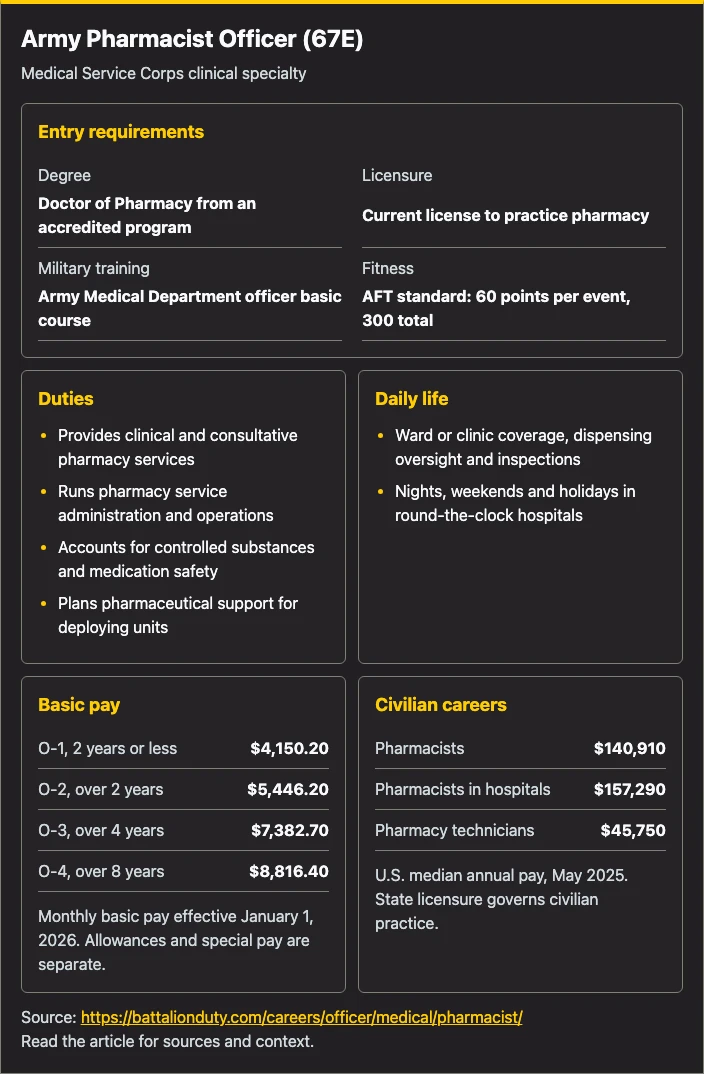
Entry requirements
- Degree
- Doctor of Pharmacy from an accredited program
- Licensure
- Current license to practice pharmacy
- Military training
- Army Medical Department officer basic course
- Fitness
- AFT standard: 60 points per event, 300 total
Duties
- Provides clinical and consultative pharmacy services
- Runs pharmacy service administration and operations
- Accounts for controlled substances and medication safety
- Plans pharmaceutical support for deploying units
Daily life
- Ward or clinic coverage, dispensing oversight and inspections
- Nights, weekends and holidays in round-the-clock hospitals
Basic pay
- O-1, 2 years or less
- $4,150.20
- O-2, over 2 years
- $5,446.20
- O-3, over 4 years
- $7,382.70
- O-4, over 8 years
- $8,816.40
Monthly basic pay effective January 1, 2026. Allowances and special pay are separate.
Civilian careers
- Pharmacists
- $140,910
- Pharmacists in hospitals
- $157,290
- Pharmacy technicians
- $45,750
U.S. median annual pay, May 2025. State licensure governs civilian practice.
Source: https://battalionduty.com/careers/officer/medical/pharmacist/
Read the article for sources and context.
On this page
Job Role and Responsibilities
Army 67E pharmacist officers plan, direct and evaluate pharmaceutical care in military organizations. They provide clinical and consultative pharmacy services, manage pharmacy operations and administration, and advise medical and command teams on medication use. The specialty requires a pharmacy degree from an accredited program and a current license to practice pharmacy.
The profession belongs to the Army Medical Service Corps. A pharmacist officer holds clinical authority from licensure and granted privileges, and holds military authority from appointment and assignment. The two are not the same thing, and the officer needs both.
What pharmacy practice involves beyond dispensing
The Army’s classification chapter describes the duties as planning, implementing, directing, executing and evaluating pharmaceutical care activities. That covers both table of distribution and table of organization units, in the continental United States and overseas. Clinical and consultative pharmacy and pharmacy management administration are named as the substance of the work.
In practice that means several distinct activities.
Clinical pharmacy. The officer reviews medication regimens, recommends therapy changes to prescribers, monitors for interactions and adverse effects, and participates in patient care decisions on a medical team. The clinical recommendation is advice to a licensed prescriber, and the pharmacist’s value lies in getting it right.
Consultative pharmacy. A pharmacist may be the medication expert a commander, a hospital or a headquarters turns to on drug policy, formulary questions, safety events or the pharmaceutical support plan for an operation.
Pharmacy service administration and operations. A pharmacy service needs staffing, inventory control, accountability for controlled substances, sterile and non-sterile compounding standards, automation, records and inspection readiness. An officer who runs a pharmacy section owns those systems.
Readiness. Deployable medical units need pharmaceutical resupply, storage and accountability in conditions a hospital pharmacy never faces. A pharmacist officer may be the officer who plans and validates that support.
Where a 67E officer is placed
Published positions include pharmacy consultant to the Office of The Surgeon General, chief of a pharmacy service, officer in charge of a pharmacy section, staff pharmacist, senior staff positions in medical research and development commands, positions at the Army Medical Department center and school, and staff roles in the Defense Health Agency and the Department of War. Broadening assignments in a security force assistance brigade are named in the career guidance as well.
The list names kinds of billets, not a career order. A new officer does not begin as a consultant, and the senior positions are competitive.
Pharmacist officer and pharmacy specialist are different jobs
The Army also trains an enlisted pharmacy specialist. That soldier works under supervision to prepare and dispense medications, manage stock and support the pharmacy’s daily operation. The officer is the licensed practitioner accountable for the clinical decisions, the standards and the service as a whole.
The distinction matters for applicants comparing routes. The enlisted pharmacy specialist is a pathway into pharmacy work without a doctorate. The 67E route requires the professional degree and the license before the officer can practice independently.
Salary and Benefits
2026 military officer basic pay
An Army pharmacist is paid according to appointed rank and years of creditable service. The appointment rules in force at the time set the entry grade and any credit for prior professional experience. The doctorate and the license do not, on their own, fix a rank or a constructive service credit amount.
| Rank | DFAS service bracket | 2026 monthly basic pay |
|---|---|---|
| O-1, Second Lieutenant | Two years or less | $4,150.20 |
| O-2, First Lieutenant | Over two years | $5,446.20 |
| O-3, Captain | Over four years | $7,382.70 |
| O-4, Major | Over eight years | $8,816.40 |
These examples come from the Defense Finance and Accounting Service (DFAS) 2026 commissioned officer pay table, effective January 1, 2026. A licensed pharmacist entering through a direct commission may be appointed above the entry grade shown here. The correct figure depends on the actual appointment and the service credit granted with it.
Scholarships, special pays and benefits
The Army Medical Recruiting Brigade medical services page states that practicing pharmacists may be eligible for a special pay bonus and that student loan repayment options exist for some medical specialties. Eligibility, amounts and current availability change between boards, so an applicant must confirm the terms rather than plan around a published headline.
Army ROTC and the Health Professions Scholarship Program also support pharmacy students. The cadet command regulation describes participants enrolled in an accredited Doctor of Pharmacy program at a school affiliated with a senior ROTC program. On completing the degree, they are reappointed as Medical Service Corps pharmacy officers. That route carries scholarship, training and service obligation conditions that belong to the program, not to the specialty.
Benefits for eligible officers include military healthcare, housing and subsistence allowances, paid leave and education programs. Retirement runs through the Blended Retirement System, which sets the framework for qualifying service and eligible Thrift Savings Plan contributions.
Pharmacy schedules can include clinic or ward coverage, dispensing oversight, meetings, inspections and administrative work. Hospitals that operate around the clock require night, weekend and holiday coverage. No fixed weekday schedule should be promised to a prospective 67E officer.
Qualifications and Eligibility
Degree, license and entry route
The Army requires a graduate of an accredited school of pharmacy acceptable to The Surgeon General, a current license to practice pharmacy in the United States, its territories or the District of Columbia, and completion of the Army Medical Department officer basic course.
| Requirement | Standard | Notes |
|---|---|---|
| Professional degree | Doctor of Pharmacy from an accredited program | The program must be acceptable to The Surgeon General |
| License | Current license to practice pharmacy | A United States, territorial or District of Columbia license |
| Military training | Army Medical Department officer basic course | Completed after appointment |
| Later military education | Captains Career Course for lieutenant colonel level positions, intermediate level education for colonel level | Required for the executive positions listed in the career guidance |
The license is not a formality. An applicant who has the degree but not the license does not meet the qualification standard. A license restricted in a way that prevents unrestricted practice is a problem to resolve with the recruiter before a board.
Commissioning tests, age and grade
A 67E applicant should work with a medical professional recruiter. The board considers academic records, licensure, professional references and an interview rather than the ordinary branch ranking process. The SIFT, the Selection Instrument for Flight Training, is an aviation test and has no role here. Enlisted ASVAB scores do not substitute for the doctorate and license.
Age, medical, citizenship and security rules vary by program, and approved exceptions can exist. No fixed age limit, grade point average floor or entry rank is claimed here. Read the current announcement and the written appointment terms before you commit.
Work Environment
A pharmacist officer may work in a military treatment facility pharmacy, a hospital clinical service, a research command, a staff section or a deployable medical unit. The setting changes the balance of the job more than the rank does. A hospital assignment may center on clinical services and operations, while a staff assignment may center on policy and plans.
The officer also leads people. A pharmacy service includes civilian pharmacists, enlisted pharmacy specialists and technicians, and the officer is accountable for their training, standards and performance. Leadership in a clinical service means defending professional standards while meeting the operational demands of a military hospital.
Some officers pursue residency training, research, teaching or senior health-system leadership as their careers develop.
Training and Skill Development
Pharmacy training continues well past the degree. The Army’s career guidance lists accredited residency programs as a significant opportunity, and those programs are where much of the clinical depth develops.
| Training or milestone | Setting | Duration | Purpose |
|---|---|---|---|
| Doctor of Pharmacy | Accredited civilian program, or an Army-supported route | Degree-specific | Professional foundation and licensure eligibility |
| Army Medical Department officer basic course | Army Medical Department center and school | Current class schedule required | Military leadership and medical support context |
| Postgraduate year one pharmacy residency | Accredited Army or civilian program | Typically one year | Clinical practice foundation |
| Postgraduate year two pharmacy residency | Accredited program in a specialized area | Typically one year | Advanced specialty practice |
| Pharmacy operations course and health care administration courses | Army Medical Department school | Course-specific | Pharmacy service leadership and management |
| Captains Career Course and intermediate level education | Army school system | Required at the corresponding grade | Senior leadership and staff qualification |
The published residency areas include pharmacy, health-system pharmacy administration, managed care pharmacy, oncology pharmacy, pharmacoeconomics and outcomes research, and pharmacy informatics, among other specialized practice areas. The programs are accredited by the American Society of Health-System Pharmacists. Selection is competitive and depends on Army requirements and board decisions.
Career Progression and Advancement
Clinical credibility and military leadership develop together, but they are measured separately. Selection for promotion rests on performance, military schooling and what the corps needs. Clinical standing depends on licensure, privileges and demonstrated practice.
| Officer grade | Typical stage | Possible role |
|---|---|---|
| O-1, Second Lieutenant | Initial appointment or scholarship status | Entry grade, with licensure and training requirements still in force |
| O-2, First Lieutenant | Early practice | Staff pharmacist in a treatment facility or medical unit |
| O-3, Captain | Qualified practitioner | Clinical pharmacist, pharmacy section officer in charge, residency or specialty practice |
| O-4, Major | Experienced practitioner and manager | Chief of a pharmacy service or senior clinical role |
| O-5, Lieutenant Colonel | Senior professional assignment | Service chief, medical command staff, consultant role |
| O-6, Colonel | Limited senior positions | Senior medical leadership and policy positions |
The table is a framework rather than a promotion schedule. Executive billets at lieutenant colonel require the Captains Career Course, and colonel-level billets require intermediate level education, according to the career guidance. The Army does not publish a guaranteed 67E promotion rate for an individual officer.
Physical Demands and Medical Evaluations
Pharmacist officers must meet applicable Army commissioning and continuing fitness standards. Scoring on the Army Fitness Test (AFT) is age and sex specific, and combat-enabling specialties require 60 points per event with 300 overall. The official AFT scoring standards publish these minimums for ages 17 through 21:
| Test event | Male 17-21 minimum | Female 17-21 minimum |
|---|---|---|
| Three-repetition maximum deadlift | 150 lb | 120 lb |
| Hand-release push-ups | 15 | 11 |
| Sprint-drag-carry | 2:28 or faster | 3:15 or faster |
| Plank | 1:30 or longer | 1:30 or longer |
| Two-mile run | 19:57 or faster | 22:55 or faster |
Older age groups have different standards. Military medical fitness and professional licensure are separate requirements, and both apply. The 67E specialty does not carry a routine aviation flight physical requirement.
Deployment and Duty Stations
Pharmacist officers serve in military treatment facilities, research commands, staff sections and deployable medical units. Assignment depends on available 67E positions, grade, qualifications and Army needs. A pharmacist in a residency program has limited location choice because the program exists only at specific sites.
Deployment is part of the specialty. A deployable medical unit needs pharmaceutical support planned and supervised by an officer who understands storage, accountability, controlled substances and resupply under field conditions. Not every pharmacist deploys on the same schedule, and no fixed deployment frequency is supported by the sources reviewed here.
Risk, Safety, and Legal Considerations
Pharmacy carries direct patient safety responsibility. Medication errors, incorrect dosing, look-alike products and unsafe storage can harm patients, and the officer is accountable for the systems that prevent them. Controlled substance accountability is a legal obligation with military as well as civilian consequences.
Clinical recommendations must stay inside the officer’s scope and the prescriber’s authority. A pharmacist advises and, where privileges allow, manages therapy, but the boundaries between recommendation and order follow policy and privilege documents rather than personal preference.
Impact on Family and Personal Life
Pharmacy education, licensure and any residency year can extend the runway before a first operational assignment. Later service can include changes of station, shift work, duty travel and deployment. Hospital pharmacies operate continuously, so night and weekend coverage is a realistic part of the schedule in many assignments.
Eligible families can use military healthcare, housing support and Army family services. Dual-military couples may request assignment coordination, subject to program locations and service needs that can narrow the options. A licensed civilian pharmacist considering a commission should plan for license portability and for any continuing education obligations that follow a move.
Reserve and National Guard
The Army Reserve and Army National Guard commission pharmacists when needs and vacancies permit. The requirement does not change. A Reserve or Guard pharmacy officer still needs the accredited degree and the current license. A civilian pharmacy career does not by itself produce a military commission.
| Topic | Active Army | Army Reserve | Army National Guard |
|---|---|---|---|
| Employment model | Full-time military service | Drills, training and possible mobilization | State and federal duties, drills and possible mobilization |
| O-3 pay comparison, over four years | $7,382.70 monthly basic pay | About $984.36 for four drill periods | About $984.36 for four drill periods |
| Clinical qualification | License and privileges for the assigned scope | License and privileges plus unit conditions | License and privileges plus state and unit conditions |
| Availability | Current 67E board required | Specialty recruitment when needs permit | Confirm the individual state vacancy |
| Retirement | Active service rules | Points-based non-regular retirement when eligible | Points-based non-regular retirement when eligible |
The four-drill figure uses the same DFAS monthly O-3 rate divided by 30 and multiplied by four. It isn’t a monthly Reserve salary. Mobilization, annual training and credentialing can demand more days than a standard drill weekend.
Post-Service Opportunities
Pharmacy is a licensed civilian profession. An officer who leaves service must satisfy the licensing rules of the state where they intend to practice, and hospital or clinical roles may add credentialing requirements of their own. Military pharmacy experience can be relevant to an employer, and it does not replace licensure.
| Civilian occupation | Median U.S. yearly wage, May 2025 | Projected growth, 2025-2035 |
|---|---|---|
| Pharmacists | $140,910 | 5% |
| Pharmacists in hospitals | $157,290 | Included in the category above |
| Pharmacy technicians | $45,750 | 6% |
The figures come from the Bureau of Labor Statistics pharmacist profile. These are civilian labor market figures rather than military compensation, and they are not an offer of salary. The technician row is included because readers often confuse the two roles. The gap between them shows what the professional degree is worth in the market.
Is This a Good Job for You? The Right (and Wrong) Fit
The 67E career suits a licensed pharmacist who wants clinical responsibility beyond retail dispensing, who is interested in leading a service, and who accepts military assignment and deployment as part of the job. It rewards people who are precise, comfortable with accountability for controlled substances and safety systems, and willing to keep studying through residency and continuing education.
It’s a poor fit for someone who wants a pharmacy career without the doctorate, for a reader who dislikes shift work or supervision, or for someone who expects a purely clinical role with no administrative ownership. A reader who cannot accept a posting cycle and an active duty obligation should treat this career as a poor match.
The honest comparison is between the specific route a reader qualifies for, the obligation attached to it, and whether running a pharmacy service as well as practicing pharmacy is the work they want.
More Information
Contact an Army healthcare professions recruiter for the current 67E board, direct commission terms, residency selection and any scholarship or loan repayment program. Ask what obligation the accession carries, which license the board accepts, what grade applies and whether a residency slot comes with it. Basic military terms are covered in the Army officer commissioning overview, which does not replace a professional recruiting notice.
The Medical Service Corps officer parent explains how 67E fits the Army health system. To compare a related clinical route, read the published Army clinical psychologist profile. Readers comparing officer and enlisted medical work should start with the enlisted pharmacy specialist.