Army Physician Assistant Officer (65D)
An Army physician assistant is a commissioned officer who treats patients and may be the senior medical provider on the ground. The role is distinct from both a physician and an enlisted medic.
That responsibility sets 65D apart. A PA runs care at the unit level and, when no physician is nearby, makes decisions about medical evacuation. The Army places considerable trust in that judgment.
This page explains how the Army PA route differs from becoming a physician and what the job involves. For the branch basics, see the Specialist Corps officer guide.
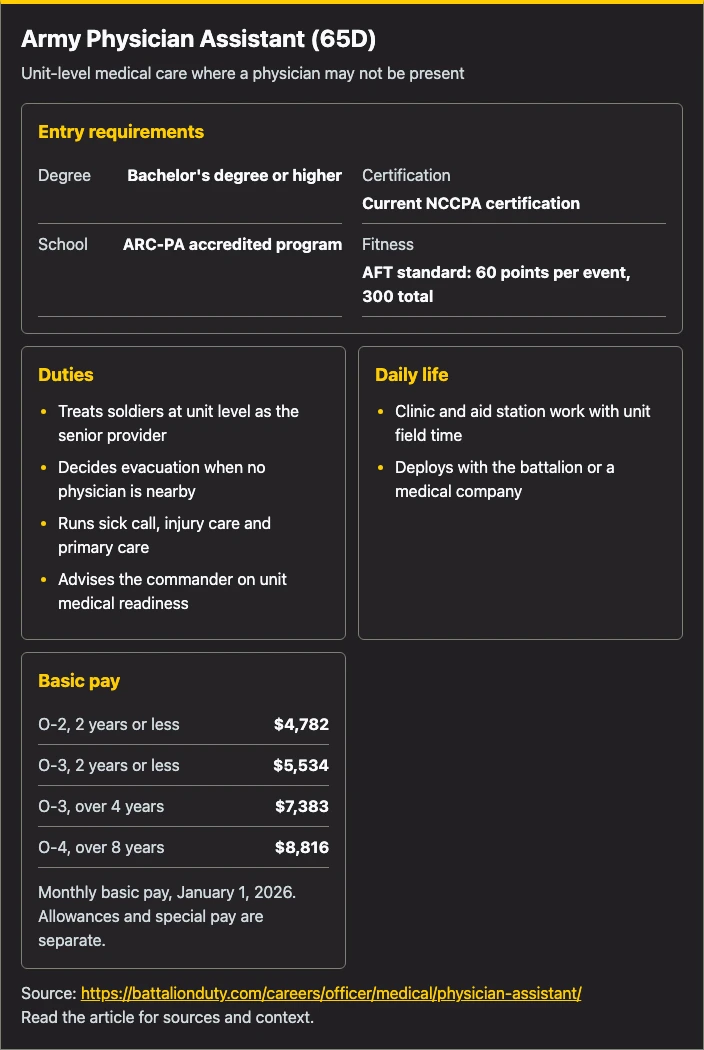
Entry requirements
- Degree
- Bachelor's degree or higher
- Certification
- Current NCCPA certification
- School
- ARC-PA accredited program
- Fitness
- AFT standard: 60 points per event, 300 total
Duties
- Treats soldiers at unit level as the senior provider
- Decides evacuation when no physician is nearby
- Runs sick call, injury care and primary care
- Advises the commander on unit medical readiness
Daily life
- Clinic and aid station work with unit field time
- Deploys with the battalion or a medical company
Basic pay
- O-2, 2 years or less
- $4,782
- O-3, 2 years or less
- $5,534
- O-3, over 4 years
- $7,383
- O-4, over 8 years
- $8,816
Monthly basic pay, January 1, 2026. Allowances and special pay are separate.
Source: https://battalionduty.com/careers/officer/medical/physician-assistant/
Read the article for sources and context.
On this page
Job Role and Responsibilities
A 65D plans and runs troop care at Levels I and II, forward of a hospital. Level I provides the first care a soldier can reach; Level II adds equipment and treatment capabilities.
Teaching and leadership are part of the job too. A PA trains enlisted medics and often leads a medical platoon, taking responsibility for the people, equipment and facilities that keep a troop clinic working.
A PA also serves as a special staff officer to a commander, advising on medical issues that affect unit readiness. That advice informs training plans, deployments and readiness reports.
The clinical work spans many types of patients. Within their scope, Army PAs prescribe and select medications, review and document primary care records, order X-rays and laboratory tests, and refer patients to specialty clinics.
One of the heaviest responsibilities is deciding whether a patient needs evacuation. When no physician is present, the PA advises on the need, priority and means of moving the patient while providing initial emergency care and stabilization.
The scope grows with rank. A senior PA serves as medical staff officer at levels from battalion to the Pentagon, advising the surgeon and the commander. Some teach at the Army medical school. Others review exams for the personnel reliability program.
Salary and Benefits
PA officers receive base pay according to rank and years of service. The Specialist Corps guide covers that pay table and the benefits shared across the branch.
Two compensation questions deserve particular attention for 65D: the medical and professional pay available for the assignment, and any accession bonus offered for that program year. Bonus amounts depend on shortage designations rather than a permanent figure in the branch rule.
Bonus amounts change, so a figure quoted elsewhere, even a year ago, may no longer apply. Confirm the current offer with a recruiter. This page gives no amount because its source does not specify one.
Qualifications and Eligibility
The 65D bar is set in the Army’s officer branch chapter. Four rules apply to every PA officer.
| Rule | Standard |
|---|---|
| Degree | A bachelor’s or a higher degree |
| Cert | Current cert from the National Commission on Certification of Physician Assistants |
| School | A program cleared by ARC-PA, or its forerunner |
| Rule | Meet AR 135-100 and AR 135-101 |
Read those requirements together. The degree rule does not specify a major, but applicants must also hold current NCCPA certification and meet the school accreditation requirement. A degree alone does not establish eligibility.
The Army branch chapter lists restrictions involving court-martial records, specified civil offenses under AR 27-10 and sex-offender registration. Disclose relevant history to the responsible recruiting staff for a formal eligibility determination; this page cannot decide an individual case.
Older descriptions of entry routes may not match the current program, so confirm the route that applies to you with a recruiter before building a plan around it. Meeting the requirements does not promise a slot.
Work Environment
The job divides between garrison and field duty. In garrison, a PA runs a troop clinic, handling sick call, occupational health, minor procedures and the documentation that supports unit readiness.
In the field, a PA may work from a small treatment bay with limited equipment and fewer personnel to help. Decisions can come faster and carry greater consequences when the nearest surgeon is hours away.
The case mix follows the setting. A PA treats a wide range of primary care needs in a young, fit population, from joint problems, chest infections and skin rashes to the stress and mood issues that surface in a tight unit.
Some posts are niche. A PA can serve with a Ranger or Special Forces unit, where the bar for both medicine and fitness climbs. Others work at the White House clinic, at the Army environmental medicine lab, or in a research cell.
The officer also spends time away from patients. Reports, readiness data, training plans and checks all belong to the job. A PA who wants only clinic work will find the desk load grows with rank.
Training and Skill Development
For the qualified-clinician accession route, a candidate completes an accredited PA program and holds NCCPA certification before being considered for 65D. The Army’s training route has separate admissions requirements.
The Army also participates in the Interservice Physician Assistant Program, which provides a training route for eligible service members. Its admissions process is distinct from accession as an already qualified civilian PA; check the current program instructions before planning around it.
Further training follows commissioning. A PA may attend military or civilian courses and work under a physician’s supervision in a chosen field, building clinical depth beyond primary care.
Teaching assignments include positions in the 68W medic course, the PA program and the Army medical training center. Senior PAs may also serve as course chiefs for special operations medical training.
Professional development depends on clinical practice, military schooling and teaching. Officers who advance typically contribute to training others while continuing their own education, rather than limiting their careers to treatment alone.
Career Progression and Advancement
Promotion runs on the normal officer clock. What differs is the spread of jobs open at each grade.
Early in a career, a PA may lead a platoon or run a clinic. The practical test is whether patients receive good care and the unit remains medically ready.
Midcareer assignments broaden into personnel and policy work. The rule lists positions such as PA career manager at HRC, program manager at Recruiting Command, and staff roles at Forces Command and the combat doctrine organization.
Senior assignments include corps or division senior PA, clinical operations officer at Medical Command or the Surgeon General’s office, and chief of the PA branch. Other positions involve directing residencies in emergency medicine, orthopedics or surgery, or leading the PA program itself.
A 65D can reach senior positions in the corps without becoming a physician. Moving into the Medical Corps, however, requires meeting that separate branch’s degree and accession requirements.
Physical Demands and Medical Evaluations
The fitness bar for 65D is the same as the other Specialist Corps parts. It is not eased because the work is clinical.
| Item | Standard |
|---|---|
| Eyes and hands | Fixable sight, hand skill, normal color sense per AR 40-501 |
| Profile | 222222 |
| Demands rating | Moderate (Gold) |
| OPAT long jump | 120 cm or more |
| OPAT power throw | 350 cm or more |
| OPAT deadlift | 120 lb or more |
| OPAT shuttle run | 36 shuttles or more |
These are Moderate-category Occupational Physical Assessment Test accession standards, distinct from the Army Fitness Test used during service. The officer physical-requirements table lists this specialty in the Moderate category. Confirm the current accession requirements with the responsible recruiter.
The Moderate tag fits a job that mixes clinic work with field duty. A PA in a brigade medical platoon hauls gear and moves with the unit. The fitness bar is not for show.
Medical examinations take place on entry and at required points throughout a career, with health conditions assessed against AR 40-501. Officers must also maintain the professional license and certification required for their clinical duties.
Deployment and Duty Stations
Deployment is part of the job, not a break from it. A PA is posted to units that deploy, and the role is built for that.
During deployment, a PA may be the senior clinician providing Level I or II care to a forward unit. Evaluating whether patients need evacuation becomes part of that operational responsibility.
Assignments span Army hospitals and field units, so a PA may move from a hospital tour to a brigade and gain experience in both settings.
The rule lists no live post list, and this page does not guess at one. Where you land depends on what the Army needs when the orders are cut.
Risk, Safety, and Legal Considerations
Prescribing medication, ordering tests and recommending evacuation all carry clinical risk. In the field, a PA may have less immediate support when a decision goes wrong.
Professional credentials carry legal responsibilities too. A PA must keep the required state license and national certification current; a lapse can affect both clinical practice and eligibility to serve.
Supervision requirements also define the role. The rule places some duties in selected fields under a physician’s supervision, so independent practice should never be assumed.
Accession restrictions also apply to Specialist Corps officers. A recruiting eligibility review is separate from clinical licensure and professional-board requirements, so applicants must address both.
Personnel reliability examinations carry particular responsibility. A PA’s medical review contributes to decisions about access to certain weapons and materials, making that sign-off part of a broader safety process.
Impact on Family and Personal Life
Families may find on-base clinic hours predictable, but field duty and deployments are less so. PAs assigned to brigades should plan for both.
Deployment frequency and duration depend on the unit. A PA in a brigade medical platoon follows the brigade’s operational schedule, which can differ substantially from a hospital assignment.
Clinical responsibility can also extend beyond scheduled appointments. Coverage arrangements matter, especially when a PA is the only provider in a small clinic.
The professional skills also carry into civilian employment, giving families another option when weighing a long Army career. Officers should check the licensing and employer requirements where they plan to settle.
Reserve and National Guard
The Specialist Corps exists in the reserve parts as well as on full-time duty. A PA can serve part time and keep a civil clinic job.
Reserve service uses the same professional credential in a different patient and operational setting. A reserve PA may spend drill periods on readiness work and annual training with a field medical unit; the schedule and duties depend on the assignment.
Reserve 65D officers must still meet the degree, current NCCPA certification and accredited-program requirements. Reserve service does not lower those professional standards.
Exact slots by state and unit are not something this page can state. They shift all the time. A reserve recruiter or unit contact is the right place to ask.
Post-Service Opportunities
Physician assistant practice has a direct civilian counterpart. An Army PA can bring clinical experience, national certification and a state license into that transition, while meeting the destination’s applicable practice requirements.
Hiring spans hospitals, urgent care, ortho and surgical groups, and work health. Some PAs move into emergency care. Others go into management, where the Army staff time helps.
Federal service is a common road. A vet PA can stay in a government clinic role with credit for service time. Some come back as civilians in training or policy posts.
Experience running a clinic, briefing commanders and leading a platoon can support a move into director or management roles. It adds operational and leadership experience to the PA’s clinical background.
Is This a Good Job for You? The Right (and Wrong) Fit
This job suits someone who wants real clinical scope without a decade of medical school. A PA treats on their own, makes calls, and holds trust from the first posting. If the draw of medicine is the puzzle and the patient, and the draw of the Army is leading, this role joins both.
The role suits someone comfortable being the senior medical voice among non-medical officers. Some find that responsibility isolating, while others see it as the reason they joined.
It does not suit someone who wants to be a doctor. The path does not lead there. A PA who spends a career waiting to cross into the Medical Corps will be let down, because the branches are split and the degree rule is not the same.
It also does not suit someone who wants only clinic work. The desk and staff load grows with rank. Reports, readiness data and command advice take time that once went to patients.
The role also requires continuing attention to professional credentials. A license and certification are ongoing requirements, not qualifications earned once and forgotten.
More Information
The Specialist Corps officer guide covers branch shape, entry paths and the current pay table. The other three parts have their own pages: physical therapist, occupational therapist and dietitian.
For the doctor side, read the Medical Corps officer guide. For the enlisted side, the medical officer versus enlisted medic piece marks the line. The medical officer hub lists all four corps. To weigh officer branches in the round, start with Army officer careers; the how to become an officer guide covers entry paths.
Rules and bonus plans change. Check current terms, program year and open slots with a recruiter before you act on any of this. The standards here come from the Army officer branch chapter, paragraph 3-65, checked in October 2026.