Army Psychiatric Nurse Practitioner Officer (66R)
Main job: Army Nurse Corps Officer.
An Army psychiatric nurse practitioner (NP) in job specialty 66R cares for people with mental health problems. The nurse may check a Soldier’s mental health, talk with a returning patient about medicine, or help the care team respond when someone needs help right away.
The nurse also serves as an Army officer, with military training and leadership duties. Depending on the nurse’s training and job, the work may take place in a clinic, a hospital unit or a team that supports military missions.
To become a psychiatric NP, a registered nurse (RN) needs more nursing study after a bachelor’s degree, with training in mental health care. The nurse must also earn national certification, which shows that the nurse has met the field’s training and testing rules. The Army has its own rules for joining as an officer.
Psychiatric RNs, psychologists and psychiatrists each follow a different training path. If you are choosing a school or an Army job, check which of these roles it prepares you for.
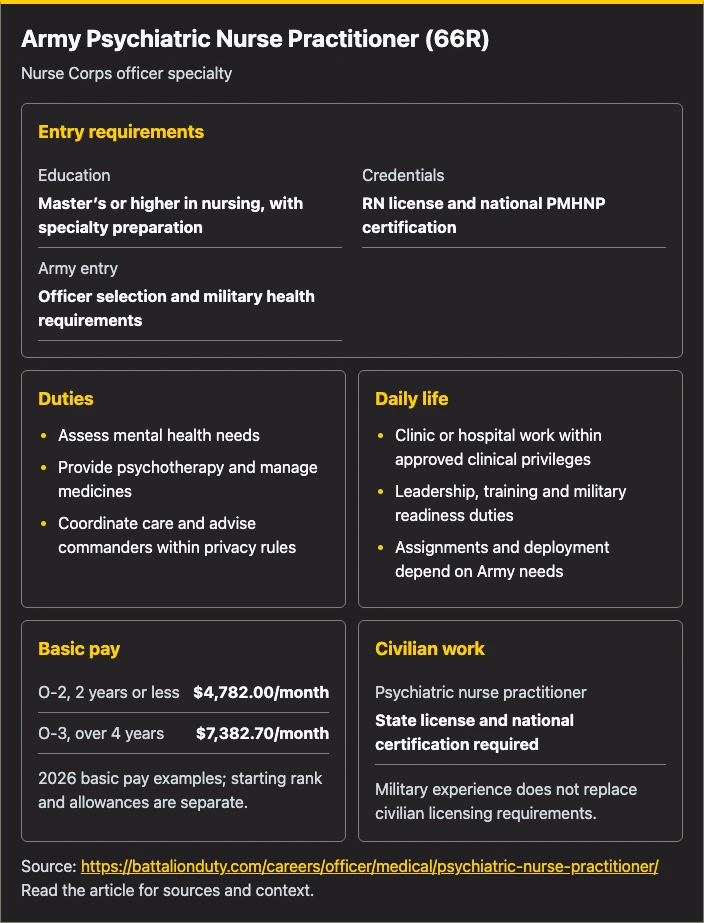
Entry requirements
- Education
- Master’s or higher in nursing, with specialty preparation
- Credentials
- RN license and national PMHNP certification
- Army entry
- Officer selection and military health requirements
Duties
- Assess mental health needs
- Provide psychotherapy and manage medicines
- Coordinate care and advise commanders within privacy rules
Daily life
- Clinic or hospital work within approved clinical privileges
- Leadership, training and military readiness duties
- Assignments and deployment depend on Army needs
Basic pay
- O-2, 2 years or less
- $4,782.00/month
- O-3, over 4 years
- $7,382.70/month
2026 basic pay examples; starting rank and allowances are separate.
Civilian work
- Psychiatric nurse practitioner
- State license and national certification required
Military experience does not replace civilian licensing requirements.
Source: https://battalionduty.com/careers/officer/medical/psychiatric-nurse-practitioner/
Read the article for sources and context.
On this page
Job Role and Responsibilities
An Army psychiatric/behavioral health nurse practitioner (66R) is a Nurse Corps officer trained to check mental health needs and plan treatment. This training comes after a bachelor’s degree in nursing. The officer works with other health workers to care for service members and families who qualify for that care.
Each clinic or hospital decides which kinds of care an officer may provide there. That permission is called clinical privileges. Officers with the right training may also lead clinics, teach or help with mental health programs during military missions.
The Army’s current 66R job guide lists these patient-care duties:
- Ask about the patient’s full health history, including past health problems, and give physical exams.
- Check the patient’s health and care needs.
- Provide psychotherapy, or talk therapy.
- Manage the patient’s medicines.
- Make referrals, which are requests for another health worker to see a patient.
- Give commanders advice.
These duties often fit into the same care plan. When a patient describes symptoms, the NP may need to check for other health problems, compare the treatments the nurse is allowed to give, and plan later care with the patient and the team.
Making care decisions with the team
Psychiatric NPs may check for mental health problems and risks, provide counseling or talk therapy, and change treatment within their clinical privileges. The Army’s Nurse Corps career chapter also describes care for health problems linked to alcohol or other drugs and for emotional illnesses.
The work includes checking what help a patient needs during a crisis, teaching patients about their health and helping them protect their mental health. The officer must know when a patient needs another health worker, care where staff can watch the patient more closely, or help right away.
A later visit may cover how the patient is managing daily life and what has changed since the last care plan. The NP also checks for treatment side effects and any new concerns. The patient, NP and other staff use that information to plan what comes next.
Clear records, shared safely with the right staff, help care continue when a Soldier moves to another unit or sees more than one health worker. The time between visits, the length of each visit and the treatment used depend on the patient and the clinic or hospital’s rules.
Military leadership is also part of the work. A 66R officer may guide psychiatric nurses, check the quality of care, help plan the clinic’s patient care or give a unit advice about mental health needs while following the privacy rules.
How 66R differs from other Army mental health professionals
The full professional title is psychiatric mental health nurse practitioner (PMHNP). The jobs below require different study and give people different roles in patient care.
| Officer role | Army code and corps | How the role differs |
|---|---|---|
| Psychiatric/behavioral health nurse practitioner | 66R, Nurse Corps | Nursing study after a bachelor’s degree and national PMHNP certification; provides mental health care at the NP level |
| Psychiatric/behavioral health nurse | 66C, Nurse Corps | RN study and training in mental health nursing; this training does not qualify the nurse as an NP |
| Clinical psychologist | 73B, Medical Service Corps | A doctoral degree in psychology, plus the field’s rules for treating patients |
| Psychiatrist | 60W, Medical Corps | A medical degree and a psychiatry residency, when doctors train in mental health care under other doctors’ guidance |
| Family nurse practitioner | 66P, Nurse Corps | Nursing study after a bachelor’s degree, focused on primary care for routine and ongoing health needs; a different NP field |
A psychiatric RN may care for mental health needs, teach patients, help during a crisis and arrange care with other staff. The 66C code does not give that nurse the further training needed for 66R.
Psychologists and psychiatrists also follow the rules for their own fields. When comparing schools or job listings, check which profession the broad label behavioral health officer means.
Salary and Benefits
Army basic pay depends on the officer’s grade, or rank, and the years of service the Army counts for pay. Each specialty has a code called an Area of Concentration (AOC), but that code does not have its own basic-pay rates. Some officers may receive special pay or extra money through a recruiting program; the examples below show basic pay from the 2026 Defense Finance and Accounting Service (DFAS) officer pay table.
| Grade | Years of service counted for this pay rate | 2026 monthly basic pay |
|---|---|---|
| O-1, Second Lieutenant | Two years or less | $4,150.20 |
| O-2, First Lieutenant | Two years or less | $4,782.00 |
| O-3, Captain | Over four years | $7,382.70 |
| O-4, Major | Over eight years | $8,816.40 |
These figures show how rank and service affect pay. They do not promise a starting rank or a date when an officer will move up.
The Army has approved 66R jobs at ranks O-2 through O-6. Those are the ranks attached to the jobs; the Army decides a new officer’s starting rank separately. It follows rules for bringing officers into service and for service credit, which is time the Army agrees to count.
Some officers who served before as enlisted Soldiers or warrant officers may receive different rates if enough of that service counts. Extra payments for housing and food may also add to basic pay under their own rules.
Benefits for officers on active duty, or full-time service, may include TRICARE, the military health program, as well as time off, help with education and retirement benefits. Officers who meet the rules of the Blended Retirement System use the Thrift Savings Plan, a retirement savings account. They may also earn military retirement pay based on their service.
Use the rank in the written offer when comparing Army pay with a civilian job. Check which extra payments and benefits you would receive, where you would serve and what your family needs. An advertised salary based on a different rank or benefit package does not tell you what your own offer is worth.
A medical recruiting program may offer extra money for this specialty, but not every psychiatric NP receives a bonus. The Army medical funding overview describes programs with different rules. Before signing, ask for the written offer for the actual 66R job and check:
- Whether it is active or Reserve service.
- How long you must serve.
- When you would have to pay any money back.
Qualifications and Eligibility
A PMHNP needs the required nursing education and licenses, as well as the Army’s approval to become an officer. The Army’s November 2025 66R job guide requires:
- Nursing education accepted by the Department of the Army.
- A current, valid, unrestricted state nursing license. A license is the state’s permission to work as a nurse. Unrestricted means the state nursing board, which oversees nurses, has placed no special limits on it.
- A master’s or higher nursing degree that includes psychiatric NP training. This is graduate study, meaning study after a bachelor’s degree. The master’s or doctoral program must be accredited, meaning it meets accepted education standards.
- National PMHNP certification that covers patients of all ages. It shows that the nurse has met the field’s training and testing standards.
The Army’s rule allows one year after graduation from the required graduate program to earn national PMHNP certification. It normally also requires one year of work as an RN. Some nurses can skip that work requirement if they move straight from one degree program into the next without a break:
- A Bachelor of Science in Nursing (BSN) followed at once by a Master of Science in Nursing (MSN) or Doctor of Nursing Practice (DNP).
- An MSN followed at once by a DNP.
The exception depends on the exact study path. Nurses still need the required psychiatric NP study, licenses and certification.
The 2022 Nurse Corps career chapter describes the certification deadline differently and ties it to when the nurse joins the Army. The 2025 AOC rule is newer. Ask how the Army will apply that rule to your graduation date and to the selection board, the group that will review your application.
Choosing how to enter 66R
Your path depends on your training and whether you already serve. Some paths require both an RN license and an advanced practice registered nurse (APRN) license, which covers nursing work beyond the RN level. Schools may also require a certain grade point average (GPA), the average of your school grades.
| Way to join or study | Minimum grade point average (GPA) | Degree needed | Age limit | Health and fitness rules | What 66R also requires |
|---|---|---|---|---|---|
| Civilian PMHNP applying to become an officer | Set by the current selection board; not given in the AOC chart | Psychiatric NP study after a bachelor’s degree | Set by the current selection board | Army health review and the fitness rules for that way of joining | RN license, any required APRN license, national PMHNP certification and the required time working as an RN |
| Serving 66C psychiatric RN changing to 66R | Set by the Army and graduate school | An approved psychiatric NP master’s or doctoral program | The Army rule for that path | Military fitness rules and the rules for earning the AOC | Army permission to change specialty, the required NP degree, licenses and certification, and an open job that fits |
| Serving 66P seeking 66R | Set by the graduate school and Army | Further psychiatric NP training | The Army rule for that path | Military health and fitness rules | PMHNP certification and Army approval for 66R |
| College nursing through the Reserve Officers’ Training Corps (ROTC), then 66R study | ROTC rules; there is no single 66R score for all applicants | A BSN and RN license first; a psychiatric NP graduate degree later | The ROTC rule | ROTC and Army health and fitness rules | Later selection for graduate study and certification in the specialty |
Professional nurses and applicants to Officer Candidate School (OCS) follow different rules to become officers. If you are a civilian PMHNP, speak with an Army Medical Department (AMEDD) recruiter about joining directly as a nurse officer. Do not assume you need the Armed Services Vocational Aptitude Battery (ASVAB), an enlistment test, or a score used to rank OCS applicants.
The Graduate Record Examination (GRE) is a test some graduate schools use. The 66R guide does not set one GRE score, school grade average, age limit or selection board score for every part of the Army and every school program. Follow the written rules for your own path.
The steps in the application
If you are a certified civilian PMHNP, the main steps are:
- Find an open 66R job. Check whether it is in the active Army, Army Reserve or Army National Guard.
- Gather your records. Bring your school records and proof of nursing training, licenses and certification. Ask for the latest written rules from the selection board.
- Complete the Army’s review. The Army checks whether you can become an officer, your starting rank, service credit, health and fitness. It also reviews the military training you need and how long you must serve.
- Get permission to treat patients. The clinic or hospital must check your training and licenses and grant clinical privileges before you provide care in the job.
If you have not yet trained as a psychiatric NP, first plan the graduate study you need. A serving Nurse Corps officer may apply for Army-funded study if the program’s rules allow it, but officers must compete for those places. An officer who earns an accepted degree another way can ask the Army to change the recorded specialty through its nursing review process.
A mental health course for RNs does not replace the PMHNP graduate degree and national certification. Army Nurse Corps education guidance lists doctoral psychiatric nursing study for officers the Army selects. It does not promise a place to every nurse.
If you are a 66C nurse, weigh the extra study against the kind of care you want to provide. Enjoying Army nursing does not by itself tell you whether you want the NP’s treatment duties. Decide whether that change in your work is worth the time in school before choosing how to pay for it.
Work Environment
Army psychiatric NPs can work in several kinds of care:
- Outpatient clinics: Patients come for visits, medicine checks, counseling and referrals without staying in a hospital.
- Embedded behavioral health clinics: A clinic serves one military unit and plans care around that unit’s schedule and needs.
- Intensive outpatient programs: Patients come for a set program of treatment sessions while they keep living elsewhere.
- Residential programs: Patients have a place to stay during treatment.
- Inpatient care: Patients have been admitted to a hospital.
The 2022 Army Nurse Corps career chapter lists these kinds of work for 66R officers. It also describes work that connects care teams and combat and operational stress-control work, which helps service members with mental health during military missions.
The list does not mean each NP will work in every setting. One officer may spend years in a clinic, while another treats patients and leads a program.
Patients who receive counseling, medicine and other care may see several health workers. The NP needs to know the agreed plan, what the team must check later and who will keep care going if the patient moves or the unit’s schedule changes.
Clear medical records and safe ways to send referrals help staff pass care from one team to another. Staff must write down the plan and follow the rules for sharing patient information, even when the teams work at different clinics or hospitals.
A patient who needs help right away can change the clinic’s plans for the day. The NP may need to judge a risk, arrange care where staff can watch the patient more closely, or work with other staff under the clinic or hospital’s rules.
The officer must protect private patient information while giving commanders any information they are allowed to receive about a Soldier’s ability to do military duties. The privacy section below explains those limits.
Training and Skill Development
Training to become a 66R practitioner and training to become an Army officer prepare nurses for different work:
- Graduate PMHNP study teaches nurses how to check mental health problems, provide therapy and manage medicines at the NP level.
- Army officer schools teach leadership and prepare officers for military duties.
The nursing degree cannot replace a required Army course, and serving in the Army does not by itself make someone a psychiatric NP.
The Army Medical Department’s Basic Officer Leader Course (BOLC) is part of officer training. The course and schedule depend on how the nurse joins, as shown below.
| Stage | Where the training takes place | How long it takes | What it does |
|---|---|---|---|
| RN and graduate PMHNP study | An approved nursing school with graduate training in psychiatric patient care | Depends on the degree already held and the program | Meets the nursing education rules and the Army’s education rules for the AOC |
| National psychiatric NP certification | An accepted national certification program | The Army allows one year after graduation from the required graduate program | Gives proof that the nurse meets the psychiatric NP certification rules |
| Direct Commission Course, when ordered | An Army officer course chosen for the nurse | Depends on how the nurse joins | Teaches new officers their basic military duties |
| AMEDD BOLC, active Army | Fort Sam Houston, Joint Base San Antonio | Army public guidance: 10 to 14 weeks | Teaches Army leadership, work in medical units and work in the field |
| AMEDD BOLC, Army Reserve | A program chosen by the Army | Army public guidance: two weeks | Completes the first officer training required for that way of joining |
| Training for the job and clinical privileges | The assigned military clinic, hospital or medical unit | Depends on the job and the check of the officer’s training and licenses | Approves which care the officer may give and teaches the rules at that workplace |
The Army AMEDD training FAQ gives these BOLC lengths. The officer’s written orders and earlier military service decide which courses the officer must take and in what order.
The Nurse Corps’ Long-Term Health Education and Training (LTHET) program can help pay for graduate study when officers meet its rules. The 2022 career chapter also describes further education and training for Reserve officers. Getting a place at a school, receiving funding, earning the Army specialty code, gaining certification and getting the next Army job each have their own rules.
After graduation, the officer must complete the required ongoing education and renew licenses and certification under the rules for that work.
Later Army study may include the AMEDD Captain’s Career Course, Intermediate Level Education or senior courses for selected leaders. These courses prepare officers to lead more people and help plan and run Army work.
Career Progression and Advancement
A 66R officer may keep treating patients or move toward running care programs, teaching or supporting mental health during military missions. The Army’s job descriptions show what work may be available, but they do not promise that each new NP will follow the same steps to become a department chief. What comes next depends on the officer’s work with patients, how well the officer does the job, military schooling and which jobs are open.
| Officer grade | How starting rank or promotion works | Possible 66R care or leadership work |
|---|---|---|
| O-1, Second Lieutenant | The current 66R AOC chart lists no O-1 jobs; the Army decides starting rank separately | A nurse officer may still be studying to become an NP |
| O-2, First Lieutenant | The Army allows 66R jobs at this rank; when an officer reaches it depends on how the officer joins and on service | Mental health care within the officer’s clinical privileges |
| O-3, Captain | The Army allows 66R jobs at this rank; there is no fixed promotion schedule just for 66R | Patient care and advice to the team; may guide other staff as they care for patients |
| O-4, Major | The Army allows 66R jobs at this rank; the Army board chooses officers under its promotion rules | Work as a senior NP or a leader of a mental health clinic |
| O-5, Lieutenant Colonel | The Army allows 66R jobs at this rank; officers compete for selection | Leading a department, teaching or running mental health programs during military missions |
| O-6, Colonel | The Army allows 66R jobs at this rank; reaching it is not promised | Leading Army mental health and nursing work in the job assigned |
The 2025 Army job guide lists these possible jobs:
- Chief of an adult behavioral health clinic.
- Chief of a child and teen behavioral health clinic.
- Chief of a behavioral health department.
- Instructor.
- Deployment behavioral health program chief, who leads a mental health program for troops sent on a mission.
The older Nurse Corps guide gives more detail about embedded clinics, hospital mental health care and leadership of intensive outpatient or residential programs. The guides show the range of work. They do not say what share of 66R officers will reach O-4 or give a fixed set of steps to lead an Army unit.
Base a career decision on the job being offered now. The chart shows possible later work, but it cannot tell you when a higher rank or a clinic leadership job will come.
An officer who wants to keep treating patients can keep records of how they checked patients’ needs, planned later care, kept learning and worked with other health workers. An officer who wants to lead a program should also show how they taught staff, kept care running safely and managed the staff and supplies the clinic needed. Those records show more about the officer’s work than the number of patient visits or a job title alone.
Physical Demands and Medical Evaluations
The November 2025 Army job guide puts 66R in the Moderate (Gold) physical-demand group when the Army first awards the specialty. This group sets the strength and fitness needed for the job. The guide also lists health requirements, including vision and the ability to use the hands with care and control.
The Occupational Physical Assessment Test (OPAT) measures physical skills needed for Army work. The table gives the Gold results needed to pass.
The 66R guide appears to use centimeters where it meant pounds for the deadlift. The Army Moderate/Gold standard gives 120 pounds. In the table, cm means centimeters and lb means pounds.
| OPAT event | Result needed for Moderate/Gold |
|---|---|
| Standing long jump | 120 cm |
| Seated power throw | 350 cm |
| Strength deadlift | 120 lb |
| Interval aerobic run | 36 shuttles, or runs back and forth |
OPAT is separate from the Army Fitness Test (AFT), which Soldiers take while serving. The AFT has five events. The general passing rule is at least 60 points in each event and 300 points in all.
The Army scores the test using tables for different ages and sexes. These examples show what earns 60 points for ages 17 to 21. If you are older, use the rows for your own age group.
| AFT event | Male 60-point mark, ages 17-21 | Female 60-point mark, ages 17-21 |
|---|---|---|
| Three-repetition maximum deadlift | 150 lb | 120 lb |
| Hand-release push-ups, two minutes | 15 | 11 |
| Sprint-drag-carry | 2:28 or faster | 3:15 or faster |
| Plank | 1:30 or longer | 1:30 or longer |
| Two-mile run | 19:57 or faster | 22:55 or faster |
These figures come from the Army AFT scoring chart and the Army’s AFT guidance.
Army Directive 2026-07 brought in a separate Combat Field Test (CFT) for certain combat jobs in April 2026. The 66R specialty is not on that combat list. The Army staff in charge of health or fitness must review medical limits on duty, requests for exceptions and any tests required for a certain job.
The job also calls for calm, careful decisions when a patient needs urgent help or a situation is upsetting. Consider how you feel about that part of care alongside the Army’s fitness and health rules.
Deployment and Duty Stations
A 66R officer may work in a military clinic or hospital, a clinic that supports a military unit, or a mental health job during field missions. The Army must have an approved job for that work.
The older Nurse Corps career guide describes combat and operational stress-control units and work giving advice to other teams. The 2025 AOC guide also lists a senior role leading mental health care for deployed troops.
During a military mission, the NP may check patients’ needs, make referrals, teach and keep care going as service members move. There may be fewer nearby specialists than at a large hospital on an Army base, so care teams may have more work to do together when they plan care.
In the field, the NP must stay within their license and clinical privileges and know when and how to seek more help.
The Army places officers where it needs them, based on rank, training and the approved jobs. Deployment schedules, tour lengths and duty stations depend on the assignment. Ask the person who arranges job assignments which 66R jobs are open in the part of the Army you plan to join and what patient care each job involves.
Risk, Safety, and Legal Considerations
Psychiatric care sometimes calls for quick decisions. An NP might notice a new safety risk or a change in a patient’s health, arrange for another worker to take over care quickly, or seek care where staff can watch the patient more closely. Safe use of medicine, clear records, advice from other health workers and the rules for treating patients still apply in Army service.
A commander does not have unlimited access to patients’ mental health information. The Department of War’s mental health command-notification rule, DoDI 6490.08, limits what staff may share when a service member chooses to seek mental health care:
- The rule names cases when staff may or must tell commanders, including certain serious safety risks.
- Being a Soldier alone is not enough reason to tell commanders that a person sought care.
- Staff may share only information the commanders have a proper need to know.
A 66R officer may give commanders advice and discuss a Soldier’s ability to do military duties within those rules. This does not mean commanders may receive the whole health record or that every discussion must be reported.
An NP should explain these limits plainly when discussing privacy with a patient. Promising that nothing will ever reach commanders would promise more than the rule allows.
When handling a patient’s case, the NP must follow the current Defense Department rule, the clinic or hospital’s policy and the rules for the nursing profession. This career guide cannot say whether staff would report a particular patient’s case.
The care an officer may give depends on clinical privileges, nursing licenses, certification and workplace rules. These limits cover prescribing, which means ordering medicine for a patient, as well as talk therapy, crisis checks and hospital work. A higher rank does not by itself give more freedom to treat patients.
Officers who lead staff must also check their work, keep enough staff available for safe care, protect records and follow the rules for professional behavior under military law.
Impact on Family and Personal Life
A psychiatric NP’s schedule may be different from one in routine primary care. Patients need to return for care, but someone who needs help right away or a talk with another care team may interrupt the clinic day. Some jobs focus on outpatient visits, while others include hospital care, more closely planned treatment programs, military missions or leadership.
The job title alone cannot tell a family what the schedule will be. Ask about:
- The unit’s working hours.
- Who covers care outside those hours.
- Whether staff must be ready to answer calls when away from work.
A move affects patients as well as the officer’s family. The NP must arrange for other staff to take over patients’ care while a spouse and children prepare to move.
An RN changing to 66R may also need to move for graduate school. If the Army pays for school, the officer may have to serve longer in return. Consider how those plans fit your family before accepting an Army-funded place.
Finding work for a spouse, arranging childcare and planning around two military careers can make a move harder. Army family programs offer help, but they cannot promise that both people in a military couple will get jobs at the same base. A spouse who needs a license for work may also have to meet the new state’s rules.
Service members who meet the rules can ask the Army to plan their assignments together. Where they go still depends on the Army’s needs and jobs that fit their training.
Reserve and National Guard
A civilian psychiatric NP may want to keep caring for patients in a private practice or hospital while serving in the Army Reserve or Army National Guard. These two parts of the Army are called the Reserve Components.
The Nurse Corps has officers in both active service and the Reserve Components. This does not mean a certain Reserve unit or Guard state has an open 66R job. Before applying, check:
- That the psychiatric NP job is open.
- Which clinical privileges it requires.
- How much time the unit expects members to spend on training or calls to duty.
The table compares full-time Army service with Reserve and Guard service. Drills are paid training periods. Reserve and Guard retirement also uses points to count service toward retirement.
| Issue | Active Army | Army Reserve | Army National Guard |
|---|---|---|---|
| Usual service | Full-time Army duty | Usually part time when not under duty orders; longer periods of service are possible | Service under state or U.S. government orders; usually part time when not under duty orders |
| 66R job | Depends on open Army jobs and who is selected | Check for an open Reserve job that fits | Check that the state has approved a job and that it is open |
| Example 2026 O-3 pay, over four years | $7,382.70 in monthly basic pay | $984.36 for four paid drills | U.S. government drill-pay rates when the officer meets the rules |
| Health coverage | Active-duty TRICARE rules | TRICARE Reserve Select for those who meet its rules; regular payments required | Reserve Select and rules based on the type of duty, for those who qualify |
| Further training | Approved Army courses and study programs that officers compete to enter | Reserve schooling and help with costs when officers meet the rules | U.S. government and state education programs and help with costs vary |
| Leadership jobs | Clinic jobs and approved program jobs | Depends on Reserve units and open jobs | Depends on jobs approved by the state and U.S. government |
| Retirement | Must meet the rules for retirement after active service | Based on service that counts toward retirement and retirement points | Guard retirement rules and points |
| Mobilization, or a call to duty | As assigned | May take the officer away from civilian patient care | A state or U.S. government call to duty may take the officer away from civilian patient care |
The 2026 DFAS Reserve drill table gives the four-drill example. It does not include pay from yearly training, other duty, special pay or a call to duty.
TRICARE Reserve Select has its own rules for joining and its own premiums, which are regular payments for coverage. These differ from active-duty coverage, and not every Reserve member can join the plan.
An NP with civilian patients needs someone to care for them during military absences. Between drill weekends, the officer may also need to renew licenses and certification, keep permission to practice at each clinic or hospital, and finish Army work that keeps the officer ready for duty.
The Uniformed Services Employment and Reemployment Rights Act (USERRA) is a law that can protect a civilian job when its rules apply. Even with that protection, a clinic needs a plan to care for patients while the officer is away.
Post-Service Opportunities
After leaving military service, a 66R officer can apply for civilian psychiatric NP jobs. The NP must still meet state licensing rules and national certification rules, and the employer must check the nurse’s training and work history.
Experience with military patients may help in civilian mental health clinics, veterans’ services or teams with several kinds of health workers. It does not mean an employer will automatically favor the former officer or that state rules for advanced nursing work no longer apply.
| Related U.S. civilian job | Median yearly pay, May 2025 | Expected job growth, 2025-2035 |
|---|---|---|
| Nurse practitioners | $132,300 | 41% |
| Medical and health services managers | $123,860 | 24% |
The Bureau of Labor Statistics (BLS) nurse practitioner figures cover NPs in all specialties across the country. They are not psychiatric NP salary figures. The median is the middle pay amount: half earn more and half earn less.
The BLS management job group is a different field with its own requirements. Holding a high military rank does not by itself show that someone meets an employer’s rules for a civilian management job.
Before leaving the Army, keep records of your RN and APRN licenses, national certification, clinical privileges, training and the work you have done. The work records you need depend on the job you want:
- Patient care: Show how you checked patients’ needs, planned later care and made decisions with the team.
- Clinic or program leadership: Record how you helped run the clinic, supervised staff and taught others.
The Post-9/11 GI Bill helps pay for education. It and other education benefits have rules about which service counts and who can use each program. The 66R job code alone does not give an officer those benefits.
Is This a Good Job for You? The Right (and Wrong) Fit
66R may suit nurses who want to assess mental health needs, plan treatment and manage medicines while serving as Army officers. The NP must make careful care decisions, speak clearly with patients, notice risks, respect privacy and work closely with other health workers. Army service may bring moves, fitness tests, leadership duties and work that changes with the mission.
More say in a patient’s treatment does not give an officer the right to pick a base or set working hours. Treat those as two separate choices: the care you want to provide and the Army life you are willing to accept.
If you are already a civilian PMHNP, compare an actual Army offer with a civilian job. Check:
- Which care you could provide and how much you could decide on your own.
- How many patients you would see.
- The kind of clinic and where you would live and work.
- Pay and how long you would have to serve.
This path is less suited to someone who wants no military duties, wants to choose one place to live for good or wants working hours that military needs cannot change. A nurse who prefers routine and ongoing health care for families may prefer the separate 66P study path. To become a doctor or psychologist, you need that field’s own education and training.
More Information
Contact an Army AMEDD recruiter to check open 66R jobs, which part of the Army is hiring and which board will review your application. Bring:
- Nursing and graduate school records.
- Current license details and national PMHNP certification.
- Work history and any earlier military records.
Ask for written rules on:
- Starting rank.
- The health review and whether you need OPAT.
- Checks of your nursing training and licenses.
- Officer school and how long you must serve.
- Any extra pay or help with costs in the actual offer.
The Army Nurse Corps parent page explains the wider group of Army nurses and the ways to join it. Army critical care nursing and emergency nursing are other nurse officer jobs. Their RN training and workplaces differ from psychiatric NP work.