Army Psychiatrist (60W)
An Army psychiatrist is the physician a unit turns to when a soldier’s mental health affects the mission. The officer diagnoses and treats the condition, manages medication when appropriate, and provides authorized advice about duty limitations. Clinical recommendations inform command and disability-evaluation decisions; a psychiatrist does not independently decide every question of retention or separation.
The specialty code is 60W, Psychiatrist, in the Army Medical Corps. The role combines medical diagnosis with medication management and other psychiatric treatment, including psychotherapy when indicated. A psychiatrist holds an MD or DO, has completed psychiatry residency and can prescribe within granted clinical privileges.
The medical degree and physician residency distinguish this route from psychology and psychiatric nursing. Prescribing is not exclusive to psychiatrists: psychiatric nurse practitioners and specially trained, privileged prescribing psychologists can also prescribe within their authorized scope.
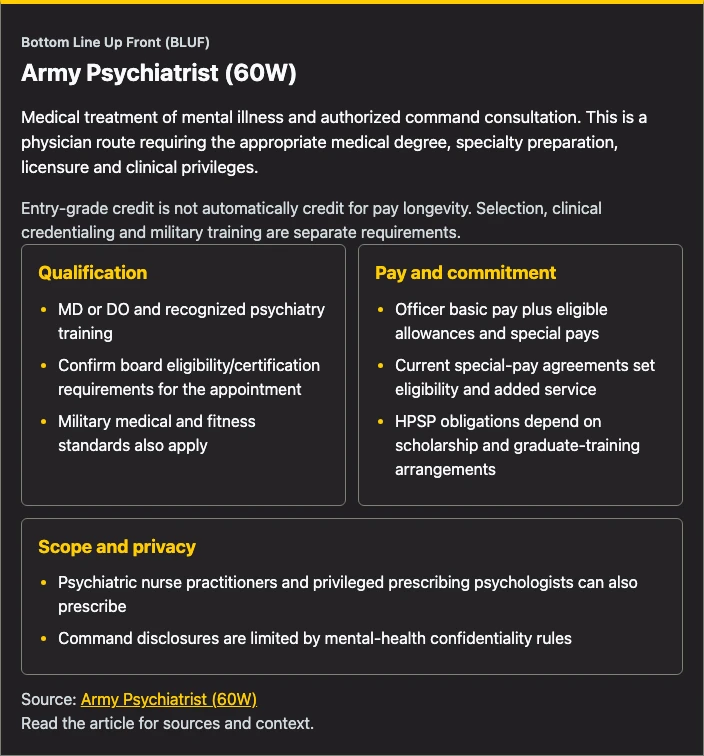
Medical treatment of mental illness and authorized command consultation. This is a physician route requiring the appropriate medical degree, specialty preparation, licensure and clinical privileges.
Entry-grade credit is not automatically credit for pay longevity. Selection, clinical credentialing and military training are separate requirements.
Qualification
- MD or DO and recognized psychiatry training
- Confirm board eligibility/certification requirements for the appointment
- Military medical and fitness standards also apply
Pay and commitment
- Officer basic pay plus eligible allowances and special pays
- Current special-pay agreements set eligibility and added service
- HPSP obligations depend on scholarship and graduate-training arrangements
Scope and privacy
- Psychiatric nurse practitioners and privileged prescribing psychologists can also prescribe
- Command disclosures are limited by mental-health confidentiality rules
Source: Army Psychiatrist (60W)
Read the article for sources and context.
On this page
Job Role and Responsibilities
Army psychiatrists (60W) examine, diagnose and treat service members with emotional or mental illness and with adjustment problems that interfere with duty. They prescribe medication, direct treatment plans, order hospitalization when needed and advise commanders on the mental health of the formation. They also supervise the behavioral health teams that deliver most of the day-to-day care.
The Army’s classification manual describes the duties in a single sentence about examining, diagnosing and treating personnel who have emotional or mental illness or difficulty adjusting to their situation. The regulation’s wording is dated in places. The work it describes is current, and it covers the full range of psychiatric practice from anxiety and depression to psychosis and severe trauma responses.
A clinic day mixes several kinds of work. There are new evaluations, medication follow-ups, treatment planning meetings with psychologists and social workers, and documentation that has to hold up when a commander, a medical board or a legal proceeding depends on it. Psychiatrists also carry after-hours call for emergencies, which in a military hospital can mean a soldier in crisis at two in the morning.
Command and Leadership Scope
A junior 60W officer leads a treatment team rather than a large formation. That team usually includes a psychologist, a social worker, a psychiatric nurse practitioner or physician assistant, nurses and behavioral health technicians. The psychiatrist owns the medical decisions and the treatment plan, and the team delivers the care.
Rank brings larger billets. A major may command a medical detachment for combat stress control, a position the classification manual lists as a unique duty position for the specialty. The manual also lists a mental health section chief billet in the headquarters and company of a medical battalion in an air assault division.
These are different responsibilities: a detachment commander leads a unit, while a section chief leads the assigned clinical service.
At the top of the clinical ladder, a psychiatrist may serve as chief of a department of behavioral health at a medical center, where the responsibility shifts to staffing, access to care, quality measures and the training of residents and fellows.
Specific Roles and Designations
| Designation | Code | What it covers |
|---|---|---|
| Psychiatrist | 60W | The primary specialty. Requires a medical degree and completed psychiatry residency |
| Child Psychiatrist | 60U | Subspecialty for children and adolescents, with additional fellowship training |
| Medical Proficiency Designator | 9A to 9E | Clinical proficiency level and deployability status |
Child and adolescent psychiatry is a separate AOC because the patient population and the treatment approach differ enough to warrant it. The Army maintains both codes, and a psychiatrist who completes the fellowship moves from 60W to 60U.
Mission Contribution
Behavioral health affects readiness in a way that is easy to measure and easy to ignore. A soldier who cannot deploy because of an untreated condition is a lost position in a formation, and the loss compounds when the condition goes unrecognized until a deployment is imminent.
Psychiatrists sit at the point where clinical judgment meets command decision. The officer’s evaluation can inform duty restrictions and formal fitness or disability decisions, alongside the authorities and processes responsible for those decisions. That is a heavier responsibility than most clinical roles carry, and it is why the specialty requires a physician rather than a technician.
Technology, Equipment, and Systems
Behavioral health practice uses little equipment compared with surgery or emergency medicine. The tools are the clinical interview, standardized assessment instruments, the electronic health record, the pharmacy system and, at larger facilities, transcranial magnetic stimulation and other treatment technology.
The military setting adds systems that civilian practice does not have. Psychiatrists document clinical care and may provide authorized information for duty or medical-board decisions. Mental health confidentiality rules limit command disclosure to specified circumstances and the minimum necessary information; a commander does not have routine unrestricted access to a patient’s treatment record.
Salary and Benefits
Base Pay (2026)
Physicians commonly enter active clinical service as captains, with appointment grade determined by the approved accession record. Entry-grade credit and years credited for basic pay are separate calculations; a medical degree alone should not be treated as extra years on the pay table.
| Rank | Pay Grade | Years of Service | Monthly Base Pay | Annual Base Pay |
|---|---|---|---|---|
| Captain (CPT) | O-3 | 2 or less | $5,534 | $66,409 |
| Captain (CPT) | O-3 | Over 4 | $7,383 | $88,592 |
| Major (MAJ) | O-4 | 2 or less | $6,295 | $75,535 |
| Major (MAJ) | O-4 | Over 8 | $8,816 | $105,797 |
| Major (MAJ) | O-4 | Over 12 | $9,888 | $118,660 |
Source: DFAS 2026 pay tables. Figures reflect the 2026 pay raise.
The table shows 2026 officer basic pay. Figures are rounded to whole dollars and exclude allowances and special pays; the service-time labels identify the applicable pay brackets.
Special Pays
Physician compensation can include Board Certification Pay, Incentive Pay and a Retention Bonus when the officer meets the applicable conditions. The DFAS Medical Corps table identifies these categories and labels its published rates as maximum amounts, with service-specific amounts determined by the service personnel office.
A listed maximum is not an individual offer. Before accepting an accession or retention agreement, ask the Army medical recruiter or special-pay office to identify the current fiscal-year authority, the qualifying specialty and training status, and the additional service obligation in writing. Compare the full compensation package rather than basic pay alone.
Additional Benefits
Basic Allowance for Subsistence is $328.48 per month for officers. Basic Allowance for Housing varies by duty station, grade and dependent status, and it is not taxed. Active duty members receive care without out-of-pocket costs under the applicable TRICARE rules.
Enrolled family members generally have no costs for covered Prime care obtained through the required referral process, but point-of-service and other plan rules can create charges. Officers earn 30 days of paid leave a year.
For officers covered by the Blended Retirement System, 20 years of active service yields a pension equal to 40 percent of the highest 36-month average of basic pay. BRS includes an automatic 1 percent Thrift Savings Plan contribution after 60 days and up to 4 percent in matching contributions after two years, when the member contributes at least 5 percent. Members who entered before 2018 and did not opt into BRS retain their applicable legacy retirement plan.
Work-Life Balance
Clinic hours in behavioral health are closer to office hours than to hospital shift work. Most appointments are scheduled, and inpatient coverage is shared across the psychiatry service. That makes the schedule more predictable than emergency medicine or surgery.
The exception is crisis work. A behavioral health emergency does not wait for business hours, and the psychiatrist on call may be the only person in the facility who can authorize a treatment decision at night. Deployments and field exercises add the same disruptions they add to every medical specialty.
Qualifications and Eligibility
Commissioning Sources
Several routes lead to the Medical Corps, and the specialty requirement is the same for all of them: an MD or DO, completed psychiatry residency and a state license.
Health Professions Scholarship Program (HPSP). The Army pays tuition, fees and a monthly stipend at a civilian medical school in exchange for an active duty obligation after residency. The student commissions during school and completes annual training each year.
Uniformed Services University of the Health Sciences (USUHS). The federal medical school pays students as officers and charges no tuition. The service obligation is longer than the scholarship route.
Direct Commission. A licensed psychiatrist already in civilian practice can commission directly and attend a condensed officer course. This is the standard route for Reserve and National Guard psychiatrists.
Financial Assistance Program. This is a fourth option for a physician who is already in a residency. It pays an annual grant and a monthly stipend and adds a service obligation.
Commissioning Requirements
| Path | Degree | Licensure | Service Obligation |
|---|---|---|---|
| HPSP | MD or DO, in progress or complete | Required before active duty practice | Depends on scholarship length and graduate training; commonly 3–4 years for the scholarship commitment |
| USUHS | MD conferred by USUHS | Required before active duty practice | 7 years after residency |
| Direct Commission | MD or DO, complete | Active state license | Depends on the appointment and any incentive agreement |
The Army’s medical accession guidance describes commitments by program rather than a universal four-year HPSP obligation. Residency, fellowship and incentive agreements can affect the total commitment, so obtain the complete obligation calculation for the chosen route before signing.
U.S. citizenship, a qualifying physical examination and a security clearance are required for every path. Age limits and waivers change with recruiting policy, so an applicant near a limit should ask a recruiter.
Test Requirements
Psychiatrists commission as health professionals, so no ASVAB score applies. HPSP and USUHS applicants take the MCAT for medical school admission. State licensure later requires the national medical exams each board accepts, as the BLS physician profile notes.
Military applicants compete for residency positions through the Joint Graduate Medical Education Selection Board, often called the military match. Civilian training requires the appropriate service approval and its own application arrangements. Board certification comes after residency through the American Board of Psychiatry and Neurology or the American Osteopathic Board of Neurology and Psychiatry.
Branch Selection and Assignment
Physicians are accessed into the Medical Corps and designated by specialty after residency, so there is no branching board to compete in. The specialty decision happens at the residency match. An officer who wants psychiatry applies to psychiatry programs, not to a branch.
Upon Commissioning
Medical Corps officers typically enter at O-3 with credit for graduate education. The 60W designation applies once residency training is complete. Until then the officer holds a training status and the 9E designator that marks a physician in graduate education.
Work Environment
Setting and Schedule
Psychiatrists work in hospital behavioral health departments, outpatient mental health clinics, embedded unit clinics and deployed combat stress control detachments. The setting shapes the work more than it does in most specialties. An embedded clinic sees soldiers who are still in their units.
A hospital department sees the patients who could not be managed there.
The deployed setting is the one that surprises new psychiatrists. Combat stress control teams move close to the units they support, and the psychiatrist may see service members in a tent with a laptop, a formulary of a few medications and no imaging. The clinical skill matters more than the equipment.
Leadership and Chain of Command
A psychiatrist reports through the behavioral health chain to the department chief and the facility commander. In an operational assignment, the officer may report to a medical company commander while advising a maneuver commander who is not in the medical chain at all. Managing those two relationships is part of the job.
Officer-NCO Dynamic
Behavioral health technicians and senior NCOs run the appointment flow, the screening process and much of the patient education. The psychiatrist owns diagnosis, medication and the treatment plan. A psychiatrist who treats the NCO as an assistant rather than a partner loses the read on the unit that the NCO has.
Staff vs. Command Roles
Junior psychiatrists spend most of their time clinically. Mid-grade officers add staff work on access to care, quality and training. Senior officers move into department leadership and, for some, command of a medical detachment.
The staff side grows with rank, as it does in every Medical Corps specialty.
Training and Skill Development
Pre-Commissioning Training
HPSP students complete a 45-day annual training period at a military medical facility or with a unit. USUHS integrates military training into the four-year curriculum, with physical training, field exercises and leadership instruction running alongside medical education.
Basic Officer Leader Course (BOLC)
Medical officers attend Army medical officer training at Fort Sam Houston, Texas. The Army AMEDD overview describes different active and Reserve training lengths and notes that specialty and prior military experience affect the requirement.
Use the course reservation and accession instructions for the actual schedule. Applicants should confirm whether they owe a direct-commission course, BOLC, or both, and which portions require resident attendance; a generic three-phase timetable is not a reliable substitute for those orders.
Graduate Medical Education
Psychiatry residency takes four years after medical school. Residents rotate through inpatient psychiatry, outpatient clinics, consultation and liaison services, child and adolescent settings, neurology and internal medicine. The inpatient year is where residents learn to manage acute risk, which is the skill the Army needs most in a deployed setting.
Fellowships add a year or more and open subspecialty codes. Child and adolescent psychiatry is the most common, and it leads to the 60U designation. Addiction psychiatry, forensic psychiatry and consultation-liaison psychiatry are other options.
Professional Military Education
Clinical training and Army professional military education serve different purposes. Residency establishes specialty preparation; military courses develop the officer for operational planning and wider leadership responsibilities.
Physicians should plan required military schooling with their career manager alongside residency, fellowship and clinical assignments. Course eligibility, delivery format and completion deadlines depend on the officer’s record and current Army guidance, so a single years-of-service timetable should not be treated as a promotion guarantee.
Additional Training
Operational assignments open the standard school list, including Airborne and Air Assault. Psychiatrists assigned to special operations units complete additional screening and medical training for those formations. The Army also funds fellowships through long-term health education and training for officers who stay.
Career Progression and Advancement
Career Path
| Rank | Grade | Typical Time in Service | Key Assignment |
|---|---|---|---|
| Captain | O-3 | 0 to 9 years, includes residency | Staff psychiatrist, embedded unit clinic |
| Major | O-4 | 10 to 15 years | Section chief, combat stress control detachment commander |
| Lieutenant Colonel | O-5 | 15 to 20 years | Department chief, corps behavioral health staff |
| Colonel | O-6 | 20 to 27 years | Medical treatment facility command, medical command staff |
Appointment grade and later promotion are separate decisions. Officers should confirm their date of rank, military education requirements and promotion eligibility with their career manager rather than infer a promotion date from the clinical training timeline.
Promotion Factors
Evaluation reports carry the most weight, and the strongest files show a psychiatrist who led something beyond a case load. Command of a detachment, a deployed behavioral health mission, a residency faculty position and staff work on access to care all help. So does finishing professional military education on schedule.
The Army also looks for physicians who can work with commanders. A psychiatrist who is trusted by maneuver units is more valuable to the service than one who is only trusted by the clinic.
Broadening and Functional Areas
Broader work can include teaching, research, clinical-service leadership and medical staff assignments. These roles should be planned around the officer’s clinical qualifications, privileges and the available positions.
Health administration has its own Army classifications and appointment requirements. The officer classification manual lists 70A Health Care Administration and 70B Health Services Administration; it does not establish an automatic “FA70” progression for a physician after company-grade service.
Physical Demands and Medical Evaluations
The officer classification manual lists correctable vision, manual dexterity, normal color perception, a physical profile of 222222 and a Moderate (Gold) physical-demands category for this specialty. The Army’s published Gold OPAT explanation gives these thresholds:
- Standing long jump: 120 cm.
- Seated power throw: 350 cm.
- Strength deadlift: 120 lb.
- Interval run: 36 shuttles.
The deadlift is 120 pounds, approximately 54 kg. Applicants should confirm which accession assessments apply to their medical appointment; the occupational classification and the recurring Army Fitness Test are separate requirements.
Officers also take the Army Fitness Test (AFT), which replaced the ACFT on June 1, 2025. For ages 17 through 21, the official AFT scoring standards list:
| Test event | Male 17-21 minimum | Female 17-21 minimum |
|---|---|---|
| Three-repetition maximum deadlift | 150 lb | 120 lb |
| Hand-release push-ups | 15 | 11 |
| Sprint-drag-carry | 2:28 or faster | 3:15 or faster |
| Plank | 1:30 or longer | 1:30 or longer |
| Two-mile run | 19:57 or faster | 22:55 or faster |
Psychiatry carries no flight physical or dive physical requirement. Medical screening for service and state licensure are separate gates, and the psychiatrist must clear both.
Deployment and Duty Stations
Deployment Details
Psychiatrists deploy with combat stress control detachments, medical brigades and the behavioral health assets of divisions. Some deploy as the only psychiatrist in a theater, which means covering inpatient care, outpatient care and command consultation at the same time.
Deployed behavioral health work differs from garrison work in caseload and in purpose. The garrison clinic treats conditions over months. The deployed team stabilizes service members so they can return to duty, and evacuates the ones who cannot.
That decision has career consequences for the patient, and the psychiatrist makes it with less support than a hospital provides.
Duty Station Options
Psychiatrists serve at military treatment facilities, at division and corps headquarters and in special operations formations. Assignment is managed by Human Resources Command against the needs of the Army, with officer preference sheets considered.
The smaller assignments are worth a look. A division psychiatrist sees the whole formation and works directly with command, which builds a different record than a hospital clinic does.
Risk, Safety, and Legal Considerations
Job Hazards
The clinical hazards are the ones behavioral health carries everywhere: exposure to patients in crisis, the strain of managing risk and the weight of decisions that change someone’s career. Military practice adds deployment conditions and the isolation of being the only psychiatrist in a location.
Safety Protocols
Clinics use standard safety measures for behavioral health settings, including interview room configuration, panic systems and de-escalation training. Deployed facilities add force protection requirements. Psychiatrists also manage their own exposure to traumatic material, which accumulates over years of trauma cases.
Legal and Command Responsibility
Psychiatric decisions carry legal weight that most clinical decisions do not. An evaluation can affect a service member’s security clearance, assignment eligibility, fitness for duty and separation from service. Documentation has to be accurate because other people will act on it.
Psychiatrists who hold command carry the same relief-for-cause exposure as any other commander. The standard is whether the officer led the unit properly, not only whether the clinical care was sound.
Impact on Family and Personal Life
Family Considerations
Behavioral health schedules are more predictable than shift specialties, which helps family life. The disruptions are the standard military ones: moves, field time and deployments. Each move brings a new facility, a new team and a new credentialing process.
Family support centers, family readiness groups and spouse employment programs exist at most installations. Military family life counselors are also available at many installations and provide confidential support outside the medical record, which some families prefer.
Dual-Military and Family Planning
Dual-military couples coordinate two assignment cycles, and the Army manages this through the married army couples program when both members are eligible. Raising the issue early matters more than raising it at orders time.
Reserve and National Guard
Component Availability
The Army Reserve and the Army National Guard both carry psychiatrists, and direct commission is the usual entry route for a practicing civilian physician. Reserve and Guard psychiatrists attend a condensed BOLC.
Drill and Training Commitment
A common training schedule is one weekend per month plus two weeks of annual training; schools, readiness duties and mobilization can add time. A drill weekend counts as four drill periods, and each period pays one-thirtieth of monthly basic pay. An O-3 with less than two years of service earns $737.88 for a standard drill weekend.
Part-Time Benefits
TRICARE Reserve Select premiums for 2026 are $57.88 per month for the member alone and $286.66 for member and family.
Eligible members can receive up to 36 months of Montgomery GI Bill Selected Reserve benefits; the full-time enrollment rate is $508 per full month from October 1, 2026, through September 30, 2027. Retirement is points-based, with points earned from drills, annual training and mobilization.
Comparison
| Factor | Active Duty | Army Reserve | Army National Guard |
|---|---|---|---|
| Commitment | Full time | One weekend per month, two weeks per year | One weekend per month, two weeks per year |
| Pay basis (O-3, under 2 years) | $5,534 basic pay | $737.88 per drill weekend | $737.88 per drill weekend |
| Healthcare | TRICARE Prime, no premiums | TRICARE Reserve Select, premiums apply | TRICARE Reserve Select, premiums apply |
| Education | Tuition assistance, Post-9/11 GI Bill | MGIB-SR, Post-9/11 after qualifying active duty | MGIB-SR, state tuition waivers in many states |
| Deployment tempo | Follows the unit | Unit rotations and individual mobilization | State missions and federal mobilization |
| Command opportunity | Department and facility leadership | Detachment and company command | Detachment and company command |
| Retirement | 20-year pension plus TSP | Points-based at age 60 | Points-based at age 60 |
Civilian Career Integration
A reserve psychiatrist usually keeps a civilian practice and serves on drill weekends and annual training. That combination works well because the clinical skill stays current in both settings. Federal law protects the civilian job during mobilization under the Uniformed Services Employment and Reemployment Rights Act.
Post-Service Opportunities
Transition to Civilian Life
Psychiatry transfers to civilian practice without a credential gap. The residency training, board certification and license all carry over. Psychiatrists leaving active duty also carry something less common: experience treating service members, running a behavioral health team and advising commanders under pressure.
Civilian employers in behavioral health, hospital systems, telehealth groups and the Department of Veterans Affairs recruit military psychiatrists directly. The transition programs that help all service members, including the Transition Assistance Program, apply here as well.
Civilian Pay and Outlook
| Occupation | Median Annual Wage (May 2025) | Job Outlook, 2025 to 2035 |
|---|---|---|
| Psychiatrists | $281,870 | 7 percent |
| Physicians and surgeons, all | $275,930 | 4 percent |
Source: BLS Occupational Outlook Handbook. BLS counts 30,000 psychiatrist jobs in 2025 and projects growth of 7 percent, faster than physicians and surgeons overall, driven by demand for psychiatric care and better access to mental health services.
Graduate Education and Credentials
The medical degree, residency certificate and board certification transfer unchanged. The GI Bill can fund a fellowship or a graduate degree, and the Army’s long-term health education and training program can fund subspecialty training while the officer is still serving.
Is This a Good Job for You? The Right (and Wrong) Fit
Ideal Candidate Profile
Psychiatrists who do well in the Army tolerate uncertainty and hold a steady line under pressure. They work with people whose judgment may be impaired, and they make decisions that affect careers. The officer needs clinical confidence and the patience to explain a decision to a commander who disagrees with it.
Applicants should compare the full clinical scope rather than reduce psychiatry to prescribing. The BLS description of psychiatry includes psychotherapy as well as medication and hospitalization. Psychology, social work and psychiatric nursing have distinct training and practice pathways that may also suit an applicant interested in behavioral health.
Potential Challenges
The heaviest part of the job is not the diagnosis. It is the consequence. A psychiatrist’s evaluation can end a career, block a deployment or change a family’s plans, and the officer has to be right often enough to keep the trust of both patients and commanders.
The second challenge is staffing. Behavioral health has been short of providers for years, which means long appointment waits and a full schedule. Psychiatrists who expected a slower pace find the opposite.
Career and Lifestyle Alignment
For a physician who wants meaningful clinical work, a predictable schedule and direct influence on how a formation functions, psychiatry fits. Psychiatric emergencies can be high-acuity work, so a preference for urgent care does not by itself rule out psychiatry. An applicant seeking surgery or other procedural specialties should compare those clinical pathways separately.
Compare a real civilian offer with the complete Army package, including eligible special pays, allowances, retirement benefits and any service obligation. National wage statistics describe a labor market; they do not establish what an individual physician will earn or guarantee that one route pays more. Location, shifts, clinical scope and control over assignments matter alongside compensation.
More Information
Psychiatry is one of more than 40 physician specialties in the Army Medical Corps. The closest comparison is the clinical psychologist, which is a doctoral psychology role in the Medical Service Corps with a different license; ordinary psychology training alone does not confer prescribing authority, although additional training and privileges can. The psychiatric nurse practitioner is the third route into the same clinics, starting from nursing and practicing under an advanced practice license.
An applicant weighing a non-physician route should compare training length and cost carefully. The psychology and nurse practitioner paths are shorter and cheaper.
The medical route provides physician training and the scope granted through medical licensure and clinical privileges. DHA guidance also recognizes psychiatric nurse practitioners and prescribing psychologists as behavioral-health prescription specialists, so prescribing alone is not a sound way to choose between the professions.
The most useful next step is a conversation with an Army medical recruiter, who can give current specialty pay, current psychiatry bonus amounts and the residency programs accepting applications this cycle.