Army Social Worker Officer (73A)
An Army social worker officer carries a clinical case load and a military assignment at the same time. The officer may counsel a soldier in crisis, brief a commander after a critical incident, and coordinate child and family services for a military household, all within one duty week. The work is clinical, but it is delivered inside a unit that expects the officer to lead.
The formal code is 73A, Social Work, in the Army Medical Service Corps. It sits in the behavioral health group of the corps alongside clinical psychology. The most important fact for an applicant is that 73A is a master’s-level licensed profession, not a doctoral one. That single difference separates it from the clinical psychologist route and shapes almost everything else about how a person enters and advances in the field.
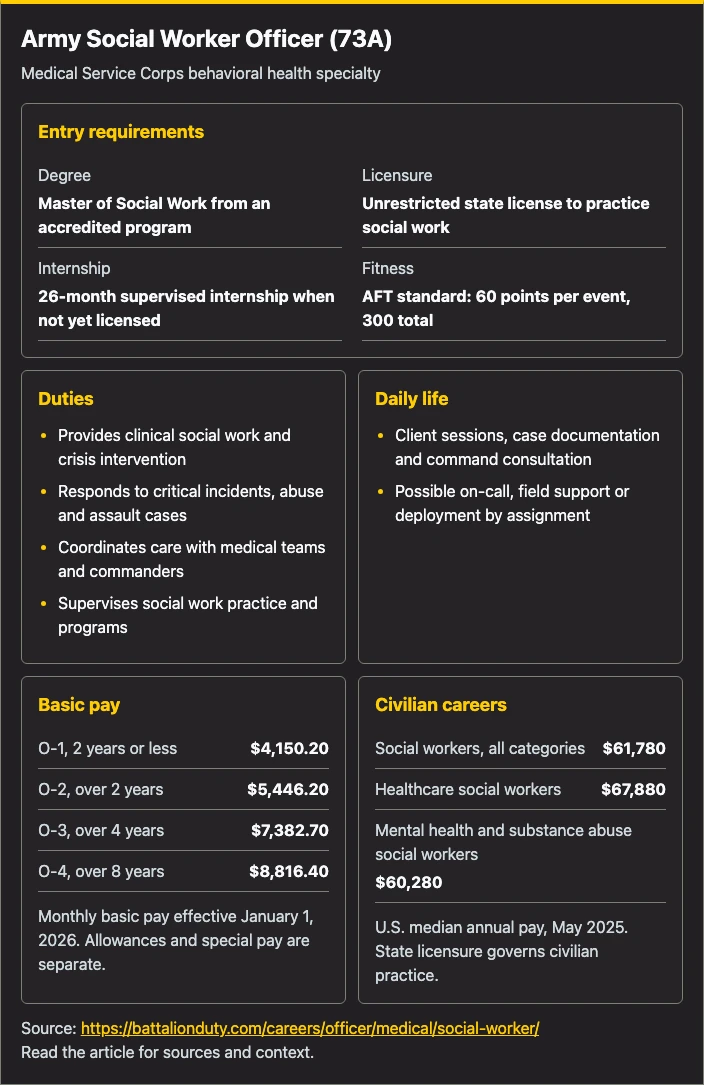
Entry requirements
- Degree
- Master of Social Work from an accredited program
- Licensure
- Unrestricted state license to practice social work
- Internship
- 26-month supervised internship when not yet licensed
- Fitness
- AFT standard: 60 points per event, 300 total
Duties
- Provides clinical social work and crisis intervention
- Responds to critical incidents, abuse and assault cases
- Coordinates care with medical teams and commanders
- Supervises social work practice and programs
Daily life
- Client sessions, case documentation and command consultation
- Possible on-call, field support or deployment by assignment
Basic pay
- O-1, 2 years or less
- $4,150.20
- O-2, over 2 years
- $5,446.20
- O-3, over 4 years
- $7,382.70
- O-4, over 8 years
- $8,816.40
Monthly basic pay effective January 1, 2026. Allowances and special pay are separate.
Civilian careers
- Social workers, all categories
- $61,780
- Healthcare social workers
- $67,880
- Mental health and substance abuse social workers
- $60,280
U.S. median annual pay, May 2025. State licensure governs civilian practice.
Source: https://battalionduty.com/careers/officer/medical/social-worker/
Read the article for sources and context.
On this page
Job Role and Responsibilities
Army 73A social work officers provide clinical social work services to soldiers, eligible family members and authorized civilians in military organizations. They assess and treat behavioral health needs, respond to critical incidents and family crises, coordinate care with medical and command teams, and supervise social work practice within their professional scope. The specialty requires a master’s degree in social work and the professional qualifications for unrestricted state licensure.
The profession belongs to the Army Medical Service Corps. A social work officer practices social work rather than general medical administration, and the officer’s clinical authority comes from professional licensure and granted privileges, not from rank.
What a 73A officer does
The Army’s officer classification chapter lists the functions of the specialty in specific terms. They include critical event debriefings, psychological autopsies, suicide prevention work, clinical counseling, disaster relief support, civil affairs support, domestic violence and child abuse intervention, sexual assault intervention, crisis intervention, substance abuse intervention, teaching and training, supervision, research, administration, consultation and policy development.
That list is broad, and it is broad on purpose. A social work officer may spend one assignment in a behavioral health clinic and the next in a brigade where the caseload is shaped by the unit’s deployment cycle. The common thread is psychosocial care and the systems around it, not a single treatment technique.
Where the officer is placed
Published 73A positions include social work officer, chief of a social work service, researcher, chief of a soldier and family services division, deputy chief of a behavioral health division, and social work consultant to the Office of The Surgeon General. Those are position types rather than a guaranteed sequence. Junior officers do not begin in consultant roles, and senior positions are competitive.
Social work and psychology are different jobs
This is the question most readers arrive with, so it belongs in the open rather than in a footnote.
A clinical psychologist in the Army holds a doctorate in clinical or counseling psychology, completes an accredited internship and is licensed as a psychologist. A social work officer holds a master’s degree in social work and is licensed as a social worker. The two professions overlap in behavioral health care, and they are not interchangeable.
The practical differences show up in scope and in method. Psychology training emphasizes psychological assessment, testing and doctoral-level psychotherapy. Social work training emphasizes psychosocial assessment, case coordination, family systems, crisis response and the resource networks that surround a person. In an Army setting, a social work officer often connects a soldier and family to housing, advocacy, protective services and benefits. The same officer may also provide clinical care.
Neither role is a physician. A psychiatrist is a medical doctor who can prescribe. A psychiatric nurse practitioner is a nurse practitioner with prescribing authority in the scope granted to that profession. The Army maintains separate routes for each, and an applicant should not treat one credential path as a shortcut into another.
Officer duties beyond the case load
A 73A officer also does what any officer does. That includes leading soldiers, managing a clinic or program, maintaining readiness and handling administrative accountability. Social work officers may supervise civilian social workers, enlisted behavioral health staff and trainees, and they must respect the scope limits of each.
Salary and Benefits
2026 military officer basic pay
An Army social worker is paid according to appointed rank and years of creditable service. Professional entry grade and credit for prior education or experience depend on the actual appointment rules. A master’s degree and a clinical license do not by themselves guarantee a particular rank or amount of constructive service credit.
| Rank | DFAS service bracket | 2026 monthly basic pay |
|---|---|---|
| O-1, Second Lieutenant | Two years or less | $4,150.20 |
| O-2, First Lieutenant | Over two years | $5,446.20 |
| O-3, Captain | Over four years | $7,382.70 |
| O-4, Major | Over eight years | $8,816.40 |
These examples come from the Defense Finance and Accounting Service (DFAS) 2026 commissioned officer pay table, effective January 1, 2026. A licensed clinical social worker who enters through a direct commission may be appointed at a higher grade than a student entering the Army master’s program. The pay for that officer depends on the actual appointment and the service credit granted, which is why the table is an illustration rather than a quote.
Scholarships, special pays and benefits
The Army Medical Recruiting Brigade medical services page describes the Army Master of Social Work program and the Social Work Internship Program. It also describes Health Professions Special Pay for Reserve social work officers, published as up to $20,000 per year for a two, three or four year affiliation in a troop program unit, active guard reserve or individual mobilization augmentee status.
That special pay is a Reserve incentive tied to a specific affiliation. It is not a general bonus for every 73A officer. A published maximum is not an individual offer. Amounts, eligibility and current board openings must be confirmed with a recruiter before an applicant relies on them.
Officers who qualify receive military healthcare, housing and subsistence allowances, paid leave and education programs. Retirement follows the Blended Retirement System, which covers qualifying service and eligible Thrift Savings Plan contributions. Those benefits do not replace the terms of a specific accession program.
Social work schedules can include client sessions, crisis response, case documentation, meetings and command consultation. Depending on assignment there may be on-call coverage, weekend duty, field support or deployment. No fixed weekday schedule should be promised to a prospective 73A officer.
Qualifications and Eligibility
Degree, license and the two entry routes
The Army requires a master’s degree in social work from a program accredited by the Council on Social Work Education and acceptable to The Surgeon General, plus the professional qualifications for unrestricted state licensure and practice. That combination is the core gate, and there is no route that skips it.
| Route | Academic requirement | Clinical requirement | What to confirm |
|---|---|---|---|
| Direct commission as a licensed social worker | MSW from an accredited program | Unrestricted state licensure and practice qualifications already met | Current board, entry grade and service obligation |
| Army Master of Social Work program | Qualifying bachelor’s degree with the required social and behavioral science coursework | Enrolled as a student, with licensure still ahead | Program start, school assignment and obligation |
| Social Work Internship Program for an unlicensed MSW holder | MSW already completed | Supervised internship toward independent practice | Whether the internship is open and what obligation applies |
The Army MSW program is published as a 14-month course of 60 semester hours delivered through the University of Kentucky, followed by a 26-month Social Work Internship Program. The recruiting page describes a 42-month active duty obligation for that combined route. The internship program is also described as a 26-month supervised bridge between graduate school and independent practice, with a 30-month active duty obligation for participants who enter it already holding an MSW.
Those figures come from the current recruiting description. Program length, school assignment, obligation and eligibility change between boards, so an applicant must read the announcement for the year they apply rather than rely on a summary.
Commissioning tests, age and grade
A 73A applicant should begin with a medical professional recruiter, not assume the ordinary ROTC or officer candidate branch process applies. The professional program uses academic records, licensure evidence, interviews and a board. The SIFT, the Selection Instrument for Flight Training, is an aviation test and is not a social work requirement. Enlisted ASVAB scores do not substitute for the MSW and the clinical license.
Medical, citizenship, security and age rules are specific to the chosen program and can include approved exceptions. This page asserts no universal age limit, grade point average floor or fixed entry rank. An applicant should obtain the current program announcement and written appointment terms before deciding.
Work Environment
A social work officer may work in a military treatment facility, a behavioral health clinic, a family advocacy program, a brigade support position or a staff office. The setting determines the mix of direct care, consultation and program management. Some billets are clinic-based and predictable. Others follow the unit’s training and deployment calendar.
The dual role is the part applicants underestimate. A social worker holds clinical obligations to a patient while also holding military obligations to a command. Command consultation and clinical care are related but not identical, and the officer must apply the correct rules about what may be shared. A commander’s interest in a soldier’s situation does not create a right to every detail of a clinical record.
Some officers move toward clinical supervision, program leadership, teaching or research as their careers develop. Workload varies with staffing, location and the unit’s operational tempo.
Training and Skill Development
A social work officer must qualify as a commissioned officer and as a professional social worker. Those are separate qualifications, and both continue after entry.
| Training or milestone | Location or setting | Duration | Purpose |
|---|---|---|---|
| Accredited MSW education | Approved graduate program, including the Army-sponsored route | Published as 14 months for the Army program | Clinical social work foundation |
| Social Work Internship Program | Designated Army medical treatment facilities | Published as 26 months | Supervised practice toward independent licensure |
| Army Medical Department officer basic course | Joint Base San Antonio, Texas | Current class schedule required | Military leadership and medical support context |
| Captains Career Course | Army Medical Department school | Required for promotion to captain | Advanced professional and leadership preparation |
| Intermediate level education | Resident, satellite or distance learning | Required at the major and lieutenant colonel stage | Senior leadership and staff qualification |
The Medical Service Corps career guidance also lists continuing opportunities that include family advocacy staff training, evidence-based treatment courses for post-traumatic stress, traumatic event management, substance use disorder training, a child and family fellowship, and long term civilian education for a doctoral degree in social work.
Those opportunities are selective. A fellowship or funded doctorate is a board decision tied to Army requirements, not a benefit an officer can claim on request.
Career Progression and Advancement
Clinical growth and military advancement run on separate tracks that have to be managed together. Boards weigh performance, military education and corps requirements. Clinical authority depends on licensure, privileges and experience.
| Officer grade | Typical stage | Possible role |
|---|---|---|
| O-1, Second Lieutenant | Student or initial appointment in a training program | Trainee or intern status, not independent licensed practice |
| O-2, First Lieutenant | Early clinical development | Social work officer in a treatment facility or brigade, with supervision as required |
| O-3, Captain | Qualified practitioner | Clinical social work, program coordination and section leadership |
| O-4, Major | Experienced clinician and supervisor | Chief of a social work section, behavioral health leadership or staff role |
| O-5, Lieutenant Colonel | Senior professional assignment | Service chief, division-level behavioral health leadership or consultant |
| O-6, Colonel | Limited senior positions | Senior medical leadership and policy roles |
The table is a framework, not a schedule. Promotion to major requires the military education level set for that grade, and promotion beyond it requires intermediate level education. The Army does not publish a simple guaranteed 73A promotion rate for an individual officer.
Physical Demands and Medical Evaluations
Social work officers must meet applicable Army commissioning and continuing fitness standards. The Army Fitness Test (AFT) sets a 60 point minimum per event and a 300 point total for combat-enabling specialties, scored against age and sex specific tables. For a 17 to 21 year old, the official AFT scoring standards set these minimums:
| Test event | Male 17-21 minimum | Female 17-21 minimum |
|---|---|---|
| Three-repetition maximum deadlift | 150 lb | 120 lb |
| Hand-release push-ups | 15 | 11 |
| Sprint-drag-carry | 2:28 or faster | 3:15 or faster |
| Plank | 1:30 or longer | 1:30 or longer |
| Two-mile run | 19:57 or faster | 22:55 or faster |
Older age groups have different event standards. Medical fitness for military service is separate from professional licensure, and an applicant must satisfy both where both apply. The 73A specialty does not carry a routine aviation flight physical requirement.
Deployment and Duty Stations
Social work officers serve at large medical centers, smaller treatment facilities and in operational units. Assignment depends on available 73A positions, grade, qualifications and Army needs. An officer in a training program has fewer choices because the program operates only at designated sites.
Deployment is possible but not uniform. Behavioral health support is part of the operational medical picture, and a social work officer may serve forward with a unit or remain at a fixed facility depending on the assignment. No fixed deployment frequency and no guaranteed location preference are supported by the sources reviewed here. Applicants should ask a recruiter what locations and assignments are realistically available in their accession year.
Risk, Safety, and Legal Considerations
Social work carries professional responsibility for assessment, documentation, confidentiality and patient safety. The work can involve disclosures of abuse, suicide risk, sexual assault and family violence, and those situations carry legal reporting duties that vary by jurisdiction and by military policy. An officer must know which duty applies and must not treat a clinical relationship as unstructured.
Military confidentiality has specific rules and limits. A social work officer advising a commander must separate what the command needs to act from what a clinical record protects. The officer also holds the ordinary obligations of a commissioned officer, including accountability for conduct in the assigned position.
Impact on Family and Personal Life
Graduate school, internship placement and the first operational assignment can arrive in quick succession. The Army MSW route places a student in a funded program and then in a supervised internship, which may mean two moves before a first permanent assignment. Later service can include changes of station, duty travel, on-call work and deployment.
Military healthcare, housing support and Army family services are available to eligible families. Dual-military couples can request assignment coordination under applicable rules, though training locations and service needs can limit the options. A licensed civilian social worker considering a commission should also plan for state licensure portability and for any supervision or continuing education requirements that follow a move.
Reserve and National Guard
The Army Reserve commissions social work officers when annual needs permit, and the recruiting command publishes a special pay incentive for 73A in troop program units and related statuses. The Army National Guard’s authorizations depend on state and unit. A civilian social work license does not by itself guarantee a commission or a part-time billet.
| Topic | Active Army | Army Reserve | Army National Guard |
|---|---|---|---|
| Employment model | Full-time military service | Drills, training and possible mobilization | State and federal duties, drills and possible mobilization |
| O-3 pay comparison, over four years | $7,382.70 monthly basic pay | About $984.36 for four drill periods | About $984.36 for four drill periods |
| Clinical qualification | License and privileges for the assigned scope | License and privileges plus unit conditions | License and privileges plus state and unit conditions |
| Special pay | Program-specific accession incentives | Published 73A special pay for qualifying affiliation | Federal and possible state programs |
| Availability | Current 73A board required | Specialty recruitment when needs permit | Confirm the individual state vacancy |
| Retirement | Active service rules | Points-based non-regular retirement when eligible | Points-based non-regular retirement when eligible |
The four-drill figure uses the same DFAS monthly O-3 rate divided by 30 and multiplied by four. It isn’t a monthly Reserve salary. Clinical credentialing and mobilization can require more days than a standard drill weekend.
Post-Service Opportunities
Social work is a licensed civilian profession as well as an Army specialty. An officer who leaves service must satisfy the licensing rules of the state and the setting they enter. Military experience can be relevant to an employer, and it does not replace the degree, supervised hours or examination that a state requires.
| Civilian occupation | Median U.S. yearly wage, May 2025 | Projected growth, 2025-2035 |
|---|---|---|
| Social workers, all categories | $61,780 | 6% |
| Healthcare social workers | $67,880 | Included in the category above |
| Mental health and substance abuse social workers | $60,280 | Included in the category above |
The figures come from the Bureau of Labor Statistics social worker profile. They describe the civilian labor market, not military compensation, and they are not a salary offer to a former officer. The category median covers bachelor’s and master’s level practice together. A licensed clinical social worker typically competes in a different part of that range than the overall figure suggests.
Is This a Good Job for You? The Right (and Wrong) Fit
The 73A career suits someone who wants to practice clinical social work and serve, and who is willing to hold a case load and a military assignment at the same time. It rewards people who are comfortable with crisis work, family systems, advocacy and the paperwork that protects both the client and the institution. Applicants should be willing to complete a master’s degree and a supervised internship if they do not already hold them.
It’s a poor fit for someone looking for a fast commission without graduate study, for a reader who mainly wants psychological testing or doctoral-level assessment, or for someone who expects clinical work with no command interface. A person unwilling to accept a posting cycle and an active duty obligation would find this career a hard fit.
What settles it is the route a reader qualifies for, the obligation attached to it, and whether the daily work described above is the work they want.
More Information
Contact an Army healthcare professions recruiter for the current 73A board, the Army Master of Social Work program, the Social Work Internship Program and any direct commission option. Ask which credentials the board accepts, what supervision remains, what obligation applies and what grade the appointment carries. The Army officer commissioning overview explains the military vocabulary, and it cannot substitute for a professional recruiting notice.
The Medical Service Corps officer parent explains how 73A fits the Army health system. To compare the neighboring licensed professions, read the published Army clinical psychologist profile and the Army Medical Corps physician profile.