35A Military Intelligence Officer
Every commander needs to know what the enemy is doing before they decide what to do next. The Military Intelligence Officer is the person who makes that knowledge possible. You’ll run collection operations, direct analysis cells, and put finished intelligence products in front of generals who make life-and-death decisions based on your work.
This is not a desk job with a security clearance attached. MI officers lead soldiers, manage classified programs, and operate in environments where bad analysis has direct consequences. If you’re an ROTC cadet weighing your branch options, or a civilian considering OCS, this guide covers the full picture: what the job actually demands, what you’ll earn, and where the career goes after you take off the uniform.
OCS candidates need a GT score of 110 on the ASVAB — our ASVAB for OCS guide covers exactly how to hit that number.
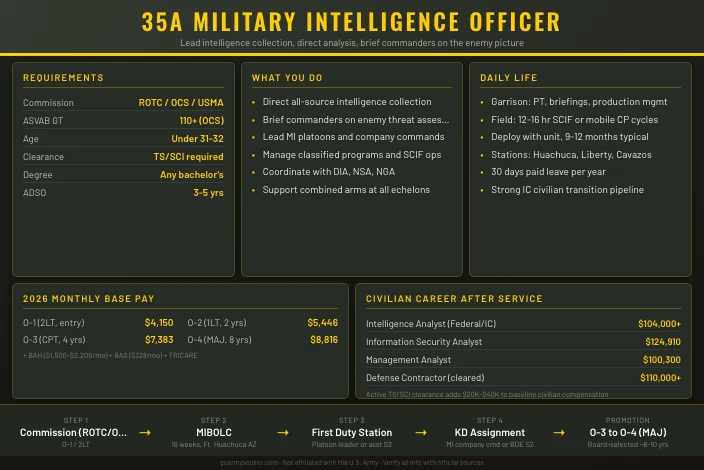
Job Role and Responsibilities
Military Intelligence Officers plan, direct, and coordinate the collection, analysis, and dissemination of intelligence across all echelons of Army operations. At the lieutenant level, this means leading intelligence platoons and serving as assistant S2 in brigade and battalion staff sections. As a captain, you command MI companies or serve as a brigade S2, owning the intelligence picture for a force of several thousand soldiers. Majors and lieutenant colonels operate at division and corps, shaping the intelligence architecture for joint and combined arms operations across entire theaters.
Command and Leadership Scope
A new MI lieutenant typically leads a collection platoon, a counterintelligence team, or fills an assistant S2 billet in a maneuver battalion. Platoon strength runs 20 to 40 soldiers depending on the MI type – HUMINT teams are smaller; all-source analysis sections larger. Your platoon sergeant handles daily maintenance and soldier management while you focus on mission planning and production requirements.
At the captain level, command of an MI company or the battalion S2 role is the career-defining assignment. Company command means 80 to 150 soldiers and accountability for all organic collection and analysis assets. The brigade S2 role puts you as the primary intelligence advisor to a brigade commander – you brief daily, you own the collection plan, and you take the heat when the picture is wrong.
Majors move into division G2 and corps J2 staff positions, coordinating intelligence across dozens of subordinate units. At this level, you’re managing production requirements across multiple collection disciplines and integrating national-level intelligence support into tactical operations.
Specific Roles and Designations
| Designation | Code | Description |
|---|---|---|
| Intelligence Officer | AOC 35A | Entry AOC upon commissioning; all MI officers |
| All-Source Intelligence Officer | AOC 35D | Plans, supervises, and produces all-source intelligence products |
| Counterintelligence Officer | AOC 35E | CI investigations, FP support, source operations at all echelons |
| Signals Intelligence Officer | AOC 35G | Plans and directs SIGINT collection and analysis |
| Strategic Intelligence Officer | AOC 35B | Strategic-level intelligence production and assessment |
| Human Intelligence Operations | SI 35H | Skill identifier for HUMINT operations management |
| Targeting Officer | FA 40 | Post-KD functional area; fires and effects integration |
| Operations Research/Systems Analysis | FA 49 | Post-KD functional area; quantitative analysis |
| Information Operations | FA 30 | Post-KD functional area; information environment operations |
Mission Contribution
The MI branch provides the knowledge advantage that makes combined arms operations work. A tank crew can’t suppress a threat they don’t know exists. A ground commander without accurate terrain and enemy analysis makes decisions on assumptions. MI officers remove that uncertainty – or at least reduce it to manageable risk.
In large-scale combat operations, MI units support every echelon from platoon through theater. At the tactical level, collection teams feed the S2 with current enemy activity. At the operational level, division G2s integrate national intelligence assets into the ground fight. In competition and security cooperation missions, MI officers support partner nation capacity building and foreign disclosure operations.
Technology, Equipment, and Systems
MI officers work with a range of classified and unclassified systems:
- DCGS-A (Distributed Common Ground System - Army): The Army’s primary intelligence processing and production system, feeding the common operating picture at all echelons
- TROJAN SPIRIT: Deployable signals intelligence and communications intercept capability
- PROPHET: Ground-based SIGINT collection platform operated by MI units
- Palantir and MFWS: Analysis platforms for fusing multiple intelligence streams into finished products
- RFI and Collection Management tools: Systems for submitting, tracking, and satisfying intelligence requirements across echelons
- JWICS and SIPRNet: Classified networks that carry the bulk of intelligence product traffic
Salary and Benefits
MI officers earn the same base pay as officers across the Army, with additional pays available for specific assignments and an active TS/SCI clearance that holds significant value in the civilian job market after service.
Officer Base Pay (2026)
All figures are monthly basic pay per DFAS 2026 pay tables. The 3.8% raise took effect January 1, 2026.
| Grade | Rank | Under 2 Yrs | 4 Yrs | 6 Yrs | 8 Yrs | 10 Yrs |
|---|---|---|---|---|---|---|
| O-1 | 2LT | $4,150 | $5,222 | – | – | – |
| O-2 | 1LT | $4,782 | $6,485 | $6,618 | – | – |
| O-3 | CPT | $5,534 | $7,383 | $7,737 | $8,126 | $8,376 |
| O-4 | MAJ | $6,295 | $7,881 | $8,332 | $8,816 | $9,420 |
| O-5 | LTC | $7,295 | $8,894 | $9,250 | $9,461 | $9,929 |
| O-6 | COL | $8,751 | $10,245 | $10,284 | $10,725 | $10,784 |
Basic pay is the floor, not the ceiling. Officers also receive Basic Allowance for Subsistence (BAS) of $328.48 per month, plus Basic Allowance for Housing (BAH) that varies by duty station and dependency status. At a typical MI installation, an O-3 without dependents receives roughly $2,007 per month in BAH – with dependents, around $2,127 per month. BAH is tax-free and adjusts annually.
Special Pay and Bonuses
MI officers may qualify for special pays based on assignment:
- Hostile Fire / Imminent Danger Pay: $225 per month during qualifying deployments
- Hardship Duty Pay: For assignments to designated austere locations
- Special Duty Assignment Pay (SDAP): Available for certain assignments such as Ranger Instructor, Drill Sergeant, or recruiting duty
- Continuation Pay: Under the Blended Retirement System, officers at the 7-12 year mark may receive a lump-sum bonus of 2.5x to 13x monthly basic pay for a three-year additional service commitment
- Language Pay: Officers with Defense Language Proficiency Test (DLPT) scores in required languages may qualify for Foreign Language Proficiency Pay (FLPP), which adds up to $500 per month depending on proficiency level and designated language
Current officer accession and retention bonus availability changes by fiscal year. Check with your branch manager at HRC or a Military Intelligence officer recruiter for the current schedule.
Additional Benefits
Active-duty MI officers receive TRICARE Prime with zero enrollment fees, zero deductibles, and zero copays for covered services. Family members are covered at the same rate for in-network care, with a $1,000 annual catastrophic cap on out-of-pocket costs.
The Post-9/11 GI Bill covers full in-state tuition at public schools, up to $29,920.95 per year at private institutions (AY 2025-2026 cap), plus a monthly housing allowance tied to E-5 BAH rates at the school location and a $1,000 annual book stipend. Benefits are transferable to dependents after six years of service, subject to a four-year additional service obligation. Army Tuition Assistance provides $250 per semester hour, up to $4,500 per year, while on active duty.
The Blended Retirement System pays 40% of your high-36 average basic pay after 20 years, with TSP matching of up to 5% of basic pay beginning in year three.
Work-Life Balance
Officers earn 30 days of paid leave per year, accruing 2.5 days per month. Garrison life follows a structured schedule, but intelligence work can be demanding during heightened threat periods or major exercises when production requirements spike. Deployment cycles and pre-deployment readiness training compress personal time significantly for 6- to 12-month stretches.
Qualifications and Eligibility
Commissioning Sources
Three paths lead to a Military Intelligence commission. Your commissioning source affects your initial ADSO and sometimes your first assignment options.
| Source | GPA Minimum | Degree Requirement | Age at Commission | Physical Standard | MI-Specific Notes |
|---|---|---|---|---|---|
| ROTC | 2.0 (competitive ~3.0+) | Any accredited bachelor’s | Under 31 | AFT passing + MEPS physical | STEM, foreign language, or social science degree competitive |
| OCS | 2.5 (competitive higher) | Any accredited bachelor’s | Under 32 | AFT passing + MEPS physical | GT score of 110+ on ASVAB required |
| USMA (West Point) | N/A (admissions-based) | West Point curriculum | Entry age 17-22 | Candidate Fitness Assessment | Competitive; analytical degree tracks valued |
ROTC is the largest commissioning source for MI officers. The Army’s talent-based branching (TBB) system – launched in 2022 – uses a HireVue interview, academic performance, leadership evaluations, and a talent assessment battery to generate branch assignments. Officers with analytical backgrounds, foreign language proficiency, or STEM degrees consistently score well in MI branch competitions.
OCS is the primary path for prior-enlisted soldiers and college graduates who did not complete ROTC. The 12-week course runs at Fort Moore, Georgia. OCS applicants need a GT score of 110 or higher (General Technical composite: VE + AR) on the ASVAB. Prior 35-series enlisted experience is a genuine advantage when competing for the MI branch as an OCS candidate.
West Point graduates select branches after commissioning. The program’s analytical curriculum – especially majors in international relations, systems engineering, and computer science – prepares officers well for MI work. The branch-detail program allows some officers to serve 2-4 years in a combat arms branch before transferring into MI, building tactical credibility that pays dividends at the S2 level.
Test Requirements
OCS applicants need a GT score of 110 or higher on the ASVAB. There is no SIFT requirement for MI officers – the test is aviation-specific. A strong GT score indicates the verbal reasoning and analytical aptitude the MI branch values. The GRE is not required for commissioning, though a competitive academic record strengthens talent-based branching scores.
Foreign language skills are not required to commission, but they open assignment options and increase FLPP pay. The Defense Language Aptitude Battery (DLAB) is used to assess language learning potential for officers assigned to language-intensive billets.
Branch Selection and ADSO
All officers commission as Second Lieutenant (O-1). The standard Active Duty Service Obligation is three years for non-scholarship ROTC and OCS graduates. Scholarship ROTC officers owe four years. West Point graduates owe five years. A Branch of Choice ADSO adds one year in exchange for guaranteed MI branch assignment.
MI is a mid-tier branch in the branching competition – not as competitive as Infantry or Special Forces, but more selective than many support branches. Officers with strong analytical backgrounds, language proficiency, and competitive OML rankings consistently secure MI assignments.
OCS candidates can find a focused GT study plan in our ASVAB for OCS guide.
Work Environment
Setting and Schedule
MI officers work in sensitive compartmented information facilities (SCIFs), forward operations centers, and field environments. A lieutenant’s day might start with physical training at 0600, shift to an intelligence briefing at 0730, and move into collection management and production work through the afternoon. During field exercises or combat rotations, that same work happens in a hardened tent or mobile command post with 12-to-16-hour production cycles.
Senior MI officers – majors and lieutenant colonels – spend significant time in briefings, coordinating with national intelligence agencies, and managing requirements across subordinate units. The analytical work doesn’t disappear as you promote; it scales up in complexity and consequence.
Leadership and Chain of Command
At the lieutenant level, the platoon sergeant is the officer’s most important working relationship. The NCO knows the soldiers, knows the equipment, and knows what can actually be produced with the resources on hand. MI lieutenants who try to manage production requirements without understanding their soldiers’ capabilities consistently underperform.
By company command, you work directly for a battalion commander. Your first sergeant manages daily operations; your job is command climate, mission accomplishment, and managing upward when collection requirements exceed your unit’s capacity.
At the S2 level – whether battalion or brigade – you report directly to the commander and serve as their primary intelligence advisor. That relationship requires trust, and trust requires accurate, timely products. An S2 who sanitizes bad news to protect the commander’s optimism quickly loses that trust.
Staff vs. Command Roles
An MI officer’s career alternates between command, staff, and specialized intelligence billets. Lieutenants spend 2-4 years in company-grade positions, then move into staff assignments. After completing a KD assignment as a captain, most return to staff as majors before competing for battalion-level command.
- LT phase (years 1-4): Platoon leader, assistant S2, company XO
- CPT phase (years 4-8): MI company command or brigade S2 (KD required); staff billets
- MAJ phase (years 9-14): Division G2, corps J2, joint staff, broadening assignments
- LTC/COL phase (years 14+): Battalion or brigade command, senior intelligence staff
Job Satisfaction and Retention
MI retains officers at rates consistent with the broader Army officer corps. Officers who find the analytical and leadership combination engaging – who like leading soldiers and solving intelligence problems – typically stay through the KD window and beyond. Those who expected predominantly technical analytical work sometimes feel the leadership and administrative demands pull them away from intelligence craft.
Training and Skill Development
Pre-Commissioning Training
ROTC cadets complete four years of leadership labs, field training exercises, and a summer Cadet Leadership Course. The pre-commissioning curriculum teaches small-unit tactics and officer fundamentals – not branch-specific intelligence content. OCS follows the same pattern: 12 weeks of officer task training at Fort Moore, with branch training starting after commissioning.
West Point’s four-year program integrates military science with a rigorous academic curriculum. Cadets selecting MI benefit from courses in international relations, systems engineering, foreign language, and strategic studies.
Military Intelligence Basic Officer Leader Course (MIBOLC)
All newly commissioned MI officers attend MIBOLC at Fort Huachuca, Arizona – home of the U.S. Army Intelligence Center of Excellence (USAICoE). The course runs approximately 16 weeks and covers both the leadership and technical foundations of Army intelligence.
| Phase | Length | Focus |
|---|---|---|
| Phase I (Common Leader Tasks) | ~4-5 weeks | Small unit leadership, land navigation, weapons qualification, Army officer fundamentals |
| Phase II (MI Branch Core) | ~11-12 weeks | Intelligence Preparation of the Operational Environment (IPOE), collection management, all-source production, S2 operations, field exercises, AOC track introduction |
MIBOLC is more analytically demanding than most other BOLC programs. Officers spend significant classroom time on the Military Decision Making Process (MDMP) from the intelligence perspective, enemy doctrine and tactics, biases in analytical production, and hands-on collection management exercises. The field training portion puts those skills under the pressure of a simulated operational environment.
After MIBOLC, HRC assigns officers to initial developmental positions: platoon leader in an MI unit, assistant battalion S2, assistant brigade S2, or staff officer in an MI battalion or brigade.
Professional Military Education (PME)
MI Captains Career Course (MICCC) at Fort Huachuca is the primary PME milestone for MI captains. Officers attend before or during their KD assignment window. MICCC develops the skills needed to command an MI company, run a brigade S2 shop, and manage multidiscipline intelligence operations at the tactical level.
Intermediate Level Education (ILE) is required for promotion to major and beyond. The 10-month program at the Command and General Staff College (CGSC) at Fort Leavenworth, Kansas develops operational-level planning and joint staff skills applicable across all branches.
Senior Service College – the Army War College at Carlisle Barracks, Pennsylvania, or the National War College at Fort McNair, Washington, D.C. – is competitive and reserved for lieutenant colonels and colonels on the senior leader track.
Additional Schools and Specialized Training
MI officers can pursue a range of additional training:
- Airborne School (3 weeks, Fort Moore) – required for assignment to airborne MI units such as those supporting the 82nd Airborne Division
- Ranger School (61 days, Fort Moore) – not MI-specific, but a Ranger Tab signals tactical credibility and enhances promotion competitiveness
- Defense Intelligence Agency (DIA) and IC rotations – senior captains and majors can serve in joint and national intelligence assignments with DIA, NSA, NGA, or the National Counterterrorism Center (NCTC)
- Foreign Area Officer (FAO) Program – MI officers can apply to become FAOs, receiving graduate-level regional and language training for long-term assignments in specific theaters
- Advanced Civil Schooling (ACS) – the Army funds fully-paid graduate degrees for competitive officers; MI officers commonly pursue master’s degrees in intelligence studies, international relations, political science, or data analytics
Before OCS, you need a qualifying GT score — see our ASVAB for OCS guide.
Career Progression and Advancement
Career Path Timeline
| Grade | Rank | Typical Time at Grade | Key Developmental Positions |
|---|---|---|---|
| O-1 | 2LT | ~18 months | Platoon leader, assistant S2, collection platoon leader |
| O-2 | 1LT | ~18 months | Platoon leader, company XO, battalion staff |
| O-3 | CPT | ~4 years | MI company command or brigade S2 (KD required) |
| O-4 | MAJ | ~4 years | Division G2 staff, corps J2, battalion XO/S3, joint billet |
| O-5 | LTC | ~3 years | Battalion command, senior G2/J2 staff (competitive) |
| O-6 | COL | ~2-3 years | Brigade command, senior staff, theater J2 (highly competitive) |
Promotion System
Promotions from O-1 to O-3 are time-based and essentially automatic, provided the officer stays in good standing. O-4 (Major) and above are board-selected – this is where competition begins in earnest.
Promotion boards evaluate the Officer Record Brief (ORB), Evaluation Reports (OERs), civilian education, KD assignment completion, and broadening assignments. An MI captain who completes company command or a brigade S2 assignment before the O-4 board has a materially stronger file than one who holds staff billets only. Joint assignments, IC rotations, and advanced degrees add competitive weight at the senior boards.
Functional Areas and Broadening
After completing company-level KD, MI captains can apply for functional areas that shift their career toward specialized expertise:
- FA 34 (Strategic Intelligence): Long-range intelligence assessments and policy support at the national level
- FA 40 (Targeting): Fires and effects integration; high demand during combat operations
- FA 30 (Information Operations): Information environment operations at division and above
- FA 49 (Operations Research/Systems Analysis): Quantitative methods for senior headquarters resource decisions
- Foreign Area Officer (FAO): Regional expertise and language immersion assignments; long-term theater presence
Physical Demands and Medical Evaluations
MI officers meet the same Army fitness standards as every other officer. The branch has no combat-arms-level physical threshold beyond the AFT general standard, though specific assignments – Ranger-tabbed positions, airborne units, special operations support – may carry additional physical expectations.
Army Fitness Test (AFT) Standards
The Army Fitness Test (AFT) replaced the ACFT on June 1, 2025. It has five events scored 0-100 points each, for a maximum of 500 points total. The general standard requires 300 total points with a minimum of 60 per event, normed by sex and age. MI officers fall under the general standard.
| Event | Abbreviation | What It Tests |
|---|---|---|
| 3 Rep Max Deadlift | MDL | Lower body and core strength |
| Hand Release Push-Up | HRP | Upper body muscular endurance |
| Sprint-Drag-Carry | SDC | Anaerobic capacity and muscular endurance |
| Plank | PLK | Core endurance |
| Two-Mile Run | 2MR | Aerobic capacity |
You must score at least 60 points per event regardless of total. Standards are sex- and age-normed within the general bracket.
Medical and Clearance Considerations
MI officers do not require a flight physical. The standard Army officer physical at MEPS applies at commissioning. The TS/SCI clearance process includes a polygraph examination for many intelligence billets – this is a medical and legal process, not a fitness standard, but it is part of the branch’s entry requirements.
Any history of mental health treatment, substance use, or significant foreign contacts may affect clearance processing. Officers should consult their recruiter about any potentially sensitive background factors before committing to the MI branch.
Deployment and Duty Stations
Deployment Patterns
MI officers deploy with their supported units. Every brigade combat team has organic intelligence assets, and every division has an MI battalion. Deployment tempo tracks with your parent unit’s cycle – officers in division-level MI units at high-readiness installations deploy more frequently than those in training or institutional assignments.
Typical deployments run 9 to 12 months. MI officers support operations under CENTCOM (Middle East and Central Asia), EUCOM (Europe, including NATO reassurance missions), INDOPACOM (Pacific theater), and AFRICOM (Africa). The nature of the mission varies significantly: high-intensity collection operations in contested environments look very different from security cooperation and training advisory missions in partner nations.
Officers at the S2 level carry deployment responsibility that differs from their enlisted soldiers. The S2 owns the intelligence picture for the entire formation – when the enemy does something unexpected, the commander’s first question is to the S2.
Primary Duty Stations
MI units are distributed across the force, but several installations concentrate intelligence billets:
- Fort Huachuca, Arizona – Home of USAICoE, the 111th MI Brigade, and the Army’s primary intelligence training base
- Fort Liberty, North Carolina – XVIII Airborne Corps; airborne MI units with high deployment tempo
- Fort Cavazos, Texas – III Corps and 1st Cavalry Division; large divisional intelligence footprint
- Fort Campbell, Kentucky – 101st Airborne Division (Air Assault); active intelligence units with frequent rotational deployments
- Fort Wainwright and Fort Richardson, Alaska – 25th Infantry Division elements; cold-weather and Indo-Pacific theater requirements
- Pentagon and DIA, Washington, D.C. area – Senior MI officers and joint billets in national intelligence organizations
- Fort Meade, Maryland – NSA co-location and cyber-intelligence assignments for senior captains and above
- OCONUS – Germany (USAREUR-AF), Korea (USFK), Hawaii (USARPAC), and various theater MI positions
Officer assignments are managed by HRC Military Intelligence Branch. Officers submit preference sheets, and HRC balances preferences against Army requirements. Early-career officers should expect to be assigned based on Army needs first.
Risk, Safety, and Legal Considerations
Job Hazards
Deployed MI officers face the full spectrum of hazards common to deployed forces – indirect fire, IED threats, and the physical demands of sustained operations in austere conditions. HUMINT and CI teams operating outside the wire in permissive or semi-permissive environments carry additional exposure risk.
The most distinctive MI risk is information security. An officer who improperly handles classified material, mismanages a sensitive source, or exposes collection methods through poor tradecraft faces consequences that range from career-ending to criminal. COMSEC and OPSEC violations are treated seriously in the intelligence community – the damage from a single breach can affect operations far beyond the officer’s unit.
Safety Protocols
MI officers use the Army’s Composite Risk Management (CRM) process for operational planning. Intelligence-specific safety involves strict compartmentalization discipline: need-to-know enforcement, proper classification handling, and regular security inspections of SCIF facilities. Officers conducting source operations follow specific safety protocols for contact management and mission approval authority.
Legal and Command Responsibility
MI officers hold the same UCMJ authority and command responsibility as officers in any other branch. The intelligence context adds specific legal layers: laws and regulations governing collection against U.S. persons (DoD 5240.1-R), foreign intelligence activities under Title 50 authorities, and the rules governing detention and interrogation operations.
A relief for cause in an intelligence context – whether for security violations, analytical misconduct, or command climate failures – carries particular weight because it affects both military career prospects and future clearance eligibility. Officers who understand their legal authorities, apply them correctly, and document their decisions consistently avoid most of these risks.
Impact on Family and Personal Life
Family Considerations
MI officers PCS roughly every 2-3 years. A 20-year career typically involves 7 to 10 moves. The Army pays for household goods shipment and provides a dislocation allowance (DLA) to offset relocation costs, but disruption to schools, spouse employment, and support networks is real and cumulative.
Fort Huachuca is geographically isolated – Sierra Vista, Arizona is a small community with limited spouse employment options outside the federal and contracting sector. Officers whose families thrive in smaller, close-knit military communities adapt well; those who need a major metropolitan environment find it harder. Larger installations like Fort Liberty and Fort Cavazos offer more civilian employment options for spouses.
Army Community Service (ACS) and Family Readiness Groups (FRGs) provide support resources at every installation. Military OneSource connects families with employment counseling, relocation assistance, financial guidance, and childcare referrals.
Dual-Military Couples
The Army’s join-spouse program attempts co-location of dual-military couples, but it is a request, not a guarantee. Two MI officers have a better-than-average chance of co-location at Fort Huachuca given the concentration of billets there. The program becomes harder to navigate as officers reach senior grades where specific command billets constrain geographic options.
Family Care Plans (FCP) are legally required for soldiers with dependents. MI officers – especially those with sensitive assignments – should maintain current FCPs and brief their chain of command on any planned family changes that could affect deployment availability.
Reserve and National Guard
Component Availability
The Military Intelligence branch exists in both the Army Reserve and the Army National Guard. Both components maintain MI units at company, battalion, and brigade level. The Army Reserve MI units fall under USARC, while National Guard MI units fall under state adjutant generals.
Reserve and Guard MI billets include company command, battalion S2, and brigade intelligence staff roles. Career progression is possible in both components, though it is slower and depends on what units and billets exist in your geographic area.
Commissioning Paths
Reserve and Guard MI officers commission through the same sources as active duty: ROTC with a Reserve component contract, state OCS programs, or direct commission in some cases. ROTC cadets can sign Reserve component contracts commissioning them directly into a Reserve or Guard unit. Active-duty MI officers can transfer to the Reserve or Guard after completing their ADSO through an Inter-Component Transfer (ICT).
Drill and Training Commitment
The standard commitment is one weekend per month (four Unit Training Assemblies) plus two weeks of Annual Training per year. MI units regularly require additional training days for security clearance certifications, SCIF accreditation exercises, intelligence readiness reviews, and collection system qualification. Expect more than the minimum 62 paid training days per year in an active MI unit.
Part-Time Pay
Reserve and Guard drill pay uses the same DFAS tables as active duty, calculated as (monthly base pay / 30) x number of drill periods. A standard weekend equals four drill periods.
An O-3 (Captain) with under two years of service earns approximately $738 per drill weekend. With three years of service, that rises to roughly $903 per weekend. Annual Training at two weeks adds 14 days of active-duty equivalent pay at the same base rate.
Active Duty vs. Reserve vs. National Guard
| Factor | Active Duty | Army Reserve | Army National Guard |
|---|---|---|---|
| Commitment | Full-time | 1 weekend/month + 2 weeks AT | 1 weekend/month + 2 weeks AT |
| Monthly Pay (O-3) | $5,534 - $9,004 (by YOS) | ~$738 - $903/weekend | ~$738 - $903/weekend |
| Healthcare | TRICARE Prime (free) | TRICARE Reserve Select ($57.88/mo individual) | TRICARE Reserve Select ($57.88/mo individual) + state options |
| Education | Post-9/11 GI Bill (full) + TA | MGIB-SR $493/mo or Post-9/11 GI Bill (if activated) + Federal TA | MGIB-SR + state tuition waivers (varies) + Federal TA |
| Deployment Tempo | Unit-driven; moderate to high | Periodic mobilization (CENTCOM, EUCOM rotations common) | Periodic mobilization + state activations |
| Command Billets | Full spectrum: PLT through BDE | Company and battalion level | Company and battalion level |
| Retirement | 20-year active pension (40% high-36) | Points-based; collect at age 60 | Points-based; collect at age 60 |
TRICARE Reserve Select costs $57.88 per month for the member alone, or $286.66 for member and family, covering medical, mental health, prescriptions, and hospitalization.
National Guard officers may qualify for state-specific education benefits. Many states offer tuition waivers at public universities, state bonuses, and state income tax exemptions on military pay. Check your state’s National Guard Education Incentive programs for current rates.
The points-based Reserve retirement system pays 2.5% per equivalent year of service, calculated from accumulated retirement points. Collection begins at age 60, with early collection possible for officers with qualifying combat mobilizations under Title 10 orders.
USERRA (Uniformed Services Employment and Reemployment Rights Act) protects Reserve and Guard officers from employment discrimination, guarantees reemployment rights after mobilization, and requires employers to continue health insurance for up to 24 months during military leave. MI officers working in government contracting or cleared civilian positions tend to experience few USERRA conflicts – their employers often value the intelligence background.
Civilian Career Integration
MI is one of the most valuable branches for Reserve and Guard service precisely because the civilian and military missions overlap substantially. A Reserve MI captain who analyzes threat intelligence on the weekend is doing fundamentally similar work to a civilian intelligence analyst during the week. That alignment is not accidental – many Reserve and Guard MI officers are full-time federal intelligence professionals.
Common civilian-military career combinations include federal GS positions with DIA, CIA, FBI, NSA, or State Department; defense contracting with Booz Allen Hamilton, SAIC, or Leidos; and homeland security roles with fusion centers and state law enforcement agencies. The TS/SCI clearance you maintain as a Reserve officer adds direct compensation value in the cleared contractor market – contracting firms pay meaningful premiums for cleared professionals who don’t require costly reinvestigations.
Post-Service Opportunities
Civilian Transition
MI officers carry a combination that civilian employers in the intelligence and national security sector actively seek: cleared, trained, and operationally credible. The intelligence community transition pipeline is well-worn. NSA encourages service members to apply at least 12 months before separation. CIA’s military liaison program actively recruits transitioning officers. DIA has direct hiring authority for former military intelligence professionals with active clearances.
Three programs help bridge the transition:
- Transition GPS (SFL-TAP): Army-mandatory counseling and job placement resources at your installation
- DoD SkillBridge: Lets service members work for a civilian employer full-time during the final 180 days of service, while the Army continues paying military pay and benefits
- Hiring Our Heroes: U.S. Chamber of Commerce fellowship program placing transitioning officers in corporate internships
Civilian Career Prospects
| Civilian Job Title | Median Annual Salary | Projected Growth (2024-2034) |
|---|---|---|
| Intelligence Analyst (Federal / IC) | $104,000 - $140,000+ | Strong; IC hiring has remained consistent |
| Information Security Analyst | $124,910 | +29% (much faster than average) |
| Management Analyst | $100,300 | +11% (faster than average) |
| Operations Research Analyst | $87,850 | +23% (much faster than average) |
| Defense Contractor (cleared) | $110,000 - $170,000+ | Strong; clearance premium adds 10-30% |
Salary data for Information Security Analysts, Management Analysts, and Operations Research Analysts is sourced from the Bureau of Labor Statistics Occupational Outlook Handbook. Federal intelligence community salary ranges reflect GS-12 through GS-15 scales plus locality pay and cleared contractor market rates.
Defense contractors – Booz Allen Hamilton, SAIC, Leidos, CACI, Northrop Grumman – recruit former MI officers specifically for program management, intelligence analysis, and cleared advisory roles. An active TS/SCI clearance can add $20,000 to $40,000 annually to baseline compensation compared to equivalent roles without clearance.
Credentials and Graduate Education
MI officers often find that military training maps directly onto recognized professional frameworks. The Army COOL program at cool.osd.mil lists certifications relevant to AOC 35A. Relevant civilian credentials include:
- Certified Intelligence Professional (CIP): Offered by the Intelligence and National Security Alliance (INSA)
- Project Management Professional (PMP): Valuable for program management roles in defense contracting
- Certified Protection Professional (CPP): For officers moving into corporate security leadership
- CISSP, Security+, CEH: For those transitioning into cybersecurity and information security roles
The Post-9/11 GI Bill covers full in-state tuition at public universities for up to 36 months. Private school coverage reaches $29,920.95 per year under the current cap. Officers with Yellow Ribbon eligibility – those with 36+ months of qualifying active service – can attend many private universities at minimal cost.
Is This a Good Job for You? The Right (and Wrong) Fit
Ideal Candidate Profile
MI is a strong fit for officers who find the intersection of information, analysis, and leadership genuinely interesting – not as a resume line, but as daily work. The best MI officers are curious, methodical, and comfortable briefing bad news to senior leaders without softening the assessment.
A background in foreign languages, international relations, political science, STEM, or economics aligns well with the analytical demands of the branch. But more than academic background, what distinguishes effective MI officers is their ability to make decisions under uncertainty and communicate those decisions clearly up and down the chain of command.
Strong candidates for this branch:
- Enjoy analytical thinking as much as people leadership
- Are comfortable working in classified environments with strict information controls
- Want a career with direct value in both the military and federal civilian sectors
- Have genuine interest in geopolitical events, threat analysis, or strategic studies
- Can communicate complex assessments concisely to commanders who have no time for caveats
Potential Challenges
Officers who expected MI to be primarily analytical work sometimes find the leadership and administrative demands heavy – especially at the company command and brigade S2 levels, where managing soldiers, readiness, and security compliance dominates the workday. Intelligence craft takes discipline to prioritize when the administrative load is high.
The security environment is also a persistent pressure. Counterintelligence requirements, clearance reinvestigations, and OPSEC compliance are constant facts of life for MI officers and their families. Some families find the restrictions – limits on foreign travel, social media scrutiny, disclosure requirements – more burdensome than others.
Frequent PCS moves, common to all Army officers, are cited regularly as a reason officers leave after their initial obligation. Fort Huachuca’s isolation is a specific factor for officers assigned there at multiple career points.
Career and Lifestyle Alignment
If you plan to serve 20 years, MI offers a genuine path to senior command and staff leadership in the most strategically relevant part of the Army. If you want one commitment and a civilian career, MI transitions better than almost any other branch – the cleared professional market pays well and hires aggressively.
This branch is less obvious if your primary goal is direct combat leadership. MI officers support the fight; they don’t lead rifle platoons or tank companies. Officers who want that experience should look at Infantry, Armor, or Field Artillery first. That said, the branch-detail program exists for officers who want tactical roots before moving into intelligence – and a combat arms background makes for a more credible S2 when soldiers are looking to you for the enemy picture under fire.
- OCS candidates: prepare for GT 110 with our ASVAB for OCS study guide
This site is not affiliated with the U.S. Army or any government agency. Verify all information with official Army sources before making enlistment or career decisions.
More Information
Contact your local Army Recruiter or ROTC battalion for current information on MI officer accession bonuses, ADSO requirements, and the talent-based branching competition. If you’re pursuing OCS, a GT score above 110 on the ASVAB requires strong verbal reasoning and arithmetic – standard ASVAB study guides cover both areas. Your Professor of Military Science (PMS) or an MI branch officer at HRC can answer specific questions about AOC assignments and the clearance timeline.
Explore more Army Military Intelligence officer careers alongside other intelligence and analytical roles in the branch.