Army Strategic Intelligence Officer (35B)
An Army strategic intelligence officer works on questions that outlast a deployment. Instead of tracking a threat formation for a brigade, the officer explains what a region will look like in five years, what a foreign service is likely to do next, and which of those judgments the Army needs to fund, train for or argue about in a joint forum.
The specialty code is 35B. The August 2026 Military Intelligence chapter of DA Pam 600-3 describes 35B officers as the people who provide strategic intelligence support and context to key decision makers in interagency, joint and combined environments at echelons above corps.
Getting there is unusual for an officer branch. The normal route is not a commissioning choice but a mid-career assessment: the chapter says 35B officers are typically assessed between 7 and 9 years of commissioned service through the Voluntary Transfer Incentive Program.
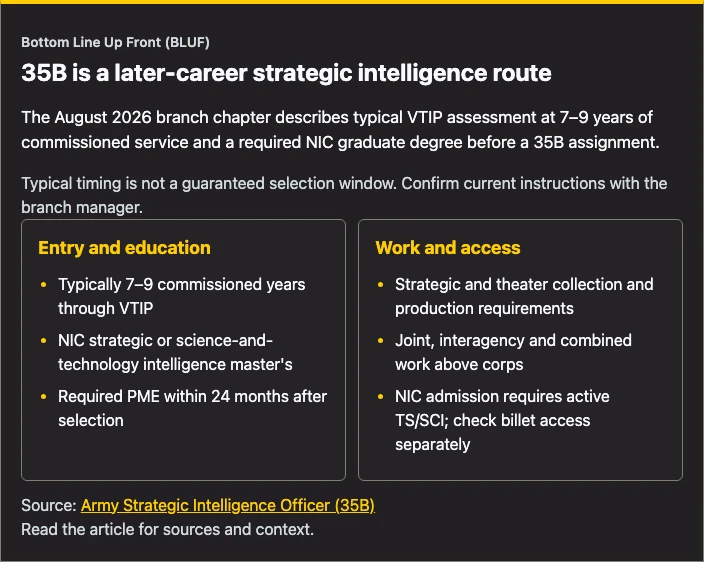
The August 2026 branch chapter describes typical VTIP assessment at 7–9 years of commissioned service and a required NIC graduate degree before a 35B assignment.
Typical timing is not a guaranteed selection window. Confirm current instructions with the branch manager.
Entry and education
- Typically 7–9 commissioned years through VTIP
- NIC strategic or science-and-technology intelligence master's
- Required PME within 24 months after selection
Work and access
- Strategic and theater collection and production requirements
- Joint, interagency and combined work above corps
- NIC admission requires active TS/SCI; check billet access separately
Source: Army Strategic Intelligence Officer (35B)
Read the article for sources and context.
On this page
Job Role and Responsibilities
Strategic intelligence officers (AOC 35B) produce the intelligence that national and theater decision makers use to set policy, allocate resources and plan campaigns.
The chapter’s duty list for the specialty is specific:
- Develops collection and production requirements
- Manages the acquisition and synchronization of strategic and theater-level intelligence
- Represents Army intelligence equities on joint staffs
- Turns analysis into products that serve Department of War and interagency requirements
The distinction from all-source work at battalion or brigade level is the customer and the time horizon. A battalion S2 answers a commander’s question about the next 72 hours. A 35B officer answers a question that may take a year to settle and that several agencies have to agree on.
Command and Leadership Scope
There is no platoon in this specialty and no company command. The chapter assigns 35B officers to positions where the leadership is over intelligence activity rather than soldiers.
At the rank of major, 35B officers serve in recurring assignments across theater, national, Department of War, joint and interagency communities. They integrate interagency intelligence activities and conduct strategic planning, collection and analysis that requires regional or functional expertise and working knowledge of the national intelligence community.
At lieutenant colonel, the work becomes managerial. The chapter describes 35B lieutenant colonels as directing and synchronizing interagency intelligence activities while overseeing the strategic planning, collection and analysis apparatus.
At colonel, a 35B officer leads strategic intelligence organizations and directs global intelligence portfolios. The chapter names the billets: joint intelligence operations center commanders, national agency and combatant command division chiefs, and branch heads.
Specific Roles and Designations
Military Intelligence has two officer areas of concentration that officers begin their careers in, 35A and 35B, and a set of skill identifiers for the single-source disciplines that a gaining unit assigns.
The practical difference is what the officer is accountable for. A 35A officer is the branch’s generalist: all-source intelligence at every echelon, from a battalion S2 section to a corps analysis and control element. A 35B officer is the specialist in strategic production, and the chapter requires a specific graduate degree before the officer is qualified to serve in a 35B assignment.
For the generalist path, read the 35A Military Intelligence officer profile. This page covers only the strategic specialty.
Mission Contribution
Army intelligence has to work at two speeds at once. Tactical formations need the threat picture now, and the institution needs judgments that survive contact with a budget cycle.
A 35B officer is the Army’s representative in the second conversation. The chapter’s duty list makes the function concrete: develop collection and production requirements, synchronize strategic and theater-level collection with planning, represent Army equities on joint staffs, and produce general intelligence products for Department of War and interagency customers.
That work decides what the Army collects, what it buys, and what it tells a combatant command to expect. The stakes differ from a tactical assessment: the supported decision may concern a theater plan or a longer-term collection priority.
Technology, Equipment, and Systems
The work depends on classified information handling and the production and coordination processes of the supported headquarters. Specific systems and access vary by assignment; the career chapter is not a public equipment list.
Clear writing matters because decision makers need the judgment, its supporting evidence and its limits. The chapter emphasizes written and oral communication without prescribing one page length for every product.
Salary and Benefits
Base Pay (2026)
Strategic intelligence officers are paid on the standard officer scale. The grades a 35B officer holds in practice run from captain through colonel, and the table below shows 2026 monthly basic pay at representative points.
| Rank | Pay Grade | Years of Service | Monthly Base Pay | Annual Base Pay |
|---|---|---|---|---|
| Captain (CPT) | O-3 | Over 4 | $7,383 | $88,592 |
| Major (MAJ) | O-4 | Over 10 | $9,420 | $113,040 |
| Major (MAJ) | O-4 | Over 14 | $10,214 | $122,573 |
| Lieutenant Colonel (LTC) | O-5 | Over 18 | $11,714 | $140,566 |
Source: DFAS 2026 pay tables. Figures reflect the 2026 pay raise.
Special Pays
The chapter lists no special or incentive pay tied to the 35B specialty. Officers in the field may qualify for language pay if they maintain a tested proficiency, and for the standard deployment-related pays when they serve in qualifying locations. Neither is automatic, and neither is specific to this AOC.
Additional Benefits
Standard officer benefits apply. Basic Allowance for Housing varies by duty station and dependent status, and Basic Allowance for Subsistence is $328.48 a month. Health coverage runs through TRICARE.
Under the Blended Retirement System, 20 years of active service qualifies an officer for retired pay; TSP includes an automatic 1 percent contribution and up to 4 percent in matching contributions, subject to contribution and service-timing rules. Members who entered before 2018 and did not opt into BRS retain their applicable legacy retirement plan. Tuition assistance covers up to $4,500 a year while on active duty, and the Post-9/11 GI Bill applies after service.
Work-Life Balance
The schedule follows the assignment rather than the specialty. A joint staff tour in the national capital region runs on a headquarters calendar with long days and short notice taskings. A theater or deployed assignment runs on the supported command’s cycle.
Ask about the specific headquarters’ battle rhythm and deployment requirements; the AOC alone does not establish working hours.
Qualifications and Eligibility
The Voluntary Transfer Incentive Program
Entry is by assessment, not application at commissioning. The chapter states that 35B officers are typically assessed between 7 and 9 years of commissioned service through the Voluntary Transfer Incentive Program.
That window lands an officer in the grade of captain, usually after key developmental service. It means the decision to specialize comes after an officer has already done the tactical work that the specialty depends on.
One sentence in the same chapter section is worth reading carefully. It says Military Intelligence officers begin their careers as 35A or 35B. Read together with the VTIP sentence, the ordinary route is a later assessment, and the chapter does not describe a lieutenant pipeline into 35B.
Graduate Education Requirement
This is the hardest gate in the specialty and it is not negotiable at the unit level. Every 35B must hold a Master of Science in Strategic Intelligence or a Master of Technical Intelligence from the National Intelligence College before serving in a 35B assignment.
The National Intelligence College programs are one year, resident in the national capital region. Selection sends an officer to graduate school as a utilization move, not as an optional credential.
Professional Military Education Clock
Selection starts a clock. The chapter gives officers 24 months after selection for 35B to complete required professional military education, and names the Commanding General, U.S. Army Intelligence Center of Excellence as the sole waiver authority.
Clearance and Access
Security requirements must be checked separately from professional qualifications. The National Intelligence College admissions page requires applicants to obtain and maintain active TS/SCI access and the current required indoctrinations before applying.
That is a graduate-program admission condition, not a substitute for checking the clearance and access requirements of a specific 35B billet. Serving officers should confirm sponsorship, access and school eligibility with their security office and career manager before planning the graduate year.
Work Environment
Echelons Above Corps
The chapter places 35B work at echelons above corps, in interagency, joint and combined settings. That is a description of the building as much as the job. The officer works in a headquarters where the Army is one customer among several and where the answer has to survive review by people who do not wear a uniform.
Joint and Interagency Settings
Representing Army intelligence equities on a joint staff is a diplomatic job with an analytic core. The officer has to know what the Army needs, understand what the other services and agencies are producing, and argue for the Army position without overstating what the intelligence supports.
How It Differs From a Battalion S2
A battalion S2 owns a section, a commander’s trust and a 24-hour battle rhythm. A 35B officer owns a problem set. The tempo is slower and the consequences are longer, and officers who need daily feedback from a commander often find the transition harder than the coursework.
Training and Skill Development
The National Intelligence College
The chapter describes two one-year graduate programs in the national capital region. The Master of Science in Strategic Intelligence focuses on globalization and intelligence for national security. The Master of Science and Technology Intelligence focuses on the strategic nature of analysis within one of five areas of concentration:
- weapons of mass destruction
- information operations and cyber
- emerging and disruptive technologies
- geostrategic resources and the environment
- foreign denial and deception
On completion, officers are prioritized for utilization at theater Military Intelligence brigades, Army service component commands, or joint and interagency positions as intelligence officers.
Intermediate and Senior Education
The chapter requires a joint professional military education one level producing course for majors and encourages joint professional military education two for lieutenant colonels. Colonels complete joint professional military education two through the Senior Service College or an equivalent producing course.
Adjacent Programs
The chapter lists several intelligence programs an officer may apply for, and generally allows participation in only one of them. They include the Army Intelligence Development Program with its counterintelligence and cyber tracks, the Junior Officer Cryptologic Career Program, and the Junior Officer Geospatial Intelligence Program. None of them substitutes for the 35B graduate requirement.
Self-Development
The chapter asks majors to pursue publication in academic and professional journals, on the reasoning that writing for a demanding audience sharpens analytic judgment. For a specialty whose output is written assessment, that is not a soft recommendation.
Career Progression and Advancement
Key Developmental Assignments by Grade
Every 35B assignment is key developmental at every grade, which is unusual and simplifies the career map. The table below uses the chapter’s own descriptions.
| Grade | Key developmental assignments | What the officer does |
|---|---|---|
| Major | Recurring assignments in theater, national, DOD, joint and interagency communities | Integrates interagency intelligence activities, conducts strategic planning, collection and analysis |
| Lieutenant Colonel | Intelligence managerial assignments across theater, national, joint and interagency | Directs and synchronizes interagency intelligence activities and oversees the planning, collection and analysis apparatus |
| Colonel | JIOC commander, national agency and combatant command division chief, branch head | Leads strategic intelligence organizations and directs global intelligence portfolios |
Promotion
Promotion follows the standard officer boards. The chapter describes the assignments that make an officer competitive and does not publish selection rates for the specialty, so none are claimed here.
Building a Competitive Record
The pattern the chapter implies is consistent. Officers who complete the graduate program, serve the utilization assignment it earns them, and then take the interagency and joint positions the specialty exists for are the ones the descriptions fit. An officer who treats the 35B code as a title rather than a posting pattern will not match the billets at lieutenant colonel and colonel.
Physical Demands and Medical Evaluations
The specialty has no separate physical test. Officers meet the standard Army officer fitness and medical requirements, including the Army Fitness Test that replaced the ACFT on 1 June 2025 and the medical standards in AR 40-501.
The chapter states nothing specific to 35B physical demands, and this page does not invent a standard. The honest description is that the daily work is sedentary and intellectually demanding, while deployment and theater assignments still require an officer who can meet the Army’s baseline.
Deployment and Duty Stations
Where the Work Sits
Strategic intelligence concentrates where national agencies and joint headquarters are. The chapter’s graduate program places officers in the national capital region for a year, and its utilization guidance points to theater Military Intelligence brigades, Army service component commands, and joint or interagency positions.
Deployment Reality
The chapter does not list deployment lengths for 35B officers, so no figure is claimed. What it does describe is work in combined and joint environments, which in practice means theater and forward headquarters assignments alongside the national ones.
Risk, Safety, and Legal Considerations
The risks in this specialty are professional rather than physical, and they are serious.
- Classification discipline. An officer who mishandles sources or methods ends careers and damages collection that took years to build.
- Analytic integrity. Strategic assessment is used to justify budgets and force structure, which creates pressure to tell a senior customer what supports a decision already made.
- Legal and policy limits. Officers at this level are expected to know where the limits on collection and on the use of intelligence sit, and to say so in a room where saying so is inconvenient.
Impact on Family and Personal Life
The pattern that shapes family life is the national capital region tour and the joint utilization that follows it. A resident graduate year plus a headquarters assignment is a period of relative stability compared with repeated tactical deployments, and it is also a period of intense hours.
Families considering the move should ask about the school and the utilization assignment together, including whether they involve separate moves.
Reserve and National Guard
The chapter portion captured for this page covers active component development, and it does not describe a Reserve or National Guard route into 35B. That is a stated limit, not a finding that no such route exists.
What is documented on this site is the broader component picture for Military Intelligence officers, which the 35A profile covers. Reserve and Guard officers considering strategic intelligence should confirm the current AOC rules with their branch manager before planning around them.
Post-Service Opportunities
A 35B officer leaves with two things that are hard to buy: a graduate degree in strategic intelligence from the National Intelligence College and a record of producing assessments that national and joint customers used.
The civilian destinations are the intelligence community, cleared industry, and the policy and analysis shops that support both. The degree carries weight in that market because it is a resident program with a strategic curriculum rather than a certificate.
This page does not quote salary figures for those roles. Civilian job titles, employers, access requirements and locations vary, so applicants should compare actual vacancies rather than assume one civilian salary follows from the AOC.
Is This a Good Job for You? The Right (and Wrong) Fit
Ideal Candidate Profile
You will do well here if you like a problem that takes a year, if you write well under review, and if you are comfortable being the person who says the evidence does not support the plan. The specialty rewards officers who read widely, keep their sources straight, and can defend a judgment in a room full of people with different interests.
The chapter’s own emphasis on critical thinking, embracing ambiguity and collaboration describes the temperament better than any list of skills.
Potential Challenges
The transition is harder than it looks. Officers who loved commanding soldiers find the headquarters pace slow and the wins invisible. The graduate year is a real academic workload in the middle of a career.
The strategic specialty also differs from the ordinary company-command path, which matters when comparing career plans.
Career and Lifestyle Alignment
If you want to command at battalion and brigade level, stay in the generalist 35A path, where those billets exist. If you want to be the Army’s expert on a region or a problem set at the national level, 35B is the route, and the chapter’s assignment descriptions show what that career actually looks like.
More Information
Your branch manager and the Military Intelligence proponent at the Intelligence Center of Excellence are the authorities on the current VTIP window and board schedule. The chapter sets the requirements. The military personnel message sets the timing.
- Current 35A generalist route and branch basics: 35A Military Intelligence officer profile
- Commissioning options before any of this applies: how to become an officer
- OCS candidates need a General Technical score of 110, covered in the ASVAB for OCS guide