31A Military Police Officer
Most Army officer branches ask you to pick one thing and get good at it. Military Police officers do two completely different jobs depending on where they are. On an installation, you run law enforcement operations: patrol, investigations, traffic enforcement, and crime prevention. Downrange, your unit shifts to combat support: maneuver and mobility, area security, enemy prisoner of war operations, and internment/resettlement. Very few career fields require that range. The 31A branch builds officers who can lead both, and the transition out is one of the strongest in uniform, with a direct pipeline to the FBI, DEA, Secret Service, ATF, and Customs and Border Protection.
OCS candidates need a GT score of 110 on the ASVAB — our ASVAB for OCS guide covers exactly how to hit that number.
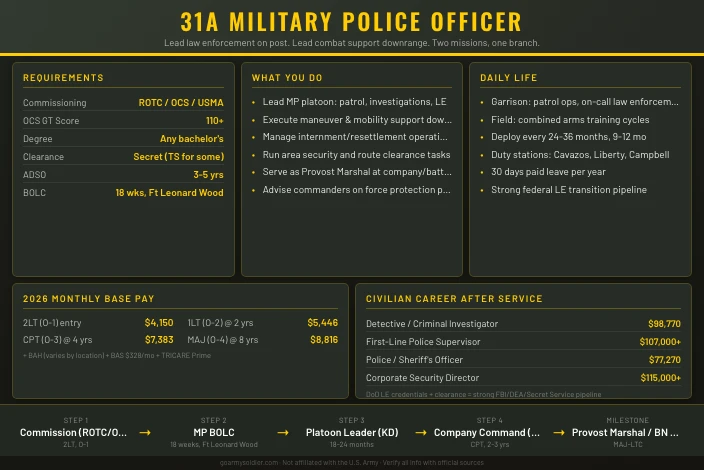
Job Role and Responsibilities
Military Police officers (AOC 31A) lead units responsible for law enforcement on Army installations and combat support operations in deployed environments. At the platoon level, they command 30 to 45 soldiers conducting patrol, investigations, and physical security. At the company level, they manage an entire law enforcement or detention operation. Senior MP officers serve as Provost Marshals, running installation security at major Army posts or advising commanders at brigade and above.
Command and Leadership Scope
As a new 2LT, you take command of an MP platoon within weeks of completing BOLC. That platoon runs garrison patrol operations or trains for one of the four core MP functions: maneuver and mobility support, area security, internment/resettlement, or law enforcement and crime prevention. At company command as a CPT, you own the full operation, including personnel management, readiness reporting, and commander accountability for everything your unit does. Field grade MP officers (MAJ and above) shift to staff work and Provost Marshal roles, advising installation commanders on force protection, physical security plans, and law enforcement policy.
Specific Roles and Designations
| Designation | Title | When Assigned |
|---|---|---|
| 31A | Military Police Officer | All commissioned MP officers |
| FA 31 | Military Police (Functional Area) | Post-KD broadening option |
| SI 9A | Airborne | After completing Airborne School |
| SI 5P | Master Parachutist | After qualifying jumps |
| SI 5Q | Ranger Tab Qualified | After completing Ranger School |
| SI 2S | SERE Trained | After Level C SERE course |
Mission Contribution
The MP branch fills a gap no other branch covers: the Army needs law enforcement expertise both in garrison and in combat. On post, MP officers reduce crime, manage traffic, and run detention facilities for confinement. In combined arms operations, MP units free maneuver commanders from security and detention tasks, enabling faster operational tempo. During stability operations, MP units stand up host-nation police forces and manage large-scale internment of enemy combatants.
Technology, Equipment, and Systems
MP officers work with the Force XXI Battle Command Brigade and Below (FBCB2/Blue Force Tracker) for tactical situational awareness and the Army Crime Records Center (ACRC) for criminal history checks. At the patrol level, officers manage vehicle-mounted communications systems, digital dispatch platforms, and evidence management software. Provost Marshal offices use installation security cameras, access control systems, and biometric databases tied into DoD identity networks. MP officers conducting internment operations use the Biometric Automated Toolset System (BATS) for detainee processing.
Salary and Benefits
Financial Benefits
MP officers earn standard commissioned officer pay based on grade and years of service. No aviation, hazardous duty, or special duty assignment pay attaches automatically to the 31A branch, though individual assignments (airborne unit, SERE-qualified positions, special duty) may qualify. There is no branch-specific accession bonus for 31A as of early 2026; check with your recruiter for the most current incentive status, as officer bonuses change quarterly.
| Grade | Title | Less than 2 yrs | 4 yrs | 8 yrs | 12 yrs |
|---|---|---|---|---|---|
| O-1 | Second Lieutenant (2LT) | $4,150 | $5,222 | – | – |
| O-2 | First Lieutenant (1LT) | $4,782 | $6,485 | – | – |
| O-3 | Captain (CPT) | $5,534 | $7,383 | $8,126 | $8,788 |
| O-4 | Major (MAJ) | $6,295 | $7,881 | $8,816 | $9,888 |
Source: DFAS 2026 pay tables. Rates effective January 1, 2026, reflecting a 3.8% raise per the FY2026 NDAA.
Additional Benefits
Officers receive TRICARE Prime at no premium cost, covering medical, dental, vision, mental health, and prescriptions for the entire family. Basic Allowance for Housing (BAH) varies by duty location and dependency status; an O-3 at Fort Sam Houston, TX earns approximately $2,007/month without dependents and $2,127/month with dependents. Basic Allowance for Subsistence (BAS) for officers is $328.48/month flat.
The Blended Retirement System (BRS) applies to all officers commissioned after January 1, 2018. It pays 40% of your high-36 average basic pay at 20 years, plus TSP matching up to 5% of basic pay. Continuation Pay at the 7-12 year mark adds a lump sum multiplied 2.5 to 13 times your monthly basic pay in exchange for three more years of service. Officers also receive 30 days paid leave per year and up to $4,500 annually in Tuition Assistance for off-duty education.
Work-Life Balance
Garrison schedules for MP officers follow standard duty hours with on-call requirements tied to the installation law enforcement mission. Field exercises and pre-deployment training cycles change that significantly, running 12-plus-hour days for weeks at a time. Deployed MP officers managing internment operations or supporting combat units work irregular schedules driven by operational tempo. Between deployments, the work pace typically returns to predictable hours, though staff positions at Provost Marshal offices can carry heavy administrative loads.
Qualifications and Eligibility
Commissioning Sources
MP officers commission through ROTC, Officer Candidate School (OCS), or the United States Military Academy (West Point). Direct Commission into 31A is not available. All three paths lead to the same starting point: 2LT branched MP, followed by BOLC at Fort Leonard Wood.
ROTC is the largest source of MP officers. Cadets compete for branch selection during their senior year using an Order of Merit List (OML) that weights GPA, physical fitness, leadership ratings, and ROTC performance. MP is not a highly competitive branch like Infantry or Special Forces, but cadets near the top half of their class reliably branch MP when they request it.
OCS accepts active-duty enlisted soldiers, National Guard and Reserve candidates, and civilians with a completed four-year degree. Enlisted soldiers attending OCS need a GT score of 110 or higher on the ASVAB. Civilian OCS candidates do not take the ASVAB.
West Point graduates branch by OML with input from the Branching Assignment Team. MP is available to all cadets.
| Commissioning Source | GPA Minimum | Degree Requirement | Age Limit | Physical Standard |
|---|---|---|---|---|
| ROTC | 2.0 cumulative | Any bachelor’s degree | 31 at commissioning | Pass AFT; DODMERB physical |
| OCS (Active) | 2.0 cumulative | Any bachelor’s degree | 32 at commissioning | Pass AFT; MEPS physical |
| OCS (Reserve/Guard) | 2.0 cumulative | Any bachelor’s degree | 35 at commissioning | Pass AFT; MEPS physical |
| West Point | Competitive | N/A (degree conferred) | 23 at entry | Pass AFT; DodMERB physical |
Age limits reflect standard Army policy; waivers are available case-by-case.
Test Requirements
OCS candidates with prior enlisted service must have an ASVAB GT score of 110 or higher. This is the standard officer threshold, not an MP-specific requirement. There is no additional aptitude test required for the 31A branch. The SIFT is not required unless the officer later pursues aviation qualification.
Branch Selection and Assignment
ROTC and West Point cadets choose branches through a competitive OML process. The Army publishes branch fill data annually; MP consistently fills without requiring top-tier OML ranking. Cadets who want a specific initial duty station or unit type should discuss preferences with their branch manager at HRC.
Officers can request a branch detail, starting their career in a combat arms branch (typically Infantry) before reverting to their base branch later. MP officers occasionally detail into Infantry or Armor, though this is less common than in Aviation or other technical branches.
Upon Commissioning
All new MP officers commission as Second Lieutenants (O-1). The standard Active Duty Service Obligation (ADSO) is 3 years for ROTC scholarship recipients and OCS graduates. West Point graduates owe 5 years. Selecting BOLC at a follow-on assignment or accepting a branch-of-choice incentive may extend the obligation. Officers who incur an advanced civil schooling benefit owe additional time equal to the program length.
OCS candidates can find a focused GT study plan in our ASVAB for OCS guide.
Work Environment
Setting and Schedule
A new MP platoon leader splits time between the motor pool, the patrol base, the range, and the classroom. In garrison, that means supervising day and night patrol shifts, conducting law enforcement training, and managing the administrative work of a platoon: counseling records, equipment readiness reports, leave requests. In a deployed environment, the work shifts to operations orders, patrol debriefs, and coordination with higher headquarters on detainee transfers or route clearance.
Provost Marshal offices have a more office-heavy tempo, but they carry real operational weight: writing the installation’s physical security plan, coordinating with local civilian law enforcement agencies, managing the access control program for thousands of personnel. Staff jobs at the G3 or corps level look more like traditional planning work with late hours tied to exercise and deployment cycles.
Leadership and Chain of Command
As a platoon leader, you work directly under a company commander (CPT) and alongside a platoon sergeant (SFC). That NCO relationship is the most important professional dynamic of your early career. Your platoon sergeant has years of operational experience and knows the soldiers. You bring planning authority, officer accountability, and the commission. The best PL-PSG teams share information openly and divide work by strength, not rank. Officers who ignore their PSG’s judgment early tend to make expensive mistakes.
At company command, you own the mission entirely. The battalion S3 gives you tasks; how you execute is your call. Your first sergeant (1SG) manages the enlisted force; you set the command climate and sign every serious document.
Staff vs. Command Roles
The Army’s standard timeline puts officers in command about 30 to 40 percent of their career; the rest is staff work or broadening assignments. After platoon leader time, a 1LT typically moves to a battalion staff position (S1, S2, S3, or S4) before company command. Post-command MAJs fill brigade staff jobs or attend intermediate-level education. The staff grind is real, but it’s where officers build the planning skills that determine how effective they are in command.
Job Satisfaction and Retention
MP officers who stay beyond their initial obligation typically cite two reasons: genuine interest in the law enforcement mission and strong post-service career options. Those who leave often mention the deployment tempo and the difficulty of managing a garrison law enforcement mission that never stops. The branch has a stable retention environment; MP does not face the same officer shortfalls as combat arms branches, which means promotion boards are competitive but not desperate.
Training and Skill Development
Pre-Commissioning Training
ROTC cadets complete four years of leadership labs, field training exercises, and a Leader’s Training Course (LTC) between junior and senior year. OCS compresses commissioning training into 12 weeks at Fort Moore, GA, covering tactics, leadership under stress, land navigation, and Army values. West Point is a four-year program that combines an accredited bachelor’s degree with commissioned officer preparation.
Basic Officer Leader Course (BOLC)
All new MP officers attend the MP BOLC at Fort Leonard Wood, Missouri, run by the U.S. Army Military Police School’s Command and Tactics Division. The course is 18 weeks long and assigns students to B Company, 701st Military Police Battalion.
| Phase | Location | Length | Focus |
|---|---|---|---|
| Phase I | Fort Leonard Wood, MO | ~4 weeks | Army officer fundamentals, land navigation, tactics basics |
| Phase II | Fort Leonard Wood, MO | ~10 weeks | MP branch tactics, law enforcement operations, detention operations |
| Phase III | Fort Leonard Wood, MO | ~4 weeks | Leadership integration, field exercises, culminating training events |
BOLC teaches the four core MP functions in depth: maneuver and mobility support (route clearance coordination, convoy security), area security, internment/resettlement operations, and law enforcement/crime prevention. Students conduct live patrol exercises, process simulated detainees, and plan law enforcement operations from scratch. Students complete mandatory online pre-course modules before arriving at Fort Leonard Wood.
Professional Military Education (PME)
Captain’s Career Course (CCC) for MP officers runs at Fort Leonard Wood. Timing is typically around the 4-6 year mark, before or after company command. The course deepens tactical and technical knowledge and prepares officers for staff responsibilities at battalion and brigade level.
Intermediate Level Education (ILE) at the Command and General Staff College (CGSC), Fort Leavenworth, KS, is a major milestone. Selection for resident ILE is competitive and signals the Army’s intent to promote an officer to LTC. Most officers attend ILE at the 10-12 year mark. Non-resident options are available for officers not selected for resident attendance.
Senior Service College (SSC), including the Army War College at Carlisle Barracks, PA, is available to COL-select and BG candidates. Selection is highly competitive and based on an officer’s overall record.
Additional Schools and Training
MP officers have strong access to additional training that builds the operational and federal credentialing resume:
- Airborne School (3 weeks, Fort Moore, GA): common for MP officers assigned to airborne or light units
- Ranger School (61 days, Fort Moore, GA): competitive; not required but valued for promotion
- Air Assault School (10 days, Fort Campbell, KY): available for officers at air assault installations
- Advanced Law Enforcement Training: specialized criminal investigation, use-of-force, and corrections courses through the MP School
- DoD Law Enforcement Credentialing: MP officers who meet DoD Directive 5525.5 requirements earn law enforcement credentials recognized across federal agencies
The Army also offers fully funded graduate education through the Advanced Civil Schooling (ACS) program for select officers, typically at the 8-12 year mark. Past programs have sent MP officers to criminology, criminal justice, and public administration programs at civilian universities.
Before OCS, you need a qualifying GT score — see our ASVAB for OCS guide.
Career Progression and Advancement
Career Path
The standard MP officer career runs from platoon leader at 2LT through battalion command at LTC, with a roughly predictable set of key developmental (KD) positions at each level.
| Rank | Typical Time-in-Grade | Key Developmental Position |
|---|---|---|
| 2LT (O-1) | 18 months | MP Platoon Leader |
| 1LT (O-2) | 18 months | Battalion staff (S1/S2/S3/S4) |
| CPT (O-3) | 4-5 years | Company Commander (KD), then battalion staff |
| MAJ (O-4) | 4-5 years | Battalion S3 or XO (KD), Installation Provost Marshal staff |
| LTC (O-5) | 4-5 years | MP Battalion Commander (KD), Brigade XO |
| COL (O-6) | Varies | MP Brigade Commander, Installation Provost Marshal, OPMG |
Promotion from O-1 to O-3 is essentially time-based with satisfactory performance. O-4 and above is board-selected.
Promotion System
Promotion to CPT happens at roughly the 3-4 year mark for officers who meet standards. MAJ is the first competitive board, with Army-wide selection rates historically running around 80 percent for well-performing officers. LTC selection tightens to around 70 percent, and COL selection runs closer to 50 percent. Officers competing for O-4 and above need completed KD positions, strong Officer Evaluation Reports (OERs), and ideally a graduate degree and additional military schooling on their record.
Branching Out and Functional Areas
After company command, CPTs and early MAJs can apply for Functional Areas (FA), which are specialty tracks outside the branch’s core tactical mission. Relevant FAs for MP officers include:
- FA 49 (Operational Research/Systems Analysis): data-driven staff work at Army headquarters
- FA 50 (Force Management): force structure and organization analysis
- FA 51 (Acquisition): managing defense contracting and procurement programs
Branch transfers are possible through the Voluntary Transfer Incentive Program (VTIP) or the Inter-Service Transfer program. Some MP officers transfer to the Military Intelligence or Judge Advocate branches. Broadening assignments outside the branch include ROTC instructor duty, recruiting battalion command, joint staff billets at combatant commands, and Congressional Fellowship programs.
Building a competitive file means: strong platoon leader OERs, completing Ranger School or Airborne before the MAJ board, finishing a graduate degree before ILE, and getting into command on time.
Physical Demands and Medical Evaluations
Physical Requirements
All Army officers, regardless of branch, take the Army Fitness Test (AFT), which replaced the ACFT on June 1, 2025. The AFT has five events scored 0-100 each, with a maximum of 500 points. Officers must pass all five events.
| Event | Abbreviation | Minimum Score (60 pts) |
|---|---|---|
| 3 Rep Max Deadlift | MDL | 60 points |
| Hand Release Push-Up | HRP | 60 points |
| Sprint-Drag-Carry | SDC | 60 points |
| Plank | PLK | 60 points |
| Two-Mile Run | 2MR | 60 points |
General passing standard: 300 total points (60 per event), sex- and age-normed. The AFT is administered at least twice per year.
The 31A branch does not carry a combat specialty designation requiring the higher 350-point standard. Officers assigned to airborne or Ranger-qualified units are expected to maintain higher personal fitness standards as a matter of professional expectation, though the formal test threshold remains the general standard.
Medical Standards and Clearance
MP officers need at least a Secret security clearance upon commissioning. Many Provost Marshal and staff assignments, particularly those involving criminal intelligence or access to law enforcement databases, require a Top Secret clearance. The investigation process begins at MEPS or the commissioning source; a clean financial history and no significant criminal record are the main factors.
There is no branch-specific medical standard beyond the standard commissioned officer physical. Officers with corrected vision, controlled medical conditions, or pre-existing injuries may still commission with a medical waiver if otherwise qualified.
Deployment and Duty Stations
Deployment Details
MP units deploy on a standard Army rotation cycle, typically 9-12 months deployed followed by a dwell period at home station. Combat deployments, peacekeeping and stability operations, and rotational training missions all fall within the MP mission set. Internment/resettlement missions have historically driven long deployments with high operational tempo. Area security and law enforcement training missions in support of partner nations represent a growing portion of MP deployment taskings.
Officers typically have more control over their deployment profile than enlisted soldiers, though HRC assignments ultimately drive timing. Platoon leaders and company commanders deploy with their units. Field-grade officers may deploy to staff positions at division or corps headquarters rather than with an MP unit directly.
Duty Station Options
MP officers serve at most major Army installations in the CONUS and OCONUS. Primary duty station options include:
- Fort Cavazos, TX: large MP presence supporting III Corps
- Fort Liberty, NC: 16th MP Brigade (Airborne) for airborne-qualified officers
- Fort Campbell, KY: 716th MP Battalion supporting 101st Airborne Division
- Fort Moore, GA: training base with MP School and TRADOC billets
- Fort Wainwright, AK and Schofield Barracks, HI: OCONUS options with unique operational environments
- OCONUS: Germany (USAREUR), Korea (USFK), and Japan (USARPAC) all maintain MP units
HRC manages officer assignments through a preference sheet system. Officers submit preferences; the branch manager makes the final call based on fill requirements and officer record. Early career officers have less leverage; post-command officers with strong records get more consideration.
Risk, Safety, and Legal Considerations
Job Hazards
MP officers face the physical risks common to all Army officers: training accidents, vehicle incidents during field exercises, and combat exposure during deployments. The law enforcement mission adds a specific layer of risk: direct confrontation with armed individuals on installations is rare but real. MP officers in internment/resettlement operations manage large detainee populations under rules of engagement that require precise judgment. Mistakes in that environment carry serious legal exposure.
The command responsibility risk for MP officers is particularly acute. Because they manage law enforcement operations, their unit’s use of force is under constant scrutiny. An improper use of force by a subordinate soldier creates a paper trail that comes back to the officer.
Safety Protocols
MP officers apply Composite Risk Management (CRM) to all training and operational planning. Law enforcement operations follow Rules for the Use of Force (RUF) standards codified in Army regulations and SOFA agreements overseas. Detention operations follow Army Field Manual 2-22.3 on human intelligence collection and the DoD Detainee Program directive.
Legal and Command Responsibility
Officers hold authority under the Uniform Code of Military Justice (UCMJ) and are accountable for the conduct of their soldiers. For MP officers, that accountability extends to how their unit exercises law enforcement authority. Improper searches, use of force violations, or civil rights issues involving unit soldiers can result in Article 15, relief for cause, or criminal prosecution depending on severity.
Relief for cause (a negative OER citing commander’s relief) effectively ends an officer’s promotion prospects. The Army’s Equal Opportunity program and command climate surveys are part of the regular accountability framework; poor command climate scores draw senior leadership scrutiny. Officers who maintain clear standards, document their counseling, and build a legitimate command climate record protect themselves from false accusations and institutional exposure alike.
Impact on Family and Personal Life
Family Considerations
MP officers move roughly every 2-3 years as assignments cycle through platoon leader, staff, and command rotations. That PCS tempo is consistent with most Army branches and requires families to rebuild schools, friendships, and employment with each move. The Army Career and Alumni Program (ACAP) and Army Community Service (ACS) provide relocation support, spouse employment assistance, and family counseling at most installations.
Family Readiness Groups (FRGs) are active in MP units and serve as the primary communication bridge during deployments. The law enforcement mission means officers may work irregular hours in garrison, particularly when on call for incident response. That schedule is harder to predict than a standard training day and can affect family routines.
Dual-Military and Family Planning
Dual-military couples with both partners in the Army can request a join spouse assignment, which HRC processes alongside both officers’ normal assignment requests. Success depends on both partners being needed at the same installation; MP officers have an advantage because MP units exist at nearly every major post. Childcare during field exercises and deployments is covered through the Child Development Center (CDC) network on post and the Army’s Child Care in Your Neighborhood program for families near off-post housing.
Reserve and National Guard
Component Availability
The 31A branch is available in both the Army Reserve and the Army National Guard. MP command billets exist at every level: platoon, company, battalion, and brigade. The 200th MP Command (Army Reserve) and multiple Guard MP brigades and battalions provide a full career track in the part-time component. Guard MP officers frequently support state emergencies involving crowd control, disaster response, and critical infrastructure protection.
Commissioning Paths
Reserve component officers commission through ROTC with a Reserve-component contract, state OCS programs (for National Guard), or by transferring from active duty after their ADSO. Direct accession into Reserve/Guard as an MP officer is possible through state OCS if the state has an MP unit with vacant officer billets. Active-duty MP officers who leave service can apply for a Reserve or Guard commission, maintaining their grade if applying within a reasonable time of separation.
Drill and Training Commitment
The standard Reserve/Guard commitment is one weekend per month (four Unit Training Assemblies) plus two weeks of Annual Training. MP units frequently add proficiency training days tied to law enforcement certification requirements: use of force, firearms qualification, and detention operations standards require regular hands-on practice beyond the minimum drill schedule. Expect 15-20 additional training days per year compared to non-law-enforcement Reserve branches.
Part-Time Pay
A Reserve or Guard MP officer at O-3 earns approximately $738/weekend (4 drill periods) at less than 2 years of service, or approximately $903/weekend at the 3-year mark. Active-duty O-3 base pay by comparison is $5,534 to $9,004/month depending on years of service. Drill pay covers the weekend commitment only; Annual Training is paid at the full active-duty daily rate for 14 days.
Benefits Differences
| Category | Active Duty | Army Reserve | Army National Guard |
|---|---|---|---|
| Commitment | Full-time | 1 weekend/month + 2 weeks AT | 1 weekend/month + 2 weeks AT |
| Monthly pay (O-3, <2 yrs) | $5,534 | ~$738/weekend | ~$738/weekend |
| Healthcare | TRICARE Prime ($0 premium) | TRICARE Reserve Select ($57.88/mo individual) | TRICARE Reserve Select ($57.88/mo individual) |
| Education | TA ($4,500/yr) + Post-9/11 GI Bill | Federal TA + MGIB-SR ($493/mo) | Federal TA + MGIB-SR + state tuition waivers (varies) |
| Deployment tempo | Regular (9-12 mo every 24-36 mo) | Periodic mobilization | State missions + federal mobilization |
| Command billets | Full ladder (PL to BDE CDR) | Company, battalion, brigade | Company, battalion, brigade, state |
| Retirement | 20-yr pension at 40% high-36 | Points-based, collect at 60 | Points-based, collect at 60 |
Deployment and Mobilization
Reserve and Guard MP units mobilize regularly. Historical mobilization tempo has averaged one 9-12 month deployment per 3-5 years for MP units. Guard MP units also deploy for domestic missions under state orders, including natural disaster response and civil unrest support, which do not count toward the federal deployment numbers. ADOS (Active Duty for Operational Support) tours are common for Reserve MP officers with strong records who want to fill active-duty gaps.
Civilian Career Integration
MP Reserve/Guard officers in law enforcement careers have one of the strongest civilian-military alignment profiles in the Army. A civilian cop or federal agent who serves as a Reserve MP officer brings directly applicable skills to both jobs. USERRA protections guarantee reemployment rights after mobilization for all employers regardless of size. Many federal law enforcement agencies actively credit Reserve and Guard service toward federal hiring preferences and time-in-service calculations.
Post-Service Opportunities
Transition to Civilian Life
The 31A career field builds a credential set that translates directly to federal law enforcement: use of force authority, detention operations management, criminal investigation experience, and DoD law enforcement credentials. The transition pipeline from MP officer to federal agency is well-worn.
Transition programs include Skillbridge (DoD internship program during the last 180 days of service), Hiring Our Heroes corporate fellowships, and the Army’s Soldier for Life Transition Assistance Program (SFL-TAP). Federal agencies with direct application from the MP officer background include the FBI, DEA, Secret Service, ATF, CBP, and USMS. Many of these agencies have specific veteran hiring initiatives and grant preference points for active-duty service.
Civilian Career Prospects
| Civilian Career | Median Annual Salary (BLS, May 2024) | Job Outlook (2024-2034) |
|---|---|---|
| Detectives and Criminal Investigators | $98,770 | 3% growth |
| First-Line Supervisors of Police/Detectives | ~$107,000 | 3% growth |
| Police and Sheriff’s Patrol Officers | $77,270 | 3% growth |
| Security Managers / Corporate Security Directors | $115,000+ | Steady demand |
| Correctional Officers and Jailers | $55,690 | Declining (automation/reform) |
Source: Bureau of Labor Statistics, Occupational Outlook Handbook, May 2024 data.
Federal criminal investigator positions (GS-1811 series) at agencies like the FBI and DEA typically start at GS-10 to GS-13 depending on experience and degree, with full federal benefits and law enforcement retirement (FERS + 6c enhanced retirement at 50 with 20 years of LE service).
Graduate Education and Credentials
The Post-9/11 GI Bill covers full in-state tuition at public universities for up to 36 months, plus a monthly housing allowance at the E-5 BAH rate for the school’s ZIP code and a $1,000/year book stipend. Private school costs are covered up to $29,920.95 per academic year. Officers can transfer unused GI Bill benefits to dependents after 6 years of service, provided they commit to 4 more.
Civilian credentials that transfer from MP officer service include DoD law enforcement credentials (recognized by civilian agencies), emergency vehicle operations certification, and specialized training in criminal investigation and interview techniques. Many MP officers pursue degrees in criminal justice, public administration, or homeland security using Tuition Assistance during service, which reduces the post-service GI Bill usage needed.
Is This a Good Job for You? The Right (and Wrong) Fit
Ideal Candidate Profile
The 31A branch attracts people who want law enforcement authority and tactical leadership in the same career. Strong candidates tend to be detail-oriented planners who are also comfortable with physical and interpersonal confrontation. A background or strong interest in criminal justice, public safety, or federal service fits naturally here. Cadets who struggle to choose between a law enforcement career and military service do not have to choose.
The post-service profile matters too. If you plan to stay for 20 years, the MP branch gives you Provost Marshal experience, staff credibility, and eventually brigade command. If you plan to serve 4-8 years and transition, the federal law enforcement pipeline is genuinely strong, and the credentials you build carry weight in that hiring process.
Potential Challenges
The garrison law enforcement mission never stops. Post MP operations run around the clock, which means platoon leaders and company commanders are on call for incidents at unpredictable hours. Officers who prefer clean planning cycles and predictable field exercise calendars will find the law enforcement operations pace disruptive.
The dual mission also means training for two very different things at once. Your soldiers need to be competent patrol officers and tactical soldiers. Managing that training balance with limited time and resources is a genuine leadership challenge that does not go away.
Career and Lifestyle Alignment
Officers who want a full 20-year career will find the MP branch gives them meaningful command opportunities at every level, a genuine functional expertise in law enforcement, and a recognizable identity in the broader Army. Officers planning to leave after their initial obligation get a clearer federal hiring path than most combat arms branches offer. The transition story writes itself: MP officer with security clearance and DoD law enforcement credentials applying to the FBI or Secret Service is not a hard pitch.
The branch is not a good fit for officers who want a purely tactical identity, those who are uninterested in the law enforcement side of the mission, or those who are uncomfortable with the legal accountability that comes with police authority. If the garrison work sounds like a distraction from the real Army, look at Infantry or Armor instead.
- OCS candidates: prepare for GT 110 with our ASVAB for OCS study guide
This site is not affiliated with the U.S. Army or any government agency. Verify all information with official Army sources before making enlistment or career decisions.
More Information
Talk to an Army officer recruiter or your campus ROTC program about the 31A Military Police branch. If you’re on the OCS track, confirm your GT score before applying and ask the recruiter specifically about current officer accession incentives, which change throughout the fiscal year. The U.S. Army Military Police School at Fort Leonard Wood and GoArmy.com’s 31A page are the authoritative starting points for current requirements and course details.
Explore more Army Military Police officer careers to find related roles in law enforcement, security operations, and maneuver support.