37A Psychological Operations Officer
Forget commanding a rifle platoon or calling for fire. Psychological Operations officers fight with words, images, and ideas. Their mission is to change what people believe and what they do, without firing a shot. It’s one of the Army’s most demanding branches to get into, and once you’re in, the work looks nothing like conventional military service.
The 37A branch sits inside Army Special Operations Forces. Officers who select it go through a competitive assessment and selection program, earn a foreign language proficiency, and spend careers embedded with theater-level commanders and joint task forces influencing foreign populations. If you want to understand what makes people act and then use that knowledge as a weapon, this is the branch for you.
OCS candidates need a GT score of 110 on the ASVAB — our ASVAB for OCS guide covers exactly how to hit that number.
Job Role and Responsibilities
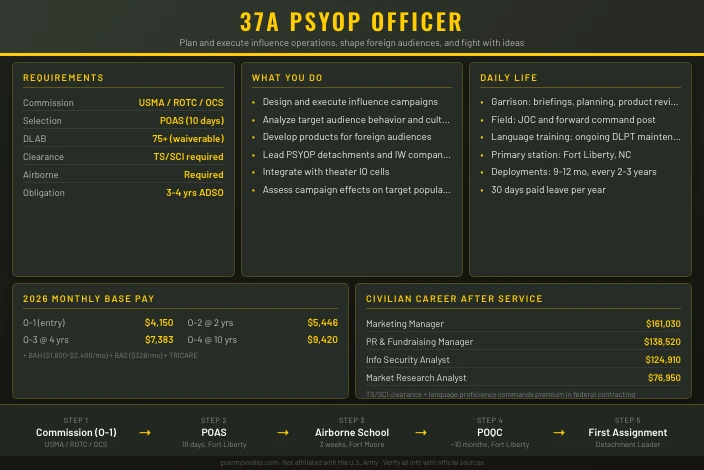
Psychological Operations officers plan, develop, and execute influence activities targeting foreign audiences to support military objectives. They analyze political, cultural, and social factors within an area of operations, design information products and campaigns, and assess their effects on target populations. At every career stage, 37A officers serve as the commander’s expert on persuasion, propaganda detection, and information environment operations.
Command and Leadership Scope
At the platoon and detachment level, a 37A officer leads a small, specialized team producing and disseminating influence products. As a Captain, the officer typically commands a PSYOP Detachment or Information Warfare Company, which functions as a company-equivalent command. At the field-grade level, officers move into battalion and group staff roles, then into command of PSYOP battalions at O-5.
Span of control at the company level is typically 20 to 60 soldiers, smaller than a conventional company but with significantly higher mission autonomy. These officers own the targeting process for influence operations, the production of tactical and strategic messaging, and the coordination with theater information operations cells.
Specific Roles and Designations
| Designation | Description |
|---|---|
| 37A | Psychological Operations Officer (primary AOC) |
| 37A SI: 3F | Special Forces Qualified PSYOP Officer |
| 37A SI: 2S | Civil-Military Operations Qualification |
| FA 39 | Information Operations Functional Area (post-KD broadening) |
Mission Contribution
PSYOP officers operate across the full spectrum of conflict. In competition, they run influence campaigns that shape adversary populations before a conflict starts. In combat, they degrade enemy morale, support tactical deception, and facilitate civilian non-combatant cooperation. The branch contributes to theater-level information environment operations and integrates with Special Forces, conventional forces, and interagency partners.
Technology, Equipment, and Systems
37A officers work with broadcast equipment, print production systems, loudspeaker platforms, and digital media tools. At the operational level, they use Army-standard command and control systems including Command Post of the Future (CPOF) and theater-level intelligence fusion platforms. TS/SCI access means regular use of classified production systems and intelligence databases not available to most Army branches.
Salary and Benefits
Base Pay (2026)
| Grade | Rank | Entry Pay | 4 Years | 8 Years |
|---|---|---|---|---|
| O-1 | 2LT | $4,150/mo | $5,222/mo | – |
| O-2 | 1LT | $4,782/mo | $6,485/mo | – |
| O-3 | CPT | $5,534/mo | $7,383/mo | $8,126/mo |
| O-4 | MAJ | $6,295/mo | $7,881/mo | $8,816/mo |
| O-5 | LTC | $7,295/mo | $8,894/mo | $9,461/mo |
| O-6 | COL | $8,751/mo | $10,245/mo | $10,725/mo |
Source: DFAS 2026 Military Pay Chart. A 3.8% raise took effect January 2026.
Special Pays and Bonuses
PSYOP officers who complete Airborne training receive jump pay (hazardous duty incentive pay) of $150 per month. Officers who achieve a Defense Language Proficiency Test rating of 2/2 or higher in a designated language earn Foreign Language Proficiency Pay (FLPP), which ranges from $100 to $500 per month depending on the language and proficiency level. Officers serving in certain Special Operations positions may qualify for Special Duty Assignment Pay.
Accession bonuses for 37A are not universally offered and depend on Army manning requirements. Check with your branch manager or recruiter for current bonus availability. The 37A branch is not consistently listed as a critical shortage branch, so substantial accession bonuses are not guaranteed.
Additional Benefits
Officer BAH varies by duty station and dependency status. At Fort Liberty, NC, the primary PSYOP installation, BAH ranges from roughly $1,800 to $2,400 per month depending on grade and whether you have dependents. BAS for officers is $328.48 per month in 2026.
Active duty TRICARE Prime covers the officer and eligible family members at $0 premiums and $0 copays. The Post-9/11 GI Bill pays full in-state tuition at public universities (up to $29,920.95 at private schools for the 2025-2026 academic year), plus a monthly housing allowance and $1,000 annual book stipend, for up to 36 months. Officers can transfer benefits to dependents after 6 years of service with a 4-year additional obligation.
Retirement under the Blended Retirement System (BRS) pays 40% of your high-36 average base pay at 20 years. The government contributes up to 5% of base pay to your Thrift Savings Plan account. Officers between 7 and 12 years of service may qualify for Continuation Pay, typically 2.5x monthly base pay with a 3-year service obligation.
Work-Life Balance
Garrison life at a PSYOP unit runs standard Army hours, typically 0630 to 1700, with periodic early call times for PT, training exercises, and mission planning. Field rotations and training deployments break that rhythm. PSYOP officers preparing for deployment or attached to an operational task force can expect long hours and significant time away from home. The branch offers 30 days of paid leave annually, accumulating at 2.5 days per month.
Qualifications and Eligibility
Commissioning Sources
Officers commission into the Army through three paths before selecting a branch.
| Commissioning Source | GPA Minimum | Degree Requirement | Age Limit | Branch-Specific Notes |
|---|---|---|---|---|
| USMA (West Point) | Competitive | Any bachelor’s degree | Under 23 at commissioning | Branch selected via OML ranking |
| ROTC | 2.0 minimum (competitive ~3.0+) | Any bachelor’s degree | Under 31 at commissioning | Branch selected via OML ranking |
| OCS | No minimum (competitive ~3.0+) | Any bachelor’s degree | Under 35 at commissioning | Branch selected via board process |
All three sources produce O-1 (Second Lieutenant) at commissioning. Degrees in psychology, sociology, communications, political science, international relations, or foreign languages strengthen a candidate’s profile for the PSYOP branch, but no specific major is required.
Branch Selection and POAS
37A is a Special Operations branch under Army Special Operations Command (USASOC). Selection works differently from conventional branches.
After commissioning, candidates must volunteer and be accepted to attend the PSYOP Assessment and Selection (POAS), a 10-day evaluation at Fort Liberty. POAS tests leadership, critical thinking, public speaking, research skills, and the ability to influence groups of people. The physical aspect is real but not the primary screen. According to PSYOP recruiters, most candidates fail because they cannot demonstrate effective public speaking and on-the-spot leadership, not because they can’t pass the fitness events.
Candidates who clear POAS also need a Defense Language Aptitude Battery (DLAB) score of 75 or higher. For some language programs, a higher score is required. This test measures your raw aptitude for learning a foreign language, not prior language knowledge.
Board competitiveness: Selectees typically need a clean record, strong peer rankings, and demonstrated performance in leadership roles. The branch is small and selective. Lateral or branch-detailed entry exists in some cases, but the primary path is selection straight from commissioning.
Upon Commissioning
New PSYOP officers enter at O-1 (Second Lieutenant). The standard Active Duty Service Obligation (ADSO) for commissioning is 3 years for OCS and 4 years for USMA graduates and ROTC scholarship recipients. Additional obligations attach to specialized training, including the PSYOP Officer Qualification Course. Officers who receive a TS/SCI clearance typically incur no additional service obligation for the clearance itself, but specific training pipelines may add 1 to 2 years.
OCS candidates can find a focused GT study plan in our ASVAB for OCS guide.
Work Environment
Setting and Schedule
PSYOP officers split their time between staff offices, collaborative production environments, and the field. In garrison at Fort Liberty, daily work involves briefings, product development reviews, targeting board meetings, and coordination with intelligence and operations cells. The work is analytically intensive. You’ll spend significant time reading intelligence products, reviewing cultural assessments, and building influence campaign plans.
Field exercises and combat deployments shift the environment entirely. Officers operate from Joint Operations Centers (JOCs), forward command posts, and occasionally austere forward positions embedded with supported units. The work stays cerebral even in the field: what changes is the pace, the access to resources, and the physical conditions.
Leadership and Chain of Command
At the lieutenant level, a 37A officer typically serves as a team or detachment leader, working for a senior PSYOP officer or conventional unit S7/Information Operations officer. The relationship with the senior NCO in a PSYOP element is important. PSYOP NCOs often carry deep regional expertise and language proficiency. A lieutenant who ignores that knowledge fails. The ones who succeed treat their NCOs as subject matter experts and integrate their judgment into planning.
Staff vs. Command Roles
Most officers spend alternating tours in command and staff billets. At O-3, the primary KD position is Detachment Commander or Information Warfare Company Commander. Between command tours, officers fill brigade or division information operations staff positions, USAJFKSWCS instructor billets (minimum 24 months), or joint staff roles. At O-4 and O-5, officers move into senior staff and battalion command tracks.
Job Satisfaction and Retention
Retention among PSYOP officers varies. The branch attracts intellectually driven officers who often have strong civilian career options in communications, consulting, and government service. Officers who stay through O-5 typically do so because they value the mission and the quality of the people they work with, not because the lifestyle is easy. The branch is small enough that you know most of your peers across the force.
Training and Skill Development
Pre-Commissioning Training
ROTC cadets complete four years of military science curriculum and a summer leadership assessment (CLDC or CGSC). OCS candidates complete a 12-week course at Fort Moore, GA, covering basic officer leadership skills. USMA graduates complete a 4-year academic program integrated with military development.
PSYOP Officer Qualification Course (POQC)
After commissioning and passing POAS, new 37A officers attend the PSYOP Officer Qualification Course (POQC) at Fort Liberty, NC. The full officer education timeline runs approximately 10 months.
| Phase | Focus | Key Skills |
|---|---|---|
| In-Processing | Administrative and medical clearances, orientation | Security clearance finalization |
| Language and Culture | Foreign language instruction, cultural analysis methods | Speaking/listening proficiency, regional expertise |
| PSYOP Core | Influence theory, target audience analysis, product development | JTTP for MISO, media production, planning |
| Culmination Exercise | Mission planning and execution against a notional adversary | Full campaign planning, assessment, and execution |
| Graduation | Branch qualification awarded | 37A AOC granted |
All PSYOP officers complete Airborne School (3 weeks, Fort Moore) either before or concurrent with the qualification course pipeline. Airborne qualification is a prerequisite for assignment to airborne-designated PSYOP units.
Professional Military Education (PME)
Captain’s Career Course (CCC) for 37A officers is conducted at Fort Liberty as part of the USAJFKSWCS curriculum. It covers advanced PSYOP planning, joint operations, and the full range of Military Information Support Operations (MISO) doctrine. Timing is typically after your first assignment, around 4 to 5 years of service.
Intermediate Level Education (ILE/CGSC) at Fort Leavenworth is required for promotion to O-4 and above. Officers attend around 10 to 12 years of service. PSYOP officers who attend ILE often leverage their influence operations background to qualify for joint staff assignments afterward.
Senior Service College (War College) is competitive and reserved for senior O-5s and O-6s selected for continued service. It prepares officers for strategic-level leadership.
Additional Schools and Training
PSYOP officers pursue additional qualifications to build competitive files. Common schools include:
- Ranger School (62 days, Fort Moore): not required but significant for promotion boards
- Special Forces Qualification Course (for officers seeking the 3F SI)
- Defense Language Institute (DLI) for intensive language training if not addressed in POQC
- Joint Psychological Operations Course at Fort Liberty for refresher and joint qualification
- Fully funded graduate school is available through the Advanced Civil Schooling (ACS) program, typically accessible after company command for competitive officers
Before OCS, you need a qualifying GT score — see our ASVAB for OCS guide.
Career Progression and Advancement
Career Timeline
| Rank | Grade | Typical Timeframe | Key Positions |
|---|---|---|---|
| 2LT | O-1 | Commissioning | POAS, POQC, Airborne School |
| 1LT | O-2 | ~18 months | Team/Detachment Leader |
| CPT | O-3 | ~4 years | Detachment CDR, IW Company CDR (KD) |
| MAJ | O-4 | ~10 years | Battalion S3, Group Staff, IO Staff (KD) |
| LTC | O-5 | ~16 years | PSYOP Battalion CDR (KD) |
| COL | O-6 | ~22 years | Group CDR, Senior Staff |
Promotion System
Promotion from O-1 to O-3 is essentially time-based for officers who meet standard performance requirements. O-4 (Major) is the first board-selected promotion and is where careers begin to differentiate. O-5 and O-6 are increasingly competitive. Officers who complete the KD positions at each level, earn strong OERs from senior raters, and build joint and broadening experience fare best at selection boards.
Current Army promotion rates fluctuate year to year, but Major selection rates for the Army overall have run in the 80 to 90 percent range in recent years. Lieutenant Colonel rates drop to roughly 70 percent. Check HRC for current board results and zone data.
Building a Competitive File
- Complete company command (Detachment/IW Company) with strong ratings
- Complete a joint assignment or joint professional military education
- Earn Airborne qualification; Ranger tab is a competitive differentiator
- Build regional expertise and maintain DLAB/DLPT proficiency
- Pursue Advanced Civil Schooling (graduate degree in relevant field)
- Seek USAJFKSWCS instructor assignment for broadening and visibility
Functional Areas and Broadening
After company command, officers can apply for Functional Area 39 (Information Operations). FA 39 broadens PSYOP officers into joint IO staff roles, strategic communication planning, and senior headquarters positions. Other broadening options include recruiting command, ROTC cadre, congressional fellowship, and interagency detail assignments to organizations like the State Department or CIA.
Physical Demands and Medical Evaluations
Army Fitness Test
All 37A officers take the same Army Fitness Test (AFT) as every other soldier. The AFT replaced the ACFT on June 1, 2025. It has five events scored 0 to 100 each, with 500 points maximum.
| Event | Abbreviation | Min Score (General) |
|---|---|---|
| 3 Rep Max Deadlift | MDL | 60 |
| Hand Release Push-Up | HRP | 60 |
| Sprint-Drag-Carry | SDC | 60 |
| Plank | PLK | 60 |
| Two-Mile Run | 2MR | 60 |
The general passing standard is 300 total points (60 per event), normed by sex and age. PSYOP is not one of the 21 designated combat specialties requiring the higher 350-point sex-neutral standard. That said, officers preparing for POAS and operational assignments should train well above the minimum. POAS includes physical events, and PSYOP units are Airborne-qualified formations with meaningful physical standards.
Branch-Specific Physical and Medical Requirements
Officers must be Airborne-qualified or eligible, which requires passing an airborne physical and meeting height/weight standards. The DLAB and language instruction phases require no special medical evaluation. A TS/SCI clearance requires a Single Scope Background Investigation (SSBI) that includes a review of mental health history, foreign contacts, and financial responsibility. Officers with recent significant mental health treatment, extensive foreign contacts, or financial issues may face delays or denial.
Deployment and Duty Stations
Deployment Patterns
PSYOP officers deploy with supported units across all theaters. The operational tempo depends heavily on the geopolitical environment and the readiness cycle of the unit. Active component PSYOP units at Fort Liberty have historically deployed on 9 to 12 month combat rotations with 12 to 24 month dwell periods between. Officers attached to theater special operations commands may serve on shorter rotational deployments of 3 to 6 months.
Deployment types range from combat operations in active conflict zones to Security Force Assistance missions, theater security cooperation events, and exercises. PSYOP officers often deploy in small teams embedded with conventional or joint forces rather than with their full organic unit.
Primary Duty Stations
| Installation | Unit | Notes |
|---|---|---|
| Fort Liberty, NC | 4th PSYOP Group (Active Component) | Primary active duty PSYOP installation |
| Fort Liberty, NC | 8th PSYOP Group (Active Component) | Also at Fort Liberty |
| Twinsburg, OH | 2nd PSYOP Group (Army Reserve) | Reserve component, USACAPOC |
| Moffett Field, CA | 7th PSYOP Group (Army Reserve) | Reserve component, USACAPOC |
Fort Liberty (formerly Fort Bragg) is the center of gravity for Army PSYOP. Most active duty 37A officers will serve multiple tours there. Broadening assignments take officers to the Pentagon, joint commands overseas (EUCOM, INDOPACOM, SOCOM), and interagency positions in Washington, DC.
Assignment Process
Officer assignments are managed by HRC’s Special Operations Branch. Officers submit preference sheets, but the Army fills requirements based on force needs. Assignments to USAJFKSWCS have a minimum 24-month tour length. Joint and interagency assignments typically run 2 to 3 years.
Risk, Safety, and Legal Considerations
Job Hazards
PSYOP officers face the same combat risks as other deployed officers when operating in hostile environments. The nature of influence operations means they often work in information environments that include adversary disinformation, social media manipulation, and influence campaigns targeting their own forces. Officers must stay alert to those threats and understand how they affect the force.
Command responsibility increases risk exposure. An officer who directs the production of influence products that violate the law of armed conflict or domestic restrictions on information operations faces serious legal consequences.
Legal and Command Responsibility
PSYOP operations are tightly regulated. Domestic information activities are restricted by law: U.S. law prohibits using PSYOP products to target domestic audiences. Officers must understand the legal boundaries between foreign-targeted influence operations and anything that could reach U.S. audiences. Violations can result in relief, investigation, and criminal referral under the UCMJ.
Officers hold full accountability under the UCMJ for the actions of their soldiers and the products their units produce. A relief for cause ends a career and generates a permanent record that follows the officer through any future federal employment.
Safety Protocols
37A officers apply Composite Risk Management (CRM) to field training and deployed operations. The more distinct risk in this branch is legal compliance risk during operations. Units use pre-mission legal reviews, product approval chains, and after-action assessments to keep operations within authorized boundaries.
Impact on Family and Personal Life
Family Considerations
Fort Liberty is a large installation with a mature support infrastructure. The Army Community Service (ACS) center, Chaplain services, Family Readiness Groups, and on-post schools and childcare exist, but high demand and limited civilian employment options in the Fayetteville, NC area are real constraints. Spouse employment is a common concern; the local job market is smaller than a major metropolitan area.
PCS tempo for PSYOP officers is typical of a Special Operations branch: expect a move roughly every 2 to 3 years, with multiple Fort Liberty tours broken up by broadening and joint assignments. Families who plan well and use the Army’s relocation resources generally manage the pace. Those who don’t tend to see it accumulate into stress over a long career.
Dual-Military Couples
The Army’s joint domicile program allows co-location for dual-military couples when possible. PSYOP officers and their military spouses can request joint assignments, but the Army does not guarantee co-location, particularly in operational periods. Both officers should communicate preferences through their respective branch managers early.
Deployments and Extended Absences
Standard Army support resources apply during deployments: Family Readiness Groups (FRGs) coordinate unit-level support, Military OneSource provides free counseling and referral services, and the Army’s yellow ribbon programs support reserve component families during mobilizations. Communication access during deployments varies by location but is generally better than it was a decade ago.
Reserve and National Guard
Component Availability
The PSYOP branch has a significant Reserve component presence. Approximately 71% of Army PSYOP capacity sits in the Reserve component, primarily in the 2nd PSYOP Group (Twinsburg, OH) and 7th PSYOP Group (Moffett Field, CA), both under U.S. Army Civil Affairs and Psychological Operations Command (USACAPOC).
National Guard PSYOP officer billets exist but are limited. Some state headquarters elements maintain PSYOP officer positions, but it is a constrained career path in the Guard with few available command billets.
Commissioning Paths
Reserve component PSYOP officers commission through the same sources as active duty: ROTC with a Reserve component contract, state OCS programs, or direct commission in some cases. After commissioning, Reserve candidates still must pass POAS and complete the POQC at Fort Liberty. There is no abbreviated version of the qualification course for Reserve officers.
Active duty officers who complete their ADSO can transfer to a Reserve PSYOP unit. This is a common path for experienced officers who want to continue serving while transitioning to civilian careers.
Drill Commitment and Training
The standard Reserve commitment is one weekend per month (two days, counting as four drill periods) plus two weeks of Annual Training per year. PSYOP units often require additional training days beyond the minimum schedule due to language maintenance, technical certifications, and readiness requirements. Officers should expect a realistic commitment of 60 to 80 paid days per year in a drilling unit.
Part-Time Pay
An O-3 (CPT) with under 2 years of service earns $737.88 per drill weekend (4 drill periods). An O-3 at 3 years earns $902.72 per weekend. Annual Training pays the equivalent of 14 active duty days at the officer’s daily rate.
Benefits Comparison
| Factor | Active Duty | Army Reserve | Army National Guard |
|---|---|---|---|
| Commitment | Full-time | ~1 weekend/mo + 2 wks/yr | ~1 weekend/mo + 2 wks/yr |
| Monthly Pay (O-3) | $5,534+ | ~$738/weekend | ~$738/weekend |
| Healthcare | TRICARE Prime ($0) | TRICARE Reserve Select ($57.88/mo individual) | TRICARE Reserve Select ($57.88/mo individual) |
| Education | Post-9/11 GI Bill (full) | MGIB-SR ($493/mo) or Post-9/11 after activation | MGIB-SR + state tuition benefits (varies) |
| Deployment Tempo | High (9-12 mo rotations) | Moderate (mobilizations, ADOS tours) | Moderate; state activation possible |
| Command Billets | Full career track | Company and battalion-level billets exist | Very limited |
| Retirement | 20-year pension (40% high-36) | Points-based, collects at age 60 | Points-based, collects at age 60 |
Deployment and Mobilization
Reserve PSYOP units deploy regularly. Given the Reserve component’s share of total PSYOP capacity, mobilizations for overseas contingency operations, theater security cooperation, and operational support are common. Typical mobilizations run 9 to 12 months for combat deployments, with shorter ADOS tours for individual augmentation to active units. Officers in drilling units should expect to mobilize at least once in a career.
Civilian Career Integration
The 37A Reserve path pairs particularly well with civilian careers in communications, marketing, government affairs, public diplomacy, and intelligence. The TS/SCI clearance carries real value in the federal contractor market. Employers in defense contracting, consulting, and national security generally view an active drilling PSYOP officer as an asset, not a liability. USERRA protections ensure your civilian employer cannot penalize you for military service.
Post-Service Opportunities
Transition to Civilian Life
PSYOP officers leave service with a rare combination: strategic communication skills, foreign language proficiency, a TS/SCI clearance, and experience designing and executing complex influence campaigns. That combination opens doors in sectors most veterans don’t access. The SFL-TAP program, available 12 to 24 months before separation, helps officers translate those skills for civilian resumes. Hiring Our Heroes and the Army Career Alumni Program provide networking and placement support.
Civilian Career Prospects
| Civilian Job | Median Annual Salary | Outlook (2024-2034) |
|---|---|---|
| Marketing Manager | $161,030 | +6% (faster than average) |
| Public Relations & Fundraising Manager | $138,520 | +5% (faster than average) |
| Market Research Analyst | $76,950 | +7% (faster than average) |
| Information Security Analyst | $124,910 | +29% (much faster than average) |
Salary data from the Bureau of Labor Statistics Occupational Outlook Handbook (May 2024).
The highest-value transition paths for former 37A officers typically fall into three lanes. The first is the federal contractor and national security consulting sector, where a TS/SCI clearance and PSYOP experience commands a premium. The second is corporate communications and strategic marketing, particularly for companies operating in international markets. The third is direct government service through agencies like the CIA, State Department, or NSA, where PSYOP experience and language skills are directly applicable.
Graduate Education and Credentials
PSYOP officers who used Advanced Civil Schooling during their careers often arrive at the transition point with a funded master’s degree in hand. Those who didn’t can use the Post-9/11 GI Bill for graduate school. A master’s degree in communications, international relations, or political science combined with PSYOP experience is a strong credential for senior roles in public affairs, government consulting, and policy research.
Language proficiency from the PSYOP qualification pipeline also carries direct civilian value. A government or commercial employer who needs an officer-level communicator with regional expertise and a clearance has a very small candidate pool to choose from.
Is This a Good Job for You?
Ideal Candidate
The officers who thrive in PSYOP tend to be curious and analytical rather than purely physical. They read widely, think about why people do what they do, and can speak and write persuasively under pressure. Strong candidates usually have some background in social science, communications, or political science, and they’re interested in foreign cultures, not just tolerant of them.
The branch selects for leaders, not just analysts. If you freeze in front of a room, POAS will find it. If you can’t think clearly when someone is challenging your ideas out loud, that will show too. The ideal 37A candidate is someone who can lead a team, build a compelling argument, and adapt both on the fly.
Potential Challenges
PSYOP is a small branch. Small branches mean fewer assignments, fewer peers to compete with, and greater visibility when things go wrong. Officers who want variety in duty locations may find the Fort Liberty concentration limiting. The work can also be frustrating because it operates in ambiguous environments where effects are hard to measure and attribution is difficult. If you need clear, quantifiable results to feel productive, influence operations will test your patience.
The regulatory environment around information operations is genuinely complex. Officers who aren’t interested in the legal and policy dimensions of their work will find that dimension of the job a burden rather than an interesting constraint.
Career and Lifestyle Fit
The 37A branch suits someone who wants a career at the intersection of military service and strategic communication, not someone who primarily wants to lead infantry soldiers or operate equipment. It fits officers who value intellectual challenge and are comfortable with ambiguity. A one-and-done officer can still get a great deal out of this branch: the clearance, the language skills, and the qualification course experience carry real civilian value. Officers who stay for a full career find themselves in senior information operations roles that few civilians or conventional military officers understand.
More Information
Your ROTC battalion or OCS brigade can connect you to a PSYOP recruiter at Fort Liberty. For test prep resources relevant to the OCS path, a strong ASVAB score on the GT composite strengthens your officer candidate application. Contact the PSYOP Proponent at USAJFKSWCS for the most current POAS schedule and prerequisites.
- OCS candidates: prepare for GT 110 with our ASVAB for OCS study guide
This site is not affiliated with the U.S. Army or any government agency. Verify all information with official Army sources before making enlistment or career decisions.
Explore more Army Psychological Operations officer careers to find other PSYOP branch profiles and roles.