18A Special Forces Officer
Nobody branches Special Forces straight from ROTC or West Point. You earn that assignment after proving yourself in another branch first – and then you have to ask for it. The Army’s Green Berets are a volunteer force, and the officers who lead them got there by outperforming their peers for years before they ever walked into the Special Forces Assessment and Selection.
As an 18A Special Forces Officer, you command an Operational Detachment Alpha – a 12-soldier team that works in small groups, deep in denied or hostile territory, doing the things conventional forces cannot or will not do. Unconventional warfare, foreign internal defense, direct action, special reconnaissance, counter-terrorism. The job exists at the intersection of tactical skill, cultural awareness, and the kind of judgment that holds up when no one is watching and the situation has changed.
This is not a staff officer’s path. But it is one of the most demanding and respected careers the Army offers.
OCS candidates need a GT score of 110 on the ASVAB — our ASVAB for OCS guide covers exactly how to hit that number.
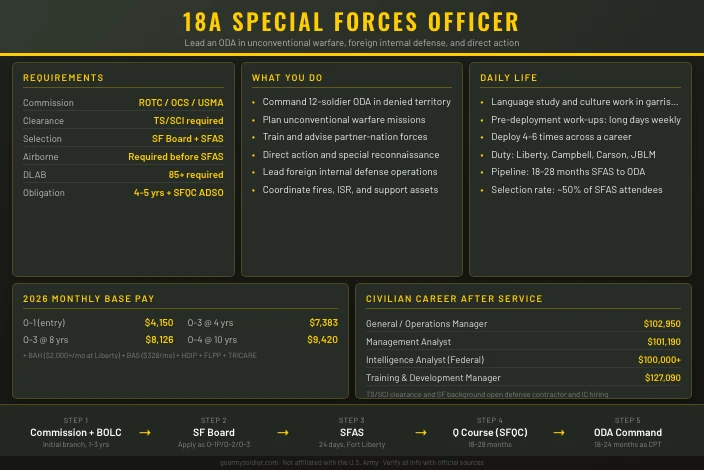
Job Role and Responsibilities
Special Forces Officers (AOC 18A) lead 12-soldier Operational Detachment Alphas (ODAs) in the full range of special operations missions, including unconventional warfare, foreign internal defense, direct action raids, special reconnaissance, and counter-terrorism. At the company level, they command Operational Detachment Bravo (ODB) elements overseeing multiple ODAs. SF officers are responsible for mission planning, team readiness, and every decision their detachment makes in some of the world’s most complex operational environments.
Command and Leadership Scope
A Captain commanding an ODA leads 11 Special Forces Soldiers: a Warrant Officer (180A), two SF medics (18D), two weapons sergeants (18B), two engineer sergeants (18C), two communications sergeants (18E), and an intelligence sergeant (18F). Every man on that team has completed the Q Course. The officer sets intent, integrates the team’s capabilities into a coherent mission plan, and coordinates with higher headquarters, partner forces, and supporting elements.
At Major, SF officers move to staff positions at the Group level (battalion or Group staff), coordinating multiple ODAs across a theater. The path to battalion command as a Lieutenant Colonel puts an officer in charge of a Special Forces Battalion, typically three to five ODAs and supporting elements operating across a specific geographic area or functional mission set.
At the operational and strategic level, senior SF officers serve in Special Operations Command (SOCOM) billets, Joint Special Operations Command (JSOC), and theater special operations commands around the world.
Specific Roles and Designations
| Designation | Code | Description |
|---|---|---|
| Special Forces Officer | 18A | Primary AOC; all SF officers begin here as ODA commanders |
| Special Forces Warrant Officer | 180A | Detachment WO; technical and operational expert on the ODA (separate career track) |
| Civil Affairs | CA | Functional Area available to SF officers post-company command |
| Psychological Operations | 37A | Functional Area available post-KD for officers with influence operations interest |
| Functional Area 59 | FA 59 | Strategic Plans and Policy (post-KD broadening) |
| Special Forces Senior Officer | 18Z | Senior grade designator for SF officers at O-6 level |
Mission Contribution
Special Forces exist to accomplish what conventional forces cannot. An ODA operating in denied territory can train a battalion of partner-nation soldiers, disrupt an enemy’s logistics network without direct engagement, or conduct long-range reconnaissance that feeds intelligence to the joint force. The force multiplier effect is the point – a 12-man ODA can shape conditions across an entire region.
SF fits into joint operations as the unconventional arm of the combined force. While conventional infantry seizes and holds terrain, SF shapes the human and information environment before, during, and after those conventional operations. The two forces are complementary, not redundant.
Technology, Equipment, and Systems
SF officers work with a range of specialized equipment beyond standard Army issue. Communications systems include SATCOM, HF radio, and encrypted digital networks that allow small teams to communicate from austere locations. For direct action missions, the ODA uses standard infantry weapons (M4, M249, M240B) alongside specialty systems including sniper rifles, explosives, and anti-armor weapons.
Mission planning relies on tactical intelligence tools, targeting systems, and coordination software integrated with joint special operations networks. SF officers are expected to understand and employ these systems, not just manage the soldiers who use them.
Salary and Benefits
Base Pay (2026)
SF officers enter the Army at O-1 and progress through the officer pay grades. The table below reflects 2026 monthly base pay at the grades most SF officers hold across a typical career.
| Rank | Grade | Years of Service | Monthly Base Pay |
|---|---|---|---|
| Second Lieutenant | O-1 | Less than 2 | $4,150 |
| First Lieutenant | O-2 | 2-3 years | $5,446 |
| Captain | O-3 | 4 years | $7,383 |
| Captain | O-3 | 8 years | $8,126 |
| Major | O-4 | 10 years | $9,420 |
| Major | O-4 | 14 years | $10,214 |
| Lieutenant Colonel | O-5 | 18 years | $11,714 |
Source: DFAS 2026 Military Pay Charts
Special Pay for SF Officers
SF officers qualify for several additional pays that can add meaningfully to total compensation:
- Hazardous Duty Incentive Pay (HDIP): Applies to airborne operations, demolitions duty, and other designated hazardous tasks – common for SF officers throughout their careers
- Foreign Language Proficiency Pay (FLPP): Monthly pay for certified proficiency in a designated language; rates vary by language and proficiency level, with languages like Arabic, Mandarin, and Russian commanding higher amounts
- Special Duty Assignment Pay (SDAP): Available for certain designated positions within the SF community; rates vary by billet
- Hostile Fire / Imminent Danger Pay: $225 per month during qualifying deployed periods
- Combat Zone Tax Exclusion (CZTE): All base pay becomes tax-free during months in a designated combat zone
Benefits Package
Active-duty SF officers receive TRICARE Prime with no premiums, no deductibles, and no copays for in-network care. Family members enroll at no additional cost, with a $1,000 annual catastrophic cap for out-of-pocket expenses.
Officers receive Basic Allowance for Subsistence (BAS) of $328.48 per month in 2026. Basic Allowance for Housing (BAH) is tax-free and varies by duty station, grade, and dependent status – at Fort Liberty, NC (home of most SF Groups), BAH for an O-3 without dependents runs above $2,000 per month.
The Blended Retirement System (BRS) provides a pension of 40% of the high-36 average basic pay at 20 years of service, plus a Thrift Savings Plan with government matching of up to 5% of base pay beginning in the third year. Officers also qualify for Continuation Pay between years 7-12, with Army SF officers typically receiving 2.5x monthly basic pay as a retention incentive in exchange for three additional years of service.
Officers earn 30 days of paid leave per year. The work-life balance in garrison follows a structured schedule, though SF units operate at a pace that makes the standard 0600-1700 garrison day the exception rather than the rule.
Qualifications and Eligibility
Commissioning Sources
No officer branches directly into Special Forces. The SF branch is reached through a secondary selection process after an officer has commissioned into another branch, completed Basic Officer Leader Course (BOLC), and performed successfully in initial assignments. The path to 18A runs through four standard commissioning sources first.
| Commissioning Source | GPA Minimum | Degree Requirement | Age at Commissioning | Physical Standard | Notes |
|---|---|---|---|---|---|
| ROTC | 2.0 (2.5 competitive) | Any accredited bachelor’s degree | 17-31 | Pass AFT; meet Army medical standards | Branch into combat arms or another eligible branch; apply to SF after initial assignment |
| OCS | No set floor; 3.0+ competitive | Bachelor’s degree required | 19-32 | Pass AFT; 4-mile run; 12-mile ruck march | Fastest civilian path; branch selection by class ranking |
| USMA (West Point) | Competitive admission | West Point grants BS | Enter 17-22; commission at ~22 | Candidate Fitness Assessment; AFT | 5-year ADSO; branch through OML |
| Direct Commission | Varies | Advanced professional degree (Judge Advocate, Medical, Chaplain) | Up to 42 | Same Army medical standards | Not a typical path to SF; line officer commissioning required |
Prerequisites for SF Selection
Once commissioned and serving in their initial branch, officers apply to the SF Officer board. Specific prerequisites include:
- Pay grade of O-1P (promotable), O-2, or O-3, and in the targeted year group for SF Branch
- Completion of Officer Basic Course (initial branch BOLC)
- Minimum SECRET clearance with TOP SECRET eligibility
- Airborne qualified or willing to attend Airborne School before SFAS
- Defense Language Aptitude Battery (DLAB) score of 85 or higher (administered at MEPS or testing centers)
- Strong Officer Evaluation Reports from initial branch service
The SF Officer board selects approximately 150 officers per year. Roughly 300 packets are submitted annually, meaning the board rejects about half before SFAS is even attended. Officers from combat arms branches have inherent advantages given their field experience, but non-combat arms officers have succeeded in the selection process.
Branch Selection and SFAS Application
The branching process for ROTC cadets uses the Talent-Based Branching (TBB) system, which fills branches by Order of Merit List (OML). An officer planning to eventually pursue SF selects a combat arms branch – most commonly Infantry – at commissioning, then applies to the SF board after completing initial assignments.
After board selection, the officer attends the Special Forces Assessment and Selection (SFAS) at Fort Liberty, NC. SFAS is a 24-day evaluation that tests physical endurance, land navigation, teamwork, and psychological resilience. Candidates carry 50+ lb rucksacks over long distances, day and night, in all weather. About half the candidates who start SFAS do not complete it.
Upon Commissioning
All new officers commission at O-1 (Second Lieutenant). The standard Active Duty Service Obligation (ADSO) is four years for ROTC scholarship and OCS accessions; USMA graduates owe five years. Officers who complete SFAS and the Q Course incur an additional service obligation. Coordinate with your assignment officer and SF Branch for current ADSO figures, as these are updated periodically.
OCS candidates can find a focused GT study plan in our ASVAB for OCS guide.
Work Environment
Setting and Schedule
SF officers do not follow a standard garrison schedule. ODA work is mission-driven, and the rhythm of pre-deployment training, deployed operations, and post-deployment reconstitution runs on its own calendar. When in garrison, the team trains – language study, direct action rehearsals, medical sustainment, marksmanship, and physical conditioning. A training day that starts at 0500 and ends at 2100 is not unusual in a pre-deployment work-up.
Deployed, the tempo varies by theater. In some environments, ODAs operate from remote forward operating bases with limited external support. In others, they embed with partner forces for weeks or months, living and working alongside the local forces they are training. The officer is managing the mission, the team, and the relationship with the host-nation unit simultaneously.
Leadership and Chain of Command
The ODA Team Sergeant (an E-8 Master Sergeant) is the officer’s counterpart on the team. This NCO is among the most experienced soldiers in the Army – a senior Special Forces NCO who has been in the SF community for a decade or more. The SF officer-NCO relationship is more collaborative and less hierarchical than in conventional units. The officer sets the mission framework; the team sergeant runs the team’s internal dynamics and technical execution.
At company level, the ODB Commander (a Major) works with a company sergeant major. Staff positions at Group level involve working with a G3 (Operations), G2 (Intelligence), and the Group Commander’s staff.
Staff vs. Command Roles
SF officers split their careers between command and staff. After ODA command as a Captain, most move to Group or battalion staff (S3, S2, or XO) before company-level command as a Major. After company command, the path moves to higher staff (SOCOM, theater SOC, or joint staff) before consideration for battalion command as a Lieutenant Colonel.
Staff tours in the SF community are not passive assignments. SOCOM and joint staff positions involve planning real operations and advising combatant commanders. The experience builds strategic literacy that ODA command alone cannot provide.
Job Satisfaction and Retention
SF officers who complete the Q Course and get to an ODA tend to stay. The work is intrinsically motivating, the people are exceptional, and the autonomy granted to a small team in the field is unlike anything in conventional Army service. Separation rates pick up after the 10-12 year mark, when officers face a choice between the administrative demands of field-grade staff work and the tactical, team-level work they joined SF to do.
The defense industry and intelligence community actively recruit SF officers at every stage of separation, which gives officers who leave early career options that are hard to match elsewhere.
Training and Skill Development
Pre-Commissioning Training
Pre-commissioning training depends on the source. ROTC cadets complete four years of military science plus Cadet Summer Training (Cadet Leader Development Training, CLDT) at Fort Knox. USMA cadets complete a four-year program with Cadet Field Training (CFT) and additional summer training. OCS runs 12 weeks at Fort Moore, Georgia, emphasizing leadership under stress and small unit tactical skills.
None of this pre-commissioning training is SF-specific. It builds the foundation; the SF-specific training comes years later.
Basic Officer Leader Course (BOLC)
After commissioning, every officer attends BOLC for their initial branch. SF officers do not go directly to the Q Course – they first complete the BOLC for the branch they commissioned into (Infantry, Armor, etc.). Officers who commission into Infantry attend the Infantry Basic Officer Leader Course (IBOLC) at Fort Moore, which is 19 weeks.
The SF Training Pipeline
After board selection and SFAS, selected officers move into the Special Forces Officer pipeline:
| Phase | Location | Duration | Focus |
|---|---|---|---|
| SFAS (Assessment and Selection) | Fort Liberty, NC | 24 days | Physical, mental, and character evaluation |
| Special Forces Detachment Officer Qualification Course (SFDOQC) | Fort Liberty, NC | ~6 weeks | Officer-specific SF skills: detachment operations, planning, leadership |
| Phase I (Small Group Instruction) | Fort Liberty, NC | 7 weeks | SF history, core tasks, unconventional warfare framework |
| Phase II (Language Training) | Fort Liberty, NC / DLI | 18-25 weeks | Regional language and cultural training |
| Phase III (Small Unit Tactics) | Fort Liberty, NC | 13 weeks | Advanced marksmanship, SERE, SF tactics |
| Phase IV (MOS Qualification) | Fort Liberty, NC | 14-50 weeks | Specialty cross-training (varies by team specialty) |
| Phase V (Robin Sage) | North Carolina | 4 weeks | Unconventional warfare field exercise with real role-players |
| Graduation | Fort Liberty, NC | 1 week | Green Beret award; assignment to Group |
Total time from board selection to ODA assignment varies, but officers typically spend 18 to 28 months in the full pipeline depending on language difficulty and Phase IV specialty. This is by far the longest officer training pipeline in the Army.
Professional Military Education (PME)
| School | Timing | Duration | Purpose |
|---|---|---|---|
| Airborne School | Before or shortly after BOLC | 3 weeks | Required before SFAS |
| Ranger School | Encouraged before or during SF career | 61 days | Leadership under extreme stress; valued but not required for SF officers |
| Captain’s Career Course (CCC) | As a Captain | ~6 months | Advanced branch tactics; SF CCC is at Fort Liberty |
| Intermediate Level Education (ILE/CGSC) | As a Major | ~10 months | Operational-level warfare; required for O-5 consideration |
| Senior Service College | As a senior Colonel | ~10 months | Strategic leadership; competitive selection |
Additional Training and Civilian Education
SF officers attend specialized courses throughout their careers: Military Freefall (HALO/HAHO), Combat Diver Qualification Course, Long Range Surveillance Leader Course, and various foreign military exchange programs. The specific courses depend on the Group’s regional focus and the officer’s assignment.
Fully-funded civilian graduate school is available through the Army’s Advanced Civil Schooling (ACS) program, typically accessible to Captains with a strong record after company command. SF officers with language proficiency also qualify for regional studies programs that combine academic work with area expertise development.
Before OCS, you need a qualifying GT score — see our ASVAB for OCS guide.
Career Progression and Advancement
Career Timeline
| Rank | Grade | Typical Timeframe | Key Position |
|---|---|---|---|
| Second Lieutenant | O-1 | Years 0-2 | Initial branch Platoon Leader |
| First Lieutenant | O-2 | Years 2-4 | PL / Assistant S3 in initial branch |
| Captain | O-3 | Years 4-10 | ODA Commander (KD); ODB staff |
| Major | O-4 | Years 10-16 | Group/Battalion S3, S2, or XO; ODB Commander |
| Lieutenant Colonel | O-5 | Years 16-22 | SF Battalion Commander (KD) |
| Colonel | O-6 | Years 22-26+ | Group Commander; SOCOM/Joint staff |
The critical branching decision happens around years 4-6, when the officer applies to the SF board. Officers who are not selected, or who choose not to apply, continue on their initial branch career path.
Key Developmental (KD) Positions
Two positions define an SF officer’s career record:
- ODA Command (CPT): Typically 18-24 months as a detachment commander. This is the defining evaluation of an SF captain’s career. Officers who do not complete a successful ODA command rarely compete for battalion command.
- SF Battalion Command (LTC): Approximately 24 months commanding an SF battalion. Performance here determines who moves to Group command and general officer consideration.
Between these command tours, staff positions at Group, SOCOM, and joint commands build the operational and strategic experience the Army expects at senior grades.
Promotion System
O-1 through O-3 promotions are essentially automatic with time in grade. O-4 (Major) and above require board selection. SF officers tend to be competitive at O-4 and O-5 boards given the quality of their records – but the selection rates are the same as for all officers, and a thin or inconsistent evaluation file will hurt regardless of SF affiliation.
Officer Evaluation Reports (OERs) drive board decisions. A “Most Qualified” rating with senior rater comments that specifically describe performance in demanding SF positions is what separates officers who make O-5 from those who do not. Ranger Tab completion, joint staff experience, and ODA performance are the file factors promotion boards for SF officers weigh most heavily.
Building a Competitive SF Officer Record
The competitive SF officer record looks like this: commission into a combat arms branch, perform well as a platoon leader, earn Airborne qualification and ideally Ranger Tab before or shortly after IBOLC, apply to SF board with strong OERs, complete SFAS and the Q Course, command an ODA, and then perform above standard in your first Group staff job. Officers who execute this sequence without a gap or a below-standard evaluation are competitive for Major and Lieutenant Colonel.
Ranger School is not required to become an SF officer, but it is expected. Officers who show up to an ODA without a Ranger Tab are noticed. Get it before or during your initial branch tour.
Physical Demands and Medical Evaluations
SF officers meet the combat specialty standard of the Army Fitness Test (AFT), the higher of two scoring tiers. The AFT has five events scored 0-100 per event (500 maximum). The combat specialty standard requires a total of 350 or higher with at least 60 points per event. Scoring is age-normed.
Army Fitness Test (AFT) Standards
| Event | Abbreviation | Minimum to Score 60 (Male, 17-21) | Minimum to Score 60 (Female, 17-21) |
|---|---|---|---|
| 3 Rep Max Deadlift | MDL | 140 lbs | 120 lbs |
| Hand Release Push-Up | HRP | 10 reps | 10 reps |
| Sprint-Drag-Carry | SDC | 3:00 | 3:35 |
| Plank | PLK | 2:09 | 2:09 |
| Two-Mile Run | 2MR | 21:00 | 23:22 |
Source: Army Fitness Test standards
Branch-Specific Physical Demands
SFAS involves multi-day rucking with 50+ lb loads, night land navigation, and continuous team events with no set pass/fail criteria announced in advance. The Q Course includes a SERE (Survival, Evasion, Resistance, and Escape) phase and extensive field work. Robin Sage – the final field exercise – lasts four weeks operating in austere conditions with limited resupply.
SF officers are expected to maintain the physical capability of their team throughout their career. At 35 with a battalion staff job, the expectation that you could ruck 20 miles with your team does not go away.
Medical and Security Requirements
SF officers require a minimum SECRET clearance with eligibility for TOP SECRET/SCI access. Investigators examine finances, foreign contacts, and personal conduct. The clearance process typically takes several months; prior drug use, significant debt, or foreign national family relationships can complicate or disqualify.
No flight physical is required for SF officers unless they separately pursue aviation qualification. Airborne qualification requires a jump physical, which screens for conditions that could be aggravated by parachute operations.
Deployment and Duty Stations
Deployment Tempo
SF officers deploy more frequently and for longer sustained periods than most conventional officers. Active SF Groups maintain a rotation cycle that can place an ODA in theater for 6-9 month deployments, returning for a reset and workup period before the next cycle. Officers across a 10-year SF career commonly complete four to six deployments. Some operational periods involve multiple shorter rotations per year.
Deployment types include direct action operations, foreign internal defense (training partner-nation forces), special reconnaissance, and theater security cooperation missions. SF deployments often involve small teams in locations where conventional forces have no presence.
Duty Station Options
SF officers are concentrated at a small number of installations tied to the five active SF Groups:
- Fort Liberty, NC – 3rd Special Forces Group (Africa) and 7th Special Forces Group (Americas); also home of the John F. Kennedy Special Warfare Center and School (SWCS)
- Fort Campbell, KY – 5th Special Forces Group (Central)
- Fort Wainwright, AK – 1st Special Forces Group (Pacific) has a battalion at Wainwright
- Joint Base Lewis-McChord, WA – 1st Special Forces Group (Pacific) headquarters
- Fort Carson, CO – 10th Special Forces Group (Europe)
Overseas assignments include Germany (10th SFG rotational presence), Japan (1st SFG forward element), and various theater special operations command billets. SF officers have less assignment flexibility than conventional officers – the community is small and the Group assignments are tied to the geographic combatant command structure.
Risk, Safety, and Legal Considerations
Job Hazards
SF officers operate in environments designed to be denied to conventional forces. That means elevated risk of direct enemy contact, IED threats, and hostile surveillance, often in locations where conventional medical evacuation and fire support are hours away. The hazard is real and well understood by anyone who selects the branch.
Beyond physical risk, SF officers carry distinct legal exposure. Command responsibility applies fully: you are accountable for the conduct of your team and any partner forces operating under your direction. Special operations involving sensitive site exploitation, detainee handling, and operations with foreign forces all carry legal dimensions that conventional officers do not routinely manage.
Risk Management
SF officers apply the Composite Risk Management (CRM) process to every training event and operation. The difference in SF is that risk assessments often involve classified factors, off-the-map operational areas, and decisions that cannot be escalated to higher command in real time. The officer’s judgment under those conditions is precisely what SFAS and the Q Course screen for.
Legal and Command Responsibility
SF officers hold full command authority under the UCMJ and are personally responsible for their team’s conduct. Operations involving direct action, detention, or working with foreign security forces create legal exposure that requires officers to know the rules of engagement, the Law of Armed Conflict, and the specific legal authorities governing their mission.
Relief for cause in the SF community ends the SF career immediately and typically the Army career with it. Command climate and Equal Opportunity requirements apply in SF as in all units. The small team culture of special operations does not exempt SF officers from these obligations.
Impact on Family and Personal Life
Family Considerations
SF is one of the hardest branches on family life. The deployment tempo is high. The periods between deployments involve intensive training cycles that keep soldiers away from home even when not deployed. PCS moves occur every 2-3 years. Fort Liberty and Fort Campbell are mid-sized cities with reasonable civilian job markets, but JBLM and Fort Wainwright are less favorable for spouses with civilian professional careers.
Army Community Service (ACS), Family Readiness Groups (FRGs), and Military OneSource provide support during deployments and high-op-tempo periods. The SF community’s FRGs tend to be tight-knit given the shared experience of deployment, but the informal support network is often more useful than any formal program.
Dual-Military Couples
The join-spouse program applies in SF as in the rest of the Army, but the small number of SF installations limits co-location options. Dual-military couples where one partner is SF and the other is in a conventional branch face a harder co-location problem than conventional-conventional pairs. Early coordination with HRC and the SF Branch assignment officer is the only way to manage this proactively.
Reserve and National Guard
Component Availability
SF is available in the Army National Guard through two Groups: the 19th Special Forces Group (headquartered in Draper, Utah, with battalions in multiple states including Washington, West Virginia, and Colorado) and the 20th Special Forces Group (headquartered in Birmingham, Alabama, with battalions in Florida, Texas, and North Carolina). There is no Army Reserve SF component – SF exists only in the active component and the National Guard.
Guard SF officers go through the same SFAS and Q Course pipeline as their active-duty counterparts. There is no abbreviated or alternative selection process for Guard officers.
Commissioning Paths
Guard SF officers commission through state Guard OCS programs or ROTC with a Guard component contract, branch into an eligible branch within the Guard, complete their initial branch BOLC (often at the same active-duty schools), and then apply to the SF board. The timeline is longer for Guard officers because branch assignments and SFAS attendance must fit around civilian schedules and Guard unit training cycles.
Active-duty SF officers can transfer to 19th or 20th SFG after completing their ADSO. This is a common path for officers who want to maintain SF affiliation while building a civilian career.
Drill and Training Commitment
Guard SF units require significantly more time than the standard one-weekend-per-month schedule. SF-specific training, language sustainment, weapons qualifications, and pre-deployment work-ups add training days beyond the 48 drill periods and 14-day Annual Training that define the minimum Guard commitment. Officers who join Guard SF should plan for 60+ training days per year in a normal year, more during mobilization build-up.
Part-Time Pay
A Guard or Reserve Captain (O-3) with less than 2 years of service earns approximately $737.88 per drill weekend (4 drill periods). An O-3 with 3 years of service earns approximately $902.72 per weekend. Annual Training and mobilizations pay at the full daily active-duty rate.
Benefits Comparison
| Benefit | Active Duty | Army Reserve | Army National Guard |
|---|---|---|---|
| Healthcare | TRICARE Prime ($0 premium) | TRICARE Reserve Select ($57.88/mo individual; $286.66/mo family) | TRICARE Reserve Select (same rates) |
| Monthly Pay (O-3, 4 yrs) | $7,383 base pay | Not applicable (no Reserve SF) | ~$983/mo drill (4 drills x 2 days) |
| Education | Full Post-9/11 GI Bill + TA ($4,500/yr) | Not applicable | State tuition waivers (varies) + MGIB-SR ($493/mo) + TA |
| Retirement | BRS: 40% high-36 at 20 years | Not applicable | Points-based; collect at age 60 (reduced if mobilized) |
| Deployment Tempo | High; 4-6 deployments over a career | Not applicable | Moderate to high; both state and federal mobilization possible |
| Command Opportunities | ODA, ODB, BN, Group command on active cycle | Not applicable | ODA and ODB billets; company command in Guard structure |
| SF Component | 5 active SF Groups | No Army Reserve SF component | 19th SFG (Utah) and 20th SFG (Alabama) |
Guard officers in 19th and 20th SFG benefit from state-level programs that vary by state. Many states offer tuition waivers at in-state public universities, state income tax exemptions on military pay, and state-level bonuses for SF-qualified personnel.
Deployment and Mobilization
Guard SF Groups deploy regularly. 19th and 20th SFG have both been deployed in support of global special operations missions, including combat deployments, theater security cooperation, and joint combined exchange training (JCET) missions with partner nations. Mobilization lengths typically range from 9-12 months for full combat deployments. Guard SF officers should expect meaningful mobilization probability, not just weekend training.
Civilian Career Integration
Guard SF officers often work in federal law enforcement (FBI, DEA, US Marshals), defense contracting, intelligence agencies, or corporate security during the week. The TS/SCI clearance and SF background are direct professional assets in those fields. USERRA protections mean employers cannot penalize Guard members for military service, and many federal agencies and defense contractors run formal veteran hiring programs that specifically target SF-qualified personnel.
Post-Service Opportunities
Transition to Civilian Life
SF officers leave the Army with a credential set that is genuinely difficult to replicate outside the military. TS/SCI clearance, leadership of small autonomous teams in high-stakes environments, regional expertise, foreign language proficiency, and experience planning and executing complex operations under uncertainty – these translate into civilian opportunities that most officers from other branches cannot access.
The Army’s SkillBridge program, SFL-TAP (Soldier for Life Transition Assistance Program), and Hiring Our Heroes fellowships provide structured transition support. SF officers frequently use SkillBridge to complete internships with defense contractors, intelligence community contractors, or private sector security firms during their final months of service.
Civilian Career Prospects
| Job Title | Median Annual Salary | Job Outlook |
|---|---|---|
| General and Operations Manager | $102,950 | Strong; 308,000+ annual openings projected |
| Management Analyst / Consultant | $101,190 | 11% growth through 2034 |
| Intelligence Analyst (Federal) | $100,000-$130,000+ | Stable; active hiring across IC agencies |
| Training and Development Manager | $127,090 | 6% growth through 2034 |
| Security Director / Program Manager | $90,000-$150,000+ | Strong; driven by defense and corporate demand |
Source: U.S. Bureau of Labor Statistics, May 2024 data.
Defense contractors including Booz Allen Hamilton, Lockheed Martin, SAIC, and CACI actively recruit former SF officers. The intelligence community – CIA, DIA, NSA, and NGA – runs direct hiring programs targeting SF-qualified personnel with active TS/SCI clearances. Private security and risk management firms (Kroll, G4S, Constellis) recruit at the senior officer level as well. The SF background opens doors that a conventional officer background does not.
Graduate Education and Credentials
The Post-9/11 GI Bill covers full in-state tuition at public universities with no dollar cap, plus a monthly housing allowance based on the E-5 with dependents BAH rate at the school’s ZIP code, and up to $1,000 per year in book stipends. At private schools, the Yellow Ribbon program can cover amounts above the $29,920.95 annual cap (AY 2025-2026 rate).
SF officers who separate with regional language proficiency and operational area expertise are competitive for graduate programs in international relations, security studies, and public policy. Schools like Georgetown, Johns Hopkins SAIS, and Tufts Fletcher actively recruit veterans with this background. Army Advanced Civil Schooling is available to Captains with a strong record, with competitive selection typically in the post-company command window.
Foreign language skills and SERE training do not map to civilian certifications, but the operational experience and clearance that SF service generates have market value that no certificate program replicates.
Is This a Good Job for You? The Right (and Wrong) Fit
SF attracts officers who want to lead a small, expert team in complex and ambiguous environments – and who are patient enough to spend four to six years earning the right to do it. The process is long. You commission into another branch, prove yourself there, compete for a board slot, survive SFAS, spend up to two years in the Q Course, and then get to your ODA. If that sequence sounds frustrating, SF is probably not the right fit.
Who Does Well Here
The candidates who succeed are not necessarily the biggest or the fastest. SFAS assesses judgment, adaptability, and the ability to keep performing when you’re exhausted and the situation is unclear. Officers who performed well in their initial branch because they genuinely led their soldiers – not because they were trying to check a box for SF – tend to show up to SFAS with the right foundation.
Regional curiosity matters too. SF teams specialize by geographic area. Officers assigned to 7th SFG work in Latin America; 5th SFG works in the Middle East. The language, the culture, and the human dynamics of the region are part of the job. Officers who have no interest in those dimensions of the work will find the Q Course and the deployed environment less engaging than they expected.
Potential Challenges
The time away from family is sustained and predictable. The Q Course keeps you in training for 18-28 months. A deployed ODA may operate in remote locations with minimal communication home. The post-command staff grind at Group and higher headquarters can feel disconnected from the team-level work that drew most SF officers to the branch in the first place.
Officers who prefer direct people leadership to small-team autonomy, who want predictable assignments and career transparency, or who want a branch where progression does not require a second competitive selection process after commissioning should look at other officer branches.
Long-Term Fit
For officers planning a full 20-year career, SF provides a path to some of the most operationally consequential commands in the Army – Group command at O-6 and SOCOM billets at the flag officer level. For officers planning to serve 8-12 years, the SF background, clearance, and language proficiency position them exceptionally well in the defense and intelligence sectors. For the Guard track, 19th and 20th SFG offer a way to maintain SF affiliation while building a civilian career in parallel.
The branch does not work for everyone, and the selection process is designed to enforce that. But for the right officer, leading an ODA is the best job in the Army.
More Information
Talk to an active-duty SF officer or contact your Army ROTC battalion to connect with officers in the community. Your officer recruiter can walk you through the SF board process, current year group timelines, and any accession incentives in effect. The John F. Kennedy Special Warfare Center and School at Fort Liberty is the institutional home of SF training and publishes current qualification course information.
If you are on the OCS track, work with your recruiter on the ASVAB GT score requirement for officer commissioning eligibility, as GT score minimums apply to candidates accessing through some commissioning pathways.
- OCS candidates: prepare for GT 110 with our ASVAB for OCS study guide
This site is not affiliated with the U.S. Army or any government agency. Verify all information with official Army sources before making enlistment or career decisions.
Explore more Army Special Forces careers and related special operations officer paths such as the Army PSYOP Officer or the Army Civil Affairs hub.