125D Geospatial Engineering Technician
Every commander making a decision on the battlefield is working from a picture of the ground – and someone built that picture. That someone is the 125D Geospatial Engineering Technician. You are the Army’s technical authority on terrain analysis, geospatial data systems, and the geographic information that shapes how battles are planned and fought. Generals rely on your products. Staff officers consult you before they brief. When the map is wrong, operations fail.
This is not a job for soldiers who want to manage people or rotate through staff positions. It’s for technically-minded warrant officers who want to go deep on one discipline, own their domain at every echelon, and spend a career solving problems that generalist officers cannot.
Warrant officer candidates need a GT score of at least 110 — our ASVAB study guide covers what drives that number.
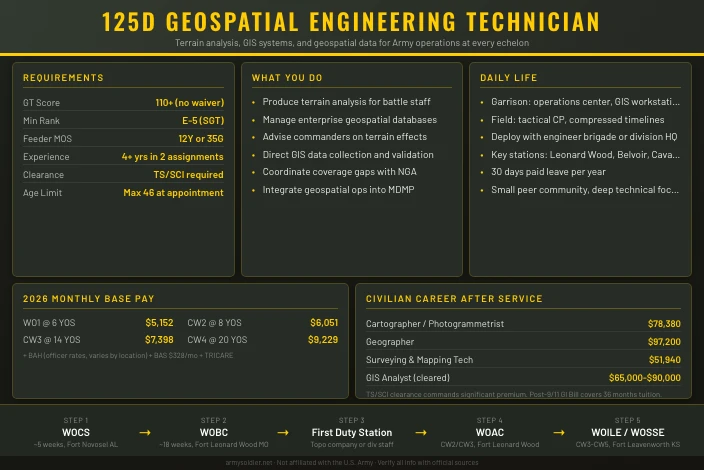
Job Role and Responsibilities
The 125D Geospatial Engineering Technician is the Army’s senior technical expert in geospatial information and services (GI&S). This warrant officer acquires, coordinates, interprets, and analyzes geospatial data to support commanders from brigade through Army-level. The 125D manages enterprise geospatial databases, directs terrain analysis for Intelligence Preparation of the Battlefield (IPB), and integrates geospatial operations into the Military Decision Making Process (MDMP). No other military occupational specialty owns this function at the technical expert level.
Technical Domain
The 125D’s core domain spans the full spectrum of geospatial engineering: topographic survey, geographic information systems (GIS), remote sensing, imagery analysis, and geodetic data. At the working level, this warrant officer directs the collection and validation of geospatial products. At higher echelons, the role shifts toward advising commanders on how terrain affects operations, coordinating data gaps with national-level agencies, and managing the geospatial component of the Common Operating Picture (COP).
Enlisted 12Y Geospatial Engineers and 35G Geospatial Intelligence Imagery Analysts operate the equipment and produce the data. The 125D validates that data, manages the broader geospatial picture, and translates technical findings into operational recommendations. Commissioned engineer officers manage units and resources. The 125D owns the technical depth that neither the enlisted soldier nor the commissioned officer has.
MOS Codes and Designations
| Designation | Title | Notes |
|---|---|---|
| 125D | Geospatial Engineering Technician | Primary warrant officer MOS |
| 12Y | Geospatial Engineer | Primary enlisted feeder MOS |
| 35G | Geospatial Intelligence Imagery Analyst | Secondary enlisted feeder MOS |
| 350G | GEOINT Imagery Technician (WO) | Related intelligence warrant MOS |
Mission Contribution
The 125D fills the gap between a soldier who can operate a GIS workstation and an officer who commands the topographic unit. Commanders need someone who understands both the technical limitations of geospatial data and the operational requirements of the mission. That is the 125D.
Specific contributions include advising battle staffs on terrain effects, identifying coverage gaps in available geospatial data and coordinating collection with national agencies like the National Geospatial-Intelligence Agency (NGA), and managing geospatial enterprise servers that feed digital products to the entire formation. At division and corps, the 125D is the go-to expert when the staff needs to understand how a specific piece of ground affects maneuver, fires, or logistics.
Technology and Systems
The 125D works with a range of geospatial platforms and tools, including:
- ESRI ArcGIS – the primary commercial GIS platform used across Army geospatial operations
- Geospatial Enterprise Server – Army’s enterprise database for storing and serving geospatial data
- ENVI / remote sensing software – for imagery analysis and spectral data processing
- TIGR (Tactical Ground Reporting) – for real-time geospatial data sharing at the tactical level
- Precision Lightweight GPS Receiver (PLGR) and Defense Advanced GPS Receiver (DAGR) – for field survey and positioning
- Digital Topographic Support System (DTSS) – legacy and transitional geospatial production systems
Salary and Benefits
Base Pay
Most 125D applicants come from the enlisted ranks with several years of service. Pay reflects total years of service (YOS), not time as a warrant officer. The table below shows realistic pay points based on typical entry scenarios.
| Rank | Typical YOS at Rank | Monthly Base Pay (2026) |
|---|---|---|
| WO1 | 6 | $5,152 |
| CW2 | 8 | $6,051 |
| CW3 | 14 | $7,398 |
| CW4 | 20 | $9,229 |
| CW5 | 26 | $11,495 |
Pay data sourced from DFAS 2026 military pay tables.
Special Pays and Bonuses
The 125D does not carry aviation incentive pay. Enlistment bonuses for specific warrant officer MOS vary by year and component needs; check with an Army warrant officer recruiter for current bonus status. Warrant officers in assignments that require security clearances and SCI access may qualify for special duty assignment pay (SDAP) depending on the specific billet.
Additional Benefits
Active-duty 125D warrant officers receive TRICARE Prime at no premium cost, covering medical, dental, vision, prescriptions, and mental health for the service member and family. The BAS (Basic Allowance for Subsistence) for officers is $328.48/month in 2026.
The Blended Retirement System (BRS) provides a pension at 20 years equal to 40% of the high-36 average basic pay. TSP matching begins in year three: the Army contributes up to 4% when the member contributes 5% of basic pay.
Tuition Assistance covers $250 per semester credit hour, up to $4,500 per year, for degree programs while on active duty. The Post-9/11 GI Bill provides up to 36 months of full tuition at public schools, plus a monthly housing allowance, after separation.
Work-Life Balance
Garrison life for a 125D runs roughly standard business hours plus staff duty and field exercise commitments. Field exercises run 12-16 hour days and can extend for weeks. The 125D is not a high-deployment-tempo MOS by historic standards, but that changes based on the operational environment and unit assignment. Warrant officers in this MOS generally report more stability and autonomy than commissioned officers, who rotate through positions every 18-24 months. You stay in your lane and go deep rather than shifting roles to build a generalist record.
All soldiers accrue 30 days of paid leave per year, with up to 60 days carrying over.
Qualifications and Eligibility
Appointment Paths
The 125D is an enlisted-to-warrant MOS. There is no direct civilian appointment path. Candidates must be a Sergeant (E-5) or above in a qualifying feeder MOS with at least four years of operational experience.
Feeder MOS requirements:
- 12Y (Geospatial Engineer) or 35G (Geospatial Intelligence Imagery Analyst) – minimum E-5, at least four years of documented operational experience as a working analyst, validated across at least two assignments. One combat tour as a working analyst may count as one assignment.
- Applicants must have a minimum of two years of documented leadership experience with clear potential for increased responsibility.
- Alternatively, a four-year geography-related degree from an accredited institution, or a GIS/GEOINT certification from an accredited college or government institution, may substitute for the operational experience requirement.
Eligibility Requirements Table
| Requirement | Standard |
|---|---|
| Minimum rank | E-5 (Sergeant) or above |
| Feeder MOS | 12Y or 35G |
| Minimum operational experience | 4 years in 12Y or 35G across 2+ assignments |
| GT score | 110 minimum (non-waiverable) |
| Age limit | Maximum 46 at time of appointment |
| Education | High school diploma or GED; college or GIS certification preferred |
| Security clearance | Must be eligible for Top Secret/SCI |
| Physical | Meet Army medical fitness standards (AR 40-501) |
| Citizenship | U.S. citizen |
Warrant Officer Candidate School (WOCS)
All warrant officer candidates, regardless of MOS, attend WOCS at Fort Novosel, Alabama (formerly Fort Rucker). The course is approximately five weeks (35 days) in resident format. WOCS covers warrant officer roles and responsibilities, Army leadership doctrine, small unit tactics, land navigation, and the professional standards expected of Army warrant officers. It is physically and mentally demanding, with limited sleep, high-pressure evaluations, and deliberate stress inoculation.
Candidates apply through a warrant officer packet submitted to the U.S. Army Recruiting Command’s Warrant Officer Recruiting Company (WORC). Key packet components include:
- DA Form 61 (Application for Appointment)
- Official photograph
- Physical examination (DA Form 3349 or flight physical for aviation)
- Letters of recommendation (minimum two from officers, preferably one from a current warrant officer)
- Academic transcripts
- NCOER copies
- Security clearance documentation
- MOS-specific prerequisites documentation
Packets are reviewed by a selection board. Competitive packets show steady technical growth, strong NCOERs, and documented leadership at E-5 and above. Civilian credentials in GIS (such as an ESRI certification or a GIS-related degree) strengthen a 125D application.
Test Requirements
All warrant officer applicants need a minimum GT score of 110, derived from the ASVAB (VE + AR). This threshold is firm – no waivers exist. If you’re preparing for the ASVAB, focus on Verbal Expression and Arithmetic Reasoning subtests. The 125D does not require the SIFT (that test is for aviation MOS only).
ADSO and Appointment Details
New warrant officers enter at WO1. Upon completing WOBC and being awarded the 125D MOS, the standard Active Duty Service Obligation (ADSO) is six years. Subsequent promotions to CW3, CW4, and CW5 each incur a two-year ADSO upon acceptance.
See our ASVAB study guide for a study plan focused on the GT composite.
Work Environment
Daily Setting
In garrison, the 125D works primarily in an engineer operations center or geospatial section, managing workstations running GIS software, directing the production of geospatial products, and advising the staff. This is an indoor, technically intensive environment – not a flight line or a motor pool. At brigade and below, the section is small: often one or two warrant officers and a handful of 12Y enlisted soldiers.
During field exercises or deployed operations, the environment shifts. The geospatial section moves with command posts, operates from vehicles or tents, and must produce terrain products on compressed timelines. The work becomes less deliberate and more reactive.
Position in the Unit
The 125D sits outside the NCO support channel and outside the traditional command chain. The warrant officer advises the commander directly on geospatial matters. At battalion and brigade, this means working alongside the S-2 (intelligence) and S-3 (operations) staff sections to integrate terrain analysis into planning products. At division and corps, the 125D fills a more formal staff advisory role and may have additional junior warrant officers working for them.
The relationship with 12Y enlisted soldiers is supervisory in a technical sense – not through the chain of command, but through technical authority and expertise. Senior NCOs manage the day-to-day personnel matters; the 125D directs the technical work.
Technical vs. Staff Balance
At WO1 and CW2, the job is hands-on. You are producing geospatial products, validating data, running the workstations, and mentoring junior 12Ys. As you progress to CW3 and CW4, the role shifts toward advising, planning, and coordinating with external agencies. CW5 positions are almost entirely advisory, filling staff seats at division, corps, or Army-level headquarters.
Job Satisfaction
Warrant officers who thrive in the 125D describe strong job satisfaction rooted in technical depth and operational relevance. The peer community is small – there are relatively few 125D positions Army-wide – which means you know the field, and the field knows you. Common reasons warrant officers stay: the work is genuinely complex, the data they produce directly affects operational decisions, and the autonomy is real. Common reasons some leave: the MOS community is small, promotion timelines can feel slow, and civilian GIS salaries are competitive.
Training and Skill Development
Warrant Officer Training Pipeline
Training Summary Table
| Phase | Location | Length | Focus |
|---|---|---|---|
| WOCS | Fort Novosel, AL | ~5 weeks | Leadership, WO roles, land navigation |
| WOBC | Fort Leonard Wood, MO | ~18 weeks | GIS systems, terrain analysis, geospatial operations |
| WOAC | Fort Leonard Wood, MO | Varies | Advanced geospatial operations, higher-echelon management |
| WOILE | Fort Leavenworth, KS | 5 weeks | Joint operations, higher-echelon service |
| WOSSE | Fort Leavenworth, KS | 2 phases | Strategic advisory, senior leader development |
Additional Schools and Certifications
- ESRI ArcGIS training courses – Army-funded through Army COOL (Credentialing Opportunities On-Line)
- Airborne School – available to qualified volunteers at Fort Moore, GA
- GIS Professional (GISP) certification – recognized professional credential, supported by Army COOL
- Geospatial Intelligence Foundation credentials – relevant to warrant officers with NGA or joint assignments
- Tuition Assistance – $4,500/year for degree programs; many 125D warrant officers pursue geography, GIS, or engineering degrees
A qualifying GT score comes first — our ASVAB study guide covers the subtests that drive GT.
Career Progression and Advancement
Career Timeline
| Rank | Typical Total YOS | Typical Time at Grade | Key Assignment |
|---|---|---|---|
| WO1 | 6-8 | 18 months (time-based) | Topographic section, brigade geospatial element |
| CW2 | 8-11 | 3-4 years (board-selected) | Division geospatial staff, WOAC attendance |
| CW3 | 12-16 | 4-5 years (board-selected) | Brigade or division geospatial officer, joint assignments |
| CW4 | 18-24 | 4-6 years (board-selected) | Corps or Army-level staff, senior technical advisor |
| CW5 | 24-30+ | Service terminal | Army, joint, or NGA-level senior technical advisor |
WO1 to CW2 promotion is time-based after completion of WOBC – no board required. CW3 and above require selection by a Department of the Army promotion board. Warrant officers receive Officer Evaluation Reports (OERs) using the DA Form 67-10 series, consistent with DA Pam 623-3 guidance for warrant officers.
Building a Competitive Record
A strong 125D record emphasizes technical mastery and progressive leadership. Specific factors that boards notice:
- Civilian credentials in GIS (GISP, ESRI certifications, geography degree)
- Documented experience managing geospatial operations at division level or higher
- Joint assignments (NGA, JFHQ, or combatant command staff)
- Advanced education (bachelor’s or master’s in geography, GIS, or related field)
- Strong OERs showing demonstrated technical impact on operations
CW5 as Senior Technical Advisor
A CW5 in the 125D is the Army’s most senior geospatial engineering expert. These warrant officers fill positions at division, corps, Army-level, and occasionally at joint or interagency assignments, including details to the National Geospatial-Intelligence Agency. The CW5 does not manage a section – they advise general officers and senior civilian leaders on geospatial capabilities, policy, and operational requirements. There are very few CW5 positions in the 125D community, making promotion to this grade highly competitive.
Physical Demands and Medical Evaluations
Army Fitness Test
All soldiers, including warrant officers, take the Army Fitness Test (AFT), which replaced the ACFT on June 1, 2025. The AFT has five events scored 0-100 points each, with a maximum of 500 points total. Warrant officers in the 125D are not in designated combat specialties, so the general standard applies.
| AFT Event | Abbreviation | Min Score (17-21, Male) | Min Score (17-21, Female) |
|---|---|---|---|
| 3 Rep Max Deadlift | MDL | 60 | 60 |
| Hand Release Push-Up | HRP | 60 | 60 |
| Sprint-Drag-Carry | SDC | 60 | 60 |
| Plank | PLK | 60 | 60 |
| Two-Mile Run | 2MR | 60 | 60 |
| Total minimum | 300 | 300 |
The AFT is sex- and age-normed at the general standard. Actual performance thresholds vary by age and sex bracket. Check army.mil/aft for current scoring tables.
MOS-Specific Medical
The 125D has no flight physical requirement and no MOS-specific vision standard beyond AR 40-501 general medical fitness. The primary medical consideration is the Top Secret/SCI security clearance – medical history related to mental health, substance use, or financial issues can affect clearance eligibility and must be disclosed honestly during the investigation.
There is no formal OPAT requirement for 125D. Medical evaluations follow standard periodic health assessments for all soldiers.
Deployment and Duty Stations
Deployment Tempo
The 125D is not a high-tempo combat arms MOS. Deployments typically follow the unit rotation cycle – 9 to 12 months deployed, 12 to 24 months dwell at home station. The 125D deploys with the formation it supports, whether a topographic company, engineer brigade, or division headquarters. Geospatial engineering support is needed in every theater, so the MOS sees a range of deployment environments from combat operations to humanitarian and disaster relief missions.
Primary Duty Stations
125D warrant officers serve across a range of installations wherever geospatial sections exist:
- Fort Leonard Wood, MO – home of the U.S. Army Engineer School; primary WOBC location
- Fort Belvoir/Army Geospatial Center, VA – a key hub for Army geospatial operations and NGA coordination
- Fort Cavazos (formerly Fort Hood), TX – III Corps; large demand for geospatial support
- Fort Campbell, KY – 101st Airborne Division
- Fort Wainwright, AK – U.S. Army Alaska
- Germany (USAREUR-AF) – European theater geospatial requirements
- Joint and interagency assignments – NGA details, JFHQ, and combatant command staff positions
Assignment preferences are submitted through the Human Resources Command (HRC) assignment process. Warrant officers generally have fewer forced moves than commissioned officers, but the small size of the 125D community limits station options compared to larger MOS fields.
Risk, Safety, and Legal Considerations
Job Hazards
The 125D operates primarily in operations centers and staff environments. The primary physical hazards come during field training and deployment, where working in a tactical command post carries the same general operational risks as any soldier in theater. The MOS does not involve direct combat operations, explosive ordnance, or aviation risk.
The more significant risk area is information handling. The 125D routinely works with classified geospatial data, including products at the SCI level. Mishandling classified materials, improper dissemination, or security violations carry serious legal and career consequences.
Safety and Risk Management
The 125D applies the Composite Risk Management (CRM) framework to geospatial operations, particularly when products will be used to support live fires, route planning, or obstacle breaching. Geospatial data errors have operational consequences – a wrong grid, an outdated terrain model, or a corrupted database can affect targeting, route selection, and maneuver decisions. The warrant officer is responsible for data validation processes that catch errors before they reach the commander.
Authority and UCMJ
Warrant officers are subject to the Uniform Code of Military Justice. The 125D does not hold command authority as defined for aviation or military police warrant officers. This warrant officer advises but does not command. However, within the geospatial section, the 125D exercises technical authority over the work products and processes of junior soldiers, and that authority comes with responsibility for results.
Impact on Family and Personal Life
Family Considerations
The 125D is not a high-operational-tempo MOS by Army standards. Field exercises and deployments still occur, but the overall pace is more predictable than combat arms. Families of 125D warrant officers typically experience two to three PCS moves over a 20-year career, though the small community means some moves to less-preferred locations.
Army Community Service (ACS), Family Readiness Groups (FRG), and the Military OneSource program provide support during deployments and PCS transitions. Military spouse employment programs help partners find work after each move.
Dual-Military and Stability
Dual-military couples involving a 125D warrant officer can request join-spouse assignments through HRC, though limited positions in this MOS make co-location harder than in larger career fields. Warrant officers generally experience more assignment stability than commissioned officers – they stay in their technical lane and are less likely to be pulled into unrelated staff positions.
PCS tempo averages every three to four years for active-duty warrant officers. Reserve and Guard soldiers in this MOS typically have far more geographic stability, staying near their unit’s home state.
Reserve and National Guard
Component Availability
The 125D is available in both the Army Reserve and Army National Guard. Reserve and Guard units include topographic companies and engineer headquarters that require geospatial expertise. Component availability varies by state and unit structure; check with a warrant officer recruiter for open positions in your area.
Appointment and Drill Commitment
Reserve and Guard warrant officer candidates follow the same WOCS and WOBC pipeline as their active-duty counterparts. The typical commitment is one weekend per month (four drill periods) plus two weeks of annual training. The 125D may require additional training days for system currency and technical qualification beyond the minimum schedule.
Part-time drill pay at the CW2 level with less than two years of service is approximately $616 per drill weekend (four drills). At the CW3 level with 14 years, it rises to roughly $987 per weekend based on 2026 pay tables.
Benefits Comparison
| Category | Active Duty | Army Reserve | Army National Guard |
|---|---|---|---|
| Monthly base pay | Full-time | Drill pay only (1/30 daily rate x drills) | Drill pay only |
| Healthcare | TRICARE Prime ($0 premium) | TRICARE Reserve Select ($57.88/mo member only) | TRICARE Reserve Select ($57.88/mo member only) |
| Education | Tuition Assistance + Post-9/11 GI Bill (full) | Fed TA + MGIB-SR ($493/mo) | Fed TA + state tuition waivers (varies) + MGIB-SR |
| Retirement | BRS pension at 20 yrs + TSP match | Points-based Reserve retirement (no pension until age 60) | Points-based Reserve retirement (no pension until age 60) |
| Deployment tempo | Moderate (unit-driven) | Periodic mobilization, varies by unit | Periodic mobilization, varies by state |
| Promotion opportunity | Board-selected, competitive | Available through CW5; slower timeline | Available through CW5; depends on state/unit vacancies |
TRICARE Reserve Select premiums reflect 2026 rates from tricare.mil. Mobilized Reserve and Guard soldiers transition to full active-duty TRICARE Prime during orders.
Career Integration with Civilian Work
The 125D is an excellent Reserve or Guard MOS for GIS professionals, cartographers, urban planners, and geospatial analysts working in the private sector or government. USERRA protects civilian employment during mobilization. Many federal agencies and defense contractors actively value Reserve and Guard service in geospatial-related positions.
Post-Service Opportunities
Civilian Transition
The technical skills a 125D develops over a 10 to 20-year career – GIS operations, terrain analysis, data management, and geospatial systems integration – translate directly to well-paying civilian roles. Defense contractors, federal agencies (NGA, USGS, NASA), and commercial GIS firms all hire former geospatial warrant officers. The SCI clearance alone has significant market value.
Programs like SFL-TAP (Soldier for Life - Transition Assistance Program), Hiring Our Heroes, and the Army Career Alumni Program support the transition. Many 125D warrant officers transition before reaching CW5 and move into senior GIS analyst or program manager roles within 90 days of separation.
Civilian Career Prospects
| Civilian Job Title | BLS Median Annual Salary (2024) | Job Outlook (2024-2034) |
|---|---|---|
| Cartographer / Photogrammetrist | $78,380 | +6% (faster than average) |
| Geographer | $97,200 | -3% (declining, niche field) |
| Surveying and Mapping Technician | $51,940 | +5% (faster than average) |
| GIS Analyst (varies by sector) | $65,000-$90,000 | Growing (no BLS code; approximated) |
BLS data sourced from the Occupational Outlook Handbook, May 2024 survey. GIS analyst salaries vary widely by sector and clearance level – cleared positions typically command a significant premium.
Certifications and Credentials
Military training and experience in the 125D supports several civilian credentials:
- GIS Professional (GISP) – the primary professional certification in the GIS field; experience from 125D service counts toward eligibility
- ESRI Technical Certifications – ArcGIS Desktop Entry, Associate, and Professional levels; Army COOL may fund exam vouchers
- Certified Mapping Scientist – issued by the American Society for Photogrammetry and Remote Sensing (ASPRS)
- PMI Project Management Professional (PMP) – applicable for warrant officers moving into program management roles
The Post-9/11 GI Bill supports degree completion after separation, covering full in-state tuition at public schools plus a monthly housing allowance. Many 125D veterans use the benefit to complete a bachelor’s or master’s degree in GIS, geography, or geospatial intelligence.
Is This a Good Job for You? The Right (and Wrong) Fit
Ideal Candidate Profile
The 125D fits a specific type of soldier. You are already in a 12Y or 35G role, you genuinely enjoy the technical work, and you’ve spent time thinking about how geospatial data shapes operational decisions – not just how to produce it. You are more energized by solving a data problem than by leading a patrol or managing a supply room. You can explain complex technical concepts to a colonel who doesn’t understand GIS and make it sound relevant.
Strong candidates often have:
- A natural curiosity about geography, mapping, and spatial data
- Experience across multiple geospatial platforms, not just one system
- A track record of technical mentorship with junior 12Ys or 35Gs
- Some exposure to or interest in civilian GIS tools and industry practices
- A willingness to operate in a small peer community with limited direct competition for recognition
Potential Challenges
This MOS is not for soldiers who want to command units. The 125D advises; it does not command. If your motivation is leading formations, aviation warrant is the more natural path for command-track aspirations. The 125D community is also small, which means fewer peers, fewer mentors, and sometimes a longer wait for the right follow-on assignment.
Promotion to CW5 is highly competitive in a small population. Some warrant officers reach CW4 and find limited CW5 billets available. If you’re planning a 30-year career, go in with clear eyes about that ceiling.
The civilian job market for pure geographers is actually declining slightly per BLS data. Demand for applied GIS professionals is strong, but the label matters – you’ll want to build credentials in applied GIS and data analytics, not just military-specific terrain analysis.
Career Alignment
The 125D works well across three different paths:
- Full 20-30 year career: strong technical depth, CW4 and CW5 advisory positions, NGA or joint assignments, retirement with a pension and significant GIS credentials
- Initial 6-year obligation then transition: excellent setup for defense contracting, federal civilian, or commercial GIS work with a clearance in hand
- Reserve or Guard part-time: pairs very well with a civilian GIS or planning career; the two reinforce each other
The comparison to staying enlisted is straightforward. An SFC or MSG in 12Y does important work, but the 125D operates with more autonomy, higher pay, and more direct influence on operational decisions. The comparison to commissioning as an engineer officer is also clear – the 125D owns technical depth for a career; a commissioned officer owns people and resources and moves through multiple fields.
More Information
Talk to an Army warrant officer recruiter to start your 125D packet. The U.S. Army Warrant Officer Recruiting Command walks you through eligibility, packet requirements, and board timelines. If your GT score needs work before you apply, the ASVAB is the test to focus on – specifically the Verbal Expression and Arithmetic Reasoning sections that make up the GT composite.
- Prepare for the ASVAB with our study guide to meet the GT 110 requirement
This site is not affiliated with the U.S. Army or any government agency. Verify all information with official Army sources before making enlistment or career decisions.
Explore more Army warrant officer careers such as 120A Construction Engineering Technician and 131A Field Artillery Targeting Technician.