351Z Attache Intelligence Operations Technician
Very few Army jobs require you to represent the United States at a foreign embassy, coordinate intelligence operations under a diplomatic roof, and brief the Defense Attache on national-level threats – all in the same week. The 351Z Attache Intelligence Operations Technician does all of that, and does it in 90 countries. This is one of the rarest warrant officer specialties in the Army, with a small authorized force and a selection process that filters for experience most NCOs will never have.
If you hold the Special Qualification Identifier 7 (SQI 7 – the Attache designation) and you’ve spent time working inside a Defense Attache Office, you already know what this job demands. If you’re trying to figure out whether this path is worth pursuing, read on.
Warrant officer candidates need a GT score of at least 110 — our ASVAB study guide covers what drives that number.
Job Role and Responsibilities
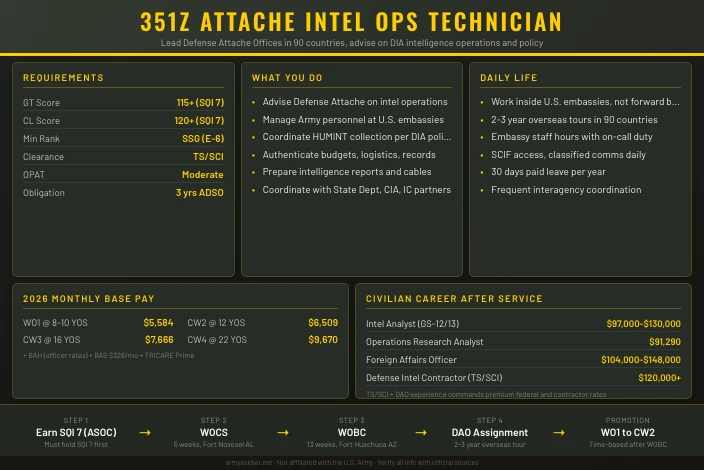
The 351Z Attache Intelligence Operations Technician serves as the Army’s senior technical expert in Defense Attache System (DAS) operations, advising the Defense Attache on intelligence activities, administrative policy, inter-agency coordination, and Army representational matters across U.S. diplomatic missions worldwide. The 351Z manages Army personnel serving in Defense Attache Offices (DAOs) across approximately 90 countries, coordinates HUMINT collection operations within legal and regulatory frameworks, and serves as the primary operations coordinator linking embassy country teams with Defense Intelligence Agency (DIA) and Department of Defense policy. This is not a field intelligence role – it’s a diplomatic-intelligence hybrid that requires equal parts operational judgment and bureaucratic precision.
Technical Expertise and Scope
The 351Z operates at the intersection of military intelligence and diplomatic protocol. The primary technical domain is Defense Attache System management: understanding DIA policy, State Department regulations, country team dynamics, and how to integrate Army intelligence reporting requirements into a diplomatic environment where host-nation relationships are always in the room.
Where an enlisted soldier with SQI 7 executes administrative and support functions inside a DAO, the 351Z warrant officer directs those functions and advises the Defense Attache on how to run the office. The difference is authority, judgment, and scope. A 351Z is accountable for compliance, operational security, personnel management, budget authentication, and intelligence reporting – simultaneously.
The technical scope also includes HUMINT collection management. The 351Z applies DIA and Army regulations governing source operations and ensures that collection activities inside the embassy environment conform to policy. This requires working knowledge of Title 10 and Title 50 authorities, interagency coordination protocols, and the legal boundaries that separate military attache reporting from covert collection.
Related MOS Codes and Designations
| MOS | Title | Relationship to 351Z |
|---|---|---|
| 350F | All Source Intelligence Technician | Primary analytical counterpart; 350F fuses intelligence the 351Z helps collect |
| 351L | Counterintelligence Technician | CI complement; 351L identifies threats to DAO operations |
| 351M | Human Intelligence Collection Technician | Feeder-adjacent; HUMINT warrants work closely with 351Z in theater |
| 35F (SQI 7) | Intelligence Analyst (Attache-qualified) | Primary enlisted feeder pathway to 351Z appointment |
| 35M (SQI 7) | HUMINT Collector (Attache-qualified) | Alternate feeder; HUMINT collectors with DAO experience |
Additional Skill Identifiers (ASIs) and Skill Identifiers (SIs) applicable to 351Z-qualified personnel are managed by the Military Intelligence branch proponent at Fort Huachuca, Arizona.
Mission Contribution
The Defense Attache System is how the Department of Defense maintains its presence and relationships inside U.S. embassies. Without 351Z warrant officers managing those offices, Army personnel serving overseas in diplomatic billets would have no senior technical advisor to ensure policy compliance, coordinate intelligence reporting, and handle the administrative complexity of operating under State Department authority while executing a DoD mission.
The 351Z fills the gap between the commissioned Defense Attache – who is a senior officer with diplomatic and representational responsibilities – and the enlisted soldiers and DA civilians who execute daily office functions. The warrant officer is the operator. The attache is the ambassador. That distinction defines the relationship.
At the strategic level, 351Z warrant officers contribute to national intelligence products by enabling lawful HUMINT collection from diplomatic vantage points that no other collection platform can access. Timely, policy-compliant attache reporting from 90 countries reaches DIA analysts and, when significant, informs decisions at the highest levels of the executive branch.
Technology, Equipment, and Systems
The 351Z’s toolkit is less about hardware and more about secure communications systems, intelligence reporting platforms, and classified administrative networks. Key systems include:
- Secure compartmented information facilities (SCIFs) and embassy-based secure communications infrastructure
- DIA reporting systems for intelligence information reports (IIRs) and defense attache reports
- Classified administrative systems for personnel management, budget authentication, and logistics requisitioning
- Inter-agency coordination platforms used across country team environments (Department of State, CIA, other IC elements present at post)
Salary and Benefits
Base Pay
Warrant officers use the same basic pay table as commissioned officers but follow the W-grade scale. Most 351Z candidates enter with significant enlisted time, so their pay at appointment reflects their total years of service, not just time as a warrant officer. All figures below are 2026 DFAS rates.
| Rank | Typical YOS at Appointment | Monthly Base Pay |
|---|---|---|
| WO1 (W-1) | 8-10 years | $5,584 - $5,786 |
| CW2 (W-2) | 10-12 years | $6,283 - $6,509 |
| CW3 (W-3) | 14-16 years | $7,398 - $7,666 |
| CW4 (W-4) | 20-22 years | $9,229 - $9,670 |
| CW5 (W-5) | 26-30 years | $11,495 - $12,071 |
Warrant officers receive BAH at officer rates. At most CONUS installations, a W-2 with dependents draws $1,608 to $2,013 monthly in BAH, depending on duty location. The officer BAS rate of $328.48 per month applies to all warrant officers regardless of MOS.
Special Pay and Bonuses
The 351Z does not carry aviation bonus eligibility or flight pay. Special pays that may apply include:
- Overseas incentive pay for extended tours at hardship-designated posts
- Foreign Language Proficiency Pay (FLPP) if the soldier maintains tested proficiency in a required language – a significant advantage in attache billets where host-nation language skills matter
- Special Duty Assignment Pay (SDAP) in some DAO assignments based on the position’s designated status
Accession bonuses for 351Z are not currently listed in standard Army warrant officer bonus programs given the MOS’s small authorized force. Verify current bonus eligibility through Warrant Officer Recruiting.
Additional Benefits and Work-Life Balance
Active duty warrant officers receive full TRICARE Prime coverage at no premium cost, covering medical, dental, vision, and mental health for the soldier and enrolled family members. Retirement under the Blended Retirement System (BRS) pays 40% of the high-36 average basic pay at 20 years, with TSP matching up to 5% of basic pay beginning in the third year of service.
Annual leave accrues at 2.5 days per month – 30 days per year – with a maximum carryover of 60 days. Warrant officers in garrison typically work structured duty hours with leave that’s easier to plan than field-intensive combat MOS assignments.
The 351Z lifestyle involves overseas tours of two to three years at a time. That means PCS moves are less frequent than many stateside assignments, but they take the whole family abroad. Soldiers who thrive in this environment tend to view overseas living as a benefit, not a cost.
Qualifications and Eligibility
Appointment Paths
The 351Z has a single appointment path that differs from most warrant officer MOS: there is no standard enlisted feeder MOS list. You cannot apply for 351Z directly from any enlisted position without the Attache qualification.
The requirement is clear: all applicants must hold SQI 7 (Attache) in their primary MOS. SQI 7 is awarded only after a soldier successfully completes the Attache Staff Operations Course (ASOC) at the Defense Intelligence Agency Attache Center, Bolling Air Force Base, Washington, DC. Eligible grades for SQI 7 are SSG (E-6) through SGM (E-9) in any MOS that supports DAO functions.
To earn SQI 7 in the first place, a soldier must meet high aptitude standards: GT score of 115 or higher and CL (Clerical) score of 120 or higher on the ASVAB. These are the SQI 7 standards, not the 351Z warrant officer standards – but since 351Z requires SQI 7, these scores function as the effective floor.
The Army-wide minimum GT score for any warrant officer appointment is 110 (non-waiverable), but 351Z applicants will have already exceeded that threshold to earn their SQI 7 qualification.
| Requirement | Standard |
|---|---|
| ASVAB GT Score (SQI 7 floor) | 115 (non-waiverable for SQI 7 award) |
| ASVAB CL Score (SQI 7 floor) | 120 |
| Minimum Enlisted Rank | SSG (E-6) with SQI 7 |
| Prior Service | Required – must have completed DAO tour |
| Security Clearance | TS/SCI required |
| OPAT Category | Moderate |
| Age Limit | Under 46 at time of appointment (check current waiver policy with WORC) |
| Citizenship | U.S. citizen (non-waiverable) |
| Education | High school diploma or GED minimum; degree preferred |
Warrant Officer Candidate School (WOCS)
WOCS is the gateway to any warrant officer appointment and runs five weeks at Fort Novosel, Alabama (formerly Fort Rucker, renamed April 10, 2023). The U.S. Army Warrant Officer Career College (WOCC) administers the program.
Reserve component soldiers may attend a two-phase WOCS format run by authorized Regional Training Institutes: drill weekends over approximately five months plus a 15-day culminating phase.
Packet and Board Competitiveness
The 351Z authorized force is small – 56 positions were authorized when DIA resumed accessions in 2019. That means few annual vacancies. A competitive packet demonstrates:
- Multiple DAO assignments showing progressive responsibility
- Strong SQI 7 documentation and ASOC completion
- Endorsements from senior DAS personnel or DIA-affiliated officers
- Language proficiency in a strategic-value language (Arabic, Chinese, Russian, Farsi)
Civilian education at the bachelor’s level is increasingly expected in intelligence warrant officer packets, though not a hard requirement. A degree in international relations, political science, or foreign area studies reinforces the diplomatic-intelligence skill set.
Upon Appointment
New 351Z warrant officers enter as WO1 (W-1). The standard Active Duty Service Obligation (ADSO) for non-aviation warrant officer appointment is three years from the date of appointment.
See our ASVAB study guide for a study plan focused on the GT composite.
Work Environment
Setting and Schedule
The 351Z works primarily in embassy environments and secure office facilities, not in the field. A typical day inside a DAO might include reviewing intelligence reports for policy compliance, coordinating with the country team on a visiting delegation, authenticating a logistics purchase, and preparing a classified cable for DIA. The rhythm is bureaucratic and diplomatic, with moments of urgency when something significant happens in-country.
Garrison-equivalent schedules apply in most DAO assignments. Work hours track embassy operations more than military formations. However, overseas posts – especially in high-threat environments – operate under different conditions where after-hours duty is common and emergencies don’t follow a schedule.
Position in the Unit
The 351Z doesn’t sit in a traditional Army unit. They sit inside a Defense Attache Office, which operates under the U.S. Ambassador’s country team with administrative oversight from DIA. The Defense Attache is typically an O-6 or general officer. The 351Z warrant officer is the senior Army warrant on the team, advising the Attache on technical and operational matters.
The warrant officer-NCO dynamic in a DAO differs from a conventional unit. The 351Z supervises DA civilians, enlisted soldiers, and sometimes foreign national employees – a supervisory scope that crosses standard Army reporting channels. Relationships with the State Department, CIA station, and other IC elements at post require a warrant officer who reads the room as well as they read a reporting cable.
Technical vs. Staff Roles
At WO1 and CW2, the 351Z spends the majority of time executing DAO functions: processing reports, managing personnel records, coordinating logistics, and learning how the interagency environment works at post. By CW3, the warrant officer moves into an advisory role – shaping DAO policy, supervising junior staff, and representing the Army in interagency meetings. CW4 and CW5 officers are serving at division, corps, or higher staff positions with DIA advisory roles.
The ratio of technical work to staff advising shifts with each promotion. By CW5, the 351Z is primarily a policy advisor and institutional expert, not a report-processing technician.
Job Satisfaction and Retention
Warrant officers who thrive in the 351Z specialty cite the uniqueness of the mission, overseas living, and genuine strategic impact. The job puts you inside embassies during moments of real geopolitical consequence. That’s not a career experience available in most MOS.
Retention challenges are familiar across technical intelligence warrants: civilian intelligence agencies (CIA, DIA, NSA) recruit experienced attache-qualified personnel aggressively. A CW3 with multiple DAO tours and TS/SCI clearance can earn considerably more in the GS-13 to GS-15 range or as a contractor. Soldiers who stay typically value the military structure, benefits package, and mission continuity over civilian pay.
Training and Skill Development
Warrant Officer Basic Course (WOBC)
The Military Intelligence WOBC is a 13-week resident course at Fort Huachuca, Arizona, administered by the United States Army Intelligence Center of Excellence (USAICoE). All 35-series and 351-series warrant officers attend the same installation, though MOS-specific instruction tracks separate specialties.
| Phase | Location | Length | Focus |
|---|---|---|---|
| Common Core | Fort Huachuca, AZ | Weeks 1-4 | Warrant officer fundamentals, doctrine, military writing, leadership |
| MOS Technical | Fort Huachuca, AZ | Weeks 5-10 | Intelligence tradecraft, DAS operations, HUMINT reporting policy |
| Practicum | Fort Huachuca, AZ | Weeks 11-13 | Applied exercises, scenario-based training, evaluation |
WOBC differs from enlisted AIT in scope and framing. Where AIT trains soldiers to execute specific tasks, WOBC develops warrant officers to advise commanders and manage complex technical programs. The expectation at the end of WOBC is that you can function as the senior MI expert in your organization on day one.
Warrant Officer Advanced Course (WOAC)
WOAC is attended as a CW2 or CW3, typically five to eight years after initial appointment. The course is conducted at Fort Huachuca and runs approximately four weeks. WOAC deepens tactical and operational intelligence knowledge, introduces higher-echelon staff functions, and begins preparing the warrant officer for advisory roles at brigade and above. For 351Z officers, WOAC reinforces interagency coordination skills and introduces Army-level intelligence doctrine that shapes DAO reporting priorities.
Warrant Officer Intermediate Level Education (WOILE)
WOILE is a five-week MOS-immaterial resident course attended by CW3s and CW4s preparing for service at higher echelons. It’s conducted at Fort Novosel. Unlike WOBC and WOAC, WOILE is not MOS-specific – it focuses on joint operations, strategic thinking, and warrant officer advisory responsibilities at division level and above. For a 351Z who has spent a career in embassy environments, WOILE provides the joint military context that DAO work often doesn’t.
Warrant Officer Senior Service Education (WOSSE)
WOSSE is the senior-most PME for warrant officers, attended by senior CW4s and CW5s. It runs as a two-phase program combining distance learning with a resident segment. WOSSE covers strategic advising, DoD policy, joint and interagency leadership, and the senior warrant officer’s role in shaping Army institutional decisions. Completion is required for consideration for CW5 promotion.
Additional Schools and Training
The 351Z has access to several specialized training opportunities:
- Defense Attache Staff Operations Course (ASOC) – prerequisite for SQI 7 and foundational to the 351Z specialty; refresher attendance may be required with each DAO assignment
- Foreign Area Officer (FAO) regional courses – regionally focused training on political-military dynamics in specific geographic combatant commands
- Defense Language Institute (DLI) – language training funded by the Army for soldiers in attache billets requiring proficiency in specific languages
- Joint Intelligence Operations Center (JIOC) courses – advanced operational intelligence training available through DIA and the combatant commands
Army Tuition Assistance pays up to $4,500 per year for college courses, and the Post-9/11 GI Bill provides up to 36 months of education benefits. Many 351Z warrant officers pursue graduate degrees in international relations, strategic intelligence, or security studies during their service.
A qualifying GT score comes first — our ASVAB study guide covers the subtests that drive GT.
Career Progression and Advancement
Career Timeline
The 351Z career arc assumes entry with prior enlisted time as a staff sergeant (E-6) or above. Total years of service at each rank reflect enlisted time plus warrant officer service.
| Rank | Time in Grade | Total YOS (Estimate) | Key Assignments |
|---|---|---|---|
| WO1 (W-1) | 18 months | 8-10 | WOCS, WOBC, first DAO tour |
| CW2 (W-2) | 5-6 years | 12-16 | DAO operations coordinator, WOAC |
| CW3 (W-3) | 5-6 years | 17-22 | Senior DAO advisor, regional MI staff |
| CW4 (W-4) | 5-6 years | 22-26 | Division/corps MI staff, DIA advisory role |
| CW5 (W-5) | Terminal | 26-30+ | Army staff, DIA, senior attache advisor |
Promotion System
WO1 to CW2 is time-based and tied to WOBC completion – no board required. CW3 and above require board selection at HRC. Evaluation reports use the DA Form 67-10 series (Officer Evaluation Report), with warrant-officer-specific guidance under DA Pam 623-3, Appendix B. Senior raters assess warrant officers against their peers, and quantitative ratings at the CW3 and CW4 level drive selection board outcomes.
Promotion to CW5 is the most competitive tier. The Army selects a small percentage of eligible CW4s annually, and for a MOS with a small total force, every promotion board cycle may see only one or two CW5 slots. Building a competitive record requires multiple DAO assignments, joint duty credit, advanced education, and a consistent pattern of “Most Qualified” OERs.
CW5 as Senior Technical Advisor
A CW5 351Z serves as the Army’s most senior technical authority on Defense Attache operations. Assignments at this level are typically at DIA headquarters, a geographic combatant command J2, or the Army staff in Washington, D.C. The CW5’s job is to advise general officers and senior defense officials on how to employ the attache system, resolve policy disputes, and shape the doctrine that governs DAO operations worldwide.
General officers provide command authority. The CW5 provides institutional knowledge that no general officer rotation can replicate. That distinction is the foundation of the senior warrant officer advisory role.
Building a Competitive Record
- Complete multiple DAO tours across different geographic regions
- Pursue Foreign Language Proficiency Pay-qualifying language training
- Complete a joint duty assignment to earn joint qualifying service
- Publish intelligence or defense attache doctrine-related professional writing
- Pursue a graduate degree in a relevant field (international relations, strategic intelligence)
- Seek early attendance at WOAC and WOILE to signal readiness for advancement
Physical Demands and Medical Evaluations
Physical Requirements and AFT Standards
All warrant officers take the Army Fitness Test (AFT), which replaced the ACFT on June 1, 2025. The AFT has five events scored 0-100 each, with a maximum of 500 points.
| Event | Abbreviation | General Standard (Minimum) |
|---|---|---|
| 3 Repetition Maximum Deadlift | MDL | 60 points per event |
| Hand Release Push-Up – Arm Extension | HRP | 60 points per event |
| Sprint-Drag-Carry | SDC | 60 points per event |
| Plank | PLK | 60 points per event |
| Two-Mile Run | 2MR | 60 points per event |
The general standard requires a minimum total of 300 points (60 per event), sex- and age-normed. The 351Z is not a designated combat specialty, so the 350-point combat standard does not apply.
The OPAT category for 351Z is Moderate, reflecting office-based work with no heavy physical demands beyond standard soldier fitness.
Medical and Clearance Considerations
The 351Z does not require an aviation flight physical or MOS-specific vision/hearing standards beyond the standard Army commission physical. The critical medical consideration for this MOS is the TS/SCI security clearance, which includes a polygraph examination for access to SCI-level information.
A full-scope lifestyle polygraph may be required for certain DIA-affiliated billets. Medical or legal issues that surface during the clearance investigation process can delay or disqualify an otherwise qualified candidate. The clearance investigation for TS/SCI can take 6 to 15 months. Candidates should avoid new foreign contacts, foreign financial interests, or drug use during the application window.
Deployment and Duty Stations
Deployment Patterns
The 351Z operates within the Defense Attache System, which means primary duty stations are overseas – U.S. embassies and consulates, not forward operating bases. Deployment in the traditional combat sense is not the primary operational mode. Instead, 351Z warrant officers serve two- to three-year overseas tours at posts in Europe, the Pacific, the Middle East, Africa, and Latin America.
High-threat posts (classified locations with elevated security risk) exist within the DAO network and carry additional hazard pay and restricted tour lengths. Some posts are unaccompanied, meaning families remain at a home station while the soldier serves alone. Post hardship ratings drive tour lengths, compensation, and family separation pay eligibility.
Duty Station Options
Because the 351Z serves within the DAS, stateside duty stations typically involve positions at DIA headquarters (Defense Intelligence Agency, Washington, D.C.), Fort Huachuca for training billets, or geographic combatant command J2 staffs (EUCOM, INDOPACOM, AFRICOM, CENTCOM, SOUTHCOM).
Duty station assignments for 351Z are managed by HRC in coordination with DIA, and the small force size means individual preferences carry more weight than in larger MOS communities – but also that available slots are fewer.
Risk, Safety, and Legal Considerations
Job Hazards
The primary risks in attache service are not combat-related but diplomatic and security-related. Working under a U.S. embassy roof in a host nation carries risks that vary by post: civil unrest, anti-American protest, terrorism, and in some regions, direct targeting of embassy personnel. The State Department Regional Security Officer (RSO) manages post security, and DAO personnel operate under their threat guidance.
Counterintelligence threats are a constant reality. Foreign intelligence services actively attempt to recruit or surveil U.S. military personnel assigned to embassies. The 351Z must maintain strict operational security and report anomalous contacts through proper CI channels – a failure here carries consequences ranging from clearance revocation to federal prosecution.
Legal Authority and UCMJ
Warrant officers hold federal authority under their warrant of appointment. The 351Z does not typically hold command authority (which is reserved for commissioned officers and specific warrant officer MOS), but they exercise supervisory authority over enlisted personnel and DA civilians assigned to the DAO.
Operations inside a DAO are governed by Title 10 (DoD authority), Title 50 (intelligence authority), and the Vienna Convention on Diplomatic Relations. The 351Z must understand where military authority ends and diplomatic protocol begins – and never confuse the two.
Technical failures in this MOS carry legal weight. Mishandling classified materials, failing to report a significant CI contact, or violating DIA collection policy can result in criminal charges, loss of clearance, and administrative separation.
Impact on Family and Personal Life
Family Considerations
Overseas tours are the central family consideration for 351Z warrant officers. Accompanied posts allow families to live abroad with the soldier and access on-post or State Department schools, medical facilities (via Embassy Medical), and the logistical support the embassy community provides. Unaccompanied tours mean family separation for 12 to 24 months, depending on the post.
The Army Community Service (ACS) system and Family Readiness Groups (FRGs) function differently in attache assignments. Embassy communities are smaller and often more tightly knit than garrison units, with State Department family support systems supplementing Army programs. Many military families find overseas assignments personally enriching – particularly those with children, who often gain language exposure and global perspective not available stateside.
PCS Tempo and Stability
Overseas tours of two to three years provide more residential stability than many stateside Army assignments, where PCS moves can occur every 18 months. The tradeoff is geographic unpredictability – the Army sends you where the DAO vacancies are, not necessarily where you’d choose to live.
Dual-military couples face assignment coordination challenges in the attache system. DIA will attempt to co-locate dual-military couples when possible, but the small force size limits flexibility. The Army Exceptional Family Member Program (EFMP) applies to overseas tours and must be factored in early if a family member has special needs that require specific medical or educational support.
Reserve and National Guard
Component Availability
The 351Z MOS is available in both the Army Reserve and the Army National Guard, though positions are far fewer than in the active component given the small total authorized force. Reserve and Guard 351Z positions are generally tied to units supporting DIA, geographic combatant commands, or theater-level intelligence structures.
Appointment Paths for Reserve and Guard
Reserve and Guard appointment to 351Z follows the same SQI 7 prerequisite requirement as the active component. The most common pathway is an active duty 351Z transitioning to the Reserve or Guard after initial obligation, bringing DAO experience and an active clearance into the part-time structure.
Enlisted Reserve and Guard soldiers with SQI 7 who want to pursue warrant officer appointment should contact their state G2 or unit warrant officer advisor for current vacancy and packet submission guidance.
Reserve candidates attend the same WOCS program, either the five-week resident course at Fort Novosel or the two-phase format through an authorized Regional Training Institute.
Drill and Training Commitment
The standard Reserve and Guard commitment is one weekend per month (four Unit Training Assemblies) plus two weeks of Annual Training. The 351Z MOS does not carry aviation-style currency or flight-hour requirements. However, intelligence-related currency – including clearance maintenance, annual training certifications, and any DIA-directed refresher training – adds to the standard schedule.
Annual Training for intelligence units often involves exercises that replicate operational environments, which may require travel to exercise locations outside the home station area.
Part-Time Pay
A CW2 with two years of service draws approximately $674.53 per drill weekend (four drill periods) based on 2026 monthly base pay of $5,059 divided by 30, multiplied by four. A CW3 at 14 years of service earns approximately $986.40 per weekend based on the $7,398 monthly rate.
Component Comparison
| Factor | Active Duty | Army Reserve | Army National Guard |
|---|---|---|---|
| Commitment | Full-time | 1 weekend/month + 2 wks AT | 1 weekend/month + 2 wks AT |
| Monthly Pay (CW2, 10 YOS) | $6,283 | ~$838/weekend | ~$838/weekend |
| Healthcare | TRICARE Prime ($0 premium) | TRICARE Reserve Select ($57.88/mo individual) | TRICARE Reserve Select ($57.88/mo individual) |
| Education Benefits | Full GI Bill + TA | MGIB-SR ($493/mo, 36 months) or Post-9/11 if activated | Same as Reserve + possible state tuition waivers |
| Retirement | 20-year pension (40% high-36 at 20 yrs) | Points-based BRS, collect at 60 | Same as Reserve + state-specific benefits |
| Deployment Tempo | Continuous overseas DAO tours | Periodic ADOS/mobilization orders | State emergency + federal mobilization |
| Advancement to CW4/CW5 | Yes, board-selected | Yes, but fewer vacancies | Yes, but fewer vacancies |
Civilian Career Integration
The 351Z pairs naturally with federal intelligence careers. A civilian working in a DIA, CIA, State Department, or defense contractor role who serves as a Reserve or Guard 351Z brings classified operational experience that enhances both the civilian career and the military service. USERRA protects civilian employment rights during any military activation.
Post-Service Opportunities
Civilian Career Transition
Few military specialties translate as directly into civilian federal employment as the 351Z. The combination of TS/SCI clearance, verified experience in a DIA-affiliated environment, and demonstrated policy-compliance expertise opens doors in the intelligence community that most veterans never reach.
Federal intelligence agencies – DIA, CIA, NGA, NSA – actively recruit former attache-qualified personnel for GS-12 through GS-15 positions. Defense contractors supporting IC programs recruit at similar pay levels for cleared intelligence operations support roles. State Department and embassy-adjacent organizations seek candidates with DAO experience for diplomatic security and foreign affairs roles.
Civilian Career Prospects
| Civilian Job Title | Median Annual Salary | Job Outlook (2024-2034) | Notes |
|---|---|---|---|
| Intelligence Analyst (GS-12/13, Federal) | $97,000-$130,000 | Stable | DIA/CIA/NSA; clearance required |
| Operations Research Analyst | $91,290 (BLS May 2024) | +21% growth | Defense contractors; analytical tradecraft applies |
| Management Analyst | $99,800 (BLS 2024) | +10% growth | DoD consulting; program management |
| Foreign Affairs Officer (State Dept) | $104,000-$148,000 | Stable | DAO experience directly relevant |
| Defense Intelligence Contractor | $120,000-$175,000+ | Stable | TS/SCI commands premium contract rates |
Certifications and Credentials
Army COOL (Credentialing Opportunities On-Line) supports 351Z-related civilian credentials. Relevant certifications include:
- Project Management Professional (PMP) – directly applicable to DAO administrative management experience
- Certified Intelligence Professional (CIP) – through the Association of Former Intelligence Officers (AFIO)
- Foreign Service Institute (FSI) credentials – for civilians moving into State Department roles
- Defense Acquisition Workforce Improvement Act (DAWIA) certification – for acquisition-related federal positions
The Post-9/11 GI Bill covers up to 36 months of tuition, a monthly housing allowance at the E-5 with dependents BAH rate for the school’s ZIP code, and up to $1,000 annually for books and supplies. Private school tuition is capped at $29,920.95 per academic year for 2025-2026.
Is This a Good Job for You? The Right (and Wrong) Fit
Who Excels in This MOS
The 351Z attracts a specific type of soldier: someone who wants to operate at the intersection of intelligence and diplomacy, who reads people as well as they read classified reports, and who is comfortable working in small, autonomous teams far from the standard Army support structure. The best 351Z warrant officers are methodical, patient, politically aware, and able to shift between military protocol and diplomatic decorum without thinking about it.
Strong indicators of fit:
- You’ve already served in a DAO and want to lead that environment at the warrant officer level
- You hold SQI 7 and have a genuine interest in attache operations, not just a desire to go overseas
- You speak or are learning a strategic foreign language
- You can work through interagency bureaucracy without friction
The SQI 7 prerequisite means self-selection is already built into this MOS. By the time you’re eligible to apply, you know whether you’re suited for it.
Potential Challenges
This MOS is not for soldiers who want tactical field assignments, frequent interaction with large formations, or the command authority that commissioned officers hold. The 351Z advises – it doesn’t command. If your career motivation is leading soldiers in the field rather than advising policymakers in an embassy, a different MI warrant officer path will serve you better.
The small authorized force creates real limitations. Promotion opportunities, vacancy options, and peer cohort size are all smaller than in 350F or 351M. You may wait longer for the assignments you want because fewer positions exist. The diplomatic and overseas lifestyle, while rewarding for many, includes real family hardship in unaccompanied and hardship posts.
Career and Lifestyle Alignment
A 351Z career makes most sense as a full 20-to-30-year commitment. The SQI 7 prerequisite means you’re already mid-career by appointment, and the overseas tour model rewards longevity. Soldiers who leave after one obligation frequently discover that their attache experience is worth more in a federal civilian role than they expected – but leaving mid-career means walking away from a pension and clearance-maintenance benefits that are hard to replicate on the outside.
Compared to staying enlisted as an SGM, the 351Z warrant path offers higher pay, more technical autonomy, and a clearer advisory identity. Compared to commissioning as an MI officer, the 351Z path offers more operational continuity, less rotation through generalist staff assignments, and deeper specialization in a specific intelligence domain.
More Information
Contact your local Army Warrant Officer Recruiting Command to discuss your SQI 7 status, packet timeline, and current 351Z vacancy picture. The recruiter assigned to intelligence MOS can tell you exactly how many positions are available and when the next board convenes. If your ASVAB GT score is below 115, start with the Army’s GT Score Improvement Program before building your packet.
- Prepare for the ASVAB with our study guide to meet the GT 110 requirement
This site is not affiliated with the U.S. Army or any government agency. Verify all information with official Army sources before making enlistment or career decisions.
Explore more Army warrant officer intelligence careers such as the 350F All Source Intelligence Technician and the 351L Counterintelligence Technician.