352N SIGINT Analysis Technician
The commanders who make targeting decisions, route convoys, and plan operations depend on people who can pull signal intelligence from the noise and turn it into something useful. The 352N SIGINT Analysis Technician is that person. Not the analyst copying intercepts into a log. Not the officer reading the finished product. The technical expert who manages the entire collection and analysis process, sets the priorities, and tells the commander what the signals mean.
This is one of the most access-controlled warrant officer MOS in the Army. The path in is deliberately narrow: you need years in the enlisted SIGINT world, a clearance that takes months to adjudicate, a polygraph, and a letter from a senior 352N vouching for your readiness. The Army does not take shortcuts on this one. Neither should you.
Warrant officer candidates need a GT score of at least 110 — our ASVAB study guide covers what drives that number.
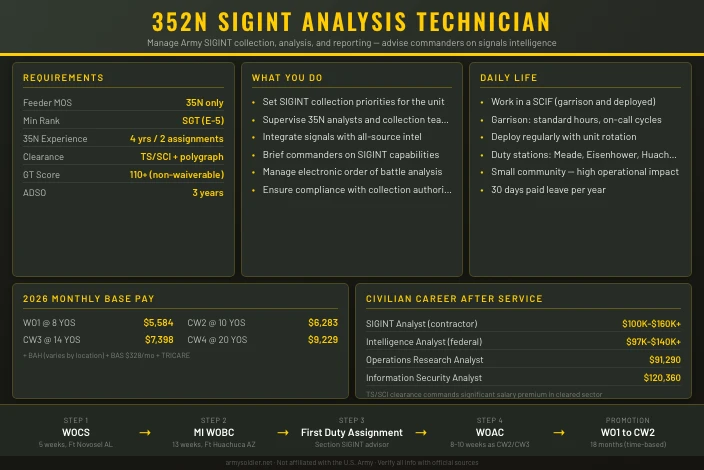
Job Role and Responsibilities
The 352N Signals Intelligence Analysis Technician manages personnel and equipment across the full SIGINT/Electronic Warfare mission – collection, processing, exploitation, location, identification, analysis, and reporting of SIGINT information. They establish collection priorities, provide technical guidance and oversight to subordinate sections, integrate multi-source intelligence into unified assessments, and advise commanders on SIGINT planning and operations at tactical through strategic levels.
Technical Expertise and Scope
The 352N owns the analytical side of Army SIGINT. Where a 35N (Signals Intelligence Analyst) operates equipment and produces intercepts, the 352N decides what gets collected, how it gets processed, and what conclusions the commander can draw from it. That distinction matters. A 352N is not a more senior 35N. They operate at a different level of the intelligence process.
Predictive intelligence is the role’s defining output. A 352N synthesizes intercepts, patterns of life, electronic order of battle, and reporting from other intelligence disciplines to build a picture of what the adversary is likely to do next. That product goes directly into the commander’s decision cycle.
Related MOS Codes and Designations
| Code | Title | Notes |
|---|---|---|
| 352N | SIGINT Analysis Technician | Primary warrant officer SIGINT analysis MOS |
| 352S | Signals Collection Technician | Focuses on collection operations vs. analysis |
| 35N | Signals Intelligence Analyst | Enlisted feeder for 352N |
| 350F | All-Source Intelligence Technician | Broader all-source analysis WO MOS |
| 351L | Counterintelligence Technician | Related MI warrant field |
Mission Contribution
The 352N sits in the intelligence section of units ranging from battalion to theater army. At lower echelons, they run the SIGINT shop and directly supervise collection teams. At higher echelons – division G2, corps, INSCOM commands – they fill senior staff advisory positions, shaping how the command allocates scarce SIGINT resources and integrates signals with imagery, human intelligence, and cyber.
Technology, Equipment, and Systems
352Ns work across the Army’s SIGINT platform inventory, including ground-based collection systems, airborne ISR platforms, and the software tools that process and exploit signals data. They use intelligence analysis platforms, databases shared across the IC community, and reporting tools that push finished products into the broader intelligence enterprise. Because the 352N role involves directing collection rather than operating equipment directly, proficiency with planning and tasking tools is as important as understanding the hardware.
Salary and Benefits
Base Pay
Warrant officers receive officer-rate base pay. Most 352N candidates come in as experienced E-5s or E-6s with 8-12 years of service, so their entry pay as a WO1 reflects that accumulated time. The table below shows realistic pay points across a 352N career.
| Rank | Typical YOS | Monthly Base Pay (2026) |
|---|---|---|
| WO1 | 8 YOS | $5,584 |
| CW2 | 10 YOS | $6,283 |
| CW3 | 14 YOS | $7,398 |
| CW4 | 20 YOS | $9,229 |
| CW5 | 26 YOS | $11,495 |
Pay figures reflect the DFAS 2026 Military Pay Chart.
Special Pays and Bonuses
The 352N does not receive flight pay or hazardous duty pay in the standard case. Warrant officers in this MOS may qualify for Special Duty Assignment Pay (SDAP) in certain billet-coded assignments. Accession and retention bonuses for intelligence warrant officers are set annually by HRC; check the current HRC warrant officer bonus page for active incentives, as amounts change with each fiscal year cycle.
Additional Benefits
BAH is paid at warrant officer rates and varies by duty station. At a typical SIGINT-heavy installation like Fort Meade, Maryland, BAH for a CW2 with dependents runs well above $2,500 per month – verify current rates at the DoD BAH lookup tool. On top of base pay, all active-duty warrant officers receive:
- BAS: $328.48/month (officer rate, 2026)
- TRICARE Prime: $0 premiums, $0 deductibles, $0 copays for the service member and family
- Tuition Assistance: Up to $4,500/year for degree coursework
- Post-9/11 GI Bill: 36 months of full tuition benefits, transferable to dependents after 6 years of service
Retirement
All warrant officers appointed after January 1, 2018, enter the Blended Retirement System (BRS). After 20 years of service, the pension pays 40% of the high-36 average basic pay. BRS also includes TSP matching: the Army contributes 1% automatically and matches up to 4% more when the service member contributes 5% of base pay. Many 352N warrant officers serve 24-28 years, reaching CW4 or CW5 before retirement.
Work-Life Balance
Garrison life for a 352N follows a roughly standard duty day, though SIGINT operations often run around the clock in exercises and deployed environments. The technical specialization and staff advisory role mean warrant officers in this field have more schedule flexibility than company-grade commissioned officers who own daily formations. The tradeoff is that the work itself – especially at INSCOM commands – never fully stops.
Qualifications and Eligibility
Appointment Paths
The 352N has one path in: enlisted-to-warrant from within the MI career management field (CMF 35). The Military Intelligence proponent does not accept applicants from non-MI MOS backgrounds for 352N. There is no civilian direct appointment and no WOFT-style street-to-seat option.
Feeder MOS Requirements
The qualifying feeder MOS is 35N (Signals Intelligence Analyst). Applicants must have:
- Completed the 35N MOS-Producing Course or the 35N Transition Course
- Graduated from the 35N Advanced Leader Course (ALC)
- A minimum of 4 years of 35N experience across at least 2 separate assignments
That last requirement filters out SGTs who have only served in one unit. The Army wants breadth: someone who has worked in different echelons, different commands, and ideally different geographic contexts.
Requirements Table
| Requirement | Details |
|---|---|
| Appointment path | Enlisted-to-warrant (35N feeder only) |
| Feeder MOS | 35N (Signals Intelligence Analyst) |
| Minimum rank | SGT (E-5) |
| Minimum experience | 4 years as 35N, at least 2 assignments |
| Education | High school diploma or GED (minimum) |
| Age limit | Maximum 46 at time of appointment (standard WO limit) |
| Security clearance | Active TS/SCI based on SSBI; current SCI access eligibility |
| Polygraph | CI-scope polygraph within the last 5 years |
| Special requirement | Written letter of recommendation from a 352N (CW3-CW5) |
| GT score | 110 minimum (non-waiverable) |
| Physical | Pass Army Fitness Test; meet Army height/weight standards |
Warrant Officer Candidate School (WOCS)
All warrant officer candidates attend WOCS at Fort Novosel, Alabama (formerly Fort Rucker). WOCS is a 5-week resident course covering Army leadership principles, warrant officer roles and responsibilities, Army doctrine, and the professional expectations for the warrant officer cohort. It is not a technical course – the MOS-specific training comes in WOBC.
The application process, known as submitting a “warrant officer packet,” requires:
- DA Form 61 (Application for Appointment)
- Letters of recommendation (including the mandatory letter from a 352N CW3-CW5)
- Official transcripts and training records
- Physical evaluation
- NCOERs covering the past 3 years
- Proof of current TS/SCI access and CI-scope polygraph
Packets compete before a centralized selection board at HRC. The 352N board evaluates depth of SIGINT experience, quality of evaluations, and the senior 352N recommendation heavily. Selection rates vary by year and Army needs; contact the MI warrant officer proponent or a warrant officer recruiter for current rates.
GT Score
All warrant officer applicants need a minimum GT score of 110. The GT composite is VE + AR (Verbal Expression plus Arithmetic Reasoning). If your current GT score falls below 110, you must retest before submitting a packet. GT score improvement resources, including ASVAB prep courses, are available through Army education centers and commercial study programs.
Upon Appointment
New 352N warrant officers enter at WO1 (Warrant Officer 1). The standard Active Duty Service Obligation (ADSO) for non-aviation warrant officers is 3 years from date of appointment. Some billet assignments and Army-funded training programs carry additional service obligations; confirm the current ADSO with your warrant officer recruiter at the time of application.
See our ASVAB study guide for a study plan focused on the GT composite.
Work Environment
Setting and Schedule
The 352N works in sensitive compartmented information facilities (SCIFs). That is not negotiable – the nature of the work requires a protected environment. In garrison, that means the intelligence section or G2 operations center. In the field, it means a classified tent or vehicle-mounted SCIF equivalent. On deployment, it typically means an operations center that runs 24 hours.
Garrison duty days are structured but not rigid. Most 352Ns in staff advisor roles maintain a normal duty day with occasional extended hours during exercises, readiness cycles, or emerging intelligence requirements.
Position in the Unit
The 352N does not sit in the NCO support channel, nor does the role carry command authority in the traditional sense. The warrant officer in this MOS functions as the senior technical advisor to the intelligence officer (S2/G2) and to the commander on all SIGINT matters. The relationship is advisory and expert-based: the commissioned intelligence officer is responsible for the section, but the 352N is the person who knows whether a collection plan is technically feasible and whether an analytical product is sound.
At the tactical level, 352Ns directly supervise small teams of 35N analysts and collection operators. At the operational and strategic level – INSCOM brigades, corps G2, theater army – the 352N fills staff positions and influences collection strategy across large formations.
Technical vs. Staff Roles
A WO1 or CW2 in this MOS is doing hands-on analytical work: reviewing intercepts, building products, training subordinates, and running daily operations. A CW3 moves increasingly into supervisory and advisory functions. By CW4, most 352N warrant officers are filling senior staff positions at brigade, division, or INSCOM command level, spending the majority of their time advising senior leaders rather than personally producing intelligence.
Job Satisfaction
The 352N community is small. Most warrant officers in the field report high job satisfaction tied to the technical depth of the work, the direct operational impact of their products, and the relative freedom from the administrative grind that weighs on many commissioned officer careers. The work is intellectually demanding and rarely repetitive. The main frustrations are clearance-related delays in assignments, the physical constraints of SCIF environments, and the limited peer community compared to larger MOS fields.
Training and Skill Development
Warrant Officer Basic Course (WOBC)
After WOCS, newly appointed 352N WO1s attend the Military Intelligence WOBC at the U.S. Army Intelligence Center of Excellence (USAICoE) at Fort Huachuca, Arizona.
| Phase | Location | Length | Focus |
|---|---|---|---|
| WOCS | Fort Novosel, AL | 5 weeks | Leadership, warrant officer roles, Army doctrine |
| MI WOBC | Fort Huachuca, AZ | 13 weeks | SIGINT analysis, doctrine, systems, tactics |
WOBC is the technical foundation for the warrant officer role. It goes deeper than anything in the 35N ALC – focusing on how a warrant officer manages SIGINT operations across echelons, applies doctrine in planning, and integrates signals with other intelligence disciplines. WOBC also covers the legal, policy, and oversight framework governing Army SIGINT operations, which is essential background for anyone advising commanders.
WOBC differs from AIT in that students are already experienced NCOs. The course assumes SIGINT proficiency and builds on it with officer-level doctrine and advisory skills.
Warrant Officer Advanced Course (WOAC)
352Ns attend WOAC as CW2s or early CW3s, typically 4-6 years after initial appointment. WOAC is conducted at USAICoE at Fort Huachuca and runs approximately 8-10 weeks. The course covers advanced SIGINT analysis concepts, operational planning at higher echelons, and leadership responsibilities for warrant officers moving into senior technical advisor roles.
Warrant Officer Intermediate Level Education (WOILE)
WOILE is attended as a CW3 or CW4. It is a 5-week MOS-immaterial resident course that prepares warrant officers for service at higher echelons: corps, army, joint, and interagency environments. The course covers strategic-level military operations, joint doctrine, and the warrant officer’s role in joint and combined arms environments. WOILE is conducted at Fort Novosel.
Warrant Officer Senior Service Education (WOSSE)
Senior CW4s and CW5s attend WOSSE, which runs in two phases – distance learning followed by a resident period. WOSSE prepares the most senior warrant officers for advisory roles at the highest Army and joint echelons. It covers national security policy, senior leader advisory responsibilities, and the unique position of the CW5 as the Army’s top technical expert.
Additional Training
352Ns have access to a range of additional training that builds professional depth:
- NSA-affiliated technical courses through interagency training pipelines
- Advanced analytic tools and tradecraft courses through the National Intelligence University and Defense Intelligence components
- Army Continuing Education System (ACES) tuition assistance for degree completion
- Army COOL (Credentialing Opportunities On-Line) for civilian intelligence and security certifications aligned with the MOS
A qualifying GT score comes first — our ASVAB study guide covers the subtests that drive GT.
Career Progression and Advancement
Career Timeline
| Rank | Typical TIG | Typical Total YOS | Key Assignments |
|---|---|---|---|
| WO1 | 18 months | 8-10 YOS | WOBC, initial duty assignment as section-level SIGINT advisor |
| CW2 | 3-4 years | 10-13 YOS | WOAC, team leader or small section OIC |
| CW3 | 4-5 years | 14-18 YOS | WOILE, battalion/brigade SIGINT advisor, staff roles |
| CW4 | 4-6 years | 20-24 YOS | Division G2 staff, INSCOM brigade advisor, WOSSE |
| CW5 | Until retirement | 26-30+ YOS | Senior technical advisor at corps, theater army, or INSCOM major command |
YOS figures include prior enlisted time. Most 352Ns enter with 8-12 years of service already accumulated as 35Ns.
Promotion System
WO1 to CW2 is time-based – typically 18 months after successful completion of WOBC and initial assignment. CW3 through CW5 require board selection. Warrant officer promotion boards evaluate Officer Evaluation Reports (OERs), depth of assignments, PME completion, and senior rater assessments.
The CW5 promotion is the most competitive grade in the warrant officer corps. Army-wide, only a small percentage of eligible CW4s are selected. In the 352N community specifically, the small population means the board has a clear view of every file. Assignments at joint or interagency positions and broadening tours (fellowships, DA-level staff billets) carry weight.
Building a Competitive Record
Strong 352N files have a few things in common:
- Consecutive assessments showing technical mastery and expanding scope of responsibility
- Progressive assignments across multiple echelons (battalion, brigade, INSCOM command, joint)
- PME completion ahead of schedule (WOAC and WOILE before primary zone)
- Broadening assignments – joint duty, interagency fellowships, or instructor/trainer positions
- Civilian education at the bachelor’s or master’s level, preferably in a related field
CW5 as Senior Technical Advisor
A CW5 352N typically serves at corps G2, theater army, or an INSCOM major command. At that level, the role is almost entirely advisory: briefing senior officers on SIGINT capabilities and limitations, influencing collection strategy at scale, and representing Army SIGINT interests in joint and interagency forums. Some CW5s fill positions directly embedded with national-level intelligence organizations.
Physical Demands and Medical Evaluations
Army Fitness Test
All warrant officers take the Army Fitness Test (AFT), which replaced the ACFT on June 1, 2025. The AFT has five events scored 0-100 points each, with a maximum of 500 total. The 352N MOS carries a general standard (300 minimum, sex- and age-normed), not the combat specialty standard.
| Event | Abbreviation | Min Score (General Standard) |
|---|---|---|
| 3-Rep Max Deadlift | MDL | 60 |
| Hand Release Push-Up | HRP | 60 |
| Sprint-Drag-Carry | SDC | 60 |
| Plank | PLK | 60 |
| Two-Mile Run | 2MR | 60 |
| Total | 300 |
Scores are sex- and age-normed, meaning the raw performance standard (weight lifted, time, reps) varies by age group and sex while the point value remains the same.
MOS-Specific Medical Requirements
The 352N has no flight physical requirement. The primary medical consideration for this MOS is meeting Army general medical fitness standards (AR 40-501) for worldwide assignment. Because 352Ns must be deployable and capable of serving in field SCIF environments, any condition that limits worldwide deployment is a significant consideration during the accession process.
Vision requirements are standard Army corrected-vision standards; no special vision requirement applies beyond what is needed for worldwide assignment. Hearing standards follow AR 40-501 – 35N experience means candidates are typically already screened for hearing acuity through their enlisted SIGINT career.
Deployment and Duty Stations
Deployment Tempo
The 352N community deploys regularly. SIGINT capability is in high demand across the Army’s operational commitments, and the small number of qualified warrant officers means high-priority billets fill from a limited pool. Deployment cycles vary by unit type: conventional units typically follow a deploy/dwell cycle, while INSCOM units may have more continuous rotational requirements.
Deployments for 352Ns range from combat support rotations in active theaters to peacekeeping operations, training missions with partner nations, and supporting theater-level intelligence requirements. Deployed 352Ns typically work in a joint intelligence center or a division/brigade operations center alongside officers and NCOs from other services and agencies.
Duty Stations
The Army’s SIGINT enterprise concentrates at a handful of installations where the requisite infrastructure and classification facilities exist.
Primary duty stations for 352N:
- Fort Meade, Maryland – Home of NSA, INSCOM headquarters, and multiple intelligence-focused units
- Fort Eisenhower, Georgia (formerly Fort Gordon) – Major SIGINT and cyber installation, Cyber Center of Excellence
- Fort Huachuca, Arizona – USAICoE, initial training assignment common for new WO1s
- Schofield Barracks, Hawaii – Pacific theater intelligence support
- Wiesbaden, Germany – European theater INSCOM presence
- Fort Bragg (Fort Liberty), North Carolina – XVIII Airborne Corps, significant intelligence footprint
Duty station assignment is managed through HRC based on valid vacancies and warrant officer preferences. Because SIGINT billets require cleared facilities, 352N assignments are more geographically concentrated than most MOS.
Risk, Safety, and Legal Considerations
Job Hazards
The 352N role carries physical risk in deployed environments: SCIF facilities in operational theaters are located at forward operating bases and combat outposts that face the same threats as any other military position. The work itself is not inherently dangerous, but the operating environment can be.
The more day-to-day risk in this MOS is legal and administrative. SIGINT collection is governed by Title 50 (National Security Act), Executive Order 12333, and a web of classified authorities. A 352N who approves or directs collection activities outside authorized authorities faces potential UCMJ exposure and career-ending consequences. Rigorous attention to legal authorities is as much a professional requirement as technical proficiency.
Safety Protocols
Risk management in this MOS follows the standard Army Composite Risk Management (CRM) process. In deployed environments, 352Ns contribute to site security planning for intelligence facilities, which requires balancing operational security needs with physical force protection requirements.
Authority and Responsibility
The 352N does not hold command authority in the conventional sense – this is a staff and advisory role outside aviation. The authority is technical and advisory: within their scope, the 352N’s expert judgment on what is technically achievable, legally permissible, and operationally sound carries significant weight with commanders.
UCMJ applies fully. As warrant officers, 352Ns are officers under the code and are held to officer standards of conduct.
Impact on Family and Personal Life
Family Considerations
The intelligence community lifestyle – regular deployments, SCIF-centric work schedules, and geographic concentration at major installations – creates predictable patterns that families adapt to. Fort Meade, Fort Eisenhower, and Fort Huachuca all have established Army Family support infrastructure: Army Community Service (ACS), Family Readiness Groups (FRGs), and school liaison programs.
PCS (permanent change of station) moves for 352N warrant officers happen every 2-3 years on average, similar to other non-aviation warrant officer MOS. The geographic concentration of duty stations means moves tend to cycle among a predictable set of installations, which makes family planning more manageable over a career.
Dual-Military and Stability
Dual-military couples where both partners are in SIGINT or intelligence career fields can request assignment consideration through HRC’s Joint Spouse program, though colocation is never guaranteed. Because 352N billets are concentrated at a small number of installations, there is a reasonable chance of overlapping duty assignments.
Compared to commissioned officers in the same intelligence field, 352N warrant officers generally experience fewer PCS moves and more stability at any given installation. The staff advisory role does not require the same rotation through command and staff assignments that shapes a commissioned intelligence officer’s career.
Reserve and National Guard
Component Availability
The 352N MOS is available in both the Army Reserve and the Army National Guard. Reserve and Guard units with SIGINT missions maintain 352N positions, particularly at military intelligence brigades, theater-level intelligence support units, and INSCOM subordinate commands.
Appointment Paths
Reserve and Guard candidates follow the same enlisted-to-warrant path as active-duty applicants: 35N feeder MOS, minimum E-5, ALC completion, 4 years of 35N experience across 2 assignments, and current TS/SCI with CI-scope polygraph. The standards are identical – the Army does not apply a lower bar for Reserve and Guard SIGINT warrant officers.
Active-duty 352Ns who separate and wish to continue serving may transfer to a Reserve or Guard unit if they find an open position and receive approval from their gaining command.
Drill and Training Commitment
Standard drill commitment is one weekend per month (4 drill periods) plus two weeks of Annual Training. For 352N warrant officers, this baseline may expand: SIGINT currency requirements, classified training events, and readiness certifications often require additional training days beyond the minimum. Access to a SCIF at the Reserve Center or armory is a practical requirement, and not all facilities have one – this affects which units a Reserve or Guard 352N can realistically join.
Part-Time Pay
Drill pay is calculated as (monthly base pay / 30) x number of drill periods. A weekend drill = 4 periods.
| Rank | YOS | Weekend Drill Pay (approx.) |
|---|---|---|
| WO1 | 8 YOS | ~$745 |
| CW2 | 10 YOS | ~$838 |
| CW3 | 14 YOS | ~$986 |
These figures are derived from the 2026 warrant officer pay table. Active-duty monthly base pay for the same grades is shown in the Salary section above.
Benefits Differences
| Benefit | Active Duty | Army Reserve | Army National Guard |
|---|---|---|---|
| Monthly base pay | Full | Drill days only | Drill days only |
| Healthcare | TRICARE Prime ($0) | TRICARE Reserve Select ($57.88/mo individual) | TRICARE Reserve Select ($57.88/mo individual) |
| Education | Full TA ($4,500/yr) + Post-9/11 GI Bill | Federal TA available; MGIB-SR $493/mo | Federal TA + state tuition waivers (varies by state) |
| Retirement | BRS pension at 20 years active | Points-based, collect at age 60 | Points-based, collect at age 60; state bonuses vary |
| Deployment tempo | Regular rotation | Periodic mobilizations (Title 10) | State + federal missions |
| Advancement to CW4/CW5 | Competitive board | Yes, board-selected | Yes, board-selected |
Career Progression and Civilian Integration
Reserve and Guard 352N warrant officers can promote to CW4 and CW5, attend WOAC, WOILE, and WOSSE, and fill senior staff billets in their component. Promotion timelines are generally slower than active duty because fewer positions exist and mobilized time accrues more slowly.
The civilian career alignment for Reserve and Guard 352Ns is one of the strongest in the Army: intelligence analysts, SIGINT specialists, and cleared technical roles at defense contractors and government agencies pair naturally with the drill weekend schedule. Employers in the cleared defense sector often view the Reserve or Guard commitment as a benefit rather than a burden.
USERRA protects all Reserve and Guard members from employer discrimination related to military service, including reemployment rights after deployments up to 5 cumulative years.
Post-Service Opportunities
Civilian Demand for 352N Skills
A 352N who retires or separates carries a combination that the cleared defense sector actively recruits: deep SIGINT tradecraft, experience managing technical personnel, current TS/SCI access, and credibility in the intelligence community. That combination commands a significant salary premium over analysts who have only the clearance or only the technical background.
Primary hiring sectors include NSA and its contractor support base, DIA and defense intelligence components, CIA technical services, and the major defense intelligence contractors that support INSCOM, NGA, and combatant command J2 staffs.
Civilian Career Prospects
| Job Title | Median Annual Salary | Outlook |
|---|---|---|
| Intelligence Analyst (federal) | $97,000-$140,000+ (GS-12 to GS-14 range) | Strong; demand tied to national security priorities |
| SIGINT Analyst (defense contractor) | $100,000-$160,000+ | Strong; cleared workforce shortage continues |
| Operations Research Analyst | $91,290 | +21% growth 2024-2034 (BLS) |
| Information Security Analyst | $120,360 | +33% growth 2023-2033 (BLS) |
| Intelligence Program Manager | $110,000-$150,000+ | Strong in cleared sector |
Federal pay scales (GS) are published at OPM.gov. Defense contractor salaries vary by company and clearance level; current postings on USAJobs.gov and cleared job boards reflect live market rates.
Certifications and Credentials
Army COOL lists certifications available to 352Ns through Army-funded pathways, including intelligence-specific credentials and analytical tradecraft certifications. Relevant civilian credentials include:
- Certified Intelligence Professional (CIP) through the National Military Intelligence Association
- CompTIA Security+ and related information security certifications
- Certified Information Systems Security Professional (CISSP) for warrant officers moving into security roles
- Analytical tradecraft certifications through Intelligence Community programs
The Post-9/11 GI Bill covers 36 months of full in-state tuition at public universities or up to $29,920.95 per year at private institutions (AY 2025-2026 cap). Many 352N veterans use this benefit to complete or advance degrees in intelligence studies, national security, data science, or a related field.
Is This a Good Job for You? The Right (and Wrong) Fit
Who Thrives in This Role
The best 352N candidates are 35Ns who have never been satisfied just running the equipment. They want to know why the intercept matters, how it connects to other reporting, and what the commander should do with it. They push for more access, more context, and a bigger picture. They’re also capable managers – this is a leadership role, and the 352N who can’t develop 35N analysts won’t last long in the job.
Technical depth without communication skills is a dead end in this MOS. A 352N who can’t brief a battalion commander on SIGINT limitations in plain language, or who can’t write a product that a non-SIGINT officer can use, will struggle regardless of how good their analytical skills are.
Potential Challenges
The warrant officer path in this MOS is not for E-5s fresh out of AIT. The Army’s requirement for 4 years of experience and 2 assignments means you’ll spend at minimum 4-6 years in the enlisted ranks before you’re eligible. If you’re an SGT with 2 years of 35N experience who wants to be a warrant officer, the answer is: not yet.
Promotion to CW5 is slow and competitive. The 352N community is small, and strong performers still wait years at CW4 before a board selects them. If you need command authority or rapid promotion, this is not the right track.
The TS/SCI and polygraph requirements mean that any significant lifestyle or financial issue – untreated debt, foreign contacts, past drug use – can derail your clearance and end your warrant officer career before it starts.
Career and Lifestyle Alignment
For an experienced 35N who wants to stay in the SIGINT world, stay technical, and grow into a senior advisory role without climbing the commissioned officer career pyramid, the 352N path is a strong fit. You get more autonomy than a senior NCO, more technical depth than a commissioned MI officer, and access to the highest-level intelligence work the Army does.
If you want command authority, geographic flexibility, or a broader management career path, a different warrant officer MOS or the commissioned officer path may serve you better.
More Information
A warrant officer recruiter can give you current packet deadlines, board dates, and the most up-to-date bonus information for the 352N MOS. The Army Warrant Officer Recruiting Command maintains a dedicated page at gowarrantnow.com with MOS-specific eligibility details. If your GT score needs improvement before you apply, Army education centers and ASVAB prep programs can help you reach the 110 minimum.
- Prepare for the ASVAB with our study guide to meet the GT 110 requirement
This site is not affiliated with the U.S. Army or any government agency. Verify all information with official Army sources before making enlistment or career decisions.
Explore more Army warrant officer intelligence careers such as the 350F All-Source Intelligence Technician and the 351L Counterintelligence Technician.