352S Signals Collection Technician
Every time an Army commander asks what the enemy is doing on the radio net, somewhere a 352S Signals Collection Technician made that answer possible. This warrant officer owns the full collection architecture – the systems, the operators, and the technical tradecraft that turns intercepted electronic signals into usable intelligence. It is one of the most technically specialized positions in Military Intelligence, and one of the least visible outside the community.
Most soldiers in this field started as a 35S Signals Collector/Analyst. They spent years at intercept positions, built technical depth in non-Morse collection and direction-finding systems, and eventually earned the right to step into a role that commissioned officers rarely understand well enough to manage without them. The 352S warrant officer is the expert the commander turns to when the technology and the mission intersect.
Warrant officer candidates need a GT score of at least 110 — our ASVAB study guide covers what drives that number.
Job Role and Responsibilities
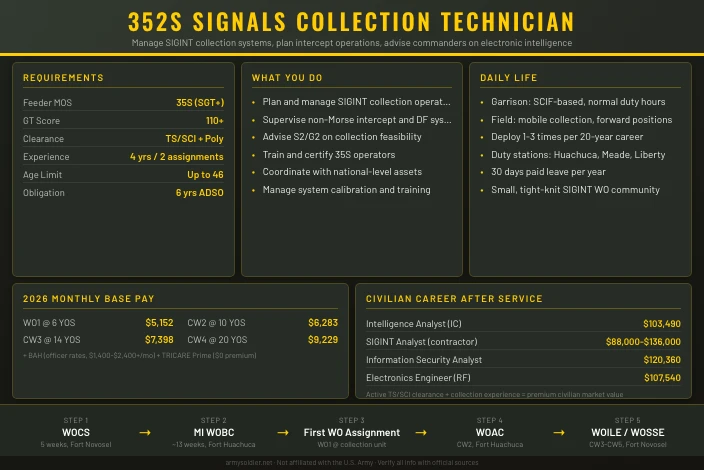
The 352S Signals Collection Technician is a warrant officer who manages personnel and equipment for Army signals intelligence (SIGINT) collection operations. This MOS plans, coordinates, and supervises the employment of non-Morse intercept systems and direction-finding equipment to collect foreign communications and electronic emissions. The 352S serves as the technical authority for SIGINT collection at tactical, operational, and strategic levels, bridging the gap between enlisted intercept operators and commanders who need accurate, timely collection reporting.
Technical Expertise and Scope
The 352S owns the collection side of the SIGINT mission. Where the enlisted 35S operates intercept equipment, the warrant officer manages the collection architecture across an entire unit or task force. That means designing collection plans, assigning frequencies and targets, allocating operator hours, and ensuring the right systems are positioned to cover priority intelligence requirements.
Non-Morse collection encompasses a wide range of electronic emissions: communications signals, radar pulses, telemetry data, and other radio-frequency traffic. The 352S applies antenna theory, wave propagation principles, and traffic analysis to determine how to exploit those signals most effectively. At higher echelons, this warrant officer coordinates collection across multiple teams and systems, deconflicting with adjacent units and national-level collection assets.
Unlike a commissioned intelligence officer (35A or 35D) who focuses on analysis and reporting, the 352S stays anchored to the collection function. The technical depth required to manage intercept equipment lifecycles, troubleshoot collection gaps, and train operators on system employment keeps this warrant officer in a hands-on technical role throughout their career.
Related MOS Codes and Designators
| Code | Title | Relationship |
|---|---|---|
| 352S | Signals Collection Technician (WO) | This MOS |
| 352N | SIGINT Analysis Technician (WO) | Companion WO; analysis vs. collection |
| 35S | Signals Collector/Analyst (Enlisted) | Primary feeder MOS |
| 353T | MI Systems Maintenance/Integration Technician (WO) | Supports collection system sustainment |
| 35F | Intelligence Analyst (Enlisted) | Related MI field |
| 35N | Signals Intelligence Analyst (Enlisted) | Related SIGINT enlisted MOS |
Mission Contribution
SIGINT collection provides commanders with intelligence that no other source can match. Human sources cannot monitor an enemy’s radio traffic in real time. Imagery cannot capture voice communications. The 352S ensures that collection systems are positioned, configured, and operated to fill those gaps in the intelligence picture.
At the tactical level, a 352S advises the battalion or brigade S2 on what collection is feasible given available systems and the electromagnetic environment. At higher echelons, this warrant officer integrates collection plans with Army and joint intelligence production cycles. The 352S also functions as the institutional memory for SIGINT collection within the unit, training replacements and ensuring continuity across personnel rotations.
Technology and Systems
The 352S works with a family of ground-based and airborne SIGINT collection platforms. Ground systems include direction-finding equipment, tactical intercept receivers, and associated processing hardware. The warrant officer manages system calibration, maintenance schedules, and operator certification programs to keep equipment mission-ready.
At higher grades, the 352S engages with larger collection architectures that integrate tactical systems with theater and national-level collection. Proficiency with command-and-control software, collection management tools, and signals database systems grows across the career progression.
Salary and Benefits
Base Pay
Most 352S warrant officers enter with significant prior enlisted service as a 35S Sergeant (E-5) or Staff Sergeant (E-6). That enlisted time counts toward their total years of service for pay purposes, so very few enter at the lowest pay bracket. The table below shows realistic pay points across a typical 352S career. All figures are 2026 monthly base pay from DFAS.
| Rank | Typical Total YOS | Monthly Base Pay |
|---|---|---|
| WO1 | 6 years | $5,152 |
| WO1 | 8 years | $5,584 |
| CW2 | 8 years | $6,051 |
| CW2 | 10 years | $6,283 |
| CW3 | 14 years | $7,398 |
| CW3 | 18 years | $8,150 |
| CW4 | 20 years | $9,229 |
| CW4 | 24 years | $10,032 |
| CW5 | 26 years | $11,495 |
Special Pays and Bonuses
The 352S MOS requires a Top Secret/SCI clearance. Soldiers with active SCI access may qualify for special duty assignment pay depending on position, though rates and eligibility vary by assignment. Check current ALARACT messages or contact your career manager at the Human Resources Command for current incentive pay details.
Warrant officer accession and retention bonuses are managed by HRC and change periodically. Intelligence warrant officers, particularly in SIGINT specialties, have been included in bonus programs in recent years. Verify current bonus availability at hrc.army.mil before making a career decision based on bonus figures.
Additional Benefits
Warrant officers receive BAH at officer rates, not enlisted rates. For a single CW2 at Fort Huachuca, AZ, that runs roughly $1,400 to $1,600 per month in 2026 depending on dependency status; at larger installations like Fort Meade, MD, BAH can exceed $2,400. TRICARE Prime covers the warrant officer and eligible family members with no premiums and no copays for active duty.
The Blended Retirement System (BRS) applies to most soldiers who entered service after January 1, 2018. Under BRS, a 20-year retirement pays 40% of the high-36 average basic pay as a monthly pension. The government automatically contributes 1% of basic pay to the Thrift Savings Plan (TSP) and matches up to an additional 4% when the soldier contributes at least 5%. Warrant officers who stay 20 or more years – which many do – build substantial retirement income.
The Post-9/11 GI Bill provides up to 36 months of education benefits, covering full in-state tuition at public schools and up to $29,920.95 per academic year at private institutions. Army Tuition Assistance covers up to $4,500 per year while on active duty.
Work-Life Balance
Garrison life for a 352S centers on normal duty hours with additional demands during exercises, operations, and collection events. Field exercises run in cycles tied to unit training calendars, typically several weeks per year. Deployment tempo depends on the unit – intelligence units supporting combat formations deploy more frequently than those assigned to training or institutional roles.
The warrant officer lifestyle sits between the constant staff grind of commissioned officers and the physical demands of senior NCO positions. A CW3 or CW4 352S typically manages a team, advises commanders, and runs collection programs without taking on the full administrative burden of company command. The autonomy is real, but so is the accountability.
Qualifications and Eligibility
Appointment Paths
The 352S has one primary appointment path: enlisted-to-warrant from MOS 35S. There is no direct civilian appointment or prior-service waiver for non-35S personnel. The Army designed this MOS so that warrant officers bring hands-on intercept experience from their enlisted careers directly into the technical leadership role.
To be competitive for a 352S packet, a 35S must hold the rank of Sergeant (E-5) or above, though most competitive applicants are Staff Sergeants (E-6). The Army requires a minimum of four years of operational experience in MOS 35S across at least two different assignments. That breadth requirement is deliberate – it filters out soldiers who have only served in a single collection environment.
Eligibility Requirements Table
| Requirement | Standard |
|---|---|
| Feeder MOS | 35S (Signals Collector/Analyst) |
| Minimum rank | SGT (E-5), E-6 competitive |
| Minimum enlisted TIS | 5 years (waiverable) |
| Maximum age | 46 (waiverable) |
| Education | High school diploma or GED (minimum) |
| GT score | 110 minimum (non-waiverable) |
| Security clearance | Top Secret / SCI (active SSBI required) |
| Polygraph | CI Scope Polygraph within 5 years of submission |
| Operational experience | 4 years in 35S across at least 2 assignments |
| Course completion | Intermediate Communications Signals Analysis Course (A-231-0451 or SIGE3810) |
| Leadership course | 35S Advanced Leader Course (ALC) |
| NCOERs required | Three finalized NCOERs (most recent within 12 months) |
WOCS and the Warrant Officer Packet
All 352S candidates attend the Warrant Officer Candidate School (WOCS) at Fort Novosel, AL – a five-week resident course that covers leadership, officership, Army doctrine, and the roles and responsibilities of warrant officers. WOCS is not MOS-specific; the technical training comes in the follow-on WOBC.
The selection packet for a 352S warrant includes:
- DA Form 61 (Application for Appointment)
- Official and academic transcripts
- Letters of recommendation (typically from current and former commanders or supervisors)
- NCOERs
- Medical screening documentation
- Security clearance verification
- A photo and physical fitness record
Packets are reviewed by an HRC selection board. Competitive packets show consistent NCOERs above center of mass, documented collection experience across multiple echelons, and completed technical coursework. The CI Scope Polygraph is a hard requirement and must be current at time of submission.
GT Score and Test Requirements
All warrant officer candidates must score 110 or higher on the GT composite (Verbal Expression + Arithmetic Reasoning) of the ASVAB. This requirement has no waiver. If your GT score is below 110, retesting is authorized and preparation resources are available through the Army’s COOL program and commercial ASVAB study guides.
The 352S does not require a SIFT score. That test is reserved for aviation warrant officer candidates.
Upon Appointment
New 352S warrant officers are appointed at WO1 upon graduation from WOCS. The standard active duty service obligation is six years following completion of both WOCS and WOBC. WO1 is not a commissioned grade – it is an appointment by warrant of the Secretary of the Army. Promotion to CW2 elevates the warrant officer to a commissioned status within the warrant cohort.
See our ASVAB study guide for a study plan focused on the GT composite.
Work Environment
Daily Setting
A 352S at a tactical intelligence unit spends most of the duty day in a Sensitive Compartmented Information Facility (SCIF) or a tactical operations center, managing collection programs, reviewing operator logs, and advising the S2 section. The physical environment is controlled – air-conditioned, climate-managed – but the pace can be relentless during exercises and real-world collections events.
The garrison schedule mirrors a standard Army duty day, with extra hours during major exercises, collection events, or when supporting operational requirements. In the field, the 352S operates from mobile collection platforms or tactical SCIFs, often under limited power and communications constraints.
Position in the Unit
The 352S sits outside the normal NCO support channel. This warrant officer does not serve in the chain of command in the traditional sense – there is no command authority over line soldiers in the way a platoon leader or company commander holds it. Instead, the 352S functions as the technical advisor to the intelligence officer (S2 or G2) and the commander on all matters related to SIGINT collection.
The relationship with the S2 officer is collaborative but defined. The commissioned intelligence officer owns the intelligence requirements; the 352S owns the collection plan and the technical execution. At brigade and higher, the warrant officer may supervise multiple teams of 35S operators while simultaneously advising the staff.
Senior NCOs in the 35S career field know the 352S as the authoritative voice on collection tradecraft. The warrant officer ranks above the NCO technically but does not function as a rater or senior rater unless given explicit authority to do so. In practice, the relationship is professional and mutually dependent – operators rely on the 352S for technical guidance, and the warrant officer relies on experienced NCOs to run the section.
Technical vs. Staff Balance
At WO1 and CW2, the 352S is mostly hands-on. This means reviewing collection reports, troubleshooting system issues, training operators, and building collection plans. The staff advisory role grows with rank. By CW3, the 352S spends more time in commander’s updates and intelligence working groups, less time at the intercept position.
At CW4 and CW5, the work is almost entirely advisory and programmatic. The senior warrant officer shapes collection strategy, writes doctrine, and represents the command at joint and interagency SIGINT forums. Hands-on technical work does not disappear, but the scope shifts from running individual collection sessions to managing entire collection programs.
Job Satisfaction and Retention
Retention rates among SIGINT warrant officers tend to be high relative to other technical specialties. The civilian market for cleared SIGINT professionals is strong, but warrant officers who reach CW3 and beyond are often drawn to stay by the unique access, mission relevance, and peer community that civilian contracting rarely matches. The most common reasons for leaving are the security clearance maintenance burden, the limited number of duty stations, and the pay gap at senior grades compared to cleared contractor positions.
Training and Skill Development
Training Pipeline Table
| Phase | Course | Location | Duration |
|---|---|---|---|
| Phase 1 | Warrant Officer Candidate School (WOCS) | Fort Novosel, AL | 5 weeks |
| Phase 2 | MI Warrant Officer Basic Course (WOBC) | Fort Huachuca, AZ | ~13 weeks |
| CW2 | Warrant Officer Advanced Course (WOAC) | Fort Huachuca, AZ | Varies |
| CW3-CW4 | Warrant Officer Intermediate Level Education (WOILE) | Fort Novosel, AL | 5 weeks resident |
| CW4-CW5 | Warrant Officer Senior Service Education (WOSSE) | Fort Novosel, AL | 4 weeks resident |
Warrant Officer Basic Course (WOBC)
The MI WOBC at Fort Huachuca is a roughly 13-week course that provides MOS-specific technical qualification for new MI warrant officers. For 352S, this means advanced training in SIGINT collection management, collection planning doctrine, system employment, and multi-echelon collection coordination. WOBC differs from enlisted AIT in that it assumes the student already has technical competence in the 35S skillset – the course builds management and advisory capability on top of that foundation.
New WO1s must complete WOBC within two years of appointment. Failure to complete on time can delay promotion to CW2.
Warrant Officer Advanced Course (WOAC)
WOAC is attended as a CW2 preparing for CW3 responsibilities. It covers advanced technical skills in collection management, SIGINT integration across intelligence disciplines, and leadership at higher echelons. The course includes both a distance learning phase and a resident phase at Fort Huachuca. WOAC completion is required for CW3 promotion eligibility.
Warrant Officer Intermediate Level Education (WOILE)
WOILE is a five-week resident course at the U.S. Army Warrant Officer Career College (WOCC) at Fort Novosel. It is MOS-immaterial – meaning all warrant officers attend together regardless of specialty. WOILE develops institutional perspective, joint officer knowledge, and the leadership skills needed to serve effectively at division-level and higher echelons. It is required for CW4 consideration.
Warrant Officer Senior Service Education (WOSSE)
WOSSE prepares senior CW4s and CW5s for positions at corps, DA, and joint-level staff. The course runs a 48-hour distance learning phase followed by a four-week resident phase at Fort Novosel. WOSSE focuses on strategic-level advisory roles, interagency coordination, and the warrant officer’s contribution to Army modernization.
Additional Schools and Certifications
The Army funds access to Army COOL (Credentialing Opportunities On-Line) credentials that translate 352S skills into civilian certifications. Intelligence-related certifications such as CompTIA Security+, Certified Information Systems Security Professional (CISSP), and GIAC analyst certifications are relevant. Language training through the Defense Language Institute is available for soldiers who work with foreign-language collection missions.
Tuition Assistance covers up to $4,500 per year for degree completion while on active duty. Many 352S warrant officers pursue bachelor’s or master’s degrees in intelligence studies, cybersecurity, or electrical engineering over their careers.
A qualifying GT score comes first — our ASVAB study guide covers the subtests that drive GT.
Career Progression and Advancement
Career Timeline
| Rank | Typical Total YOS | Typical TIG | Promotion Method | Key PME |
|---|---|---|---|---|
| WO1 | 5-8 years | 1-2 years | Automatic (time-based post-WOBC) | WOBC |
| CW2 | 7-10 years | 5-6 years | Automatic (TIG + WOBC complete) | WOAC |
| CW3 | 12-16 years | 5-6 years | Competitive selection board | WOILE |
| CW4 | 17-22 years | 5-6 years | Competitive selection board | WOSSE |
| CW5 | 22-30+ years | 5+ years | Highly competitive selection board | WOSSE complete |
Total years of service includes prior enlisted time. A 35S who makes E-6 before applying typically enters the warrant officer corps at roughly six to eight total years of service.
Promotion System
WO1 to CW2 is automatic – no selection board required. The warrant officer must complete WOBC and serve the minimum time-in-grade. CW3 and above require competitive selection board review, which evaluates the full Officer Evaluation Report (OER) record using DA Form 67-10-1A (the warrant officer OER form under the DA Pam 623-3 series).
Boards look at assignment breadth, duty performance, education, and the strength of OER support form narratives. A 352S who has only served at one installation in a single collection environment will struggle to compete against peers with joint assignments, interagency rotations, or advanced degrees. Promotion to CW4 is selective; CW5 is limited to roughly 5% of the active warrant officer population.
Building a Competitive Record
Specific steps that differentiate competitive records:
- Echelon breadth: Serve at tactical (battalion/brigade), operational (division/corps), and strategic (INSCOM or national-level agency) assignments before CW4 consideration.
- Joint and interagency tours: NSA, DIA, or combatant command assignments carry weight on selection boards.
- Civilian education: A bachelor’s degree is standard; a master’s degree is a clear differentiator at CW4 and CW5 boards.
- Advanced technical certifications: SIGINT-relevant security and technical certifications demonstrate initiative.
- OER quality: Senior raters who know warrant officer culture write more effective support forms. Seek raters familiar with MI warrant officer development.
CW5 as Senior Technical Advisor
A CW5 352S serves as the senior SIGINT collection advisor at corps, Army, or national-level command. At this level, the warrant officer shapes collection doctrine, influences system acquisition decisions, and represents collection equities in joint intelligence planning processes. The role is entirely advisory – there is no equivalent of a battalion command for a CW5 – but the influence over national SIGINT architecture is substantial.
Physical Demands and Medical Evaluations
Army Fitness Test Standards
All warrant officers take the same Army Fitness Test (AFT), which replaced the ACFT on June 1, 2025. The AFT has five events scored on a 0-100 scale with a maximum total of 500 points. A minimum score of 60 per event is required to pass.
| Event | Abbreviation | Minimum Score (60 pts, age 17-21) |
|---|---|---|
| 3 Repetition Maximum Deadlift | MDL | 60 |
| Hand Release Push-Up - Arm Extension | HRP | 60 |
| Sprint-Drag-Carry | SDC | 60 |
| Plank | PLK | 60 |
| Two-Mile Run | 2MR | 60 |
The 352S MOS is not among the 21 designated combat specialties that require a 350-point total. The general standard of 300 total points (60 per event minimum) applies, with scores age-normed and sex-normed per official Army scoring tables.
Medical and Clearance Evaluations
The 352S has no flight physical requirement and no specific vision or hearing standard beyond the Army-wide medical retention standards in AR 40-501. The more significant medical-adjacent requirement is the CI Scope Polygraph, which must remain current throughout the career.
The Top Secret/SCI clearance requires a Single Scope Background Investigation (SSBI) and periodic reinvestigation. Reinvestigation cycles are typically every five years for TS/SCI holders. Any adverse personal conduct – financial problems, foreign contacts, drug use – can result in clearance suspension, which would disqualify the soldier from serving in this MOS.
Deployment and Duty Stations
Deployment Tempo
SIGINT collection warrant officers deploy with intelligence units supporting ground combat, special operations, and joint task forces. Typical deployment length is nine to twelve months for a combat rotation, with additional temporary duty (TDY) assignments for collection support, exercise support, and interagency rotations. Tempo varies considerably by unit type.
Units assigned to active combat formations – brigade combat teams, Special Forces groups, or INSCOM field stations – deploy more frequently. Training support and institutional positions offer lower operational tempo. Most active duty 352S warrant officers should expect one to three combat or contingency deployments over a 20-year career, plus numerous shorter TDY periods.
Duty Station Options
The primary installations for 352S warrant officers are those with significant SIGINT and intelligence missions:
- Fort Huachuca, AZ – home of USAICoE and the 111th Military Intelligence Brigade; the primary institutional assignment for new warrant officers completing WOBC
- Fort Meade, MD – proximity to NSA and INSCOM headquarters; high-demand assignment for senior warrant officers
- Fort Liberty, NC – XVIII Airborne Corps and Special Forces Group support
- Fort Cavazos (formerly Fort Hood), TX – III Corps intelligence support
- Fort Wainwright, AK and Schofield Barracks, HI – Pacific theater intelligence units
- OCONUS positions – Germany (USAREUR-AF), South Korea (Eighth Army), Japan, and various rotational collection positions
HRC assigns warrant officers based on unit vacancies, career progression needs, and the soldier’s assignment preferences. Senior warrant officers (CW3 and above) have more pull in assignment negotiation than junior grades. The intelligence community is a relatively small world; building relationships with senior warrant officers and career managers early pays dividends at assignment time.
Risk, Safety, and Legal Considerations
Job Hazards
The 352S does not face the direct combat hazards of infantry or armor warrant officers in most assignments. The primary occupational risks are those associated with extended SCIF work – sedentary duty, shift work for collection missions, and the sustained cognitive demand of intelligence operations under time pressure.
During deployments to combat zones, SIGINT collection teams sometimes operate in forward positions to meet collection requirements. A 352S supporting a brigade combat team may spend time in areas exposed to indirect fire, route hazards, and other combat zone risks.
Safety Protocols
The principal safety framework for 352S is operational security (OPSEC) and the Army’s Composite Risk Management (CRM) process. Protecting collection capabilities, avoiding signals that could compromise collection platforms, and managing the information security environment around a collection operation are all warrant officer responsibilities.
Authority and Responsibility
The 352S does not hold command authority in the traditional sense, but the warrant officer does carry direct responsibility for the accuracy of collection reporting and the security of collection systems. A failure in collection management that provides bad intelligence to a commander can have serious operational consequences. Warrant officers are subject to the Uniform Code of Military Justice (UCMJ) and to the additional security obligations that come with TS/SCI access, including potential prosecution under federal statutes for mishandling classified information.
Impact on Family and Personal Life
Family Considerations
The duty station pattern for a 352S creates a reasonably stable family environment by Army standards. Intelligence units tend to be garrison-heavy with predictable training cycles. Deployments follow unit schedules that are usually known months in advance, giving families time to prepare.
Frequent access to Fort Huachuca during the early career means the Sierra Vista, AZ area becomes home for many 352S families during the first assignment. Later moves to Fort Meade or Fort Liberty bring different cost-of-living environments; BAH adjusts accordingly.
Army Community Service (ACS), Family Readiness Groups (FRGs), and the Military OneSource program provide support during deployments and transitions. Spouses of warrant officers in intelligence billets sometimes face additional challenges finding employment that accommodates clearance sensitivities or overseas assignment restrictions.
PCS Tempo and Stability
Active duty warrant officers typically PCS every two to three years, similar to the commissioned officer pattern. Some 352S warrant officers stabilize at intelligence community hubs – Fort Meade, Fort Huachuca, or OCONUS positions – for extended tours by mutual agreement with HRC. That kind of stability is more accessible for warrant officers than for commissioned officers who need command time at multiple echelons.
Dual-military couples where both soldiers hold sensitive intelligence assignments can face assignment coordination challenges. Army policy allows join-spouse requests, but the small number of 352S positions and the clearance-sensitive nature of many billets limits options. Start the conversation with HRC early if this applies to your situation.
Reserve and National Guard
Component Availability
The 352S MOS is available in both the Army Reserve and the Army National Guard. Reserve and Guard units with intelligence missions at division, corps, and INSCOM-aligned levels carry 352S warrant officer positions. The number of positions is smaller than in the active component, but demand for cleared SIGINT professionals in the reserve component has grown with increased operational tempo.
Appointment Paths in the Reserve Component
The eligibility requirements for a Reserve or Guard 352S packet mirror the active component requirements. The feeder MOS is still 35S, the minimum GT score of 110 still applies, the TS/SCI clearance is still required, and the experience standards still hold. Reserve candidates attend the same five-week WOCS at Fort Novosel (or the extended drill-weekend format through an authorized Regional Training Institute) and the same WOBC at Fort Huachuca.
Soldiers already serving as active duty 352S warrant officers who transfer to the reserve component retain their grade and continue progressing through PME requirements on reserve timelines.
Drill and Training Commitment
The standard reserve commitment is one weekend per month (four drill periods) plus two weeks of annual training. For a 352S, additional training days are common – maintaining SIGINT currency and clearance-required training events often add training days beyond the minimum. Expect some years to run 70-80 paid training days rather than the standard 62.
Reserve Pay Comparison
| Component | Pay Example | Notes |
|---|---|---|
| Active Duty CW2 (8 YOS) | $6,051/month | Full-time base pay |
| Reserve CW2 (per drill weekend) | ~$807 per weekend | 4 drills at CW2 8-YOS rate |
| Reserve CW2 (annual) | ~$53,000 equivalent | 48 drills + 14 days AT |
Reserve warrant officers receive one-thirtieth of monthly base pay per drill period. A CW2 at eight years of service earns approximately $201 per drill period.
Benefits Comparison
| Factor | Active Duty | Army Reserve | Army National Guard |
|---|---|---|---|
| Monthly base pay | Full (grade + YOS) | Per drill only | Per drill only |
| Healthcare | TRICARE Prime ($0 premium) | TRICARE Reserve Select ($57.88/mo individual) | TRICARE Reserve Select ($57.88/mo individual) |
| Education | Post-9/11 GI Bill (full) + TA $4,500/yr | MGIB-SR ($493/mo) or Post-9/11 GI Bill if activated | MGIB-SR + possible state tuition waiver |
| Retirement | 20-yr pension (40% high-36) at separation | Points-based; collected at age 60 | Points-based; collected at age 60; state benefits vary |
| BAH | Officer rates at duty station | When on orders only | When on orders only |
| Deployment tempo | Moderate (unit-dependent) | Mobilization-driven | State and federal activation |
| CW5 advancement | Competitive; ~5% of WO population | Possible; slower timeline | Possible; slower timeline |
Civilian Career Integration
The 352S skillset maps directly to careers in the federal intelligence community and the cleared contractor market. Reserve and Guard service maintains the TS/SCI clearance that is the most valuable credential in that job market. Many 352S warrant officers serve in civilian roles at NSA, DIA, or intelligence community contractors while drilling on weekends, maintaining both a competitive civilian salary and military retirement points.
USERRA protections apply to all Reserve and Guard members. Employers cannot deny promotions, seniority, or benefits based on military service obligations, and must restore the employee to their position after a covered absence.
Post-Service Opportunities
Transition to Civilian Life
The 352S career prepares warrant officers for high-demand civilian technical roles in the intelligence community. The combination of an active TS/SCI clearance, hands-on collection management experience, and warrant officer leadership development makes these veterans competitive for senior positions that career civilian employees often spend a decade qualifying for.
Programs like the Soldier for Life Transition Assistance Program (SFL-TAP), Hiring Our Heroes, and the Army Career Alumni Program (ACAP) support the transition process. Start transition planning at least 12 months before your expected separation or retirement date.
Civilian Career Prospects
| Civilian Job Title | Median Annual Salary | BLS Outlook |
|---|---|---|
| Intelligence Analyst (federal/contractor) | $103,490 | Steady demand |
| SIGINT Analyst (DoD/IC contractor) | $88,000-$136,000 | Growing |
| Information Security Analyst | $120,360 | +33% (much faster than average) |
| Electronics Engineer (signals/RF) | $107,540 | Average |
| Technical Program Manager (cleared) | $115,000-$145,000 | Strong |
Salary figures for federal positions reflect BLS Occupational Employment Statistics. Contractor SIGINT analyst salaries from ZipRecruiter and salary.com March 2026 data range from $88,000 to $136,000 at NSA-adjacent positions, with senior cleared roles frequently exceeding those figures.
Certifications and Credentials
Army COOL provides funding and guidance for civilian certifications that translate 352S skills into marketable credentials. Relevant certifications include:
- CompTIA Security+ – widely required by DoD contractors
- CISSP (Certified Information Systems Security Professional) – senior-level credential for security architects
- GIAC Security Essentials (GSEC) – recognized in SIGINT and cybersecurity roles
- Certified Intelligence Professional (CIP) – intelligence community credential
The Post-9/11 GI Bill covers tuition for degree programs after service. Combined with the clearance and collection experience, a master’s degree in intelligence studies, cybersecurity, or electrical engineering positions transitioning 352S warrant officers well above the competition for senior cleared roles.
Is This a Good Job for You? The Right (and Wrong) Fit
Ideal Candidate Profile
The 352S career rewards soldiers who are genuinely interested in how electronic signals work and how intelligence collection shapes military operations. The best candidates are 35S NCOs who have found themselves thinking beyond their assigned target set – asking why collection resources are positioned the way they are, or how a different collection approach might produce better intelligence. That intellectual curiosity about the collection architecture, not just the operator skills, is what separates future warrant officers from career operators.
Strong 352S warrant officers are comfortable with ambiguity, because collection environments rarely give you clean answers. They communicate effectively with both technical operators and non-technical commanders. They can explain signal theory to an S2 officer who never touched intercept equipment without making it condescending. And they tolerate the administrative demands of maintaining personnel, equipment, and clearances across a large team.
Potential Challenges
This MOS does not suit soldiers who want command authority or the traditional leadership satisfaction of taking a platoon through training and deployment. The 352S advises and enables – the commander decides. That dynamic is the right fit for some soldiers and deeply frustrating for others. Know which category you fall into before submitting a packet.
The small SIGINT warrant officer community means the peer group is tight but limited. Career progression depends heavily on the assignments you can access, and not all units provide equal developmental opportunities. A 352S warrant officer who spends too many years in institutional roles may find their operational currency declining precisely when CW3 boards are reviewing their record.
Clearance maintenance is a lifelong obligation. Financial discipline, careful management of foreign contacts, and meticulous honesty in all security reporting are requirements, not suggestions. Soldiers who have complicated personal finances or extensive international family connections should factor that into the decision.
Career and Lifestyle Alignment
For a 35S Staff Sergeant who is good at the job but ceiling-aware about enlisted progression, the 352S path offers a genuine career extension into work that remains technically substantive well into the senior grades. The civilian market for cleared SIGINT professionals makes the post-service transition straightforward. The work is important, the peer community is tight, and the CW5 advisory role provides meaningful institutional influence.
If you want to command units, this is not the path. If you want to be the person in the room who actually understands what the signals mean and how to collect them better, it probably is.
More Information
Contact a warrant officer recruiter directly to get current packet requirements, board dates, and bonus eligibility. The Army Warrant Officer Recruiting website has the most current eligibility criteria and submission timelines for 352S. If your GT score needs improvement before you apply, official ASVAB preparation materials are available through your installation education center.
- Prepare for the ASVAB with our study guide to meet the GT 110 requirement
This site is not affiliated with the U.S. Army or any government agency. Verify all information with official Army sources before making enlistment or career decisions.
Explore more Army warrant officer careers such as the 352N SIGINT Analysis Technician and the 351L Counterintelligence Technician.