353T MI Systems Maintenance and Integration Technician
Every intelligence operation depends on the systems underneath it. Sensors go down. Networks drop. Airborne ISR platforms return from mission with equipment faults that no one in the unit can diagnose. That’s when the 353T walks in.
The 353T MI Systems Maintenance and Integration Technician is the Army’s top-level technical expert for electronic warfare, intercept, and Intelligence, Surveillance, and Reconnaissance systems. You are not a generalist. You are the warrant officer that commanders call when nobody else can fix the problem, and the one who tells the brigade S6 and S2 what their systems can and cannot do. Most senior NCOs who become 353Ts already spent four or more years repairing some of the most complex electronics in the DoD inventory as an enlisted 35T. The warrant officer path takes that expertise and puts it in a position with real authority to shape how intelligence systems are managed, trained, and fielded across the formation.
Warrant officer candidates need a GT score of at least 110 — our ASVAB study guide covers what drives that number.
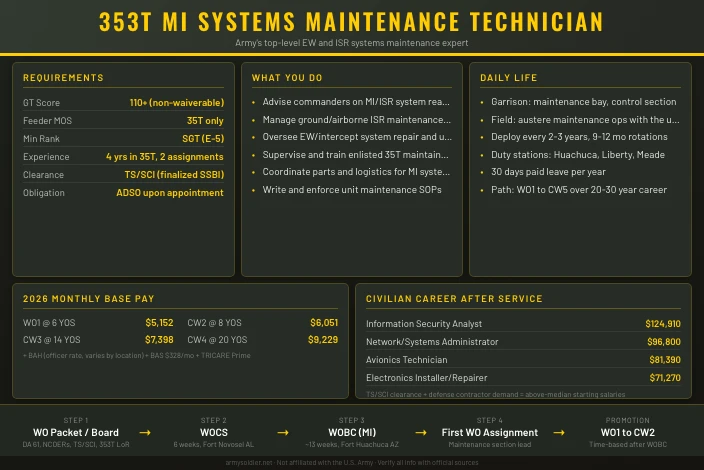
Job Role and Responsibilities
The 353T Intelligence Systems Integration and Maintenance Technician provides technical guidance to commanders and staffs on the management and use of Army and Joint Force Military Intelligence and ISR systems and networks. The 353T manages shop operations, oversees workflow for ground and airborne ISR systems, and serves as the principal advisor to the commander on intelligence maintenance operations, training, policies, and procedures. No other warrant officer MOS combines deep electronics maintenance expertise with command-level advisory authority across this range of classified intelligence systems.
Technical Expertise and Scope
The 353T’s primary domain is electronic warfare and intercept systems maintenance at the field and sustainment level. Where an enlisted 35T repairs individual pieces of equipment, the 353T manages the entire maintenance enterprise: prioritizing work orders, overseeing repair pipelines, integrating new systems into the unit’s maintenance architecture, and advising the commander on readiness.
The role covers ground-based intercept systems, airborne ISR platforms, and the networks that tie them together. Systems like the Prophet ground-based signals intelligence system, Tactical Unmanned Aircraft Systems with intelligence payloads, and related EW equipment fall within this warrant officer’s technical purview. Beyond hardware, the 353T owns the integration problem: making sure disparate MI systems communicate, that software versions are current, and that the maintenance cycle doesn’t create capability gaps during operations.
Unlike a commissioned intelligence officer who rotates through positions and relies on NCOs for technical detail, the 353T stays in this lane for an entire career. The depth compounds over time. A CW3 353T has likely worked on more equipment variants across more units than any officer in the formation.
Related MOS Codes and Designators
| Designator | Title | Notes |
|---|---|---|
| 353T | Intelligence Systems Integration and Maintenance Technician | The only AOC within this specialty |
| 35T (feeder) | MI Systems Maintainer/Integrator | Enlisted feeder MOS; required prior to warrant appointment |
| SQI H | Master Gunner | Not applicable to this MOS |
| ASI A2 | Electronic Warfare Technician | May be held by 353Ts with additional EW qualifications |
Mission Contribution
The 353T bridges the gap between the enlisted maintainers who fix equipment and the officers who command intelligence units. Senior NCOs understand the technical work at the bench level. Commissioned officers understand the mission requirements. The 353T translates between both worlds, telling a battalion commander what maintenance backlog means for tomorrow’s collection mission, and telling the shop what the commander actually needs the systems to do.
At higher echelons, 353Ts fill staff positions advising intelligence brigade and division G2 staffs. In those roles, they shape maintenance policies, write standing operating procedures, and represent the MI maintenance enterprise in multi-echelon planning. Their advice carries weight because it’s built on hands-on experience that no staff officer can replicate.
Technology, Equipment, and Systems
- Ground-based SIGINT and EW intercept systems (Prophet, Terrestrial Layer System)
- Unmanned aircraft system payloads and ground control stations with ISR mission equipment
- Tactical communications systems integrated with MI networks
- MI system software and firmware management tools
- Automated Maintenance Management Systems (GCSS-Army, SAMS-E)
- Test, measurement, and diagnostic equipment specific to EW and intercept systems
Salary and Benefits
Base Pay at Realistic Career Points
Most 353T candidates enter the warrant officer corps after six or more years of enlisted service as a 35T. Their years of service (YOS) for pay purposes include all prior enlisted time, so a new WO1 entering at 6 YOS earns substantially more than an entry-level warrant.
| Rank | Typical YOS at Appointment | Monthly Base Pay (2026) |
|---|---|---|
| WO1 | 6 years | $5,152 |
| CW2 | 8 years | $6,051 |
| CW3 | 14 years | $7,398 |
| CW4 | 20 years | $9,229 |
| CW5 | 26 years | $11,495 |
Pay data is from DFAS 2026 military pay charts. The 2026 tables reflect a 3.8% across-the-board raise effective January 1, 2026.
Special Pays and Bonuses
The 353T does not receive aviation ACIP (flight pay) or hazardous duty pay unless assigned to a position that qualifies separately. Depending on assignment, some 353Ts may draw Special Duty Assignment Pay (SDAP) when serving in designated senior advisory positions.
The Army launched a Warrant Officer Retention Bonus Auction in 2025, allowing eligible warrant officers to submit confidential bids for retention bonuses in exchange for a six-year active duty service obligation. Whether 353T is an eligible MOS in any given auction cycle depends on Army-wide manning data. Check HRC Warrant Officer Accession and Retention Bonuses for the current list.
Additional Benefits
Warrant officers use officer BAH rates, which are higher than enlisted rates at the same installation. For reference, a W-2 at Fort Novosel, Alabama earns $1,608 per month (without dependents) or $2,013 per month (with dependents) in BAH. A W-3 at the same installation draws $1,764 (without) or $2,268 (with dependents). The exact figure depends on your duty station ZIP code.
The Basic Allowance for Subsistence (BAS) for officers is $328.48 per month in 2026. TRICARE Prime covers the warrant officer and all dependents at no premium cost, with $0 copays for in-network care.
Retirement uses the Blended Retirement System (BRS) for those who entered service after January 1, 2018. BRS combines a traditional pension (2% per year of service multiplied by high-36 average basic pay) with TSP matching of up to 4% of basic pay, with matching beginning in the third year of service. Warrant officers who serve 20-30+ years can receive substantial pensions given their higher pay grades at retirement.
Work-Life Balance
Garrison life for a 353T typically runs weekday business hours, with some evening and weekend commitments during pre-deployment preparation, major maintenance inspections, and training exercises. The 353T is not a desk job – expect frequent time on the maintenance floor and in the field with units during exercises.
Warrant officers generally carry fewer administrative burdens than commissioned officers at the same grade. A 353T CW3 spends most working time on technical matters rather than staff processes, which many warrant officers cite as one of the role’s primary attractions. That said, senior 353Ts in brigade or division staff positions do carry staff workloads comparable to a commissioned O-3 or O-4.
Qualifications and Eligibility
Appointment Paths
The 353T has one path to appointment: enlisted-to-warrant conversion from the 35T Military Intelligence Systems Maintainer/Integrator MOS. The Army does not accept applicants from non-MI feeder MOS positions for this specialty. There is no street-to-seat or direct civilian appointment program.
| Requirement | Detail |
|---|---|
| Feeder MOS | 35T (MI Systems Maintainer/Integrator) only |
| Minimum Rank | Sergeant (E-5) or above |
| Experience | Minimum 4 years operational experience in 35T across at least 2 assignments |
| Prior Training | Completed MOS-producing course 102-35T10 (EW/Intercept Systems Repair) |
| Prior PME | Graduate of the Military Intelligence Advanced Leader Course (ALC) |
| Performance | Minimum 3 NCOERs reflecting outstanding/exceptional ratings in EW/Intercept Systems Repair duty positions |
| GT Score | Minimum 110 (non-waiverable, applies to all warrant officer applicants) |
| Security Clearance | Top Secret based on Single Scope Background Investigation (SSBI); eligible for access to Sensitive Compartmented Information (SCI) |
| Recommendation | Written Letter of Recommendation from a senior 353T (CW3 through CW5) |
| Age Limit | Generally must be able to complete 20 years before age 62; confirm current limits with USAREC |
| Physical | Meet Army height/weight and AFT standards; OPAT category varies by specific duty position |
The TS/SCI clearance is not optional. An interim clearance will not satisfy the requirement. Candidates who do not hold a current, finalized TS/SCI should resolve that before submitting a packet.
The four-year minimum experience requirement in at least two assignments is also non-negotiable for this MOS. The MI Proponent reviews the duty position history carefully. A 35T who spent all four years at one unit will have a harder time demonstrating the breadth of technical experience the board expects.
Warrant Officer Candidate School (WOCS)
All warrant officer candidates attend WOCS at Fort Novosel, Alabama before receiving their warrant. WOCS is a six-week course that covers Army doctrine, leadership principles, the legal and ethical responsibilities of warrant officers, and the cultural differences between the warrant officer corps and the enlisted and commissioned officer ranks.
WOCS does not teach MOS-specific technical skills. That happens at the Warrant Officer Basic Course. WOCS prepares candidates to think and act as warrant officers: advising commanders, managing technical sections, and operating in the space between enlisted and commissioned officer leadership.
The application packet (warrant officer packet) includes DA Form 61, letters of recommendation (including the required senior 353T letter), official transcripts, NCOERs, medical clearance, and a security clearance verification. Packets go through the unit chain of command before reaching the Warrant Officer Recruiting Company at USAREC. The MI Proponent reviews all submitted packets and makes selection recommendations.
Selection for 353T is competitive. The MI maintenance warrant officer community is small, and the requirement for a specific feeder MOS, a finalized TS/SCI clearance, and a recommendation letter from a senior 353T screens out applicants who haven’t built strong relationships within the MI maintenance community.
Test Requirements
All warrant officer applicants need a minimum GT score of 110, derived from the ASVAB Verbal Expression (VE) and Arithmetic Reasoning (AR) subtests. This threshold is non-waiverable. Candidates below 110 must retest before submitting a packet.
The SIFT exam is not required for 353T. That test applies only to aviation warrant officer candidates (153A, 153D, 153M, and related aviation MOS).
Upon Appointment
New 353T warrant officers enter at WO1 with a federal warrant of appointment issued by the Secretary of the Army. Upon promotion to CW2, they receive a commission. The standard Active Duty Service Obligation (ADSO) for non-aviation warrant officers is generally two to three years. Confirm the current ADSO with your warrant officer recruiter, as this can change with Army policy updates.
See our ASVAB study guide for a study plan focused on the GT composite.
Work Environment
Setting and Schedule
The 353T’s primary work setting is the maintenance bay, test bench, and maintenance control section of a military intelligence unit. In garrison, expect a structured workday managing shop operations, coordinating with supply and logistics for parts, and advising the unit’s leadership on equipment readiness status.
In the field and during exercises, the 353T moves with the unit and runs maintenance operations in austere conditions. ISR systems don’t stop breaking because the unit is in the field. The 353T manages field maintenance teams, liaises with higher echelon sustainment units for equipment beyond the organic repair capability, and keeps the commander informed of what ISR capability is actually available.
Deployments add complexity. Operating in a theater of operations means working around parts availability constraints, dealing with equipment that has absorbed additional wear, and managing a maintainer workforce that’s running on less sleep than in garrison.
Position in the Unit
The 353T does not sit in the NCO support channel and is not part of the traditional command chain. In an MI battalion or brigade, the 353T advises the commander and staff as a technical expert, similar to how a Warrant Officer 1 (WO1) aircraft maintainer advises an aviation unit commander. At lower echelons, the 353T typically runs the maintenance section directly, supervising enlisted 35T soldiers.
The relationship with senior NCOs in the same field requires some navigation. A senior Staff Sergeant (SSG) or Sergeant First Class (SFC) with ten years of 35T experience knows the equipment well. The 353T’s authority comes from that same technical foundation, plus the broader advisory role and rank that warrant officer status provides. In practice, effective 353Ts treat senior NCOs as partners, not subordinates.
Technical vs. Staff Roles
At WO1 and CW2, the work is mostly hands-on: running the maintenance section, reviewing work orders, supervising repairs, and managing parts accountability. As 353Ts progress to CW3 and CW4, they begin filling staff positions at battalion and brigade, where the work becomes more advisory and planning-focused.
CW4 and CW5 353Ts at division or corps level spend most of their time on policy, readiness reporting, and advising senior commanders and staff on MI systems capabilities and limitations across the formation. The technical hands-on work recedes, replaced by technical judgment applied at scale.
Training and Skill Development
Warrant Officer Basic Course (WOBC)
After WOCS, newly appointed 353Ts attend the Military Intelligence Warrant Officer Basic Course at Fort Huachuca, Arizona, home of the United States Army Intelligence Center of Excellence (USAICoE). The 111th Military Intelligence Brigade runs MI officer and warrant officer training there.
| Phase | Location | Length | Focus |
|---|---|---|---|
| WOCS | Fort Novosel, AL | 6 weeks | Leadership, doctrine, warrant officer roles |
| WOBC (MI) | Fort Huachuca, AZ | ~13 weeks | MOS-specific technical training, MI systems, doctrine, tactics, and techniques |
The WOBC for MI warrant officers runs approximately 13 weeks as a resident course. It covers the technical and doctrinal content specific to the 353T MOS: managing MI maintenance operations, integrating ISR systems, advising commanders, and applying Army doctrine to MI maintenance management. The course is MOS-specific and builds on the candidate’s existing 35T technical background rather than starting from scratch.
Warrant Officer Advanced Course (WOAC)
CW2s and CW3s eligible for promotion to CW4 must complete the MI Warrant Officer Advanced Course before competitive selection. WOAC is also conducted at Fort Huachuca. It covers advanced technical skills, leadership at higher echelons, and prepares warrant officers to fill brigade and division-level staff positions. CW3s who have not completed WOAC before their CW4 board are at a significant disadvantage.
Warrant Officer Intermediate Level Education (WOILE)
WOILE is a five-week MOS-immaterial resident course, meaning all warrant officers from all MOS attend together rather than in branch-specific cohorts. It prepares CW3s and CW4s for service at higher echelons, focusing on joint operations, interagency coordination, and the broader context in which warrant officers advise senior leaders. WOILE is conducted at Fort Novosel.
Warrant Officer Senior Service Education (WOSSE)
Senior CW4s and CW5s complete WOSSE, a two-phase course combining distance learning and a resident component. WOSSE covers strategic-level topics relevant to senior warrant officers serving on corps, Army, and joint staffs. Completion is required for nomination to senior CW5 positions.
Additional Training and Civilian Education
353Ts have access to a range of additional training opportunities:
- Army COOL (Credentialing Opportunities On-Line): The Army funds civilian certifications relevant to the 353T skill set, including CompTIA Security+, CompTIA Network+, and CompTIA A+. These certifications directly support post-service job searches in the defense electronics and cybersecurity sectors.
- Tuition Assistance (TA): The Army covers up to $4,500 per year ($250 per semester hour) for college coursework taken while on active duty.
- Post-9/11 GI Bill: Up to 36 months of education benefits for use after service, covering full in-state tuition at public schools or up to $29,920.95 per academic year at private institutions (AY 2025-2026 cap), plus a monthly housing allowance.
- Specific platform and system courses: The Army funds attendance at manufacturer and government-run technical courses for specific MI systems when the duty position requires it.
A qualifying GT score comes first — our ASVAB study guide covers the subtests that drive GT.
Career Progression and Advancement
Warrant Officer Career Timeline
| Rank | Typical Total YOS | How Promotion Works | Key Assignments |
|---|---|---|---|
| WO1 | 6-8 | Federal warrant; time-based | Maintenance section leader, unit 353T advisor |
| CW2 | 8-10 | Time-based after WOBC completion | Maintenance platoon technical advisor, small unit lead |
| CW3 | 10-16 | Board selected | Battalion or brigade maintenance officer, staff positions |
| CW4 | 16-22 | Board selected; WOAC required | Brigade, division G2 staff; senior MI maintenance advisor |
| CW5 | 22-30 | Board selected; WOSSE required | Corps, Army, or joint staff; proponent CW5 positions |
WO1 to CW2 promotion is time-based and occurs after successful completion of WOBC with no adverse actions. CW3 and above require selection board action. 353Ts competing for CW3 should have demonstrated technical excellence in at least two distinct duty positions, with strong OERs that speak to both technical proficiency and advisory effectiveness.
Promotion and File Factors
Warrant officers receive OERs using the DA Form 67-10 series, with specific warrant officer guidance in DA Pam 623-3, Appendix B. The senior rater’s narrative matters. OERs that document specific technical contributions, measurable readiness improvements, and advisory impact on named operations carry more weight than generically positive assessments.
Promotion to CW5 is highly competitive. There are far fewer CW5 billets than CW4s. 353Ts who reach CW5 typically have broadening assignments on joint staffs or at Army-level headquarters, advanced civilian education (a master’s degree is common), and a record of advising senior commanders at echelons above brigade.
CW5 as Senior Technical Advisor
A CW5 353T operates at the corps, Army command, or Joint Force headquarters level. At that altitude, the role is almost entirely advisory and policy-focused: writing doctrine, shaping acquisition requirements for next-generation MI systems, advising general officers on the readiness of theater-level ISR capabilities, and mentoring the next generation of MI warrant officers. It is a strategic-level position, but the authority still flows from decades of technical credibility built from the bench up.
Building a competitive record means taking difficult assignments over comfortable ones, volunteering for broadening opportunities like joint duty, and pursuing a graduate degree through TA or the GI Bill while on active duty.
Physical Demands and Medical Evaluations
Fitness Requirements
All 353T warrant officers take the Army Fitness Test (AFT), which replaced the ACFT on June 1, 2025. The AFT has five events scored 0-100 each, with a maximum of 500 points. The general standard requires a minimum score of 60 per event and 300 total points.
| AFT Event | Full Name | Min Score (17-21, Male) | Min Score (17-21, Female) |
|---|---|---|---|
| MDL | 3-Rep Max Deadlift | 60 pts | 60 pts |
| HRP | Hand Release Push-Up | 60 pts | 60 pts |
| SDC | Sprint-Drag-Carry | 60 pts | 60 pts |
| PLK | Plank | 60 pts | 60 pts |
| 2MR | Two-Mile Run | 60 pts | 60 pts |
The 353T MOS is not designated as a combat specialty requiring the higher 350-point standard. AFT scores are sex- and age-normed, so the minimum passing performance at each age bracket differs. See army.mil/aft for current scoring tables by age and sex.
MOS-Specific Physical and Medical Requirements
The 353T does not require a flight physical. Standard Army medical standards (AR 40-501) apply. The role involves occasional heavy lifting, working in confined spaces on aircraft and vehicle-mounted systems, and operating in field environments. No specific vision or hearing waivers beyond standard officer accession medical requirements apply unless individual duty positions specify otherwise.
There are no annual renewal medical requirements beyond the standard periodic health assessment that all soldiers complete.
Deployment and Duty Stations
Deployment Tempo
The 353T deploys with the MI units it supports. MI brigades, battalions, and theater-level intelligence formations deploy in support of combatant command requirements. Deployment cycles vary by unit and mission, but a 353T assigned to a division or corps MI unit can expect to deploy every two to three years for nine to twelve month rotations, in addition to participation in combat training center rotations and joint exercises.
During deployment, the 353T operates from a forward maintenance control section, manages parts requisitioning in a theater supply environment, and often serves as the only officer-level technical expert for MI systems maintenance in the supported formation.
Duty Station Options
Major installations for 353T warrant officers follow the footprint of Army intelligence units:
- Fort Huachuca, Arizona – USAICoE and 111th MI Brigade; a major training and operational hub
- Fort Liberty, North Carolina – XVIII Airborne Corps and 525th Military Intelligence Brigade
- Fort Meade, Maryland – Army intelligence and NSA-adjacent units
- Fort Wainwright, Alaska – Units supporting USARPAC
- Fort Shafter, Hawaii – USARPAC intelligence units
- OCONUS assignments – Germany (USAREUR), Korea (Eighth Army), and various theater support units
HRC manages 353T assignments. Warrant officers can submit assignment preferences, and duty station continuity is more achievable than in many commissioned officer career fields because the warrant officer community is smaller and positions are more specialized.
Risk, Safety, and Legal Considerations
Job Hazards
The 353T works with high-voltage electronic systems, RF-emitting equipment, and classified systems in physically demanding field environments. Electrostatic discharge (ESD) risks are real when working on sensitive electronic assemblies. Some airborne ISR system maintenance requires work on or around aircraft, with the associated aviation safety requirements.
The classified nature of the work carries its own risks. Handling TS/SCI materials requires adherence to strict security protocols, and a compromise of classified information has career-ending and potentially criminal consequences.
Safety Protocols
The 353T applies Composite Risk Management (CRM) to all maintenance operations. Unit safety SOPs govern work on electrical systems, RF equipment, and aviation-associated ground tasks. Army Technical Manuals for specific systems contain mandatory safety warnings that form the baseline for shop safety protocols.
Authority and Responsibility
353T warrant officers do not hold command authority in the conventional sense. They advise and direct technical activities within their section but do not command soldiers in the UCMJ command authority sense. They can, however, write counseling statements, participate in NCO evaluation processes for soldiers they supervise, and serve as raters on OERs for junior warrant officers.
The technical authority of the 353T carries real accountability. A maintenance release signed off by the 353T puts the warrant’s professional judgment on record. Equipment failures traceable to improper maintenance decisions will be reviewed against the 353T’s decisions and actions.
Impact on Family and Personal Life
Family Considerations
The 353T career involves PCS moves every two to three years on average, fewer than many commissioned officer tracks but not minimal. Families should plan on two to four installations over a 20-year career. Warrant officers tend to have more predictable assignments than junior commissioned officers because the community is smaller and positions are clearly defined by MOS.
Army Community Service (ACS), Family Readiness Groups (FRGs), and the Army’s spouse employment assistance programs are available at all major installations. The WORX-Stabilize initiative, launched in 2025, specifically targets reducing the PCS tempo for warrant officers to improve family stability. Whether a specific 353T benefits depends on unit requirements and HRC decisions, but the direction of policy is toward greater stability.
Dual-Military and Family Planning
Dual-military couples with one or both partners in MI-related specialties can request assignment consideration through the Army’s join-spouse program. There are no guarantees, but the Army makes reasonable efforts to place couples within commuting distance when assignments allow.
Deployments of nine to twelve months, combined with pre-deployment training that can add two to three months, mean a 353T may be away from family for a cumulative year or more during each deployment cycle. FRG support during deployments is unit-dependent in quality, but Army installations provide childcare, counseling, and emergency financial assistance through Military OneSource and ACS.
Reserve and National Guard
Component Availability
The 353T is available in both the Army Reserve and the Army National Guard. MI maintenance technician positions exist in reserve component MI brigades, battalion-level units, and Army National Guard intelligence units across many states. The career field is smaller in the reserve components than on active duty, so available positions depend on state and unit structure.
Appointment Paths
Reserve and Guard candidates follow the same basic warrant officer packet process as active duty applicants: E-5 or above in 35T, four years of experience in at least two assignments, completed ALC, TS/SCI clearance, and a letter of recommendation from a senior 353T. The same non-waiverable GT score of 110 applies.
Reserve and National Guard soldiers with prior active duty 35T experience who separate can pursue 353T appointment within a reserve component unit, provided they meet all eligibility requirements and a vacancy exists. Active duty 353Ts transferring to the Guard or Reserve retain their rank and can continue career progression in the reserve component.
Drill and Training Commitment
Standard Battle Assembly commitment is one weekend per month (four drill periods) plus two weeks of Annual Training per year. 353Ts in the reserve components may carry additional training requirements:
- Annual or biennial MOS-specific sustainment training to maintain technical currency on assigned systems
- Potential additional training assemblies when units are preparing for OCONUS deployment or combat training center rotations
- Equipment-specific recertification requirements as systems are upgraded or replaced
Part-Time Pay
Reserve and Guard warrant officers earn drill pay based on active duty monthly base pay divided by 30, multiplied by the number of drill periods. A W-2 with less than 2 years of service earns approximately $616 per drill weekend (4 periods). A CW3 with 14 years of total service draws approximately $986 per weekend. These figures derive from the verified 2026 warrant officer pay tables.
Active Duty vs. Reserve vs. Guard Comparison
| Factor | Active Duty | Army Reserve | Army National Guard |
|---|---|---|---|
| Commitment | Full time | 1 weekend/mo + 2 wks/yr | 1 weekend/mo + 2 wks/yr |
| Monthly Pay (CW3, 14 YOS) | $7,398 base | ~$986/drill weekend | ~$986/drill weekend |
| Healthcare | TRICARE Prime ($0 premium) | TRICARE Reserve Select ($57.88/mo individual) | TRICARE Reserve Select ($57.88/mo individual) |
| Education Benefits | Full TA ($4,500/yr) + Post-9/11 GI Bill | TA + MGIB-SR ($493/mo for 36 mo) | TA + MGIB-SR + state tuition benefits (vary by state) |
| Deployment Tempo | Every 2-3 years | Periodic mobilization, varies | Periodic mobilization, state activations possible |
| Advancement to CW4/CW5 | Yes, board selected | Yes, slower pace | Yes, slower pace |
| Retirement System | BRS pension + TSP at 20 yrs | Points-based, collect at 60 | Points-based, collect at 60 |
Guard-specific state benefits vary significantly. Some states offer tuition waivers at public universities, state income tax exemptions on drill pay, and state hiring preferences for Guard members. Check your state’s military affairs office for current offerings.
Civilian Career Integration
The 353T skill set pairs well with defense contractor positions, federal civil service intelligence support roles, and private sector electronics systems integration work. Reserve and Guard 353Ts who work in government contractor roles often find their clearance and technical expertise make them valuable employees whose military service directly enhances their civilian career standing.
USERRA protects drilling reservists from employment discrimination and guarantees reemployment rights after deployments of up to five cumulative years.
Post-Service Opportunities
Civilian Transition
Twenty or more years maintaining and integrating some of the most complex electronics the DoD fields produces a resume that defense contractors, federal agencies, and intelligence community partners actively pursue. Former 353Ts bring a combination that’s hard to replicate in the civilian market: deep technical knowledge of classified systems, leadership experience managing technical teams, a current (or recently expired) TS/SCI clearance, and the ability to operate under pressure.
The transition programs available include the Soldier for Life Transition Assistance Program (SFL-TAP), Hiring Our Heroes, and the Army Career Alumni Program (ACAP). These programs help translate military experience into civilian resume language, connect veterans with hiring managers, and provide job search resources.
Civilian Career Prospects
| Civilian Role | Median Annual Salary (May 2024) | Job Outlook (2024-2034) |
|---|---|---|
| Information Security Analyst | $124,910 | +29% (much faster than average) |
| Electrical/Electronics Installer and Repairer | $71,270 | Stable (~0% change) |
| Network and Computer Systems Administrator | $96,800 | -4% (modest decline) |
| Aerospace/Avionics Technician | $81,390 | +5% (faster than average) |
Salary data from BLS Occupational Outlook Handbook, May 2024. Former 353Ts entering the information security field may earn above median given their classified systems background and active clearances.
Defense contractors (Leidos, CACI, Booz Allen Hamilton, Northrop Grumman) actively hire former MI maintenance warrant officers for system integration, intelligence support, and engineering technical representative roles. Federal civil service positions (GS-11 through GS-13) in Army or intelligence community organizations are another well-worn path.
Certifications and Credentials
Army COOL maps the 353T skill set against civilian certifications and can fund credentialing assistance for eligible soldiers. Relevant credentials include:
- CompTIA Security+: DoD-required baseline cybersecurity certification; directly relevant to 353T’s classified systems work
- CompTIA Network+: Covers networking fundamentals used in MI system integration
- CompTIA A+: Foundational hardware and software support certification
- Manufacturer-specific certifications for equipment the 353T maintained during service
The Post-9/11 GI Bill’s 36 months of benefits can fund a bachelor’s or master’s degree after service. Many 353Ts pursue degrees in electrical engineering technology, cybersecurity, or systems engineering – fields that directly complement their military technical background.
Is This a Good Job for You? The Right (and Wrong) Fit
Ideal Candidate Profile
The 353T path fits a 35T who genuinely loves working on complex electronics and wants to keep doing that work at a higher level of scope and authority. If you find the troubleshooting process satisfying – not just the solution, but the diagnostic reasoning – you’ll find the 353T role rewarding. Warrant officers in this MOS describe the appeal as staying technical without getting pulled into the generalist officer career track.
Strong candidates have built a reputation within the MI maintenance community before applying. That’s not incidental to the process – the requirement for a letter of recommendation from a senior 353T means you need to be known to the warrant officer community in your field. 35Ts who work in isolated assignments or who haven’t sought out exposure to more experienced warrant officers will struggle to meet that bar.
Potential Challenges
This is not a role for someone who wants command authority or the traditional officer career path. 353Ts advise commanders; they do not command. At CW3 and above, some officers in the same formation will be junior to the warrant in terms of technical expertise but senior in terms of command authority. That dynamic requires maturity and a clear sense of where the warrant’s authority actually comes from.
The community is small. There are far fewer 353T billets than positions in larger warrant officer career fields like aviation. Small communities mean slower promotion timelines at the senior grades, fewer peers to learn from, and assignments that can sometimes feel geographically constrained to MI-heavy installations.
Getting and keeping a TS/SCI clearance requires a clean personal history. Financial problems, foreign contacts, or prior legal issues can delay or prevent clearance adjudication. Candidates who have lifestyle factors that could complicate the SSBI process should consult a warrant officer recruiter before investing time in a packet.
Career and Lifestyle Alignment
A 20-year career as a 353T produces a retirement at CW4 or CW5, with a pension, lifetime TRICARE coverage, and a civilian skill set that opens doors in defense and intelligence sectors. That’s a strong outcome for someone who joined the Army as a 35T and built expertise over two decades.
For 35Ts who want to stay in the technical lane but aren’t interested in a 20-year career, the 353T path can still make sense. The deeper technical credential, the warrant officer rank, and the clearance all enhance civilian prospects after even one ADSO as a WO1 or CW2.
The wrong fit: someone who wants to be a commander, someone who dislikes being the subject-matter expert rather than the decision-maker in the room, or someone whose lifestyle history is likely to complicate a TS/SCI investigation.
More Information
Your local Army warrant officer recruiter is the right first call. The Warrant Officer Recruiting Company at USAREC manages 353T packets and can tell you what the current board timeline looks like, whether there are open quotas, and what a competitive packet looks like this cycle. If your GT score is below 110, work with your education center on an ASVAB retest before anything else – that threshold is the first gate and it doesn’t move.
- Prepare for the ASVAB with our study guide to meet the GT 110 requirement
This site is not affiliated with the U.S. Army or any government agency. Verify all information with official Army sources before making enlistment or career decisions.
Explore more Army warrant officer careers including the 350F All Source Intelligence Technician and 351L Counterintelligence Technician.