420A Human Resources Technician
Every unit in the Army runs on personnel data. Promotions, reassignments, retirement eligibility, casualty reports, awards, and evaluation records all flow through a system that needs someone who knows it cold. The 420A Human Resources Technician is that person. As the senior HR expert at the brigade and higher echelons, you do what neither the 42A specialist nor the commissioned AG officer can do alone: you own the technical system, troubleshoot the automation, and give commanders the personnel picture they need to make decisions. This is not a job for someone who wants to lead formations. It is a job for someone who wants to be the expert that everyone else turns to.
Warrant officer candidates need a GT score of at least 110 — our ASVAB study guide covers what drives that number.
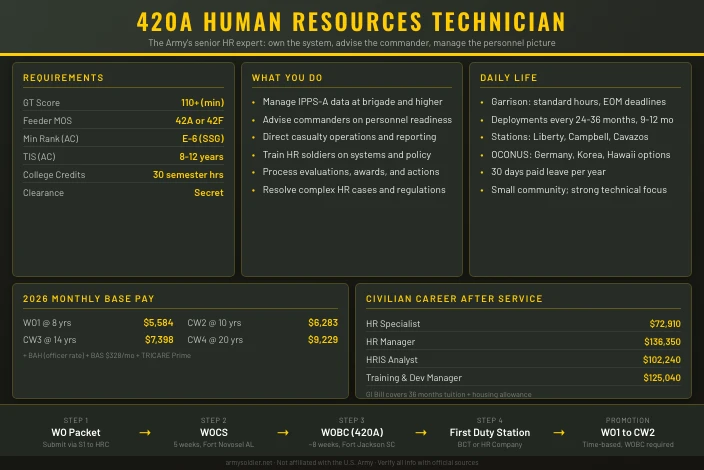
Job Role and Responsibilities
The 420A Human Resources Technician is the Army’s warrant officer-level expert in personnel management and HR automation systems. As a 420A, you advise commanders on the full spectrum of HR operations: personnel accountability, strength reporting, awards, evaluations, casualty operations, and records management. You serve as the senior technical authority in HR companies, brigade combat teams, and major command staffs, bridging the gap between the enlisted HR soldiers who work the daily transactions and the commissioned officers who set HR policy.
Technical Expertise and Scope
The 420A owns the HR automation stack at the unit level. That includes the Integrated Personnel and Pay System-Army (IPPS-A), which replaced the legacy SIDPERS and DIMHRS systems, along with the Official Military Personnel File (OMPF) and electronic management tools for evaluations and awards. When automation breaks or produces wrong data, the 420A diagnoses and corrects it. No one in the unit has deeper access or broader system authority.
The role sits distinctly apart from both the enlisted 42A who processes individual actions and the AG-branched captain who commands the HR company. The 420A does not command. The 420A solves the hard technical problems that commanders and HR NCOs escalate, and the 420A writes the standard operating procedures and trains the team on how the system actually works.
MOS Codes and Designations
| Code | Title | Notes |
|---|---|---|
| 420A | Human Resources Technician | Primary warrant officer MOS |
| 420C | Bandmaster | Separate AG branch warrant MOS |
| 420T | Talent Acquisition Technician | Warrant officer MOS added 2022 |
| 42A | Human Resources Specialist | Primary enlisted feeder MOS |
| 42F | Human Resources Information System Management Specialist | Enlisted feeder MOS |
Additional Skill Identifiers (ASIs) and functional designators may apply at higher-level staff positions. Check with your branch manager at HRC for current ASI applicability.
Mission Contribution
HR operations are classified as a Warfighting Function in Army doctrine. Accurate personnel accountability feeds the personnel readiness picture that commanders use to determine if a unit can execute its mission. During high-intensity conflict or large-scale combat operations, casualty reporting becomes a life-or-death function that demands a technically qualified warrant officer at the helm. The 420A ensures that data flows correctly, that records are legally compliant, and that Soldiers get the entitlements and actions they earned.
Systems and Tools
- IPPS-A: The Army’s integrated personnel and pay platform (cloud-based, replacing all legacy HR systems)
- Integrated Disability Evaluation System (IDES): Medical and disability case management
- Total Officer Personnel Management Information System (TOPMIS): Officer management records
- Defense Casualty Information Processing System (DCIPS): Casualty reporting
- eMILPO/OMF: Legacy systems still encountered in some units transitioning to IPPS-A
Salary and Benefits
Base Pay
Most active-duty 420A warrant officers enter with at least 8 years of prior enlisted service, so they carry significant time-in-service credit toward base pay immediately. The table below shows realistic pay at typical career waypoints using 2026 DFAS pay rates.
| Grade | Typical YOS at Grade | Monthly Base Pay |
|---|---|---|
| WO1 | 8 years | $5,584 |
| CW2 | 10 years | $6,283 |
| CW3 | 14 years | $7,398 |
| CW4 | 20 years | $9,229 |
| CW5 | 26 years | $11,495 |
All warrant officers receive BAH at officer rates, which is meaningfully higher than enlisted BAH. A single WO1 at Fort Jackson, SC draws roughly $1,500-$1,800 per month in BAH depending on the local housing market. Add BAS of $328.48 per month for officers, and your total compensation package runs well above base pay alone.
Special Pay and Bonuses
The 420A does not receive aviation bonus pay or hazardous duty pay tied to the MOS. Special Duty Assignment Pay (SDAP) may apply in certain staff positions; check with your gaining unit. Accession and retention bonuses for 420A have been offered in recent years but are not permanent entitlements. Confirm current bonus status through your warrant officer recruiter or the Army Warrant Officer Recruiting website.
Additional Benefits
Active-duty 420A warrant officers receive TRICARE Prime with zero enrollment fees and zero copays for themselves and their families. BAH fluctuates by installation and dependent status; use the official BAH calculator for your duty station. Under the Blended Retirement System (BRS), the government automatically contributes 1% of base pay to your Thrift Savings Plan after 60 days and matches up to 4% once you contribute 5% yourself. At 20 years, a BRS pension pays 40% of your high-36 average base pay.
Work-Life Balance
Garrison life for a 420A runs roughly standard duty hours, though end-of-month personnel cutoffs, evaluation cycles, and Army-wide HR deadlines create predictable crunch periods. Field exercises and deployments shift the tempo significantly. Most 420A warrant officers report that the workload is demanding but manageable, and that the technical focus of the role spares them from the staff-officer bureaucracy grind that commissioned peers often describe. You get 30 days of paid leave per year.
Qualifications and Eligibility
Appointment Paths
The 420A does not offer a civilian direct-appointment path. All candidates must come from the enlisted force. Active-component applicants must hold a 42A or 42F MOS at the grade of E-6 (Staff Sergeant) with between 8 and 12 years of active federal service. Reserve and National Guard applicants may qualify at E-5 (Sergeant) with 3 years of operational HR experience in a 42A, 42F, or 42L capacity.
There is no civilian street-to-seat option for this MOS. This is a technically experienced-practitioner role, and the Army expects you to have done the work at the NCO level before you advise as a warrant.
Requirements Table
| Requirement | Active Component | Reserve / Guard |
|---|---|---|
| Feeder MOS | 42A or 42F | 42A, 42F, or 42L |
| Minimum Rank | E-6 (SSG) | E-5 (SGT) |
| Time in Service | 8-12 years | Varies by state/unit |
| Education | 30 semester college credit hours | 30 semester college credit hours |
| GT Score | 110 minimum (non-waiverable) | 110 minimum (non-waiverable) |
| Security Clearance | Secret (must be eligible; interim acceptable at WOCS entry) | Secret |
| Age (max at appointment) | 46 years (waiverable) | 46 years (waiverable) |
| Army Leader’s Course | Required (or BNCOC equivalent) | Recommended |
Warrant Officer Candidate School (WOCS)
All 420A candidates attend WOCS at Fort Novosel, Alabama, administered by the U.S. Army Warrant Officer Career College. The active-component course runs five weeks as a resident program. Reserve and Guard candidates may attend the same five-week course or complete a two-phase format through authorized Regional Training Institutes, typically spread over five months with a 15-day resident culmination.
WOCS covers officership, Army doctrine, ethics, leadership under stress, land navigation, and tactical operations. It does not cover 420A-specific technical content – that comes at WOBC. The school uses a candidate-led structure where students rotate through leadership positions throughout the program. Graduates are appointed to WO1 at a ceremony held at the U.S. Army Aviation Museum on Fort Novosel.
Test Requirements
All warrant officer candidates require a GT score of 110 or higher. The GT composite is calculated from the Verbal Expression (VE) and Arithmetic Reasoning (AR) subtests of the ASVAB. This threshold is non-waiverable – no exceptions, regardless of experience or education. If your current GT score falls below 110, you can retake the ASVAB to improve it before submitting your packet.
The SIFT exam is not required for 420A. That test is reserved for aviation warrant officer candidates.
Packet and Board Process
A warrant officer packet includes DA Form 61 (application), letters of recommendation, academic transcripts, NCOERs, a physical examination, and a commander’s endorsement. Active-duty packets are submitted through your battalion S1 to the Adjutant General Branch Proponent at HRC for board review. Boards convene annually; check current MILPER messages for 420A-specific board dates and packet submission windows.
Strong packets show NCOERs with consistent “Among the Best” senior rater profiles, documented IPPS-A or HR automation proficiency, deployment experience with HR operations under pressure, and civilian college credits beyond the 30-hour minimum. A bachelor’s degree in business administration, human resources management, or a related field stands out.
Upon Appointment
Candidates are appointed as WO1 upon WOCS graduation. The standard Active Duty Service Obligation (ADSO) for warrant officer appointment is three years beyond WOCS completion. No extended obligation applies to 420A – aviation carries a much longer 10-year ADSO.
See our ASVAB study guide for a study plan focused on the GT composite.
Work Environment
Setting and Schedule
The 420A works primarily in administrative and operations office environments, not in the field or on a flight line. Garrison duty means time in the S1 shop, HR company, or brigade staff section, depending on the assignment. You will spend significant time at a workstation inside IPPS-A, reviewing personnel data, correcting errors, and generating reports for commanders. Field exercises require deploying HR capabilities forward, which means running HR operations from a tactical operations center or command post.
Position in the Unit
Warrant officers do not sit in the NCO support channel and do not command units (with exceptions in some aviation MOS). The 420A sits in a staff advisory role, reporting to the AG-branch officer or brigade S1 officer depending on the assignment level. You are the technical expert that the command team and the HR NCOs alike look to for answers on complex personnel actions, system anomalies, and policy interpretation.
The relationship with enlisted HR soldiers is collegial but distinct. You are not their rater in most organizational structures, but you are their technical mentor. Senior 42A NCOs understand that the 420A has system access and regulatory knowledge they don’t, and the best working relationships are built on mutual respect for each lane of expertise.
Technical vs. Staff Roles
At WO1 and CW2, the work is heavily hands-on: correcting records, training soldiers on IPPS-A, running casualty operations, and working individual personnel actions with the team. By CW3, the role shifts toward advising the brigade commander directly and reviewing HR readiness across subordinate battalions rather than working individual records yourself. CW4 and CW5 positions typically sit on division, corps, or Army-level staffs where the work becomes policy development, HR architecture, and strategic personnel planning.
Job Satisfaction and Retention
The 420A community is relatively small, which means strong peer networks and close relationships with branch managers. Warrant officers in this field tend to cite the technical autonomy and the direct impact on Soldier welfare as the primary retention drivers. The most common reason for early departure is civilian compensation: experienced HR professionals with a Secret clearance command strong salaries in the private sector, and the gap between military pay and civilian compensation widens at the CW3-CW4 level for those in high-cost-of-living metro areas.
Training and Skill Development
Warrant Officer Basic Course (WOBC)
After WOCS graduation, new WO1s attend the 420A WOBC at the Adjutant General School, Fort Jackson, South Carolina. The course runs approximately eight weeks and covers IPPS-A at the administrator level, personnel readiness management, casualty operations, HR planning and operations, and legal compliance in personnel administration. Unlike the 42A AIT, which teaches individual task execution, WOBC trains you to manage the entire HR function at the brigade level.
| Phase | Location | Length | Focus |
|---|---|---|---|
| WOCS | Fort Novosel, AL | 5 weeks | Officership, leadership, Army doctrine |
| WOBC | Fort Jackson, SC | ~8 weeks | IPPS-A mastery, HR operations, casualty management |
| First duty assignment | Unit | Ongoing | Applied practice under senior WO mentorship |
WOBC must be completed within two years of WO1 appointment. Failing to complete within that window can affect promotion eligibility.
Warrant Officer Advanced Course (WOAC)
CW2s preparing for CW3 positions attend the 420A WOAC, also at Fort Jackson. The course combines a non-resident distance learning phase with a resident phase at the AG School. WOAC advances technical skills beyond WOBC: multi-echelon HR planning, theater-level personnel accounting, casualty operations at the division level, and leader development responsibilities for subordinate HR soldiers. Completing WOAC is a prerequisite for promotion to CW3.
The SSI Learning Resource Center at Fort Jackson also offers a Human Resources Technician Intermediate Level Education follow-on course that deepens functional expertise for 420A warrants transitioning between career phases.
Warrant Officer Intermediate Level Education (WOILE)
CW3s and CW4s attend WOILE at the Warrant Officer Career College, Fort Novosel. The course consists of a 48-hour distance learning phase followed by five weeks of resident instruction. WOILE is MOS-immaterial – you train alongside warrant officers from across the Army. The focus is broadening your institutional perspective, developing influential leadership skills, and preparing for senior staff positions at brigade and above.
Warrant Officer Senior Service Education (WOSSE)
Senior CW4s and CW5s attend WOSSE, also at Fort Novosel. WOSSE follows the same format as WOILE: a 48-hour distance learning phase plus four weeks in residence. The curriculum addresses strategic-level advisory responsibilities, joint and interagency HR operations, and the senior warrant officer’s role in advising general officers and senior executives on personnel policy.
Additional Training and Certifications
- IPPS-A system administrator courses: Army-funded, conducted through the Program Manager’s office
- Casualty operations training: Annual sustainment requirement for all HR warrant officers
- Army Tuition Assistance: $250 per semester hour, up to $4,500 per year, for degree completion while serving
- Post-9/11 GI Bill: Available for post-service education; private school cap of $29,920.95 for the 2025-2026 academic year
- SHRM-CP / SHRM-SCP: Society for Human Resource Management certifications align directly with 420A experience; Army COOL tracks credential funding opportunities
A qualifying GT score comes first — our ASVAB study guide covers the subtests that drive GT.
Career Progression and Advancement
Career Path Table
| Rank | Typical Total YOS | Key Assignments | PME Milestone |
|---|---|---|---|
| WO1 | 8-10 years | HR company technician, BCT S1 team member | Complete WOBC within 2 years |
| CW2 | 10-13 years | BCT HR technician, HR company operations | Complete WOAC |
| CW3 | 13-18 years | Brigade or division HR tech, senior S1 advisor | Complete WOILE |
| CW4 | 18-24 years | Division/corps staff, Army G1 staff positions | Complete WOSSE |
| CW5 | 24-30+ years | Army-level staff, HQDA G1, combatant command HR advisor | Senior advisory roles |
Promotion System
WO1 to CW2 is automatic after completing WOBC and meeting time-in-grade requirements – no selection board required. CW3 and above are board-selected. Officers receive OERs using the DA Form 67-10 series; warrant-officer-specific guidance is in DA Pam 623-3, Appendix B. Board results depend on the quality and consistency of your OER record, your PME completion status, and the strength of your senior rater’s profile.
Promotion to CW5 is competitive. The 420A community is small enough that a CW5 billet at the Army level or a combatant command is a genuine career capstone, not a routine outcome. Most 420A warrant officers who stay for 20+ years retire at CW4.
CW5 as Senior Technical Advisor
A 420A CW5 advises the Army G1, combatant command J1, or equivalent senior staff on the full personnel management picture. At that level, the work is policy: how the Army accounts for its people in large-scale combat, how IPPS-A architecture should evolve, and how HR doctrine needs to change based on operational lessons. A CW5 with 420A experience and a decade of joint staff assignments is among the Army’s most knowledgeable HR practitioners alive.
Building a Competitive Record
Strong candidates for CW4 and CW5 combine technical depth with breadth of assignment. Key differentiators include:
- Deployment experience with a BCT or division HR element in an operational theater
- A joint assignment (J1 billet at a combatant command or CJTF)
- Completion of a fellowship or broadening assignment
- A bachelor’s or master’s degree in HR management, business administration, or public administration
- Consistent senior rater “Most Qualified” blocks on OERs
Physical Demands and Medical Evaluations
Physical Requirements
The 420A is not a physically demanding MOS in the same way combat arms roles are. You will not carry crew-served weapons or perform heavy manual labor as a job function. That said, all warrant officers must meet the same Army Fitness Test (AFT) standards as every other soldier.
Army Fitness Test Standards
The AFT has five events scored 0-100 each, for a maximum of 500 points. The general standard requires a minimum of 60 points per event and 300 total, with scores normed by sex and age. The table below shows minimum passing scores for male and female soldiers in the 17-21 age bracket.
| Event | Male (17-21) Min Score | Female (17-21) Min Score |
|---|---|---|
| 3 Rep Max Deadlift (MDL) | 60 pts | 60 pts |
| Hand Release Push-Up (HRP) | 60 pts | 60 pts |
| Sprint-Drag-Carry (SDC) | 60 pts | 60 pts |
| Plank (PLK) | 60 pts | 60 pts |
| 2-Mile Run (2MR) | 60 pts | 60 pts |
| Total minimum | 300 | 300 |
The AFT replaced the ACFT on June 1, 2025. The 420A does not fall under the combat specialty standard (350 points); the general standard of 300 applies.
MOS-Specific Medical
The 420A has no aviation flight physical requirement and no MOS-specific vision or hearing standard beyond normal Army enlistment standards. A Secret clearance requires a standard background investigation. The main medical consideration is meeting the physical fitness standard at every annual AFT cycle throughout your career.
Deployment and Duty Stations
Deployment Details
The 420A deploys with the units they support. BCT-level HR technicians can expect deployment cycles that mirror the BCT’s rotation tempo, typically nine to twelve months in theater with twelve to eighteen months between deployments. At division and higher staff levels, some 420A positions deploy for shorter rotational tours of three to six months.
HR warrant officers deploy forward because personnel accountability in combat operations requires a technically qualified warrant officer who can resolve IPPS-A issues in austere environments, manage casualty reporting under operational conditions, and advise the commander on personnel readiness in real time. This is not a rear-echelon-only MOS.
Duty Station Options
The 420A is present at nearly every major installation because every combat brigade, support brigade, and division needs an HR technician. Common duty stations include:
- Fort Liberty, NC (XVIII Airborne Corps, 82nd Airborne Division)
- Fort Campbell, KY (101st Airborne Division)
- Fort Cavazos, TX (III Corps, 1st Cavalry Division)
- Fort Stewart, GA (3rd Infantry Division)
- Fort Wainwright, AK (Arctic Brigade Combat Teams)
- OCONUS: Germany (USAREUR-AF), Korea (Eighth Army), Hawaii (25th Infantry Division)
Assignment preferences are submitted through HRC, but the Army fills vacancies based on organizational need. Warrant officers generally have somewhat more flexibility than company-grade commissioned officers in negotiating follow-on assignments, especially at CW3 and above where the pool of qualified 420A warrants shrinks.
Risk, Safety, and Legal Considerations
Job Hazards
The primary risk for 420A warrant officers is the same as for most staff-role soldiers: operational environment risks when deployed. Forward HR operations in a BCT support area place the 420A within a combined arms formation that can come under indirect fire, IED threat, or other hazards associated with the theater. The 420A is a combatant soldier first and a technical expert second.
In garrison, the occupational hazards are minimal. The ergonomic demands of extended computer work are the most common physical concern.
Safety Protocols
The 420A applies Composite Risk Management (CRM) in all activities, from field exercise planning to daily HR operations. In a deployed environment, you coordinate with the S2 and S3 on threat assessments before moving HR assets forward. Personnel accountability in itself is a safety function – accurate strength reports allow commanders to identify missing soldiers quickly and trigger appropriate response.
Authority and Responsibility
The 420A does not hold unit command authority. Warrant officers in this MOS serve in staff and advisory roles, not command positions. You are accountable for the accuracy and legal compliance of all personnel actions you supervise or certify. Errors in awards, promotions, or casualty reporting can have legal, financial, and operational consequences for individual soldiers and their families. The UCMJ applies in full, and the standard of care for technical errors is high.
Impact on Family and Personal Life
Family Considerations
The 420A career pattern includes regular PCS moves, typically every two to three years. This is comparable to commissioned officers rather than senior NCOs, who often have more assignment stability. Families can expect to relocate four to six times over a 20-year career. Army Community Service (ACS), the Family Readiness Group (FRG), and the Army OneSource program provide relocation support, financial counseling, and community connection at each installation.
Spouse employment can be challenging across frequent moves. Spouses with portable credentials (nursing, accounting, teaching certifications) fare better than those in location-dependent careers. The Military Spouse Employment Partnership (MSEP) connects military families with employers who have committed to portable hiring practices.
Dual-Military Families
The Army has joint-domicile request procedures for dual-military couples. There is no guarantee of co-location, but HRC makes reasonable efforts to assign both partners near each other when operationally feasible. The smaller size of the 420A community can make this harder than for high-density MOSs, because there are fewer available billets at any given installation.
Stability Compared to Commissioned Officers
Warrant officers in non-aviation technical MOSs tend to experience slightly fewer PCS moves than commissioned peers because they are not tracked through the generalist developmental pipeline that requires captains and majors to rotate through a variety of assignments. A CW3 or CW4 who has built a strong reputation at division level may remain in the same geographic area for three to four years, which families generally prefer.
Reserve and National Guard
Component Availability
The 420A is available in both the Army Reserve and the Army National Guard. Reserve and Guard HR companies and special troops battalions are located across the country, making this one of the more geographically distributed warrant officer MOS options.
Appointment Path for Reserve and Guard
Reserve and Guard candidates follow the same WOCS pipeline as active-duty candidates. The minimum rank is E-5 rather than E-6 for the Reserve component, and three years of operational HR experience in a 42A, 42F, or 42L capacity substitutes for some of the active-duty service requirements. State National Guard programs may have additional state-level requirements; contact your state G1 or ARNG Warrant Officer Strength Manager.
Drill and Training Commitment
The standard commitment is one weekend per month (four Unit Training Assemblies) plus 14 days of Annual Training. The 420A does not carry aviation-level currency requirements that add significant days beyond the standard schedule. Some positions with active casualty operations responsibilities or IPPS-A administrator roles may require periodic additional training days for system recertification.
Part-Time Pay
Drill pay is calculated as (monthly base pay / 30) multiplied by the number of drills. A standard weekend equals four drills.
| Grade | Monthly Active Duty Pay | Weekend Drill Pay (4 drills) |
|---|---|---|
| W-1 (<2 YOS) | $4,057 | $541 |
| CW2 (<2 YOS) | $4,622 | $616 |
| CW2 (2 YOS) | $5,059 | $675 |
Benefits Comparison
| Factor | Active Duty | Army Reserve | Army National Guard |
|---|---|---|---|
| Commitment | Full-time | 1 wknd/mo + 2 wks/yr | 1 wknd/mo + 2 wks/yr |
| Monthly Base Pay (CW3 @ 14 YOS) | $7,398 | Drill pay only | Drill pay only |
| Healthcare | TRICARE Prime ($0 premium) | TRICARE Reserve Select ($57.88/mo individual) | TRICARE Reserve Select ($57.88/mo individual) |
| Education | Federal TA ($4,500/yr) + Post-9/11 GI Bill | Federal TA + MGIB-SR ($493/mo) | Federal TA + state tuition waivers (varies by state) |
| Retirement | 20-yr BRS pension (40% high-36) | Points-based, collect at age 60 | Points-based, collect at age 60 |
| Deployment Tempo | Continuous operational cycle | Periodic mobilizations (6-12 months) | State and federal missions |
| Advancement to CW5 | Yes, board-selected | Yes, slower timeline | Yes, slower timeline |
Civilian Career Integration
The Reserve and Guard path for a 420A pairs extremely well with civilian HR careers. An IPPS-A-qualified HR warrant officer with a Secret clearance working in a civilian HR department brings skills in systems administration, regulatory compliance, and personnel management that civilian employers value. Defense contractors and federal agencies actively seek candidates with military HR system experience.
USERRA protections guarantee your civilian job upon return from mobilization and prohibit discrimination based on Reserve or Guard service. The Department of Labor VETS division enforces these protections.
Post-Service Opportunities
Transition to Civilian Life
Twenty or more years as a 420A leaves you with deep expertise in HR systems, personnel law, and organizational management at scale. Most civilian HR generalist roles underuse this background – you will be more valuable to employers who need someone who can both run HR operations and manage complex systems. Federal agencies, defense contractors, and large corporations with established military HR pipelines recruit former warrant officers directly.
Programs like the Soldier For Life Transition Assistance Program (SFL-TAP) and Hiring Our Heroes provide resume workshops, networking events, and employer connections specifically for transitioning veterans.
Civilian Career Prospects
| Civilian Title | BLS Median Annual Salary | Job Outlook (2024-2034) |
|---|---|---|
| Human Resources Specialist | $72,910 | +6% (faster than average) |
| Human Resources Manager | $136,350 | +5% (faster than average) |
| Compensation and Benefits Manager | $136,380 | +3% (as fast as average) |
| Training and Development Manager | $125,040 | +7% (faster than average) |
| HR Information Systems Analyst | $102,240 | +11% (much faster than average) |
Salary data from the U.S. Bureau of Labor Statistics Occupational Outlook Handbook, May 2024.
HRIS analyst roles are the strongest match for 420A warrants who spent years inside IPPS-A and DoD personnel systems. These positions pay well and are in high demand across both the federal government and private sector.
Certifications and Credentials
Army COOL tracks certifications that align with 420A experience and identifies funding sources. Certifications worth pursuing before or during transition include:
- SHRM Certified Professional (SHRM-CP) or Senior Certified Professional (SHRM-SCP)
- Professional in Human Resources (PHR) or Senior Professional in Human Resources (SPHR) from HRCI
- Certified Payroll Professional (CPP) for warrant officers with strong pay administration background
- Security+ or related DoD 8570 certifications if moving into HR IT or system administration roles
The Post-9/11 GI Bill provides up to 36 months of education benefits. Private school tuition is capped at $29,920.95 for the 2025-2026 academic year. A master’s degree in HR management or organizational development during the last years of service positions you strongly for senior civilian roles at separation.
Is This a Good Job for You? The Right (and Wrong) Fit
Ideal Candidate Profile
The best 420A warrant officers are detail-driven problem solvers who find satisfaction in getting the right answer on a complex personnel case. They are comfortable working inside software systems, comfortable reading and applying Army regulations, and comfortable telling a senior officer that an action cannot be processed the way the commander wants because the regulation does not allow it. This role requires someone who can hold a technical standard under pressure.
Prior experience as a 42A NCO who has handled evaluation reports, awards packets, and personnel accountability during field exercises and deployments is the ideal preparation. If you found that work satisfying and wanted more authority and deeper system access, the 420A path is built for you.
Potential Challenges
The 420A is a niche community. There are far fewer warrant officers in this MOS than in aviation or intelligence. That means your peer network is smaller, promotion competition can be intense at CW4 and CW5 because there are fewer billets, and geographic flexibility in assignments is limited compared to high-density MOSs.
This MOS does not offer command authority. If your long-term goal is commanding a unit, the commissioned officer path is the right choice. The 420A path rewards those who want to be the permanent expert, not the rotating commander.
Career and Lifestyle Alignment
A 20-year career as a 420A is well-suited for someone who values technical mastery, a defined field, and steady career progression with predictable developmental milestones. The Reserve and Guard path pairs well with a parallel civilian HR career, allowing you to build credentials in both sectors simultaneously. For a senior 42A NCO eyeing the warrant path, the 420A offers more pay, more authority within the HR function, and direct access to commanders that enlisted soldiers rarely experience.
Someone who thrives on variety, wants to command, or is drawn to the combat arms world will find this MOS confining. But for the HR NCO who wants to own the technical domain and advise at the highest levels, the 420A is the right move.
More Information
Talk to a warrant officer recruiter to verify current board dates, bonus availability, and packet requirements before you start building your application. The Army Warrant Officer Recruiting website has the most current requirements and packet checklists for 420A. If your GT score needs improvement before applying, an ASVAB prep course can help you reach the 110 minimum threshold. Contact the AG Branch Proponent at the Soldier Support Institute or reach your local recruiting station to start the conversation.
- Prepare for the ASVAB with our study guide to meet the GT 110 requirement
This site is not affiliated with the U.S. Army or any government agency. Verify all information with official Army sources before making enlistment or career decisions.
Explore more Army warrant officer careers such as the 420T Talent Acquisition Technician and the 420C Bandmaster.