420C Bandmaster
Most Army warrant officers are technical experts in weapons, aircraft, or digital systems. The 420C Bandmaster is the exception: the Army’s only warrant officer whose primary technical domain is music. As a Bandmaster, you command an Army band, hold UCMJ authority over its soldiers, and advise senior commanders on how to use music as a tool of military influence – at ceremonies, in communities, and in support of Army operations worldwide. It is not a side job or a soft assignment. The Army runs 97 bands across the active component, Reserve, and National Guard, and every one of them needs a qualified warrant officer to lead it. If you are a 42R Army Musician sitting at Staff Sergeant with five years of band experience and a conducting degree, this is the path to command.
Warrant officer candidates need a GT score of at least 110 — our ASVAB study guide covers what drives that number.
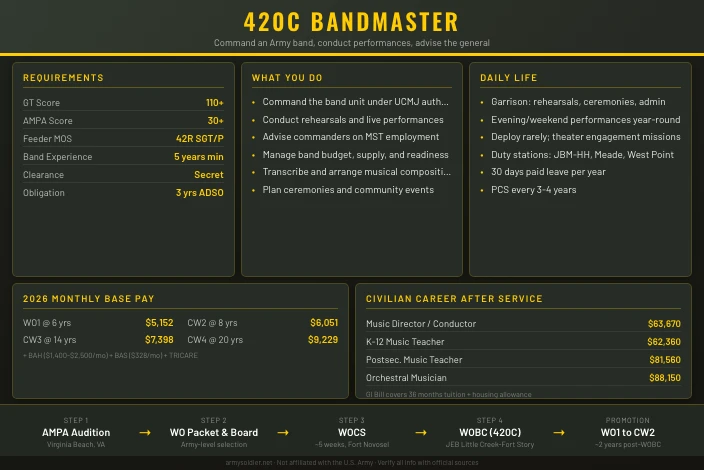
Job Role and Responsibilities
The 420C Bandmaster is the Army’s warrant officer commander and technical expert for Army band operations. As a Bandmaster, you hold command authority over your band unit, execute UCMJ actions, manage a budget, supervise training, and advise the commander on the employment of Music Support Teams (MSTs) in support of operational missions. You are simultaneously the band’s conductor, its commander, and its senior musical authority.
Technical Expertise and Scope
The Bandmaster’s technical domain spans two distinct areas. On the musical side, you direct rehearsals, select repertoire, conduct live performances, transcribe and arrange music, and evaluate musician proficiency. On the command side, you manage unit administration, supply, and readiness in the same way any small-unit commander would.
What makes this role distinct from both a senior NCO band leader and a commissioned officer is the combination of technical depth and command authority. The 42R musician plays the instrument. The 42S band director runs rehearsals as an enlisted leader but does not hold command authority. The 420C Bandmaster commands the unit, executes the budget, and serves as the subject matter expert the brigade commander consults when planning a change of command ceremony, a community relations concert, or a joint forces demonstration.
Related MOS Codes and Designators
| Designator | Title | Notes |
|---|---|---|
| 420C | Bandmaster | Warrant officer commander of Army band units |
| 42R | Army Musician | Enlisted feeder MOS for the 420C |
| 42S | Special Band Member | Enlisted senior musician/band director; also a 420C feeder |
Mission Contribution
Army bands serve an operational function that goes beyond entertainment. They support unit morale, execute official military ceremonies, represent the Army in community relations events, and project American military presence in joint and combined operations. The Bandmaster plans how the band’s MSTs are task-organized and deployed, matches musical capability to mission requirements, and keeps the unit trained and ready to support the full range of Army operations.
The role sits between the enlisted technical skill of the musicians themselves and the general mission authority of the brigade commander. The Bandmaster translates both: technical enough to run rehearsals, senior enough to brief the general.
Equipment and Systems
Army bands use a wide range of concert and field instruments, public address and sound reinforcement systems, digital audio workstations for recording and arrangement, and Army logistics systems for property accountability. Bandmasters at higher-echelon units may also work with recording facilities. The U.S. Army Band “Pershing’s Own” at Joint Base Myer-Henderson Hall and the U.S. Army Field Band at Fort Meade represent the most visible examples of full-scale professional Army musical organizations.
Salary and Benefits
Base Pay
Most 420C candidates enter from the E-6 or E-7 enlisted pay grades, so their years of service credit at appointment typically runs six years or higher. The table below shows 2026 monthly base pay at realistic YOS points for a 420C career track. All figures are from DFAS.
| Rank | Typical Total YOS | Monthly Base Pay (2026) |
|---|---|---|
| WO1 | 6 years | $5,152 |
| CW2 | 8 years | $6,051 |
| CW3 | 14 years | $7,398 |
| CW4 | 20 years | $9,229 |
| CW5 | 26 years | $11,495 |
Base pay does not tell the full financial picture. Warrant officers receive housing allowance (BAH) at officer rates, which at most CONUS installations ranges from roughly $1,400 to $2,500 monthly depending on location and dependent status. BAS for officers is $328 per month in 2026. Combined, a CW2 at a mid-cost installation with dependents realistically brings home over $8,500 per month in total compensation before TSP and other benefits.
Special Pay
The 420C MOS does not carry aviation bonus pay, hazardous duty pay, or parachutist pay as standard special pays. National Guard bandmasters may qualify for appointment bonuses of up to $10,000 depending on the state and position requirements; verify current amounts with your state’s National Guard G1. Active-component accession and retention bonus availability varies by fiscal year and Army manning levels – check HRC Warrant Officer Retention for current fiscal year incentives.
Benefits and Retirement
Active-duty Bandmasters receive TRICARE Prime at no cost, covering medical, dental, vision, and prescriptions for the soldier and family members. The Blended Retirement System (BRS) provides a pension equal to 2 percent of high-36 average base pay per year of service, reaching 40 percent of high-36 at 20 years. The government matches TSP contributions up to 5 percent of base pay starting in the third year of service.
Army Tuition Assistance covers up to $4,500 per year and $250 per semester hour for degree completion while serving. After service, the Post-9/11 GI Bill covers full in-state tuition at public universities for up to 36 months, plus a monthly housing allowance at the E-5 BAH rate for the school’s ZIP code.
Work-Life Balance
Garrison life for a Bandmaster runs on a schedule tied to performance commitments and unit training. A week might include morning physical training, instrument maintenance, section rehearsals, full-band rehearsal, and an evening ceremony. Field exercises and deployments are less frequent than combat arms units, but the performance calendar can compress recovery time, especially during high-ceremony seasons around national holidays.
Warrant officers generally experience less staff grind than commissioned officers. You do not rotate through the general officer development pipeline. You command your band and advise your commander. That focused technical role tends to produce higher job satisfaction among Bandmasters who enter the position for the right reasons.
Qualifications and Eligibility
Appointment Path
The 420C is an enlisted-to-warrant MOS. There is no street-to-seat option and no direct civilian appointment path. All candidates must have prior active Army service as an Army Musician.
Specific requirements (verify current cycle requirements with Army Warrant Officer Recruiting at recruiting.army.mil):
- Minimum rank of Sergeant (SGT) Promotable (SGT/P) in MOS 42R (Army Musician) as the primary feeder MOS
- Completion of the Advanced Leaders Course (ALC)
- Five years of cumulative experience in an Army band in PMOS 42R
- Army Musician Proficiency Assessment (AMPA) score of 30 or higher, obtained at the U.S. Army School of Music within the past four years
- Video submission demonstrating band conducting ability, reviewed by the 420C selection board
A background in 42S (Special Band Member) may also qualify depending on the current fiscal year’s application instructions. Confirm feeder MOS eligibility with your Warrant Officer Recruiter before beginning your packet.
Requirements Summary Table
| Requirement | Standard |
|---|---|
| Appointment path | Enlisted-to-warrant only |
| Feeder MOS | 42R (Army Musician); 42S may qualify |
| Minimum rank | SGT/P (Sergeant Promotable) |
| Enlisted experience | 5 years in an Army band in PMOS 42R |
| GT score | 110 minimum (non-waiverable) |
| AMPA score | 30 or higher (within 4 years of application) |
| ALC completion | Required |
| Conducting video | Required (reviewed by selection board) |
| Security clearance | Secret (required) |
| Age limit | Not to exceed 46 by date of appointment (verify current cycle) |
| ADSO | 3 years minimum from date of appointment |
ASVAB Test Requirement
All Army warrant officer candidates must meet a minimum GT score of 110. This is non-waiverable across all MOS. The GT score is a composite of the Verbal Expression (VE) and Arithmetic Reasoning (AR) subtests. If you currently score below 110, you can retest to improve your score. Strong performance on the Word Knowledge and Paragraph Comprehension subtests drives VE – reading-focused study plans work well for this composite.
The AMPA Audition
The Army Musician Proficiency Assessment is conducted at the U.S. Armed Forces School of Music in Virginia Beach, Virginia. The AMPA evaluates individual instrumental performance and is a gating requirement for the 420C packet. You must score 30 or higher, and the score must be current within four years of your application submission date. Plan this early – scheduling at the School of Music requires coordination through your chain of command and bandmaster.
The conducting video requirement adds another dimension that sets 420C selection apart from other warrant officer MOS. The board evaluates your ability to direct a musical ensemble, your technique, your presence, and your musical communication. Strong ALC records, solid NCOERs, and band leadership experience all matter, but the audition and video are the technical gatekeepers.
WOCS and Packet Process
After meeting the prerequisites, candidates submit a DA Form 61 (application for appointment), letters of recommendation, performance evaluations (NCOERs), ALC diploma, AMPA score, and the conducting video. The packet goes before an Army-level selection board. Selection rates for 420C are low – the Army has a small number of vacancies each year relative to the applicant pool, and the audition requirement filters candidates early.
Upon selection, you attend Warrant Officer Candidate School (WOCS) at Fort Novosel, Alabama. WOCS is approximately five weeks long and covers Army leadership doctrine, warrant officer roles and responsibilities, and the foundational standards expected of all warrant officers regardless of MOS. WOCS is academically and physically demanding and functions as the final gate before appointment.
Upon graduation from WOCS, you are appointed as a Warrant Officer 1 (WO1). Your Active Duty Service Obligation is a minimum of three years from the date of appointment.
See our ASVAB study guide for a study plan focused on the GT composite.
Work Environment
Daily Setting
A Bandmaster’s workday looks different from almost any other warrant officer in the Army. Most of your time is split between the rehearsal hall, the unit orderly room, and the installation event schedule. Garrison duty centers on rehearsal preparation, instrument and equipment accountability, budget management, and performance planning. You conduct rehearsals, evaluate musicians, develop the band’s training schedule, and coordinate with the installation operations officer for upcoming ceremonies.
Unlike aviation or maintenance warrants, you do not work from a flight line or a motor pool. Your physical work environment is largely a music facility: practice rooms, a concert hall or performance space, and an administrative office.
Position in the Unit
The Bandmaster commands the band. This is one of the few warrant officer MOS with formal command authority, not just a technical advisory role. You hold UCMJ authority over your soldiers, you sign unit property books, and you own the readiness report. Commissioned officers above you are typically in the supported unit’s chain of command (a brigade commander or installation directorate), not in a dedicated band chain of command. You brief them, you advise them, and you execute in support of their mission.
The relationship with your senior NCOs (the band’s First Sergeant equivalent and section leaders) follows normal Army dynamics. Your 42R and 42S soldiers look to you as the musical authority and the unit commander simultaneously. That dual role sets Bandmasters apart from nearly every other warrant in the Army.
Technical vs. Staff Roles
At WO1 and CW2, the Bandmaster’s time is heavily execution-focused: conducting rehearsals, running ceremonies, and developing as a technical leader. By CW3 and CW4, some Bandmasters move into staff advisory roles at Army Service Component Commands or installation directorates, providing input on band program resourcing, Army music policy, and long-range performance scheduling. CW5 Bandmasters serve as the senior Army music advisor at the corps or Army level.
Retention and Satisfaction
The 420C community is small. There are a limited number of active-duty Bandmaster positions, which means competition is intense but advancement opportunities are visible. Warrant officers who entered from 42R consistently cite the combination of musical mission and command responsibility as the reason they stay – it is a rare military job where deep technical expertise and leadership authority are equally required. The main retention challenge is the same as most non-aviation warrant MOS: promotion to CW5 is highly competitive with few positions available.
Training and Skill Development
WOBC: Warrant Officer Basic Course
After appointment at WOCS, Bandmasters attend the 420C Warrant Officer Basic Course (WOBC), conducted at the U.S. Armed Forces School of Music at Joint Expeditionary Base Little Creek-Fort Story in Virginia Beach, Virginia. The WOBC is MOS-specific and concentrates on the technical, administrative, and leadership skills required to command an Army band.
| Phase | Location | Focus |
|---|---|---|
| WOCS | Fort Novosel, AL | Leadership, warrant officer doctrine, Army standards |
| WOBC (420C) | JEB Little Creek-Fort Story, VA | Band command, conducting, music operations, administration |
The WOBC trains you on the full scope of band administration, music operations planning, rehearsal techniques at the warrant officer level, MST task organization, and Army logistics as applied to a band unit. It is distinct from the enlisted Army Musician course in that the emphasis is on command and technical direction, not individual instrument performance.
WOAC: Warrant Officer Advanced Course
Bandmasters attend the Warrant Officer Advanced Course (WOAC) as a CW2 or CW3. WOAC builds on WOBC with advanced technical content, staff advisory skills, and preparation for service at higher echelons. The 420C WOAC is also conducted through the Army music proponency.
WOILE and WOSSE
The Warrant Officer Intermediate Level Education (WOILE) is a five-week, MOS-immaterial resident course typically attended as a CW3 or CW4. It develops warrant officers for service at higher organizational levels, covering joint operations, Army doctrine, and strategic advisory skills. Location is Fort Novosel.
The Warrant Officer Senior Service Education (WOSSE) is for senior CW4 and CW5 officers. It is a two-phase course combining distance learning and resident instruction, focused on the strategic role of warrant officers and preparation for senior advisory positions.
Civilian Education and Certifications
The 420C is one of the few Army warrant officer MOS where civilian academic credentials are evaluated as part of the selection process. Candidates with a baccalaureate degree in music, music education, or conducting have a demonstrably stronger packet. Tuition Assistance supports degree completion while on active duty. The Army COOL program identifies civilian credentialing opportunities aligned to the 420C technical skill set, including music education certification and conducting credentials.
A qualifying GT score comes first — our ASVAB study guide covers the subtests that drive GT.
Career Progression and Advancement
Career Timeline
The 420C career is shorter in unit count but deeper in technical progression than most warrant officer tracks. Bandmasters typically command the same band for a three-year tour, then move to a different band or a staff position. The table below shows the typical progression.
| Rank | Typical TIG | Typical Total YOS | Key Assignments |
|---|---|---|---|
| WO1 | 1-2 years | 6-8 | Complete WOCS, WOBC; initial band assignment |
| CW2 | 3-5 years | 8-13 | Primary band commander; attend WOAC |
| CW3 | 5-7 years | 13-20 | Senior band command; staff advisory roles begin; WOILE |
| CW4 | 5-7 years | 20-27 | Corps or ASCC staff; proponency positions; WOSSE |
| CW5 | Until retirement | 27-30+ | Senior Army music advisor; Army-level staff |
WO1 to CW2 promotion is time-based and follows WOBC completion. CW3 and above are board-selected. Promotion to CW4 is competitive; CW5 is highly competitive with only a handful of positions Army-wide.
Building a Competitive Record
A strong 420C career file includes consistent “Most Qualified” OER ratings, band performance evaluations that show measurable improvement, advanced civilian music education (graduate degree), broadening assignments at higher staff levels, and volunteer contributions to Army music policy or proponency. The warrant officer community at this MOS is small enough that your reputation as a Bandmaster – the performances you conduct, the soldiers you develop, the commanders you advise – directly influences your standing with selection boards.
CW5 as Senior Music Advisor
A CW5 Bandmaster serves as the Army’s senior technical advisor on all matters related to Army music programs. At that level, you advise corps or Army-level commanders, interface with congressional liaison activities, and provide technical guidance on Army band resourcing, procurement, and policy. There are fewer than a handful of CW5 Bandmaster positions in the entire Army, which makes selection for CW5 the most competitive promotion in the MOS.
Physical Demands and Medical Evaluations
AFT Standards
All soldiers, including warrant officers, take the Army Fitness Test (AFT). The AFT replaced the ACFT on June 1, 2025. It consists of five events scored 0 to 100 each, for a maximum of 500 points. The minimum passing score is 60 per event (300 total). Standards are sex- and age-normed.
| Event | Abbreviation | Min Score (17-21, Male) | Min Score (17-21, Female) |
|---|---|---|---|
| 3-Rep Max Deadlift | MDL | 60 | 60 |
| Hand Release Push-Up | HRP | 60 | 60 |
| Sprint-Drag-Carry | SDC | 60 | 60 |
| Plank | PLK | 60 | 60 |
| Two-Mile Run | 2MR | 60 | 60 |
The 420C is not a designated combat MOS. The standard passing score is 300 total, not the 350-point combat specialty standard. Physical demands in the day-to-day work environment are moderate: moving equipment, setup/breakdown of staging and sound systems, and normal soldier physical training.
MOS-Specific Medical
There are no flight physical or specialized medical evaluation requirements for the 420C. Standard Army medical fitness standards apply (AR 40-501). Musicians and Bandmasters should be aware that hearing conservation is occupationally relevant: repeated exposure to high-decibel environments during rehearsals and performances creates a real occupational hearing hazard. The Army’s hearing conservation program applies, and Bandmasters should enforce compliance for their soldiers.
Deployment and Duty Stations
Deployment Patterns
The 420C deploys significantly less frequently than combat arms or aviation warrant officers. Army bands do deploy – they have supported operations in Iraq, Afghanistan, and various theater engagement missions – but combat deployments for band units are rare. More common are operational support deployments: theater security cooperation missions, partnership building exercises with allied armies, and joint exercises where Army music capability is a diplomatic tool.
Bandmasters deploy with their bands when the band is ordered to support theater operations. The tempo is lower than combat arms, but it is not zero.
Duty Stations
Army bands are assigned to installations across the continental United States and overseas. The active-duty 420C community is spread across Army band organizations that include installation bands at major posts, division bands at combat divisions, and premier units like the U.S. Army Band “Pershing’s Own” at Joint Base Myer-Henderson Hall, the U.S. Army Field Band at Fort Meade, and the West Point Band at the United States Military Academy.
Key active-duty installations for Army bands include:
- Joint Base Myer-Henderson Hall, Virginia
- Fort Meade, Maryland
- West Point, New York
- Fort Liberty, North Carolina
- Fort Campbell, Kentucky
- Fort Moore, Georgia
- Fort Bliss, Texas
- Fort Wainwright, Alaska
- Schofield Barracks, Hawaii
- Germany, Korea, and other OCONUS locations
Duty station assignments are managed through HRC based on position vacancies and Bandmaster career needs. Warrant officers have input through the assignment preference process but do not choose assignments unilaterally.
Risk, Safety, and Legal Considerations
Job Hazards
The physical risk profile for a Bandmaster is low compared to combat or aviation warrant officers. The primary occupational hazards are noise-induced hearing loss from sustained high-decibel performance environments, musculoskeletal strain from equipment movement, and the physical demands of field environments when supporting deployed operations.
Safety Protocols
Bandmasters implement and enforce the Army’s Composite Risk Management (CRM) process for all unit activities, from equipment transport to field deployments. Hearing conservation compliance is a specific occupational safety priority. Sound level monitoring during rehearsals in enclosed spaces and proper use of hearing protection are areas where the Bandmaster has direct accountability.
Command Authority and UCMJ
The 420C holds command authority over the band unit. This means you can impose non-judicial punishment (Article 15), initiate administrative separation actions, and take other legal actions under the UCMJ – authority that most warrant officer MOS do not have. With that authority comes the same accountability as any other unit commander. Technical failures, safety violations, and personnel misconduct in your unit reflect directly on you.
Impact on Family and Personal Life
Family Considerations
Bandmaster assignments follow the standard Army PCS (permanent change of station) cycle, typically every two to three years. The move tempo is similar to other warrant officer MOS and somewhat more predictable than commissioned officer assignments. Families benefit from access to installation services, Army Community Service (ACS), and Family Readiness Group (FRG) support at each duty station.
The performance schedule introduces a work-life complexity that is unique to this MOS. Evening performances, holiday ceremonies, and weekend concerts are built into the job. Family members should understand that the Bandmaster’s calendar includes commitments outside normal duty hours – sometimes with significant advance scheduling, sometimes with short notice.
Dual-Military and Stability
Dual-military couples with one 420C spouse face the same joint-tour and co-location challenges as all Army couples. HRC makes joint-domicile assignments when positions exist at or near the same installation. Given the limited number of Bandmaster positions, co-location is not guaranteed and may require one spouse to accept a less-preferred assignment.
Warrant officers typically PCS less frequently than commissioned officers because the warrant officer single-track specialty keeps them in technical positions rather than rotating through command and staff positions on a rapid cycle. Bandmasters tend to see PCS moves every three to four years – more predictable than many commissioned branch paths.
Reserve and National Guard
Component Availability
The 420C MOS is available in both the Army Reserve and Army National Guard. There are Reserve and Guard band units across the country, and most require a qualified Bandmaster. Reserve and Guard bands frequently support state ceremonies, federal funerals, community events, and mobilized support missions.
Reserve and Guard Appointment
The path for Reserve and Guard 420C appointments mirrors the active component process in most requirements: 42R or 42S feeder MOS, AMPA score, conducting video, WOCS completion, and WOBC. The selection board may differ (Reserve and Guard components run separate selection processes), and the number of vacancies varies by state and unit. Some states offer National Guard appointment bonuses for hard-to-fill warrant positions.
Active-duty 420C Bandmasters who leave active service can transfer to a Reserve or Guard unit if a vacancy exists and they meet the component’s current requirements.
Drill Commitment and Currency
The standard Reserve/Guard commitment is one weekend per month (four Unit Training Assemblies) plus two weeks of Annual Training. For Bandmasters, this baseline is supplemented by performance commitments: state ceremonies, funerals, official functions, and community relations events that occur on drill weekends and often on non-drill days as well. Part-time Bandmasters should expect a higher-than-average non-drill commitment relative to most Reserve warrant officer MOS.
Part-Time Pay
Drill pay is calculated as one day’s base pay per drill period. A standard weekend equals four drill periods. The table below shows 2026 drill pay estimates for the most common 420C pay grades.
| Rank | Monthly Base Pay | Weekend Drill Pay (4 periods) |
|---|---|---|
| WO1 (6 YOS) | $5,152 | ~$687 |
| CW2 (8 YOS) | $6,051 | ~$807 |
| CW3 (14 YOS) | $7,398 | ~$987 |
Benefits: Reserve vs. Active Comparison
| Category | Active Duty | Army Reserve | Army National Guard |
|---|---|---|---|
| Commitment | Full-time | 1 wknd/mo + 2 wks AT | 1 wknd/mo + 2 wks AT |
| Monthly pay (CW3, 14 YOS) | $7,398 | ~$987/wknd | ~$987/wknd |
| Healthcare | TRICARE Prime ($0) | TRICARE Reserve Select ($57.88/mo individual) | TRICARE Reserve Select ($57.88/mo individual) |
| Education | TA + Post-9/11 GI Bill | MGIB-SR ($493/mo) or Post-9/11 GI Bill if activated | MGIB-SR + state tuition waivers (varies by state) |
| Deployment tempo | Low-moderate | Low; mobilization-based | Low; Governor or federal mobilization |
| Advancement | CW2-CW5 available | CW2-CW5 available; slower promotion pace | CW2-CW5 available; slower promotion pace |
| Retirement | 20-year pension (BRS) | Points-based, collect at 60 | Points-based, collect at 60 |
Civilian Career Integration
The Reserve and Guard path pairs naturally with civilian music careers. A part-time Bandmaster who also teaches instrumental music, directs a community orchestra, or works in music education maintains their Army skills while building a civilian career in the same field. The scheduling flexibility of a once-monthly drill commitment makes this combination more practical for 420C than for most Reserve warrant MOS.
USERRA protections apply: your civilian employer cannot demote you, reduce your seniority, or deny you benefits because of military service, and they must allow you to return to your position after mobilizations of up to five cumulative years.
Post-Service Opportunities
Transition to Civilian Music Roles
Former 420C Bandmasters exit the Army with a set of credentials that translates well into civilian music careers: conducting experience, ensemble leadership, program management, and a graduate-level music background (for those who completed advanced degrees while serving). The transition programs available through SFL-TAP (Soldier for Life-Transition Assistance Program) help warrant officers connect their military experience to civilian job markets.
Civilian Career Prospects
| Civilian Job Title | Median Annual Salary | Outlook (2024-2034) |
|---|---|---|
| Music Director / Conductor | $63,670 | Little or no change |
| Music Teacher (K-12) | $62,360 | 1% growth |
| Postsecondary Music Teacher | $81,560 | 8% growth |
| Musicians and Singers (orchestral) | $88,150 (annual, full-time) | 1% growth |
Salary data from the U.S. Bureau of Labor Statistics (BLS), May 2024. The top 10 percent of music directors earn over $157,000 annually, concentrated in major metropolitan orchestras and prominent educational institutions. Former Bandmasters with active security clearances and project management experience also qualify for program management roles in defense contracting and government services.
Certifications and Credentials
The Army COOL program maps 420C experience to civilian credentialing opportunities, including state teaching certifications, music education endorsements, and conducting credentials. Many states accept military music training and experience toward provisional teaching licensure. A Bandmaster with a baccalaureate or graduate music degree and five or more years of conducting experience meets the educational and experiential requirements for most state K-12 music educator positions without additional coursework.
The Post-9/11 GI Bill covers 36 months of tuition plus a housing allowance, which is enough for a full graduate degree program in music performance, music education, or arts administration after separation. Private school tuition is capped at $29,920.95 per academic year (2025-2026 cap).
Is This a Good Job for You?
The Right Fit
The 420C is built for a specific type of soldier: an experienced 42R who has reached the limit of what they can do as an NCO and wants both the technical challenge of leading a professional musical organization and the authority to command the soldiers in it. If you spend your ALC asking why the band conducts poorly-prepared ceremonies or why the commander doesn’t use the band more effectively, the Bandmaster path is an answer to that frustration.
You need the academic and audition credentials to get through the packet. You also need the leadership record to convince a selection board you can command. Musicians who are technically excellent but have avoided additional duties, staff roles, or administrative experience will struggle with the command side of the job.
Potential Challenges
The 420C has a smaller career community than almost any other Army warrant officer MOS. There are limited positions, limited promotion opportunities above CW3, and limited duty station flexibility because bands are tied to specific installations. If you want frequent reassignments, joint assignments, or a clear path to CW5, the numbers work against you. Most Bandmasters spend their career at three to five band units and retire at CW3 or CW4.
The evening and weekend performance schedule does not go away at any rank. If your family needs predictable hours, this job will challenge that expectation consistently.
Career Alignment
For a 42R Sergeant First Class who loves conducting, wants to command, and can meet the audition standard, this is one of the most unique and fulfilling warrant officer paths in the Army. For a soldier who wants combat deployments, rapid promotion, or a clear civilian technical credential in a high-demand field, there are better fits in the warrant officer corps.
The Guard and Reserve option is genuinely strong for musicians who want to pursue a civilian music career while maintaining an Army role. The part-time Bandmaster who also directs a school band program or a community symphony is the person this track was designed for.
More Information
Contact your local Army Warrant Officer Recruiter or visit the official Army Warrant Officer Recruiting page for current 420C application instructions, fiscal year deadlines, and audition scheduling. Your AMPA assessment must be scheduled through the U.S. Armed Forces School of Music in Virginia Beach, and scores take time to process – start that coordination at least six months before you plan to submit your packet. If your GT score is below 110, the ASVAB General Technical composite is improvable with focused preparation on Word Knowledge, Paragraph Comprehension, and Arithmetic Reasoning.
- Prepare for the ASVAB with our study guide to meet the GT 110 requirement
This site is not affiliated with the U.S. Army or any government agency. Verify all information with official Army sources before making enlistment or career decisions.
Explore more Army warrant officer careers such as 420A Human Resources Technician and 420T Talent Acquisition Technician.