420T Talent Acquisition Technician
The Army struggles to recruit. It has for years. In 2023, the Secretary of the Army responded by creating a new kind of expert: the 420T Talent Acquisition Technician, a warrant officer whose entire job is fixing the recruiting enterprise from the inside. No other warrant officer MOS was built this recently, this deliberately, or this directly in response to a crisis. The 420T uses labor market analysis, data analytics, marketing science, and Army intelligence processes to figure out where the best recruits are, why they are not joining, and what it takes to change that. This is not a uniformed HR generalist role. It is a technical advisory position at the intersection of data, strategy, and national security – and the Army is still building it from the ground up.
Warrant officer candidates need a GT score of at least 110 — our ASVAB study guide covers what drives that number.
Job Role and Responsibilities
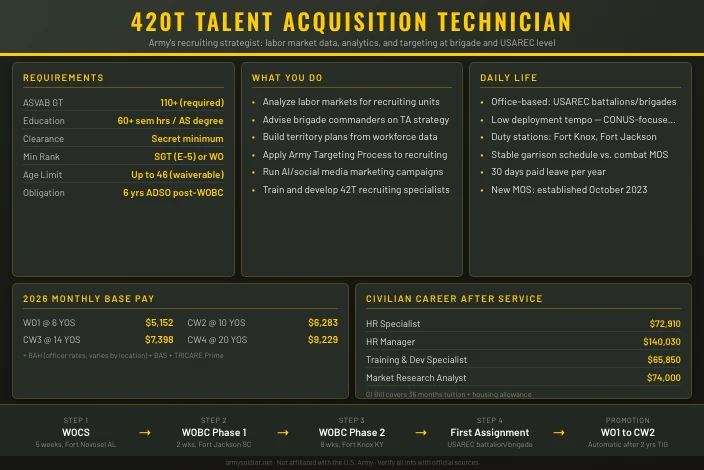
The 420T Talent Acquisition Technician is the Army’s senior recruiting strategist at battalion, brigade, and higher echelons. This warrant officer applies data analytics, labor market intelligence, workforce planning frameworks, and marketing principles to drive recruiting outcomes across the U.S. Army Recruiting Command (USAREC) enterprise. The 420T advises commanders on talent acquisition strategy, analyzes market trends and lead quality data, and integrates Army targeting processes into brigade- and battalion-level recruiting plans.
Technical Domain
The 420T owns a domain that sits between traditional HR work and operational intelligence. Where the 42A Human Resources Specialist processes personnel records and the 79R/42T Army Recruiter executes face-to-face prospecting, the 420T operates above both. You build the targeting model. You define which markets to prioritize, which demographic segments to approach, what messaging resonates in which communities, and how to measure whether any of it is working.
The platforms and tools vary by assignment, but the core competencies are consistent:
- Labor market databases and civilian recruiting analytics platforms
- USAREC reporting systems and lead management software
- Social media analytics tools and advertising metrics dashboards
- Army data systems that feed recruiting intelligence
- Marketing and brand analysis frameworks
MOS Codes and Designations
| Designation | Title | Notes |
|---|---|---|
| 420T | Talent Acquisition Technician | Primary warrant officer MOS |
| 42T | Talent Acquisition Specialist | Enlisted feeder MOS (formerly 79R) |
| 79R | Army Recruiter | Previous enlisted designation, reclassified to 42T |
The 420T MOS was established in October 2023. No Additional Skill Identifiers (ASIs) specific to 420T had been published as of early 2026; check with your warrant officer proponent at the Adjutant General’s Corps Regimental Association (AGCRA) for the current ASI landscape as the MOS matures.
Mission Contribution
The Army cannot fight without soldiers. Recruiting is force generation, and when it fails, readiness suffers at every level. The 420T’s mission contribution is strategic: you give the recruiting enterprise the analytical intelligence it needs to compete in a civilian labor market that does not wait for the Army to catch up.
At the battalion level, the 420T translates national labor market data into concrete territory plans. At brigade and USAREC headquarters, the 420T advises senior commanders on resource allocation, market saturation, and campaign effectiveness. CW5 Chad G. Bowen serves as the first Command Chief Warrant Officer (CCWO) for USAREC, establishing a dedicated warrant officer voice at the command’s highest level.
Salary and Benefits
Base Pay
Most 420T warrant officers enter as WO1 with prior enlisted or warrant officer experience, which means their years of service (YOS) for pay purposes will already be substantial. A former SGT with seven years before appointment enters at W-1 with seven YOS, not at the entry-level rate.
| Rank | Typical YOS at Grade | Monthly Base Pay (2026) |
|---|---|---|
| WO1 | 6 YOS | $5,152 |
| WO1 | 8 YOS | $5,584 |
| CW2 | 10 YOS | $6,283 |
| CW2 | 12 YOS | $6,509 |
| CW3 | 14 YOS | $7,398 |
| CW3 | 18 YOS | $8,150 |
| CW4 | 20 YOS | $9,229 |
| CW4 | 24 YOS | $10,032 |
Pay figures are 2026 rates per DFAS. Warrant officers use officer BAH rates, which are higher than enlisted rates. At most CONUS installations, a WO1 without dependents receives $1,407-$1,900+ monthly in BAH depending on duty location.
Special Pays and Bonuses
No MOS-specific aviation or hazardous duty pay applies to the 420T. The primary special pay relevant to this MOS is Special Duty Assignment Pay (SDAP), which may apply to certain recruiting-related assignments. Check current MILPER messages for the latest SDAP rates, as recruiting command positions qualify at varying levels.
The Army has used accession and retention bonuses selectively for 420T as the MOS builds strength. Given the MOS was just established in 2023, bonus programs are subject to change. Verify current bonus eligibility directly with a warrant officer recruiter.
Additional Benefits
Active-duty warrant officers receive TRICARE Prime at no premium or copay, covering the soldier and dependents for medical, dental, vision, and prescriptions. After six years of service, GI Bill benefits become transferable to dependents (with a four-year service extension). The Army funds up to $4,500 per year in Tuition Assistance for degree completion, which many 420T warrant officers use given the associate degree requirement at entry.
Retirement
Under the Blended Retirement System (BRS), a 420T retiring after 20 years draws a pension equal to 40% of the average of their highest 36 months of basic pay. The government matches TSP contributions up to 5% of base pay starting at the third year of service. Many 420T warrant officers will serve 20-30 years given the specialized nature of the MOS and the career investment required to build expertise.
Work-Life Balance
Garrison assignments in recruiting battalions follow a structured work schedule, though mission demands during peak recruiting seasons can extend hours. Deployments in the traditional combat sense are rare for 420T; most assignments are CONUS-based, supporting USAREC units spread across the country. Warrant officers in USAREC typically have more schedule predictability than combat arms counterparts but may face pressure during accession mission cycles.
Compared to commissioned AG officers who rotate through staff and command positions, the 420T stays focused on the recruiting enterprise throughout the career. Compared to senior NCOs in recruiting, the 420T carries greater analytical responsibility and operates at a higher advisory echelon with more institutional autonomy.
Qualifications and Eligibility
Appointment Paths
The 420T accepts candidates through three main pathways, all of which require prior service. This MOS does not have a street-to-seat or civilian direct appointment option.
Pathway 1 – Current Warrant Officers: Mid-career warrant officers from other MOS fields who have demonstrated potential in data analysis, leadership, or recruiting. Prior recruiting experience or a degree in marketing, psychology, human resources, or data analytics is preferred.
Pathway 2 – Recruiting NCOs (42T/79R): Staff Sergeant through Master Sergeant permanently assigned to USAREC with the 42T (formerly 79R) MOS. These candidates bring direct recruiting experience and are the most natural pipeline into the MOS.
Pathway 3 – MOS-Immaterial NCOs: Sergeant through Master Sergeant from any active component MOS who have completed the Advanced Leader Course and demonstrate potential in data analytics and leadership.
| Requirement | Details |
|---|---|
| Appointment paths | Current WOs (any MOS), 42T/79R NCOs, MOS-immaterial NCOs |
| Minimum enlisted rank | SGT (E-5) for NCO pathway; no enlisted minimum for current WO reclassification |
| Education | Associate’s degree or 60+ semester hours of college |
| ASVAB GT score | 110 minimum (non-waiverable) |
| Security clearance | Secret minimum |
| Age limit | Up to 46 (waiverable; technical warrant officer standard) |
| Additional check | Specialized recruiting background investigation |
| PME requirement (NCO path) | Advanced Leader Course completed |
| Preferred background | Prior recruiting, or degree in marketing, HR, psychology, or data analytics |
Warrant Officer Candidate School (WOCS)
All NCO-pathway candidates must complete WOCS at Fort Novosel, Alabama before attending WOBC. WOCS is a five-week resident course that covers leadership development, officership, Army doctrine, ethics, land navigation, and tactical exercises. Candidates rotate through student leadership positions throughout the course. Current warrant officers reclassifying to 420T skip WOCS and proceed directly to WOBC.
WOCS graduation results in appointment as a WO1. The application process requires assembling a warrant officer packet: DA Form 61, official transcripts showing 60+ semester hours, evaluations (NCOERs or OERs), letters of recommendation, security clearance verification, and recruiting background check results.
Test Requirements
The GT score of 110 is the non-waiverable baseline for all warrant officer applicants. GT is calculated from the Verbal Expression (VE) and Arithmetic Reasoning (AR) subtests of the ASVAB. Candidates who do not meet 110 must retake the ASVAB before applying.
No SIFT score is required for 420T. This is a non-aviation warrant officer MOS.
Board and Assessment Process
After packet review, selected candidates attend an in-person attribute-based assessment at Fort Knox, Kentucky. This assessment evaluates analytical aptitude, leadership potential, and fit with the recruiting enterprise mission. The Army held three selection boards in 2024 with approximately 75 candidates per board, and the January 2025 board (MILPER 25-051) selected candidates for a subsequent Fort Knox assessment in April 2025.
Selection is competitive. Strong packets include demonstrated quantitative skills (coursework, civilian work experience), letters that speak to specific analytical achievements, and NCOERs that reflect initiative rather than routine performance. A degree in a directly applicable field strengthens any packet.
Upon Appointment
New 420T warrant officers enter at WO1. The standard Active Duty Service Obligation (ADSO) is six years following WOBC completion, consistent with technical warrant officer MOS requirements.
See our ASVAB study guide for a study plan focused on the GT composite.
Work Environment
Setting and Schedule
Most 420T warrant officers work in USAREC battalion and brigade headquarters – office environments with access to data systems, marketing platforms, and Army reporting tools. Assignments span the continental United States, aligned to the seven USAREC brigades. Four 420T positions sit at the Soldier Support Institute (SSI) at Fort Jackson, South Carolina, where personnel serve as MOS proponents, instructors, and training developers.
Garrison work follows a predictable weekday schedule, though mission cycles and recruiting season pushes will occasionally extend hours. There is no comparable field exercise or deployment pattern to combat MOS; the operational environment is the American civilian labor market, not the battlefield.
Position in the Unit
The 420T occupies the technical expert seat within the USAREC structure. This warrant officer does not sit in the NCO support channel and does not hold command authority in the traditional sense. The relationship with the commanding officer is advisory: the 420T provides data-driven analysis, the commander makes decisions based on it.
The dynamic with senior NCOs (42T Master Sergeants and First Sergeants) involves mutual respect and clear lane discipline. NCOs run the day-to-day recruiter mission; the 420T runs the analytical and strategic overlay. Junior 42T specialists often look to the 420T for technical guidance on data tools, market analysis, and territory planning.
Technical vs. Staff Roles
At WO1 and CW2, the work is largely hands-on: pulling data, building analyses, advising battalion-level recruiters on market prioritization, and learning the systems. As the warrant officer progresses to CW3 and CW4, advisory responsibilities at brigade and USAREC headquarters increase. CW4 and CW5 positions feed into USAREC Division Headquarters and Army Innovation Directorate billets where the work becomes more strategic and less operational.
Because the MOS is new, the 420T community is still defining what “broadening assignments” look like at CW3+ levels. Interagency fellowships, joint staff positions, and industry partnership programs are emerging areas of interest within the USAREC enterprise.
Job Satisfaction
The 420T community is small, tightly knit, and actively building its own identity within the warrant officer corps. Soldiers who joined the first cohorts describe the MOS as intellectually challenging with direct impact visibility. The challenge: limited peer community size means fewer fellow warrant officers in adjacent roles for day-to-day mentorship, and the MOS proponent infrastructure is still maturing. Soldiers who need a well-established institution with decades of precedent will find the 420T environment more ambiguous than older MOS fields.
Training and Skill Development
Warrant Officer Basic Course (WOBC)
The 420T WOBC is a two-phase program conducted at two installations.
| Phase | Location | Length | Focus |
|---|---|---|---|
| Phase 1 | Adjutant General School, Fort Jackson, SC | 2 weeks | Fundamental data analytics, Army HR systems |
| Phase 2 | Recruiting and Retention College, Fort Knox, KY | 8 weeks | Recruiting operations, marketing, public affairs, AI/social media tools, data analytics for talent acquisition |
WOBC total length is approximately 10 weeks. The curriculum covers over 75 lessons developed specifically for this MOS, including recruiting operations frameworks, marketing fundamentals, public affairs integration, USAREC intelligence analysis, and Army Targeting Process application to brigade- and battalion-level recruiting plans.
This pipeline differs sharply from most WOBC courses. Where an 888A Mobility Officer or 255A Data Operations Warrant Officer attends a school with decades of curriculum history, the 420T WOBC was built from scratch in less than a year by a small team at the AG School and Recruiting and Retention College. Expect the curriculum to evolve.
Warrant Officer Advanced Course (WOAC)
WOAC is attended as a CW2 preparing for CW3 positions. For the 420T, the resident phase is conducted at the branch school (AG School at Fort Jackson or Recruiting and Retention College at Fort Knox, depending on the WOAC track as the MOS matures). WOAC develops advanced technical skills and prepares the warrant officer for advisory roles at higher echelons. The AG Corps proponent manages the WOAC course design for 420T; verify current schedule and location through the WOCC or AG Branch.
Warrant Officer Intermediate Level Education (WOILE)
WOILE is a five-week resident course at the U.S. Army Warrant Officer Career College (WOCC), Fort Novosel, Alabama. It is MOS-immaterial and attended as a CW3 or CW4. WOILE develops leadership and institutional perspective beyond the technical MOS specialty, preparing warrant officers to advise at division level and above. The 48-hour distance learning phase precedes the resident course.
Warrant Officer Senior Service Education (WOSSE)
WOSSE is attended as a senior CW4 or CW5. It consists of a 48-hour distance learning phase followed by a four-week resident course at Fort Novosel, Alabama. WOSSE prepares senior warrant officers for strategic-level advisory roles at corps and Army echelons. Completion is required for progression to CW5-level positions.
Additional Training
The Army funds tuition assistance for degree completion, and 420T warrant officers with only 60 semester hours at entry have strong incentive to complete a bachelor’s degree while serving. Fields like data science, marketing analytics, statistics, and organizational behavior directly reinforce the technical core of the MOS. Army COOL (Credentialing Opportunities On-Line) identifies civilian certifications that align with 420T training, including SHRM-CP (Society for Human Resource Management - Certified Professional) and various data analytics credentials.
A qualifying GT score comes first — our ASVAB study guide covers the subtests that drive GT.
Career Progression and Advancement
Career Path
| Rank | Typical TIG | Typical Total YOS | Key Assignments |
|---|---|---|---|
| WO1 | 2 years | 6-12 | WOBC completion; battalion-level recruiting analytics advisor |
| CW2 | 2-3 years | 8-15 | WOAC; expanded territory analysis; battalion/brigade support |
| CW3 | 5-6 years (primary zone) | 13-21 | WOILE; brigade-level talent acquisition advisor; USAREC staff roles |
| CW4 | 5-6 years (primary zone) | 18-27 | WOSSE; USAREC brigade S2/S3 equivalent advisory positions; proponent roles |
| CW5 | Terminal grade | 24-30+ | USAREC/FORSCOM strategic advisor; Army Innovation Directorate; CCWO positions |
Promotion System
WO1 to CW2 is automatic after completing WOBC and meeting a two-year time-in-grade requirement – no selection board required. CW3 and above require competitive board selection. Warrant officers are evaluated on Officer Evaluation Reports (OERs) using DA Form 67-10, with warrant-officer-specific guidance in DA Pam 623-3, Appendix B.
Because the 420T MOS launched in 2023, the first CW3 promotion boards for this MOS will occur as early members reach primary zone. Historical promotion rates from other technical warrant MOS fields provide a rough benchmark: CW3 selection rates typically run 70-80% in primary zone for well-documented candidates. CW5 appointments are Army-wide limited to roughly 5% of the warrant officer population – the terminal grade is selective across all MOS fields.
CW5 Role
A CW5 in the 420T serves as a strategic advisor at USAREC headquarters, FORSCOM, or DA-level staff positions. The Command Chief Warrant Officer role at USAREC – currently filled – represents the peak advisory position within the recruiting enterprise. CW5 420Ts shape Army-wide talent acquisition policy, advise general officers on recruiting strategy, and represent the warrant officer community’s institutional interests within the AG Corps.
Building a Competitive Record
Because the MOS is new, standing out requires deliberate file construction from day one:
- Complete a bachelor’s degree (data analytics, marketing, statistics, or HR) while serving as a WO1 or CW2
- Document measurable outcomes on OERs (e.g., “increased market penetration in target demographic by X%”)
- Pursue certifications through Army COOL (SHRM, data analytics, project management)
- Seek broadening assignments as the MOS proponent develops them
- Maintain a clean personnel file – the small peer community means visibility is high
Physical Demands and Medical Evaluations
AFT Standards
All Army warrant officers take the Army Fitness Test (AFT), which replaced the ACFT on June 1, 2025. The AFT has five events scored 0-100 points each, for a maximum of 500 points. The general passing standard is 300 total points with at least 60 points per event, normed by age and sex. The 420T is not a designated combat MOS, so the 350-point sex-neutral combat standard does not apply.
| Event | Abbreviation | What It Tests |
|---|---|---|
| 3 Rep Max Deadlift | MDL | Muscular strength |
| Hand Release Push-Up | HRP | Muscular endurance |
| Sprint-Drag-Carry | SDC | Anaerobic capacity |
| Plank | PLK | Core endurance |
| Two-Mile Run | 2MR | Aerobic endurance |
Scoring tables are sex- and age-normed. Minimum passing scores vary by age bracket; official current standards are published at army.mil/aft.
MOS-Specific Medical
The 420T has no flight physical requirement and no unique hearing, vision, or physical capacity standards beyond the standard Army medical screening. Soldiers who require a medical waiver for general service may still qualify for 420T provided the waiver does not affect fitness test participation or security clearance eligibility.
Deployment and Duty Stations
Deployment Tempo
The 420T is a CONUS-based MOS anchored to the USAREC enterprise. Traditional combat deployments are not part of the standard assignment pattern. Some 420T warrant officers may support operational test exercises, Army innovation programs, or joint recruiting efforts that require temporary duty travel, but sustained overseas combat deployment is not a baseline expectation for this MOS.
This sets the 420T apart from nearly every other warrant officer field. The deployment risk profile is low, and family stability is correspondingly higher than for combat, aviation, or intelligence warrant officers.
Duty Station Options
The seven USAREC brigade headquarters and the battalions underneath them generate the primary billets. Key locations include:
- Fort Knox, Kentucky (USAREC headquarters and Recruiting and Retention College)
- Fort Jackson, South Carolina (Adjutant General School; SSI instructor/proponent positions)
- USAREC brigade areas: Raleigh (NC), Atlanta (GA), Columbus (OH), Houston (TX), Sacramento (CA), Minneapolis (MN), New York (NY) metropolitan areas, and others aligned to brigade boundaries
HRC manages warrant officer assignment preferences, and 420T warrant officers may submit preferences through the normal officer assignment process. Given the relatively small population of 420T positions, assignment choices may be constrained by billet availability.
Risk, Safety, and Legal Considerations
Job Hazards
The 420T carries minimal physical risk compared to most Army warrant officer MOS fields. The primary risk is mission-related: failure in the talent acquisition role has downstream consequences for Army readiness. There is also professional risk in a nascent MOS – career patterns are still being established, precedents are limited, and institutional frameworks are incomplete.
Safety Protocols
Risk management in the 420T context applies to data security rather than physical safety. The MOS handles personally identifiable information (PII) of applicants and potential recruits, and Army data governance policies (AR 25-2) apply to all systems operated by 420T personnel.
Authority and Responsibility
The 420T holds advisory authority, not command authority. UCMJ authority is standard for all warrant officers: the 420T can impose non-judicial punishment under Article 15 on soldiers in their chain of supervision and is accountable for the accuracy of official reports, analyses, and recommendations they provide to commanders. Providing false or misleading recruiting data to a commander constitutes a serious professional and legal failure.
Impact on Family and Personal Life
Family Considerations
The 420T is among the most family-friendly warrant officer MOS fields in the Army. CONUS-based assignments, predictable schedules relative to combat MOS, and low deployment tempo mean families spend more time together than in most other warrant officer career fields. Army Community Service (ACS), Family Readiness Groups (FRGs), and the broader USAREC community support programs are available at every major installation.
PCS frequency follows the standard Army pattern of every two to three years. Given the concentration of 420T billets within USAREC’s geographic footprint, some warrant officers may find themselves returning to the same brigade area on a subsequent tour, which improves school continuity for children.
Dual-Military and Family Planning
Dual-military couples where one partner is a 420T can request join-spouse assignment through HRC, though the USAREC-centric nature of 420T billets may limit options if the other partner is in a very different functional area. The Army’s Career Intermission Program (CIP) allows up to three years of paid inactive status for family care, and the relatively low operational tempo of the 420T makes return-to-duty planning more straightforward than in high-deployment MOS fields.
Compared to commissioned AG officers who face broadening assignment pressure and frequent PCS moves, the 420T warrant officer typically experiences more assignment stability. Compared to senior NCOs in USAREC, the 420T has greater career autonomy and less exposure to the day-to-day pressure of individual recruiter mission quotas.
Reserve and National Guard
Component Availability
The 420T MOS is available in both the Army Reserve and the Army National Guard, though the position structure is still developing as the MOS matures in the active component. Reserve and Guard units with USAREC or recruiting support missions are the most likely home for 420T warrant officers in the RC.
MILPER messages confirm Reserve and Guard 420T selections alongside active component selections, indicating both components have active requirements. Verify current billet availability through your state G1 (Guard) or USARC HQ (Reserve).
Appointment Paths
Reserve and Guard candidates follow the same eligibility criteria as active component applicants: GT 110, associate degree or 60 semester hours, Secret clearance, and the MOS-specific feeder MOS or qualifying background. RC candidates may attend either the five-week active component WOCS at Fort Novosel or the Reserve Component WOCS format (drill weekend phases plus a 15-day AT culminating phase conducted through authorized Regional Training Institutes).
After WOCS, all 420T candidates attend the same WOBC regardless of component.
Drill and Training Commitment
The standard Reserve and Guard commitment is one weekend per month (four Unit Training Assemblies) plus two weeks of Annual Training. The 420T does not have the aviation currency requirements or additional flight hour mandates that significantly increase time commitment for aviation warrant officers. Some analytical currency requirements may apply as the MOS proponent establishes training standards; confirm with your unit.
Part-Time Pay
Drill pay is calculated as (monthly base pay / 30) x number of drills. A standard four-drill weekend produces:
- CW2 at less than 2 YOS: approximately $616 per weekend
- CW2 at 2 YOS: approximately $675 per weekend
Annual Training pay is equivalent to 14 days of active-duty basic pay at the warrant officer’s grade and YOS.
Active Duty vs. Reserve vs. Guard Comparison
| Factor | Active Duty | Army Reserve | Army National Guard |
|---|---|---|---|
| Commitment | Full-time | 1 weekend/mo + 2 weeks AT | 1 weekend/mo + 2 weeks AT |
| Monthly base pay (CW2, 10 YOS) | $6,283 | ~$838/mo drill | ~$838/mo drill |
| Healthcare | TRICARE Prime ($0 premium) | TRICARE Reserve Select ($57.88/mo) | TRICARE Reserve Select ($57.88/mo) |
| Education | Full TA ($4,500/yr) + GI Bill | Federal TA + MGIB-SR ($493/mo) | Federal TA + state tuition waivers (varies) |
| Deployment tempo | Low (CONUS-focused) | Occasional ADOS/mobilization | State missions + federal mobilization |
| Advancement to CW4/CW5 | Yes, competitive board | Yes, slower timeline | Yes, slower timeline |
| Retirement | 20-year pension (BRS) | Points-based, collect at age 60 | Points-based, collect at age 60 |
Civilian Career Integration
The 420T pairs exceptionally well with civilian HR, talent acquisition, and workforce analytics careers. Reserve and Guard 420T warrant officers who work in corporate recruiting, HR technology, or workforce planning bring direct professional relevance to their military duties – and vice versa. USERRA protections guarantee reemployment rights after military service up to five cumulative years.
Post-Service Opportunities
Civilian Transition
A 420T warrant officer exits the Army with a rare combination: analytical depth in labor market data, hands-on experience with marketing and brand strategy, and the credibility of military leadership experience. Civilian employers in talent acquisition, workforce analytics, and HR technology actively recruit veterans with this background.
The Army’s Soldier for Life – Transition Assistance Program (SFL-TAP) and Hiring Our Heroes fellowships provide structured transition pathways. The Army Career Alumni Program (ACAP) offers additional support for résumé translation and industry networking.
Civilian Career Prospects
| Civilian Role | Median Annual Salary (BLS, May 2024) | Job Outlook (2024-2034) |
|---|---|---|
| Human Resources Specialist | $72,910 | +6% (faster than average) |
| Human Resources Manager | $140,030 | +5% (as fast as average) |
| Training and Development Specialist | $65,850 | +11% (much faster than average) |
| Market Research Analyst | ~$74,000 | +8% (faster than average) |
| Compensation and Benefits Manager | ~$131,000 | +4% (as fast as average) |
Former 420T warrant officers with data analytics skills and recruiting leadership experience frequently command salaries above the HR specialist median, particularly in defense contracting, corporate talent acquisition, and HR technology consulting.
Certifications and Credentials
Army COOL lists civilian credentials that align with 420T training. The most directly relevant:
- SHRM-CP / SHRM-SCP (Society for Human Resource Management): HR generalist and senior practitioner credentials
- AIRS Certifications (Internet Recruiting / Sourcing): data-driven recruiting specialist credentials
- Google Analytics / Meta Blueprint Certifications: digital marketing analytics directly applicable to recruiting campaigns
- Project Management Professional (PMP): applicable to complex recruiting program management at senior grades
The Post-9/11 GI Bill covers up to 36 months of tuition and fees at public schools (in-state rate, no cap) or up to $29,920.95 per academic year at private institutions. Combined with Army TA during service, a 420T can enter the civilian market with a fully funded graduate degree in data science, organizational leadership, or HR management.
Is This a Good Job for You? The Right (and Wrong) Fit
Ideal Candidate Profile
The 420T is built for a specific kind of soldier. The best-fit candidate is an NCO or warrant officer who is frustrated that the Army’s recruiting machine operates on gut instinct when it could operate on data. You like spreadsheets and strategy sessions as much as field problems. You can read a labor market analysis and translate it into a plan that a First Sergeant can execute. You have a high tolerance for ambiguity – because this MOS is young and the career path is still being written.
Strong candidates typically bring some combination of:
- Experience in data analysis, statistics, or market research (civilian or military)
- A background in Army recruiting (42T, 79R) or AG/HR systems
- College coursework in math, behavioral science, business, or analytics
- A track record of identifying problems and building solutions independently
Potential Challenges
The 420T is not the right choice for soldiers who want a well-worn career path with decades of precedent. Promotion timelines beyond CW2 are not yet established by historical data. Command authority does not come with this MOS – the 420T advises but does not command. And the peer community is intentionally small, which can feel isolating compared to large MOS fields with hundreds of CW3s and CW4s in the system.
Soldiers who want frequent deployments, operational intensity, or traditional Army leadership structures will find the 420T environment unsatisfying. The job is analytical, advisory, and office-based – deliberately so.
Career and Lifestyle Alignment
If you are a 42T Staff Sergeant with recruiting experience and a data analytics minor from night school, the 420T is probably the strongest career move available to you in the AG Corps. The pay jump from E-6 to WO1 is immediate and substantial. The career ceiling is real: CW5 positions and a CCWO billet already exist. The lifestyle is stable by Army standards.
If you are a mid-career warrant officer in another MOS looking for something less physically demanding with a clear civilian transition story, the 420T is worth a close look – provided you can make a credible case for analytical aptitude in your packet.
For soldiers who want the depth of technical specialization without the career disruption of commissioning, and who are drawn to the intersection of data and organizational performance, the 420T warrant officer path is one of the Army’s most forward-looking MOS fields.
More Information
Contact the Army Warrant Officer Recruiting team for current application windows and eligibility confirmation. The AGCRA 420T community page provides field-level updates as the MOS matures, including board results and assignment news. If your GT score needs work before submitting a packet, the ASVAB section of the Adjutant General School’s preparatory guidance can help you target the specific subtests that drive the GT composite.
- Prepare for the ASVAB with our study guide to meet the GT 110 requirement
This site is not affiliated with the U.S. Army or any government agency. Verify all information with official Army sources before making enlistment or career decisions.
Explore more Army warrant officer careers such as the 420A Human Resources Technician and the 420C Bandmaster.