640A Veterinary Corps Food Safety Officer
Every piece of food soldiers eat – field rations, dining facility meals, food stocked in commissaries on post – passes through a safety system that warrant officers run. The 640A Food Safety Officer is the Army’s technical expert in veterinary public health, food inspection, and food defense. This is not a desk job with an occasional site visit. It is a technical specialty that puts you in commercial processing plants, military food distribution nodes, and operational environments across multiple countries, certifying that the food supply chain meets standards that protect troop health and readiness. If you are an experienced 68R or 68S Sergeant who wants to own the technical side of food safety at a level that enlisted soldiers do not reach, this is the path.
Warrant officer candidates need a GT score of at least 110 — our ASVAB study guide covers what drives that number.
Job Role and Responsibilities
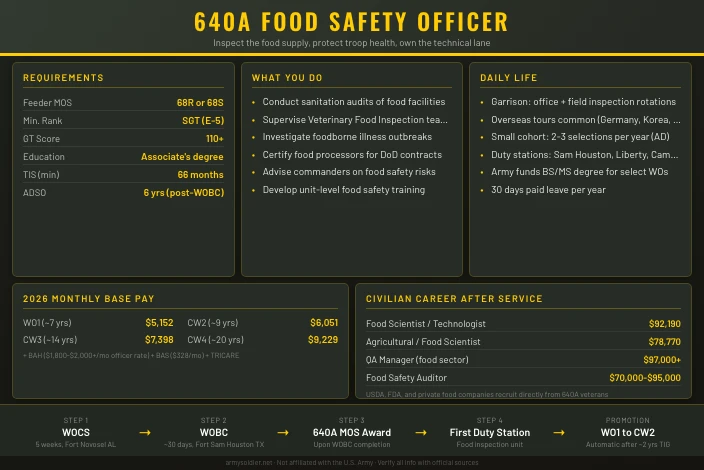
The 640A Veterinary Corps Food Safety Officer manages and directs military food safety and quality assurance programs. These warrant officers supervise food inspection personnel, conduct sanitation audits of commercial food processors, investigate foodborne disease incidents, and serve as technical consultants to veterinary officers and senior commanders on all matters involving subsistence safety and food defense. The 640A is the Army’s authoritative warrant officer for food safety across the joint force and host-nation supply chains.
Technical Domain and Scope
The 640A owns food safety at the technical execution level. Unlike a commissioned veterinary officer who carries broader medical and public health responsibilities, the 640A drills deep into food inspection, quality assurance systems, and regulatory compliance. Their scope spans:
- Conducting and supervising inspections of commercial food facilities, military food distribution points, and field feeding operations
- Determining sanitary compliance ratings for facilities that handle, process, or store subsistence
- Identifying microbiological, chemical, and physical contamination threats in the food supply
- Developing and delivering food safety training programs for unit-level soldiers
- Implementing Statistical Process Control, Systems Auditing, and Total Quality Management methods
- Investigating foodborne illness outbreaks with epidemiological significance
At mid-grade levels, the 640A supervises food safety operations in tactical Division and Corps environments. At senior levels, they act as technical consultant to the Senior Veterinary Officer and may serve as Chief of Branch for food inspection programs across an entire theater.
Related Designations
| MOS / AOC | Title | Relationship |
|---|---|---|
| 640A | Veterinary Corps Food Safety Officer | Primary WO designation |
| 68R | Veterinary Food Inspection Specialist | Primary enlisted feeder MOS |
| 68S | Veterinary Technician | Secondary enlisted feeder MOS |
| 64A | Field Veterinarian | Commissioned officer counterpart |
| 64B | Veterinary Corps Officer (Public Health) | Senior commissioned advisor |
Mission Contribution
The Army feeds hundreds of thousands of soldiers daily, drawing on a global supply chain that touches commercial processors, foreign vendors, military food service contractors, and tactical field kitchens. A single contaminated lot can sicken an entire unit and collapse combat effectiveness overnight. The 640A is the warrant officer who keeps that from happening.
They work with the Defense Commissary Agency (DeCA), Army and Air Force Exchange Service (AAFES), Defense Logistics Agency (DLA), Morale Welfare and Recreation (MWR), and foreign customs agencies. When commanders need certainty that the food supply is safe, they get it from the 640A.
Tools and Systems
640A warrant officers apply Food Safety Hazard Analysis and Critical Control Points (HACCP) methodology, veterinary inspection protocols, and DoD food safety regulations. They use laboratory testing tools to identify microbiological and chemical contamination, and they interface with federal regulatory frameworks from the USDA, FDA, and host-nation equivalents during overseas assignments.
Salary and Benefits
Base Pay
Most 640A candidates enter WOCS with six to twelve years of enlisted service, which means their pay at appointment reflects that time in service. The table below shows realistic pay points based on total years of service at each grade. All figures are 2026 DFAS rates.
| Rank | Typical Total YOS | Monthly Base Pay |
|---|---|---|
| WO1 | ~7 years | $5,152 |
| CW2 | ~9 years | $6,051 |
| CW3 | ~14 years | $7,398 |
| CW4 | ~20 years | $9,229 |
| CW5 | ~26 years | $11,495 |
Special Pays and Bonuses
The 640A does not receive flight pay or hazardous duty pay as a standard entitlement. The Army’s warrant officer retention bonus program – which allows eligible senior warrant officers to bid on retention bonuses in exchange for a six-year service obligation – may apply depending on the needs of the force in a given fiscal year. Check with HRC for current retention incentive availability.
Additional Benefits
Warrant officers receive BAH at officer rates, which are higher than enlisted rates for the same location. At Fort Sam Houston (a common duty station for the medical functional area), a W-2 without dependents draws roughly $1,827/month in BAH; a W-3 draws roughly $2,007/month. BAS for officers runs $328/month in addition to base pay.
Healthcare is TRICARE Prime with no enrollment fees, no deductibles, and no copays for active duty members. Family coverage is included at no additional cost for in-network care.
Retirement and TSP
Under the Blended Retirement System (BRS), warrant officers earn a pension worth 2% per year of service of their high-36 average base pay. At 20 years, that is 40%. Many 640A warrant officers serve 25 to 30 years, which substantially increases that multiplier.
The government matches TSP contributions up to 5% of base pay: automatic 1% contribution starts after 60 days, and matching on your contributions (3% full match, 2% at 50%) begins in the third year. Contribute 5% to get the full match.
Work-Life Balance
Garrison life for a 640A runs on a fairly predictable schedule. Food inspection missions follow regulatory timelines, and the warrant officer manages their team’s inspection schedule. Deployments and overseas assignments change that rhythm, but the 640A’s role is not a continuous high-tempo combat assignment. Leave accrual is 30 days per year (2.5 days per month), and federal holidays add another 11 days.
The warrant officer lifestyle offers more technical autonomy than an NCO position and less command-pressure rotation than a commissioned officer career. You are not cycling through staff assignments to compete for command. You own your technical lane.
Qualifications and Eligibility
Appointment Paths
The 640A is an enlisted-to-warrant path. There is no civilian direct-appointment option for this MOS. All candidates must already hold MOS 68R (Veterinary Food Inspection Specialist) or 68S (Veterinary Technician) as their primary specialty before applying.
The Army selects two to three 640A candidates per year from the active component, making this one of the smallest and most selective warrant officer cohorts in the Army.
Requirements Table
| Requirement | Active Duty | USAR |
|---|---|---|
| Feeder MOS | 68R or 68S (primary MOS) | 68R, 68S, or 64-series AOC |
| Minimum Rank | SGT (E-5) or above | SGT (E-5) or above |
| Time in Specialty | 60 months minimum | 60 months minimum |
| Total TIS Window | 66-144 months | Varies by unit |
| Education | Associate’s degree (accredited) + college-level writing course | Same |
| GT Score | 110+ (non-waiverable) | 110+ (non-waiverable) |
| Security Clearance | Eligible for Secret (interim acceptable at WOCS entry) | Same |
| Age Limit | Maximum 46 at time of appointment (waiverable) | Same |
| SIFT | Not required | Not required |
WOCS
All candidates attend Warrant Officer Candidate School (WOCS) at Fort Novosel, Alabama before their MOS-specific training. WOCS is a five-week resident course run by the U.S. Army Warrant Officer Career College (WOCC). The course covers leadership development, Army doctrine, officership, ethics, and land navigation. Candidates rotate through student leadership positions throughout the course.
WOCS is physically and mentally demanding. The graduation ceremony is held at the U.S. Army Aviation Museum, where candidates are appointed to WO1.
For Reserve component candidates, WOCS is available in a two-phase format: drill weekends over five months, plus a 15-day annual training culminating phase conducted at authorized Regional Training Institutes.
GT Score and the Packet
All warrant officer applicants need a GT score of 110 or higher. This score is non-waiverable. The GT composite on the ASVAB is derived from Verbal Expression (VE) and Arithmetic Reasoning (AR). If your current score falls short, you can retake the ASVAB to improve it before submitting your packet.
The warrant officer packet for 640A includes:
- DA Form 61 (application)
- Letters of recommendation (minimum two, from officers or senior NCOs)
- Academic transcripts confirming Associate’s degree
- Current NCOERs
- Physical and medical clearance
- Evidence of 60 months in 68R or 68S
Upon Appointment
Graduates of WOCS are appointed to WO1 and proceed immediately to the Veterinary Corps Food Safety Warrant Officer Basic Course at Fort Sam Houston. Upon completing WOBC, the 640A MOS is formally awarded and a six-year Active Duty Service Obligation (ADSO) begins.
See our ASVAB study guide for a study plan focused on the GT composite.
Work Environment
Daily Setting
In garrison, the 640A typically works out of a veterinary food inspection unit or a preventive medicine element. The daily environment includes office-based planning, coordination with supervisors and subordinate inspection teams, and regular field visits to food facilities. On any given week, a 640A might be auditing a commercial contractor’s processing plant in the morning and reviewing inspection reports back at the office in the afternoon.
The 640A does not work in isolation. They supervise enlisted food inspection soldiers (68Rs) and interface daily with commissioned veterinarians, preventive medicine officers, and unit commanders who rely on their technical assessment.
Position in the Unit
640A warrant officers sit outside the NCO support channel and outside the traditional command track. They are the technical advisor to the veterinary officer and commander, not a member of the standard platoon-to-battalion leadership chain.
At the company and battalion level, the relationship is direct: the warrant officer advises the commanding officer on food safety matters, supervises inspection teams, and ensures compliance. Senior NCOs handle day-to-day soldier management; the warrant officer handles technical decisions that NCOs are not qualified to make. That boundary is clear and generally well-respected in the medical functional area.
Technical vs. Staff Roles
A WO1 or CW2 spends the majority of their time doing hands-on inspection work and supervising soldiers in the field. As they advance to CW3 and CW4, they take on more staff advisory roles – writing policy guidance, advising at brigade or division level, and managing food safety programs across larger geographic footprints.
A CW5 may serve on corps-level or DA-level staff as the senior technical authority for food safety in a theater of operations.
Job Satisfaction and Retention
The 640A community is small, and warrant officers in it tend to stay. Those who thrive in the role point to three consistent factors: being the technical expert that others depend on, the opportunity to mentor junior 68R soldiers, and the variety of assignments – including overseas tours that cover multiple countries. The role is relationship-dense, with significant interagency work that keeps the job intellectually varied.
The primary tension is the small cohort size. Promotion opportunities and assignment choices are narrower than in larger warrant officer communities. If you want a large peer group or frequent lateral moves within the Army, this is not the right MOS.
Training and Skill Development
Warrant Officer Basic Course (WOBC)
After WOCS graduation, new 640A warrant officers attend the Veterinary Corps Food Safety Warrant Officer Basic Course at Fort Sam Houston, Texas, conducted at the Medical Center of Excellence (MEDCoE). This is an approximately 30-day resident course focused entirely on MOS qualification.
| Phase | Location | Length | Focus |
|---|---|---|---|
| WOCS | Fort Novosel, AL | 5 weeks | Leadership, officership, Army doctrine |
| WOBC | Fort Sam Houston, TX | ~30 days | Food safety technical qualification, inspection methods, HACCP, regulatory frameworks |
WOBC covers military food inspection law and regulations, HACCP principles and systems auditing, food microbiology and chemistry fundamentals, sanitation rating procedures, and the operational food safety environment. Completing WOBC is required for the 640A MOS award and for promotion eligibility to CW2.
Warrant Officer Advanced Course (WOAC)
WOAC is attended as a CW2 preparing for CW3-level positions. It combines a non-resident distance learning phase with a resident phase at Fort Sam Houston. The course builds on WOBC with advanced technical content and develops the warrant officer’s ability to advise at higher echelon staffs.
Warrant Officer Intermediate Level Education (WOILE)
WOILE is a MOS-immaterial course attended at the CW3 or CW4 level. It runs as a 48-hour distance learning phase followed by a five-week resident course at the Warrant Officer Career College, Fort Novosel. The focus shifts away from technical specialty content toward institutional leadership and broadening the warrant officer’s perspective beyond their MOS.
Warrant Officer Senior Service Education (WOSSE)
WOSSE is the senior-level PME course for CW4 and CW5 warrant officers. It includes a 48-hour distance learning phase followed by a four-week resident course at Fort Novosel. WOSSE develops strategic perspective and prepares senior warrant officers for advisory roles at corps and above.
Civilian Education Opportunities
The Army selects two to three 640A warrant officers per year to attend a major university at Army expense for a bachelor’s or master’s degree in food safety, food science, or a related field. This is a significant investment in human capital that is rare in any military occupational specialty. Warrant officers chosen for this program complete their degree while remaining on active duty and return to the force with credentials that directly strengthen their technical authority.
Beyond that program, the Army’s Tuition Assistance program funds up to $4,500 per year ($250 per semester hour) for courses taken on personal time. Army COOL identifies civilian certifications funded through this program, including credentials relevant to food safety.
A qualifying GT score comes first — our ASVAB study guide covers the subtests that drive GT.
Career Progression and Advancement
Career Timeline
| Rank | Typical Total YOS | Key Developmental Focus |
|---|---|---|
| WO1 | 7-9 years total | WOBC completion, initial food inspection assignments, technical proficiency |
| CW2 | 9-13 years total | WOAC, operational-level inspection management, section leadership |
| CW3 | 13-20 years total | WOILE, staff advisory roles, division/corps food safety programs |
| CW4 | 18-26 years total | WOSSE, senior staff positions, theater-level food safety oversight |
| CW5 | 24-30+ years total | DA-level technical advisor, program-level policy and doctrine |
Promotion System
Promotion from WO1 to CW2 is automatic following WOBC completion and two years in grade – no selection board required. Promotions to CW3, CW4, and CW5 are competitive board selections.
Given the small size of the 640A community, board competition is both intense and personal. Every warrant officer in the cohort is known by reputation within the Veterinary Corps. NCOERs and OERs that speak specifically to food safety technical judgment, mentoring of enlisted soldiers, and performance in operational or deployed environments carry the most weight.
Promotion to CW5 is the most selective grade in the warrant officer corps. Approximately 5% of active duty warrant officers reach CW5 across all MOS. In a cohort as small as 640A, CW5 is a position held by one or two individuals at any given time.
CW5 as Senior Technical Advisor
A CW5 Food Safety Officer serves at the corps, Army component command, or DA level as the technical conscience of the food safety program. They do not command units, but their technical recommendations carry policy-level weight. They advise general officers on food safety risks, shape doctrine, and represent Army food safety equities in joint and interagency settings.
Building a Competitive Record
- Get deployed or overseas assignments that demonstrate performance outside a garrison environment
- Volunteer for joint billets or interagency assignments (USDA, FDA, DLA)
- Complete your degree or advanced degree in food science
- Mentor junior 68R soldiers – documented NCO mentoring is noticed at promotion boards
- Pursue relevant civilian certifications through Army COOL before the board cycle
Physical Demands and Medical Evaluations
Army Fitness Test
All warrant officers take the Army Fitness Test (AFT), which replaced the ACFT on June 1, 2025. The AFT has five events scored 0-100 points each, with a maximum of 500 points. The 640A is not a combat MOS, so the general standard (sex- and age-normed) applies.
| Event | Abbreviation | What It Measures |
|---|---|---|
| 3-Rep Max Deadlift | MDL | Lower-body and core strength |
| Hand Release Push-Up | HRP | Upper-body pushing endurance |
| Sprint-Drag-Carry | SDC | Anaerobic power and functional movement |
| Plank | PLK | Core stability |
| 2-Mile Run | 2MR | Aerobic endurance |
Minimum passing standard: 60 points per event, 300 points total. All five events must be passed in a single session. Scores are normed for sex and age group.
MOS-Specific Physical Demands
The 640A does not require a flight physical, special vision standards, or hearing standards beyond Army baseline. The role involves standing inspections in food processing and storage facilities, occasional lifting and movement of food containers, and work in temperature-controlled environments (refrigerated warehouses, freezers, kitchen facilities). None of these are medically disqualifying beyond normal Army standards.
Deployment and Duty Stations
Deployment Tempo
The 640A deploys at a moderate tempo relative to combat arms. Food safety requirements exist in every operational environment, so 640A warrant officers support contingency operations, theater-level logistics missions, and stability operations. Deployments are driven by Army-wide operational requirements rather than a fixed rotation cycle.
During deployments, 640A warrant officers oversee the food safety mission for the supported command – inspecting contracted food vendors, advising on subsistence procurement, and investigating any foodborne illness events.
Primary Duty Stations
The 640A community is geographically distributed because food safety missions exist wherever soldiers are stationed. Common assignments include installations with large veterinary food inspection units and medical commands:
- Fort Sam Houston, TX (MEDCoE, primary training base, medical functional area headquarters)
- Fort Liberty, NC (large troop concentrations requiring food safety coverage)
- Fort Campbell, KY
- Fort Wainwright, AK
- European Command (Germany, Belgium, Italy) – multinational food supply chains create consistent demand for experienced warrant officers
- Indo-Pacific Command installations (Japan, South Korea, Hawaii)
Overseas assignments are a genuine feature of this MOS, not a rare exception. The interagency work with foreign customs agencies and host-nation vendors that makes overseas tours distinctive is also what makes them professionally valuable.
Assignment Process
HRC manages 640A assignments. Given the small cohort, warrant officers develop professional relationships with their proponent and may have more influence over assignment preferences than warrant officers in larger MOS communities. Still, Army needs drive all assignments.
Risk, Safety, and Legal Considerations
Job Hazards
The 640A works in food processing and storage environments that carry occupational hazards: industrial refrigeration facilities, commercial kitchens with hot surfaces and machinery, and food warehouses with forklift traffic. Deployed environments add the standard risks of operating in a contingency theater.
The most consequential professional risk is technical error. A faulty sanitation compliance rating that allows a contaminated food lot to reach soldiers can cause a mass foodborne illness event. The 640A carries significant professional and legal accountability for these assessments.
Safety Protocols
640A warrant officers apply Composite Risk Management (CRM) to inspection operations and maintain strict documentation of all compliance assessments. Food safety determinations follow established regulatory standards (DoD, USDA, FDA, and host-nation frameworks where applicable), which provide the legal basis for rejection decisions.
Authority and Responsibility
The 640A holds technical authority, not command authority. They direct food inspection operations and issue compliance ratings, which commanders act on. In practice, the weight of a 640A’s technical determination – condemning a food lot or closing a contractor facility – is final unless overturned by a veterinary officer.
Warrant officers are subject to the Uniform Code of Military Justice (UCMJ) and the same standards of conduct as all Army officers. Falsification of inspection records or negligence in food safety assessments can result in criminal liability, not just administrative consequences.
Impact on Family and Personal Life
Family Considerations
The 640A’s assignment pattern is more predictable than combat arms. Overseas tours are common, but they are planned assignments rather than rapid emergency deployments. Family support programs are available at every installation, including Army Community Service (ACS), Family Readiness Groups (FRGs), and spouse employment assistance programs.
PCS moves occur roughly every two to three years, consistent with the broader warrant officer force. That frequency is roughly comparable to commissioned officers in small specialties and somewhat more frequent than senior NCO careers in larger MOS. Families who have navigated one or two PCS cycles typically develop systems that make subsequent moves manageable.
Dual-Military and Planning
When both spouses serve, HRC has programs to request co-location. No program guarantees it, but the 640A’s presence at installations with large medical footprints gives some flexibility. Overseas tours in EUCOM can be accompanied tours, which allows families to live in Germany or Italy during the assignment.
The warrant officer lifecycle – less staff grind, no command selection pressure, more technical stability – tends to produce a more predictable daily schedule in garrison than a commissioned officer career in the same functional area.
Reserve and National Guard
Component Availability
The 640A MOS is available in both the Army Reserve and Army National Guard. Reserve 640A units support food safety missions for Reserve and Guard formations, and in mobilized environments, they deploy alongside active component units.
USAR candidates can hold 68R, 68S, or a 64-series AOC as their qualifying background. The Reserve path follows the same WOCS requirement but may use the two-phase drill weekend/annual training format at a Regional Training Institute.
Drill Commitment and Part-Time Pay
The standard Reserve and Guard commitment is one weekend per month (four drill periods) plus two weeks of Annual Training. The 640A may require additional training days to maintain inspection currency and keep skills validated.
A CW2 Reserve warrant officer with less than two years at grade earns approximately $616 per drill weekend (four drill periods). A CW3 at a similar TOS point earns roughly $720 per weekend. These are pre-tax figures based on the 2026 DFAS pay tables.
Component Comparison
| Feature | Active Duty | Army Reserve | Army National Guard |
|---|---|---|---|
| Commitment | Full-time | 1 weekend/mo + 2 weeks AT | 1 weekend/mo + 2 weeks AT |
| CW2 Monthly Pay | $6,051+ | ~$616/weekend | ~$616/weekend |
| Healthcare | TRICARE Prime ($0 premium) | TRICARE Reserve Select ($57.88/mo) | TRICARE Reserve Select ($57.88/mo) |
| Education (TA) | $4,500/year | $4,500/year (federal TA) | $4,500/year + state waivers (varies) |
| Deployment Tempo | Moderate | Mobilization-driven | State emergencies + federal mobilization |
| Retirement | 20-yr pension (BRS) | Points-based (collect at 60) | Points-based (collect at 60) |
| Career to CW5 | Yes | Yes (slower timeline) | Yes (slower timeline) |
National Guard members may receive additional state-level benefits: tuition waivers, state bonuses, and state income tax exemptions on military pay, depending on the state. Guard warrant officers can also be activated for state emergencies under Title 32 authority, which provides another avenue for active service and retirement points.
Civilian Career Integration
The 640A MOS pairs naturally with civilian careers in food safety inspection, food science, and regulatory compliance. Reserve service strengthens civilian credentials by providing active-duty equivalent experience that most civilian employers cannot offer. USERRA protects Reserve and Guard members’ civilian jobs for up to five cumulative years of military service.
Post-Service Opportunities
Civilian Transition
Army food safety training is credentialed, regulated, and directly applicable to federal and private sector roles. Former 640A warrant officers are well positioned for federal civil service careers with the USDA Food Safety and Inspection Service (FSIS), the FDA, and the Defense Logistics Agency. Private sector food manufacturers, third-party food safety auditing firms, and food retail corporations also recruit heavily from individuals with regulatory inspection backgrounds.
The Army funds SFL-TAP (Soldier for Life – Transition Assistance Program) starting 180 days before separation to help warrant officers translate military experience into civilian terms, build resumes, and connect with employers.
Civilian Career Outlook
| Civilian Job Title | Median Annual Salary | Job Outlook (2024-2034) |
|---|---|---|
| Food Scientist / Technologist | $92,190 | 6% growth, ~3,100 openings/yr |
| Agricultural / Food Scientist | $78,770 | 6% growth |
| Food Safety Inspector (USDA/FDA) | $65,000-$90,000 | Stable federal demand |
| Quality Assurance Manager | $97,000-$115,000 | Strong private sector demand |
| Food Safety Auditor (Third Party) | $70,000-$95,000 | Growing with regulatory complexity |
Salary data for food scientists from BLS (May 2024). Quality assurance and auditor figures are representative market ranges.
Certifications and Credentials
Army COOL (Credentialing Opportunities On-Line) lists civilian credentials available to 640A warrant officers, including certifications in food safety management and HACCP systems. Relevant civilian certifications include:
- Certified Professional-Food Safety (CP-FS) – National Environmental Health Association
- HACCP Certification – various approved bodies
- Registered Environmental Health Specialist/Registered Sanitarian (REHS/RS) – state-level, requirements vary
The Post-9/11 GI Bill covers 36 months of tuition for public or private schools, plus a monthly housing allowance based on the school’s ZIP code. Private school cap is $29,920.95 per academic year (AY 2025-2026). Warrant officers who complete the Army-sponsored degree program may have their credential needs largely met before separation.
Is This a Good Job for You? The Right (and Wrong) Fit
Who Thrives Here
This MOS rewards 68R and 68S Sergeants who already take the technical side of food inspection seriously – not just completing tasks, but understanding why standards exist and how they protect soldiers. The ideal candidate:
- Has genuine interest in food science, microbiology, and public health systems
- Wants to be the technical expert in the room, not the manager tracking administrative tasks
- Is comfortable with regulatory work: documentation, compliance rating decisions, and interagency coordination
- Wants overseas assignment opportunities built into their career
- Can operate with a small peer group and does not need a large cohort of peers at the same installation
The Army’s investment in civilian education for select 640A warrant officers is a strong signal about the kind of person the Veterinary Corps wants: someone who will grow into a genuine subject matter expert that no one can outflank on technical questions.
Potential Challenges
The small cohort is both the appeal and the challenge. Promotion competition is intense in a community where everyone knows everyone. Assignment choices are limited. If you want the broader social world of a large warrant officer MOS – dozens of peers at every installation – the 640A community will feel narrow.
This is also not a field where technical errors have low stakes. A contaminated food supply can cause mass casualty events as surely as a kinetic threat. Warrant officers who need certainty of outcome before every decision will find the ambiguity of field conditions difficult.
How It Compares to Other Paths
An experienced 68R who stays enlisted as a Staff Sergeant or Sergeant First Class will manage food inspection teams in a supervisory role but will not carry independent technical authority. The commissioned veterinary officer (64A/64B) has broader medical authority but also broader administrative and clinical responsibilities that pull attention away from food safety specifically. The 640A owns the technical lane more completely than either alternative.
If you are a 68R Sergeant with six to ten years in the field, a GT score at or above 110, and an Associate’s degree, this is worth a serious look. The selection rate is low, but the Army’s investment in warrant officers who make the cut is substantial.
More Information
Contact your local Army recruiter or the Army Warrant Officer Recruiting office to get current application deadlines and verify that this fiscal year’s 640A selection board is open. Qualification requirements and annual selection numbers change by MILPER message, so confirm directly with the Veterinary Corps proponent at the Army Medical Center of Excellence.
If your GT score is below 110, retaking the ASVAB is the first step. Review Army COOL for credential funding opportunities available while you are still on active duty.
- Prepare for the ASVAB with our study guide to meet the GT 110 requirement
This site is not affiliated with the U.S. Army or any government agency. Verify all information with official Army sources before making enlistment or career decisions.
Explore more Army warrant officer careers including 670A Health Services Maintenance Technician and 740A CBRN Technician.