670A Health Services Maintenance Technician
The ventilator malfunctions at 0300 in a forward surgical team. The defibrillator in the battalion aid station hasn’t been calibrated in nine months. The hospital commander has zero idea what any of her medical equipment is actually worth or whether it will work when it matters. The 670A Health Services Maintenance Technician is the warrant officer who fixes all of that – not just the broken machines, but the entire system that keeps Army medical equipment mission-ready. This is the Army’s only single-track maintenance warrant officer in the Medical Department, and it is one of the most technically demanding specialties in the warrant officer corps. If you are an experienced 68A Biomedical Equipment Specialist who wants to run the program instead of just fixing the equipment, this is where that path leads.
Warrant officer candidates need a GT score of at least 110 — our ASVAB study guide covers what drives that number.
Job Role and Responsibilities
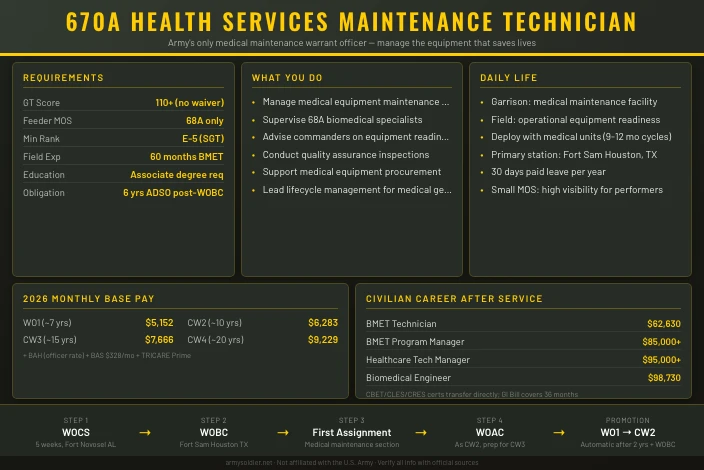
The 670A Health Services Maintenance Technician plans, manages, and executes medical equipment maintenance programs across Army medical institutions and operational units. These warrant officers supervise biomedical equipment specialists, medical supply personnel, and contractors while providing authoritative technical guidance to commanders on equipment lifecycle management, readiness, and procurement. The 670A is the Army Medical Department’s highest-ranking technical expert on medical equipment maintenance – the one person in the unit who can look a hospital commander in the eye and say exactly what is broken, what it will cost, and how long it will take to fix.
Technical Domain and Scope
The 670A owns medical equipment maintenance at the management level. An enlisted 68A Biomedical Equipment Specialist turns wrenches and runs diagnostics. A Medical Service Corps commissioned officer commands the unit. The 670A sits between them, translating technical detail into command decisions and translating command priorities into maintenance schedules that actually work.
Their scope covers the full lifecycle of medical equipment:
- Managing maintenance schedules, workload tracking, and maintenance records across unit fleets
- Conducting and supervising quality assurance inspections and preventive maintenance programs
- Providing technical consultation to hospital commanders and staff on equipment capabilities and limitations
- Supporting medical equipment procurement by advising on performance specifications and vendor evaluations
- Drafting medical facility layouts and installation plans that account for equipment power, space, and support requirements
- Supervising budget development and safety reporting tied to medical equipment operations
- Training operators, NCOs, and junior warrant officers on equipment care and maintenance standards
At CW3 and above, the 670A fills senior staff advisory positions at Medical Center, Medical Brigade, and Army Medical Command level, where they set policy for maintenance programs that span hundreds of pieces of equipment across multiple installations.
Related Designations
| MOS / AOC | Title | Relationship |
|---|---|---|
| 670A | Health Services Maintenance Technician | Primary WO designation |
| 68A | Biomedical Equipment Specialist | Required enlisted feeder MOS |
| 67J | Aeromedical Evacuation Officer | Commissioned officer in the AMEDD aviation space |
| 67A | Medical Corps General Officer | Senior commissioned officer counterpart |
Mission Contribution
Medical equipment is not a logistics problem. It is a readiness problem. A ventilator that fails during surgery or a defibrillator that has not been calibrated in a year is not a maintenance backlog item – it is a dead soldier. The 670A ensures that the equipment Army medical units depend on is functional, calibrated, documented, and ready at the point of need.
That responsibility reaches into every echelon. At the unit level, the 670A runs the daily maintenance program. At division and corps level, they advise commanders on equipment readiness rates across the theater. During contingency operations and combat deployments, they manage maintenance support for the medical units attached to the force.
Tools and Systems
670A warrant officers work with a wide range of medical equipment categories: patient monitoring systems, ventilators, infusion pumps, defibrillators, anesthesia machines, surgical imaging systems, X-ray units, and dental equipment. They apply DoD equipment management policies, Army maintenance regulations, and Joint Commission standards. Diagnostic software platforms, manufacturer technical manuals, and Army medical logistics systems are all part of the daily toolkit.
Salary and Benefits
Base Pay
Most 670A candidates come to WOCS with five to twelve years of enlisted service as a 68A, which means their pay at appointment reflects that time in service. The table below shows realistic pay points at each grade. All figures are 2026 DFAS rates.
| Rank | Typical Total YOS | Monthly Base Pay |
|---|---|---|
| WO1 | ~7 years | $5,152 |
| CW2 | ~10 years | $6,283 |
| CW3 | ~15 years | $7,666 |
| CW4 | ~20 years | $9,229 |
| CW5 | ~26 years | $11,495 |
Special Pays and Bonuses
The 670A does not carry flight pay or standard hazardous duty pay. The Army’s warrant officer retention bonus program – which lets eligible senior warrant officers bid on financial incentives tied to additional service obligations – may apply depending on Army needs in a given fiscal year. Check HRC for current incentive availability by MOS.
Warrant officer candidates may also be eligible for an accession incentive depending on Army recruiting priorities in the fiscal year of application. The FY2026 MILPER message for 670A (MILPER 25-449) governs current bonus and incentive terms.
Additional Benefits
Warrant officers receive BAH at officer rates, which run higher than the enlisted rates for the same location. At Fort Sam Houston (a common 670A duty station), a W-2 without dependents draws roughly $1,827/month in BAH; a W-3 draws roughly $2,007/month. BAS for officers is $328/month on top of base pay.
Healthcare is TRICARE Prime with no enrollment fees, no deductibles, and no copays for active duty members and covered family members for in-network care.
Retirement and TSP
Under the Blended Retirement System (BRS), warrant officers earn a pension worth 2% per year of service of their high-36 average base pay. At 20 years that equals 40% of high-36 pay. Most 670A warrant officers serve well past 20 years, and many reach 25 to 28 years before retiring.
The government automatically contributes 1% of base pay to TSP after 60 days of service. Matching begins in the third year: 100% match on the first 3% you contribute, 50% match on the next 2%. Contribute 5% to capture the full government match of 4%, for a total government contribution of 5%.
Work-Life Balance
In garrison the 670A works structured hours in a medical maintenance facility or hospital support environment. The job has a technical rhythm – equipment deadlines, calibration cycles, and inspection schedules – that creates predictability compared to many combat arms warrant officer roles.
Field exercises and deployments shift that pattern significantly. During combat or contingency deployments the tempo extends and the 670A becomes the sole technical authority on medical equipment readiness for the force. That pressure is real. But the day-to-day garrison environment tends to be more stable than infantry or aviation warrant officer positions.
Qualifications and Eligibility
Appointment Path
The 670A is an enlisted-to-warrant MOS. There is no street-to-seat program and no civilian direct appointment. Candidates must have an active military background in the biomedical equipment specialty.
To qualify for FY2026 selection boards, applicants must:
- Hold PMOS 68A (Biomedical Equipment Specialist) or a recognized service equivalent (Air Force, Navy, or Marine Corps biomedical equipment specialty)
- Have a minimum of 60 months of hands-on experience in biomedical equipment maintenance, excluding AIT time
- Have a minimum of 24 months in a supervisory capacity within the biomedical equipment field (recommended; considered in packet evaluation)
- Hold the rank of Sergeant (E-5) or higher
- Have between 48 and 144 months of total military service
The FY2026 MILPER 25-449 governs exact application windows and board dates. Contact the 670A Medical Service Corps Warrant Officer Consultant at Army Recruiting Command for current board status.
Candidates with active CBET, CLES, or CRES industry certifications from the Association for the Advancement of Medical Instrumentation (AAMI) receive preferential consideration during packet evaluation.
Requirements Table
| Requirement | Standard |
|---|---|
| Appointment path | Enlisted-to-warrant only |
| Feeder MOS | 68A (or service equivalent) |
| Minimum rank | E-5 (Sergeant) |
| TIS minimum | 48 months |
| TIS maximum | 144 months |
| Field experience | 60 months in biomedical equipment maintenance (excl. AIT) |
| Supervisory experience | 24 months recommended |
| Age limit | Up to 46 (waiverable) |
| Education | Associate degree in engineering, business technology, or management; 6 credit hours each in college-level writing and computer science/automation |
| GT score | 110 minimum (non-waiverable) |
| Security clearance | Eligible for Secret |
| Preferred certifications | CBET, CLES, or CRES |
Warrant Officer Candidate School (WOCS)
All selected candidates attend WOCS at Fort Novosel, Alabama (formerly Fort Rucker, renamed April 10, 2023). The course runs 5 weeks for active component candidates. Reserve and Guard candidates may attend either the 5-week resident course or a two-phase option delivered through a Regional Training Institute.
WOCS focuses on officership, warrant officer roles and responsibilities, Army values, leadership development, problem-solving, land navigation, and tactical exercises. It does not teach your MOS – that comes in WOBC. WOCS prepares you to carry a federal warrant of appointment as a WO1.
The application process runs through a warrant officer packet submitted to your chain of command and forwarded to Army Recruiting Command. A complete packet includes:
- DA Form 61 (Application for Appointment)
- Officer Record Brief (ORB)
- Enlisted Record Brief (ERB)
- Physical examination results (Army standard physical)
- Letters of recommendation (minimum two, from commissioned or warrant officers)
- College transcripts
- NCO evaluation reports (NCOERs)
- GT score documentation
- AAMI certification copies (if held)
Packets compete against other 68A candidates during the MOS-specific selection board. Commanders who can document strong technical performance, supervisory roles, and professional development history – especially AAMI certifications – build the most competitive packets.
Test Requirements
The GT score is the only ASVAB-derived requirement for 670A. A minimum score of 110 is required and no waiver is authorized. The GT composite draws from the Verbal Expression (VE) and Arithmetic Reasoning (AR) subtests. Candidates who fall short of 110 should focus ASVAB study on both subtests before submitting a packet.
The SIFT test is not required for 670A – that applies to aviation warrant officer MOS only (153A and related specialties).
Upon Appointment
Selected candidates are appointed as Warrant Officer 1 (WO1) upon graduation from WOCS. Active duty appointments carry a 6-year Active Duty Service Obligation (ADSO) that begins upon completion of WOBC – not WOCS. Reserve appointments carry a separate obligation structure detailed in the MILPER message for the relevant fiscal year.
See our ASVAB study guide for a study plan focused on the GT composite.
Work Environment
Daily Setting and Schedule
In garrison the 670A typically works from a medical maintenance shop or hospital support facility. The workday runs around maintenance schedules, equipment inspections, technical consultations with hospital staff, and administrative requirements for the maintenance program. A junior WO1 or CW2 spends more time in the shop doing hands-on technical work alongside 68A soldiers. A mid-grade CW3 shifts toward program management – reviewing maintenance records, advising the commander, coordinating with contractors and logistics staff.
Field training environments push the 670A into supporting roles with combat medical units. Deployments shift the balance further toward operational equipment readiness: getting broken gear back into service fast, managing limited spare parts inventories, and advising deployed commanders on what their medical units can and cannot do with the equipment on hand.
Position in the Unit
The 670A occupies the same structural position as other warrant officers: they are not in the NCO support channel and they do not hold traditional command authority. They sit outside the standard chain but carry significant advisory authority over their technical domain. A battalion or brigade commander depends on the 670A for accurate information on medical equipment status – the warrant officer’s assessment shapes decisions that affect the entire force.
The day-to-day relationship with senior NCOs in the 68A field is collaborative. The 670A relies on the Senior NCO (typically a 68A Staff Sergeant or Sergeant First Class) to execute the maintenance schedule. The NCO runs the shop floor. The warrant officer runs the program.
Technical vs. Staff Split
At WO1 and early CW2, you spend the majority of your time doing technical work – diagnostics, calibration, inspection, repair consultation. By CW3, staff functions start to dominate: maintenance policy development, budget input, commander consultation, and coordination with medical logistics. At CW4 and CW5, technical work is advisory. The senior 670A is a program-level expert, not a bench technician.
That shift is a strength. If you want to spend a 25-year career buried in circuit boards, a senior NCO track in 68A may serve you better. The 670A path is for 68A Soldiers who want to own the whole program.
Job Satisfaction and Retention
The 670A community is small. The Army maintains a limited number of 670A warrant officer positions, which means the peer group is tight and assignment options are more constrained than larger warrant officer MOS. That cuts both ways: a small community creates closer professional relationships and clearer visibility for performers, but it also means fewer opportunities for broadening assignments.
Warrant officers who stay in 670A consistently report high satisfaction with the technical depth of the role and the direct impact on medical readiness. The gap between what a senior 670A CW4 earns in the Army and what a private-sector BMET program manager earns can create tension at mid-career – that is the most common reason warrant officers in this field leave before 20 years.
Training and Skill Development
Warrant Officer Basic Course (WOBC)
After WOCS graduation, newly appointed WO1s attend the Health Services Warrant Officer Basic Course at Joint Base San Antonio – Fort Sam Houston, Texas. WOBC delivers MOS-specific technical training and prepares the WO1 for their first assignment. The table below summarizes the training pipeline.
| Phase | Location | Focus |
|---|---|---|
| WOCS | Fort Novosel, AL | Leadership, officership, warrant officer roles |
| WOBC | Fort Sam Houston, TX | Medical equipment management, maintenance program operations |
| First assignment | Varies | Application of WOBC skills under supervision |
WOBC covers maintenance management systems, Army medical logistics regulations, equipment lifecycle documentation, program administration, and unit-level technical advisory skills. It deliberately goes beyond bench repair to prepare the WO1 to manage a program, not just execute tasks.
WOBC is a significant step up from 68A AIT in both scope and expected output. AIT teaches you how to fix equipment. WOBC teaches you how to run the program that keeps all of the equipment fixed.
Warrant Officer Advanced Course (WOAC)
WOAC is attended as a CW2, typically in preparation for CW3-level positions. It delivers advanced MOS-specific content and additional common leader development. The course blends a non-resident distance learning phase with a resident phase at the branch school. WOAC prepares the warrant officer to take on program management responsibilities at a higher level and to advise commanders at brigade and division echelon.
Warrant Officer Intermediate Level Education (WOILE)
WOILE is a 5-week resident course conducted at the U.S. Army Warrant Officer Career College (WOCC) at Fort Novosel, AL, preceded by a 48-hour distance learning phase. It is MOS-immaterial – all warrant officers in the same cohort attend together regardless of specialty. WOILE targets CW3 and CW4 warrant officers and builds the skills needed to function at higher echelons: inter-organizational leadership, broad institutional perspective, and influence across organizational boundaries.
Warrant Officer Senior Service Education (WOSSE)
WOSSE is the senior-level education course for CW4 and CW5 warrant officers. Like WOILE, it runs at Fort Novosel following a 48-hour distance learning phase, with a 4-week resident phase. WOSSE develops the strategic perspective and advisory skills that CW5 warrant officers need to operate effectively at division, corps, and Army-level staff.
Additional Schools and Civilian Credentials
The Army supports 670A warrant officers in pursuing industry certifications through the Army COOL (Credentialing Opportunities On-Line) program. Certifications worth pursuing include:
- CBET (Certified Biomedical Equipment Technician) – AAMI
- CLES (Certified Laboratory Equipment Specialist) – AAMI
- CRES (Certified Radiology Equipment Specialist) – AAMI
- HTM (Healthcare Technology Management) credentials
Tuition Assistance covers up to $4,500 per year ($250 per semester hour) for college coursework taken while serving. The Post-9/11 GI Bill provides up to $29,920.95 per year for private school tuition (AY 2025-2026 cap) or full in-state tuition at public institutions. Many 670A warrant officers complete a bachelor’s degree in biomedical engineering technology, healthcare administration, or a related field during their enlisted or early warrant officer years.
A qualifying GT score comes first — our ASVAB study guide covers the subtests that drive GT.
Career Progression and Advancement
Career Timeline
| Rank | TIG Min | Typical Total YOS | Key Assignment |
|---|---|---|---|
| WO1 | – | 5-12 years (entry) | WOBC completion; medical maintenance section |
| CW2 | 2 years | 7-14 years | Section chief or technical lead; WOAC attendance |
| CW3 | 2 years | 12-20 years | Medical maintenance officer at Medical Center or Brigade; WOILE |
| CW4 | 2 years | 17-26 years | Senior technical advisor at Medical Brigade or MEDCOM; WOSSE |
| CW5 | 2 years | 22-30+ years | DA-level advisor; Army Medical Command or joint staff positions |
The WO1-to-CW2 promotion is automatic after completing WOBC and meeting the 2-year time-in-grade requirement. No selection board. CW3 and above are board-selected, and competition increases at each level.
Promotion System
Warrant officer promotions use the Officer Evaluation Report (OER) system – the same DA Form 67-10 series that commissioned officers use, with warrant-officer-specific guidance in DA Pam 623-3 Appendix B. Your rated officer and senior rater assess performance and potential. Those assessments drive board outcomes.
Promotion to CW3 from the primary zone typically comes around five to six years as a CW2. CW4 selection is competitive and requires a strong record of technical performance and progressive responsibility. CW5 is limited to roughly 5% of the active warrant officer population – it requires demonstrating that you have operated effectively at the highest advisory levels and that the Army needs your expertise at division or corps echelon.
Building a Competitive Record
The 670A field is small and performance visibility is high. Senior raters know the warrant officers in this MOS well. To build a competitive record:
- Pursue AAMI certifications early and maintain them
- Seek positions that put you in front of commanders as an advisor, not just in the shop
- Complete professional military education ahead of the primary zone (not behind it)
- Request broadening assignments at the CW3 level – joint, interagency, or OCONUS positions where you advise across organizational lines
- Complete a bachelor’s degree before CW3 if at all possible
The CW5 Role
A CW5 670A operates at Army Medical Command or joint force headquarters level. They do not manage a unit maintenance program – they advise on medical equipment policy, acquisition strategy, and readiness frameworks for the entire force. They are the Army’s authoritative voice on medical equipment maintenance at the strategic level, and they brief general officers. It is a rare rank in a small MOS, which makes it genuinely competitive.
Physical Demands and Medical Evaluations
Army Fitness Test
All soldiers, including warrant officers, take the Army Fitness Test (AFT). The AFT replaced the ACFT on June 1, 2025 and consists of five events scored 0-100 each, with a maximum total of 500 points.
| Event | Abbreviation |
|---|---|
| 3 Repetition Maximum Deadlift | MDL |
| Hand Release Push-Up - Arm Extension | HRP |
| Sprint-Drag-Carry | SDC |
| Plank | PLK |
| Two-Mile Run | 2MR |
The general passing standard is 300 total points with a minimum of 60 points per event (sex- and age-normed). The 670A is not a designated combat MOS – the general 300-point standard applies, not the 350-point combat specialty standard. Candidates must pass the AFT as part of the warrant officer selection packet.
MOS-Specific Physical Requirements
The 670A does not require a flight physical, special vision standards, or a color vision waiver program. Standard Army medical fitness requirements apply. The physical demands of the job include lifting and moving medical equipment – some pieces are heavy and awkward – but there are no formal lifting standards beyond Army height and weight requirements and AFT performance.
Deployment and Duty Stations
Deployment Patterns
The 670A deploys in support of medical units – forward surgical teams, combat support hospitals, medical logistics companies, and similar organizations. Deployment tempo is tied to Army Medical Department demand, not combat arms rotations. The 670A is not typically assigned to infantry brigade combat teams, but they do deploy with the medical units that support those formations.
Typical deployments run 9 to 12 months. OCONUS rotational assignments, training support missions, and support to joint or coalition medical operations are also part of the picture. The 670A deploys less frequently than aviation or special operations warrants, but the medical support mission means deployments do happen and can be rapid.
Duty Stations
Primary installations for 670A warrant officers include:
- Fort Sam Houston, TX – home of the Army Medical Center of Excellence; largest concentration of medical warrant officer positions
- Fort Campbell, KY – 101st Airborne Division medical units
- Fort Bragg (Fort Liberty), NC – XVIII Airborne Corps and ARSOF medical support
- Fort Hood (Fort Cavazos), TX – III Corps medical units
- Landstuhl Regional Medical Center, Germany (OCONUS) – European theater medical support
- Tripler Army Medical Center, HI – Pacific theater
Warrant officer assignments are managed by HRC. The 670A community is small enough that most warrant officers know their likely next assignment well in advance. Preference input matters, but position vacancies and Army needs drive final decisions.
Risk, Safety, and Legal Considerations
Job Hazards
The 670A works in medical environments and maintenance facilities. Hazards include exposure to biological material during equipment servicing (ventilators, suction systems, surgical equipment), electrical hazards from high-voltage medical devices, radiation exposure when working with imaging equipment, and chemical hazards from cleaning agents and equipment fluids.
These risks are manageable with proper personal protective equipment and adherence to established safety protocols. They are not the same category of risk as combat arms or aviation warrant officer roles, but they are real and require ongoing attention.
Safety Protocols and Risk Management
670A warrant officers apply Composite Risk Management (CRM) to maintenance operations and enforce shop safety standards across their 68A teams. Equipment-specific safety protocols, manufacturer lockout/tagout procedures, and Army safety regulations govern the work environment. When imaging or radiation-producing equipment is involved, the 670A coordinates with radiation safety officers and ensures compliance with DoD radiation protection standards.
Authority and UCMJ
As a warrant officer, the 670A holds the authority that comes with officer status under the UCMJ. They can issue lawful orders, and they are subject to the full range of UCMJ provisions. In the medical maintenance context, their technical authority is extensive – a 670A’s assessment of whether equipment is safe to use carries real weight, and incorrect certification of equipment readiness can have serious consequences. That is not theoretical. Medical equipment failures caused by missed maintenance or improper repair have direct patient safety implications.
Impact on Family and Personal Life
Family Considerations
The 670A career involves PCS moves every two to three years on average – similar to other Army warrant officer MOS. The assignment set is less dispersed than aviation or intelligence warrant officer careers because the primary duty stations cluster around major Army medical centers. That predictability helps family planning.
Army Community Service (ACS), Family Readiness Groups (FRGs), and Army spouse employment programs operate at all primary 670A duty stations. Fort Sam Houston has a large military community, strong family support infrastructure, and a deep civilian job market for spouses in the San Antonio metro area.
Dual-Military and Deployment Planning
Dual-military couples with a 670A warrant officer can request join-spouse assignments through HRC, though the small size of the 670A position set limits options compared to larger MOS. During deployments, the standard FRG and ACS support structures are active. Most 670A deployments are predictable enough in timing that families can plan around them.
Warrant officers generally move less frequently than commissioned officers in the same career stage. They do not rotate through the generalist staff positions that consume commissioned officer time and trigger reassignments. That means more time at each duty station, which reduces the disruption to family life that PCS moves create.
Reserve and National Guard
Component Availability
The 670A is available in both the Army Reserve and the Army National Guard. Reserve and Guard medical units include maintenance support positions that require 670A warrant officers. The 670A is one of the more stable Reserve/Guard warrant officer specialties – medical equipment maintenance units exist in most states and regions, and the demand for qualified personnel is consistent.
Appointment Path in Reserve/Guard
Reserve and Guard candidates follow the same enlisted-to-warrant path: hold 68A with 60 months of qualifying experience, meet minimum rank requirements, and compete through the warrant officer packet and board process. The FY2026 MILPER 25-449 covers both active duty and Reserve appointments.
Reserve and Guard 670A warrant officers may attend the active component 5-week WOCS resident course at Fort Novosel or a phase-based Reserve component WOCS through an authorized Regional Training Institute.
Drill and Training Commitment
The standard Reserve/Guard commitment is one weekend per month (two days, four drill periods) plus two weeks of annual training. The 670A may require additional training days to maintain technical currency – annual certifications, equipment-specific training updates, and Medical Center exercises – beyond the standard drill schedule. Confirm the specific requirements with your unit before contracting.
Part-Time Pay
Reserve and Guard warrant officers draw drill pay based on their grade and years of service. A CW2 at under two years of service earns roughly $616 per drill weekend (4 drill periods). A CW3 at 6 years earns more. The reference base is the same DFAS pay table used for active duty – the formula is monthly base pay divided by 30, multiplied by the number of drill periods.
Benefits Comparison
| Factor | Active Duty | Army Reserve | Army National Guard |
|---|---|---|---|
| Monthly pay | Full base pay | Drill pay only | Drill pay only |
| Healthcare | TRICARE Prime ($0 premium) | TRICARE Reserve Select (~$57.88/mo member only) | TRICARE Reserve Select (~$57.88/mo member only) |
| Education | Tuition Assistance ($4,500/yr) + Post-9/11 GI Bill | Federal TA + MGIB-SR ($493/mo) | Federal TA + MGIB-SR + state tuition waivers (varies) |
| Deployment tempo | Moderate (unit-dependent) | Lower (mobilization-dependent) | Lower (mobilization + state missions) |
| Retirement | 20-year pension (high-36) | Points-based, collect at age 60 | Points-based, collect at age 60 |
| Advancement | CW5 possible; board-driven | CW4/CW5 possible; slower pace | CW4/CW5 possible; slower pace |
Civilian Career Integration
The 670A pairs directly with healthcare technology management careers in the civilian sector. A part-time 670A CW3 who also works full-time as a BMET program manager at a regional hospital system is building skills that reinforce each other every week. USERRA protections ensure civilian employer compliance with your Reserve or Guard service commitments.
Post-Service Opportunities
Civilian Career Paths
The 670A warrant officer leaves active duty with a credential set that the private healthcare sector values highly. Hospitals, healthcare systems, and medical device companies are the primary employers. The technical depth of the 670A role – combined with Army program management experience – puts veterans well above entry-level civilian BMET positions.
| Civilian Job Title | Median Annual Salary | Job Outlook (2024-2034) |
|---|---|---|
| Biomedical Equipment Technician (BMET) | $62,630 | +13% (much faster than average) |
| BMET Program Manager | $85,000-$100,000+ | Strong demand |
| Healthcare Technology Manager | $95,000-$120,000+ | Strong demand |
| Biomedical Engineer | $98,730 | +10% |
| Medical Equipment Procurement Specialist | $75,000-$90,000 | Steady |
BLS data covers the Medical Equipment Repairers category (SOC 49-9062). Senior 670A warrant officers with CW4/CW5 experience typically move into Healthcare Technology Management (HTM) director roles, which command salaries well above the BMET median.
Certifications and Credentials
Army COOL supports pursuit of AAMI certifications while serving. Civilian credentials that transfer directly from 670A service include:
- CBET (Certified Biomedical Equipment Technician) – aligns with 68A and early 670A technical work
- CLES (Certified Laboratory Equipment Specialist) – relevant for 670A experience with laboratory equipment
- CRES (Certified Radiology Equipment Specialist) – relevant for 670A work with imaging systems
- CHTM (Certified Healthcare Technology Manager) – aligns with CW3-CW5 program management experience
The GI Bill supports degree completion in biomedical engineering, healthcare administration, or related fields after service. Up to 36 months of benefits at the Post-9/11 GI Bill rate cover full in-state tuition at public universities or up to $29,920.95 per year at private institutions (AY 2025-2026 cap).
Transition support programs include SFL-TAP (Soldier for Life – Transition Assistance Program), Hiring Our Heroes, and the Army Career and Alumni Program (ACAP). The healthcare sector has active veteran hiring programs and BMET shortages make experienced 670A veterans competitive without additional training.
Is This a Good Job for You? The Right (and Wrong) Fit
Ideal Candidate Profile
The 670A is built for a specific type of 68A. You need five-plus years of hands-on biomedical equipment experience and a genuine interest in running programs – not just fixing equipment. The warrant officer path in this MOS is a transition from technician to technical manager. If you are energized by budget conversations, maintenance program design, commander briefings, and developing junior soldiers as much as you are by diagnosing a broken ventilator, this is the right direction.
Technical curiosity matters throughout the career. Medical device technology in military medicine evolves constantly. A CW5 670A who stopped learning at CW2 will fall behind. The best 670A warrant officers stay current on medical device technology, industry certification standards, and Army medical logistics policy simultaneously.
Candidates with AAMI certifications before applying show the board exactly the right kind of professional initiative.
Potential Challenges
This is a small MOS. Fewer than 200 670A warrant officer positions exist across the active Army, Reserve, and National Guard combined. Small peer community means limited competition for top positions but also limited flexibility on assignment choices. If you want a career that takes you to ten different installations across a 20-year span, other warrant officer specialties offer more variety.
The pay comparison with civilian BMET program manager salaries creates friction at mid-career. A CW3 with 15 years of service earns strong pay with full benefits, but a civilian peer with the same technical credentials and experience level can earn substantially more in a major metro area. Many 670A warrant officers weigh this by factoring retirement, healthcare, and stability into the total compensation picture. But the gap is real and it does accelerate departures at CW2-CW3.
Command authority is limited. Unlike aviation warrant officers, the 670A does not hold unit command positions. If command is a career goal, this is not the path.
Career Alignment
The 670A is a strong fit for:
- Experienced 68A Sergeants (E-5 to E-7) who want to own the medical maintenance program
- Soldiers who prefer technical depth over command authority
- People with a long-term career plan that includes 20-plus years and a transition into healthcare technology management
- Soldiers who value assignment stability and a predictable deployment cycle relative to combat arms roles
The fit is weak for soldiers who want command authority, maximum assignment variety, or a rapid promotion track.
More Information
Talk to a warrant officer recruiter – not a general Army recruiter – to get accurate, current information on 670A selection timelines and board status. The Army Recruiting Command maintains a 670A warrant officer information page with official requirements and contact information for the Medical Service Corps Warrant Officer Consultant.
If your GT score is below 110, the ASVAB is retakeable and study materials can make a real difference on the Verbal Expression and Arithmetic Reasoning subtests. Review current AAMI certification requirements at the Association for the Advancement of Medical Instrumentation before deciding which credential to pursue first.
- Prepare for the ASVAB with our study guide to meet the GT 110 requirement
This site is not affiliated with the U.S. Army or any government agency. Verify all information with official Army sources before making enlistment or career decisions.
Explore more Army warrant officer careers such as the 640A Veterinary Corps Food Safety Officer for other medical warrant officer options, or browse the full range of technical specialist paths available across the warrant officer corps.