740A CBRN Technician
Most soldiers hope they never need a CBRN warrant officer. When one shows up, something serious is happening – and it’s their job to answer the question no commander can answer alone: what exactly is out there, how dangerous is it, and what do we do about it?
The 740A Chemical, Biological, Radiological, and Nuclear (CBRN) Technician is the Army’s technical authority on weapons of mass destruction threats. CBRN warrant officers plan and direct the full spectrum of chemical and nuclear defense operations – vulnerability assessments, reconnaissance, decontamination, and force protection – at every echelon from battalion through joint task force. They are not generalists. They go deep on one of the most specialized and consequential technical domains in the military, and they stay there for a career.
If you’re a senior 74D Chemical Operations Specialist wondering what comes next, or a technical professional with a strong science background considering military service, this guide covers everything you need to know about becoming a 740A warrant officer.
Warrant officer candidates need a GT score of at least 110 — our ASVAB study guide covers what drives that number.
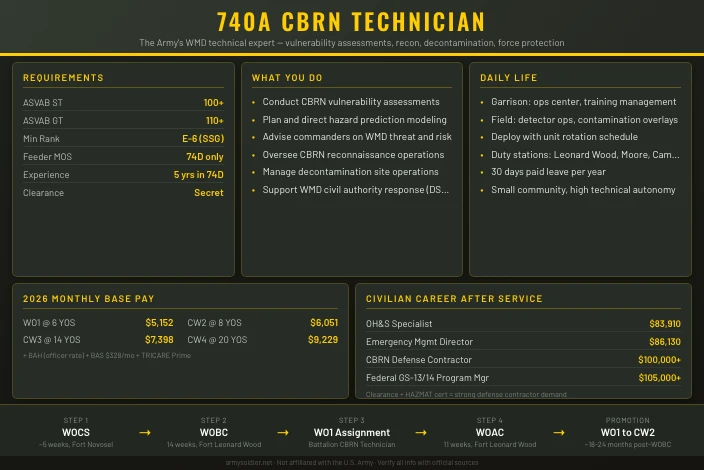
Job Role and Responsibilities
The 740A CBRN Technician is the Army’s principal subject-matter expert on chemical, biological, radiological, and nuclear threats. Warrant officers in this MOS plan, coordinate, and direct CBRN defense operations across the full operational spectrum – from peacetime vulnerability assessments to active WMD response on a contaminated battlefield. They advise commanders at battalion level and above on CBRN risk, mitigation options, and the technical realities of operating in toxic environments.
Technical Expertise and Scope
A 740A warrant officer owns the technical domain that no commissioned officer or NCO can fully cover. Commissioned officers manage the CBRN branch and command CBRN units, but they rotate through staff and command assignments. Senior NCOs run day-to-day operations inside a CBRN platoon or company. The warrant officer sits between them, building deep technical expertise over a full career and applying it across every level of the organization.
The technical scope is broad. CBRN warrant officers operate and manage the Army’s suite of detection, reconnaissance, and decontamination systems. They conduct and supervise hazard prediction modeling, sensitive site exploitation, and multi-spectral obscuration operations. They advise on WMD response in support of civil authorities – DSCA missions that put them in contact with federal law enforcement and emergency management agencies.
Related Designations
| MOS/Identifier | Title | Notes |
|---|---|---|
| 740A | CBRN Technician | Primary warrant officer MOS for CBRN branch |
| L1 | CBRN Reconnaissance and Surveillance | Additional Skill Identifier (ASI) |
| L5 | M93 Series CBRN Reconnaissance System Fox | ASI for Fox NBC vehicle operators |
| L6 | CBRN Reconnaissance for Brigade Combat Teams | ASI for BCT-level CBRN recon |
Mission Contribution
At battalion level, the 740A serves as the CBRN Officer / Technical Advisor to the battalion commander and staff. At brigade and division, they fill staff positions advising on CBRN integration into the overall operational plan. At corps and Army-level, senior CW4 and CW5 warrant officers shape doctrine, training standards, and equipment acquisition for the entire CBRN enterprise.
Technology and Systems
CBRN warrant officers maintain expert-level knowledge of the Army’s detection and decontamination inventory. Key systems include the Joint Chemical Agent Detector (JCAD), the M8A1 Automatic Chemical Agent Alarm, and the M93A1 Fox NBC Reconnaissance System. They work with hazard prediction software including the D2 Hazard Prediction and Assessment Capability (HPAC) to model toxic corridors and inform maneuver decisions in contaminated environments.
Salary and Benefits
Base Pay
Most 740A warrant officers enter as WO1 with 6+ years of service from their 74D enlisted career. Pay is calculated on total years of service, not time as a warrant officer. All figures below are 2026 DFAS monthly base pay rates.
| Rank | Typical YOS | Monthly Base Pay |
|---|---|---|
| WO1 | 6 YOS | $5,152 |
| WO1 | 8 YOS | $5,584 |
| CW2 | 8 YOS | $6,051 |
| CW2 | 10 YOS | $6,283 |
| CW3 | 14 YOS | $7,398 |
| CW3 | 18 YOS | $8,150 |
| CW4 | 20 YOS | $9,229 |
| CW4 | 24 YOS | $10,032 |
| CW5 | 26 YOS | $11,495 |
Base pay is only part of the picture. Warrant officers use officer BAH rates, which are higher than enlisted rates. At Fort Leonard Wood, Missouri – the primary 740A training and duty installation – a CW2 without dependents receives approximately $1,608 monthly in BAH; with dependents, that rises to roughly $2,013. Officers also receive BAS of $328.48 monthly (2026 rate) as a food allowance on top of base pay.
Special Pay and Bonuses
The 740A does not currently qualify for aviation bonus or flight pay. Warrant officers may be eligible for Hazardous Duty Incentive Pay if assigned to specific duty positions involving direct work with chemical or nuclear materials – verify current eligibility with your branch manager at HRC. Continuation Pay under the Blended Retirement System is available during the 7-12 year service window, typically at a multiplier of 2.5x monthly base pay with a 3-year service obligation attached.
Additional Benefits
- Healthcare: TRICARE Prime with no enrollment fees, no copays, and no deductibles for active-duty soldiers and their families
- Retirement: Blended Retirement System pension of 2.5% per year of service (40% at 20 years, based on high-36 average base pay) plus TSP matching up to 5% of base pay
- Education: Up to $4,500 per year in Tuition Assistance while on active duty; Post-9/11 GI Bill covers up to $29,920.95 annually at private schools or full in-state tuition at public schools after separation
- Leave: 30 days paid leave per year
Work-Life Balance
In garrison, most CBRN warrant officers work standard duty hours with occasional extended days during exercises or readiness cycles. The job involves less staff grind than a commissioned officer branch – no battalion command competition, no alternate-year branch-specific developmental assignments. That said, field exercises and deployment tempo add real demands. The tradeoff versus a senior NCO is more technical autonomy and a clear lane of expertise.
Qualifications and Eligibility
Appointment Paths
The only path to 740A is through the enlisted feeder MOS. This is not an aviation MOS with a street-to-seat civilian track, and it is not a cyber MOS with a direct appointment option. To become a 740A warrant officer, you must first serve as a 74D Chemical Operations Specialist at the Staff Sergeant (E-6) level or above.
Requirements Table
| Requirement | Standard |
|---|---|
| Feeder MOS | 74D only |
| Minimum Rank | E-6 (Staff Sergeant) |
| MOS Experience | 5 years minimum in 74D |
| Leadership Experience | 1 year as squad leader in a CBRN unit OR 1 year as CBRN NCO at battalion level or higher |
| ASVAB ST Score | 100 minimum |
| GT Score | 110 minimum (Army-wide warrant officer standard) |
| Security Clearance | Secret (required; must be eligible for TS/SCI for some positions) |
| Education | Associate’s degree with focus in math, science, or engineering (preferred) |
| Age | 18-46 at time of appointment (must be commissioned before 46th birthday) |
| Physical | Fully deployable; must meet height/weight and AFT standards |
| BNCOC | Must be a graduate of 74D BNCOC |
Warrant Officer Candidate School (WOCS)
All warrant officer candidates attend WOCS at Fort Novosel, Alabama (formerly Fort Rucker). The course runs approximately 5 weeks and covers Army doctrine, warrant officer roles and responsibilities, leadership under stress, and military customs and courtesies. WOCS is not a technical school – it bridges the transition from senior NCO to warrant officer and instills the professional identity that distinguishes WOs from both the enlisted and officer corps.
The warrant officer packet is submitted through your chain of command. A complete packet includes DA Form 61 (application), the last 10 years of NCOERs and AERs showing a pattern of outstanding performance, letters of recommendation from your company commander and battalion commander, official transcripts, and medical documentation. The warrant officer selection board meets several times per year; contact Army Warrant Officer Recruiting for current board schedules.
What Makes a Packet Stand Out
Strong CBRN packets typically include direct CBRN operational experience – not just time in grade – along with documented WMD-related training, HAZMAT certification, and any relevant science or engineering coursework. Deployments where you served as the primary CBRN advisor to a commander above platoon level carry significant weight. An associate’s or bachelor’s degree in chemistry, biology, or a related field strengthens a packet considerably.
Upon Appointment
New 740A warrant officers are appointed as Warrant Officer 1 (WO1). The standard Active Duty Service Obligation (ADSO) is 6 years from the date of appointment. Each promotion to CW3, CW4, or CW5 adds a 2-year ADSO that must be completed before voluntary retirement.
See our ASVAB study guide for a study plan focused on the GT composite.
Work Environment
Setting and Schedule
CBRN warrant officers work across a range of settings depending on assignment. A battalion-level 740A spends time in the operations center reviewing mission planning, conducting or overseeing CBRN vulnerability assessments of the installation or area of operations, and running training events for assigned CBRN soldiers. During field exercises, they work extended hours running detection operations, advising the S3 on contamination overlays, and coordinating decontamination site setup.
Staff positions at brigade, division, or corps involve more planning and briefing work – developing the CBRN annex to operational orders, advising senior officers on WMD threat integration, and coordinating with joint and interagency CBRN elements.
Position in the Unit
The 740A sits outside the standard command chain. They are not in the NCO support channel, and they do not fill command billets (unlike aviation warrant officers). Instead, they function as technical advisors who report directly to the commander or chief of staff on CBRN matters. This gives them significant access and influence without the administrative burden of traditional officer staff roles.
Senior NCOs in the CBRN platoon run day-to-day operations. The warrant officer is the technical backstop – the person the platoon sergeant calls when a detection reading doesn’t make sense or when a decontamination procedure needs to be modified for an unusual agent. That relationship works best when the warrant officer maintains hands-on currency with equipment and doctrine.
Technical vs. Staff Roles
At WO1 and CW2, the role is heavily technical. You’re at the unit level, directly involved in detector maintenance, training certification, and unit readiness. As you progress to CW3 and CW4, advisory and planning responsibilities grow. Senior CW4 and CW5 warrant officers spend the majority of their time in staff advisory roles at division, corps, or Army-level, shaping policy and doctrine rather than hands-on CBRN operations.
Job Satisfaction and Retention
The CBRN warrant officer community is small – roughly a few hundred 740A warrant officers Army-wide. That creates a tight professional network and genuine ownership of a niche. Warrant officers in this field consistently cite technical depth and mission relevance as drivers of retention. The primary reasons for leaving before 20 years are the civilian pay premium in defense contracting and federal CBRN positions, and the relatively slow pace of promotion compared to larger warrant officer communities.
Training and Skill Development
Warrant Officer Basic Course (WOBC)
After WOCS, new 740A warrant officers attend the WOBC at Fort Leonard Wood, Missouri, conducted by the U.S. Army CBRN School.
| Phase | Location | Length | Focus |
|---|---|---|---|
| WOBC | Fort Leonard Wood, MO | 14 weeks | Organizational equipment diagnostics, staff procedures, CBRN defense, radiation fundamentals, reconnaissance operations, decontamination, battalion-level planning |
WOBC is where the technical specialization begins in earnest. Instruction covers CBRN vulnerability assessment methodology, hazard prediction and modeling, WMD operational planning, and the administrative and logistical functions that support a CBRN section at battalion level. Unlike enlisted AIT, which focuses on operational skills, WOBC develops the planning and advisory capabilities that define a warrant officer’s role.
Warrant Officer Advanced Course (WOAC)
CW2 and CW3 warrant officers attend the WOAC at Fort Leonard Wood, which runs approximately 11 weeks. The curriculum advances into leadership and training management, written and oral communications for senior staff environments, advanced radiological safety, digital CBRN systems, hazard prediction modeling, and threat doctrine at the joint level. A current Secret clearance and a passing AFT score within 72 hours of enrollment are required for WOAC attendance.
Warrant Officer Intermediate Level Education (WOILE)
Typically attended as a CW3 or CW4, WOILE is a 5-week resident course conducted at Fort Leavenworth, Kansas. Unlike WOBC and WOAC, WOILE is MOS-immaterial – it develops warrant officers across all specialties for service at higher echelons. Curriculum focuses on joint operations, Army doctrine, and broadening the warrant officer’s perspective beyond their technical lane.
Warrant Officer Senior Service Education (WOSSE)
Senior CW4 and CW5 warrant officers attend WOSSE, which runs in two phases: a distance learning phase followed by a resident phase. WOSSE develops strategic-level thinking and prepares senior warrant officers for advisory roles at division, corps, and Army-level. Attendance is required for consideration for CW5.
Additional Schools and Certifications
- HAZMAT Technician Certification: The Army funds HAZMAT certifications for CBRN warrant officers through Army COOL (Credentialing Opportunities On-Line). The HAZMAT Technician credential aligns directly with 740A duties and is widely recognized in the civilian sector.
- Airborne School: Available but not required for 740A.
- Sensitive Site Exploitation (SSE) Courses: Specialized CBRN exploitation training at the Army level for advanced career positions.
- Tuition Assistance: Up to $4,500 per year for college courses while on active duty. Many 740A warrant officers complete a bachelor’s or master’s degree in chemistry, environmental science, or emergency management.
A qualifying GT score comes first — our ASVAB study guide covers the subtests that drive GT.
Career Progression and Advancement
Career Timeline
| Rank | Typical Promotion Point | Total YOS (incl. enlisted time) | Key Assignments |
|---|---|---|---|
| WO1 | Appointment | 6-8 YOS | WOCS, WOBC, battalion CBRN technician |
| CW2 | ~18-24 months after WOBC | 8-10 YOS | Battalion / brigade CBRN technician |
| CW3 | Board selected, ~5-7 years TIG from CW2 | 13-17 YOS | Brigade / division CBRN staff officer, WOAC, WOILE |
| CW4 | Board selected, ~4-6 years TIG from CW3 | 18-23 YOS | Division / corps CBRN advisor, WOSSE, broadening assignments |
| CW5 | Board selected, highly competitive | 24-30+ YOS | Corps, Army, DA-level CBRN technical advisor |
Promotion System
WO1 to CW2 is time-based – after completing WOBC and meeting service requirements, promotion is essentially automatic. CW3 through CW5 are board-selected, using the Officer Evaluation Report (OER, DA Form 67-10-1A for warrant officers) as the primary record. Selection rates for CW3 are generally favorable. CW4 and CW5 are progressively more competitive.
The 740A community is small enough that a warrant officer with a strong record and the right developmental assignments has a clear path to CW4. CW5 positions are limited; most warrant officers in this MOS who reach CW5 serve at echelons above corps or in DA-level training and doctrine roles.
Building a Competitive Record
- Seek battalion-level CBRN technician assignments early in your career to build operational credibility
- Complete a broadening assignment at the joint or interagency level by CW3-CW4 (DSCA operations, joint task force staff)
- Finish a bachelor’s degree in a STEM field by CW3
- Earn the HAZMAT Technician or related civilian credential through Army COOL
- Write clear, direct OER support forms that quantify your technical contributions to the commander’s decision-making
CW5 as Senior Technical Advisor
A CW5 740A serves as the senior CBRN technical advisor at corps, Army, or Department of Army level. They shape training doctrine, review equipment acquisition programs, and advise general officers and SES civilians on WMD threat responses. The role is advisory and consultative – a CW5 in this MOS carries institutional authority built over 25+ years of technical expertise.
Physical Demands and Medical Evaluations
Army Fitness Test Standards
All soldiers, including 740A warrant officers, take the Army Fitness Test (AFT). The AFT replaced the ACFT on June 1, 2025, and consists of five events scored 0-100 each (500 points maximum).
| Event | Abbreviation | Minimum Score (All Soldiers) |
|---|---|---|
| 3 Repetition Maximum Deadlift | MDL | 60 |
| Hand Release Push-Up | HRP | 60 |
| Sprint-Drag-Carry | SDC | 60 |
| Plank | PLK | 60 |
| Two-Mile Run | 2MR | 60 |
| Total | 300 minimum |
Scores are sex- and age-normed. The 740A is not a designated combat specialty MOS, so the higher 350-point combat specialty standard does not apply. A score of 300 with no event below 60 is the passing threshold.
MOS-Specific Physical Considerations
The 740A does not require a flight physical or special vision standards beyond Army-wide requirements. The work can involve wearing Mission Oriented Protective Posture (MOPP) gear in hot environments for extended periods – a physical demand that doesn’t show up in the AFT but matters during field operations. Soldiers with claustrophobia or heat-stress conditions may find MOPP operations challenging.
There are no MOS-specific medical disqualifiers beyond standard Army physical fitness standards. Annual physicals and height/weight standards apply throughout a warrant officer’s career.
Deployment and Duty Stations
Deployment Tempo
CBRN warrant officers deploy at a moderate tempo compared to combat arms specialties. They support combat deployments, peacekeeping operations, and stability missions wherever a CBRN threat assessment is required. DSCA (Defense Support to Civil Authorities) missions – responding to domestic chemical or nuclear incidents – are a distinct mission set that can involve short-notice activations without an overseas deployment.
Typical deployment cycles follow the unit’s rotation schedule. Most CBRN warrant officers can expect one to two combat or contingency deployments over a 20-year career, with additional rotational training exercises to regions with elevated CBRN threat environments.
Primary Duty Stations
740A warrant officers serve wherever Army CBRN units and staffs are located. Primary installations include:
- Fort Leonard Wood, Missouri – home of the U.S. Army CBRN School and the largest concentration of 740A billets
- Fort Moore, Georgia – Infantry and Armor units with organic CBRN sections
- Fort Campbell, Kentucky – 101st Airborne Division
- Fort Bragg (Fort Liberty), North Carolina – XVIII Airborne Corps
- Fort Hood (Fort Cavazos), Texas – III Corps and 1st Cavalry Division
- Overseas: Korea, Europe (Germany, Poland), and Pacific (Hawaii, Japan)
HRC manages warrant officer assignments. Preference matters but is not guaranteed. Fort Leonard Wood is the most common first assignment given the concentration of CBRN billets and the school mission.
Risk, Safety, and Legal Considerations
Job Hazards
CBRN warrant officers face occupational exposure risks that are unique in the Army. Training with simulants and working around live chemical or radiological agents in controlled environments carries inherent exposure risk. The warrant officer is responsible for knowing current safety thresholds and enforcing them – a failure here can harm soldiers in their own unit.
Field operations in contaminated or potentially contaminated environments add mission-level risk. The 740A manages that risk through rigorous adherence to detection protocols, proper protective equipment, and decontamination procedures. Warrant officers who cut corners on safety procedures put their soldiers and themselves at legal and physical risk.
Safety Protocols
CBRN warrant officers apply Composite Risk Management (CRM) to all CBRN training and operations. For operations involving radiological materials, Army Regulation 11-9 and radiation safety protocols govern exposure thresholds and monitoring requirements. The warrant officer is typically the unit’s primary radiation safety officer or a direct advisor to that function.
Authority and Responsibility
The 740A does not hold command authority. They advise – and that advice can directly shape whether a commander orders troops into a contaminated area. A wrong assessment can cause unnecessary casualties or an unnecessarily cautious posture that degrades the mission. The authority is technical, but the weight of that authority is real. UCMJ standards apply fully; an officer who provides a negligent CBRN assessment may face administrative or legal consequences.
Impact on Family and Personal Life
Family Considerations
The 740A is a single-track technical specialty, which means fewer mandatory developmental moves than a commissioned officer of comparable seniority. Most warrant officers in this MOS can expect three to five PCS moves over a 20-year career, compared to five to seven for commissioned counterparts. That relative stability matters for families with school-age children or a spouse in a portable career.
Army Community Service (ACS) and the Family Readiness Group (FRG) are available at every installation where 740A warrant officers are stationed. Spouse employment programs and school liaison officers help families manage the moves that do occur.
Dual-Military Couples
The Army’s join-spouse program allows dual-military couples to request co-location assignments, though it is not guaranteed. For a 740A 74D dual-military couple, the concentration of CBRN billets at Fort Leonard Wood creates a realistic chance of co-location, particularly in the early career phase.
Stability vs. Commissioned Officers
Warrant officers in this MOS generally experience more predictable assignment patterns than commissioned officers. There is no command selection board requiring a move to a command position every two years. The tradeoff is less organizational influence over where you serve and reduced access to certain developmental opportunities that are reserved for commissioned officers.
Reserve and National Guard
Component Availability
The 740A is available in both the Army Reserve and Army National Guard. Reserve and Guard CBRN units fill a critical role in WMD consequence management, particularly for DSCA missions supporting domestic emergency response. Forty-seven states and territories maintain CBRN WMD Civil Support Teams (CSTs) in the National Guard, creating a significant demand for experienced 740A warrant officers at the part-time level.
Appointment Paths
Reserve and Guard 740A warrant officers follow the same basic eligibility path: E-6 or above in 74D with five years of MOS experience and BNCOC graduation. Candidates submit packets through their state (Guard) or Reserve command. Some candidates transition from active duty to Reserve or Guard component after completing their ADSO; others build the required experience entirely in a drilling Reserve or Guard unit.
Drill and Training Commitment
The standard Reserve/Guard commitment is one weekend per month (4 Unit Training Assemblies) plus two weeks of Annual Training. CBRN warrant officers may have additional currency requirements tied to equipment proficiency and certification maintenance – verify with your specific unit.
Part-Time Pay
Reserve and Guard drill pay is calculated as (monthly base pay / 30) x 4 drills per weekend.
| Rank | YOS | Approx. Monthly Drill Pay (4 drills) |
|---|---|---|
| WO1 | <2 | ~$541 |
| CW2 | <2 | ~$616 |
| CW2 | 2 YOS | ~$675 |
Component Comparison
| Factor | Active Duty | Army Reserve | Army National Guard |
|---|---|---|---|
| Commitment | Full-time | 1 weekend/mo + 2 wks AT | 1 weekend/mo + 2 wks AT |
| Monthly Pay (CW2, 8 YOS) | ~$6,051 | ~$807 per weekend | ~$807 per weekend |
| Healthcare | TRICARE Prime ($0 premium) | TRICARE Reserve Select ($57.88/mo individual) | TRICARE Reserve Select ($57.88/mo individual) |
| Education | TA + GI Bill (Post-9/11) | Federal TA + MGIB-SR ($493/mo) | Federal TA + state tuition waivers (varies) |
| Retirement | 20-yr pension (40% base pay) + BRS TSP | Points-based, collect at 60 | Points-based, collect at 60 |
| Deployment Tempo | Moderate | DSCA-heavy, periodic mobilizations | DSCA + state activations, periodic federal mobilizations |
| Advancement | CW2-CW5 board-selected | CW2-CW5 possible; slower timeline | CW2-CW5 possible; slower timeline |
Benefits Differences
TRICARE Reserve Select costs $57.88 per month for individual coverage and $286.66 per month for member-and-family in 2026. That is far cheaper than most civilian employer plans but comes with higher cost-sharing than active-duty TRICARE Prime.
Guard members may have access to state-specific tuition waivers that cover in-state public college tuition entirely – a significant benefit for warrant officers completing a degree while drilling. USERRA protections apply regardless of employer size, ensuring civilian job protection during mobilizations up to 5 cumulative years.
Civilian Career Integration
A Reserve or Guard 740A who works in emergency management, environmental health and safety, or defense contracting during the week runs parallel careers that reinforce each other directly. WMD Civil Support Team (CST) positions in the National Guard often lead to federal GS positions in emergency management, EPA, or DoD installation safety roles, since the operational experience is essentially civilian-equivalent.
Post-Service Opportunities
Transition to Civilian Life
Twenty or more years as a 740A warrant officer produces a technical profile that has no close civilian equivalent in terms of breadth and operational depth. The civilian market for former CBRN warrant officers spans three primary sectors: federal government, defense contracting, and emergency management. All three sectors actively recruit veterans with clearances and operational CBRN experience.
SFL-TAP (Soldier for Life – Transition Assistance Program) begins 24 months before separation for warrant officers planning retirement. The Hiring Our Heroes program facilitates civilian fellowships for transitioning military, including warrant officers. Army Career Alumni Program (ACAP) provides one-on-one coaching for resume writing and civilian career positioning.
Civilian Career Outlook
| Civilian Job Title | Median Annual Salary (BLS, May 2024) | 10-Year Job Outlook |
|---|---|---|
| Occupational Health and Safety Specialist | $83,910 | +12% (much faster than average) |
| Emergency Management Director | $86,130 | +4% (as fast as average) |
| Defense Contractor CBRN Analyst | $90,000-$130,000+ | Strong; clearance premium |
| Federal GS-13/14 CBRN Program Manager | $105,000-$155,000+ | Steady; competitive |
Defense contracting is the most lucrative immediate post-service path. A cleared CW4 or CW5 with 20+ years of CBRN experience can command $100,000-$130,000+ at companies like FLIR, SAIC, Leidos, and Battelle, which support CBRN equipment programs, training, and analysis contracts.
Certifications and Credentials
Army COOL funds civilian certifications that align with 740A duties. High-value credentials for this MOS include:
- HAZMAT Technician (OSHA HAZWOPER 40-hour certification) – directly fundable through Army COOL
- Certified Safety Professional (CSP) – recognized across industrial, federal, and defense sectors
- Emergency Management Institute (FEMA EMI) certifications – IS-100 through IS-800 series, no cost
- Certified Emergency Manager (CEM) – through the International Association of Emergency Managers
The Post-9/11 GI Bill covers up to $29,920.95 per year at private institutions (AY 2025-2026 cap) or full in-state tuition at public schools. A 740A retiree with 20+ years qualifies for 100% benefit and can complete a master’s degree in emergency management, environmental science, or public health at little or no cost.
Is This a Good Job for You? The Right (and Wrong) Fit
Ideal Candidate Profile
The best 740A warrant officers are 74D NCOs who have already decided that CBRN is their career – not a stepping stone. They find the technical complexity of detection and decontamination genuinely interesting, not just professionally useful. They’re comfortable briefing senior officers on technical matters where the stakes are real, and they’re confident enough in their expertise to push back on a commander’s plan when the CBRN data doesn’t support it.
A science or engineering background, even informal, accelerates success in this MOS. Soldiers who excelled in chemistry, biology, or math before enlisting, or who picked up a strong working knowledge of CBRN systems during their 74D career, will find the warrant officer training builds naturally on that foundation.
Potential Challenges
This is a small community. If you thrive on a large peer group, a fast-moving assignment sequence, or the prestige of command authority, the 740A path will feel limited. There are no command billets for CBRN warrant officers. Promotion above CW4 is competitive and slow in a field with few senior positions. The work is intellectually demanding but can be administratively isolated – a single warrant officer advising a battalion may be the only person in that unit who deeply understands CBRN threat modeling.
Pay growth is real but not as dramatic as, say, aviation, which carries flight pay. If maximizing compensation in the first 10 years of military service is the goal, aviation warrant officer paths offer more earning potential through bonus structures.
Career and Lifestyle Alignment
The 740A is a strong fit for a technically-minded 74D sergeant who wants to go deeper into CBRN rather than broader into senior NCO management. It’s also a strong fit for someone who values technical autonomy, a relatively stable assignment pattern, and a clear civilian career translation in a field with genuine demand.
It’s a poor fit for someone who primarily wants to command troops, move quickly up a general officer track, or build a career on organizational leadership rather than technical expertise. Those paths lead through commissioned officer programs, not the warrant officer corps.
More Information
Talk to an Army Warrant Officer recruiter to confirm current board schedules, packet requirements, and whether any accession incentives apply to 740A. The Army Warrant Officer Recruiting Command maintains current eligibility information and a board schedule you can access directly. If your GT score needs work before applying, ASVAB prep resources are widely available and can meaningfully raise your score. Your chain of command and career counselor are also key partners in building a competitive packet.
- Prepare for the ASVAB with our study guide to meet the GT 110 requirement
This site is not affiliated with the U.S. Army or any government agency. Verify all information with official Army sources before making enlistment or career decisions.
Explore more Army warrant officer careers such as the 890A Ammunition Warrant Officer and the 120A Construction Engineering Technician.