881A Marine Engineering Officer
The Army operates a fleet of watercraft – and every vessel depends on an engineering plant that actually works. The 880A on the bridge commands the ship. The 881A keeps it running.
As a Marine Engineering Officer, your domain is the engine room. You manage propulsion systems, power generation, auxiliary machinery, and every mechanical, electrical, and plumbing system aboard U.S. Army Watercraft System vessels. You’re the senior technical authority on vessel engineering – not an administrator signing off on work orders, but the person who diagnoses a failing propulsion plant in the middle of a transit and makes the call on whether the mission continues. This is a credentialed maritime engineering role with a direct path to civilian engineer-officer licensing and salaries well above $100,000 per year.
Warrant officer candidates need a GT score of at least 110 — our ASVAB study guide covers what drives that number.
Job Role and Responsibilities
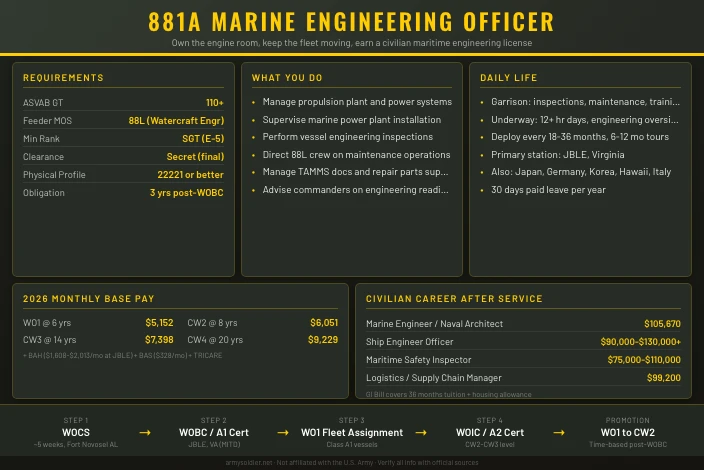
The 881A Marine Engineering Officer manages the efficient and economical operation of the engine room machinery plant, auxiliary machinery, and specific deck equipment aboard U.S. Army Watercraft System vessels. Warrant officers in this MOS supervise and perform installation, maintenance, and repair of marine power plants, propulsion systems, heating and ventilation systems, and other mechanical, plumbing, and electrical equipment aboard AWS vessels and Army maritime facilities. They apply the Army Maintenance Management System (TAMMS) for marine materials and manage onboard repair parts supply operations.
What This Warrant Officer Actually Does
At the WO1 and CW2 levels, you operate and maintain complex machinery directly. You’re in the engineering spaces, diagnosing problems, directing repair operations, and ensuring the propulsion plant meets mission requirements before any vessel gets underway. As you advance to CW3, you manage engineering operations across multi-vessel maintenance plans and begin advising commanders on vessel engineering readiness. At CW4, you may command a watercraft detachment and carry the technical authority for a unit’s entire engineering picture.
Day-to-day technical responsibilities include:
- Marine power plant operation, monitoring, and repair
- Propulsion system maintenance and troubleshooting
- Electrical distribution and power generation systems
- Heating, ventilation, and auxiliary machinery
- Onboard safety systems, including firefighting and damage control equipment
- TAMMS documentation and repair parts supply management
- Vessel inspection and engineering certification compliance under Army Regulation 56-9
MOS Codes and Designations
| Designation | Role | Technical Domain |
|---|---|---|
| 881A | Marine Engineering Officer | Engineering plant, propulsion, auxiliary systems |
| 880A | Marine Deck Officer | Navigation, vessel command, deck operations |
| 882A | Mobility Officer | Intermodal transportation planning |
The 881A and 880A are paired MOS in Army watercraft units. The 880A commands the vessel and manages deck operations; the 881A owns everything below decks. Most Army watercraft units carry both warrant officers, and they operate as complementary technical authorities.
How This Role Fits the Army’s Mission
Army watercraft operate in logistics environments where conventional transportation does not. Joint Logistics Over-the-Shore (JLOTS) operations, amphibious sustainment, and theater opening missions all depend on vessels that stay operational under harsh sea conditions. When a vessel’s propulsion plant fails during a critical sustainment mission, the 881A solves that problem.
The U.S. Army Transportation School’s Maritime and Intermodal Training Department trains 881A warrant officers alongside 88L Watercraft Engineers, creating a deep technical community that supports the Army’s watercraft fleet at every echelon. The warrant officer bridges the gap between the enlisted 88L crew and the commissioned Transportation officers overseeing the unit – and when a commander needs to know whether a vessel can get underway safely, the 881A answers that question.
Salary and Benefits
Base Pay at Realistic Career Points
Most 881A candidates enter WOCS after four to six years as an 88L Watercraft Engineer, so their years of service (YOS) continue from their enlisted time. All figures are 2026 rates from DFAS.
| Rank | Typical YOS | Monthly Base Pay |
|---|---|---|
| WO1 | 6 years | $5,152 |
| CW2 | 8 years | $6,051 |
| CW3 | 14 years | $7,398 |
| CW4 | 20 years | $9,229 |
| CW5 | 26 years | $11,495 |
Warrant officers receive the officer rate for Basic Allowance for Subsistence ($328/month in 2026) and Basic Allowance for Housing (BAH) based on duty location and dependent status. At Joint Base Langley-Eustis, Virginia – the primary 881A duty station – a CW2 without dependents draws roughly $1,608/month in BAH; with dependents, approximately $2,013/month. BAH varies by duty location; check the official BAH rate lookup for your specific installation.
Special Pays and Bonuses
The Army has offered accession bonuses for maritime warrant officer MOS in recent years, with amounts reaching up to $20,000 for qualified 880A and 881A candidates. A Student Loan Repayment Program option has also been available for those with qualifying education debt. Bonus availability changes with Army manning priorities – confirm current offers directly through the Warrant Officer Recruiting office before building your packet.
Under the Army’s updated retention bonus structure, senior warrant officers may participate in a bidding-based retention incentive system in exchange for an additional six-year active duty obligation. Hazardous duty pay applies when operating in designated hazardous environments.
Additional Benefits
Active duty warrant officers receive TRICARE Prime at no cost – zero premiums, zero deductibles, and zero copays for the member and family, including dental and vision. The Blended Retirement System pairs a pension with Thrift Savings Plan matching: after two years of service, the government matches up to 4% of basic pay in TSP contributions. A 20-year career earns 40% of the high-36 average basic pay as a monthly pension for life.
Tuition Assistance covers up to $4,500 per year for college coursework during service. Thirty days of paid leave accrue annually, plus 11 federal holidays.
Work-Life Balance
Garrison periods at JBLE provide relatively predictable schedules – morning PT, vessel maintenance, administrative work, and crew training fill most days. When the unit deploys or conducts major field exercises, engineering support tempo intensifies. Pre-deployment maintenance cycles and underway operations require extended hours without fixed schedules. Compared to commissioned officers who rotate through staff assignments, warrant officers have more stable assignment patterns tied to their technical specialty and primary duty station.
Qualifications and Eligibility
Appointment Path
The 881A has one appointment path: enlisted-to-warrant from a maritime engineering feeder MOS. Unlike aviation or cyber warrant officers, there is no street-to-seat or direct civilian appointment for this MOS. You need documented hands-on engineering experience aboard Army watercraft before the Army will put you in charge of a vessel’s engineering plant.
The primary feeder MOS is 88L (Watercraft Engineer), the enlisted specialty responsible for unit and sustainment-level maintenance on Army watercraft. The 88K (Watercraft Operator) background may also be considered for candidates with documented engineering department experience, but 88L is the direct path.
| Requirement | Detail |
|---|---|
| Appointment path | Enlisted-to-warrant only |
| Primary feeder MOS | 88L (Watercraft Engineer) |
| Minimum rank | SGT (E-5); SSG (E-6) typical |
| Minimum experience | Engineering department experience on AWS vessels |
| GT score | 110 minimum (non-waiverable) |
| Education | High school diploma or GED; 12th-grade TABE math score required |
| Security clearance | Secret (final) required |
| Physical profile | 22221 or better |
| Deployability | Must be worldwide deployable |
| Citizenship | U.S. citizen |
The TABE (Test of Adult Basic Education) mathematics portion is a separate requirement unique to maritime warrant officer MOS. It reflects the applied math demands of the job – load calculations, fuel consumption, power plant efficiency, and stability computations all require solid math fundamentals.
WOCS: Warrant Officer Candidate School
All warrant officer candidates attend Warrant Officer Candidate School (WOCS) at Fort Novosel, Alabama. WOCS runs approximately 5 weeks and covers Army leadership doctrine, warrant officer roles and responsibilities, military customs and courtesies, and physical fitness standards. It is demanding by design: the school tests your ability to lead and perform under pressure before you take charge of a vessel engineering plant.
The WOCS application packet includes a DA Form 61, NCOERs and evaluations, letters of recommendation, transcripts, a physical examination, and the MOS-specific Marine Certification Form with endorsement from a senior maritime warrant officer. Your packet competes at a centralized selection board – selection is not guaranteed.
Test Requirements
All warrant officer applicants need a minimum GT score of 110 – the General Technical composite (Verbal Expression + Arithmetic Reasoning from the ASVAB). This score is non-waiverable. There is no SIFT requirement for 881A; the SIFT applies only to aviation warrant officer MOS. If your GT score falls below 110, retesting on the ASVAB is your path forward.
The TABE mathematics test is a separate requirement beyond the GT score. You must score at the 12th-grade level on the mathematics portion before submitting a packet.
Packet and Board Process
The warrant officer selection board evaluates the complete packet – not just scores. Evaluators look at OER/NCOER quality, documented technical experience, civilian education, and the credibility of your endorsements. Strong packets show sustained superior performance in engineering roles, documented vessel experience, and a clear technical background that matches the demands of the 881A.
Selection rates vary by year and Army manning requirements. This is a small, specialized community: the Army selects carefully because every 881A carries direct command authority over critical vessel systems.
Active Duty Service Obligation
Upon appointment, all warrant officers incur an Active Duty Service Obligation (ADSO). The standard ADSO for non-aviation warrant officers is three years from completion of the Warrant Officer Basic Course. Your prior enlisted time does not reduce this obligation.
See our ASVAB study guide for a study plan focused on the GT composite.
Work Environment
Daily Work Setting
Most 881A warrant officers spend their garrison days at Joint Base Langley-Eustis, Virginia, home of the U.S. Army Transportation School and the Maritime and Intermodal Training Department. The work environment is maritime and industrial – engineering spaces, maintenance bays, and waterfront facilities rather than offices. A typical garrison day includes engineering systems inspections, maintenance scheduling, crew training, and technical documentation.
When units deploy or conduct field training, the pace changes. Engineering support for underway operations means longer days, close coordination with the 880A vessel commander, and direct responsibility for keeping the propulsion plant operational under real conditions.
Position in the Unit
The 881A occupies a distinct position in the unit’s technical chain. You are not in the NCO support channel, and you don’t command the unit administratively – but you carry real authority over the vessel’s engineering systems and the crew members who operate them.
Your relationship with the 880A vessel commander is a working technical partnership: the 880A sets the course; the 881A determines whether the engineering plant can sustain it. Senior NCOs in the 88L specialty look to you for technical guidance and final calls on engineering readiness. Commissioned Transportation officers rely on your assessments when making mission planning decisions.
Technical vs. Staff Work by Rank
Job Satisfaction and Retention
The 881A community is small – a few hundred active-duty billets across the Army. That tight community creates a culture of technical ownership that many warrant officers find sustaining. You are recognized as the authority on what you know. The work is concrete: either the propulsion plant runs or it doesn’t, and your expertise is the difference.
Warrant officers who leave often do so to pursue civilian maritime engineering careers where compensation can significantly exceed military pay, especially at senior levels. Those who stay typically value the technical depth, command authority, and operational variety that a maritime engineering career provides.
Training and Skill Development
Warrant Officer Basic Course (WOBC)
After WOCS, 881A warrant officers attend the Warrant Officer Basic Course at the Maritime and Intermodal Training Department at Joint Base Langley-Eustis, Virginia. The MITD trains both 880A and 881A warrant officers alongside 88L and 88K enlisted soldiers, creating a unified maritime training environment.
| Phase | Location | Focus |
|---|---|---|
| WOCS | Fort Novosel, AL | Leadership, Army doctrine, warrant officer fundamentals |
| WOBC | JBLE, VA (MITD) | Marine engineering systems, propulsion, machinery operation |
| A1 Certification | MITD / On-vessel | Certification to operate as Engineer Officer aboard Class A1 vessels |
WOBC provides progressive instruction from basic machinery operation through advanced engineering management. Graduates earn A1 certification under Army Regulation 56-9, authorizing service as Marine Engineering Officer aboard Class A1 vessels. Training incorporates STCW (Standards of Training, Certification and Watchkeeping) competencies, giving graduates credentials with civilian maritime recognition.
Warrant Officer Intermediate Course (WOIC)
The WOIC is attended at the CW2 or CW3 level and builds on WOBC skills. Graduates earn A2 certification, authorizing service aboard ocean-going Class A2 vessels. The course also prepares warrant officers for staff-level liaison positions at higher echelons. STCW and USCG certification elements are incorporated throughout.
Warrant Officer Advanced Course (WOAC)
CW3 officers attend the Warrant Officer Advanced Course, which addresses advanced leadership, technical management at the company and higher levels, and staff advisory skills for brigade and division positions. This course marks the transition from primarily hands-on technical work to a blend of technical authority and staff leadership.
Warrant Officer Intermediate Level Education (WOILE)
WOILE is a 5-week, MOS-immaterial resident course attended at the CW3 or CW4 level. It prepares warrant officers for service at higher echelons across joint and interagency environments. The course is not engineering-specific – it broadens your perspective beyond the maritime community and develops the skills needed to advise at theater and Army level.
Warrant Officer Senior Service Education (WOSSE)
Senior CW4 and CW5 officers attend WOSSE, a two-phase course combining distance learning and a resident component. It prepares senior warrant officers for DA-level and joint advisory roles, covering strategic advisory work, policy, and senior technical leadership.
Additional Training and Certifications
The Army funds civilian maritime certifications through the MITD and Army COOL:
- USCG Merchant Mariner Credential (MMC) – federally recognized engineering officer license
- STCW certification series, including Engineer Officer competencies
- Basic and Advanced Firefighting (maritime)
- GMDSS Radio Operator License
- Radar Observer certification
- Emergency Response and Survival Craft qualifications
Tuition Assistance covers up to $4,500 per year for college coursework. Many 881A warrant officers complete degrees in marine engineering, mechanical engineering, or technical management during their service.
A qualifying GT score comes first — our ASVAB study guide covers the subtests that drive GT.
Career Progression and Advancement
Career Timeline
| Rank | Time in Grade | Total YOS (est.) | Key Assignments |
|---|---|---|---|
| WO1 | 18-24 months | 6-8 | Engineering Officer, Class A1 vessels; building A1 certification hours |
| CW2 | 4-6 years | 8-14 | Senior Engineering Officer; WOIC and A2 certification |
| CW3 | 4-6 years | 14-20 | Ocean operations; battalion-level engineering advisor |
| CW4 | 4-6 years | 20-26 | Detachment command; brigade/division technical advisor |
| CW5 | Until retirement | 26-30+ | DA-level advisor; transportation doctrine and acquisitions |
WO1 to CW2 is time-based after completing WOBC and meeting service requirements. CW3 and above require board selection. Promotion to CW5 is highly competitive: fewer positions exist at that level, and selection depends on a strong OER record, documented command time, and impact at successively higher echelons.
What Drives Board Selection
Warrant officers receive Officer Evaluation Reports (OERs) using DA Form 67-10-1A (warrant officer version), governed by DA Pam 623-3. The factors that matter most at CW3 and CW4 selection boards:
- Sustained superior performance across multiple OER rating periods
- Documented engineering leadership aboard Army vessels
- A2 certification and ocean operations experience
- Broadening assignments: joint duty, interagency, instructor roles at MITD
- Advanced civilian education, particularly in engineering or technical fields
- Additional USCG certifications beyond Army minimums
- Performance in positions above your grade level
CW5 as Branch Technical Expert
A CW5 in this MOS serves as the Army’s senior authority on maritime engineering systems. At this level, you may advise the Army G4, TRANSCOM, or joint staff on watercraft engineering doctrine, vessel acquisitions, and sustainment planning. The role is not hands-on aboard vessels – it shapes the technical standards that every 881A and 88L in the force follows.
The 881A community is small. Reaching CW5 means being recognized as the best technical officer in a closely watched peer group over a 25 to 30-year career.
Physical Demands and Medical Evaluations
Army Fitness Test Standards
All soldiers, including warrant officers, take the Army Fitness Test (AFT), which replaced the ACFT on June 1, 2025. The AFT has five events scored 0-100 each, with a maximum of 500 total points. The minimum passing standard is 60 points per event.
| Event | Abbreviation | Min Score (Ages 17-21, Male) | Min Score (Ages 17-21, Female) |
|---|---|---|---|
| 3 Rep Max Deadlift | MDL | 60 | 60 |
| Hand Release Push-Up | HRP | 60 | 60 |
| Sprint-Drag-Carry | SDC | 60 | 60 |
| Plank | PLK | 60 | 60 |
| Two-Mile Run | 2MR | 60 | 60 |
| Total minimum | 300 | 300 |
The 881A MOS is not among the 21 designated combat MOSs requiring the higher 350-point combat specialty standard. The general standard of 300 total points (sex- and age-normed) applies.
MOS-Specific Medical Requirements
The physical profile requirement for 881A is 22221 or better – no significant limiting physical profiles. Engineering spaces aboard vessels require the ability to climb ladders, work in confined spaces, lift heavy components, and perform physically demanding maintenance in unstable underway environments.
- Must be worldwide deployable
- Must comply with AR 40-501 para 4-12a5(a)(b)
- Must meet AR 56-9 para 5-2b requirements for vessel engineering service
- Annual physical exams standard for all active duty soldiers
There is no flight physical requirement for this MOS. The physical demands are industrial and maritime: working around high-temperature machinery, fuel systems, electrical systems, and heavy mechanical components in spaces that move with the vessel.
Deployment and Duty Stations
Where 881A Warrant Officers Are Assigned
The 881A community is geographically concentrated. Joint Base Langley-Eustis, Virginia is the primary duty station, home to the bulk of the active-duty Army watercraft fleet and the Transportation School. The Transportation Corps also documents 881A assignments in Hawaii, Japan, Germany, Italy, Korea, and Central America.
Other documented CONUS locations with Army watercraft billets include Alabama, California, Florida, Washington, and Texas. Overseas tours add variety to the assignment pattern, though most warrant officers will return to JBLE at multiple points in their career given the concentration of watercraft units there.
HRC manages warrant officer assignments. You submit preferences, but unit vacancies and Army needs drive actual orders. The small size of the 881A community means your assignment options are fewer – and more predictable – than in a larger MOS.
Deployment Tempo
Army watercraft units support theater sustainment operations, humanitarian response, and Joint Logistics Over-the-Shore exercises. Major exercises including the DEFENDER series and Pacific Pathway regularly require maritime engineering warrant officers. Operational support missions have deployed 881As to Europe, the Pacific, and the Middle East in support of combat operations and theater opening.
Deployment length typically runs 6-12 months. Between deployments, the focus at JBLE is vessel certification maintenance, crew qualification, and readiness. The 881A community does not deploy at combat arms tempo, but operational demands are real and unpredictable.
Risk, Safety, and Legal Considerations
Hazards in the Engineering Space
Shipboard engineering carries specific risks that shore-based maintenance work does not. High-temperature machinery, fuel and lubricant systems, pressurized systems, electrical hazards, and confined spaces are the daily work environment. Man-overboard risk, fire, flooding, and engineering casualty situations are not hypothetical – they are the emergencies the 881A trains to manage.
If the vessel carries fuel, ammunition, or combat vehicles, an engineering failure during a mission-critical transit has consequences beyond the ship itself. The 881A carries technical authority over systems where failure affects the mission and the crew.
Safety Protocols
The 881A applies Composite Risk Management (CRM) and maritime-specific risk frameworks drawn from USCG and STCW standards. You are responsible for the engineering risk assessment before and during every underway evolution. Army Regulation 56-9 governs watercraft operations and specifies certification, inspection, and safety requirements for every vessel class. Compliance with AR 56-9 is a condition of service in this MOS, not a suggestion.
Authority and Accountability
The 881A holds direct technical authority over vessel engineering systems. While vessel command authority rests with the 880A, the engineering officer’s recommendations on propulsion readiness, casualty repair, and engineering plant status carry real operational weight. A commanding officer who overrides a marine engineering officer’s safety assessment and suffers a casualty faces serious command accountability questions – so does the engineering officer who fails to raise a valid safety concern.
UCMJ applies fully. Technical negligence that results in injury, vessel casualty, or mission failure carries both administrative and potential criminal exposure.
Impact on Family and Personal Life
Life at JBLE
Families assigned to Joint Base Langley-Eustis live in the Hampton Roads, Virginia area – a large military community with strong school systems, reasonable cost of living for the region, and solid spouse employment prospects given the density of military and defense industry employers nearby. Army Community Service (ACS) and Family Readiness Group (FRG) programs are active at JBLE given the size of the watercraft community there.
Overseas assignments, particularly Japan and Germany, involve more significant family planning. Some duty locations have limited family housing or require unaccompanied tours. JBLE remains the base the 881A career returns to repeatedly.
PCS Tempo and Stability
The small size of the 881A community creates relatively predictable assignment patterns. Most warrant officers cycle between JBLE tours and overseas assignments, with less frequent PCS moves than in larger MOS communities or commissioned officer branches. That stability helps with family planning, especially for dual-military couples.
The Warrant Officer Lifestyle
The warrant officer path provides technical focus without the career-broadening staff rotations that commissioned officers navigate. You will not be sent to a finance billet to punch a ticket. Your OERs reflect what you know, what you’ve maintained, and what you’ve led – in the engineering spaces where the actual work happens.
That said, underway operations and pre-deployment maintenance cycles are demanding. The lifestyle is maritime, which means extended periods of operational tempo that affect families. Garrison periods provide recovery, but the tempo is real.
Reserve and National Guard
Component Availability
The 881A MOS exists in both the Army Reserve and the Army National Guard, though billets are fewer than in the active component. States with active waterway infrastructure and port access – Virginia, Washington, California, Florida, and Texas – tend to have the most Reserve and Guard watercraft units with engineering warrant officer billets.
Appointment Path in Reserve and Guard
The enlisted-to-warrant appointment process mirrors the active component: E-5 or above in MOS 88L with documented engineering department experience, a GT score of 110, TABE math qualification, and completion of WOCS. Reserve and Guard candidates may apply while in their drilling unit and attend WOCS on extended active duty orders.
Active component 881A warrant officers transferring to the Reserve or Guard retain their grade and may count active service toward both retirement eligibility and promotion consideration.
Drill and Training Commitment
The standard Reserve and Guard schedule is one weekend per month (four Unit Training Assemblies) plus two weeks of Annual Training. For 881A warrant officers, additional currency requirements apply – AR 56-9 certification standards require documented vessel hours and periodic practical evaluations that may exceed the standard drill schedule. Confirm specific hour and currency requirements with your unit before committing.
Part-Time Pay
A CW2 at under two YOS earns approximately $616 per weekend (four drills). A CW3 at eight YOS earns approximately $857 per weekend. Figures follow the standard formula: (monthly base pay / 30) x number of drills.
Active Duty vs. Reserve vs. Guard Comparison
| Factor | Active Duty | Army Reserve | Army National Guard |
|---|---|---|---|
| Commitment | Full-time | 1 wknd/mo + 2 wks/yr | 1 wknd/mo + 2 wks/yr |
| Monthly pay (CW2, ~8 YOS) | $6,051 | ~$807/mo drill equiv. | ~$807/mo drill equiv. |
| Healthcare | TRICARE Prime ($0 premium) | TRICARE Reserve Select (~$58/mo member only) | TRICARE Reserve Select (~$58/mo member only) |
| Education | TA ($4,500/yr) + Post-9/11 GI Bill | TA + MGIB-SR ($493/mo) | TA + MGIB-SR + state tuition benefits |
| Deployment tempo | Moderate; JLOTS, exercises | Mobilization-dependent | Mobilization + state activation possible |
| Advancement (CW4-CW5) | Competitive; board-selected | Yes, with fewer billets | Yes, with fewer billets |
| Retirement | 20-yr pension (high-36) | Points-based; collect at 60 | Points-based; collect at 60 |
The Guard adds a layer of state-specific benefits that vary by state. Many states provide tuition waivers for drilling Guard members, which can be stacked with federal Tuition Assistance. USERRA protections apply to all Reserve and Guard 881A warrant officers, securing reemployment rights with civilian employers after mobilization or deployment.
Civilian Career Integration
The Reserve and Guard path pairs particularly well with a civilian maritime engineering career. An 881A working as a merchant marine engineering officer, marine systems technician, or maritime maintenance manager reinforces military skills directly. USERRA prevents civilian employers from penalizing Reserve and Guard members for military service.
Post-Service Opportunities
What Leaves the Army with You
A career as an 881A builds documented engineering credentials, USCG-recognized training, and STCW competencies that civilian maritime employers value. You are not translating military experience into civilian terms – you hold the technical credentials. The SFL-TAP (Soldier for Life - Transition Assistance Program), Hiring Our Heroes, and the American Corporate Partners (ACP) mentorship program provide structured transition support.
The maritime industry, defense contractors, shipyards, and the federal government all recruit former maritime warrant officers. Civilian marine engineers with 10-20 years of hands-on experience and recognized credentials command salaries well above the median.
Civilian Career Prospects
| Civilian Job | Median Annual Salary | Job Outlook (2024-34) |
|---|---|---|
| Marine Engineer / Naval Architect | $105,670 | 6% growth (faster than average) |
| Marine Machinery Mechanic / Technician | $57,990 | Stable |
| Ship Engineer Officer (Merchant Marine) | $90,000-$130,000+ | Steady demand |
| Maritime Safety Inspector (USCG / Federal) | $75,000-$110,000 | Stable government demand |
| Logistics / Supply Chain Manager | $99,200 | 18% growth |
Marine engineer and naval architect figures are from the Bureau of Labor Statistics Occupational Outlook Handbook, based on May 2024 OES data. Ship engineer officer and maritime safety inspector salaries are representative market ranges.
Certifications and GI Bill
Army COOL funds several civilian maritime certifications for 881A warrant officers during service. Post-service, the Post-9/11 GI Bill covers up to $29,921 per year at private institutions (AY 2025-2026 cap) or full in-state tuition at public schools, plus a monthly housing allowance and $1,000 annual book stipend for up to 36 months.
For those who want to upgrade civilian credentials, USCG engineering officer licensing above the level obtained through Army training is a direct next step. Former 881A officers with documented sea time can pursue Unlimited Horsepower or Chief Engineer credentials through the standard USCG licensing pathway.
Is This a Good Job for You? The Right (and Wrong) Fit
Who Thrives in This MOS
The ideal 881A candidate is a senior 88L who has spent years in the engineering spaces of Army watercraft and wants to own that domain – not manage it from a distance. You need genuine technical depth in marine engineering systems, comfort working in physically demanding industrial environments, and the patience to build expertise over a decade before you reach senior advisory roles.
Strong candidates typically demonstrate:
- Hands-on mastery of propulsion and auxiliary machinery maintenance
- Leadership credibility with 88L enlisted crews
- Methodical approach to engineering diagnostics and safety
- Comfort with extended field and underway operations
- Interest in maintaining currency through ongoing USCG certification
What Doesn’t Work Here
If you want command authority over a large unit, a fast-moving career with frequent moves to diverse locations, or a path toward senior commissioned officer positions, this isn’t the right choice. The 881A community is small and technically specialized. Promotion timelines are steady but not fast, and the CW5 position is competitive among a limited peer group.
The 881A lifestyle also demands honesty about engineering work. This is not an office job. You will work in hot, loud, confined spaces aboard vessels in conditions that don’t respect work schedules. Candidates who prefer clean administrative environments will not find this a good fit.
Comparing the Paths
Staying enlisted as a senior 88L NCO gives you a broader peer community and more predictable promotion timelines without the command responsibility of a warrant officer. Commissioning as a Transportation officer gives you command authority at company and battalion level but requires the generalist staff rotation that warrant officers avoid.
The 881A path is the right choice if you want to be the Army’s recognized expert on marine engineering systems, carry real technical authority aboard Army vessels, and leave the service with civilian credentials that have immediate market value in the maritime industry.
More Information
Talk to an Army Warrant Officer recruiter before building a packet. The 881A community is small and selection is technical – the endorsement of a senior 881A who knows your work matters as much as any document in your file. Current recruiter contact information and bonus details are available through the Warrant Officer Recruiting page.
If your GT score needs improvement, focused ASVAB study on the Verbal Expression and Arithmetic Reasoning components pays off. The TABE mathematics requirement is a separate hurdle that rewards preparation – work through algebra, applied math, and mechanical problem-solving before your assessment.
- Prepare for the ASVAB with our study guide to meet the GT 110 requirement
This site is not affiliated with the U.S. Army or any government agency. Verify all information with official Army sources before making enlistment or career decisions.
Explore more Army warrant officer careers such as the 880A Marine Deck Officer and the 882A Mobility Officer.