882A Mobility Officer
Moving an Army isn’t just a logistics problem – it’s a planning discipline that requires someone who understands every mode of transport simultaneously. Rail, sea, air, highway, and inland waterway don’t operate in isolation. Someone has to integrate them into a single coherent movement plan. That person is a Warrant Officer holding MOS 882A.
The 882A Mobility Officer is the Army’s expert in intermodal transportation planning. You don’t manage one mode of movement – you manage the hand-offs between all of them, the constraints of each, and the impact of those constraints on the commander’s timeline. When a division needs to move thousands of soldiers, hundreds of vehicles, and tons of ammunition from Fort Cavazos to a port of embarkation in 72 hours, the 882A is the officer who determines how that’s possible and coordinates the chain of organizations that makes it happen.
Warrant officer candidates need a GT score of at least 110 — our ASVAB study guide covers what drives that number.
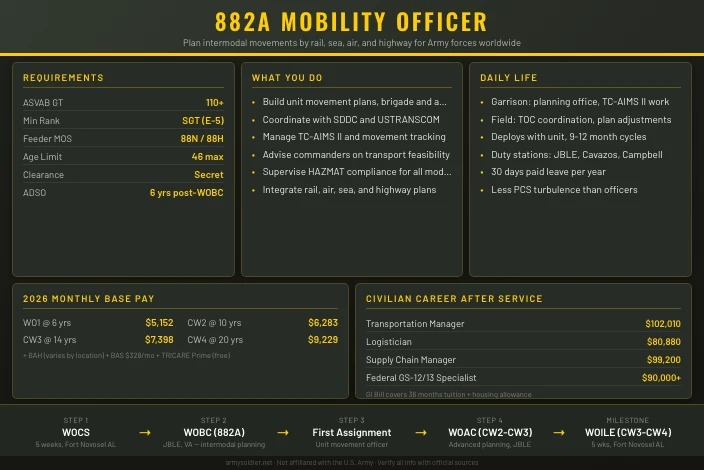
Job Role and Responsibilities
The 882A Mobility Officer is an Army warrant officer who plans, coordinates, and supervises intermodal transportation movements in support of Army and joint force operations. These warrant officers serve as the primary technical experts on unit movement planning, container management, port operations, commercial transportation coordination, and the regulatory frameworks governing the movement of military forces and equipment across all modes of transport.
Technical Domain
The 882A’s technical domain is movement. At its core, that means understanding each transportation mode deeply enough to plan around its constraints and exploit its capabilities. Highway transport has weight limits, hour-of-service regulations, and bottleneck chokepoints. Rail has gauge compatibility issues, loading configuration requirements, and terminal limitations. Sea movement involves vessel scheduling, port throughput capacity, and customs documentation. Air movement has weight and cube limits that dominate planning math before anything else.
The 882A integrates all of these into a movement plan that satisfies the commander’s requirements while staying within what each mode can actually deliver. That integration work – not the individual mode expertise – is what makes this warrant officer irreplaceable. Enlisted transportation coordinators and commissioned officers understand pieces of the picture. The 882A holds the whole thing.
Key technical responsibilities include:
- Developing and reviewing unit movement plans (UMPs) for organizations at battalion level and above
- Coordinating with U.S. Transportation Command (USTRANSCOM), Army G4, and Military Surface Deployment and Distribution Command (SDDC) for movement requirements
- Managing transportation control and movement documents (TCMDs)
- Supervising container management and retrograde operations
- Advising commanders on transportation feasibility, constraints, and risk
- Coordinating with commercial carriers, railroads, and port authorities
- Planning and supervising load plans for all equipment classes
- Ensuring compliance with hazardous materials (HAZMAT) regulations governing military shipments
- Integrating movement requirements with logistics and sustainment plans
Related MOS Codes and Designators
| Designator | Title | Primary Function |
|---|---|---|
| 882A | Mobility Officer | Intermodal movement planning, UMP coordination |
| 880A | Marine Deck Officer | Army vessel command, deck operations |
| 881A | Marine Engineering Officer | Army vessel engineering, propulsion systems |
The 882A is the land-and-multi-modal counterpart to the maritime 880A and 881A. All three sit within the Transportation Corps warrant officer community, but the 882A’s focus is integration across modes rather than command of a single platform.
Mission Contribution
Transportation is the connective tissue between Army force generation and Army force employment. A unit that cannot move is a unit that cannot fight. The 882A ensures the Army can actually execute the movement concepts that commanders plan against. At the strategic level, that means coordinating with SDDC and USTRANSCOM to sequence force flow. At the operational level, it means building movement plans that hold up when the first truck misses its window or a rail terminal loses power for six hours.
Commanders depend on their 882A to tell them the truth about what’s possible. When a staff officer writes a plan that assumes transportation capacity that doesn’t exist, the 882A is the officer who catches it before execution – not after. That advisory function is as valuable as the technical planning itself.
Systems and Tools
882A warrant officers work in the Defense Transportation System (DTS) environment, which includes multiple automated planning and tracking systems. Primary tools include:
- Defense Transportation System (DTS) – the overarching system framework
- Transportation Coordinator’s – Automated Information for Movements System II (TC-AIMS II) – unit movement planning and execution tracking
- Global Air and Space Operations Center (GAOC) and supporting air movement planning tools
- Integrated Booking System (IBS) – commercial vessel and carrier booking
- Hazardous Materials Management System (HMMS) – regulatory compliance tracking for hazmat shipments
- Commercial transportation management software used in coordination with SDDC and carriers
Salary and Benefits
Base Pay at Realistic Career Points
Most 882A candidates enter warrant officer training with at least six to ten years of enlisted service in a Transportation Corps feeder MOS. That prior service counts toward years of service (YOS) for pay purposes, so a new WO1 draws significantly more than the minimum W-1 rate. All figures are 2026 rates from DFAS.
| Rank | Typical YOS | Monthly Base Pay |
|---|---|---|
| WO1 | 6 years | $5,152 |
| WO1 | 8 years | $5,584 |
| CW2 | 10 years | $6,283 |
| CW2 | 12 years | $6,509 |
| CW3 | 14 years | $7,398 |
| CW3 | 18 years | $8,150 |
| CW4 | 20 years | $9,229 |
| CW4 | 24 years | $10,032 |
| CW5 | 26 years | $11,495 |
Base pay is the foundation, not the ceiling. Warrant officers receive the officer rate for Basic Allowance for Subsistence ($328/month in 2026) and Basic Allowance for Housing based on duty location and dependency status. BAH varies considerably: at a major installation like Fort Cavazos, TX, rates differ from a location like Joint Base Langley-Eustis, VA. Check the DoD BAH lookup tool for your duty station.
Special Pays and Bonuses
The Army has offered Warrant Officer Accession Bonuses (WAOB) for qualified 882A applicants. Specific dollar amounts shift each fiscal year based on manning targets – verify current incentives directly with the Warrant Officer Recruiting Company before submitting a packet, as bonus availability can change faster than published guides reflect.
Hazardous duty pay may apply when working in designated environments. SDAP (Special Duty Assignment Pay) can apply to specific instructor or training positions. No aviation incentive pay applies to this MOS.
Additional Benefits
Active duty warrant officers receive TRICARE Prime at no cost – zero premiums, zero deductibles, and zero copays for the member and enrolled family members. That coverage includes medical, dental, vision, mental health, and prescriptions.
The Blended Retirement System (BRS) provides a pension after 20 years plus Thrift Savings Plan matching. The government matches up to 4% of basic pay in TSP contributions once matching begins in year three of service. A WO who serves 20 years collects 40% of their high-36 average basic pay as a monthly pension for life. Many 882A warrant officers serve 25 or more years given the consistent demand for intermodal expertise at higher echelons.
Thirty days of paid leave per year accrue automatically. Tuition Assistance covers up to $4,500 per year for college courses during service.
Work-Life Balance
In garrison, the 882A works primarily Monday through Friday with some irregular demand tied to exercise planning cycles, unit deployment preparations, and port support. Large movement exercises such as DEFENDER-series and theater opening drills create concentrated busy periods. Between exercises, the garrison schedule is more predictable than most combat arms fields.
The warrant officer lifestyle in this MOS offers more stability than the commissioned officer rotation – you won’t be moved into an infantry battalion S4 slot to punch a career ticket. Your assignments reflect where your transportation planning expertise is needed, which creates more continuity than the generalist officer development track.
Qualifications and Eligibility
Appointment Paths
The primary path to 882A is enlisted-to-warrant from Transportation Corps feeder MOS backgrounds. There is no street-to-seat or direct civilian appointment for this MOS. Candidates must already serve as Army enlisted soldiers with hands-on transportation operations experience.
The baseline warrant officer requirement is SGT (E-5) or above, but 882A candidates typically present at SSG (E-6) with demonstrable planning and coordination experience. The Army needs warrant officers who have operated inside the transportation system before it trusts them to advise commanders about it.
| Requirement | Detail |
|---|---|
| Appointment path | Enlisted-to-warrant only |
| Primary feeder MOS | 88N (Transportation Management Coordinator), 88H (Cargo Specialist) |
| Secondary feeder MOS | 88K (Watercraft Operator), 88L (Watercraft Engineer), other 88-series with relevant experience |
| Minimum rank | SGT (E-5); SSG (E-6) competitive |
| GT score | 110 minimum (non-waiverable for all WO appointments) |
| Security clearance | Eligible for Secret; final clearance required |
| Age | Maximum 46 years at time of WO1 appointment (waiverable) |
| Education | High school diploma or GED |
| Physical | Must meet Army height/weight standards (AR 600-9) and pass AFT |
| Citizenship | U.S. citizen |
| ADSO | 6 years upon WOBC graduation |
The 88N (Transportation Management Coordinator) is the most direct feeder MOS for 882A. The 88N already works in transportation coordination, movement management, and modal operations at the unit level. The transition from managing movement requirements as an NCO to planning and advising on them as a warrant officer is the natural progression this MOS was built around.
Warrant Officer Candidate School (WOCS)
All warrant officer candidates attend Warrant Officer Candidate School (WOCS) at Fort Novosel, Alabama (formerly Fort Rucker). WOCS runs approximately 5 weeks. The course develops officer fundamentals – leadership under pressure, Army doctrine, land navigation, military history, and the role of warrant officers in the Army’s institutional framework. The focus is not transportation; it’s proving you can function as an officer before the MOS-specific training begins.
The application packet includes:
- DA Form 61 (Application for Appointment)
- Official military personnel file (ORB/iPERMS)
- NCOERs for the preceding 3 years (at minimum)
- Physical examination results (current within 12 months)
- GT score verification
- Letters of recommendation
- Commander endorsement at battalion level or above
- Any MOS-specific documentation required by the Transportation Corps proponent
Packets are submitted through the Warrant Officer Recruiting Company. Work with your unit career counselor and a warrant officer recruiter well before your target board date – boards typically meet twice per year, and competitive packets take months to properly build.
Test Requirements
All warrant officer applicants require a minimum GT score of 110 from the ASVAB. The GT composite is Verbal Expression (VE) + Arithmetic Reasoning (AR). If your score is below 110, retesting is available and this score cannot be waived. No additional MOS-specific ASVAB composite beyond GT applies to the 882A selection process.
The SIFT is not required for this MOS. SIFT is mandatory only for aviation warrant officer programs (153A, 153D, 153M).
Packet and Board Process
A competitive 882A packet reflects documented transportation planning experience, not just operational time in an 88-series MOS. Boards look for candidates who have planned movements, managed HAZMAT compliance issues, coordinated with higher headquarters, and demonstrated an ability to work across functional boundaries. That experience should be reflected in NCOERs – if your evaluations don’t capture your transportation coordination work, talk to your rater before submitting a packet.
Letters of recommendation from serving 882A warrant officers carry significant weight. If you don’t have a relationship with an 882A, work through your unit chain of command to establish contact with one. A senior warrant officer who can speak to your technical readiness is more persuasive to a selection board than any other packet element.
Upon Appointment
New warrant officers enter at WO1 (Warrant Officer 1), holding a federal warrant of appointment issued by the Secretary of the Army. WO1 is not a commissioned officer grade – that changes at CW2. WO1 to CW2 is automatic after completing WOBC and meeting time requirements; no selection board is required at this step.
The ADSO for non-aviation technical warrant officers is 6 years from WOBC completion. Your prior enlisted service time does not reduce this obligation.
See our ASVAB study guide for a study plan focused on the GT composite.
Work Environment
Daily Work Setting
The 882A typically works in a transportation office, movement management center (MMC), or logistics operations center – not on a flight line or a vessel deck. The environment is planning-oriented: spreadsheets, automated movement systems, coordination calls with SDDC and commercial carriers, and briefings to commanders and staff officers.
In garrison, work is Monday through Friday with predictable hours during normal operational periods. Exercise preparation and deployment support cycles drive overtime and weekend work, but the baseline tempo is manageable compared to aviation or combat arms warrant officer fields.
In the field or deployed, the 882A operates out of a TOC or tactical operations center, maintaining movement coordination across theater transportation networks while adapting plans to real-time disruptions. Deployed periods are less predictable and more demanding than garrison operations.
Position in the Unit
The 882A sits outside the standard NCO support channel and is not in the traditional command chain for unit administration. Their authority is technical – they are the expert on movement planning, and that expertise drives the influence. In practice, an 882A at a brigade or division will brief transportation plans directly to the S3 or G3, advise the S4/G4 on logistics movement integration, and serve as the liaison to SDDC and higher transportation headquarters.
The relationship with commissioned Transportation officers is collaborative. A commissioned Transportation officer may outrank an 882A but rarely matches their depth in intermodal planning. Most senior commissioned officers in this field rely heavily on their warrant officers to catch planning errors and translate operational requirements into feasible movement solutions.
Senior NCOs – 88N or 88H SSGs and SFCs – look to the 882A for technical guidance on complex coordination problems. The 882A is the escalation point for problems the NCO support channel can’t resolve independently.
Technical vs. Staff Work
Job Satisfaction
The 882A field draws soldiers who find satisfaction in solving complex coordination problems. Transportation planning isn’t glamorous – but the work has direct operational impact when a movement succeeds that seemed impossible on paper. Warrant officers in this field tend to cite the problem-solving nature of the work and the visible connection between their planning and unit readiness as major retention factors. The frustration is usually bureaucratic: navigating commercial carrier agreements, SDDC approval processes, and HAZMAT regulatory compliance under time pressure.
Training and Skill Development
Warrant Officer Basic Course (WOBC)
After WOCS, 882A warrant officers attend the Warrant Officer Basic Course at the U.S. Army Transportation School, Joint Base Langley-Eustis, Virginia. The Transportation School is the Army’s center for all transportation training – it’s where enlisted transportation MOS train, where commissioned Transportation officers complete their branch qualification, and where warrant officer technical development for all Transportation Corps specialties happens.
| Phase | Location | Focus |
|---|---|---|
| WOCS | Fort Novosel, AL | Leadership, Army doctrine, warrant officer fundamentals |
| WOBC (882A) | Joint Base Langley-Eustis, VA | Intermodal planning, TC-AIMS II, SDDC coordination, HAZMAT, UMP development |
The WOBC is not a restatement of what an experienced 88N already knows. It builds on that operational experience and reframes it at the officer advisory level: planning for units rather than executing for platoons, advising commanders rather than managing transactions, and integrating across modes rather than operating within one. The instructional approach assumes you already know how movements work – WOBC teaches you how to be the expert others rely on.
Warrant Officer Advanced Course (WOAC)
CW2 and early CW3 warrant officers attend the Warrant Officer Advanced Course at the Transportation School, Joint Base Langley-Eustis. WOAC covers advanced intermodal planning concepts, theater-level transportation operations, joint movement coordination with USTRANSCOM and TRANSCOM components, and staff advisory skills for brigade and higher echelon positions. A distance learning phase precedes the resident component.
Warrant Officer Intermediate Level Education (WOILE)
WOILE is a 5-week, MOS-immaterial resident course conducted at the U.S. Army Warrant Officer Career College (WOCC), Fort Novosel, AL. It’s attended at the CW3 or CW4 level and has nothing to do with transportation specifically. The curriculum develops warrant officers for service at higher echelons – joint operations, interagency coordination, strategic advisory functions, and institutional leadership. Completion is a prerequisite for CW4 consideration.
Warrant Officer Senior Service Education (WOSSE)
WOSSE is the senior professional military education course for CW4s and CW5s. It runs in two phases – distance learning followed by a resident component at Fort Novosel – and prepares senior warrant officers for DA-level advisory and policy roles. WOSSE is required for CW5 promotion consideration.
Additional Training and Certifications
The Transportation School and Army COOL (Credentialing Opportunities On-Line) fund several professional credentials for 882A warrant officers:
- Certified Transportation Professional (CTP) – Transportation Intermediaries Association credential directly applicable to intermodal planning roles
- HAZMAT Transportation Specialist certifications – DOT and IATA compliance credentials
- Certified in Logistics, Transportation and Distribution (CLTD) – APICS credential for supply chain and logistics professionals
- Defense Transportation 101/201 courses through SDDC
Tuition Assistance covers up to $4,500 per year for college coursework while serving. Many 882A warrant officers pursue bachelor’s or master’s degrees in logistics management, supply chain management, transportation systems, or business administration during their careers.
A qualifying GT score comes first — our ASVAB study guide covers the subtests that drive GT.
Career Progression and Advancement
Career Timeline
| Rank | Time-in-Grade | Typical Total YOS | Key Assignments |
|---|---|---|---|
| WO1 | 18-24 months | ~6-10 | Unit movement officer, brigade-level UMP planning, WOBC completion |
| CW2 | 3-5 years | ~10-14 | Senior unit movement officer, MMC staff, SDDC coordination roles |
| CW3 | 4-6 years | ~15-20 | Division G4 movement advisor, SDDC staff, theater transportation sections |
| CW4 | 4-6 years | ~21-26 | Corps G4/J4, USTRANSCOM components, Army-level movement staff |
| CW5 | Until retirement | ~28-34 | DA-level advisor, doctrine writer, transportation policy advisor |
WO1 to CW2 is automatic – complete WOBC, meet time requirements, and the promotion happens without a board. From CW3 onward, promotion is competitive. Selection boards evaluate the full OER file, PME completion, and performance in progressively more complex positions.
Promotion System
Warrant officers receive Officer Evaluation Reports (OERs) using DA Form 67-10-1A (warrant officer version), governed by DA Pam 623-3, Appendix B. The same form used for commissioned officers applies to warrant officers, with warrant-specific guidance in the appendix.
Board selection from CW3 upward weighs:
- Sustained superior performance ratings on OERs across multiple rating periods
- Senior rater assessments and comments
- PME completion on time or early
- Assignments in positions above your grade level
- Broadening: joint duty, SDDC assignments, interagency coordination billets
- Civilian education (bachelor’s or master’s degree)
- Professional certifications (CTP, CLTD)
CW5 is the most selective promotion board in the warrant officer corps. Fewer positions exist at that grade, and selection requires a file that demonstrates consistent excellence at successively higher levels of responsibility.
Building a Competitive Record
The warrant officers who advance most quickly in this field share a pattern: they complete PME ahead of schedule, they seek out SDDC and TRANSCOM assignments that expose them to joint transportation operations, and they document their planning contributions in OERs rather than letting those contributions disappear into operational memory. A CW3 who holds a joint assignment, has a completed degree in logistics or supply chain, and holds a civilian transportation credential stands out in a competitive board file.
CW5 as Senior Technical Advisor
A CW5 in this MOS serves as the Army’s senior movement planning authority. At this level, you advise the Army G4, SDDC, or TRANSCOM components on Army transportation doctrine, policy, and capability gaps. Day-to-day planning execution is behind you – your role is to ensure the Army’s intermodal movement planning enterprise remains technically sound and operationally capable.
Physical Demands and Medical Evaluations
Army Fitness Test Standards
All soldiers, including warrant officers, take the Army Fitness Test (AFT), which replaced the ACFT on June 1, 2025. The AFT has five events scored 0-100 each, with a maximum total of 500 points. The minimum passing standard is 60 points per event, sex- and age-normed.
| Event | Abbreviation | Min Score (Ages 17-21, Male) | Min Score (Ages 17-21, Female) |
|---|---|---|---|
| 3 Rep Max Deadlift | MDL | 60 | 60 |
| Hand Release Push-Up | HRP | 60 | 60 |
| Sprint-Drag-Carry | SDC | 60 | 60 |
| Plank | PLK | 60 | 60 |
| Two-Mile Run | 2MR | 60 | 60 |
| Total minimum | 300 | 300 |
Scoring tables are age-normed – the raw performance required to score 60 points varies by age bracket. Detailed standards for all age groups are available at army.mil/aft. The 882A is not among the 21 designated combat MOSs requiring the 350-point combat specialty standard. The general 300-point standard applies.
MOS-Specific Medical Requirements
The 882A has no aviation flight physical requirement and no MOS-specific vision or hearing standards beyond standard Army requirements. There are no shipboard physical profile requirements equivalent to the 880A. The role is primarily cognitive and planning-oriented rather than physically specialized.
Standard annual physical examinations apply to all active duty soldiers. Height and weight standards under AR 600-9 apply throughout service. No additional specialized medical evaluation is required at appointment.
Deployment and Duty Stations
Deployment Patterns
The 882A deploys with the units they support. When a brigade deploys, it needs its movement planning capability forward – the 882A goes with it. Theater transportation coordination doesn’t become less critical in a combat environment; it becomes more critical because the commercial transportation infrastructure that simplifies garrison planning largely disappears.
Deployment tempo varies by unit type. Brigade Combat Teams historically deploy on 9- to 12-month rotational cycles with multi-year dwell between deployments. Sustainment brigades and logistics support elements may deploy more frequently or at different cycle lengths. SDDC and TRANSCOM staff billets may involve extended TDY rather than traditional deployments.
Warrant officers in this field can expect deployment to support major exercises (DEFENDER, Pacific Pathway, WARFIGHTER exercises) as well as operational deployments. The timing and frequency depend heavily on assignment, not just MOS.
Duty Station Options
The 882A is found at installations with major maneuver units, theater logistics commands, SDDC area offices, and Transportation School. High-density duty stations include:
- Joint Base Langley-Eustis, VA – Transportation School, SDDC headquarters, major 882A billet concentration
- Fort Cavazos (Fort Hood), TX – III Corps and 1st Cavalry Division
- Fort Campbell, KY – 101st Airborne Division (Air Assault)
- Fort Liberty (Fort Bragg), NC – XVIII Airborne Corps and supporting units
- Fort Bliss, TX – 1st Armored Division
- OCONUS – Germany (USAREUR-AF), Korea, Kuwait, and other theater support positions
HRC manages warrant officer assignments through the Assignment Interactive Module (AIM). Warrant officers submit preferences, and HRC fills positions based on Army needs and individual qualifications. Unlike some smaller warrant officer communities, the 882A has representation at enough installations to give experienced warrant officers meaningful preference options.
Risk, Safety, and Legal Considerations
Job Hazards
The 882A faces few physical hazards in a garrison or staff setting. The primary professional risk is a planning failure that has operational consequences: a movement plan that can’t be executed, a HAZMAT shipment that moves without proper documentation, or an equipment configuration that doesn’t meet rail or vessel loading specifications. These failures don’t typically result in physical injury – they result in equipment left behind, missions delayed, or regulatory penalties.
In deployed environments, the 882A operates in theater alongside the units they support, with all the inherent risks of an operational environment. They are not typically in a direct combat role, but forward-deployed transportation coordination elements operate in environments where direct fire threats, IED exposure during route surveys, and convoy coordination work are real considerations.
Safety Protocols
The 882A applies Composite Risk Management (CRM) to all planning and coordination activities. For HAZMAT movements, this extends to compliance with DOT, IATA, and IMDG Code requirements governing how specific material classes are packaged, documented, and declared for each mode of transport. Errors in HAZMAT compliance can result in shipment rejection at ports of embarkation, regulatory fines, and safety incidents if incompatible materials are loaded together.
AR 55-355 (Defense Traffic Management Regulation) and the Defense Transportation Regulation (DTR) govern most of the regulatory environment in which an 882A operates. Compliance with these documents is a professional baseline, not a discretionary standard.
Authority and Responsibility
The 882A does not typically hold command authority in the sense that a vessel commander does. Their authority is technical and advisory – they are the expert, and that expertise drives the influence they exercise over planning decisions. At higher echelons, senior 882A warrant officers sign movement documents and transportation plans that carry their professional endorsement.
UCMJ responsibilities apply fully. Planning errors that result from negligence, or HAZMAT violations that lead to safety incidents, can carry both administrative and legal consequences. The warrant officer’s professional signature on a movement plan is a statement of competence, not just a routing step.
Impact on Family and Personal Life
Family Considerations
The 882A lifestyle is more predictable than most combat arms warrant officer fields. Garrison periods run on a standard weekday schedule, with extended demand tied to exercise cycles and deployment preparations. Families at Joint Base Langley-Eustis, Fort Cavazos, or Fort Campbell have access to established military community infrastructure: ACS (Army Community Service), FRG support, on-post schools, and employment programs for spouses.
Deployments create the same family stress as any Army assignment – extended separation, solo parenting, remote communication during field periods. The 882A’s deployment cycle is tied to the unit rather than an MOS-specific rotation, so planning around it follows the same patterns as the broader unit.
PCS Tempo and Stability
The 882A spans enough installations and organizational types that warrant officers generally have meaningful assignment options throughout their careers. Compared to commissioned officer branch development patterns – which often drive moves every 18 to 24 months – warrant officers in technical specialties like 882A tend to remain at installations longer between moves. A CW2 or CW3 who establishes strong performance at a stable installation can realistically expect two to four years per assignment before PCS.
Warrant Officer Lifestyle vs. Enlisted and Commissioned Officer Paths
The warrant officer path lets you build expertise without the rotational grind of commissioned officer development. You won’t be sent to be an infantry S4 for a year to round out your file. Your next assignment will reflect your transportation planning background. That continuity is a real quality-of-life advantage, and it produces officers who are better at their jobs by the time they reach CW3 and CW4 positions.
The trade-off is limited command authority and a smaller peer community than most enlisted or commissioned officer fields. If professional identity is tied to commanding large formations, the warrant officer path in this MOS won’t satisfy that goal.
Reserve and National Guard
Component Availability
The 882A MOS is available in both the Army Reserve and the Army National Guard. Reserve and Guard transportation units require movement planning expertise to support their own deployment readiness and to augment active component transportation operations during mobilizations. States with significant logistics and sustainment command presence – Texas, Virginia, California, Georgia, Pennsylvania – tend to have higher concentrations of transportation warrant officer billets.
Reserve and Guard Appointment
Reserve and Guard candidates follow the same warrant officer packet process as active component soldiers. Enlisted soldiers in Army Reserve or Guard units with qualifying 88N or 88H experience can apply directly through their component’s warrant officer proponency system. WOCS and WOBC are attended at the same installations as active component candidates, either during a mobilization period or on extended active duty orders specifically for training.
Active component warrant officers transferring to the Reserve or Guard retain their grade and may count active service toward retirement qualifying years.
Drill and Training Commitment
The standard Reserve and Guard commitment is one weekend per month (four Unit Training Assemblies) plus two weeks of Annual Training. Some 882A billets may require additional training days for system currency – TC-AIMS II proficiency and SDDC coordination procedures can degrade without regular practice. Confirm specific requirements with your unit’s warrant officer before committing.
Part-Time Pay
Reserve drill pay is calculated as (monthly base pay / 30) x number of drills. A standard weekend of four drills pays:
- CW2 at under 2 YOS: approximately $616 per weekend
- CW2 at 2 YOS: approximately $675 per weekend
Annual Training at 14 days adds roughly an additional half-month of base pay at the active component rate.
Active Duty vs. Reserve vs. Guard Comparison
| Factor | Active Duty | Army Reserve | Army National Guard |
|---|---|---|---|
| Commitment | Full-time | 1 wknd/mo + 2 wks AT | 1 wknd/mo + 2 wks AT |
| Monthly Pay (CW2, ~8 YOS) | $6,051 | ~$807/mo drill equiv. | ~$807/mo drill equiv. |
| Healthcare | TRICARE Prime ($0 premium) | TRICARE Reserve Select (~$58/mo member-only) | TRICARE Reserve Select (~$58/mo member-only) |
| Education | TA ($4,500/yr) + Post-9/11 GI Bill | TA + MGIB-SR ($493/mo) | TA + MGIB-SR + state tuition benefits |
| Deployment tempo | Tied to unit cycle; moderate | Mobilization-based; variable | Mobilization + state activations |
| Advancement to CW4-CW5 | Competitive board; active slots | Yes; fewer active billets | Yes; fewer active billets |
| Retirement | 20-yr pension (40% of high-36) | Points-based; collect at age 60 | Points-based; collect at age 60 |
Guard members may access state-level tuition waivers, state bonuses, and state tax exemptions that vary by state. Drilling Guard members can stack state tuition benefits with federal Tuition Assistance in many states.
USERRA protections apply to all Reserve and Guard warrant officers. Civilian employers cannot deny reemployment, promotion, or benefits because of military service obligations.
Civilian Career Integration
The Reserve and Guard path pairs naturally with a civilian career in logistics, supply chain management, or transportation management. An 882A warrant officer who works as a transportation planner or logistics manager in their civilian job is reinforcing skills directly relevant to their military duties and building a resume that reflects real expertise in both domains. USERRA prevents civilian employers from penalizing drilling members for military obligations.
Post-Service Opportunities
Transition to Civilian Life
The 882A career produces skills that defense contractors, 3PLs (third-party logistics providers), federal agencies, and large commercial shippers actively recruit. Deep intermodal planning expertise, TC-AIMS II system proficiency, HAZMAT compliance experience, and a track record of coordinating complex military movements are not common skills in the civilian workforce. Former 882A warrant officers enter the job market with a clear value proposition for roles that entry-level logistics professionals cannot fill.
SFL-TAP (Soldier for Life – Transition Assistance Program) provides structured pre-separation counseling, resume writing, and federal employment application guidance. Hiring Our Heroes facilitates hiring connections with defense-sector employers. The American Corporate Partners (ACP) mentorship program connects transitioning officers with civilian mentors in target industries.
Civilian Career Prospects
| Civilian Job Title | Median Annual Salary | Job Outlook (2024-2034) |
|---|---|---|
| Transportation, Storage & Distribution Manager | $102,010 | ~6% growth (faster than average) |
| Logistician | $80,880 | 7%+ growth (much faster than average) |
| Supply Chain Manager | $99,200 (median) | 18% growth |
| Federal Transportation Specialist (GS-11 to GS-13) | $73,939-$117,962 | Steady federal demand |
| Defense Contractor (Transportation/Mobility Analyst) | $85,000-$130,000+ | Steady DoD demand |
Transportation manager and logistician salary data from O*NET and BLS May 2024 data. Federal pay range reflects OPM GS tables at the 2026 rate for GS-11 step 5 through GS-13 step 5. Defense contractor ranges vary significantly by company and clearance level.
A retired CW4 with 20 to 22 years of service enters the civilian market with a pension, deferred TRICARE access at 60, and a background that reads like a senior logistics executive’s file. Many transition into GS-12 or GS-13 federal civilian positions, defense contractor roles, or 3PL management positions.
Certifications and Credentials
Army COOL funds civilian professional credentials for warrant officers during service. Relevant certifications for 882A include:
- Certified Transportation Professional (CTP) – direct alignment with intermodal planning and carrier management
- Certified in Logistics, Transportation and Distribution (CLTD) – APICS supply chain credential
- HAZMAT Transportation Specialist – DOT-aligned credential applicable to any industry moving regulated materials
- Project Management Professional (PMP) – broadly applicable to planning and coordination roles
The Post-9/11 GI Bill covers up to $29,920.95 per year at private institutions (AY 2025-2026 cap) or full in-state tuition at public schools, plus a monthly housing allowance and $1,000 annual book stipend for up to 36 months. For a warrant officer separating after 10 or more years of active service, this benefit fully funds a graduate degree program. Logistics, supply chain management, business administration, and transportation systems engineering are natural academic paths.
Is This a Good Job for You? The Right (and Wrong) Fit
Ideal Candidate Profile
The best 882A candidates are experienced Transportation Corps NCOs – typically 88N or 88H – who have spent years in movement coordination and want to move from executing movements to planning and advising on them. The intellectual core of this work is integration: holding multiple constraints simultaneously, finding the feasible path through them, and communicating that path clearly to commanders who need to make decisions.
Strong 882A candidates demonstrate:
- Genuine interest in transportation systems and intermodal logistics
- Comfort with analytical and planning work as the core of the job
- Ability to brief senior officers and hold their technical ground under pressure
- Patience with complex coordination across military and commercial organizations
- Systems fluency – comfort learning and operating in automated transportation management tools
Senior 88N NCOs with 6 to 10 years of experience who have managed movement requirements across multiple modes and want more technical authority are exactly who this MOS was designed for.
Potential Challenges
This is not a field for someone who wants to command troops or spend most of their time in a field environment. The 882A’s primary work is planning, coordination, and advisory functions. It’s office-intensive by design. If you measure job satisfaction by how often you’re in the field or leading soldiers physically, this MOS will frustrate you.
The peer community in this MOS is smaller than most Army fields, which limits mentorship options and can make career networking more effort-intensive. Promotion to CW5 is competitive in the same way as all senior warrant officer grades – very few positions exist, and the margin between selected and non-selected candidates at that level is narrow.
Long-Term Fit
Three career patterns work well for the 882A. First, the full 20-to-30-year career to CW4 or CW5 as a senior transportation planning authority, finishing with a pension and a proven record at theater or DA level. Second, the 10-to-12-year profile, satisfying the ADSO, building marketable expertise, and transitioning into a civilian logistics or federal transportation role with an active professional network. Third, the Reserve or Guard path, where 882A skills enhance a civilian transportation or logistics career without requiring full-time military service.
The warrant officer path beats staying enlisted if you want technical depth and advisory authority without the rotational generalist development track of a commissioned officer. It beats commissioning if you prefer being the subject matter expert rather than the unit commander.
More Information
Reach out to the Army Warrant Officer Recruiting Company before you start building a packet. A recruiter can tell you whether your current NCOER file, feeder MOS experience, and GT score put you in a competitive position – saving months of work on a packet that needs strengthening first. The Warrant Officer Recruiting page is the starting point for contact information and application guidance.
If your GT score needs improvement, focused ASVAB preparation in Verbal Expression and Arithmetic Reasoning is the most efficient path to 110. The GT composite responds well to targeted study, and improving your score before submitting a packet removes one variable from the selection board’s assessment.
- Prepare for the ASVAB with our study guide to meet the GT 110 requirement
This site is not affiliated with the U.S. Army or any government agency. Verify all information with official Army sources before making enlistment or career decisions.
Explore more Army warrant officer careers such as the 880A Marine Deck Officer and the 920A Property Accounting Technician.