890A Ammunition Warrant Officer
Every round fired by an Army cannon, every missile launched from a launcher, and every bomb dropped from an aircraft started its life in an ammunition supply chain managed by someone who knew exactly what they were handling. That someone is often an 890A Ammunition Warrant Officer. You’re not pushing paper. You’re the Army’s technical authority on some of the most dangerous materiel in the world, and units trust your expertise to keep them combat-ready and their soldiers alive.
The 890A sits at the intersection of logistics, explosive ordnance management, and operational planning. You’ll manage the Standard Army Ammunition System (SAAS), advise commanders on ammo accountability, and solve supply problems that no one else in the unit can touch. If you’re a senior NCO in an ammunition MOS who wants deeper technical authority and less time in the NCO support channel, this is the path that gets you there.
Warrant officer candidates need a GT score of at least 110 — our ASVAB study guide covers what drives that number.
Job Role and Responsibilities
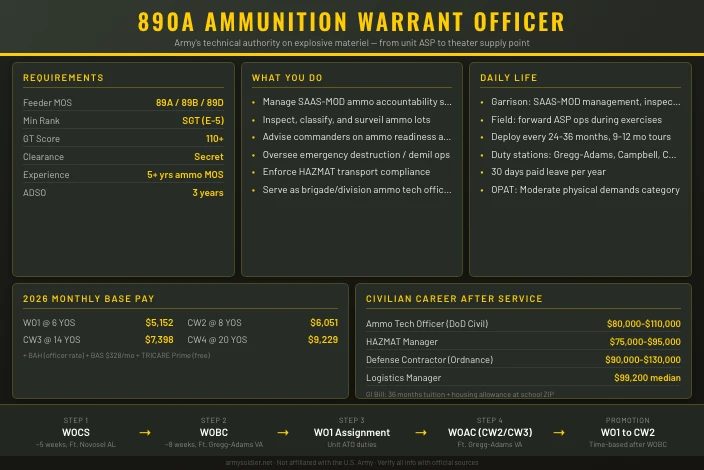
The 890A Ammunition Warrant Officer serves as the Army’s primary technical expert on all matters related to conventional ammunition, including storage, receipt, issuance, inspection, maintenance, demilitarization, and emergency destruction of explosive items from unit level through theater strategic operations. This warrant officer manages accountability systems, enforces safety and transportation regulations, and advises commanders on ammunition readiness across the full spectrum of Army operations.
Technical Domain
The 890A owns ammunition lifecycle management. That means tracking rounds from the theater ammunition supply point (ASP) all the way to the firing unit, ensuring the right ammo gets to the right place in the right condition. You are not a supply clerk with a warrant. You are the person commanders call when they have an accountability discrepancy, a SAAS system failure, or a question about whether a lot of aging rounds is still serviceable.
Key technical areas include:
- SAAS-MOD (Standard Army Ammunition System-Modernized): the Army’s primary ammunition accountability platform
- Storage and surveillance of conventional ammunition stocks
- Inspection, classification, and serviceability of ammunition lots
- Emergency destruction and demilitarization operations
- Transportation regulatory compliance (DOT/IATA hazmat rules)
- Accident investigation and reporting procedures
MOS Codes and Designations
| Code | Title | Notes |
|---|---|---|
| 890A | Ammunition Warrant Officer | Primary warrant MOS for conventional ammo management |
| ASI K1 | Ammunition Executive | Senior advisor ASI available at CW4+ |
Mission Contribution
The 890A sits between the enlisted ammunition specialists who handle the physical work and the commissioned logistics officers who manage broader supply chains. An Ordnance officer may oversee multiple functions, but the 890A is the one who knows the technical regulations cold. When a unit shows up short on a particular lot, or when a storage site has a safety violation, the 890A resolves it. That technical authority is not shared with anyone above or below in the same way.
At battalion, brigade, and division, the 890A provides the ammunition technical officer (ATO) function, advising commanders and S4 staff on ammunition status, requirements, and risk.
Salary and Benefits
Base Pay
Most 890A candidates come from the enlisted ranks as SGT (E-5) or SSG (E-6), meaning they arrive at WO1 with significant years of service already accrued. Pay tables below reflect realistic years of service (YOS) at each grade. All figures are 2026 rates verified against DFAS.
| Rank | Realistic YOS | Monthly Base Pay |
|---|---|---|
| WO1 | 6 YOS | $5,152 |
| CW2 | 8 YOS | $6,051 |
| CW3 | 14 YOS | $7,398 |
| CW4 | 20 YOS | $9,229 |
| CW5 | 26 YOS | $11,495 |
A CW3 at 14 years of service earns $7,398/month in base pay alone. Add tax-free BAH (which follows officer rates for warrant officers) and you’re looking at total compensation well above most civilian equivalents in the same field.
Allowances and Special Pay
Warrant officers receive officer-rate BAH, which is higher than the enlisted BAH they earned before appointment. A WO1 at Fort Novosel, Alabama without dependents draws $1,407/month in BAH; with dependents that rises to $1,761/month. At a higher cost-of-living installation such as Fort Belvoir, Virginia, BAH climbs significantly higher.
BAS for officers is $328/month (2026 rate). The 890A does not qualify for flight pay or other special pays associated with aviation or hazardous duty in flight, but hazardous duty incentive pay may apply during specific demolition or emergency destruction operations.
The Army rolled out a warrant officer retention bonus bidding program in early 2026. CW3 and CW4 warrant officers in critical specialties submit confidential bids for a six-year retention commitment, and the Army sets a market-clearing rate. Exact amounts vary by fiscal year and critical fill status. Check current HRC warrant officer bonus guidance for 890A eligibility.
Retirement and Long-Term Benefits
The Blended Retirement System (BRS) applies to warrant officers who joined after January 1, 2018, or who opted in during the election window. BRS pays 40% of high-36 average basic pay at 20 years, plus TSP contributions. The government matches up to 4% of basic pay once you hit three years of service, and auto-contributes 1% from day one. Contribute 5% yourself to get the full match.
Many 890A warrant officers serve 25 to 30 years. A CW4 retiring at 24 years walks out with a pension calculated on their highest 36 months of pay, plus a TSP account that has been compounding for two decades.
Healthcare under TRICARE Prime is free for active duty members and their families, with no premiums, no deductibles, and no copays for in-network care.
Work-Life Balance
Garrison life for an 890A is close to a standard business day, though ammo operations do not always respect duty hours. Field training exercises and deployments shift the schedule dramatically. The warrant officer lifestyle generally means fewer administrative burdens than senior NCO positions and fewer forced PCS moves than commissioned officer counterparts. You have more predictability once you reach CW3, and more say in your own assignments.
Qualifications and Eligibility
Appointment Paths
The 890A has one primary appointment path: enlisted-to-warrant. This MOS does not offer direct appointment from civilian life. You must already be serving as an ammunition NCO before you can apply.
Requirements at a Glance
| Requirement | Standard |
|---|---|
| Minimum Rank | SGT (E-5) or above |
| Feeder MOS | 89A, 89B, or 89D |
| Experience | 5+ years in feeder MOS |
| GT Score | 110 minimum (non-waiverable) |
| Age Limit | Under 46 at time of appointment (waiverable) |
| Security Clearance | Secret (eligibility required at application) |
| Education | ALC (Advanced Leaders Course) complete |
| Physical Demands | Moderate (OPAT category) |
Feeder MOS Detail
- 89A (Ammunition Stock Control and Accounting Specialist): supply accounting background
- 89B (Ammunition Specialist): hands-on storage, handling, and inspection experience
- 89D (Explosive Ordnance Disposal): technical ordnance disposal background
Your NCOERs need to show leadership capacity, not just technical proficiency. A packet full of “among the best” ratings in a staff position is not competitive. Raters who write specifically about your technical decision-making, mentorship of junior soldiers, and independent judgment will carry your packet.
WOCS
All candidates attend Warrant Officer Candidate School (WOCS) at Fort Novosel, Alabama. WOCS runs approximately 5 weeks and covers Army leadership doctrine, warrant officer roles and responsibilities, and the ethical and legal framework of a federal warrant of appointment. The course is demanding and intentionally stressful. Candidates who have served as NCOs often find the leadership content familiar but the pace and accountability standards challenging.
The application process runs through your chain of command. You’ll build a packet including:
- DA Form 61 (application for appointment)
- Letters of recommendation (minimum one from a current warrant officer)
- Last five NCOERs
- ALC completion documentation
- Official transcripts (if applicable)
- Medical pre-screening documentation
- TABE (Test of Adult Basic Education) score
Packets are reviewed by a centralized selection board at HRC. Selection rates vary by year and critical fill status. A complete, error-free packet with strong NCOERs and a compelling letter from a senior 890A warrant officer significantly improves your odds.
Upon Appointment
New 890A warrant officers enter at WO1. This rank carries a federal warrant of appointment issued by the Secretary of the Army. Upon promotion to CW2, you receive a commission and become a commissioned warrant officer. The standard Active Duty Service Obligation (ADSO) is 3 years from the date of appointment, though additional obligations may apply if the Army provided an accession bonus.
See our ASVAB study guide for a study plan focused on the GT composite.
Work Environment
Daily Setting
Most 890A warrant officers work at or near ammunition supply points, theater storage areas, or divisional support battalions. Garrison work involves office time for SAAS-MOD management, inspections, briefings, and coordination with supported units. Field exercises pull you to field ASPs, where accountability and safety oversight happen in the same tent you sleep in.
At the brigade and division level, the 890A fills the ammunition technical officer role on the S4 or G4 staff. That means more time in battle rhythm meetings, more briefings to senior leaders, and less hands-on physical work with ammunition.
Position in the Unit
Warrant officers do not sit in the NCO support channel and do not hold positions in the traditional command chain (except where specifically authorized). The 890A advises the commander through the S4 or G4, but is not supervised by the command sergeant major in the same way NCOs are. This distinction matters in practice: you have technical authority that senior NCOs do not, and you’re expected to exercise it independently.
The relationship with enlisted ammunition specialists is collegial but different from an NCO-to-soldier relationship. You mentor technically, resolve problems that exceed their authority, and set standards, but you do not own the formation the way a platoon sergeant does.
Technical vs. Staff Balance
At WO1 and CW2, roughly 70% of your work is hands-on technical: SAAS management, inspections, accountability reports, and direct support to operations. As you progress to CW3 and CW4, the ratio shifts toward staff advisory work, training management, and policy development. A CW5 functions almost entirely as a senior technical advisor at corps or Army-level staff.
Retention
The 890A is a relatively small community. Warrant officers who enjoy technical depth over command authority tend to stay. The biggest pull toward separation is civilian compensation in defense contracting and government service, where the same expertise commands significantly higher pay. Those who stay generally value the operational relevance, the mission, and the benefits package that civilian employers cannot match dollar-for-dollar.
Training and Skill Development
Training Pipeline
WOBC Details
| Phase | Location | Length | Focus |
|---|---|---|---|
| WOCS | Fort Novosel, AL | ~5 weeks | Leadership, warrant officer doctrine |
| WOBC | Fort Gregg-Adams, VA | ~8 weeks | Ammo management, SAAS-MOD, storage, surveillance |
WOBC is where you go from ammunition NCO to ammunition technical expert. The course covers Army ammunition regulations in depth, SAAS-MOD operations, lot number tracking, surveillance and inspection procedures, and emergency disposal. Commissioned logistics officers receive a portion of this training, but the 890A WOBC goes deeper than what generalist officers see.
Warrant Officer Advanced Course (WOAC)
Attended as a CW2 or CW3, typically 4 to 6 years after WOBC. WOAC is conducted at Fort Gregg-Adams and runs several weeks. It covers advanced ammunition management, leadership at higher echelons, and preparation for brigade and division staff roles.
Warrant Officer Intermediate Level Education (WOILE)
WOILE is a 5-week MOS-immaterial resident course attended as a CW3 or CW4. It prepares warrant officers for advisory roles at battalion, brigade, and above. Location varies; the course focuses on Army doctrine, interagency coordination, and leadership in joint environments rather than MOS-specific content.
Warrant Officer Senior Service Education (WOSSE)
Senior CW4 and CW5 warrant officers attend WOSSE, a two-phase course combining distance learning with a resident phase. It prepares warrant officers for corps and Army-level advisory positions and addresses strategic-level issues in their technical field.
Additional Training
The Army funds a range of additional training for 890A warrant officers:
- Hazardous materials (HAZMAT) transportation certification
- Explosives safety officer courses
- Army SAAS-MOD system administrator training
- Airborne School (available for competitive applicants)
- Instructor qualification courses for those assigned to the Ordnance School
Army COOL (Credentialing Opportunities On-Line) maps military training to civilian credentials and covers fees for many certification exams. Tuition Assistance covers up to $4,500 per year in tuition at $250 per semester hour.
A qualifying GT score comes first — our ASVAB study guide covers the subtests that drive GT.
Career Progression and Advancement
Career Timeline
| Rank | Time in Grade | Total YOS (approx.) | Key Assignments |
|---|---|---|---|
| WO1 | 18 months (min) | 6-8 | WOBC, unit ATO, SAAS-MOD management |
| CW2 | 5 years (typical) | 8-12 | WOAC, platoon/company ATO, ASP operations |
| CW3 | 6 years (typical) | 14-18 | Brigade ATO, division staff, WOILE |
| CW4 | 6+ years | 20-24 | Division G4 ammo advisor, joint staff, WOSSE |
| CW5 | Final grade | 26-30+ | Corps/Army-level senior technical advisor |
Promotion from WO1 to CW2 is time-based after completing WOBC. CW3 and above require board selection. CW5 is the most competitive grade; the Army selects a small number of warrant officers in each MOS to serve as the senior technical authority at the highest echelons.
Promotion Factors
CW3 and CW4 boards evaluate OERs using DA Form 67-10-1A (the warrant officer evaluation form). What moves a warrant officer’s file to the top:
- Consistent “Highly Qualified” or “Most Qualified” ratings
- Progressive technical assignments, not lateral moves
- Broadening experiences: joint billets, interagency assignments, TRADOC instructor positions
- Graduate education (relevant to ammunition, logistics, or operations)
- Awards that reflect technical leadership, not just participation
CW5 as Senior Technical Advisor
A CW5 in the 890A serves at corps, Army command (ACOM), or Army Staff level. They advise general officers and senior civilian leaders on ammunition policy, readiness, and risk. They shape doctrine, influence acquisition decisions, and represent the Army’s technical ammunition community at the highest levels. Command authority is not part of the role, but the advisory weight of a CW5 in a technical field carries real influence.
To build a competitive record for CW5 selection, seek joint assignments early, complete graduate education before CW4, and document your technical contributions in a way that board members can measure, not just read.
Physical Demands and Medical Evaluations
Army Fitness Test
Warrant officers take the Army Fitness Test (AFT), which replaced the ACFT on June 1, 2025. The AFT has five events scored 0-100 each for a maximum of 500 points. The minimum passing standard is 60 points per event (300 total), normed by sex and age.
| Event | Abbreviation | Description |
|---|---|---|
| 3 Rep Max Deadlift | MDL | Strength baseline |
| Hand Release Push-Up | HRP | Upper body endurance |
| Sprint-Drag-Carry | SDC | Anaerobic power and agility |
| Plank | PLK | Core endurance |
| Two-Mile Run | 2MR | Aerobic capacity |
The 890A does not fall under the combat specialty standard (350 total). The general standard of 300 total points applies, normed for sex and age group.
MOS-Specific Physical Demands
The 890A carries a Moderate OPAT (Occupational Physical Assessment Test) physical demands category. This reflects the reality that ammunition warrant officers regularly handle, inspect, and supervise the movement of heavy ordnance items in garrison and field environments. Heavy lifting, working in confined storage areas, and operating in extreme heat or cold are routine parts of the job.
No aviation flight physical or special vision standard applies to the 890A. Standard Army medical fitness requirements (AR 40-501) govern appointment eligibility. Any medical condition that would prevent handling of explosive materials or working in hazardous storage environments is potentially disqualifying.
Deployment and Duty Stations
Deployment Tempo
The 890A deploys regularly. Ammunition is a combat multiplier, and every brigade combat team that rotates through a theater needs an ammunition technical officer. Deployments typically run 9 to 12 months, with rotation cycles averaging every 24 to 36 months depending on unit assignment.
Forward deployed environments involve managing ammunition supply points under operational security constraints, coordinating with host nation authorities on transportation, and managing consumption rates to keep units stocked without creating excessive storage risk.
Primary Duty Stations
890A warrant officers fill billets across the force. Primary installations include:
- Fort Gregg-Adams, VA (CASCOM, Ordnance School)
- Fort Campbell, KY (101st Airborne Division)
- Fort Liberty, NC (82nd Airborne Division, 18th Airborne Corps)
- Fort Cavazos, TX (III Corps, 1st Cavalry Division)
- Fort Moore, GA (Maneuver Center of Excellence)
- Joint Base Lewis-McChord, WA (I Corps, 2nd Infantry Division)
- Europe and Pacific OCONUS assignments (through USAREUR-AF and USARPAC)
Assignment preferences are submitted through HRC but remain subject to Army needs. Warrant officers generally experience fewer PCS moves than commissioned officers, though the small size of the 890A community can mean limited assignment options at higher grades.
Risk, Safety, and Legal Considerations
Job Hazards
The 890A works with explosive materials every day. That fact shapes everything from physical workspace to legal liability. Mistakes in ammunition accounting, storage conditions, or lot surveillance can result in misfires, accidents, or supply failures that directly impact combat operations. The warrant officer bears technical responsibility for those outcomes in a way that enlisted soldiers and commissioned officers do not.
Common hazards include:
- Exposure to explosive materials during inspection, surveillance, and emergency disposal operations
- Working in and around ammunition storage areas with strict safety zone requirements
- High-temperature environments during field operations and in some storage facilities
- Transportation of hazardous materials under federal and Army regulations
Safety Protocols
The 890A applies Composite Risk Management (CRM) to all ammunition operations. This includes pre-task safety briefs, safety officer inspections, and compliance with DA Pam 385-64 (Ammunition and Explosives Safety Standards). Emergency destruction and demilitarization operations require specific authorization, detailed planning, and trained execution.
Authority and Accountability
The 890A does not hold command authority over a formation in the traditional sense, but carries significant technical authority in their specialty. Commanders rely on the 890A’s technical judgment for decisions involving millions of dollars in materiel and real safety risk to soldiers. If an 890A signs off on a lot of ammunition and it later fails in combat, the accountability trail leads back to that warrant officer’s signature.
All standard UCMJ provisions apply. Technical errors that result from negligence rather than honest judgment carry consequences ranging from administrative action to criminal liability depending on severity.
Impact on Family and Personal Life
Family Stability
The 890A is a field-deployable role, so families should expect regular separations during deployments and extended field exercises. At the same time, the warrant officer path typically delivers more PCS stability than the commissioned officer career. Commissioned logisticians move every 2 to 3 years as a deliberate career development tool. Warrant officers in technical fields like 890A can often extend at a duty station when a CW3 or CW4 billet is available.
Family support programs through the unit Family Readiness Group (FRG) and Army Community Service (ACS) are available at every installation. ACS offers financial counseling, employment assistance for spouses, and childcare resources.
PCS Tempo
Expect a PCS move every 3 to 4 years on average. The smaller 890A community means fewer available assignments, which can restrict location choices but also makes it easier to stay put when a follow-on billet exists at the same installation.
Dual-Military Considerations
The Army’s Joint Domicile program allows dual-military couples to request co-location at the same installation when suitable billets exist for both. The 890A’s relatively small billet count makes this harder to guarantee but not impossible. Soldier and Spouse Employment Assistance programs are available at every major installation through ACS.
Reserve and National Guard
Component Availability
The 890A exists in both the Army Reserve and the Army National Guard. Both components maintain ammunition units, and warrant officer billets exist at the company through corps level in Reserve and Guard formations.
Career progression can reach CW4 and CW5 in the Reserve components, though the pace is slower than active duty due to fewer available billets at the senior grades.
Appointment in the Reserve Components
Reserve and Guard NCOs with feeder MOS (89A, 89B, 89D) experience and the required rank can apply for warrant officer appointment through the same packet process used on active duty. The state Adjutant General’s office manages National Guard packets; the Army Reserve manages Reserve applications through USARC. Some states have historically maintained state-funded warrant officer programs, but the federal appointment process applies to 890A in all components.
Drill Commitment and Pay
The standard commitment is one weekend per month plus two weeks of annual training. Some ammunition units add weekend training days for certification maintenance or system currency requirements.
A CW2 at less than 2 years of warrant service earns $616/month per drill weekend (4 drill periods). A CW3 at 14 years draws proportionally more based on the monthly base pay tables above divided by 30, multiplied by 4.
Component Comparison
| Factor | Active Duty | Army Reserve | Army National Guard |
|---|---|---|---|
| Commitment | Full-time | ~39 days/year | ~39 days/year |
| Monthly Pay | Full base pay + BAH + BAS | Drill pay only (when not mobilized) | Drill pay only (when not mobilized) |
| Healthcare | TRICARE Prime, $0 premium | TRICARE Reserve Select, $57.88/month (member only) | TRICARE Reserve Select, $57.88/month (member only) |
| Education | Full GI Bill + TA | MGIB-SR $493/month + TA; Post-9/11 if activated | Same as Reserve + state tuition waivers (state-specific) |
| Retirement | 20-year pension (BRS) | Points-based Reserve retirement | Points-based Reserve retirement |
| Deployment | Frequent; 9-12 months every 2-3 years | Mobilization-based; less frequent | Mobilization-based; varies by unit |
| CW5 availability | Yes | Limited billets | Limited billets |
Civilian Career Integration
The 890A pairs naturally with defense industry, federal government, and hazardous materials management careers. Reserve or Guard service lets you build that civilian career while maintaining technical currency in Army ammunition systems. USERRA protections require civilian employers to hold your position during mobilization and prohibit discrimination based on military service.
Post-Service Opportunities
Civilian Transition
The 890A builds a skill set that is genuinely scarce in the civilian labor market. Ammunition accountability, explosives safety, HAZMAT management, and large-scale inventory control are not skills most civilian employers can train quickly. Former 890A warrant officers walk out with both the technical knowledge and the regulatory expertise to step directly into senior roles.
Transition programs including SFL-TAP (Soldier for Life Transition Assistance Program) and Hiring Our Heroes provide resume workshops, employer connections, and federal hiring preference guidance. The Army’s SkillBridge program lets warrant officers intern with civilian employers during their final 180 days of service.
Civilian Career Prospects
| Civilian Role | Median Annual Salary | Notes |
|---|---|---|
| Explosives Worker / Ordnance Handler | ~$60,000-$75,000 | BLS SOC 47-5032; varies by employer |
| Ammunition Technical Officer (DoD Civilian) | $80,000-$110,000+ | GS-11 to GS-13 range; defense agencies |
| Hazardous Materials Manager | $75,000-$95,000 | Federal, state, and private sector |
| Supply Chain / Logistics Manager | $80,000-$115,000 | BLS median $99,200 for logistics managers |
| Defense Contractor (Ammo/Ordnance) | $90,000-$130,000+ | BAE Systems, General Dynamics, L3Harris |
Certifications and Credentials
Army COOL covers fees for several credentials directly relevant to 890A experience:
- Certified Hazardous Materials Manager (CHMM) through the Institute of Hazardous Materials Management
- Certified Supply Chain Professional (CSCP) through APICS
- Department of Transportation HAZMAT certifications
- Logistics and inventory management credentials
The Post-9/11 GI Bill covers 36 months of tuition at full in-state rates for public schools, plus a monthly housing allowance at the E-5 with dependents BAH rate at the school’s zip code. Private school tuition is capped at $29,920.95 per academic year (AY 2025-2026 rate). Graduate programs in logistics management, supply chain, or emergency management align directly with the 890A skill set.
Is This a Good Job for You? The Right (and Wrong) Fit
Ideal Candidate
The best 890A candidates are already deep in the ammunition world as NCOs and are frustrated by the ceiling on their technical authority. You know the regulations. You’ve fixed the problems that junior soldiers and even some officers couldn’t solve. You want a career that keeps you in the technical lane while giving you the rank and recognition that your expertise deserves.
Strong candidates typically have:
- Consistent top-block NCOERs in 89A, 89B, or 89D
- Experience managing SAAS-MOD at the company or battalion level
- A track record of independent problem-solving rather than just executing guidance
- Patience for detail work; ammunition accountability has zero tolerance for rounding errors
- Willingness to deploy and work in demanding field environments
Potential Challenges
The 890A is a small community. If you want to command a formation, this is not the path; warrant officers do not command battalions or brigades. Promotion to CW5 is competitive and the number of billets at that level is limited. Civilians with equivalent expertise often earn more, particularly in defense contracting, which creates a persistent pull at the CW3-CW4 level.
Assignment options are constrained by the size of the field. You may have less flexibility in choosing where you live than a 25-series or 15-series warrant officer would, simply because there are fewer 890A billets spread across the force.
Career Alignment
The 890A is a strong fit if you plan to serve 20+ years and want to retire with a pension, a TRICARE-covered family, and a technical reputation that opens doors in defense industry. It’s a reasonable path if you plan to serve one ADSO and transition to a defense contracting or DoD civilian role where your SAAS-MOD expertise and SECRET clearance make you immediately hireable. It’s a poor fit if your primary goal is command authority, geographic flexibility, or a large peer network.
More Information
Contact your unit’s warrant officer recruiter or the Army Warrant Officer Recruiting office through the official warrant officer recruiting site for current 890A packet requirements, board dates, and accession timelines. Your GT score drives eligibility for the warrant officer program; if you’re below 110, ASVAB prep resources are available through Army education centers and commercial study programs.
- Prepare for the ASVAB with our study guide to meet the GT 110 requirement
This site is not affiliated with the U.S. Army or any government agency. Verify all information with official Army sources before making enlistment or career decisions.
Explore more Army warrant officer careers such as 913A Armament Systems Maintenance Warrant Officer and 920A Property Accounting Technician.